
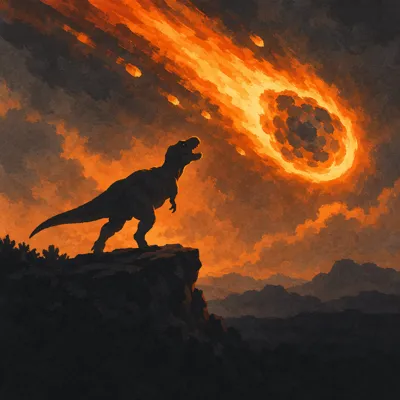
Cretaceous–Paleogene Extinction Event quiz
3 questions. No signup. Your move.
What best explains the K-Pg mass extinction 66 million years ago?
Now make it a duel.
Play more questions on Cretaceous–Paleogene Extinction Event in LearnClash. Challenge friends in a new quiz duel.
Play more in the appA tap copies this page’s link so the app can pick up where you left off.
That was every question in this preview. Pick another topic or keep going in the app.
A new quiz every day: Today’s quiz
The video couldn’t load. You can watch it on YouTube.
Choose a topic, answer questions and challenge a friend in LearnClash.
Watch on YouTubeA tap copies this page’s link so the app can pick up where you left off.
More questions about Cretaceous–Paleogene Extinction Event
These visible examples show the question style. LearnClash turns the full topic into ranked duels and spaced repetition.
-
What percentage of species died in the dinosaur extinction event?
Answer: 75 percent
Why: Counted by genus rather than by species the loss drops to about half, and the crisis at the end of the Permian was far worse still.
-
How did the K-Pg asteroid impact trigger a global deep-freeze?
Answer: Dust and soot blocked the sun
Why: Micrometre-sized silicate dust could have stayed airborne for up to 15 years, cooling Earth's surface by as much as 15 °C (Senel et al., 2023).
-
At what angle did the Chicxulub asteroid likely hit Earth?
Answer: 60 degrees
Why: Asymmetries buried in the crater point to a strike from the northeast, and that steep angle was among the deadliest, lofting debris high into the atmosphere.
-
Which animals alive today are technically dinosaurs?
Answer: Birds
Why: Archosaurs split into a bird line and a crocodile line over 200 million years ago, so crocodiles are cousins of dinosaurs rather than dinosaurs.
-
What massive volcanic activity coincided with the dinosaur extinction?
Answer: Deccan Traps
Why: About 70% of the 500,000-plus cubic kilometres of basalt erupted after a surge that began within roughly 50,000 years of the impact.
-
What glass-like beads formed from molten rock cooled in the atmosphere?
Answer: Microtektites
Why: Any tektite under a millimetre across counts as one, and the boundary beds around the Gulf of Mexico are packed with them.
Keep going in the app
A tap copies this page’s link so the app can pick up where you left off.

