
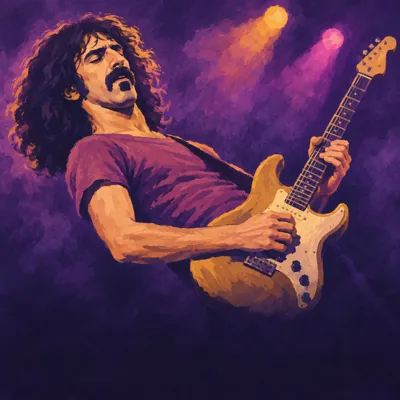
Frank Zappa quiz
3 questions. No signup. Your move.
Which language did Frank Zappa use for almost all his songs?
Now make it a duel.
Play more questions on Frank Zappa in LearnClash. Challenge friends in a new quiz duel.
Play more in the appA tap copies this page’s link so the app can pick up where you left off.
That was every question in this preview. Pick another topic or keep going in the app.
A new quiz every day: Today’s quiz
The video couldn’t load. You can watch it on YouTube.
Choose a topic, answer questions and challenge a friend in LearnClash.
Watch on YouTubeA tap copies this page’s link so the app can pick up where you left off.
More questions about Frank Zappa
These visible examples show the question style. LearnClash turns the full topic into ranked duels and spaced repetition.
-
Which guitarist got his big break transcribing music for Frank Zappa?
Answer: Steve Vai
Why: At 18, Vai sent Zappa a transcription of the drum piece The Black Page, was paid to transcribe solos, and toured with him at 20.
-
Frank Zappa's Freak Out! influenced which Beatles album?
Answer: Sgt. Pepper's
Why: During the Sgt. Pepper sessions McCartney kept repeating 'This is our Freak Out!'; Barry Miles had given him Zappa's album in 1966.
-
Which genre is Frank Zappa's 1993 album The Yellow Shark?
Answer: Classical
Why: Recorded live by Germany's Ensemble Modern in 1992, it was the last album Zappa released in his lifetime, a month before he died of cancer.
-
Which prestigious award did Zappa receive for lifetime achievement in 1997?
Answer: Grammy Award
Why: The Recording Academy gave it posthumously; in life Zappa won just one competitive Grammy, for his 1986 album Jazz From Hell.
-
How were Frank Zappa's bands unlike their wild image?
Answer: Demanding rigorous musicianship
Why: Zappa's touring bands rehearsed roughly two months, six days a week, six to ten hours a day, as he told Musician magazine in 1979.
-
What experiments did Frank Zappa do at Studio Z?
Answer: Tape manipulation, overdubbing, audio innovation
Why: Zappa bought the Cucamonga studio on 1 August 1964; its five-track deck, hand-built by Paul Buff, let him overdub every part alone.
Keep going in the app
A tap copies this page’s link so the app can pick up where you left off.

