
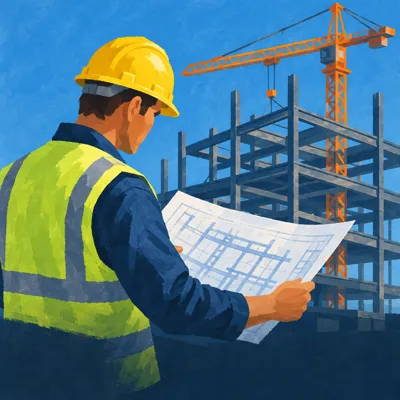
General Contracting quiz
3 questions. No signup. Your move.
Which color hard hat signifies a site supervisor or manager?
Now make it a duel.
Play more questions on General Contracting in LearnClash. Challenge friends in a new quiz duel.
Play more in the appA tap copies this page’s link so the app can pick up where you left off.
That was every question in this preview. Pick another topic or keep going in the app.
A new quiz every day: Today’s quiz
The video couldn’t load. You can watch it on YouTube.
Choose a topic, answer questions and challenge a friend in LearnClash.
Watch on YouTubeA tap copies this page’s link so the app can pick up where you left off.
More questions about General Contracting
These visible examples show the question style. LearnClash turns the full topic into ranked duels and spaced repetition.
-
Which US agency enforces safety rules on construction sites?
Answer: OSHA
Why: OSHA opened in 1971 after the 1970 safety law; US worker deaths later fell from about 38 a day in 1970 to 15 a day in 2023.
-
Which structural element transfers the weight of the building to the earth?
Answer: Footing
Why: Building codes set them below the local frost line: soil that freezes above it would heave the whole structure up, then drop it again in spring.
-
What protects an owner if a contractor fails to complete work?
Answer: Performance bond
Why: A surety is not an insurer; it can hire another firm to finish the job, then bill the defaulting contractor for every dollar it spent.
-
What sticky food did ancient builders use to strengthen wall mortar?
Answer: Sticky rice
Why: The Ming city wall of Nanjing still stands on lime mortar whose sticky rice amylopectin kept the calcite crystals small and dense.
-
How many board feet are in a twelve-foot two-by-four?
Answer: Eight
Why: Board feet use nominal size, so a 2x4 counts as 2 by 4 inches even though a planed one really measures 1.5 by 3.5.
-
What test measures the consistency and workability of concrete?
Answer: Slump test
Why: Duff Abrams published the method in 1918 at Chicago's Lewis Institute, which is why the metal cone still carries his name.
Keep going in the app
A tap copies this page’s link so the app can pick up where you left off.

