
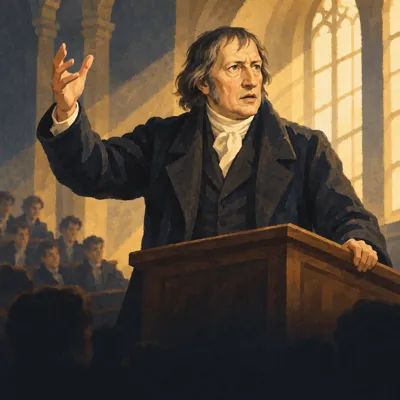
Georg Wilhelm Friedrich Hegel quiz
3 questions. No signup. Your move.
Who declared the end of history using Hegel's ideas?
Now make it a duel.
Play more questions on Georg Wilhelm Friedrich Hegel in LearnClash. Challenge friends in a new quiz duel.
Play more in the appA tap copies this page’s link so the app can pick up where you left off.
That was every question in this preview. Pick another topic or keep going in the app.
A new quiz every day: Today’s quiz
The video couldn’t load. You can watch it on YouTube.
Choose a topic, answer questions and challenge a friend in LearnClash.
Watch on YouTubeA tap copies this page’s link so the app can pick up where you left off.
More questions about Georg Wilhelm Friedrich Hegel
These visible examples show the question style. LearnClash turns the full topic into ranked duels and spaced repetition.
-
In which German city was the philosopher Hegel born in 1770?
Answer: Stuttgart
Why: His birthplace in Stuttgart is preserved today as a museum dedicated to his life and philosophy.
-
What country was philosopher Georg Wilhelm Friedrich Hegel from?
Answer: Germany
Why: Hegel was born in Stuttgart in 1770, when Württemberg was its own duchy; a unified Germany arrived only in 1871, forty years after his death.
-
What was the usual punishment at Hegel's Tübingen seminary?
Answer: forfeit wine
Why: In 1791 Hegel himself spent a few hours in the Stift's student jail for riding to a nearby village without permission and returning too late.
-
In which language did Hegel write his major philosophical books?
Answer: German
Why: Hegel's 1801 Jena habilitation thesis on planetary orbits appeared in Latin, yet every major book from the 1807 Phenomenology on was German.
-
What kind of idealism did Georg Wilhelm Friedrich Hegel create?
Answer: absolute idealism
Why: Hegel's absolute idealism is monistic: one Absolute Spirit unfolds itself as history, covering all natural and social phenomena.
-
What three parts make up Hegel's Encyclopaedia?
Answer: Logic, Nature, and Spirit
Why: Hegel published the Encyclopaedia in Heidelberg in 1817 as a textbook for his lecture audience, then revised it in 1827 and 1830.
Keep going in the app
A tap copies this page’s link so the app can pick up where you left off.

