
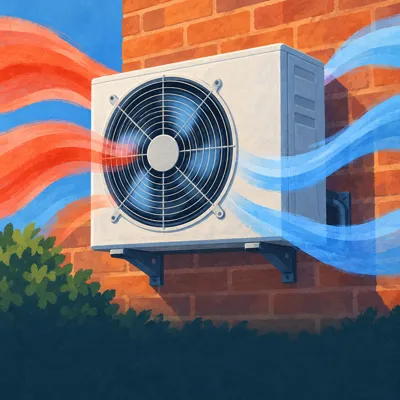
Heat Pumps quiz
3 questions. No signup. Your move.
What is the COP of a simple electric fan heater?
Now make it a duel.
Play more questions on Heat Pumps in LearnClash. Challenge friends in a new quiz duel.
Play more in the appA tap copies this page’s link so the app can pick up where you left off.
That was every question in this preview. Pick another topic or keep going in the app.
A new quiz every day: Today’s quiz
The video couldn’t load. You can watch it on YouTube.
Choose a topic, answer questions and challenge a friend in LearnClash.
Watch on YouTubeA tap copies this page’s link so the app can pick up where you left off.
More questions about Heat Pumps
These visible examples show the question style. LearnClash turns the full topic into ranked duels and spaced repetition.
-
About how warm is a heat pump's water for underfloor heating?
Answer: 35 °C
Why: Classic radiators usually need water at about 45 to 55 °C to heat a room properly, far warmer than underfloor heating.
-
Which air heat pump design keeps everything outdoors in one box?
Answer: Monobloc
Why: With the refrigerant circuit sealed in the outdoor box, a flammable refrigerant such as propane stays outside the house.
-
What was Peter von Rittinger's 1850s heat pump meant to help make?
Answer: Salt
Why: The Ebensee saltworks finally made salt with the heat pump method from 1953, almost a century after Rittinger's trials there.
-
Where do most heat pumps sold in Germany get their heat?
Answer: Outdoor air
Why: Ground-source models are the rarer choice: Germany sold about 8,000 of them in 2024, against roughly 178,000 air-source units.
-
Where does the refrigerant lose pressure and turn cold again?
Answer: Expansion valve
Why: Past the valve the chilled, low-pressure refrigerant enters the evaporator, where it boils and soaks up heat from outside.
-
Which gas is the refrigerant in Japan's EcoCute water heaters?
Answer: Carbon dioxide
Why: Unlike toxic ammonia or highly flammable propane, carbon dioxide is a refrigerant that does not burn and has low toxicity.
Keep going in the app
A tap copies this page’s link so the app can pick up where you left off.

