
Machining quiz
3 questions. No signup. Your move.
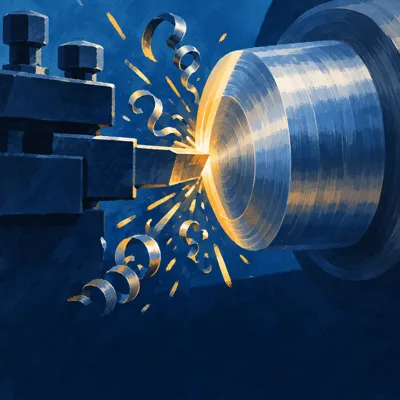
How does traditional machining shape a part?
Now make it a duel.
Play more questions on Machining in LearnClash. Challenge friends in a new quiz duel.
Play more in the appA tap copies this page’s link so the app can pick up where you left off.
That was every question in this preview. Pick another topic or keep going in the app.
A new quiz every day: Today’s quiz
The video couldn’t load. You can watch it on YouTube.
Choose a topic, answer questions and challenge a friend in LearnClash.
Watch on YouTubeA tap copies this page’s link so the app can pick up where you left off.
More questions about Machining
These visible examples show the question style. LearnClash turns the full topic into ranked duels and spaced repetition.
-
What liquid powers high-pressure abrasive jet machining systems used to cut thick steel plates?
Answer: Water
Why: Water only carries the cut: the garnet grit in the 90,000 psi stream is what erodes the steel, and that jet leaves the nozzle near Mach 3.
-
Which abrasive is most often mixed into high-pressure waterjet cutters?
Answer: Garnet
Why: Garnet crystals have sharp, angular fracture edges that slice through titanium and steel without heat-affected zones.
-
What self-excited vibration causes wavy marks and screeching during a cut?
Answer: Chatter
Why: Stability lobe charts map spindle speed against chatter free depth of cut: hit the right speed and each tooth meets the last wave in phase.
-
What primary dual role does cutting fluid perform during metal cutting?
Answer: Cooling and lubrication
Why: Coolant also flushes away sharp chips called swarf that would otherwise scar the surface finish or damage the cutting edge.
-
Whose equation links cutting speed to how long a tool lasts?
Answer: F. W. Taylor
Why: Taylor's equation came from 26 years of trials: 30,000 to 50,000 recorded experiments and over 800,000 pounds of steel cut into chips.
-
Which machining process uses a spinning abrasive wheel to achieve precision smooth surfaces?
Answer: Grinding
Why: Grinding removes microscopic metal chips and is commonly performed on parts that have already been hardened by heat treatment.
Keep going in the app
A tap copies this page’s link so the app can pick up where you left off.

