
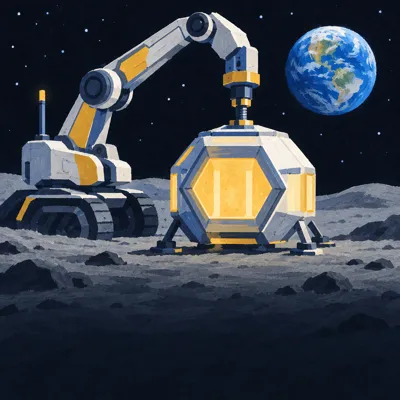
Moon Base Construction quiz
3 questions. No signup. Your move.
Moon base construction tests tech for trips to what planet?
Now make it a duel.
Play more questions on Moon Base Construction in LearnClash. Challenge friends in a new quiz duel.
Play more in the appA tap copies this page’s link so the app can pick up where you left off.
That was every question in this preview. Pick another topic or keep going in the app.
A new quiz every day: Today’s quiz
The video couldn’t load. You can watch it on YouTube.
Choose a topic, answer questions and challenge a friend in LearnClash.
Watch on YouTubeA tap copies this page’s link so the app can pick up where you left off.
More questions about Moon Base Construction
These visible examples show the question style. LearnClash turns the full topic into ranked duels and spaced repetition.
-
What magnetic shield protects Earth but is missing at the Moon?
Answer: Magnetosphere
Why: Earth generates its magnetosphere through a churning molten iron core, a dynamo mechanism that the geologically quiet Moon lacks.
-
What treaty demands all moon bases stay peaceful?
Answer: Outer Space Treaty
Why: Article IV of the 1967 Outer Space Treaty bans military bases on the Moon, but still allows military personnel there for peaceful research.
-
Why is sulfur concrete a top candidate for Moon habitats?
Answer: No water required
Why: Sulfur melts at about 115 °C and sets as it cools, no water needed; the catch is that lunar midday can top 120 °C, hot enough to soften the walls.
-
Moon bases are built in what fraction of Earth's gravity?
Answer: $1/6$
Why: Lunar gravity measures 1.62 m/s², one sixth of Earth's, so loads weigh six times less on the Moon while their mass and inertia stay unchanged.
-
Moon bases bury homes deep to block what danger?
Answer: radiation
Why: Chang'e 4 measured about 200 times Earth's radiation dose on the Moon, so habitats hide under metres of regolith.
-
What hazard does the "plume effect" pose to a lunar base?
Answer: high-speed regolith ejecta
Why: Apollo 12's landing sandblasted the Surveyor 3 probe over 150 metres away, and models put the fastest plume grains at up to about 2 km per second.
Keep going in the app
A tap copies this page’s link so the app can pick up where you left off.

