
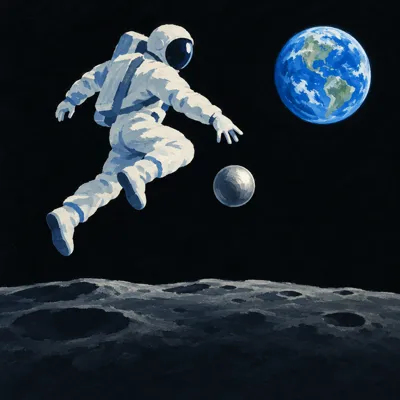
Moon Base Physics quiz
3 questions. No signup. Your move.
What type of harmful space energy must a Moon base block?
Now make it a duel.
Play more questions on Moon Base Physics in LearnClash. Challenge friends in a new quiz duel.
Play more in the appA tap copies this page’s link so the app can pick up where you left off.
That was every question in this preview. Pick another topic or keep going in the app.
A new quiz every day: Today’s quiz
The video couldn’t load. You can watch it on YouTube.
Choose a topic, answer questions and challenge a friend in LearnClash.
Watch on YouTubeA tap copies this page’s link so the app can pick up where you left off.
More questions about Moon Base Physics
These visible examples show the question style. LearnClash turns the full topic into ranked duels and spaced repetition.
-
How many times higher can a person jump at a moon base than on Earth?
Answer: six
Why: Suit and backpack weighed about 82 kg on Earth, and John Young's Apollo 16 jump salute rose only about 0.42 m.
-
What underground structures could protect Moon bases from radiation and meteors?
Answer: lava tubes
Why: Shaded floors of Moon pits stay near 17 C while the surface swings from 127 C to minus 173 C, and radar confirmed a cave under one in 2024.
-
How could moon bases store energy during the long night?
Answer: regenerative fuel cells
Why: By day solar power splits water; at night the gases recombine, storing over twice the energy per kilogram of space-grade batteries.
-
Why must moon base residents exercise several hours every day?
Answer: muscle atrophy
Why: Station crews already train an average of two hours a day, harnessed to a treadmill and mimicking weightlifting on a resistance machine.
-
How many Earth days long is the lunar day-night cycle for moon bases?
Answer: 29.5
Why: This 29.5 day cycle is the Sun returning to the same spot; the Moon orbits in 27.3 days, and each lunar night alone lasts about 14.75 days.
-
Why can we see about 59% of the lunar surface?
Answer: libration
Why: Libration in longitude reaches almost 8 degrees and in latitude nearly 7, letting Earth peek past all four lunar limbs.
Keep going in the app
A tap copies this page’s link so the app can pick up where you left off.

