
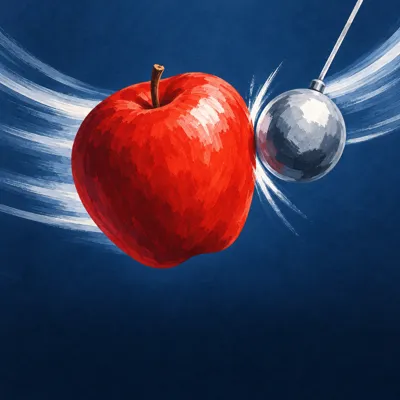
Newton's Laws of Motion quiz
3 questions. No signup. Your move.
Which falling fruit inspired Newton's thinking on gravity?
Now make it a duel.
Play more questions on Newton's Laws of Motion in LearnClash. Challenge friends in a new quiz duel.
Play more in the appA tap copies this page’s link so the app can pick up where you left off.
That was every question in this preview. Pick another topic or keep going in the app.
A new quiz every day: Today’s quiz
The video couldn’t load. You can watch it on YouTube.
Choose a topic, answer questions and challenge a friend in LearnClash.
Watch on YouTubeA tap copies this page’s link so the app can pick up where you left off.
More questions about Newton's Laws of Motion
These visible examples show the question style. LearnClash turns the full topic into ranked duels and spaced repetition.
-
Why do action and reaction forces in Newton's Third Law never cancel out?
Answer: They act on different objects
Why: Earth pulls a falling book with the same force the book pulls Earth up; Earth's huge mass hides its tiny acceleration.
-
What force slows a sliding hockey puck across rough ice?
Answer: Friction
Why: Pucks are frozen before games to reduce bouncing; struck hard, they can reach 100 mph (160 km/h) or more.
-
Why does a stone on a snapped string fly off in a straight tangent line?
Answer: No net force acts to curve its path
Why: Many people expect the stone to fly radially outward, but Newton's first law keeps it moving along its instantaneous velocity vector.
-
In Newton's Second Law, net force equals mass multiplied by which quantity?
Answer: Acceleration
Why: Acceleration is a vector, so a car rounding a bend without speeding up is still accelerating, pulled sideways by a net force.
-
From which country was Isaac Newton, the creator of the laws of motion?
Answer: England
Why: Newton served as President of England's Royal Society and spent three decades overseeing the Royal Mint.
-
What backward kick from firing a gun shows Newton's third law?
Answer: Recoil
Why: Recoil matches the bullet plus the escaping propellant gases, so a gun kicks back harder than the bullet alone would explain.
Keep going in the app
A tap copies this page’s link so the app can pick up where you left off.

