
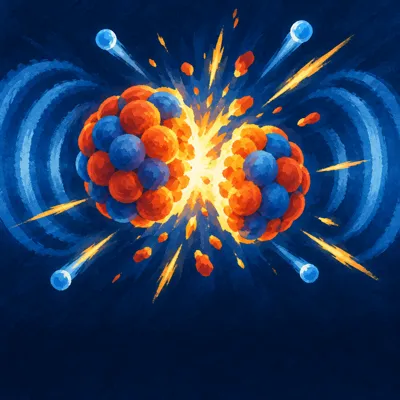
Nuclear Fission and Fusion quiz
3 questions. No signup. Your move.
How does a fusion reactor react if its plasma is disturbed?
Now make it a duel.
Play more questions on Nuclear Fission and Fusion in LearnClash. Challenge friends in a new quiz duel.
Play more in the appA tap copies this page’s link so the app can pick up where you left off.
That was every question in this preview. Pick another topic or keep going in the app.
A new quiz every day: Today’s quiz
The video couldn’t load. You can watch it on YouTube.
Choose a topic, answer questions and challenge a friend in LearnClash.
Watch on YouTubeA tap copies this page’s link so the app can pick up where you left off.
More questions about Nuclear Fission and Fusion
These visible examples show the question style. LearnClash turns the full topic into ranked duels and spaced repetition.
-
Which equation explains where fusion energy comes from?
Answer: E = mc²
Why: One gram of mass equals about 90 trillion joules, roughly what a one-gigawatt power station makes in a day.
-
Which isotope makes up over 99% of natural uranium?
Answer: Uranium-238
Why: Natural uranium is only about 0.7% uranium-235, while most reactors run on fuel enriched to 3 to 5%.
-
What gives off about as much heat per cubic metre as the Sun's core?
Answer: A compost heap
Why: At about 276 watts per cubic metre, the core's peak output is lower than an adult human body's metabolism.
-
Who led the team behind the first human-made nuclear reactor?
Answer: Enrico Fermi
Why: Chicago Pile-1 sustained its first chain reaction on 2 December 1942, beneath the stands of a University of Chicago sports field.
-
How does ITER's plasma temperature compare with the Sun's core?
Answer: About 10 times hotter
Why: Reactors lack the Sun's crushing gravity, which packs its core densely, so they make up for it with extra heat.
-
Which process makes most elements heavier than iron?
Answer: Neutron capture
Why: About half of the nuclei heavier than iron come from rapid neutron capture, the r-process, and most of the rest from the slower s-process.
Keep going in the app
A tap copies this page’s link so the app can pick up where you left off.

