
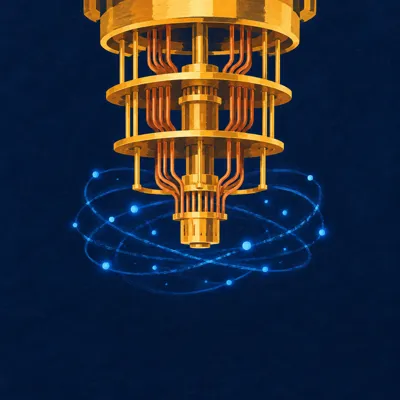
Quantum Computing quiz
3 questions. No signup. Your move.
How many states can a quantum bit represent at once in superposition?
Now make it a duel.
Play more questions on Quantum Computing in LearnClash. Challenge friends in a new quiz duel.
Play more in the appA tap copies this page’s link so the app can pick up where you left off.
That was every question in this preview. Pick another topic or keep going in the app.
A new quiz every day: Today’s quiz
The video couldn’t load. You can watch it on YouTube.
Choose a topic, answer questions and challenge a friend in LearnClash.
Watch on YouTubeA tap copies this page’s link so the app can pick up where you left off.
More questions about Quantum Computing
These visible examples show the question style. LearnClash turns the full topic into ranked duels and spaced repetition.
-
Which quantum effect links the measurement outcomes of particles?
Answer: Entanglement
Why: Einstein called this “spooky action at a distance” in a 1947 letter, yet entanglement cannot send a message faster than light.
-
How long did Google's 2019 chip take for a 10,000-year supercomputer task?
Answer: 200 seconds
Why: IBM answered within days that a supercomputer could match the run in 2.5 days, and by 2024 a 1,432-GPU cluster beat Sycamore's own time.
-
Which technology uses lasers to suspend atoms in a vacuum?
Answer: Neutral atoms
Why: Focused laser beams called optical tweezers grip single rubidium atoms, while ion machines hold their particles with electric fields.
-
What amplifies right answers and cancels wrong ones?
Answer: Interference
Why: Lov Grover's 1996 search algorithm uses exactly this: it finds one item among N in about the square root of N steps, a quadratic speedup.
-
What did Einstein call the link between two distant quantum particles?
Answer: Spooky action at a distance
Why: He used the German spukhafte Fernwirkung in a 1947 letter to Max Born; the 2022 physics Nobel honoured experiments confirming it.
-
Who proposed using quantum physics to simulate nature in 1981?
Answer: Richard Feynman
Why: He said it at the Physics of Computation meeting at MIT in May 1981; Soviet mathematician Yuri Manin had raised a similar idea in 1980.
Keep going in the app
A tap copies this page’s link so the app can pick up where you left off.

