
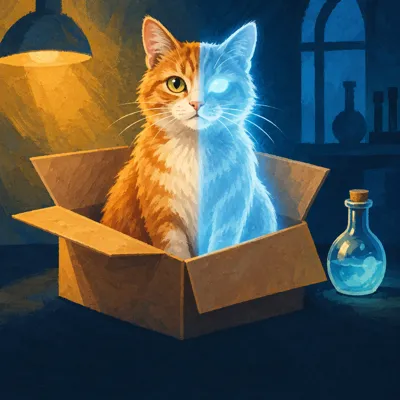
Schrödinger's Cat quiz
3 questions. No signup. Your move.
What poison is sealed in the flask with the cat?
Now make it a duel.
Play more questions on Schrödinger's Cat in LearnClash. Challenge friends in a new quiz duel.
Play more in the appA tap copies this page’s link so the app can pick up where you left off.
That was every question in this preview. Pick another topic or keep going in the app.
A new quiz every day: Today’s quiz
The video couldn’t load. You can watch it on YouTube.
Choose a topic, answer questions and challenge a friend in LearnClash.
Watch on YouTubeA tap copies this page’s link so the app can pick up where you left off.
More questions about Schrödinger's Cat
These visible examples show the question style. LearnClash turns the full topic into ranked duels and spaced repetition.
-
What kind of scientist was Erwin Schrödinger?
Answer: Physicist
Why: He published his wave equation in 1926, nine years before his cat, and shared the 1933 Nobel Prize in Physics with Paul Dirac.
-
Who shared the 1933 Nobel Prize in Physics with Erwin Schrödinger?
Answer: Paul Dirac
Why: Dirac and Schrödinger won jointly for wave mechanics and relativistic quantum theory, just two years before the cat paper.
-
Which interpretation says the universe splits into two cats?
Answer: Many-worlds
Why: Under Many-Worlds, the wave function never collapses, meaning an observer exists in one branch seeing a live cat, and another seeing a dead one.
-
How many real cats were used in the experiment?
Answer: Zero
Why: In 1935 Schrödinger invented the cat to mock the idea that a closed box leaves an animal both alive and dead.
-
Who first proposed that particles like electrons can act like waves?
Answer: Louis de Broglie
Why: De Broglie proposed matter waves in his 1924 doctoral thesis, winning the Nobel Prize just five years later.
-
Who won the 2012 Nobel Prize for observing cat state decoherence?
Answer: Serge Haroche
Why: Haroche's cat state used about ten photons in a cavity, and its superposition survived only several microseconds.
Keep going in the app
A tap copies this page’s link so the app can pick up where you left off.

