
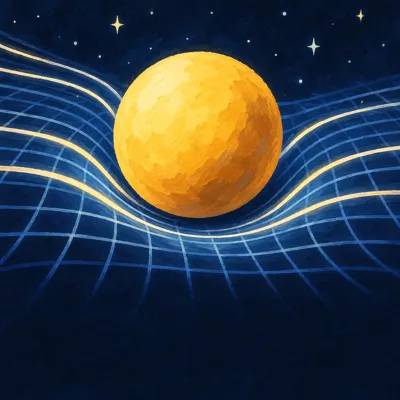
Theory of Relativity quiz
3 questions. No signup. Your move.
What would it take to push a spaceship to light speed?
Now make it a duel.
Play more questions on Theory of Relativity in LearnClash. Challenge friends in a new quiz duel.
Play more in the appA tap copies this page’s link so the app can pick up where you left off.
That was every question in this preview. Pick another topic or keep going in the app.
A new quiz every day: Today’s quiz
The video couldn’t load. You can watch it on YouTube.
Choose a topic, answer questions and challenge a friend in LearnClash.
Watch on YouTubeA tap copies this page’s link so the app can pick up where you left off.
More questions about Theory of Relativity
These visible examples show the question style. LearnClash turns the full topic into ranked duels and spaced repetition.
-
What do you see in a hand mirror while flying near light speed?
Answer: A normal reflection
Why: No experiment inside a smoothly moving ship can reveal its speed, so light still races from your face to the mirror as usual.
-
What principle says free fall feels like floating in space?
Answer: Equivalence principle
Why: Using this idea alone, Einstein predicted that gravity slows clocks and bends light, years before he finished general relativity.
-
How much TNT matches the energy in one gram of mass?
Answer: About 21,000 tonnes
Why: That's about 25 gigawatt-hours, roughly what a large 1-gigawatt power station generates in a full day.
-
How many dimensions does Einstein's spacetime have?
Answer: Four
Why: Hermann Minkowski, who had once taught Einstein mathematics, recast relativity as four-dimensional geometry in a 1908 lecture.
-
What cosmic-ray particle reaches the ground thanks to time dilation?
Answer: Muon
Why: Without that stretch, a muon living about 2.2 microseconds would fly only about 660 m, far short of the ground some 15 km below.
-
Which force can an electric force become for a moving observer?
Answer: Magnetic force
Why: Einstein's 1905 relativity paper opens with a magnet and a wire, where the current depends only on how they move relative to each other.
Keep going in the app
A tap copies this page’s link so the app can pick up where you left off.

