
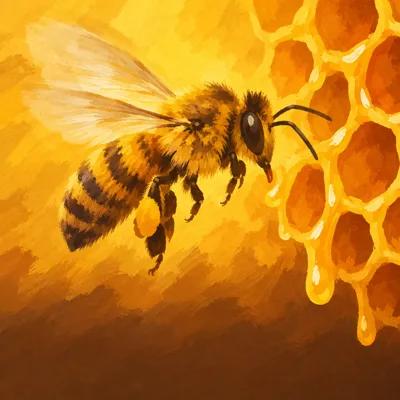
Bees quiz
3 questions. No signup. Your move.
What are the individual hexagonal storage units in a hive called?
Now make it a duel.
Play more questions on Bees in LearnClash. Challenge friends in a new quiz duel.
Play more in the appA tap copies this page’s link so the app can pick up where you left off.
That was every question in this preview. Pick another topic or keep going in the app.
A new quiz every day: Today’s quiz
The video couldn’t load. You can watch it on YouTube.
Choose a topic, answer questions and challenge a friend in LearnClash.
Watch on YouTubeA tap copies this page’s link so the app can pick up where you left off.
More questions about Bees
These visible examples show the question style. LearnClash turns the full topic into ranked duels and spaced repetition.
-
Why do bees build hexagonal cells for storing honey?
Answer: Most efficient space usage
Why: A kilo of wax costs bees roughly 7 to 9 kilos of honey; in 1999 Thomas Hales proved hexagons need the least wall of any equal-area tiling.
-
What is the largest species of bee in the world?
Answer: Wallace's giant bee
Why: Its wingspan reaches about 63 mm, it nests only inside living termite mounds in trees, and nobody photographed a live one until 2019.
-
What do bees use to grip smooth surfaces like glass?
Answer: Arolia
Why: Pulling a bee's claw tendon also swings its foot pad into place, and a thin liquid film between pad and surface gives the grip.
-
Where on their bodies do worker bees pack bright pellets of pollen?
Answer: Hind legs
Why: These leg cavities are officially called corbiculae and use specialized hairs to secure pollen pellets during flight.
-
How do Japanese honeybees kill predatory hornets that enter their hive?
Answer: Cooking them with body heat
Why: Hundreds of workers heat the ball to about 46 °C; with the carbon dioxide they exhale, the hornet dies while the bees survive up to 50 °C.
-
How do orchid bees achieve their vibrant metallic green color?
Answer: Structural coloration
Why: No green pigment is involved: nanoscale structure in the cuticle reflects the light, so the metallic sheen shifts with the viewing angle.
Keep going in the app
A tap copies this page’s link so the app can pick up where you left off.

