
Gas Laws quiz
3 questions. No signup. Your move.
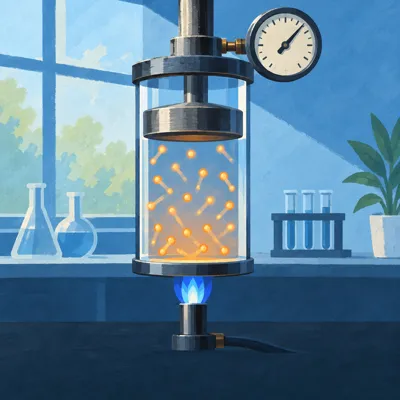
How do gas molecules change when the gas is squeezed?
Now make it a duel.
Play more questions on Gas Laws in LearnClash. Challenge friends in a new quiz duel.
Play more in the appA tap copies this page’s link so the app can pick up where you left off.
That was every question in this preview. Pick another topic or keep going in the app.
A new quiz every day: Today’s quiz
The video couldn’t load. You can watch it on YouTube.
Choose a topic, answer questions and challenge a friend in LearnClash.
Watch on YouTubeA tap copies this page’s link so the app can pick up where you left off.
More questions about Gas Laws
These visible examples show the question style. LearnClash turns the full topic into ranked duels and spaced repetition.
-
Why does a gas push on the walls of its container?
Answer: Molecular collisions
Why: Newton's Principia derived Boyle's law from a model of resting particles that repel one another, a picture later replaced by moving, colliding molecules.
-
By what factor does a rigid can's gas pressure rise from 27°C to 327°C?
Answer: 2
Why: Gas laws need absolute temperatures: 27 °C is 300 K and 327 °C is 600 K, so the pressure doubles instead of rising twelvefold.
-
Roughly how many molecules fill one cubic centimeter of air?
Answer: $10^{19}$
Why: This count, about $2.7 \times 10^{19}$ at 0 °C and 1 atm, is known as the Loschmidt constant.
-
How does Boyle's law say doubling pressure changes volume?
Answer: It halves
Why: Boyle tested it by trapping air under mercury in a J-shaped glass tube and pouring in more mercury to squeeze it.
-
How much steam do 2 L of hydrogen and 1 L of oxygen form?
Answer: 2 liters
Why: Three gas molecules, two H₂ and one O₂, become only two H₂O molecules, so the 3 liters of gas shrink to 2.
-
How many atoms does an air balloon hold versus a same-size helium one?
Answer: About twice as many
Why: Air's nitrogen and oxygen come as two-atom molecules while helium atoms travel alone, so equal molecule counts mean about double the atoms.
Keep going in the app
A tap copies this page’s link so the app can pick up where you left off.

