
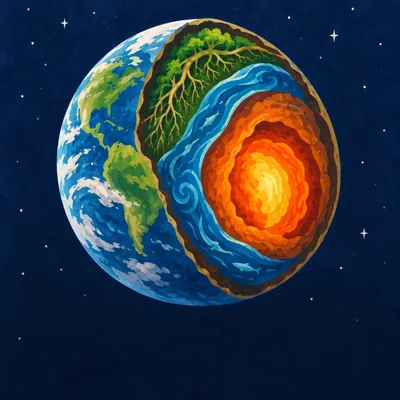
Life and Earth Sciences quiz
3 questions. No signup. Your move.
What causes Earth's global magnetic field to form?
Now make it a duel.
Play more questions on Life and Earth Sciences in LearnClash. Challenge friends in a new quiz duel.
Play more in the appA tap copies this page’s link so the app can pick up where you left off.
That was every question in this preview. Pick another topic or keep going in the app.
A new quiz every day: Today’s quiz
The video couldn’t load. You can watch it on YouTube.
Choose a topic, answer questions and challenge a friend in LearnClash.
Watch on YouTubeA tap copies this page’s link so the app can pick up where you left off.
More questions about Life and Earth Sciences
These visible examples show the question style. LearnClash turns the full topic into ranked duels and spaced repetition.
-
Which organelle arose from an engulfed bacterium through endosymbiosis?
Answer: Mitochondrion
Why: Mitochondria still retain their own circular DNA and replicate independently inside eukaryotic host cells.
-
What creates new crust at mid-ocean ridges?
Answer: Divergent boundary
Why: These spreading ridges form a chain nearly 65,000 km long, the longest mountain range on Earth, and almost all of it sits underwater.
-
What RNA molecule can catalyze biochemical reactions?
Answer: Ribozyme
Why: Ribozymes showed that RNA can act as both an information carrier and a functional catalyst without proteins.
-
How do decomposers primarily sustain an ecosystem's food web?
Answer: By recycling nutrients into soil
Why: Without decomposers, essential elements like nitrogen and phosphorus would remain permanently locked in dead biomass.
-
Which ancient organisms made the oxygen that formed banded iron formations?
Answer: Cyanobacteria
Why: Ocean iron absorbed cyanobacterial oxygen for hundreds of millions of years, so free oxygen only began building up in the air 2.4 billion years ago.
-
Which supercontinent broke apart before Pangaea formed?
Answer: Rodinia
Why: Breaking apart Rodinia opened fresh coastlines that absorbed vast amounts of carbon dioxide and cooled the planet.
Keep going in the app
A tap copies this page’s link so the app can pick up where you left off.

