
37 Science Trivia Questions [With Answers]
37 science trivia questions across physics, biology, chemistry, and space, with answers and the reason your gut picks the wrong one.
How many do you know?
Think of your answer, then reveal it.
Did you know it before revealing the answer?
Read this answer in the articleRound complete
Turn what you know into a quiz duel.
Start a new duel in LearnClash and learn from every answer.
Get LearnClashFree to play on iPhone and Android. No ads.
Try the questions you missed once more.


Venus is hotter than Mercury. Your skin outweighs your liver. Blue stars burn hotter than red ones. Three facts that feel wrong, and all three are true.
Science is the category where smart people lose, not because the answers are obscure, but because your gut keeps handing you the one that sounds right and isn’t. These 37 questions span physics, biology, chemistry, and space, and each one comes with a short note on where that gut feeling goes wrong.
The pattern repeats across all four branches. You pick the obvious option, you get burned, and then the right answer locks in for good.
Use the list for a quiz night, for exam prep, or as a way to settle an argument. Science is one of 23 categories in our best trivia questions collection, and chemistry sneaks into art too: our art trivia questions cover Prussian blue, the first industrially synthesized pigment (1704).
Test your physics knowledge on LearnClash
How the 37 questions break down
Four categories, three difficulty levels, weighted toward the medium and hard end because that’s where science actually bites.
| Category | Questions | Easy | Medium | Hard |
|---|---|---|---|---|
| Physics | 1–9 | 2 | 4 | 3 |
| Biology | 10–18 | 2 | 3 | 4 |
| Chemistry | 19–27 | 1 | 4 | 4 |
| Space & Astronomy | 28–37 | 2 | 3 | 5 |
| Total | 37 | 7 | 14 | 16 |
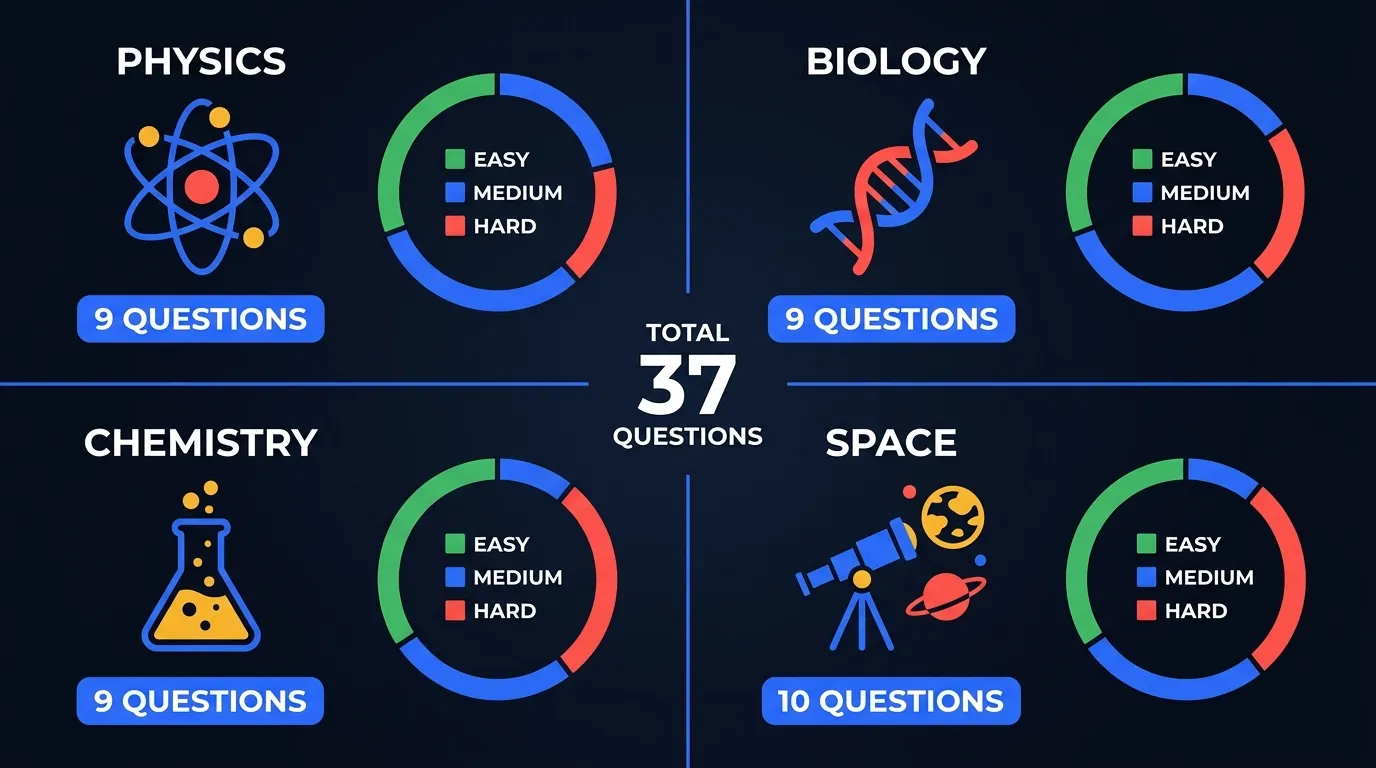 Nine physics, nine biology, nine chemistry, and ten astronomy questions, weighted toward medium and hard.
Physics Trivia Questions (1–9)
Physics splits a room down the middle. You either nail the answer or whiff it cold, with very little in between. Light, heat, and forces are the worst offenders, because the everyday version of each one quietly lies to you. These 9 questions run from mechanics and thermodynamics to quantum physics and astrophysics.
 Physics: 9 questions spanning mechanics, thermodynamics, quantum physics, and astrophysics.
1. What are the three primary colors of light? Easy
Answer: Red, green, and blue (RGB).
Your gut says red, yellow, and blue, but those are paint primaries. Light works by additive color mixing, not subtractive. Mix red and green light and you get yellow. Mix red and green paint and you get brown. Same colors, opposite results.
2. What is the speed of light in a vacuum? Easy
Answer: About 186,282 miles per second (299,792 km/s).
Everyone knows “really fast.” Almost nobody can land on the number. At this speed, light circles Earth 7.5 times per second and reaches the Moon in 1.3 seconds.
3. What color does a star appear when it’s hottest? Medium
Answer: Blue.
In daily life, red means hot: stove burners, fire embers, warning lights. Stars flip that completely. Blue stars burn at roughly 36,000°F to 90,000°F (20,000 to 50,000°C), while red stars sit around 5,400°F (3,000°C). The hottest flame you can see is blue, for the same reason.
4. Does sound travel faster in air or water? Medium
Answer: Water, about 4.3 times faster (4,856 ft/s vs 1,125 ft/s in air at 68°F; 1,480 m/s vs 343 m/s).
Air feels less dense, so you’d expect sound to slide through it more easily. But sound is a pressure wave, and denser material packs its molecules closer together. Tighter molecules pass the wave along faster.
5. What happens to water’s boiling point at high altitude? Medium
Answer: It decreases. Water boils at about 203°F (95°C) in high-altitude cities like Denver or Johannesburg (roughly 5,250 ft) and about 160°F (71°C) at the summit of Mount Everest (29,032 ft).
We treat 212°F (100°C) like a law of nature. It isn’t. Up high, the air pushes down with less force, so water turns to gas with less energy. That’s why pasta takes longer to cook in the mountains.
6. What is the strongest force in nature? Medium
Answer: The strong nuclear force, about 100 times stronger than electromagnetism and 10 to the 38th power times stronger than gravity.
Nearly everyone reaches for gravity, which is actually the weakest of the four basic forces by an absurd margin. The strong force holds atomic nuclei together and beats the electromagnetic push between protons that would otherwise blow every atom apart.
7. What is the Chandrasekhar limit? Hard
Answer: About 1.4 solar masses, the maximum mass for a stable white dwarf star.
Even astronomy buffs swap it for the Schwarzschild radius, which is the boundary of a black hole. Subrahmanyan Chandrasekhar worked the limit out at age 19, and it earned him the 1983 Nobel Prize in Physics.
8. What is the half-life of Carbon-14? Hard
Answer: About 5,730 years.
Radiocarbon dating is famous. The number behind it isn’t. That 5,730-year half-life is exactly why the technique caps out near 50,000 years: after about nine half-lives, too little Carbon-14 is left to measure.
9. What is Hawking radiation? Hard
Answer: Theoretical radiation emitted by black holes due to quantum effects near the event horizon, proposed by Stephen Hawking in 1974.
Black holes trap everything, including light, and that’s the one fact everybody carries around. So the idea that they slowly leak energy and eventually evaporate sounds like a contradiction. We’ve never observed it directly, but it’s widely accepted in theory, and it means every black hole will one day vanish given enough time.
For a swerve into fiction, our 37 Harry Potter trivia questions open the same confidence gap. Fans who’ve seen every film still trip on book-only details.
Biology Trivia Questions (10–18)
Biology earns more “I should have known that” groans than any other category. You live inside a body, you assume you know how it works, and then a question about your own anatomy blindsides you. These 9 cover human anatomy, genetics, and the living world, and at the end of the section I’ve added one biology result from LearnClash’s own player data where the wrong answer outdraws the right one.
 Biology: 9 questions on the human body, DNA, and the living world.
10. What is the largest organ in the human body? Easy
Answer: The skin, covering about 18 square feet (1.7 m²) and weighing 6.6 to 8.8 lb (3 to 4 kg) in an average adult.
Liver, lungs, intestines: those are the organs you picture. Skin doesn’t read as an “organ” because you can see it, and it looks like it just sits there. It holds your heat in, fights off germs, makes vitamin D, and feels touch across nearly two square meters.
11. Which human organ can regenerate its own tissue? Easy
Answer: The liver. It can regrow to full size from as little as 25% of its original tissue.
No other solid organ pulls this off, and it’s the whole reason living-donor transplants work. Both the donor’s leftover piece and the recipient’s new piece grow back to full working size within weeks.
12. What blood type is the universal donor? Medium
Answer: O negative.
Two words tangle here, “donor” and “recipient.” O negative gives to everyone. AB positive receives from everyone. O negative red blood cells carry no A, B, or Rh antigens, which makes them safe for any patient in an emergency.
13. What is the fastest muscle in the human body? Medium
Answer: The orbicularis oculi, the muscle that controls blinking.
The heart hogs all the credit. It beats roughly 100,000 times daily, which makes it the hardest-working muscle, but hardest-working isn’t fastest. A single blink fires in 100 to 150 milliseconds, quicker than any other muscle twitch in the body.
14. What is the smallest bone in the human body? Medium
Answer: The stapes (stirrup bone) in the middle ear, about 3 mm long.
You know it’s somewhere small. You can’t quite place where. The stapes sits in the middle ear next to the incus and malleus, three tiny bones that carry sound vibrations from the eardrum to the inner ear.
15. What percentage of human DNA do we share with bananas? Hard
Answer: About 60%.
Sixty percent overlap with a banana reads like a prank answer. It’s real, and it shows how ancient the machinery of life is. Cell division, energy production, protein synthesis: these processes evolved billions of years ago and barely budged since. You and a banana run the same core operating system.
16. What is CRISPR? Hard
Answer: A gene-editing technology (Clustered Regularly Interspaced Short Palindromic Repeats) that allows precise modification of DNA sequences.
Everyone has heard “CRISPR.” Almost nobody can explain how it works. CRISPR-Cas9 acts like molecular scissors, snipping DNA at a chosen location so genes can be removed, replaced, or inserted. Jennifer Doudna and Emmanuelle Charpentier won the 2020 Nobel Prize in Chemistry for this discovery.
17. How many bones does an adult human have? Hard
Answer: 206.
Babies arrive with about 270 bones. Dozens fuse through childhood and adolescence, and the last fusions wrap up in your mid-20s, so a teenager and a 30-year-old carry genuinely different skeletal structures.
18. How many species are estimated to exist on Earth? Hard
Answer: About 8.7 million, according to a landmark 2011 study, but only about 1.2 million have been formally described.
What throws the guess off is the scale of the unknown. About 86% of land species and 91% of marine species still aren’t cataloged. Scientists describe roughly 18,000 new species a year, and at that pace it would take centuries just to log what’s already here.
If these body facts surprised you, our 49 dinosaur trivia questions that stump adults take biology back 66 million years. For something invented instead, our 37 Lord of the Rings trivia questions land the same jolt for Tolkien fans.
Test your biology knowledge on LearnClash
Chemistry Trivia Questions (19–27)
Chemistry pulls the loudest “wait, really?” once the answer flips. The answers aren’t obscure. The reactions just refuse to behave the way daily life trains you to expect. Sodium explodes in water. Sodium chloride is table salt. Same sodium. These 9 questions cover elements, reactions, and molecular chemistry.
 Chemistry: 9 questions on elements, chemical reactions, and molecular science.
19. What is the chemical symbol for gold? Easy
Answer: Au (from the Latin aurum).
“Go” or “Gd” feel right, and neither is. Gd is gadolinium. Eleven element symbols trace back to Latin or other non-English roots: Na (sodium, from natrium), Fe (iron, from ferrum), Ag (silver, from argentum).
20. What is the most abundant element in the universe? Medium
Answer: Hydrogen, making up about 75% of all normal matter by mass.
Oxygen and helium draw the popular guesses. Hydrogen formed within minutes of the Big Bang and still fuels every star, our Sun included.
21. What is dry ice made of? Medium
Answer: Solid carbon dioxide (CO₂) at −109.3°F (−78.5°C).
The name lies. “Ice” promises frozen water, but dry ice skips the liquid phase entirely at normal atmospheric pressure, jumping straight from solid to gas. So it “smokes” but never leaves a puddle.
22. Which noble gas actually glows in neon signs? Medium
Answer: Neon, producing a distinctive red-orange glow.
Walk a commercial strip and count the “neon” signs. Almost none actually hold neon. Blue comes from argon, white from krypton, and most modern signs run LEDs or fluorescent tubes. True neon gas produces exactly one color, red-orange.
23. What makes chili peppers spicy? Medium
Answer: Capsaicin, a chemical compound that binds to TRPV1 pain receptors in the mouth.
Spiciness isn’t a taste at all. It’s pain. Your tongue has no “spicy” taste buds, and capsaicin fires the same receptors that flag burning heat, so hot food literally feels hot. The Scoville scale measures capsaicin concentration: a jalapeño scores 2,500 to 8,000 SHU, while a Carolina Reaper clears 2.2 million.
Challenge a friend to a chemistry quiz
24. What is the Maillard reaction? Hard
Answer: A chemical reaction between amino acids and reducing sugars that creates browning and complex flavors when food is heated above roughly 284°F (140°C).
You meet it every morning: toast, coffee, seared steak, the browning on roasted vegetables. The chemistry carries a name that sounds far too obscure for something this ordinary, and that’s what catches people. Louis-Camille Maillard first described the reaction in 1912. It’s not caramelization, which involves only sugars. For more food science surprises, try our 43 food trivia questions.
25. What element has the highest melting point? Hard
Answer: Tungsten (wolfram) at 6,192°F (3,422°C).
Iron, titanium, and diamond (which isn’t an element anyway) take most of the wrong votes. Tungsten’s brutal melting point made it the perfect filament for old light bulbs, because it glows white-hot and still won’t melt.
26. What is an isotope? Hard
Answer: Atoms of the same element with different numbers of neutrons.
Isotopes, ions, and isomers are three “iso” terms that smear together in your head. Isotopes differ in neutron count, ions differ in electron count, and isomers differ in molecular arrangement. Carbon-12 and Carbon-14 are both carbon (6 protons each), but Carbon-14 carries 2 extra neutrons, which makes it radioactive.
27. What percentage of Earth’s atmosphere is oxygen? Hard
Answer: About 21%. Nitrogen makes up roughly 78%.
Most guesses land at 50% or more. The air is overwhelmingly nitrogen. Oxygen’s 21% is plenty for respiration, yet a swing of just a few points would rewrite fire behavior and biological processes across the planet.
Space and Astronomy Trivia Questions (28–37)
Space takes down the most players. Past Earth’s atmosphere, the intuition you grew up with stops being useful: distances stop making sense, temperatures go to extremes, and words like “up” and “seasons” quietly change meaning. These 10 questions roam our solar system and the universe past it, and we dig further in our 42 space trivia questions collection.
 Space and Astronomy: 10 questions exploring our solar system and the universe beyond.
28. What is the closest star to Earth? Easy
Answer: The Sun, about 93 million miles (150 million km) away.
Alpha Centauri and Proxima Centauri are the reach-for answers, and they skip right past the fact that the Sun is a star. After the Sun, Proxima Centauri is next at 4.24 light-years, roughly 25 trillion miles (40 trillion km).
29. What causes tides on Earth? Easy
Answer: Primarily the Moon’s gravitational pull, with the Sun contributing a smaller but real effect.
Crediting the Moon alone gets you most of the way and still misses. The Sun supplies about one-third of Earth’s tidal force, and at full and new moons, when Sun and Moon line up, their combined pull drives stronger “spring tides.”
30. Which planet is the hottest in our solar system? Medium
Answer: Venus, with a surface temperature of roughly 869°F (465°C).
Mercury sits closer to the Sun, and that’s all most people fixate on. But Venus wraps itself in a thick CO2 atmosphere that traps heat through a runaway greenhouse effect. Mercury has almost no atmosphere, so its heat just radiates into space. Venus is hot enough to melt lead.
31. What causes the seasons on Earth? Medium
Answer: Earth’s 23.5-degree axial tilt relative to its orbital plane.
“Distance from the Sun” jumps out first, and it’s backward. The Northern Hemisphere actually sits closer to the Sun during its own winter. Seasons happen because the tilt changes how directly sunlight hits each hemisphere over the year.
32. What is the largest volcano in the solar system? Medium
Answer: Olympus Mons on Mars, about 13.6 miles (21.9 km) tall and 373 miles (600 km) in diameter.
Earth doesn’t hold this record, and it isn’t close. Olympus Mons stands nearly three times the height of Mount Everest and spreads roughly across the area of France. Mars’s lower gravity and missing tectonic plates let the volcano keep growing for billions of years.
33. What is the Great Red Spot? Hard
Answer: A massive anticyclonic storm on Jupiter, roughly the size of Earth, that has been raging for at least 350 years.
A surface feature, a volcanic formation, a crater: those are the usual guesses. It’s a storm, a stubborn high-pressure system with winds topping 250 mph (400 km/h). First spotted in the 1600s, it’s been slowly shrinking over the past century.
34. What is the cosmic microwave background? Hard
Answer: Thermal radiation left over from the Big Bang, filling the entire universe at a temperature of about 2.7 Kelvin (−454.8°F / −270.45°C).
Two scientists found it by mistake in 1965. Arno Penzias and Robert Wilson kept hearing persistent static in their radio antenna and first blamed pigeon droppings in the dish. What they’d actually caught was the oldest observable light in the universe, and they won the 1978 Nobel Prize in Physics for it.
35. What percentage of the universe is ordinary matter? Hard
Answer: About 5%.
Everything you can see, touch, or measure (stars, planets, galaxies, your own body) crams into that sliver. Dark matter takes roughly 27% and dark energy about 68%, and both sit among the biggest unsolved problems in physics.
36. What is a magnetar? Hard
Answer: A type of neutron star with an extraordinarily powerful magnetic field, roughly a quadrillion (10 to the 15th power) times stronger than Earth’s.
Magnetars and pulsars get swapped all the time. Pulsars fire off regular radiation pulses. Magnetars are a different beast: their magnetic fields run so intense they’d be lethal from 620 miles (1,000 km) away, bending atoms and breaking chemistry at the subatomic level.
37. What is the Oort Cloud? Hard
Answer: A theoretical spherical shell of icy objects surrounding the solar system, extending from roughly 2,000 to 100,000 AU from the Sun.
Nobody has ever laid eyes on it. We infer the whole thing from the orbits of long-period comets that swing toward the Sun from every direction. If the Oort Cloud is real, it marks the outermost edge of the Sun’s gravitational reach and may hold trillions of icy bodies.
Challenge a friend to a space quiz
How to Use These Science Trivia Questions
Answer “Mercury” in a duel, learn it’s Venus, and that correction sticks harder than any fact you picked up from scratch. Cognitive science has a tidy explanation: your brain tags a confident mistake as high priority, far above anything you absorbed passively.
 How a missed question travels back to you: three mastery stages, with review intervals of 7 days and 90 days based on your accuracy.
“Spacing study and testing over longer intervals of time produces more durable learning than massed practice.” Cepeda et al., Psychological Bulletin (2006)
Cepeda and colleagues ran the numbers across 317 experiments and found that spacing your practice out beats cramming in nearly every comparison they tested. Here’s the version you can run by hand without any app at all:
- Today: work through all 37 questions and mark the misses.
- Next week: retake only the ones you got wrong.
- In a month: test yourself on the whole set again.
Each pull from memory makes the trace a little stronger. LearnClash handles the timing for you, and the two intervals in that diagram (7 days for a miss, 90 days for a hit) were a judgment call I made rather than a value inherited from any published algorithm. Classic spacing curves suggest a growing ladder of intervals; I compressed that to two stops because a trivia duel is not a flashcard session, and a schedule players cannot predict is a schedule they stop trusting. Miss a question and it drops a stage and returns sooner.
Building a quiz night or want a ready-made set to pull from? We also published a free open-source trivia database with 100 curated questions across 8 categories, released under CC BY 4.0.
Liked this set? A few more worth your time:
- 43 geography trivia questions for countries, borders, and world records.
- 43 math trivia questions for paradoxes and famous mathematicians.
- 53 true or false questions for a format that weaponizes common misconceptions.
- 43 sports trivia questions for NFL, NBA, MLB, and Olympic deep cuts.
- 89 trivia questions for kids ages 5 to 13 for family-friendly STEM, animal, and space rounds.
- 37 Greek mythology trivia questions for myths that shaped Western civilization.
- 43 general knowledge trivia questions for a broader challenge across seven categories.
- Franchise lore with 37 Lord of the Rings Trivia Questions and 37 Harry Potter Trivia Questions.
To see how LearnClash stacks up against other quiz apps, check our LearnClash vs Trivia Crack comparison and LearnClash vs Kahoot comparison.
Frequently Asked Questions
What are good science trivia questions for quiz night?
The best science trivia questions are counterintuitive, like 'Which planet is hottest?' (Venus, not Mercury) or 'What color is the hottest star?' (blue, not red). Questions with surprising answers spark discussion and stick in memory. This list includes 37 verified questions across four science categories at easy, medium, and hard difficulty levels.
Are science trivia questions good for learning?
Yes. Research on the testing effect shows that actively recalling answers strengthens long-term memory more effectively than rereading notes. LearnClash builds on this by combining trivia questions with spaced repetition. Questions you miss reappear at increasing intervals until mastered across three stages: Learning, Known, and Mastered.
What is the hardest science trivia category?
Space and astronomy trivia stumps the most people because everyday intuition doesn't apply. Questions about the cosmic microwave background, magnetars, or the Oort Cloud require specialized knowledge, which makes astronomy one of the toughest science categories to answer cold.
Where can I practice science trivia questions online?
LearnClash lets you practice science trivia on any topic (physics, biology, chemistry, astronomy, and more) with questions at every difficulty level. The app tracks your accuracy per topic and uses spaced repetition to help you retain answers long-term. Available free on iOS and Android.