
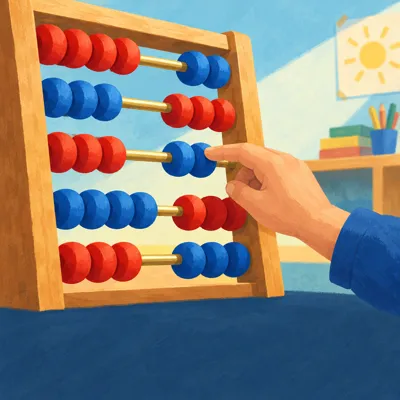
Single-Digit Addition and Subtraction quiz
3 questions. No signup. Your move.
What total do you get when adding the single digit 4 to itself?
Now make it a duel.
Play more questions on Single-Digit Addition and Subtraction in LearnClash. Challenge friends in a new quiz duel.
Play more in the appA tap copies this page’s link so the app can pick up where you left off.
That was every question in this preview. Pick another topic or keep going in the app.
A new quiz every day: Today’s quiz
The video couldn’t load. You can watch it on YouTube.
Choose a topic, answer questions and challenge a friend in LearnClash.
Watch on YouTubeA tap copies this page’s link so the app can pick up where you left off.
More questions about Single-Digit Addition and Subtraction
These visible examples show the question style. LearnClash turns the full topic into ranked duels and spaced repetition.
-
What single-digit value remains when subtracting 7 from 9?
Answer: 2
Why: In Johannes Widmann's 1489 German business arithmetic the minus sign marked a deficit; its use for subtraction is attested in 1518.
-
Why does reversing the order in single-digit subtraction change the result?
Answer: Subtraction is non-commutative
Why: While addition is commutative ($7 + 2 = 2 + 7$), swapping subtraction order inverts the sign: $7 - 2 = 5$ but $2 - 7 = -5$.
-
What term describes repeatedly summing digits to one single digit?
Answer: Digital root
Why: The digital root always matches the number's value modulo 9, except multiples of 9 yield 9.
-
What is the largest total you can reach by adding two single-digit numbers?
Answer: 18
Why: The 18 ceiling is why adding two numbers in columns never carries more than a single unit into the next place value.
-
What is a set of four equations built from three numbers called?
Answer: Fact family
Why: A fact family with two identical addends, such as $4 + 4 = 8$, contains only two unique equations instead of four.
-
Which three distinct single digits have a sum of 24?
Answer: 7, 8, 9
Why: Because 7, 8, and 9 are the three largest single digits, their sum of 24 is the maximum possible for three distinct digits.
Keep going in the app
A tap copies this page’s link so the app can pick up where you left off.

