
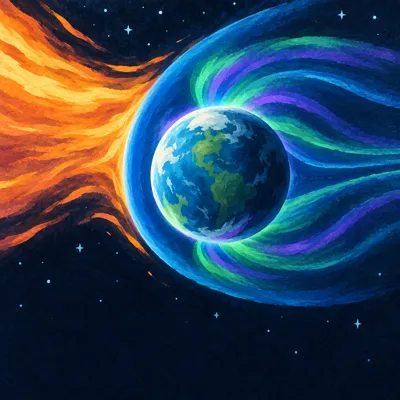
Space Weather quiz
3 questions. No signup. Your move.
What is the constant stream of particles from the Sun?
Now make it a duel.
Play more questions on Space Weather in LearnClash. Challenge friends in a new quiz duel.
Play more in the appA tap copies this page’s link so the app can pick up where you left off.
That was every question in this preview. Pick another topic or keep going in the app.
A new quiz every day: Today’s quiz
The video couldn’t load. You can watch it on YouTube.
Choose a topic, answer questions and challenge a friend in LearnClash.
Watch on YouTubeA tap copies this page’s link so the app can pick up where you left off.
More questions about Space Weather
These visible examples show the question style. LearnClash turns the full topic into ranked duels and spaced repetition.
-
Which subatomic particle makes up most of the solar wind?
Answer: Protons
Why: The solar wind, mostly protons and electrons, carries off roughly 1.3 to 1.9 million tonnes of the Sun's mass every second.
-
How often does the Sun's magnetic field completely flip its polarity?
Answer: Every 11 years
Why: The flip happens at solar maximum, so the Sun needs two cycles, about 22 years, to get back to its original polarity.
-
What phenomenon causes GPS signals to delay during solar storms?
Answer: Total Electron Content
Why: Because the delay depends on frequency, receivers that measure two bands can cancel it; some survey-grade and military receivers use L1 and L2 for this.
-
Which animal uses Earth’s magnetic field to find its way home?
Answer: pigeons
Why: Homing pigeons mix magnetic cues with a sun compass and airborne odours, and a 2012 Nature study ruled out the iron cells in their beaks.
-
Which space weather event reaches Earth at the speed of light?
Answer: Solar flares
Why: A flare's light crosses 150 million km in about 8 minutes, while the plasma cloud behind it needs 15 hours to several days.
-
What provides the primary energy for Earth's magnetospheric storms?
Answer: Magnetic reconnection
Why: Reconnection fires when the Sun's field turns south, injecting magnetic and particle energy into Earth's magnetosphere and feeding storms and auroras.
Keep going in the app
A tap copies this page’s link so the app can pick up where you left off.

