
42 Space Trivia Questions [With Answers]
42 space trivia questions across planets, stars, the Moon, NASA missions, black holes, and common misconceptions. Answers included.
How many do you know?
Think of your answer, then reveal it.
Did you know it before revealing the answer?
Read this answer in the articleRound complete
Turn what you know into a quiz duel.
Start a new duel in LearnClash and learn from every answer.
Get LearnClashFree to play on iPhone and Android. No ads.
Try the questions you missed once more.

Mercury is closer to the Sun. Venus is hotter. That single fact trips up more people than any other space trivia question.
These 42 space trivia questions cover planets, stars and galaxies, the Moon, NASA missions, black holes, and the misconceptions that fool almost everyone. Every answer explains exactly why it catches people off guard, with sources from NASA and the European Space Agency. Why 42? Because it’s the answer to life, the universe, and everything.
Six sections, three difficulty tiers, and the counterintuitive facts that stump astronomy fans. Space is one of the best trivia question topics we cover across 22 categories.
Challenge a friend to space trivia on LearnClash
Pick Your Launch Window
The 42 questions are grouped by category and by the same three difficulty tiers LearnClash uses in the app, and the set leans medium and hard because easy planet questions don’t catch anyone who paid attention in school. Treat the table below as a jump menu and skip to whatever orbit you want.
| Section | Questions | Easy | Medium | Hard |
|---|---|---|---|---|
| Planets & the Solar System | 1-7 | 1 | 3 | 3 |
| Stars & Galaxies | 8-14 | 1 | 4 | 2 |
| The Moon & Earth from Space | 15-21 | 2 | 3 | 2 |
| Space Exploration & NASA | 22-28 | 1 | 4 | 2 |
| Black Holes & Cosmic Phenomena | 29-35 | 0 | 4 | 3 |
| Space Misconceptions | 36-42 | 0 | 4 | 3 |
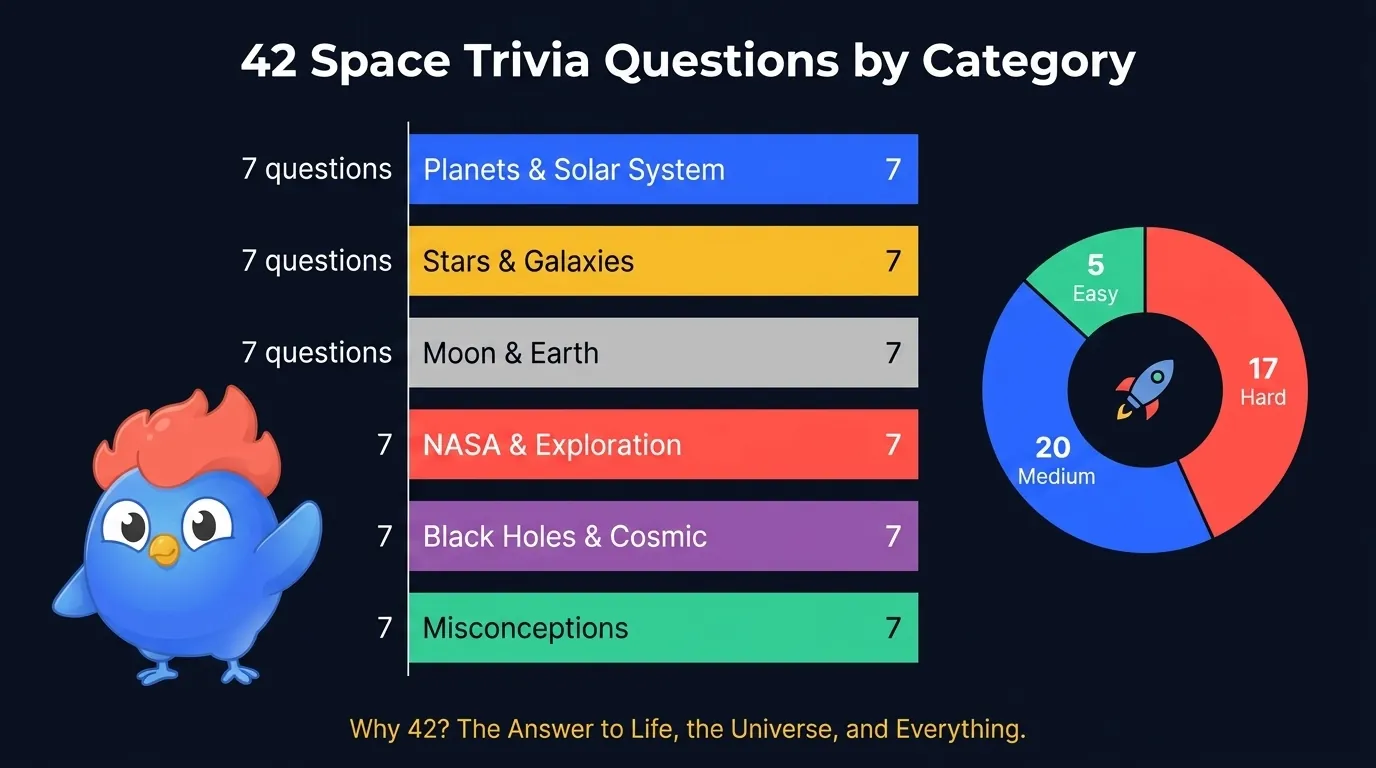 Seven questions per section across six sections, with 5 easy, 22 medium, and 15 hard.
Building the space topics taught me something specific about astronomy questions. The wrong answers cluster around school facts people never updated. Everyone “knows” Mercury is the hottest planet. Everyone “knows” the Great Wall is visible from space. Both wrong, and people defend them.
That stubbornness is useful. When spaced repetition brings a missed question back, a confident wrong answer locks in the right one far harder than a shrug ever could.
Planets & the Solar System (1-7)
Our solar system hides stranger corners than school taught: diamond rain, a mountain that dwarfs Everest, a planet where the Sun rises in the west. These seven start with the question that everyone misses.
Same pattern we hit in our science trivia questions: the answers people give fastest are the ones they get wrong.
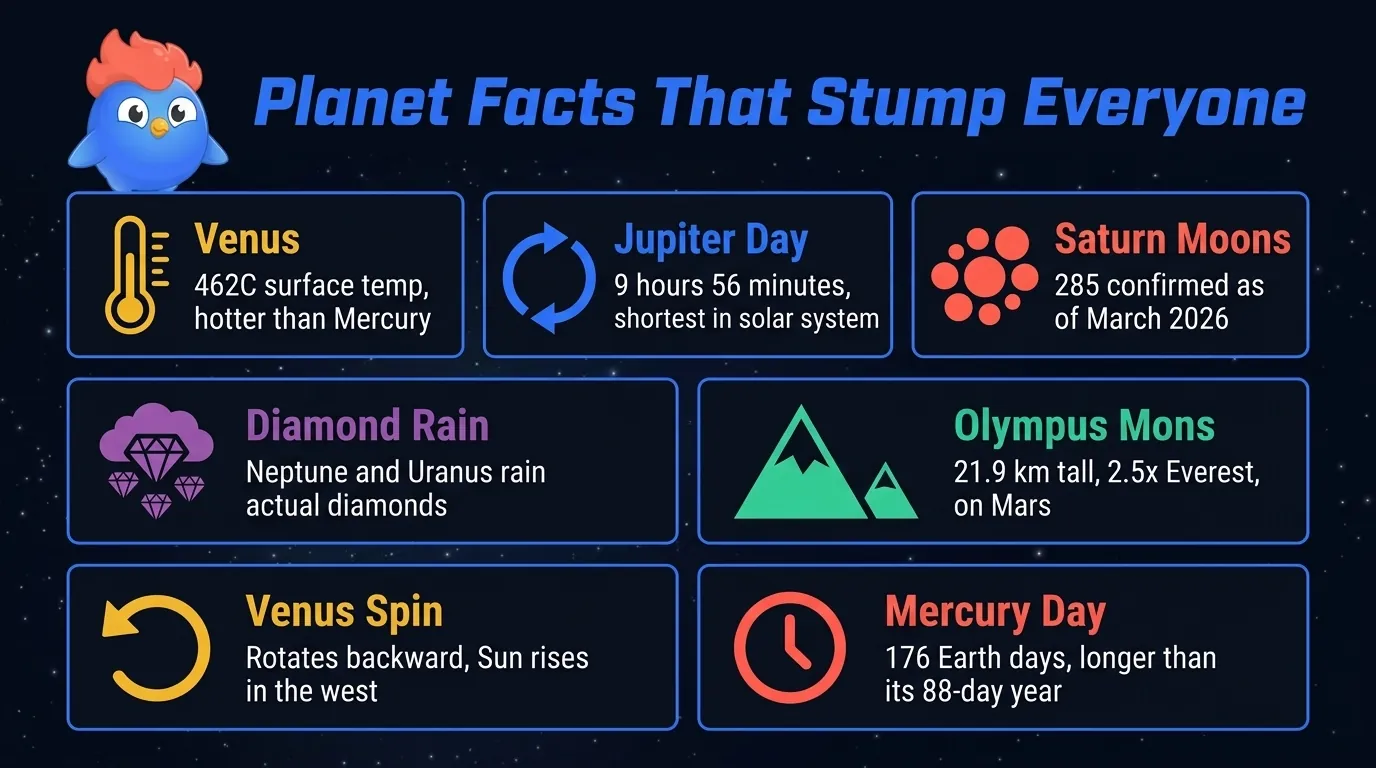 Seven planet facts that challenge what most people remember from school.
1. Which planet in our solar system has the highest surface temperature? Easy
Answer: Venus, at roughly 462 degrees Celsius (864 degrees Fahrenheit). Not Mercury.
Why it stumps people: Closer to the Sun should mean hotter. It doesn’t. Mercury has almost no atmosphere, so its dark side plunges to minus 180 degrees Celsius. Venus wears a thick carbon dioxide blanket that traps heat in a runaway greenhouse effect, so its whole surface bakes at the same scorching temperature, day and night.
2. Which planet has the shortest day in the solar system? Medium
Answer: Jupiter, with a day lasting just 9 hours and 56 minutes. It’s the largest planet and the fastest spinner.
Why it stumps people: Mercury or Mars feels like the safe guess, and that’s the wrong direction entirely. Jupiter’s enormous mass carries enough angular momentum to finish a full rotation in under 10 hours. Picture a planet 1,300 times Earth’s volume, spinning faster than Earth does.
3. How many confirmed moons does Saturn have as of 2026? Hard
Answer: 285, confirmed by the International Astronomical Union in March 2026. Saturn holds the record for most moons of any planet.
Why it stumps people: The count won’t sit still. In 2019 it was 82. By March 2025 it jumped to 274 after astronomers confirmed 128 new irregular moons. Then 11 more landed in March 2026, which is why most quiz sources are stuck on the outdated 146 figure without knowing it.
4. On which planets does it literally rain diamonds? Medium
Answer: Neptune and Uranus. Extreme pressure and temperature deep inside both ice giants crush carbon atoms into diamond crystals that sink toward their cores.
Why it stumps people: It reads like science fiction, but laboratory experiments at the SLAC National Accelerator recreated the conditions in 2017 and confirmed diamond formation. Saturn and Jupiter may rain diamonds too, though that evidence is thinner.
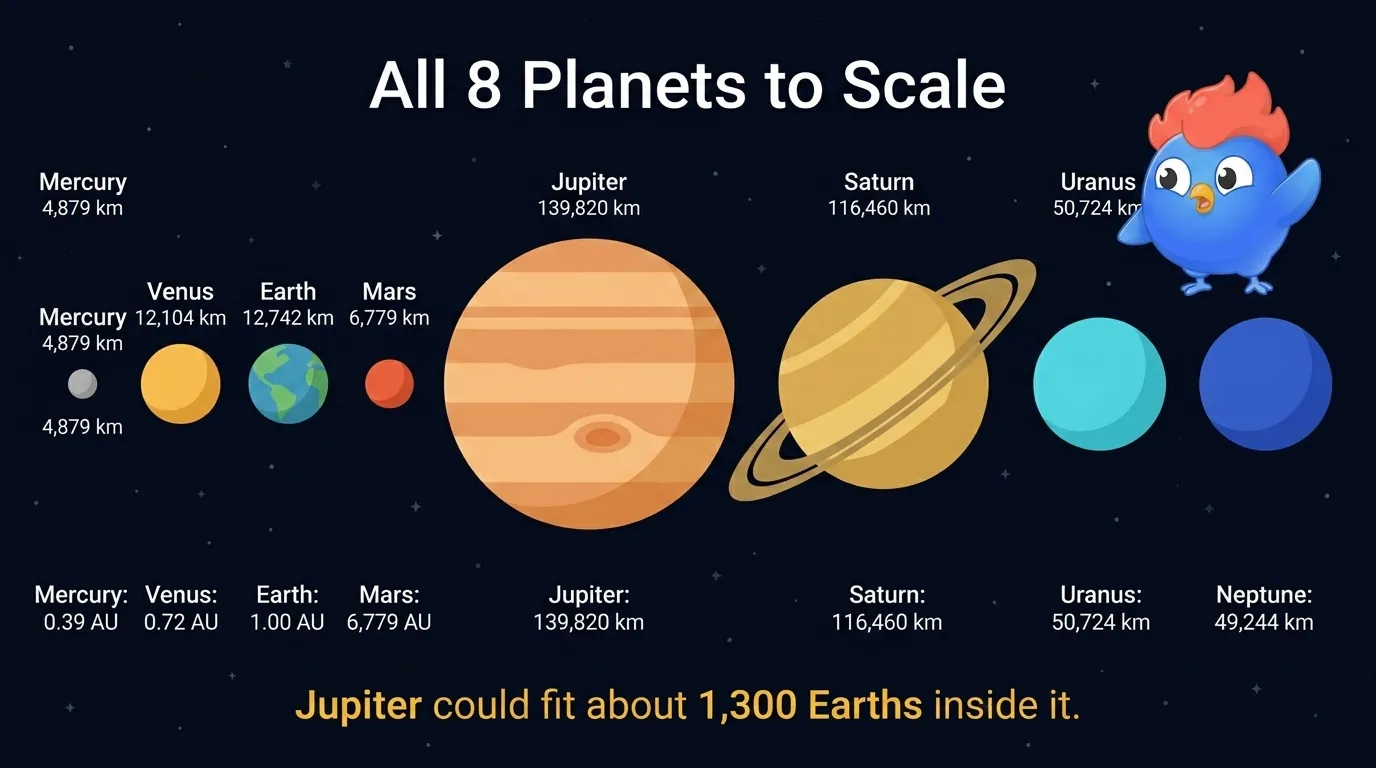 All eight planets to scale. Jupiter alone could fit about 1,300 Earths inside it.
5. What is the tallest mountain in the entire solar system? Medium
Answer: Olympus Mons on Mars, standing 21.9 kilometers (13.6 miles) high. That’s roughly 2.5 times the height of Mount Everest.
Why it stumps people: Two assumptions collide here. Biggest mountain, biggest planet, sounds logical, but gas giants have no solid surface to build a mountain on. Mars carries only 38 percent of Earth’s gravity, so it props up peaks that would slump under their own weight here at home.
6. Which planet rotates backward compared to most others in the solar system? Hard
Answer: Venus. It rotates clockwise (retrograde) while almost every other planet spins counterclockwise. On Venus, the Sun rises in the west.
Why it stumps people: Uranus muddies the answer, tilted a full 98 degrees onto its side. Still, Venus owns the only truly reversed spin axis. The cause is unsettled, with leading theories pointing to a massive ancient collision or tidal drag from that thick atmosphere.
7. On Mercury, how long is one full day-night cycle in Earth days? Hard
Answer: 176 Earth days. That’s longer than Mercury’s year, which is only 88 Earth days. One solar day on Mercury lasts exactly two Mercury years.
Why it stumps people: The question hides a trap in plain sight. Mercury’s sidereal rotation, its spin relative to the stars, runs 58.6 Earth days. But it whips around the Sun so fast that the solar day stretches to 176. Stand on Mercury and you’d watch the Sun rise, stall, slide briefly backward, then resume its crawl across the sky.
Challenge a friend to a solar system trivia duel →
Stars & Galaxies (8-14)
Past the solar system, scale stops behaving. Distances run in light-years, densities break your physics intuition, and the colors you learned as a kid turn out backward.
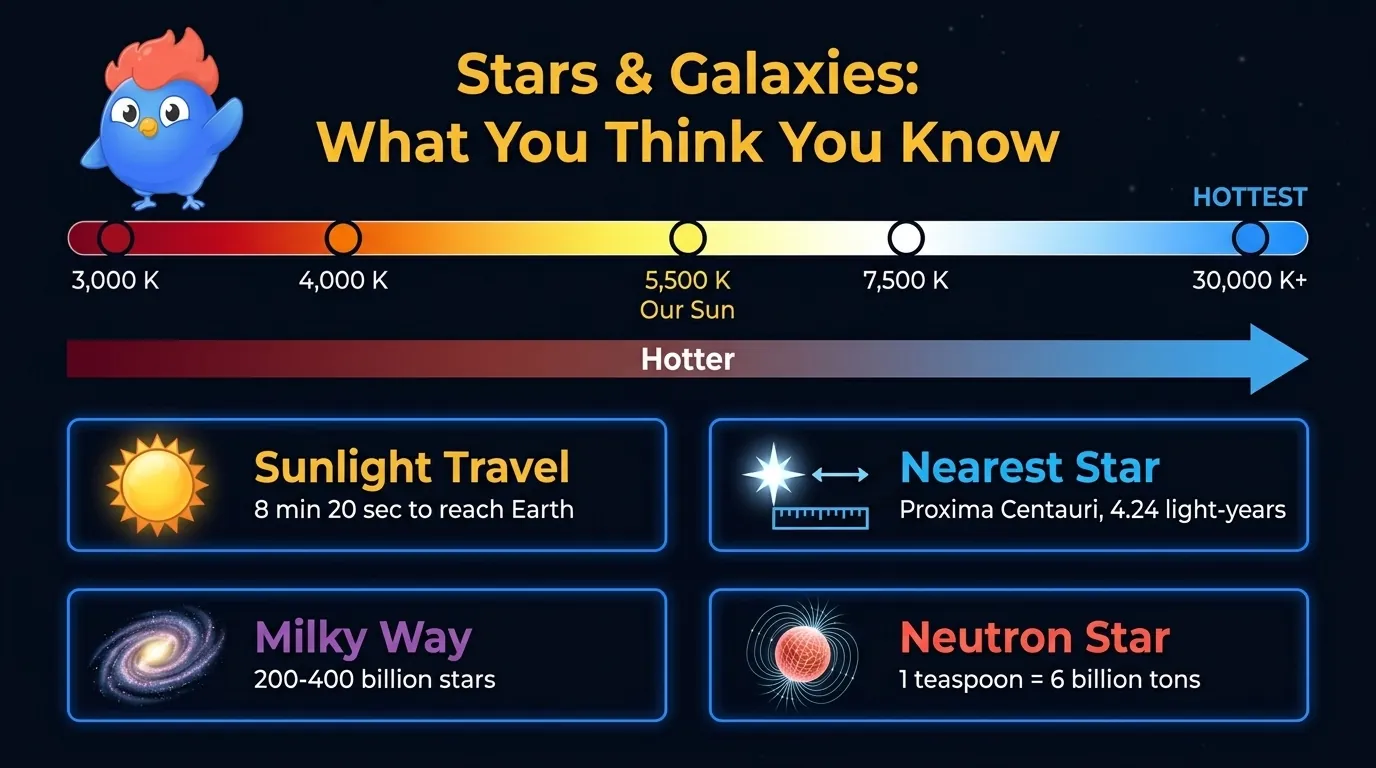 Star colors work backward from what most people expect. Blue is the hottest. Red is the coolest.
8. What color are the hottest stars? Easy
Answer: Blue. Blue stars can exceed 30,000 Kelvin. Red stars, while still incredibly hot, burn at around 3,000 Kelvin. Our Sun sits in the middle as a yellow-white star at about 5,500 Kelvin.
Why it stumps people: Down here, red means hot and blue means cold. Faucets, stoves, warning labels, all of it. Stellar physics runs the opposite way, because hotter stars emit shorter wavelengths, and short wavelengths land on the blue end of the spectrum.
9. How long does sunlight take to reach Earth? Medium
Answer: About 8 minutes and 20 seconds. Light travels at 299,792 kilometers per second, and the Sun is roughly 150 million kilometers away.
Why it stumps people: Guesses split between “instantly” and wild overshoots like an hour. The real figure is oddly precise and sits right between those extremes, which means every sunrise you’ve ever watched already happened 8 minutes before the light hit your eyes.
10. What is the nearest star to our solar system? Medium
Answer: Proxima Centauri, at 4.24 light-years away. It’s a small red dwarf star in the Alpha Centauri triple-star system.
Why it stumps people: “Alpha Centauri” carries the famous name, so it gets blurted out a lot. That’s half right. Proxima Centauri belongs to the Alpha Centauri system, but it edges slightly closer to us than the other two stars in the group.
11. Roughly how many stars are in the Milky Way galaxy? Medium
Answer: Between 200 billion and 400 billion. The exact count varies by estimation method.
Why it stumps people: Common guesses stop at “millions” or “a few billion.” Hundreds of billions is the real answer, and the Milky Way doesn’t even rank as a large galaxy. Andromeda, our nearest spiral neighbor, holds roughly a trillion stars.
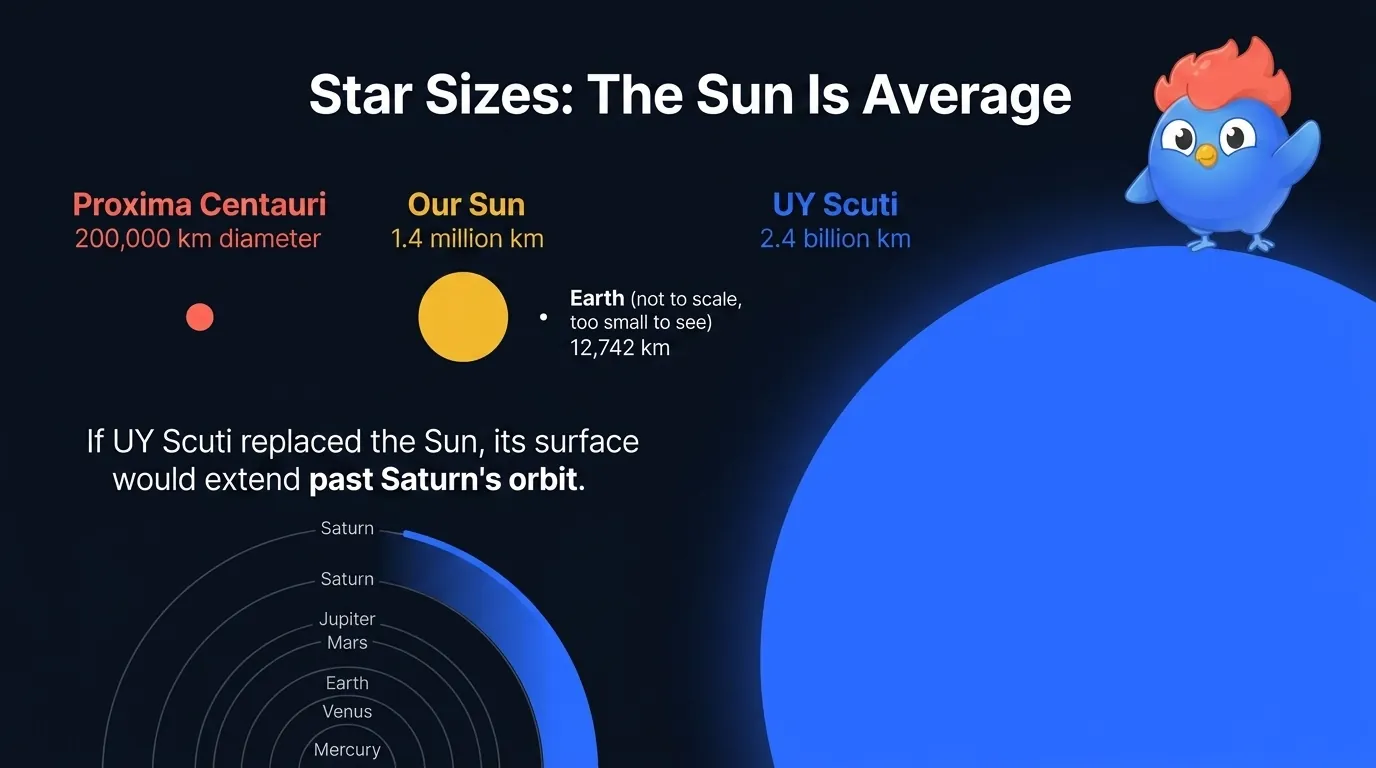 The Sun is enormous compared to Earth. UY Scuti makes the Sun look like a grain of sand.
12. When two galaxies collide, do the stars inside them crash into each other? Hard
Answer: Almost never. Galaxies are mostly empty space. The average distance between stars is so vast that during a collision, stars pass right through without touching. But gravity reshapes both galaxies dramatically.
Why it stumps people: The word “collision” promises smashing. The Milky Way is indeed barreling toward Andromeda, with contact expected in about 4.5 billion years, but park yourself on a planet during that merger and you’d notice nothing for millions of years. The stars just glide past each other.
13. How much would a teaspoon of neutron star material weigh on Earth? Hard
Answer: About 6 billion tons. A neutron star packs the mass of 1.4 to 2 Suns into a sphere roughly 20 kilometers across.
Why it stumps people: That figure sounds invented. When a massive star collapses, protons and electrons fuse into neutrons and squeeze out nearly all the empty space between particles. What’s left is the densest material in the known universe, short of a black hole itself.
14. How fast is the Sun moving through the Milky Way? Medium
Answer: About 828,000 kilometers per hour (515,000 mph), orbiting the galactic center. One full orbit takes roughly 225 to 250 million years, sometimes called a “galactic year.”
Why it stumps people: The Sun feels nailed in place because everything in our neighborhood drifts along with it. Relative to the galactic center, though, the whole solar system is moving at about 828,000 kilometers per hour.
The Moon & Earth from Space (15-21)
The Moon sits close, gets studied constantly, and hides detail after detail that contradicts the school version. Or the movie version, which is worse.
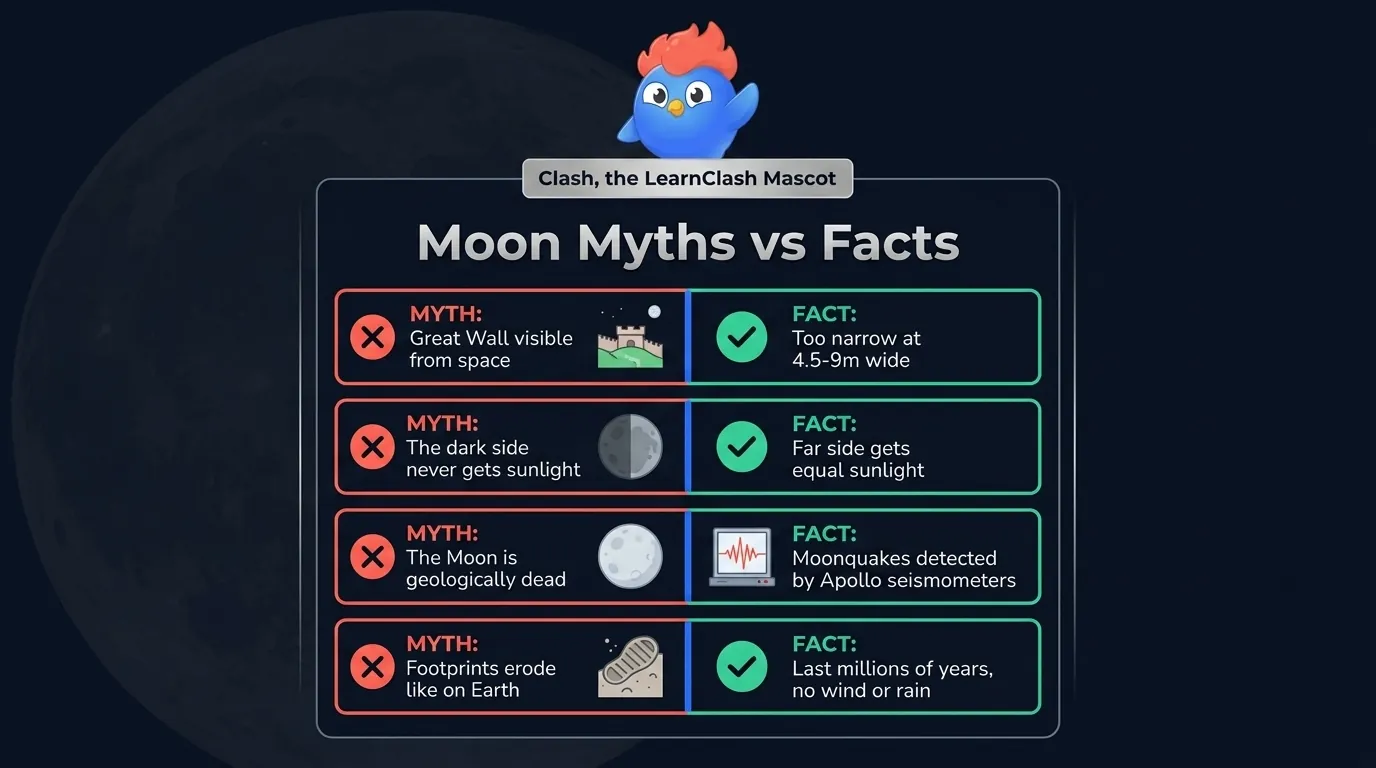 Four Moon myths that almost everyone believes. All four are wrong.
15. Can you see the Great Wall of China from space with the naked eye? Easy
Answer: No. The Wall is long but only about 4.5 to 9 meters wide. From low Earth orbit, that’s far too narrow to resolve without a camera with a zoom lens.
Why it stumps people: Textbooks repeated this myth for decades, and even some Chinese textbooks printed it. Then astronauts checked, and several, including Yang Liwei (China’s first astronaut), reported they couldn’t spot the Wall at all. You can pick out cities, highways, airports, and the Pyramids of Giza.
16. Does the far side of the Moon ever receive sunlight? Easy
Answer: Yes, just as much as the near side. The “far side” is the half that always faces away from Earth. But it gets a full two weeks of sunlight during each lunar cycle, just like the near side.
Why it stumps people: Blame Hollywood and one catchy phrase. “Dark side of the Moon” sold the idea that it sits in permanent shadow. The accurate label is “far side.” It’s hidden from us, not starved of light.
17. Does the Moon experience earthquakes? Medium
Answer: Yes. They’re called moonquakes. Apollo astronauts placed seismometers on the surface between 1969 and 1972, and those instruments detected thousands of seismic events.
Why it stumps people: Quakes seem to demand plate tectonics, and the Moon has no active plates. Yet it shakes four ways: deep ones from tidal stress, shallow ones that may be tectonic, thermal ones as the surface expands under sunlight, and impact-triggered jolts.
18. How old is the Moon? Medium
Answer: About 4.5 billion years old, nearly the same age as Earth. The leading theory is that a Mars-sized body called Theia slammed into early Earth, and the debris coalesced into the Moon.
Why it stumps people: The vague answer is “a few billion years,” no specifics attached. The Moon turns out to be Earth’s twin in age, which is exactly what the giant impact hypothesis predicts. Lunar rock samples hauled back by Apollo crews pinned the date down through radiometric dating.
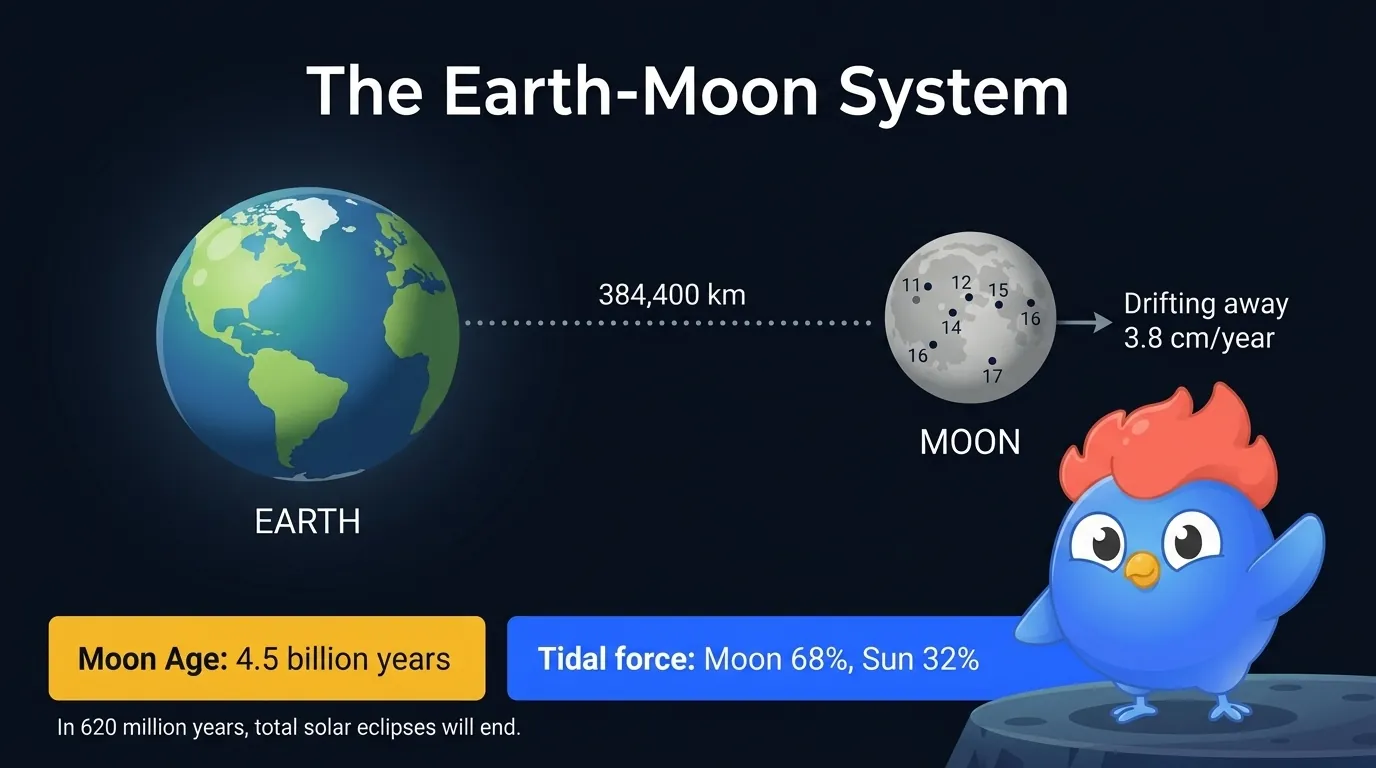 The Moon drifts 3.8 cm farther from Earth every year. In 600 million years, total solar eclipses will no longer be possible.
19. How fast is the Moon moving away from Earth? Medium
Answer: About 3.8 centimeters per year, roughly the rate your fingernails grow. Apollo astronauts left retroreflectors on the surface, and scientists bounce lasers off them to measure the distance precisely.
Why it stumps people: The drift rate sounds trivial, and on human timescales it is. Over hundreds of millions of years it adds up: about 620 million years from now, the Moon will be too far away for total solar eclipses to occur.
20. What primarily causes ocean tides on Earth? Hard
Answer: The Moon’s gravitational pull, not the Sun’s. The Moon accounts for about 68 percent of tidal force. The Sun contributes the remaining 32 percent, which is why tides are strongest during full and new moons when both align.
Why it stumps people: Both the Moon and Sun pull on the oceans, and that’s where the confusion starts. Plenty of players bet on the Sun for sheer mass, but tidal force leans on distance far more than mass, and the Moon sits about 390 times closer than the Sun.
21. How long will footprints left on the Moon last? Hard
Answer: Potentially millions of years. The Moon has no atmosphere, no wind, no rain, and no plate tectonics. The only erosion comes from micrometeorite impacts and solar wind, both extremely slow processes.
Why it stumps people: A footprint in beach sand vanishes in minutes here, so a boot print outlasting whole civilizations feels flatly wrong. Yet Neil Armstrong’s first print from 1969 still sits up there, looking much as it did when he made it.
Space Exploration & NASA Missions (22-28)
Spaceflight history runs from captured V-2 rockets to probes that won’t reach their next stop for 40,000 years. Records here fall fast, and the forgotten firsts often beat the famous ones for surprise value.
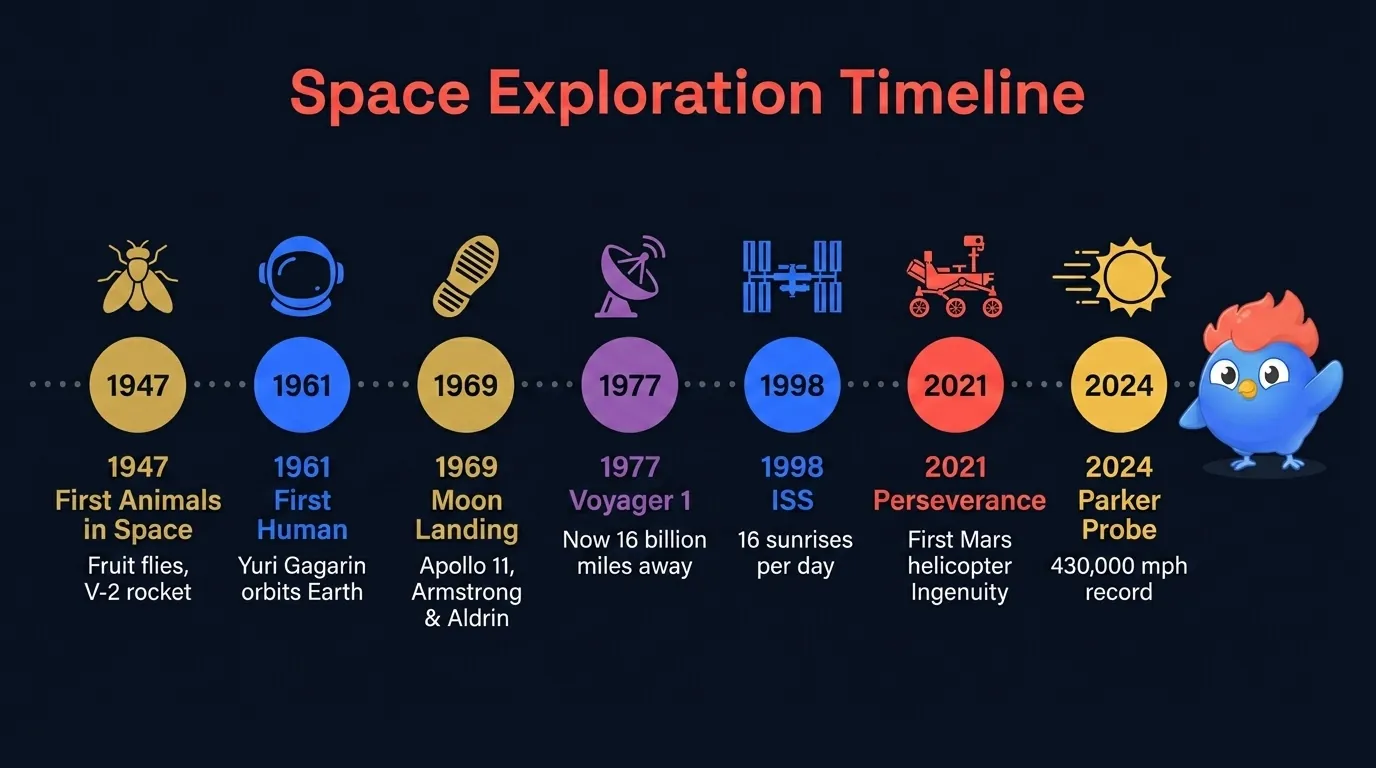 Seven decades of space exploration, from fruit flies to the fastest object humans have ever built.
22. What were the first animals sent into space? Medium
Answer: Fruit flies, launched aboard a U.S. V-2 rocket on February 20, 1947 from White Sands, New Mexico. They reached 109 kilometers altitude and were recovered alive.
Why it stumps people: Laika the dog is the reflex answer, but Laika orbited Earth in 1957, a full decade later. The fruit fly flight tested how cosmic radiation behaves at high altitude. The flies came back unharmed, and every animal and human launch since traces back to that result.
23. How many people have walked on the Moon? Medium
Answer: 12. All American. All men. All between 1969 and 1972 across six Apollo missions (11, 12, 14, 15, 16, and 17).
Why it stumps people: Apollo 13 hogs the spotlight, yet nobody walked on the Moon during it. The usual guess undershoots 12, because Armstrong and Aldrin are the only two most folks can name.
24. Which human-made object is farthest from Earth? Medium
Answer: Voyager 1, currently about 16 billion miles (25.8 billion km) from Earth. In November 2026, it will cross the one-light-day milestone, meaning radio signals will take a full 24 hours to reach it.
Why it stumps people: Voyager 2 grabs a lot of wrong votes. Both probes launched in 1977, but Voyager 1 took a shorter route and pulled ahead. It slipped into interstellar space in 2012 and still beams data home.
25. How many golf balls are on the Moon? Medium
Answer: Two. Alan Shepard hit them during the Apollo 14 mission in February 1971 using a modified 6-iron head attached to a sample collection tool.
Why it stumps people: The golf shots either don’t register at all, or they get remembered as a single ball. Shepard hit two. The first was a shanked dribble. The second flew what he bragged was “miles and miles,” though in lunar gravity it probably covered 200 to 400 yards.
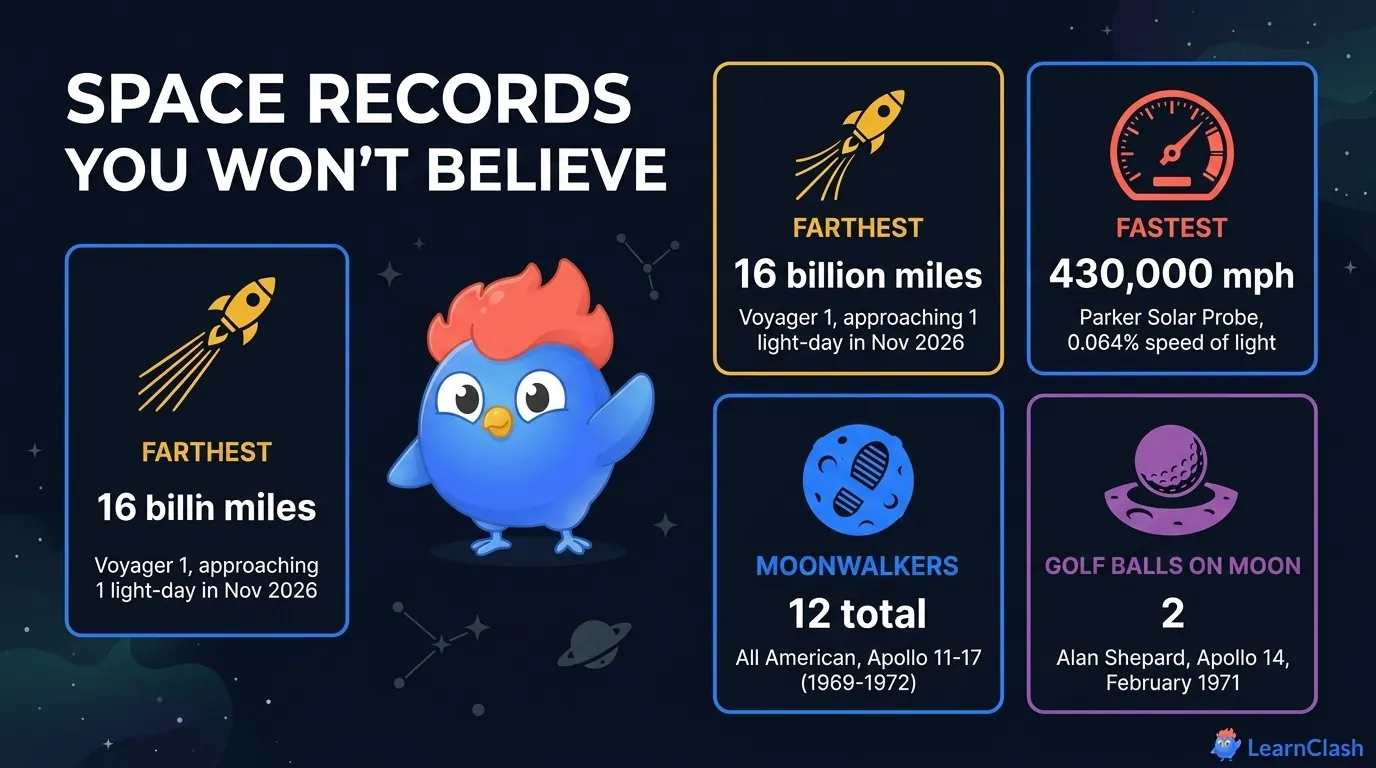 Voyager 1 at 16 billion miles, Parker at 430,000 mph, 12 moonwalkers, 2 golf balls, and 16 sunrises a day on the ISS.
26. How often does the International Space Station orbit Earth? Easy
Answer: Every 90 minutes. That means ISS astronauts see 16 sunrises and 16 sunsets every day.
Why it stumps people: The pace catches everyone off guard. The ISS screams along at about 28,000 km/h, roughly 400 km up. Guesses usually land at once a day or once every few hours, off by an order of magnitude.
27. What is the fastest human-made object ever? Hard
Answer: The Parker Solar Probe, reaching 430,000 mph (690,000 km/h) during its closest passes to the Sun. That’s 0.064 percent the speed of light.
Why it stumps people: Farthest away gets mistaken for fastest, so Voyager 1 draws the guess. But Voyager crawls along at a comparatively pokey 38,000 mph. Parker builds its speed by stealing Venus gravity assists, swinging closer and closer to the Sun and trading gravitational potential energy for raw velocity.
28. Which NASA Mars rover carried a helicopter? Hard
Answer: Perseverance, which landed on Mars in February 2021 carrying the Ingenuity helicopter. Ingenuity completed 72 flights before its mission ended in January 2024.
Why it stumps people: Perseverance trades names with Curiosity (landed 2012) and Opportunity (2004 to 2018), so memory shuffles them. And a helicopter flying on Mars still reads like fiction, given that Mars offers less than 1 percent of Earth’s atmospheric density for those blades to bite into.
Test your space exploration knowledge →
Black Holes & Cosmic Phenomena (29-35)
These seven are the hardest material in the collection. They push you to think at scales where ordinary physics buckles, time bends, and 95 percent of the universe is built from stuff nobody can see directly.
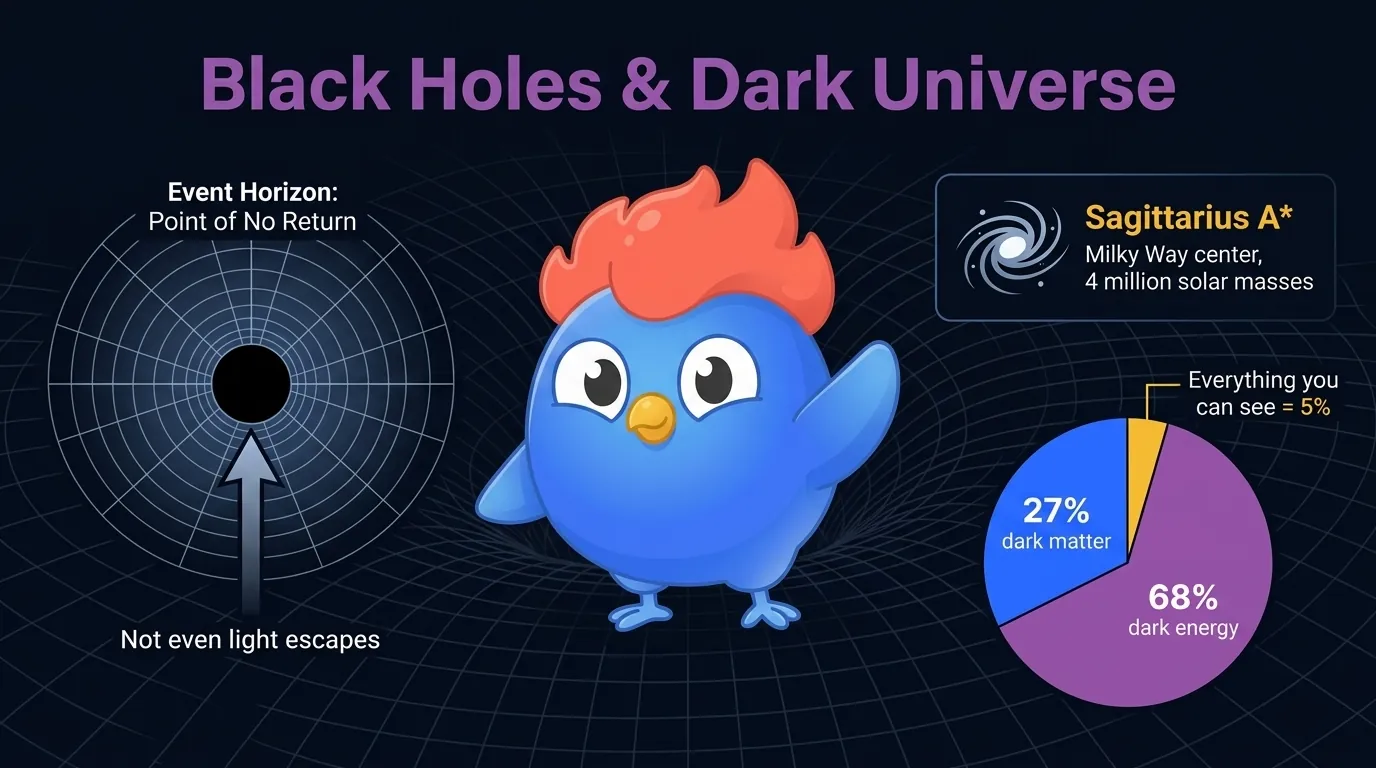 Everything you can see, touch, or detect makes up just 5 percent of the universe.
29. What sits at the center of the Milky Way galaxy? Medium
Answer: A supermassive black hole called Sagittarius A* (pronounced “A-star”), with a mass of about 4 million times our Sun.
Why it stumps people: A black hole, sure, but the name slips away. Sagittarius A* got its first direct image in 2022, courtesy of the Event Horizon Telescope, which confirmed decades of indirect evidence in a single photo.
30. What happens to time near a black hole? Medium
Answer: Time slows down. The closer you get to a black hole’s event horizon, the slower time passes for you relative to someone far away. This is called gravitational time dilation, predicted by Einstein’s general relativity.
Why it stumps people: Interstellar nailed this, and audiences shrugged it off as Hollywood license. One hour near the black hole cost seven years back on the ship. GPS satellites already correct for time dilation from Earth’s gravity, and Earth’s pull is a rounding error next to a black hole’s.
31. What percentage of the universe is made of visible matter? Hard
Answer: About 5 percent. Dark energy makes up roughly 68 percent. Dark matter accounts for about 27 percent. Everything you can see, every star, planet, and galaxy, is a small fraction of what exists.
Why it stumps people: “Dark matter” sounds like a placeholder for ignorance. Its gravitational fingerprints show up in galaxy rotation curves, gravitational lensing, and the cosmic microwave background. We can watch what it does. We just can’t say what it is.
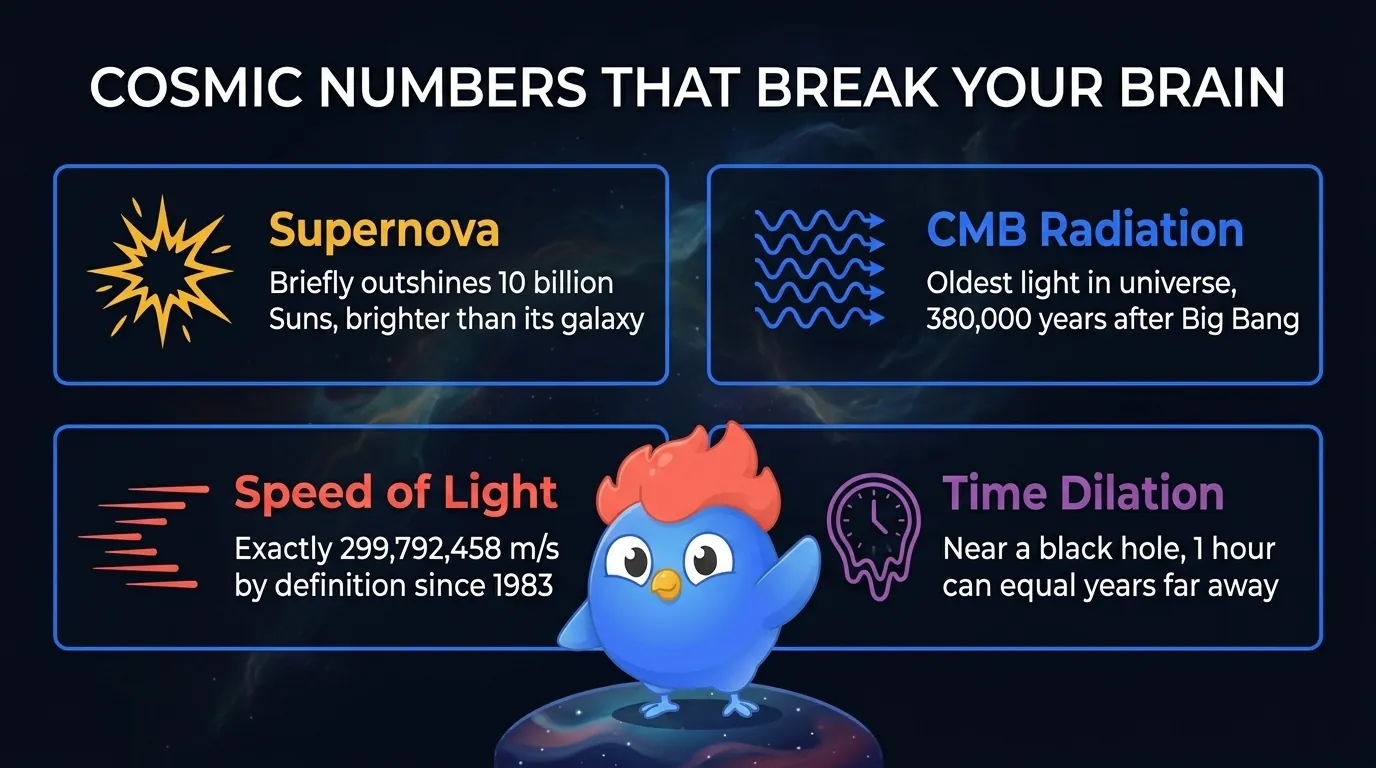 A supernova briefly outshines 10 billion stars, and the oldest light we can see is 380,000 years younger than the universe.
32. What is the cosmic microwave background? Hard
Answer: The afterglow radiation from the Big Bang, released roughly 380,000 years after the universe formed, when it cooled enough for atoms to form and photons to travel freely.
Why it stumps people: The name gives nothing away, because “cosmic microwave background” sounds technical and abstract. It’s literally the oldest light in the universe. It fills all of space and was accidentally discovered in 1965 by Arno Penzias and Robert Wilson, who initially thought their antenna had a pigeon problem.
33. What is the exact speed of light in a vacuum? Hard
Answer: Exactly 299,792,458 meters per second. Not approximately. Since 1983, the meter itself has been defined by the speed of light, which means this number is exact by definition.
Why it stumps people: “300,000 km/s” or “186,000 miles per second” are the usual answers, and both are decent estimates. The twist is that the full figure isn’t rounded at all. It anchors the entire metric system by definition.
34. How bright can a supernova get? Medium
Answer: A supernova can briefly outshine its entire host galaxy, producing the light output of 10 billion Suns at peak brightness. Some supernovae have been visible to the naked eye from Earth in broad daylight.
Why it stumps people: “Brighter than a galaxy” sounds impossible. But Supernova 1006, visible in 1006 AD, was bright enough to cast shadows at night and was recorded by observers in China, Egypt, Japan, and Europe. The energy released in a few weeks exceeds what our Sun will emit in its entire 10-billion-year lifetime.
35. What is the event horizon of a black hole? Medium
Answer: The boundary around a black hole beyond which nothing, not even light, can escape. It isn’t a physical surface. It’s a mathematical boundary defined by the escape velocity reaching the speed of light.
Why it stumps people: The mental image is a hard shell or a glowing edge, and the event horizon is invisible. For a supermassive black hole you’d drift across it and feel nothing. Around smaller ones, tidal forces shred you (the term is “spaghettification”) long before you ever reach the boundary.
Challenge a friend to black holes trivia →
Space Misconceptions That Fool Everyone (36-42)
These aren’t obscure facts. They’re things educated adults swear they already know, and every single one is wrong. This is where the testing effect earns its keep, because a confident answer, corrected, lodges in memory far deeper than the right answer read off a page.
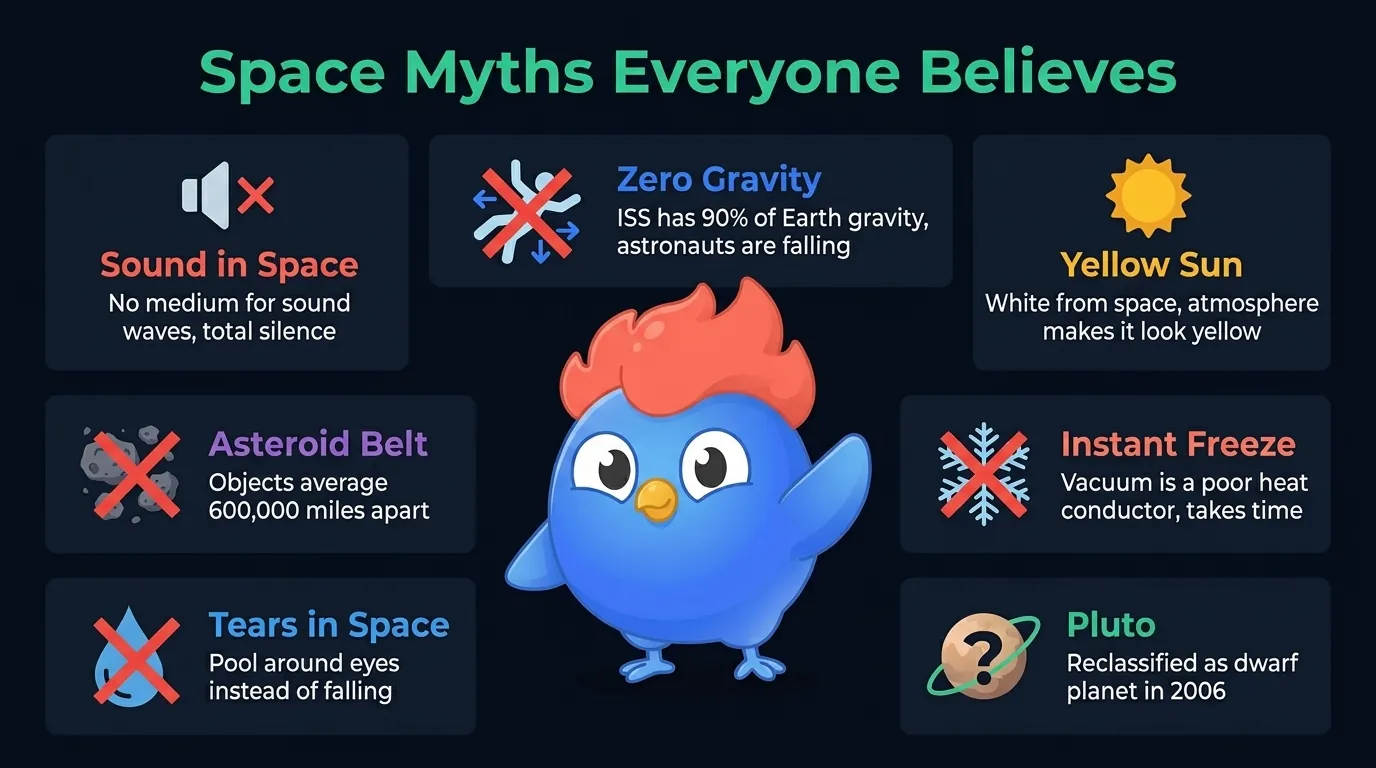 Seven things almost everyone believes about space. All seven are wrong.
36. Is there sound in outer space? Medium
Answer: No. Sound requires a medium (air, water, solid matter) to travel through. Space is a near-vacuum with too few particles to carry sound waves.
Why it stumps people: Every space movie gets this wrong, with explosions, engine roars, and laser blasts. In reality, the vacuum of space is completely silent, and astronauts on spacewalks communicate only through radio.
37. Are astronauts on the ISS floating in “zero gravity”? Medium
Answer: No. Gravity at the ISS altitude (about 400 km) is roughly 90 percent as strong as on Earth’s surface. Astronauts float because they’re in continuous freefall around the Earth, not because gravity disappears.
Why it stumps people: “Zero gravity” is one of the most repeated phrases in space coverage, and the correct term is “microgravity.” The ISS and everyone inside it are falling toward Earth constantly but moving sideways fast enough to keep missing it. That’s what an orbit is.
38. What color is the Sun when viewed from space? Hard
Answer: White. Earth’s atmosphere scatters shorter blue wavelengths (Rayleigh scattering), making the sky blue and the Sun appear yellow or orange to us on the surface. From space, with no atmospheric filter, the Sun emits roughly equal intensity across all visible wavelengths, which our eyes perceive as white.
Why it stumps people: Every crayon drawing, every emoji, every sunrise photo backs the lie of a yellow Sun. Then astronaut photos from the ISS show a blazing white star, the same star, just without an atmosphere editing the color.
39. Is the asteroid belt between Mars and Jupiter densely packed with rocks? Hard
Answer: No. The average distance between objects in the asteroid belt is about 960,000 kilometers (600,000 miles), more than twice the distance from Earth to the Moon. A spacecraft can fly straight through without any risk of collision.
Why it stumps people: The Empire Strikes Back showed the Millennium Falcon dodging asteroids every few meters. In reality, every probe that has crossed the asteroid belt (Pioneer 10 and 11, Voyager 1 and 2, New Horizons, Juno, and others) did so without any special maneuvering.
40. Would you freeze instantly if exposed to the vacuum of space? Hard
Answer: No. Space is a near-vacuum, and vacuum is actually a terrible conductor of heat. You’d lose heat slowly through radiation, not conduction. The more immediate dangers are unconsciousness within 15 seconds (from lack of oxygen), boiling saliva (from the pressure drop), and severe sunburn from unfiltered UV radiation.
Why it stumps people: Movies show instant freezing because it looks dramatic. The truth is less cinematic: NASA studies estimate you could survive about 90 seconds of vacuum exposure and recover fully if repressurized in time.
41. Can astronauts cry in space? Medium
Answer: Yes, but the tears don’t fall. Without gravity to pull them down, tears form a growing ball of liquid that pools around the eyes. Canadian astronaut Chris Hadfield demonstrated this on the ISS and described it as “stinging” because the water doesn’t drain away.
Why it stumps people: Nobody thinks about the mechanics of crying in microgravity until they hear it. It’s one of those details that makes orbital life feel completely alien despite being entirely explainable by basic physics.
42. Is Pluto a planet? Medium
Answer: No, at least not by the International Astronomical Union’s 2006 definition. Pluto is classified as a dwarf planet because it hasn’t “cleared the neighborhood” of its orbit. Its orbital zone overlaps with thousands of other Kuiper Belt objects.
Why it stumps people: Anyone educated before 2006 learned nine planets, and that muscle memory runs deep. The reclassification was controversial, and NASA’s New Horizons mission in 2015 showed Pluto has mountains, glaciers, and a thin atmosphere, which made many people argue it deserves planet status. The debate isn’t over.
How to Use These Space Trivia Questions
These 42 questions flex to fit wherever you need them, on paper or in an app:
- Trivia night at a bar: split the six sections into themed rounds.
- Classroom warm-up: open with the easy planet questions, build toward black holes.
- Family game night: shuffle all 42 and let the kids stump the adults.
- Self-testing before bed: cover the answers and guess cold.
Group by section for a structured run, or shuffle for a brutal one.
“Retrieval practice produces more learning than elaborative studying with concept mapping.” Karpicke & Blunt (2011), Science
That’s the reason answering beats rereading. Pulling an answer out of your own head, getting it wrong, then seeing the correction is what carves the fact in, while reading feels productive without doing much. On LearnClash, a space duel wraps that loop in scoring, ranking, and spaced repetition that tracks what you miss: miss Venus today and Venus comes back next week, then later, until it sticks. The same testing effect research runs through Roediger & Butler’s retrieval practice studies.
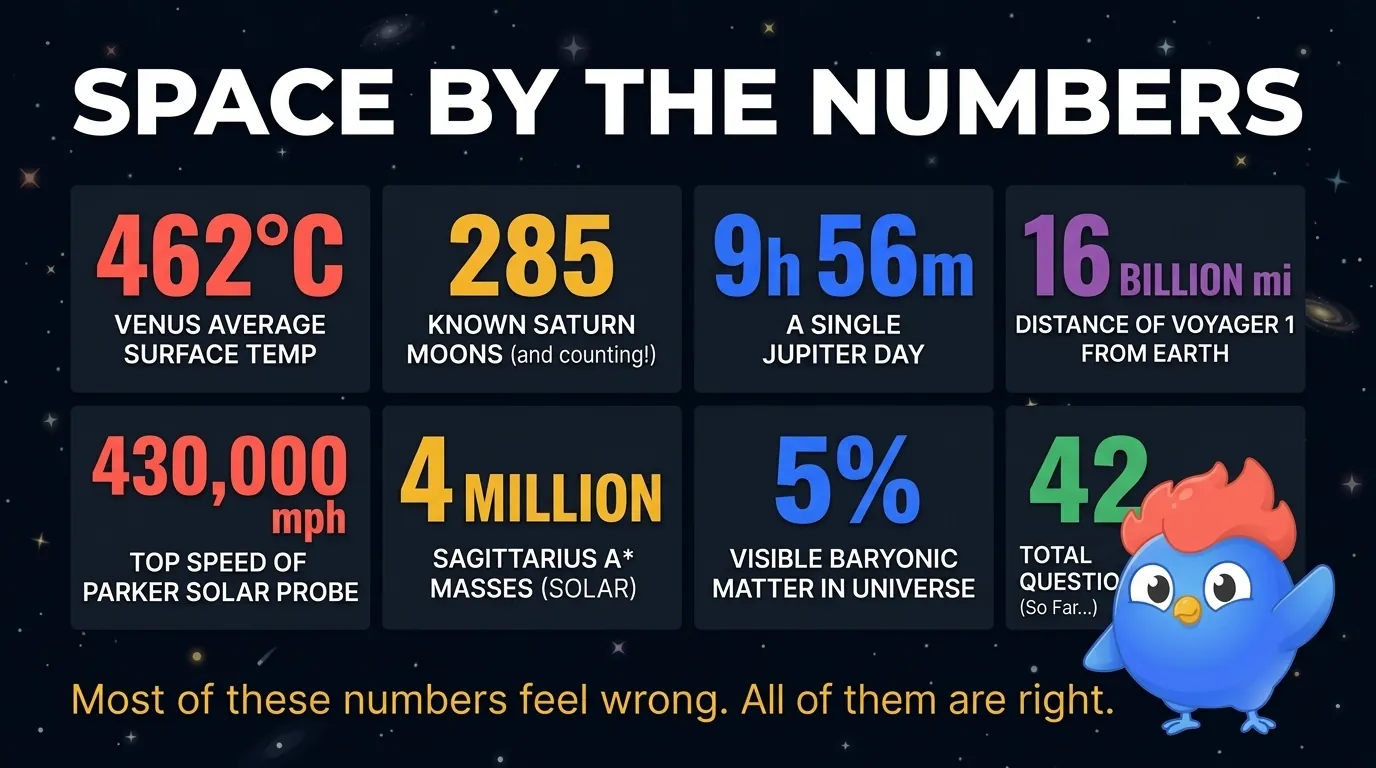 Venus at 462°C, Saturn’s 285 moons, Jupiter’s 9h56m day, and the rest of the numbers behind these 42 questions.
Frequently Asked Questions
What is the most commonly missed space trivia question?
One of the most missed space trivia questions is which planet is the hottest. Most players pick Mercury because it's closest to the Sun. The answer is Venus at 462 degrees Celsius, thanks to a runaway greenhouse effect. Mercury's lack of atmosphere means its dark side drops to minus 180 degrees.
How many questions do you need for a space trivia night?
A good space trivia night needs 20 to 30 questions split across four to six rounds. Mix difficulty levels so nobody gets shut out early. Start with easy planet questions and build toward black holes and cosmic phenomena. LearnClash space topics auto-generate fresh questions at every difficulty so you never run out.
Are space trivia questions good for learning?
Yes. Research on the testing effect shows that answering questions produces 80 percent retention after one week versus 36 percent for rereading. LearnClash builds spaced repetition into every game mode, scheduling the questions you miss at increasing intervals until you master them. Playing space trivia duels turns casual interest into durable knowledge.
What are the biggest space misconceptions?
The biggest misconceptions are that astronauts float in zero gravity (they're actually in freefall), the Sun is yellow (it's white from space), the asteroid belt is densely packed (objects average 600,000 miles apart), and you can see the Great Wall of China from space (you can't, it's too narrow). All seven show up in this list.
Where can I play space trivia against friends?
LearnClash lets you challenge friends to space trivia duels with questions on planets, stars, NASA missions, and black holes at every difficulty level. Each round takes 3 minutes. Spaced repetition tracks what you miss and brings those questions back until you master them. Free on iOS and Android, no ads.