
41 Anime Trivia Questions [With Answers]
41 anime trivia questions on creators, Studio Ghibli, records, and hidden details. Answers included, plus why each one stumps fans.
How many do you know?
Think of your answer, then reveal it.
Did you know it before revealing the answer?
Read this answer in the articleRound complete
Challenge friends on this topic.
Start a new duel in LearnClash and learn from every answer.
Get LearnClashFree to play on iPhone and Android. No ads.
Try the questions you missed once more.

Super Saiyan hair is blonde because of lazy inking. Studio Ghibli once mailed a samurai sword to a Hollywood executive. And the highest-grossing anime franchise isn’t Dragon Ball.
So these 41 questions dig into creator secrets, Studio Ghibli, records, hidden details, production stories, and cultural impact, and every answer explains the exact misdirection that catches fans. Fair warning: the production questions fight dirty, because fans know the plot cold but rarely know how the show got made. If anime is only one of your lanes, every trivia topic we cover sits in one place, from science to gaming to mythology.
I first published this page on April 1, 2026, gave it a structured-data pass two weeks later, and ran a sitewide prose cleanup through it at the end of May. This August 2026 update is the first time since publish that I re-read it top to bottom checking the facts rather than the wording. One thing that re-read made obvious: the records round is where anime trivia ages fastest, so if you are running a quiz in 2027, sanity-check the box office numbers before you read them out.
If you would rather settle it head to head before you scroll, start an anime duel with a friend →.
| Category | Questions | Easy | Medium | Hard |
|---|---|---|---|---|
| Origins & Creator Secrets | 1-7 | 2 | 3 | 2 |
| Studio Ghibli Secrets | 8-13 | 1 | 3 | 2 |
| Records & Milestones | 14-20 | 2 | 3 | 2 |
| Hidden Details & Easter Eggs | 21-27 | 2 | 3 | 2 |
| Production & Industry Secrets | 28-34 | 1 | 3 | 3 |
| Cultural Impact & Localization | 35-41 | 2 | 3 | 2 |
Origins & Creator Secrets (1-7)
Behind every franchise sits a choice the fans never got to see. These seven questions skip the plot recaps and chase those choices instead: why a character looks the way it does, which one its own creator forgot, and how a rejected draft turned into a billion-dollar hit.
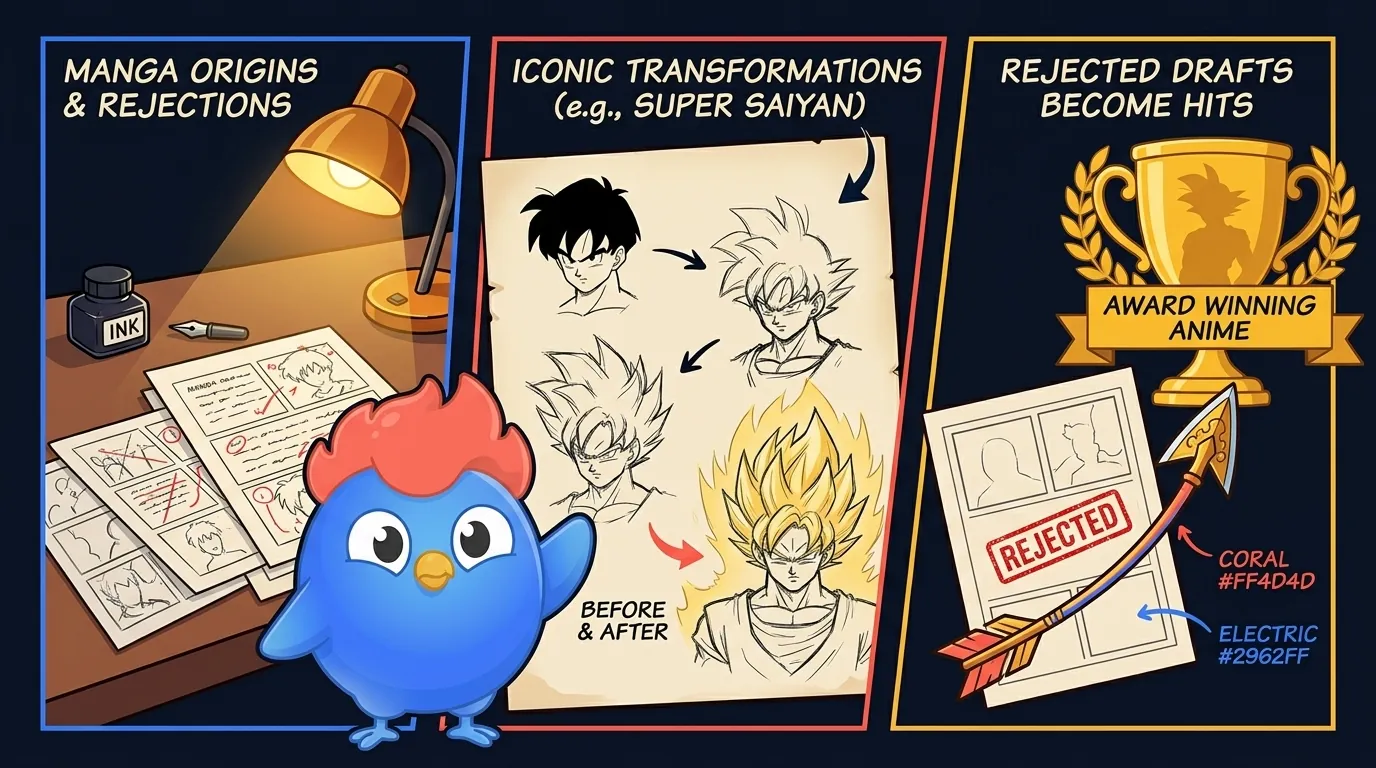 The seven origin facts, condensed for sharing.
1. Why is Super Saiyan hair blonde? Easy
Answer: Less ink. Akira Toriyama chose blonde because it meant his assistant didn’t have to fill in black hair on every manga panel. An iconic transformation born from pure laziness.
Why it stumps people: Your gut reaches for power-level meaning, maybe some myth. Wrong. He was saving time, and he said so in interviews. The most famous transformation in anime exists because filling in black hair got old fast.
2. Who is Akira Toriyama’s favorite Dragon Ball character? Medium
Answer: Piccolo. Not Goku. Not Vegeta. Toriyama said he found Piccolo more interesting to write because of the redemption arc. He also said Piccolo was easier to draw than Goku’s spiky hair.
Why it stumps people: Goku is the reflex answer. But a creator doesn’t have to love the lead, and Toriyama didn’t. He found the villain-turned-mentor more interesting than the hero he’d been drawing for decades.
3. Which main Dragon Ball character did Toriyama forget existed? Medium
Answer: Launch. She appeared regularly throughout the first Dragon Ball. Then she vanished in Dragon Ball Z. Why? Toriyama admitted he simply forgot about her.
Why it stumps people: It reads like a joke answer, yet it’s on record. Launch had two distinct personalities, flipped by a sneeze, and she ran through dozens of early episodes before vanishing without a word. Picture it from the other side: the man behind the most popular anime franchise of the 1990s sat down to draw, lost track of a recurring character, and never circled back. She just stopped existing.
4. Who was the first lead of Jujutsu Kaisen? Hard
Answer: Megumi Fushiguro. Creator Gege Akutami’s first draft centered on Megumi, not Yuji Itadori. Editors pushed for a different lead, and the story was reworked with Itadori as the lead.
Why it stumps people: Fans assume the current lead was always the plan. Megumi was meant to carry the whole thing. Once you know that, his arc reads differently. He didn’t grow into importance from the sidelines. He was always the center.
5. What happened when Bleach was first submitted to Weekly Shonen Jump? Hard
Answer: Rejected. Tite Kubo’s first submission was turned down. Then Akira Toriyama personally wrote Kubo a letter encouraging him to keep going. Kubo has cited that letter as the reason he didn’t give up.
Why it stumps people: We picture mega-hits getting waved through on the first try. Bleach sold 120 million copies. And it almost didn’t exist, because Kubo nearly quit after a single no.
6. What came first in Cowboy Bebop: the music or the story? Medium
Answer: The music. Composer Yoko Kanno wrote the soundtrack before most characters or plot existed. Director Shinichiro Watanabe built entire scenes around her compositions, then she’d create new music inspired by those scenes.
Why it stumps people: The usual assumption is that the show leads and the score follows. Cowboy Bebop flipped it. Jazz, blues, and rock came first, which is why the music feels welded to the show. It wasn’t decoration. It was the foundation.
7. What was Deku’s first character design in My Hero Academia? Easy
Answer: Black hair and red eyes. Creator Kohei Horikoshi scrapped the look entirely. The green-haired Deku fans know today was a redesign, and the first dark color scheme was given to a different character: Fumikage Tokoyami.
Why it stumps people: Deku’s green hair is so locked in that picturing him as Tokoyami short-circuits your brain. Yet the two characters genuinely swapped looks mid-development. And video game trivia runs on the same rule. The final design is almost never the first draft.
Ink savings, a forgotten character, an editor leaning hard on a draft: none of the decisions in this round were mystical, and the theories fans invent to explain them are usually more romantic than the truth.
Studio Ghibli Secrets (8-13)
Hayao Miyazaki earned the genius reputation honestly, then broke nearly every rule of filmmaking on the way there: he does not plan his endings, and the studio’s name is not even Japanese. One reply to a Hollywood boss became permanent anime lore.
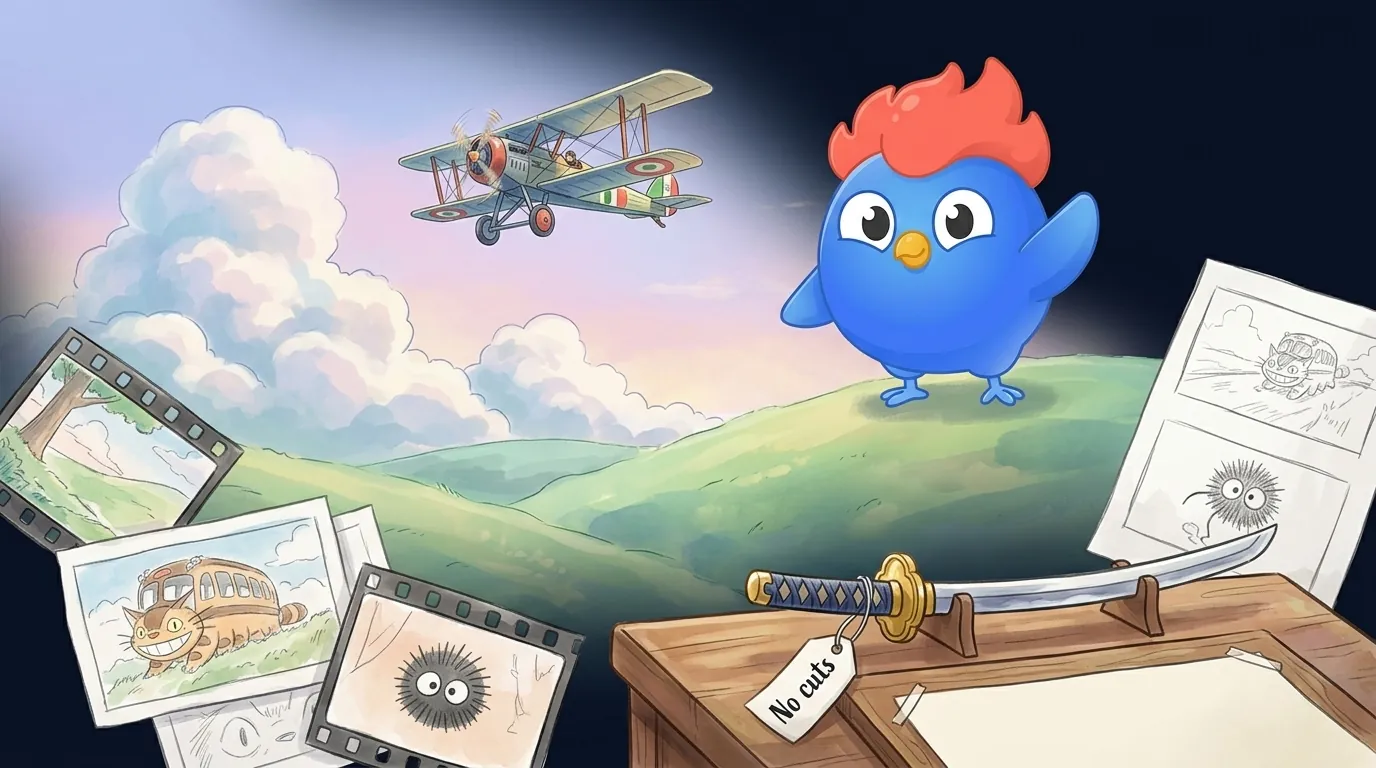
8. When Harvey Weinstein pushed to trim Princess Mononoke for its US release, what did Studio Ghibli mail him? Medium
Answer: A katana with a note reading “No cuts.” Producer Toshio Suzuki’s legendary response to Miramax’s push for a shorter Western cut. The film was released unedited.
Why it stumps people: Half the people you ask have never heard the story. The other half picture a sternly worded legal letter. Nope. A samurai sword. Studios bend over backward for Western markets all the time, and Ghibli picked the loudest possible way to say no.
9. What does “Ghibli” actually refer to? Medium
Answer: An Italian military scouting aircraft, the Caproni Ca.309 Ghibli. Miyazaki, an aviation obsessive, chose the name. “Ghibli” also means a hot Saharan wind, and he wanted the studio to “blow a new wind through the anime industry.”
Why it stumps people: Sounds Japanese. It’s Italian, and it points at one specific plane. That tracks if you know Miyazaki has drawn planes since he was a kid. The Wind Rises isn’t the odd one out in his work. It’s the through-line that was there all along.
10. Why did Miyazaki skip the Academy Awards when Spirited Away won Best Animated Feature? Hard
Answer: Protest against the Iraq War. He refused to visit a country that was “bombing Iraq.” Spirited Away was the first non-English-language animated film to win the Oscar for Best Animated Feature. He didn’t attend.
Why it stumps people: An Oscar is supposed to be the peak, the thing you show up for. Miyazaki stayed home on principle. The common guesses run to scheduling or health. The real reason says more about the man than any sit-down interview ever has.
11. Does Miyazaki know how his films end when he starts making them? Hard
Answer: No. He storyboards as he goes, and work begins before storyboarding finishes. Nobody on the team, Miyazaki included, knows the ending until they’re deep in.
Why it stumps people: A director this revered, you’d expect airtight planning. He builds the films closer to jazz. Each scene answers the one before it. That’s why the stories feel like they grew rather than got plotted. They did.
12. What inspired the story of Spirited Away? Easy
Answer: A friend’s 10-year-old daughter. Miyazaki noticed a gap in films for that exact age group and created the story specifically for her.
Why it stumps people: The obvious guess is folklore or some old children’s book. Spirited Away leans on both. But the first spark was personal. Miyazaki watched one real girl growing up and decided she deserved a film aimed squarely at her. Our movie trivia questions collection is full of beloved films that started from exactly that kind of personal itch.
13. How many frames were hand-drawn for Ponyo? Medium
Answer: Over 170,000. In 2008, when digital anime was becoming standard, Miyazaki insisted on full hand-drawn work. Every frame of Ponyo was drawn by hand.
Why it stumps people: The usual guess lands at 20,000 to 50,000, low by a factor of five. The real count explains the warmth in every frame. No shortcut buys that look. It costs 170,000 drawings per film, and Ghibli paid it.
Records & Milestones (14-20)
Ask a room of hardcore fans to name an anime record and most answers come back wrong. The longest manga is not One Piece. The biggest franchise is not Dragon Ball, and one anime film out-earned a pile of Hollywood blockbusters on its way to a record almost nobody predicted. This is also the round to steal for a LearnClash duel: record questions settle arguments fast.
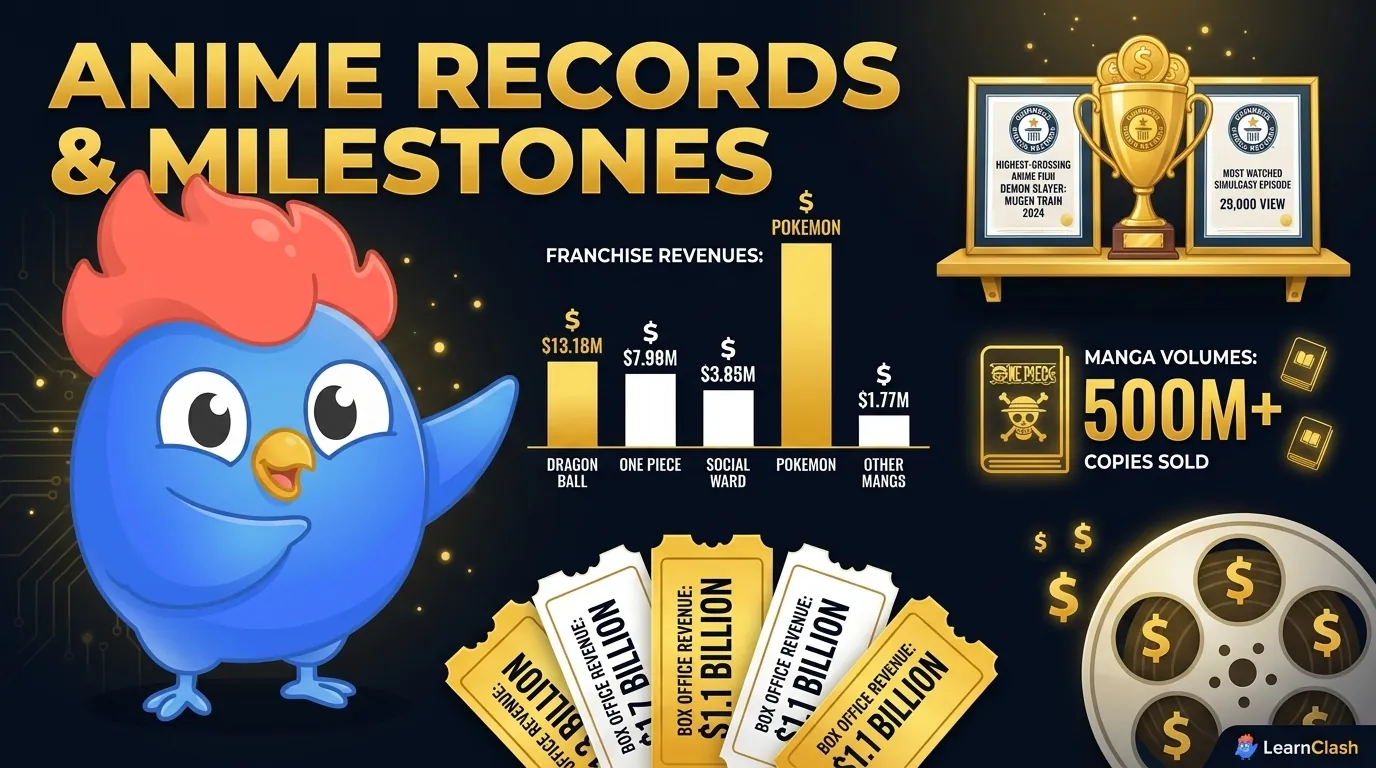 The records round: seven numbers that rewrite fan assumptions.
14. What is the highest-grossing anime franchise of all time? Easy
Answer: Pokemon at over $100 billion in lifetime revenue. Games, trading cards, merchandise, and films combined. Nothing else in anime comes close.
Why it stumps people: Dragon Ball, Naruto, One Piece, all the usual names come up. None of them are close. Pokemon’s cards and merch pull in more cash a year than the whole media output of some countries. The anime is almost a side note.
15. What Guinness World Record does One Piece hold? Medium
Answer: Most copies published for the same comic book series by a single author. Over 500 million copies worldwide. It’s a sales record, not a length record.
Why it stumps people: The phrase “longest manga” derails everyone. Wrong record. Golgo 13 and KochiKame both run longer. One Piece’s actual record is raw copies sold by one person, and Eiichiro Oda has outsold authors carrying twice his page count.
16. What is the longest-running manga series? Medium
Answer: Golgo 13, serialized since 1968 with over 200 volumes. It predates One Piece by 29 years. KochiKame holds the record for most chapters in a single shonen series at 1,960.
Why it stumps people: One Piece is the reflex answer. But it started in 1997, and Golgo 13 was already pushing 29 years old by then. The actual record-holder barely registers outside Japan, so the myth keeps standing.
Now the records get loud.
17. What is the highest-grossing anime film of all time? Easy
Answer: Demon Slayer: Infinity Castle (2025), which passed $718 million worldwide during its opening months and closed near $793 million. It also became the highest-grossing Japanese film ever and broke Crouching Tiger, Hidden Dragon’s 25-year record as the highest-grossing international film in US domestic box office.
Why it stumps people: Spirited Away and Your Name get named a lot. Both held the crown once. Demon Slayer smashed past them. One season of a TV adaptation, spun into a film, out-grossed most entries in the big Hollywood franchises.
18. How many copies did the Demon Slayer manga sell in 2020 alone? Hard
Answer: 82.3 million volumes. In that same year, One Piece sold 7.7 million. The Mugen Train film turned Demon Slayer from a mid-tier series into a cultural event.
Why it stumps people: A 10:1 ratio over One Piece in a single year sounds impossible. One well-timed adaptation flipped the whole manga sales chart overnight.
19. How many new colors were invented for the 1988 film Akira? Hard
Answer: 50 entirely new colors (327 total used), with 160,000 hand-drawn cels. That’s two to three times the average anime film of the era.
Why it stumps people: “Invented new colors for a film” sounds like nonsense. But Akira’s team mixed its own paints because the standard anime palette couldn’t catch Tokyo at night. The film’s look isn’t just good art. It’s chemistry.
20. What was the first anime film not from Studio Ghibli to be nominated for a Best Animated Feature Oscar? Medium
Answer: Mirai (2018, Studio Chizu). Until that nomination, every Oscar-nominated anime film came from Studio Ghibli. Mamoru Hosoda’s family drama broke a monopoly that had lasted since the category’s creation.
Why it stumps people: Ghibli owns the Western-awards talk so fully that fans assume no rival studio ever broke in. Mirai did, and the moment slipped past almost everyone outside anime circles.
Take these questions into a live anime duel →
Hidden Details & Easter Eggs (21-27)
Creators hide things where you will walk right past them: naming systems, visual puns, quiet nods to a spouse’s work. You catch them on the fourth rewatch, if at all. The next seven questions are about what got tucked in underneath the story.
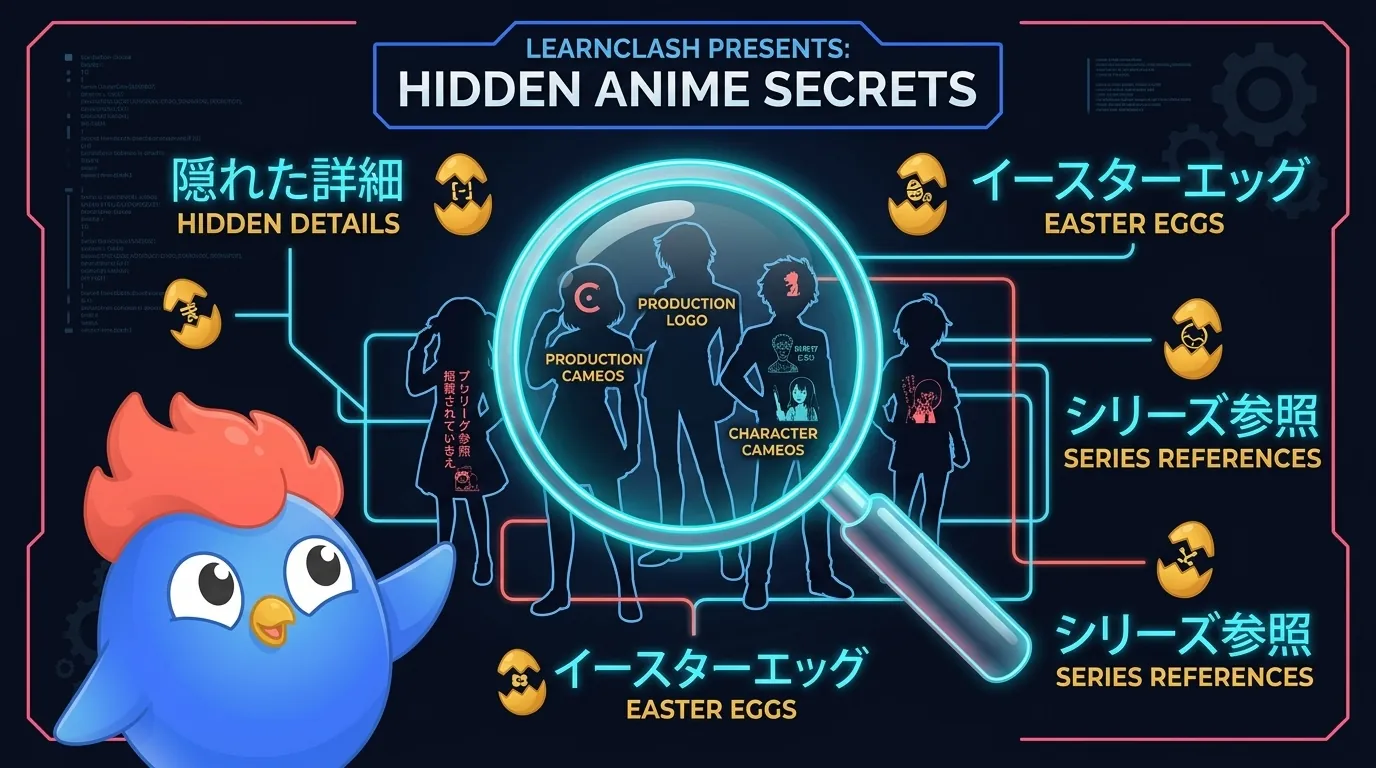
21. What naming pattern connects every military character in Fullmetal Alchemist? Hard
Answer: WWII-era military aircraft. Roy Mustang (P-51 Mustang), Riza Hawkeye (E-2 Hawkeye), Maes Hughes, Jean Havoc, Kain Fury. Even the dog Black Hayate is named after a Japanese fighter plane. King Bradley is the exception: named after a modern armored vehicle.
Why it stumps people: Nobody clocks it until someone says it out loud, and then you can’t unsee it. Hiromu Arakawa packed an entire aircraft museum into the cast list, and most fans finish the whole series without noticing.
22. What does “Ichigo” actually mean in Bleach? Medium
Answer: “One who protects” (based on the kanji used). The word “ichigo” commonly means “strawberry” in Japanese, but creator Tite Kubo chose different kanji that spell out Ichigo’s purpose in the story.
Why it stumps people: Around 90% answer “strawberry.” Right about the word, wrong about the character. Kubo built the double meaning on purpose. The kanji spells out who Ichigo is, while the sound feeds the assumption casual listeners make.
23. What are One Piece character names based on? Medium
Answer: Puns in Japanese. Nami comes from “nami” (wave). Usopp comes from “uso” (lie). Chopper reflects his medical role. Eiichiro Oda embedded wordplay into nearly every Straw Hat crew member.
Why it stumps people: Without Japanese, the names look arbitrary. With it, each one hands you a character’s core trait the second they’re introduced. Oda basically spoiled his own cast in their names. General knowledge questions tend to run the same way. The answer was sitting in plain sight if you knew where to look.
24. What does “Chihiro” mean in Spirited Away? Medium
Answer: “A thousand searches” (or “a thousand fathoms”). The name maps directly onto her journey through the spirit world. Other names carry the same weight: Yubaba means “bathhouse witch,” Kamaji means “old boiler man,” and Boh means “little boy.”
Why it stumps people: Few Western viewers ever look the meanings up. Do it once and the film’s whole naming logic clicks into place. Miyazaki didn’t chase pretty-sounding names. He chose names that describe.
25. What connects the Ghibli films The Cat Returns (2002) and Whisper of the Heart (1995)? Hard
Answer: Same universe. The character Baron Humbert von Gikkingen appears in both films. The Cat Returns is a spiritual sequel that expands on a fictional story-within-a-story from Whisper of the Heart.
Why it stumps people: Treating each Ghibli film as its own island is the default. This link is faint enough that you’d only catch it by watching both and clocking the Baron’s return. It’s the quietest shared universe Ghibli ever built.
26. What anime Easter egg appears in Hunter x Hunter when Alluka plays house? Hard
Answer: Sailor Moon figurines. Creator Yoshihiro Togashi is married to Sailor Moon creator Naoko Takeuchi. He hid references to her work throughout Hunter x Hunter as personal Easter eggs.
Why it stumps people: This one needs two pieces at once. You have to spot the Easter egg, and you have to know the marriage that explains it. Togashi and Takeuchi might be anime’s most powerful creative couple, two giants of the form sharing one house, and their series keep nodding at each other in ways only the obsessed ever catch.
27. What do Naruto’s exit signs look like? Easy
Answer: A ninja-running figure. Throughout the Naruto anime, exit signs in buildings replace the standard running figure with a ninja-running silhouette (arms stretched behind). It’s a consistent background detail that most viewers never notice.
Why it stumps people: Pure attention-to-detail stuff. You’ve probably watched hundreds of Naruto episodes and never once glanced at an exit sign. The animation team committed to the joke for the entire run anyway.
Production & Industry Secrets (28-34)
What you watch is the polished version of a process that was usually a mess: whole series shot without finished scripts, budgets that ran dry and forced a famous ending nobody planned, a cyberattack that froze four shows at once, and pay thin enough to explain why the field runs on passion rather than money. These seven go behind the curtain.
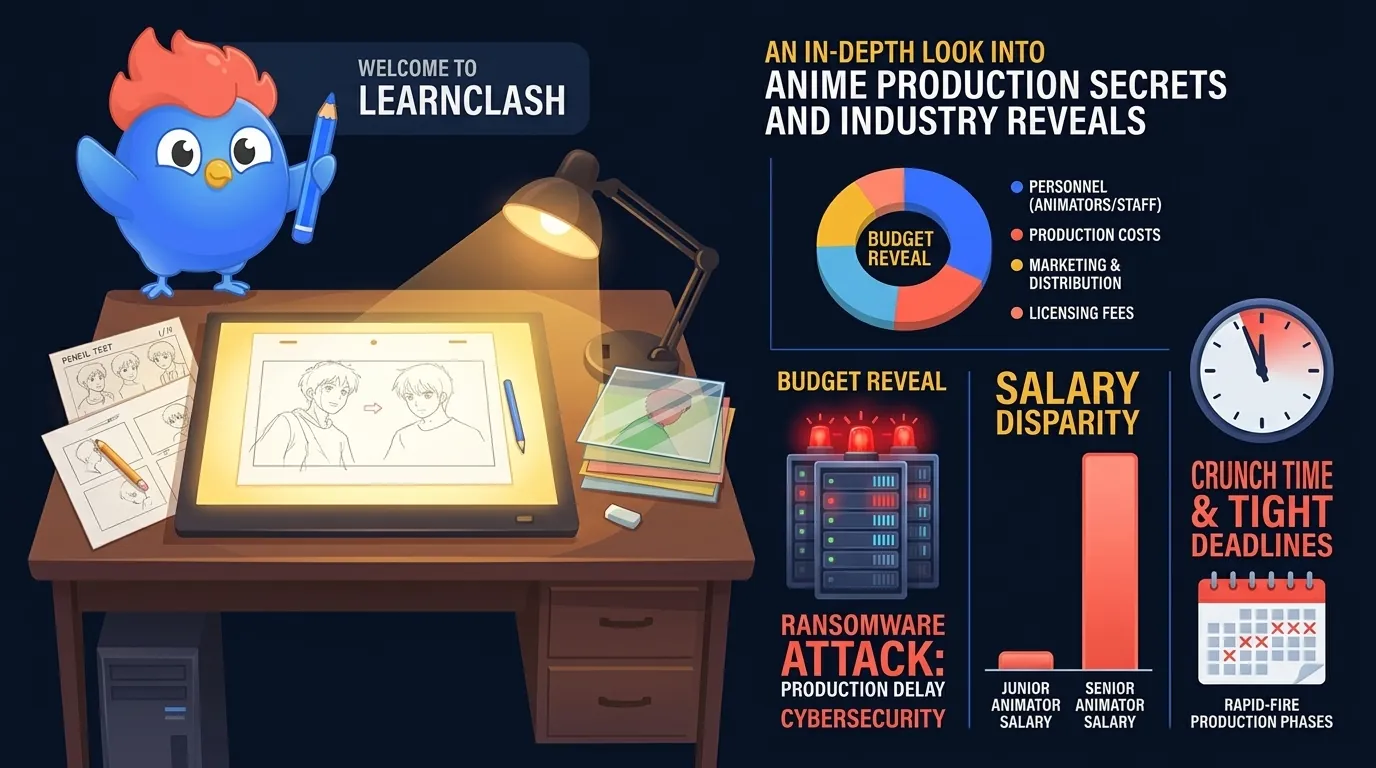 What it takes to get an episode to air.
28. How much does a single anime episode cost to produce? Medium
Answer: $100,000 to $200,000. That’s on par with low-end Western shows but with far more drawings per episode (8,000 to 12,000 frames vs. simpler Western methods).
Why it stumps people: People split into two camps. Casual viewers guess $10,000 because “it’s just cartoons.” The pros guess $1 million-plus after hearing horror stories about blown budgets. The real figure sits in the middle, and it explains both the quality and the burnout.
29. How many finished episodes existed when Neon Genesis Evangelion premiered in 1995? Hard
Answer: Two. Only episodes 1 and 2 were complete when it started airing. The rest were written week-by-week during broadcast. The first series outline was largely abandoned by episode 13.
Why it stumps people: Evangelion feels tightly plotted. The foreshadowing, the themes, the depth. Most of it got made up under deadline. Anno and his team wrote, drew, and aired episodes on a schedule that would horrify a modern studio. Fans still pick the show apart 30 years on.
30. Why did Evangelion’s final two episodes look completely different from the rest? Hard
Answer: Budget collapse. Gainax ran out of money. Director Hideaki Anno was forced to replace normal scenes with still images, text cards, crayon drawings, and long inner monologues.
Why it stumps people: Fans have argued this one for decades. Art-house genius versus money running out, and the honest answer is both. Anno turned a money crisis into something that read like a plan. That “congratulations” scene is either the deepest or the most desperate ending in anime, depending on who you ask.
31. What cyberattack halted four anime series at once in 2022? Medium
Answer: Toei Animation ransomware. The attack shut down all internal servers, delaying Dragon Quest: The Adventure of Dai, Digimon Ghost Game, Delicious Party Pretty Cure, and One Piece for weeks.
Why it stumps people: Hacking and anime feel like they live in different worlds. But Toei is one of the biggest studios going, and one breach stalled four shows that millions tuned into every week. Modern anime runs on servers. Servers get hacked.
32. What was Bakugo’s first personality in My Hero Academia? Medium
Answer: Kind and well-meaning. Creator Kohei Horikoshi first drew Bakugo as a nice kid who accidentally said offensive things. His editor pushed for a more aggressive rival archetype.
Why it stumps people: Bakugo’s rage feels so baked into My Hero Academia that picturing a gentle version short-circuits the fans. But angry Bakugo came from an editor, not the first draft. The whole Deku-Bakugo dynamic exists because someone in an editing room said, “Make him meaner.”
33. How many active voice actors does Japan have? Medium
Answer: Over 10,000. Published databases like Seiyu Meikan list about 1,790. But a 2022 industry press conference estimated the true number at over 10,000 when including unlisted freelancers and part-timers.
Why it stumps people: The gap between the published count and the real one is huge. The common guess is a few hundred. The truth runs five to six times past any public list. Female voice actors alone grew 388% since 2001.
34. What percentage of Bleach episodes are filler? Hard
Answer: About 45%. Out of 366 episodes in the first run, 163 are filler. The Bount Arc alone is 46 episodes of content that doesn’t exist in the manga. Nearly half the series is anime-first.
Why it stumps people: Weekly Bleach watchers felt the filler grind by. The actual percentage still lands like a punch. Once nearly half a series skips the source material, “occasional filler” turns into a parallel show running alongside the real one. Our 90s trivia questions collection covers the same era of anime padding and filler-heavy production schedules.
Cultural Impact & Localization (35-41)
Anime crosses borders, and weird things happen on the other side. Rice balls get renamed doughnuts, cigarettes turn into candy, a made-up wrestler kicks off a real donation drive, and one of the defining Hollywood films of its decade traces straight back to an anime. This last round follows the medium out into the real world.
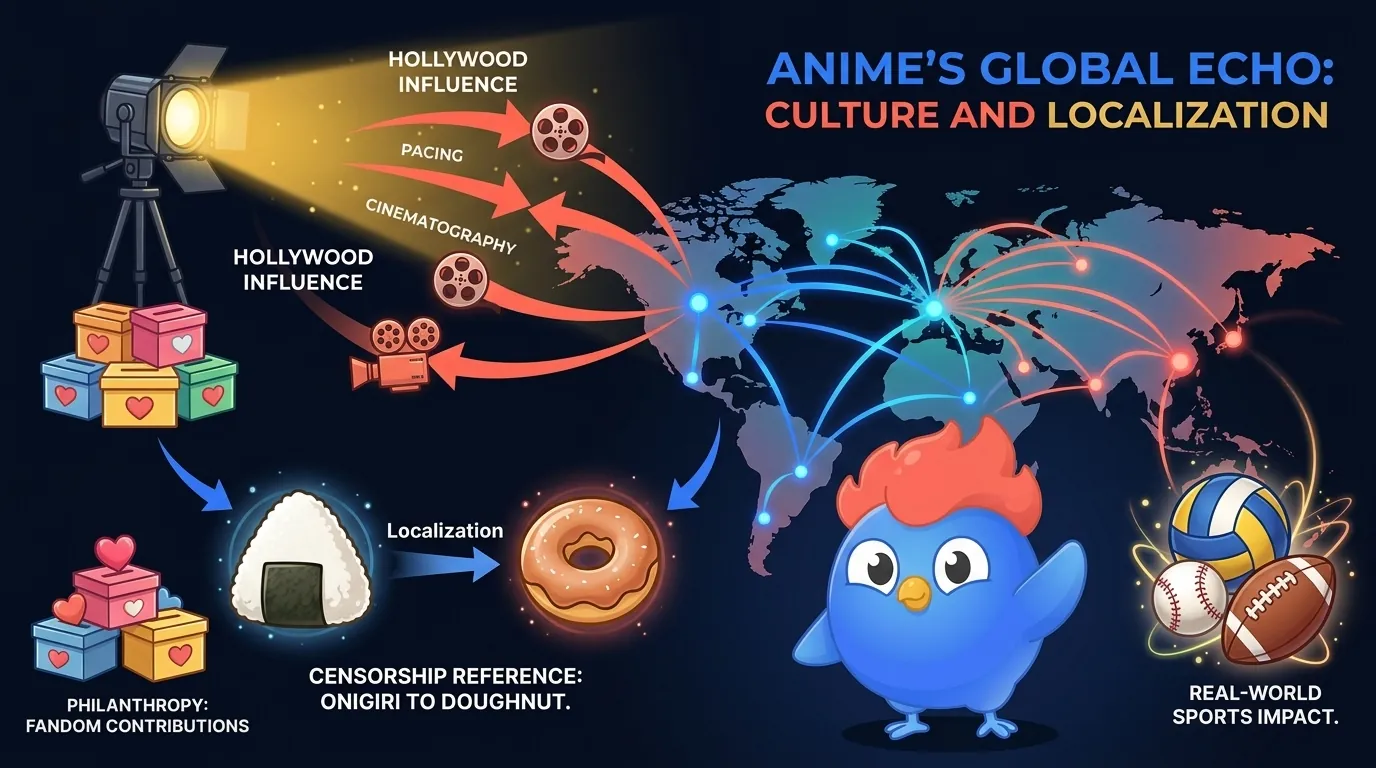 Where anime leaked into the real world.
35. What did 4Kids rename onigiri (rice balls) in the Pokemon English dub? Easy
Answer: “Jelly doughnuts.” The dub team called rice balls “doughnuts” so Western kids wouldn’t get confused. The scene shows characters eating triangular white rice. The voice track calls them doughnuts.
Why it stumps people: Even fans who know the story can’t believe a real editor signed off on it. The rice balls are clearly rice balls. The dub just pretends otherwise. It’s now one of the most memed moments in dub history, and it nails the era’s whole game plan: deny everything.
36. What replaced Sanji’s cigarettes in the One Piece 4Kids dub? Medium
Answer: Lollipops. The dub swapped his smoking for a candy habit. All booze became “juice.” Guns got cut from scenes too.
Why it stumps people: Pokemon censorship is common knowledge. The One Piece 4Kids treatment went further. Sanji’s whole look and vibe got rewritten, turning a chain-smoking chef into a lollipop fan. Plenty of fans rank this dub among the worst anime localizations ever shipped.
37. Why was Death Note partially banned in China? Medium
Answer: Kids started writing in real “Death Notebooks.” They wrote names of classmates and teachers they disliked. Schools flagged the trend, and the ban came down.
Why it stumps people: Sounds like an urban legend. It’s documented. Kids copy fiction all the time, but this case got real enough that the government stepped in.
38. What real-world social movement did the anime Tiger Mask inspire? Hard
Answer: A nationwide donation movement in Japan (2010-2011). Anonymous donors began leaving school supplies and gifts at children’s facilities, signed “Naoto Date” (the 1960s Tiger Mask lead). Over 300 facilities received donations before the movement faded.
Why it stumps people: This might be anime’s loveliest real-world ripple, and almost nobody outside Japan has heard it. Picture strangers across the country quietly leaving backpacks and school supplies at children’s homes, each one signed with the name of a wrestler from a show that aired in the 1960s. No ad campaign. No hashtag. Just a story people couldn’t shake.
39. Which Hollywood blockbuster did the Wachowskis openly say was directly inspired by an anime? Medium
Answer: The Matrix was directly inspired by Ghost in the Shell (1995). The Wachowskis showed the anime to their producer Joel Silver and told him, “We want to do that for real.”
Why it stumps people: Akira is the popular guess. The Ghost in the Shell connection is the one the Wachowskis stated out loud. The green code rain, the jack-in scenes, the questions about what makes a mind real. All of it traces back to Ghost in the Shell.
40. What happened to high school volleyball participation after Haikyuu aired? Easy
Answer: It increased measurably in Japan. Creator Haruichi Furudate, a former volleyball player, deliberately made the sport look fun and cool. Volleyball clubs reported noticeable growth in signups during the anime’s run.
Why it stumps people: “An anime boosted real sports participation” reads like marketing spin. Then the numbers from Japanese school athletic associations back it up. Haikyuu didn’t only entertain volleyball fans. It made them, which was the point from day one.
41. What percentage of Americans aged 18-24 watch anime? Hard
Answer: 44%. More than two in five young Americans regularly consume anime. The number has roughly doubled since 2018, driven by streaming platforms like Crunchyroll and Netflix pouring money into anime.
Why it stumps people: It runs higher than most fans would guess. Anime jumped from fringe to mainstream in the US in under ten years. Nearly half of young adults watch it now. At that scale it stops being a niche and becomes a market.
Turning 41 Questions Into a Quiz Night
For a quiz night, pull five questions from each category for a 30-question round and mix the difficulties so nobody coasts. Read each “Why it stumps people” note out loud after the answer lands; the origin stories and production facts reliably start table arguments.
For a 1v1, grab ten questions and take turns asking. One point per correct answer, and the loser picks the next topic. The testing effect works in your favor here: you will remember the answers you blew better than the ones you nailed.
And if you would rather have the scoring handled for you, put the whole duel on LearnClash instead. The app tracks your rating across 8 tiers (Iron to Phoenix) and drops every question you miss into a spaced repetition queue, so the answers you fumble tonight come back until they stick. There is real evidence behind that design: Dunlosky and colleagues’ 2013 review in Psychological Science in the Public Interest rated ten common study techniques and placed practice testing in its top utility tier, while rereading scored near the bottom.
When tonight’s argument needs a referee, settle it in an anime duel on LearnClash →.
More rounds to raid: video game trivia, movie trivia, 90s pop culture, and 50+ topics on LearnClash.
Frequently Asked Questions
What are the hardest anime trivia questions?
The hardest anime trivia questions test making details, not plot knowledge. Questions about why Super Saiyan hair is blonde (less ink), which military aircraft Fullmetal Alchemist characters are named after, or what the longest-running manga actually is (not One Piece) stump even dedicated fans.
What is the highest-grossing anime franchise of all time?
Pokemon is the highest-grossing anime franchise at over $100 billion in lifetime revenue. That includes games, cards, merchandise, and films. Dragon Ball and One Piece are distant runners-up. Most fans guess Dragon Ball or Naruto, but Pokemon's merchandise empire dwarfs them all.
Is anime a genre or a medium?
Anime is a medium, like film or television, not a genre. It spans romance, horror, sci-fi, sports, and everything between. The misconception comes from early Western exposure to shows like Pokemon and Sailor Moon, which gave the false impression that anime is one category.
Where can I play anime trivia against friends?
LearnClash lets you duel friends or matched opponents on anime trivia with ELO ranking across 8 tiers and built-in spaced repetition. Pick any topic, challenge someone, and the questions you miss come back until you master them. Free, no ads.
How many anime trivia questions do I need for a quiz night?
20 to 30 questions across 4 or 5 categories works best for a 45-minute anime quiz night. Mix difficulty levels so casual viewers and superfans both stay engaged. This article has 41 questions grouped into 6 ready-made rounds.