
ELO Rating System Explained [Complete 2026 Guide]
The ELO rating system ranks players by skill using win probability math. See how LearnClash shows an ELO-style rating across 8 tiers, powered by Glicko-2.

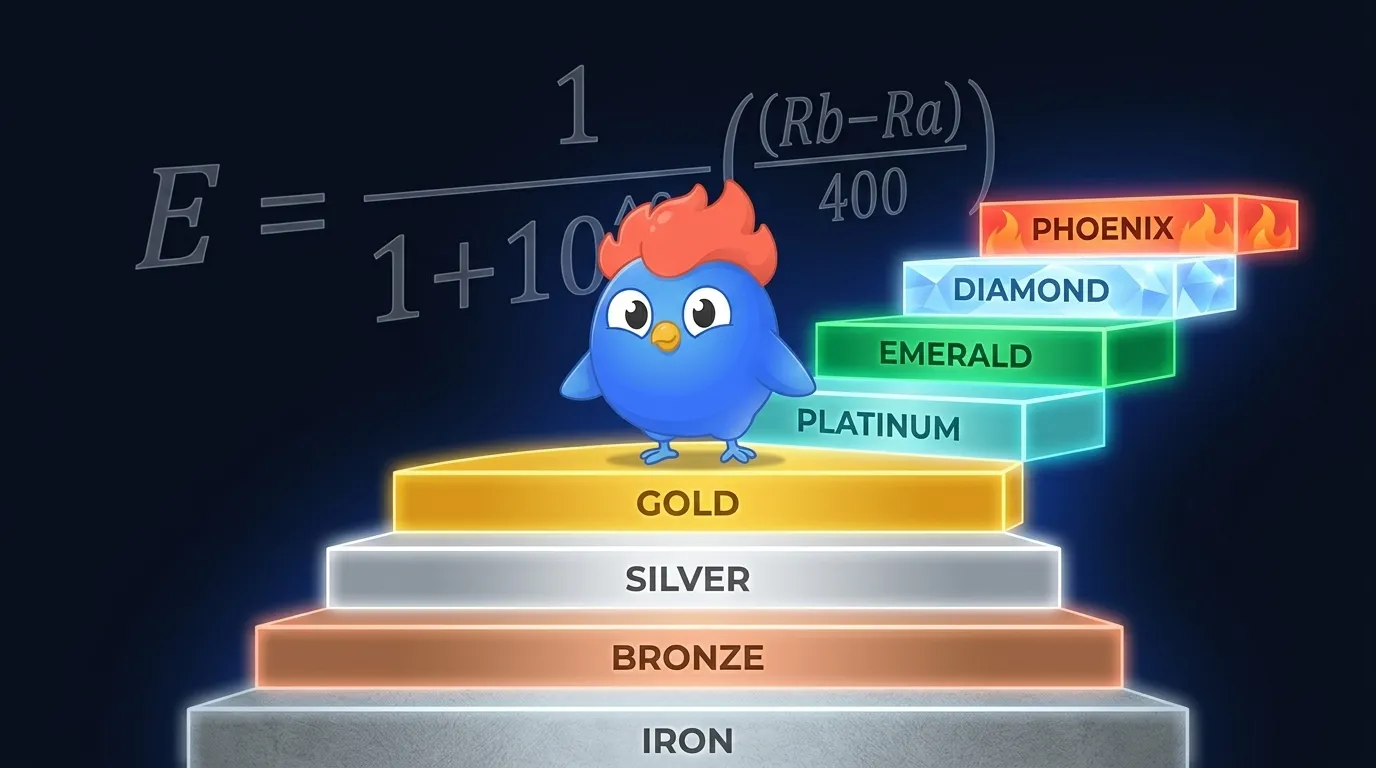
The ELO rating system is a mathematical method for calculating relative skill in head-to-head competition. Developed by physicist Arpad Elo in the 1950s and adopted by the US Chess Federation in 1960, it predicts win probability from rating differences and adjusts both players’ scores after every match. LearnClash shows an ELO-style rating across 8 ranked tiers and computes it with Glicko-2 under the hood.
The numbers, at a glance:
| LearnClash Rating System | |
|---|---|
| Starting rating | 1300 (Gold II, ladder average) |
| Engine | Glicko-2 (rating + rating deviation + volatility), shown as an ELO-style number |
| New player calibration | Rating deviation (RD) starts at 250 and settles in about 10 duels |
| Established swing | RD floor of 90, tuned so an even-rating win or loss moves about 20 points |
| Tiers | 8: Iron → Bronze → Silver → Gold → Platinum → Emerald → Diamond → Phoenix |
| Rating range | 100 (floor) to 2400+ (Phoenix) |
| Duel format | 6 rounds x 3 questions (18 total), async with a 72-hour deadline |
| Difficulty scaling | Question mix hardens in 200-point steps, keyed to the lower-rated player in the duel |
| Inactivity | No rating decay; RD grows while you’re away, so comeback duels move your rating more |
The rest of this guide covers the math, the psychology, and the places where a quiz ladder has to depart from chess.
Play a ranked duel and watch your rating moveWhat Does ELO Stand For?
Nothing, technically, because it is not an acronym. ELO is the surname of Arpad Elo (1903-1992), a Hungarian-born physics professor who spent most of his career at Marquette University in Milwaukee and chaired the US Chess Federation’s rating committee.
He built the system out of frustration with what came before it. The Harkness system, which US chess leaned on through the 1950s, produced ratings that regularly struck players as arbitrary. Elo’s fix inverted the whole approach: predict the outcome first, then adjust ratings based on whether reality matched the prediction.
The United States Chess Federation adopted it in 1960 and FIDE followed in 1970. From there it escaped chess entirely. League of Legends, Overwatch, Valorant, and Counter-Strike run Elo-derived skill systems, the FIFA World Rankings switched to an Elo formula in 2018, and quiz apps like LearnClash apply the same math to competitive quiz duels.
How Does the ELO Formula Work?
Two steps, repeated after every match: predict, then settle up. First the system computes an expected score, which is the win probability read off the rating gap. Then it moves both ratings by how far the real result beat or missed that expectation.
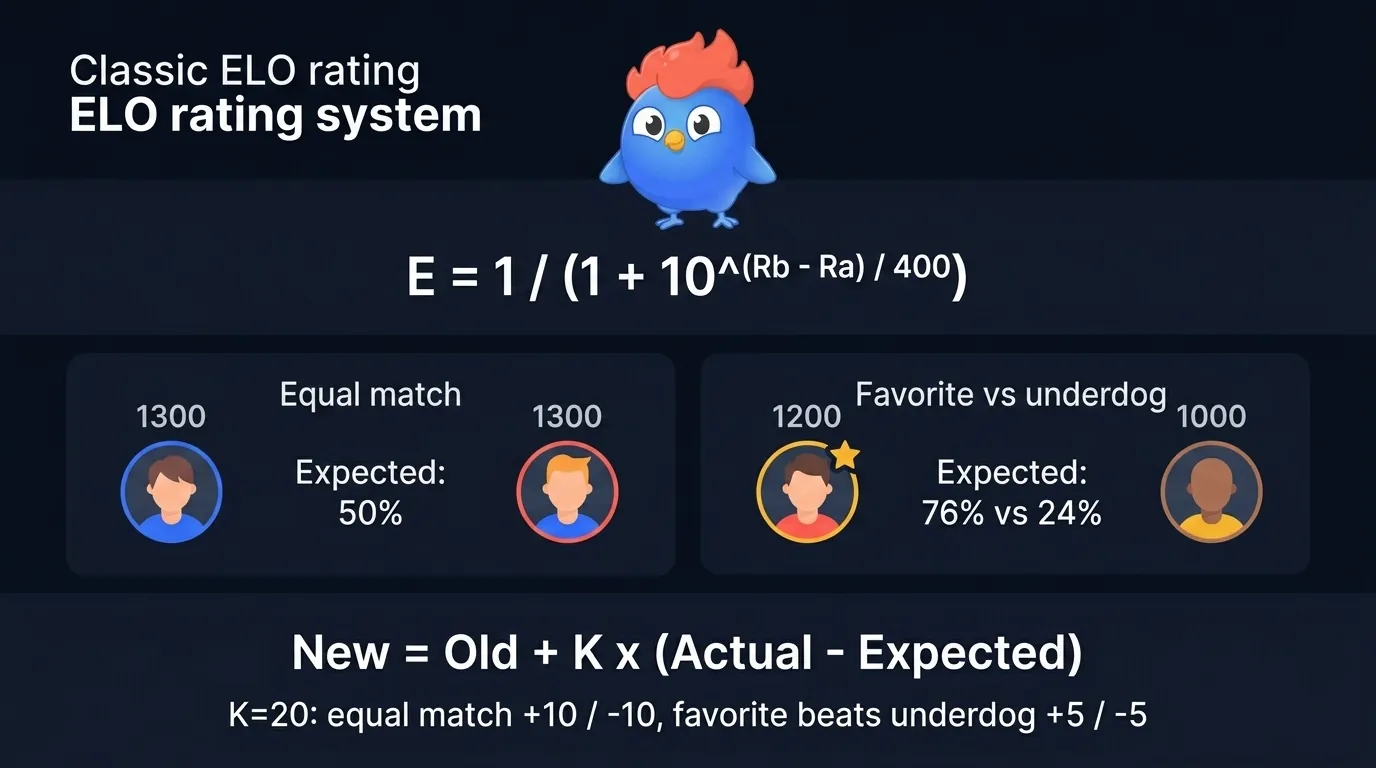 Predict first, adjust second. Everything else in this article is a refinement of these two steps.
Step 1: Predict Who Should Win
The system reads the rating gap between two players and converts it into a win probability. A small gap reads as a coin flip. A wide one means the stronger player should take it almost every time.
E = 1 / (1 + 10^((Rb - Ra) / 400))
Ra is your rating and Rb is your opponent’s. The number 400 is a scaling constant the Elo system uses so that a 200-point gap gives the stronger player roughly a 75% expected score.
| Scenario | Your ELO | Opponent ELO | Your Win Probability |
|---|---|---|---|
| Equal match | 1300 | 1300 | 50% |
| Slight favorite | 1500 | 1300 | 76% |
| Heavy favorite | 1900 | 1300 | 97% |
| Underdog | 1300 | 1900 | 3% |
Step 2: Adjust Ratings Based on the Actual Result
Once the game ends, the system compares what actually happened against what it predicted, and the gap between those two is what moves your rating.
New Rating = Old Rating + K x (Actual - Expected)
Actual is 1 for a win, 0 for a loss, and 0.5 for a draw. K is the K-factor, covered in the next section. This is the classic chess formula, shown here as an educational example rather than as LearnClash’s actual computation.
Worked example (classic Elo): a chess player rated 1200 beats an opponent rated 1000, both on K=20, a typical established-player value.
- The system predicted the 1200 player would win 76% of the time
- They won (Actual = 1), so: 20 x (1 - 0.76) = +5 points
- The loser: 20 x (0 - 0.24) = -5 points
A small adjustment, because the favorite won as expected. Had the 1000-rated underdog won instead, they would gain 20 x (1 - 0.24) = +15 points, triple the reward for the same single game. That asymmetry, big swings for surprising results and small ones for expected results, is what keeps the whole system self-correcting.
LearnClash keeps the predict-then-adjust shape but replaces the K-factor entirely; how, and why, is covered two sections down.
What Is the K-Factor (and Why Does It Matter)?
In classic ELO, one number decides how hard a single result hits your rating: the K-factor. It works like a sensitivity dial, where a higher K means bigger swings per game.
Chess federations run stepped schedules. FIDE applies K=40 to a player’s first 30 rated games, then drops to K=20, and drops again to K=10 once a player’s published rating has ever reached 2400 (it stays there permanently, even if the rating later dips). The logic: a player’s first rated games are a calibration phase, so the system allows large jumps to find their real level fast, then dampens everything once the rating settles.
The same upset pays out very differently depending on which K is in force. Suppose a 900-rated player beats an 1100-rated player, an upset with an expected score of 0.24 for the underdog.
- With K=40 (new player): gain = 40 x (1 - 0.24) = +30 points
- With K=20 (established): gain = 20 x (1 - 0.24) = +15 points
Double the K, double the reward. A K schedule is a federation’s answer to a genuinely hard question: how fast should a rating move when you don’t yet know how good someone is? There is no K-factor anywhere in LearnClash’s rating code, and the next section is the reason.
Why LearnClash Moved Beyond a Fixed K-Factor
LearnClash’s rating engine is a full Glicko-2 implementation, the algorithm Mark Glickman published as the successor to Elo’s formula and the same family Lichess runs, updated after every single duel rather than in batches. The number on your profile still reads like ELO. The arithmetic underneath doesn’t use K at all.
Glicko-2 tracks three values per player instead of one:
- Rating: the familiar number, starting at 1300
- Rating deviation (RD): how confident the system is in that number, between 90 and 250 in LearnClash
- Volatility: how erratic your results have been, around 0.06 for most players
RD is the honest replacement for a K schedule. A new account starts at RD 250, so early duels swing the rating hard, and the deviation settles toward the floor within about 10 duels. The app mirrors that window in the UI: a new account’s rating stays hidden as Unranked, with a placement countdown, until 10 rated duels are complete. A new player who drops their first few duels can fall from 1300 (Gold II) into Silver territory in one session; win them instead and Platinum III is reachable just as fast. That is RD 250 doing what K=40 was invented to approximate, then fading out gradually instead of switching off at an arbitrary game count.
Elo himself described the limits of a single number better than anyone. From his 1978 book, section 2.53:
“The process may be compared to using a meter stick waving in the wind to measure the position of a cork bobbing on the surface of waving water. The exact position of the cork cannot be stated, but one can give the probable range in which it may be found. The same can be said of ratings.” Arpad Elo, The Rating of Chessplayers, Past and Present (1978)
Glicko-2 is, in essence, that probable range promoted to a first-class part of the system.
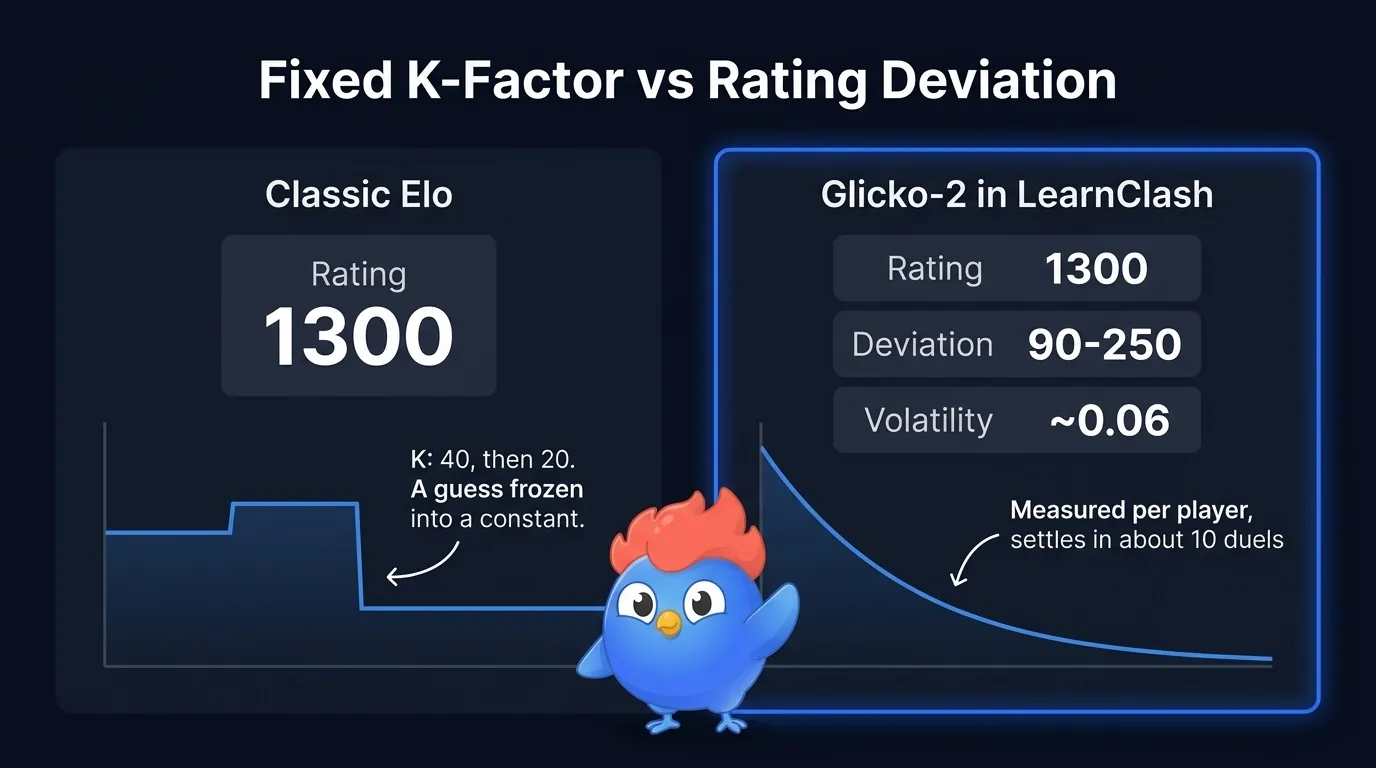
Side by side, parameter by parameter:
| Question | Classic Elo | Glicko-2 in LearnClash |
|---|---|---|
| What’s tracked | One number: your rating | Rating, rating deviation (90-250), volatility (~0.06) |
| How fast ratings move | Fixed K schedule (say, 40 then 20) | Scales with RD: new players swing hard, settled players move ~20 points on an even result |
| When you’re new | High K for N games, then a cliff | RD shrinks continuously; calibration fades instead of stopping |
| When you’re away | Nothing, or manual decay rules | RD grows, so comeback duels recalibrate you faster |
| When results turn erratic | Nothing | Volatility rises and lets the rating move more |
I can date our own migration from the code. LearnClash’s first engine was classic Elo, and the evidence is still there: user documents store the rating in a field literally named elo, and the Glicko-2 reader has to fill in default RD and volatility values for accounts that predate the switch. We moved because of the two players a fixed K never treats honestly, the brand-new account and the returning one. Both are cases where the truthful statement is “we are not sure of this rating right now,” and rating deviation is that statement expressed as a number the engine can act on.
The other reason was feel. Trivia is noisier than chess, because one 18-question duel across interleaved topics samples a thin slice of what a player knows, and when we tried chess-sized swings of 7 to 13 points they felt dead. The comment above the RD floor in our rating code still records the decision: a floor of 90 “keeps established equal-rating wins/losses near ±20 points instead of the chess-like ±7..13 range that felt unrewarding in the app.” What changed for players is simple to state: calibration that fades instead of stopping, comebacks that recalibrate in a handful of duels, and a K-factor’s frozen guess about uncertainty replaced by the uncertainty itself, measured per player and updated every duel.
One more deliberate tuning choice sits on top of the algorithm: a gentle anti-deflation regulator multiplies gains by 1.015 for players below 2000, feeding a trickle of rating into the ladder so climbing stays possible as the player base grows.
How Does LearnClash Adapt ELO for Quiz Duels?
LearnClash pushes the rating well past simple win/loss tracking. It scales question difficulty with the ladder, logs every change in your in-app rating history, and matches you on a composite score weighted 50% ELO proximity and 50% topic-category similarity. Your number ends up reflecting what you know, not just who you happened to draw.
8 Ranked Tiers from Iron to Phoenix
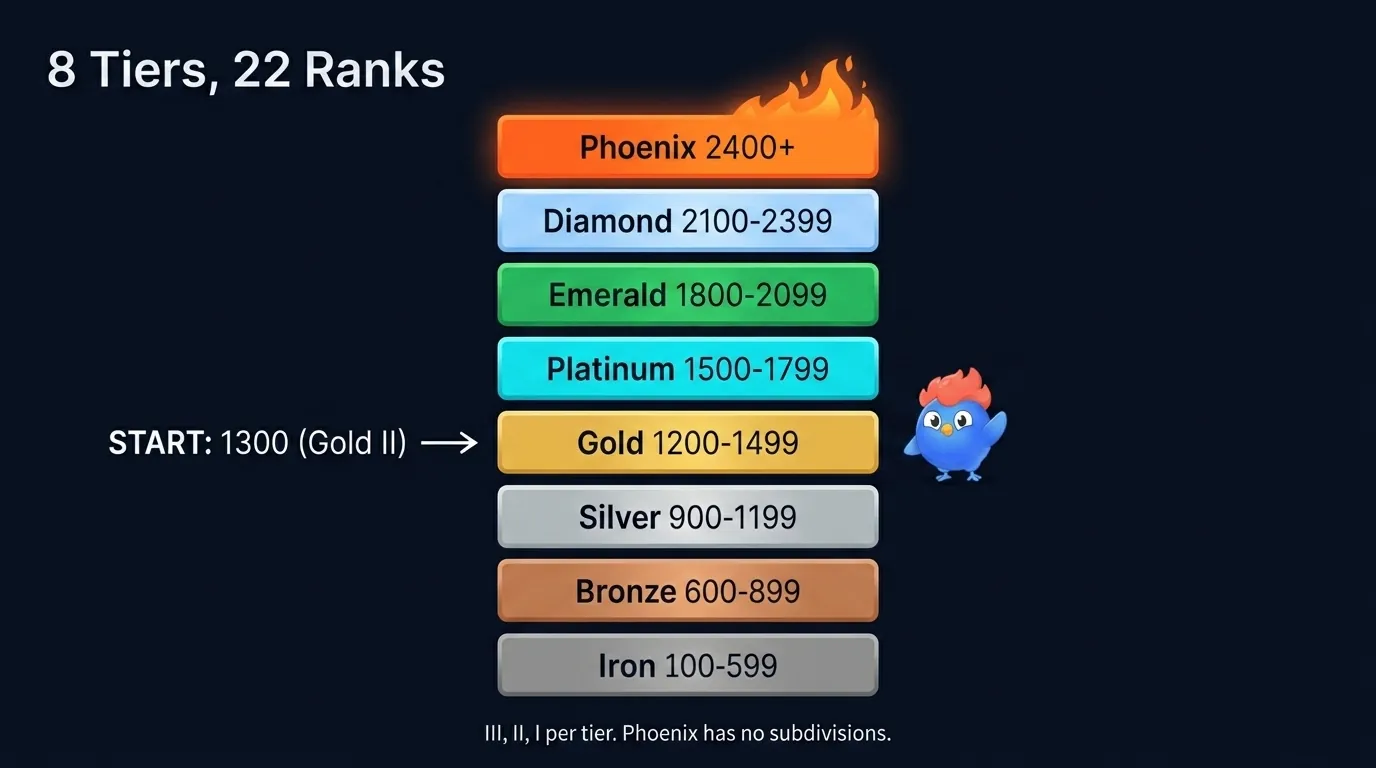 New players start at Gold II, the ladder average. Phoenix stands alone with no subdivisions.
Every tier except Phoenix has three subdivisions (III, II, I), which adds up to 22 distinct ranks:
| Tier | ELO Range | Subdivisions |
|---|---|---|
| Iron | 100-599 | III, II, I |
| Bronze | 600-899 | III, II, I |
| Silver | 900-1199 | III, II, I |
| Gold | 1200-1499 | III, II, I |
| Platinum | 1500-1799 | III, II, I |
| Emerald | 1800-2099 | III, II, I |
| Diamond | 2100-2399 | III, II, I |
| Phoenix | 2400+ | None |
New players start at ELO 1300, placing them in Gold II. That is the ladder average, chosen so roughly half the ladder sits above and half below once calibration resolves. The floor is ELO 100, and there is no ceiling. The tier names mirror competitive gaming conventions because players already understand that progression intuitively; for how the ladder, the matchmaker, and the SRS connect end to end, see the LearnClash statistics page.
Question Difficulty Scales with Your Rating
Matchmaking is only half of it, because the system also adjusts the questions themselves. Each duel runs 6 rounds of 3 questions, and the difficulty mix per round is keyed to the lower-rated player in the duel, moving in 200-point steps, so a mismatched pairing never drowns the weaker side:
| Rating band (lower-rated player) | Easy | Medium | Hard | What It Feels Like |
|---|---|---|---|---|
| Below 1200 | 3 | 0 | 0 | Recovery ramp: pure easy |
| 1200-1399 | 3 | 0 | 0 | The new-player default at 1300 |
| 1400-1599 | 2 | 1 | 0 | First medium questions appear |
| 1600-1799 | 2 | 1 | 0 | Medium becomes routine |
| 1800-1999 | 1 | 2 | 0 | Medium-dominant |
| 2000-2199 | 1 | 1 | 1 | First hard question, easy buffer kept |
| 2200+ | 1 | 1 | 1 | Hard stays capped at one per round |
This mix is gentler than the one we shipped first, and the reason is measured, not guessed. In July 2026 LearnClash production data, players answered easy questions correctly about 68% of the time, medium about 52%, and hard about 41%, so we retuned every band toward a roughly 75%-correct target and capped hard questions at one per round. A 41% hard-question rate sits uncomfortably close to the 25% floor of pure guessing on four options; stack three of those in a round and it stops measuring knowledge and starts flipping coins.
The guiding rule has not changed: your rating should reflect what you actually know, never how fast you can tap. That is also why general knowledge questions at your level stay genuinely tough, whether the topic is world capitals or 90s pop culture.
Matchmaking Uses More Than ELO
LearnClash doesn’t match players on ELO alone. The composite matchmaker scores potential opponents on a 50/50 weighted blend:
- ELO proximity (50%): perfect score at 0 rating gap, decaying smoothly to 0 at a ±400 gap
- Category similarity (50%): cosine similarity on each player’s recent topic vector
For brand-new accounts with fewer than five topic picks, the matcher scores on ELO proximity alone until the interest profile has enough signal. The result: a history enthusiast rated 1200 is far likelier to draw another 1200-rated history player than a 1200-rated science specialist, and most ELO-matched duels land in a tight, close-game win-rate band.
What Happens When You Stop Playing?
LearnClash applies no ELO decay. Your rating freezes exactly where you left it, and what shifts instead is the system’s confidence: while you’re away, your Glicko-2 rating deviation (RD) grows quietly from its settled floor of 90 toward the 250 cap. Nothing on your profile changes while that happens. You notice it only when you come back, because your first duels after a break move your rating more than usual until the deviation tightens again.
What RD means at each level:
| RD | System’s read | What you notice |
|---|---|---|
| 90 (floor) | Fully settled rating | Even-rating duels move you about 20 points |
| Growing (inactive) | Less and less certain | Your first duels back swing harder |
| 250 (cap) | Brand-new or long dormant | Maximum swing per duel |
Three design choices keep this fair to the casual player. Your headline number stays yours, with no points subtracted for taking a week off. RD signals uncertainty rather than punishment: a dormant 2300 account isn’t guaranteed to still play like 2300, so the engine treats the rating as a wider range until fresh duels prove otherwise. And recalibration is fast by design, because a high RD makes comeback duels count for more, landing a returning player back on an honest rating within a handful of games.
League of Legends decays league points at its top ranks. LearnClash’s RD path goes another way: it preserves the rating while widening the uncertainty around it, so a quiet week costs you nothing and a comeback week counts double.
Why Does ELO Make Quiz Duels Addictive?
Put a single visible number on a profile and let it move after every match, and each match becomes an event with stakes you can feel. Five psychological triggers do most of the work.
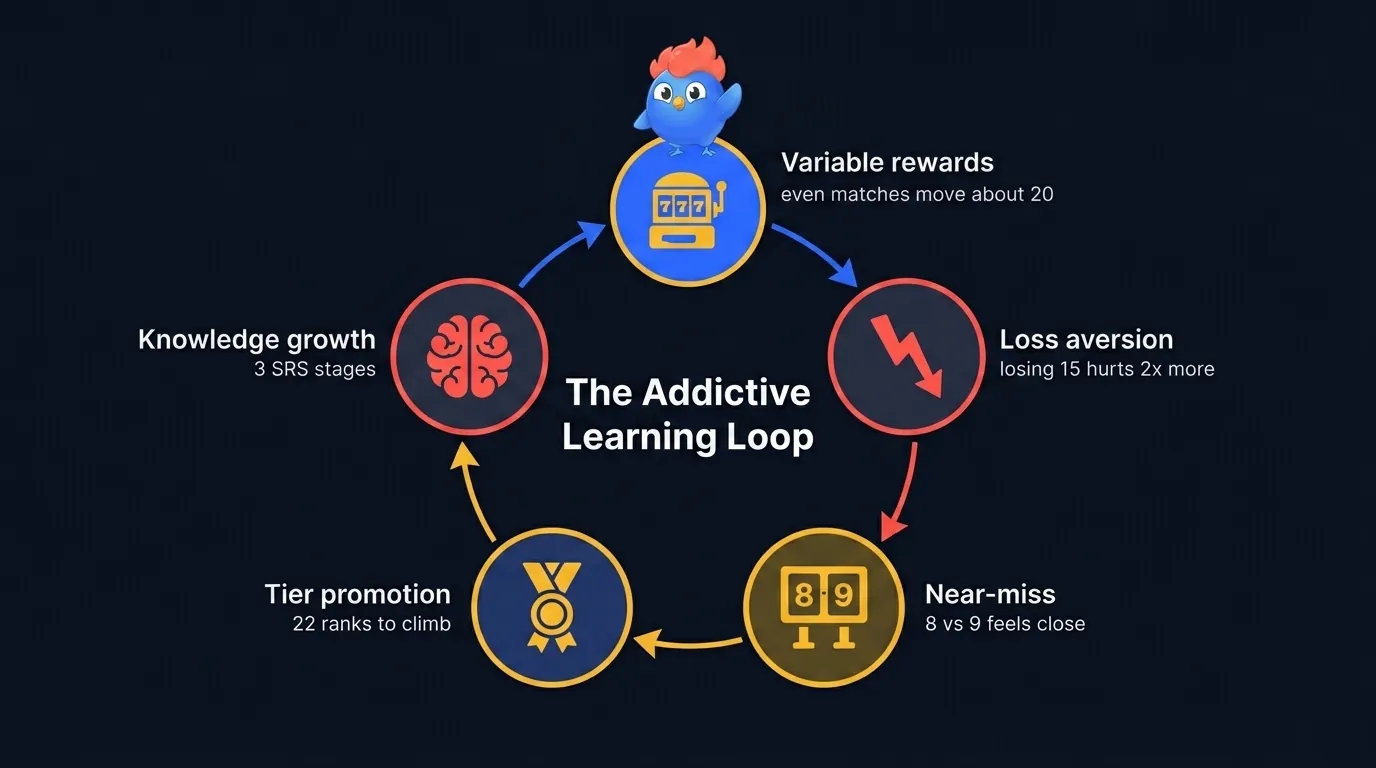
Variable rewards. Beating a player rated above you pays more than beating one below you, and both payouts shift with how settled each rating is. Because the payout depends on the matchup you happened to draw, you never know the exact number until the final answer lands.
Loss aversion. Kahneman and Tversky demonstrated that losses loom larger than gains; later estimates put the ratio near two to one. With a tier badge sitting visibly on your profile, losing 15 points stings far more than gaining 15 feels good.
Near-miss effect. Losing a duel 9-8 out of 18 questions, when a single extra correct answer would have flipped the result, lands in your head as almost-success rather than a clean loss. Topics rotate every round, so one unfamiliar food trivia question can tip the balance, and the app’s rating history lets you replay exactly which duels cost you.
Tier promotions. Crossing from Silver I to Gold III is a promotion moment that flat point totals can’t replicate. When we designed the 8-tier system against simpler alternatives like Kahoot’s point-based scoring, we placed tier boundaries so that with 22 subdivisions you are never far from the next one.
The learning payoff. Most compulsive game loops are empty calories, and this is where LearnClash deliberately splits from them. Every question enters a 3-stage spaced repetition cycle (Learning, Known, Mastered) with review intervals of 7 and 90 days, built on the testing effect; the broader science of why close matches produce stronger learning is called competitive learning.
Where Is the ELO Rating System Used Beyond Chess?
Since FIDE adopted it in 1970, Elo’s idea has spread to nearly every domain where two competitors produce a measurable outcome.
| Decade | ELO Adoption |
|---|---|
| 1960s | US Chess Federation |
| 1970s | FIDE (international chess) |
| 2000s | Online games begin adopting Elo-style ratings (WoW Arena, LoL) |
| 2010s | Overwatch, CS:GO, Valorant |
| 2018 | FIFA World Rankings |
| 2020s | Quiz platforms (LearnClash), AI model leaderboards (Chatbot Arena) |
Several improved variants now exist. Glicko and Glicko-2, developed by statistician Mark Glickman, add the rating deviation this article keeps returning to; Lichess runs Glicko-2, and Microsoft’s TrueSkill extends the idea to team-based games. LearnClash sits in the Glicko-2 column with an ELO-style number on top, because ELO is the notation chess taught the world to read. For how that compares to another 1v1 quiz app, see the LearnClash vs QuizDuel breakdown.
The concept also surfaces in stranger places. Tinder’s early algorithm reportedly used Elo to rank profile attractiveness before walking it back after the backlash, and FiveThirtyEight ran Elo ratings for NFL and NBA teams for years.
How Do You Climb the ELO Ladder Faster?
Calibration is the biggest lever, and it comes first. After that, the climb is mostly about feeding the system honest information as often as you can.
- Play your first 10 duels early. Your RD starts at 250 and settles toward the floor in about 10 duels. Those calibration duels move your rating the most, so they are the fastest route to your true level.
- Diversify your topics. Duels cover 6 topics each. One-dimensional players hit a ceiling the moment geography or mythology appears in a round.
- Practice between duels. Missed questions enter spaced repetition with 7-day and 90-day review intervals, so drilling weak areas like history directly raises your duel accuracy.
- Stay active. RD growth during breaks is real. One quick duel tightens it and keeps your rating settled instead of drifting toward bigger comeback swings.
- Accept tough matchups. Losing to someone rated 300 above you costs few points, while winning that upset pays several times an even win.
The core idea hasn’t changed since 1960; what’s changed is where it applies and how the calibration runs.
Does the Rating System Ever Feel Unfair?
Sometimes, yes. Glicko-2 weighs each result by how much it trusts both ratings, so beating an opponent whose rating the engine barely trusts yet counts for less than the number on screen suggests, and that gap between what you see and what the engine knows is where most “this feels rigged” moments come from. I accept that trade, because the alternative is a system that pretends a day-one rating and a five-hundred-duel rating deserve equal respect. If a result ever looks stingy, check whether your opponent was a new account still inside its 10-duel placement window; in my experience that is almost always the whole story.
Find out where you calibrateFrequently Asked Questions
What does ELO stand for?
ELO is not an acronym. It is the surname of Arpad Elo (1903-1992), a Hungarian-American physics professor who developed the rating system in the 1950s; the United States Chess Federation adopted it in 1960 and FIDE in 1970, and it now powers ranking in video games, sports, and quiz platforms like LearnClash.
Is a higher ELO always better?
Yes. A higher ELO means you win more often against stronger opponents. In LearnClash, your ELO determines your tier (Iron through Phoenix), the difficulty of questions you face, and the quality of opponents in matchmaking. Phoenix (2400+) is the deliberately narrow top bracket of the ladder.
How many ELO points do you gain per win?
It depends on the rating gap and on how settled both ratings are. LearnClash computes rating changes with Glicko-2, so there is no fixed points-per-win number. A brand-new account (rating deviation 250) swings far more per duel than an established one. At the settled end (RD floor of 90), winning or losing an even-rating duel moves your rating by about 20 points, and beating a higher-rated opponent pays more than beating a lower-rated one.
Does LearnClash use a K-factor?
No. The number on your profile reads like classic ELO, but LearnClash computes it with Glicko-2, which has no K-factor. Rating deviation (RD) does that job continuously: new players start at RD 250 and see big early swings that settle within about 10 duels, while established players at the RD floor of 90 move about 20 points on an even-rating win or loss.
What is the difference between Elo and Glicko-2?
Classic Elo tracks one number per player and moves it by a fixed K-factor after each game. Glicko-2, developed by Mark Glickman, tracks three: your rating, a rating deviation (how confident the system is in that rating), and a volatility (how erratic your results are). LearnClash shows you the rating and lets the other two values decide how far each duel moves it.
What happens to your ELO if you stop playing?
Your rating itself is preserved. LearnClash applies no ELO decay. What changes is the system's confidence: during inactivity your Glicko-2 rating deviation (RD) grows quietly from its settled floor of 90 toward the 250 cap. Nothing on your profile changes while you're away; you notice it only when you return, because your first duels back move your rating more than usual until the deviation tightens again.
What is a good ELO rating in LearnClash?
Gold tier (1200-1499) is where new players start (Gold II = 1300, the ladder average). Holding Platinum (1500-1799) means you consistently beat the starting pack, and Phoenix (2400+) is the deliberately narrow top bracket. New accounts keep their rating hidden as Unranked, with a placement countdown, until 10 rated duels are complete, then settle into the tier their results earn.
How does ELO work in quiz apps?
Quiz apps like LearnClash keep the core ELO idea from chess: predict each player's win probability from the rating gap, then adjust both ratings based on the actual result. LearnClash runs Glicko-2 under the hood to do that math, adds 8 ranked tiers from Iron to Phoenix, and scales question difficulty as your rating rises.