
Best Trivia Questions by Topic [With Answers]
The best trivia questions across 37 topic sets, 1,899 questions with answers. Featured samples plus a direct link to every full set.
How many do you know?
Think of your answer, then reveal it.
Did you know it before revealing the answer?
Read this answer in the articleRound complete
Turn what you know into a quiz duel.
Start a new duel in LearnClash and learn from every answer.
Get LearnClashFree to play on iPhone and Android. No ads.
Try the questions you missed once more.

Watch anyone play their first round. The misses are almost never the questions they knew were hard. They are the ones where a wrong answer arrives feeling completely settled.
The best trivia questions on this page are the 1,899 we publish across 37 topic sets, each with its answer and an explanation of the guess people reach for first. Every set links straight to its full list below, and seven topics also get sample questions written out on this page.
That is the brief a trivia question has to meet: wait until the player is sure, then produce the receipt. The samples are written for this page in the same format the sets use, and each one names the popular wrong answer and says why it feels right.
How Many Trivia Questions Are on This Page
Thirty-seven topic sets, 1,899 questions, every one with the answer and an explanation. The smallest set is car trivia at 31 questions. The largest is the Summer Olympics pack at 127.
The library those come from is a different order of magnitude. I ran a count aggregation against the production database while rewriting this page, 2026-08-04: 41,587 question documents, 1,297 of them retired, which leaves 40,290 live questions across 716 topics. So what you see here is about four and a half percent of the app.
That ratio is deliberate, and it is the only editorial rule I actually enforce on this page. A question earns a spot in a published set when it is checkable to a real source, when at least one wrong option is genuinely attractive, and when knowing the answer leaves you with something you would repeat to somebody else. Most questions in a 40,000-item library are perfectly good practice material and fail that third test. They stay in the app, where the job is repetition, not retelling. The full production breakdown lives in the LearnClash statistics page, whose census is the dated July 21, 2026 export: 34,157 questions across 655 topics. The count above is the same collection re-counted two weeks later.
A question generator will hand you a hundred questions in a second, and that is the problem: nobody checked them, the wrong options are filler, and a table can feel the difference inside two rounds. The trade here runs the other way. Fewer questions, checked by hand against real sources, with the app library behind them when you want volume instead of retelling.
In the app every question is four options with one correct answer and a difficulty label of Easy, Medium, or Hard. A duel is six rounds of three questions, so eighteen per player, with 45 seconds on the clock for each one.
Best Trivia Questions by Topic: Directory
Thirty-seven sets, every row linking to its full list. The seven rows with an arrow also have sample questions further down this page.
| Topic | # Qs | What is in the set | Samples |
|---|---|---|---|
| Science Trivia | 37 | Physics, biology, chemistry, space | ↓ |
| History Trivia | 43 | Ancient civilisations to the modern era | ↓ |
| WW2 Trivia | 47 | Battles, spies, technology, enduring myths | |
| Geography Trivia | 43 | Borders, capitals, physical extremes | ↓ |
| Movie Trivia | 43 | Classics, blockbusters, production history | ↓ |
| TV Trivia | 53 | Sitcoms, dramas, reality TV, classic shows | |
| Music Trivia | 43 | Artists, albums, chart records | ↓ |
| General Knowledge Questions | 43 | The broad mixed round | ↓ |
| Sports Trivia | 43 | Records, rules, Olympic history | ↓ |
| Dinosaur Trivia | 49 | Species, extinction, modern paleontology | |
| Disney Trivia | 43 | Animated features, parks, studio history | |
| Animal Trivia | 47 | Behaviour, anatomy, record holders | |
| Food Trivia | 43 | Ingredients, origins, cooking science | |
| 80s Trivia | 59 | Music, film, tech and toys of the decade | |
| 90s Trivia | 45 | Music, film, games and TV of the decade | |
| Space Trivia | 42 | Planets, missions, cosmology | |
| Bible Trivia | 67 | Old and New Testament people and places | |
| Greek Mythology Trivia | 37 | Olympians to the Underworld, three bands | |
| Marvel Trivia | 47 | Comics canon and the film timeline | |
| Harry Potter Trivia | 37 | Three difficulty bands, books first | |
| Lord of the Rings Trivia | 37 | Tolkien’s books and Jackson’s films | |
| Anime Trivia | 41 | Series, studios, the medium’s history | |
| Video Game Trivia | 47 | Origins, design secrets, Nintendo, easter eggs | |
| Car Trivia | 31 | Manufacturers, engineering, motoring firsts | |
| Football Trivia | 53 | NFL records, rules, franchise history | |
| Math Trivia | 43 | Numbers, proofs, famous problems | |
| True or False Trivia | 53 | Binary calls, mostly counterintuitive | |
| Basketball Trivia | 53 | NBA, college, Olympic and WNBA rounds | |
| Summer Olympics Trivia | 127 | Paris 2024, legends, ancient origins, LA 2028 | |
| Art Trivia | 37 | Painters, movements, museum stories | |
| Celebrity Trivia | 47 | Real names, awards, pre-fame jobs | |
| Kids Trivia | 89 | Ages 5 to 13, grouped by subject and age | |
| Pub Quiz Questions | 97 | Six rounds plus picture, music, tie-breaker | |
| Hardest Trivia Questions | 50 | Ranked by real miss rates, four rounds | |
| Bar Trivia Questions | 67 | Six US-format rounds built for wagers | |
| Team Building Trivia | 73 | Eight workplace-safe rounds, remote mode | |
| Father’s Day Trivia | 43 | Origins, traditions, famous fathers |
If the group needs a format before it needs an answer key, the activities and icebreakers hub covers the low-pressure end, from binary this-or-that prompts to party trivia with a host script.
Science Trivia: Biology, Chemistry, Space
Science is where confidence does the most damage, because the reflex answer usually got installed around third grade and never audited since. The set runs 37 questions across physics, biology, chemistry, and space.
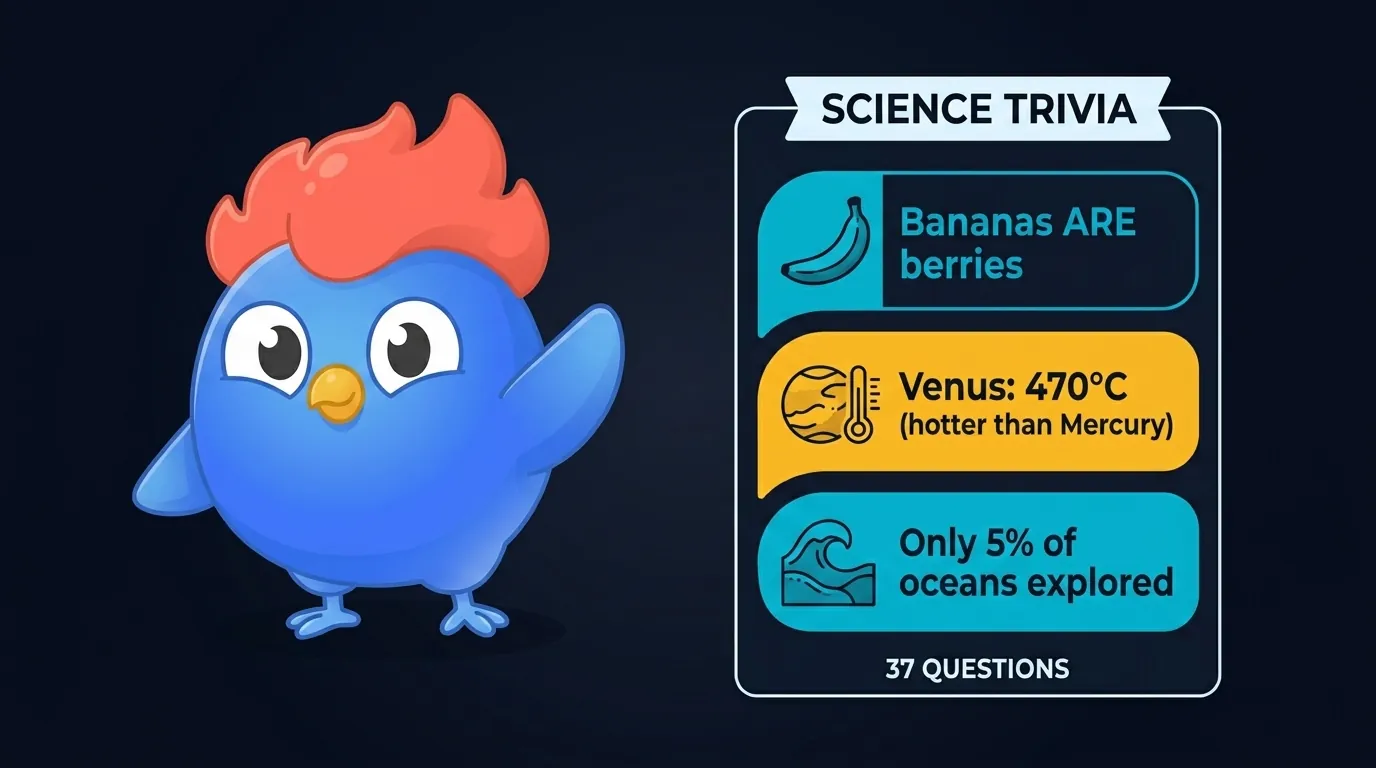 Science trivia: 37 questions across physics, biology, chemistry, and space.
1. Are bananas technically a berry?
Answer: yes, and strawberries are not. A botanical berry grows from a single flower with one ovary, and the seeds sit inside the flesh. Bananas, grapes, blueberries and avocados all qualify. The strawberry is an accessory fruit: the part you eat swells from the flower base, and the actual fruits are the specks on the outside.
Your eye sorts berries by size and shape. Botany sorts them by flower parts. The app runs this as a four-option question, asking which everyday fruit is botanically classified as a berry, and when the duel data was exported on 2026-07-27, 44.9 percent of first-time players picked banana and 28.6 percent went for cherry (n=49).
2. Which planet has the hottest surface?
Answer: Venus, around 470°C, even though Mercury sits closer to the Sun. A thick carbon dioxide atmosphere traps the heat in a runaway greenhouse, and surface pressure runs about 92 times Earth’s, comparable to 900 metres of seawater above you.
Mercury is the reflex pick, and the distance argument feels airtight until you notice Mercury has almost no atmosphere to hold anything in. The Soviet Venera 13 lander gives you the scale of the place: it touched down in March 1982 and kept transmitting for 127 minutes before the heat and pressure finished it, which is still the longest any spacecraft has survived on Venus.
Read all 37 science questions with answers →
History Trivia: Ancient to Modern
Dates are where instinct is least reliable, because we file civilisations by how old their photographs look. The set carries 43 questions across ancient empires, wars, and turning points.
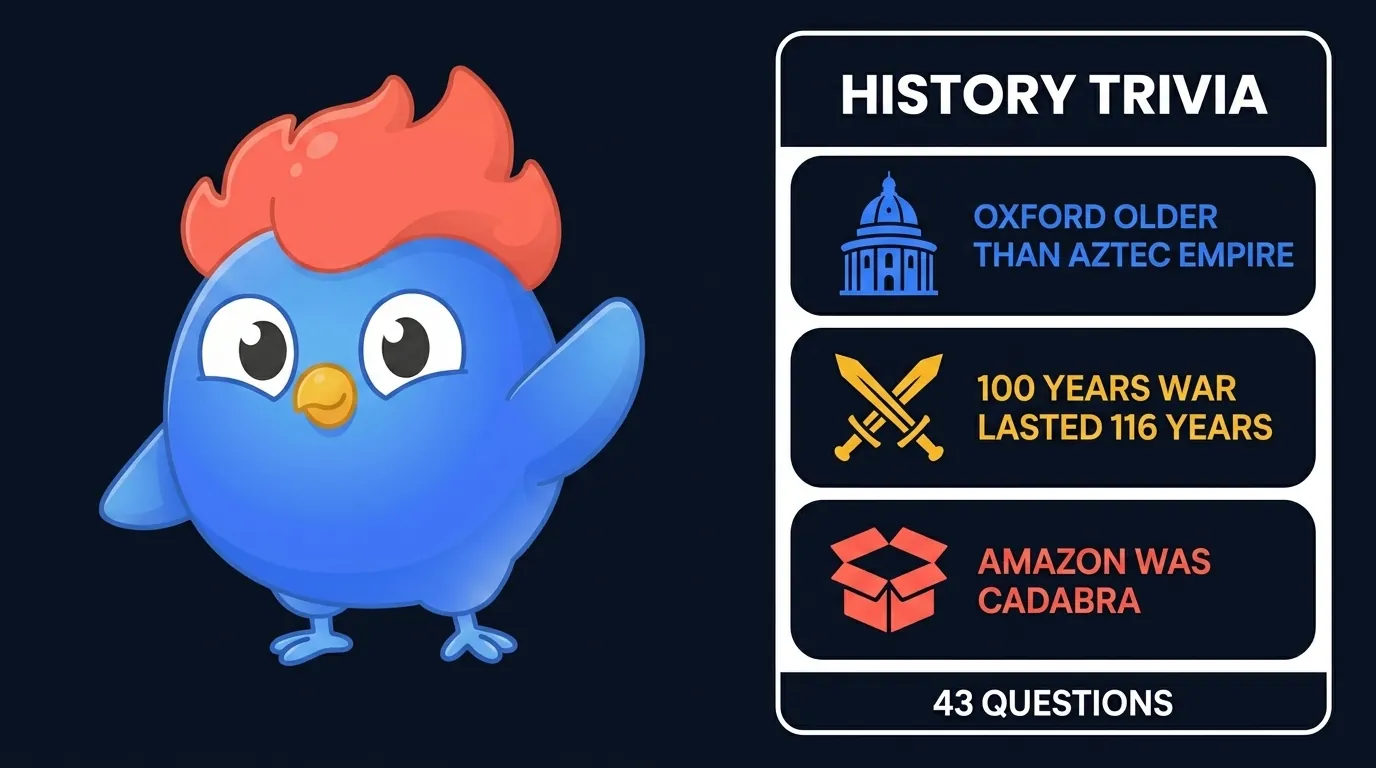 History trivia: 43 questions across ancient civilisations, wars, and turning points.
1. Which is older: Oxford University or the Aztec Empire?
Answer: Oxford. Teaching is recorded there from 1096. Tenochtitlan, the Aztec capital, was founded in 1325, and the Triple Alliance that became the empire formed in 1428. University College, which dates its founding to 1249 and is usually counted as Oxford’s oldest, puts even the college buildings ahead of the capital.
Aztec ruins photograph as ancient and Oxford stone photographs as merely expensive, so the ruins win an age contest they should lose by centuries.
2. What was Amazon’s first company name?
Answer: Cadabra, as in abracadabra. Jeff Bezos dropped it after a lawyer misheard it as “cadaver” over the phone. Amazon started with an A, which mattered in early alphabetical web directories, and it sounded enormous. The amazon.com domain was registered on 1 November 1994, and the store opened to the public the following July.
The backup name was Relentless, and Bezos kept the domain. I checked it again while rewriting this page: on 2026-08-04, relentless.com still answers with a 302 redirect to amazon.com.
Read all 43 history questions with answers →
Geography Trivia: Countries, Capitals, Extremes
Flat maps leave gaps, and the brain fills them in with confident nonsense. This set runs 43 questions on borders, capitals, and physical extremes.
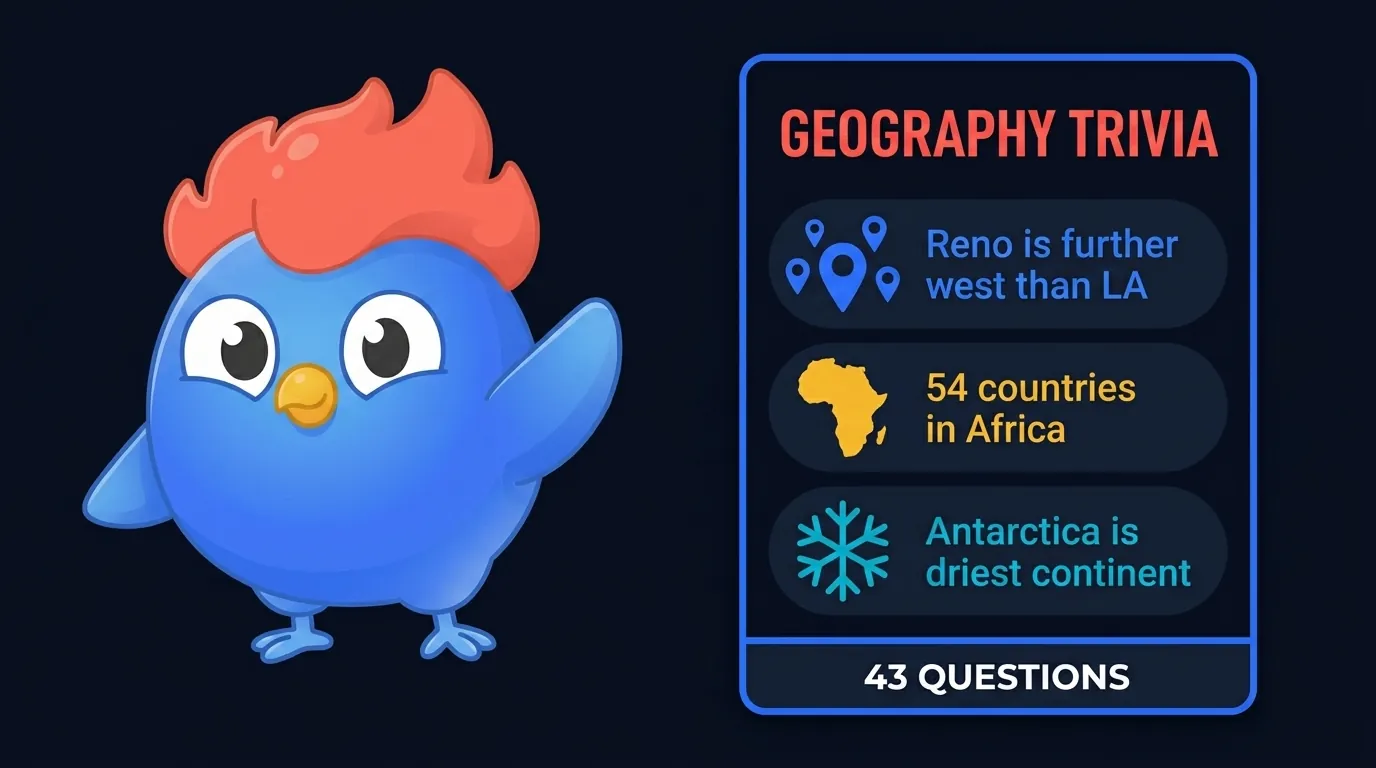 Geography trivia: 43 questions on borders, capitals, and extremes.
1. Which city is further west: Reno, Nevada or Los Angeles?
Answer: Reno, at about 119.8°W against Los Angeles at 118.2°W. California’s coastline swings east as it runs south, so southern California ends up further east than the western edge of Nevada.
California is the West Coast, so Los Angeles has to be the western one. The state line does not care.
2. What is the driest continent on Earth?
Answer: Antarctica. The interior plateau receives less water each year than the Sahara does, and the McMurdo Dry Valleys, the continent’s largest ice-free region, are thought to have gone something like two million years without rain. Katabatic winds strip out what little moisture arrives.
Africa or Australia is the instinct, because dry has been welded to hot since primary school. Cold air simply cannot hold water, and rainfall is what the question is measuring.
The full set runs the sharper wording: its version asks for the driest inhabited continent, which rules Antarctica out and makes Australia the answer.
Read all 43 geography questions with answers →
Movie Trivia: Classics, Quotes, Records
Memory edits dialogue. It trims lines, smooths them, and hands back something more quotable than anything anyone said on set. The set runs 43 questions across classics, blockbusters, and production history, and the two samples below lean on edited memory plus the box office numbers that only make sense once you count seats instead of dollars.
 Movie trivia: 43 questions on classics, blockbusters, and production history.
1. What does Darth Vader actually say in The Empire Strikes Back?
Answer: “No, I am your father.” The name Luke never appears in the line. The script matches, James Earl Jones has confirmed it repeatedly, and the misquote survives because parodies quote the parody rather than the film.
2. Which film has sold the most US tickets of all time?
Answer: Gone with the Wind, at roughly 200 million admissions since 1939. Avatar and Avengers: Endgame took far more money and sold far fewer seats: a 1939 ticket ran about 25 cents against roughly nine dollars in 2019. On the adjusted list Star Wars (1977) sits second and The Sound of Music (1965) third.
Gross revenue flatters whichever film is most recent. Counting seats instead of dollars reverses most of the modern top ten.
Read all 43 movie questions with answers →
Music Trivia: Artists, Albums, Chart History
Two things keep showing up in music trivia: songs their own label wanted to bury, and instrument “facts” that turn out to describe a filing convention rather than physics. The set runs to 43 questions.
 Music trivia: 43 questions on artists, chart records, and origin stories.
1. What happened when Queen sent “Bohemian Rhapsody” to their label?
Answer: EMI nearly refused to release it. Six minutes, no chorus, and no obvious radio edit. The DJ Kenny Everett was given a copy marked not for broadcast, played it on Capital Radio 14 times across one weekend in 1975, and record shops filled with people asking for a song that was not out yet. EMI released it uncut, and it spent nine weeks at number one in the UK.
2. Is a piano a string instrument or a percussion instrument?
Answer: percussion, if you are asking which orchestral family it belongs to. Pressing a key throws a hammer at a string, and the orchestral convention groups instruments by how the sound is started.
Here is the part most quiz answers skip. The academic Hornbostel-Sachs system, which classifies by what actually vibrates, calls the piano a chordophone, specifically a struck simple chordophone in the zither branch alongside the hammered dulcimer. Both answers are defensible, which is exactly why the question splits a room.
Read all 43 music questions with answers →
General Knowledge: The Broad-Base Category
This is the category for facts everybody knows and nobody has checked: things learned once in childhood and never questioned again. The set holds 43 questions.
 General knowledge: 43 questions aimed at the answers people defend hardest.
1. What colour is an aeroplane’s black box?
Answer: bright orange. Flight recorders are painted international orange so searchers can spot them in wreckage. The nickname’s origin is still argued over, though it most likely traces to early enclosed test housings rather than the paint. The units are built to take 3,400 G of impact and an hour at 1,100°C.
The nickname is too good to interrogate, while the device itself is engineered to shout its location.
2. How long can a goldfish remember something?
Answer: months, not seconds. The demonstration people keep citing is a 1994 University of Plymouth study: eight goldfish learned to press a lever for food, the payout was then narrowed to one hour a day, and the fish concentrated their presses inside that window. They were not reacting to food appearing. They were anticipating it.
Where the ceiling actually sits is still argued over, and fish-cognition researchers such as Culum Brown at Macquarie University put it at weeks to months and sometimes years, depending on the species and the task. What nobody defends is three seconds. That figure has no experiment behind it at all, and it persists because it is a convenient thing to believe about an animal kept in a bowl.
Read all 43 general knowledge questions with answers →
Sports Trivia: Records, Rules, Upsets
Sports records break instinct in a specific way: the number that sounds like a typo is usually the real one. The set holds 43 questions across records, rules, and Olympic history.
 Sports trivia: 43 questions on records, rules, and the history behind the games.
1. Wayne Gretzky holds the NHL record for career points. What record would he still hold if you erased every goal he scored?
Answer: career points. Gretzky finished with 894 goals and 1,963 assists. The assists alone outrank the entire career point total of every other player who has played the game, including Jaromir Jagr’s 1,921.
Delete every goal Gretzky ever scored and his passing still beats Jagr’s goals and assists combined. The stat is so lopsided that it reads like a transcription error, which is why it almost never comes up in an argument about the greatest player.
2. Which sport was once an Olympic event and then dropped?
Answer: tug of war, contested at five Games between 1900 and 1920. At London 1908 all three medals went to British police teams: gold to City of London Police, silver to Liverpool City Police, bronze to the Metropolitan Police.
Other events that came and went include solo synchronised swimming, live pigeon shooting, and the standing long jump. Stranger still, the Olympics awarded medals for art from 1912 to 1948, in architecture (town planning included), literature, music, painting, and sculpture.
Read all 43 sports questions with answers →
How Many Questions a Trivia Night Needs
Sixty to ninety questions for a full evening. That is the six-round pub structure most hosts inherited without ever being told its name: six spoken rounds of 10 to 15 questions, a picture round, a music round, and a tie-breaker phrased as a nearest-number guess.
Our 97-question pub quiz set is sized for exactly one of those nights. The 67-question bar trivia set does the same job in the American format, where the closing round carries a wager.
Two adjustments matter more than the count. Mix the difficulty inside each round rather than stacking a hard round at the end, or the table that fell behind stops talking. And keep one round narrow enough that somebody at the table is the expert, because a person getting to be the expert for ninety seconds is most of why people come back next week.
Shorter formats need much less than hosts expect. An office session runs comfortably on the eight rounds in the team-building set, and a family evening rarely gets past 30 questions before the youngest player is done, which is how the kids set ended up grouped by subject and age band rather than as one long list.
In the app the unit is smaller again. A duel is 18 questions per player, six rounds of three, 45 seconds each. It fits in the gap where you would otherwise scroll.
Why Answering Beats Reading
Dragging an answer out of your own head plants it deeper than reading the same fact does, and the effect holds whether you get it right or not. Karpicke and Roediger (2008) had students learn foreign-language word pairs, then split them: some kept being tested on pairs they had already recalled correctly, others kept restudying them. A week later the retrieval group recalled about 80 percent and the restudy-only group about 36 percent. Extra studying after the first correct recall added close to nothing.
Three things happen when you answer a question here rather than read it:
- Retrieval. You pull the fact out yourself, which is the part that does the work.
- Feedback. The correct answer arrives while the surprise is still live, which is when it encodes best.
- Spacing. Anything you miss goes into spaced repetition and comes back at widening intervals until you answer it without pausing.
That is the whole mechanism behind the testing effect, and it is why scanning the answers on this page is the weak version of using them. Sitting in a duel against somebody at your own rating tier, watching the clock, guessing wrong and feeling the right answer land is the version that sticks.
Play These Questions Live
 Any topic, any difficulty, 18 questions a duel.
Every question above sits inside a topic you can open right now. Duel a friend, or let the matchmaker pair you against somebody in your own rating band: 18 questions across six rounds, 45 seconds each. No ads in any tier, and nothing you can buy makes you win.
Play trivia on any topic, free on LearnClash
The Questions That Did Not Make This Page
Questions in the app are drafted by a model, then handed to a second pass that re-derives the fact by questioning itself, checks that the question names its own topic without leaking the answer, rejects anything with more than one defensible answer, and flags the uncertain ones for a human. Here is the part I would rather not advertise: that validation pass does no web lookup. It reasons from what the model already knows, because running live search on every generated question cost roughly $80 a month against about $15 without it, and the file still carries that decision in a comment. Search only switches on later, when a player reports a question for a wrong answer, a wrong option, or an out-of-date fact. So the generation pass is a good sanity filter and a bad fact-checker on anything the model half-remembers.
That trade is exactly why the published sets get checked by hand and the app library does not.
When I fact-checked the app’s most-missed questions in July 2026, eight came back with problems, most of them the kind no answer-key check would ever catch. A Santayana question quoted a paraphrase that matches neither Santayana’s 1905 line nor Churchill’s later version of it, which makes the “wrong” option arguably right. A question about Roman mouthwash rested on a habit that Catullus actually mocked as Celtiberian. One asked about hens’ teeth, a thing observed only in mutant chicken embryos and never in a living hen. Another gave the wrong motive for the Hogwarts ghosts.
None of them are on this page. All of them are queued for a rewrite in the app rather than deletion, because a question with a bad stem and a good idea is worth more than a fresh one. That is the unglamorous half of this work: the interesting questions and the broken questions look identical until somebody checks, and the checking is the only part readers never see.
Frequently Asked Questions
What are the best trivia questions to ask at game night?
The ones where the wrong answer is the popular answer. A question nobody can guess kills the room, and a question everybody knows adds nothing. Aim for the middle band, where half the table commits to something confidently and the reveal starts an argument. The seven featured topics on this page are picked on exactly that criterion.
How many trivia questions do you need for a trivia night?
Roughly 60 to 90 spoken questions for a full evening. The pub format most hosts inherited runs six spoken rounds of 10 to 15 questions, with a picture round, a music round, and a tie-breaker on top of that count. Our pub quiz set holds 97 questions for that reason. A shorter kitchen-table night works fine on 30.
What makes a good trivia question?
A surprising answer that survives a fact-check, and a wrong option people actually want to pick. If no distractor is tempting, the question is a vocabulary test. If the answer falls apart when you look it up, it should never have shipped.
What topics work best for trivia?
Science, history, movies, and general knowledge, because everybody has an opinion and almost nobody has the exact fact. Sets built on numbers (sports records, chart history) work well too, since the real figure usually sounds wrong.
Where can I find trivia questions organized by category?
The directory on this page lists all 37 topic sets with their question counts, from 31 questions in car trivia to 127 in the Summer Olympics set, 1,899 in total. Seven topics also have sample questions on this page.
How often do you add new trivia questions?
Not on a schedule. The last new topic set published here went up in May 2026, and since then the work has gone into re-verifying and rewriting the sets that already exist. Inside the app it is different: the topic count moved from 691 to 716 between 2026-07-27 and 2026-08-04, because players keep creating topics of their own.
Do harder trivia questions actually help you learn?
Yes, when the correct answer arrives right after the guess. Karpicke and Roediger (2008) had students learn word pairs, then either keep testing them or keep restudying them. A week later the retrieval group recalled about 80% and the restudy-only group about 36%.
What are the easiest trivia questions to start with?
General knowledge and pop culture, where a wrong guess still leaves you with a fact worth keeping. Every LearnClash question carries an Easy, Medium, or Hard label, and the rating ladder runs eight tiers from Iron to Phoenix, so a beginner is matched against beginners.
Are these trivia questions free to play?
Yes, and there are no ads in any tier. Every topic in the directory is playable free. Premium ($7.99 per month or $59.99 per year) includes up to 20 Solo sessions an hour and 3 New hands per round instead of 1.
Can trivia improve memory in adults?
The evidence for retrieval practice in adults is strong. Roediger and Karpicke (2006) tested undergraduates on prose passages and found that after five minutes restudying looked better, but at two days and one week the group that had been tested remembered substantially more. Trivia is that experiment with a scoreboard attached.