
43 Geography Trivia Questions [With Answers]
43 geography trivia questions on countries, borders, and world records. Ranked by difficulty, with answers and explanations.

Quiz yourself on these questions
How many do you know?
Think of your answer, then reveal it.
Did you know it before revealing the answer?
Read this answer in the articleRound complete
Challenge friends on this topic.
Start a new duel in LearnClash and learn from every answer.
Get LearnClashFree to play on iPhone and Android. No ads.
Antarctica is a desert. Nepal’s flag has five sides. Bolivia lost its coastline in the 1880s and still keeps a navy.
All three sound made up, and all three are true. That gap between what feels right and what is right is where geography trips people, and these 43 questions live in it. They run from countries and capitals through physical features, borders, and world records. Easy warmups come first, the geography-buff stumpers last, and every answer carries a short note on why it catches people.
I re-checked all 43 answers in August 2026, five months after this page first went up, and several needed fixing. Some were numbers that had moved since March (France’s visitor count, the UNESCO tally). One was a runner-up I had simply gotten wrong (the coastline question, where second place depends on who measures).
The fix I enjoyed least was a fact I had never thought to question, and it turns out a space probe settled it against me back in 2015. You’ll find it at question 1. School lied to you a little, and so did I, briefly.
Difficulty is not decoration here. When we tuned the duel question mix in July 2026, measured accuracy in duels sat at about 68% on easy questions, 52% on medium, and 41% on hard, against a 25% floor from guessing on four options. That is why a LearnClash duel never serves more than one hard question in every three, even at Phoenix, the top of the ladder.
Your rating moves on match results, not on individual questions (it is an ELO-style number computed with Glicko-2), and the question mix stiffens in 200-point steps as that number climbs. Geography is one of the topics in our trivia questions directory.
Challenge a friend to geography trivia on LearnClash
How the 43 Questions Break Down
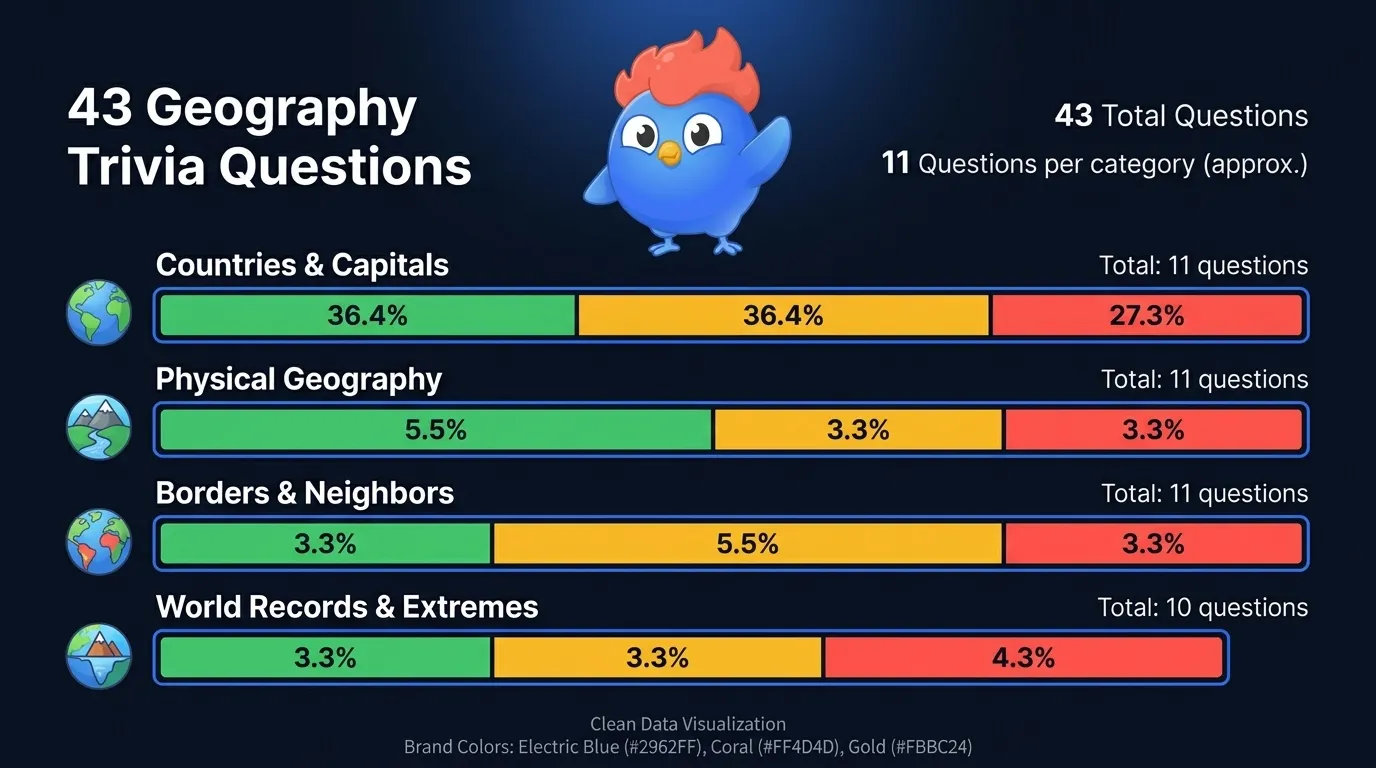
We weighted these 43 toward medium and hard on purpose. Easy capital questions are fun, but they don’t tell you much about who at the table actually knows the map. The medium and hard ones are where the arguing starts.
| Category | Questions | Easy | Medium | Hard |
|---|---|---|---|---|
| Countries & Capitals | 1-11 | 4 | 4 | 3 |
| Physical Geography | 12-22 | 4 | 4 | 3 |
| Borders & Neighbors | 23-33 | 4 | 4 | 3 |
| World Records & Extremes | 34-43 | 3 | 4 | 3 |
One pattern to watch for as you go. In three of the four categories, the trap answer is not a random wrong guess but the famous place: Sydney for Australia’s capital, the Netherlands for the flattest country, Cape Town for where two oceans meet. Fame and correctness are different properties, and geography trivia is mostly the sport of telling them apart.
Countries & Capitals Questions (1-11)
These 11 start with facts you think you already own. Then they twist into constitutional quirks that redraw your mental map.
1. What is the largest country in the world by area? Easy
Answer: Russia, at roughly 17.1 million km² (6.6 million mi²).
The catch: Everyone knows the answer. Almost nobody grasps the scale: Russia is nearly twice the size of second-place Canada and spans 11 time zones from Kaliningrad to Kamchatka.
Here is the correction I owed you from the intro. “Russia is bigger than Pluto” was true on the old estimate of Pluto’s size, but when New Horizons flew past in July 2015 it measured the dwarf planet larger than expected, and Pluto’s surface now works out to about 17.7 million km². Russia lost that contest by roughly 600,000 square kilometers, and the meme never got the memo.
2. What is the smallest country in the world? Easy
Answer: Vatican City, at less than half a square kilometer.
Where it goes wrong: Nearly everyone reaches for Monaco. But Vatican City fits inside Rome’s city limits, and its whole territory is smaller than most golf courses. Monaco is the second smallest, and at 2.02 km² it is still more than four times larger.
3. What is the capital of Australia? Easy
Answer: Canberra.
Why it trips people: Sydney is the biggest city, the most famous, and the one that hosted the Olympics. But Canberra was purpose-built from 1913 as a compromise, because Sydney and Melbourne could not agree on which of them should be capital. The rivalry ran so deep that the constitution required the new capital to sit at least 100 miles from Sydney, so they carved a territory out of New South Wales and built a government city from scratch.
4. Which country has the most people? Easy
Answer: India, at roughly 1.48 billion in mid-2026 on the UN projection.
Why it trips people: Decades of “China is the most populous country” sit so deep in everyone’s head that India’s 2023 overtake still catches people off guard. The fact changed years ago. The reflex is taking longer.
5. Which country has three capital cities? Medium
Answer: South Africa. Pretoria (executive), Cape Town (legislative), and Bloemfontein (judicial).
The reason it’s hard: The whole concept breaks a rule you didn’t know you believed, that countries have one capital. South Africa has three, each housing a different branch of government. The popular guess is Johannesburg, which is none of them.
6. How many months are in the Ethiopian calendar? Medium
Answer: 13. Twelve months of 30 days each, plus Pagume, a short 13th month of 5 or 6 days.
Why it trips people: Grow up with a 12-month calendar and the number 13 just sounds invented. There is a second surprise here too. The Ethiopian calendar runs 7 to 8 years behind the Gregorian one, so as of August 2026 it is still 2018 in Ethiopia, with 2019 arriving in September.
7. How many landlocked countries are in South America? Medium
Answer: Two. Bolivia and Paraguay.
Why it trips people: South America has 12 countries, and the gut says more than two must be landlocked. Bolivia is the better story. It lost its Pacific coast to Chile in the War of the Pacific (1879-1884) and has never gotten over it: it still keeps a navy on Lake Titicaca, and every March 23rd it marks Día del Mar, the Day of the Sea, mourning a coastline it lost more than 140 years ago.
8. What is the youngest internationally recognized country in the world? Medium
Answer: South Sudan, which declared independence on July 9, 2011.
The trap: Kosovo (2008) predates South Sudan but isn’t universally recognized at the UN, so it doesn’t count here. Others reach for Timor-Leste (2002) or mix up South Sudan with Sudan. The independence referendum passed with almost 99% support.
9. Which country has the most UNESCO World Heritage Sites? Hard
Answer: Italy, with 62 sites after the World Heritage Committee’s July 2026 session in Busan.
Why it trips people: China sits right behind at 61 (both countries added exactly one site in Busan), and plenty of players assume it already passed Italy. France and Spain feel like contenders too. For several years running, the Italy-China race has come down to a single site, so check the count again after each summer’s committee meeting before you put this one in a quiz.
10. Which country’s flag is not rectangular? Hard
Answer: Nepal. Its flag is a double pennant (two stacked triangles), making it the only non-rectangular national flag in the world.
Why it trips people: Your gut says Switzerland, since Swiss flags are square. But a square is still a rectangle. Nepal’s flag is the only one that isn’t even quadrilateral. It has five sides.
11. What is the only country that borders both the Caspian Sea and the Persian Gulf? Hard
Answer: Iran.
Why it trips people: The Caspian Sea and Persian Gulf feel like they belong to two different worlds. Azerbaijan, Turkmenistan, and Kazakhstan touch the Caspian but not the Gulf; Iraq and Kuwait touch the Gulf but not the Caspian. Iran stretches from one to the other, and the shape of Iran is something few people can draw from memory.
Physical Geography Questions (12-22)
Mountains, rivers, oceans, deserts: each one hides an assumption that falls apart the moment you check the numbers. These 11 all share one trait. They sound wrong, and they’re not.
12. What is the longest river in the world? Easy
Answer: The Nile, at roughly 6,650 km (4,130 mi).
Why it trips people: The Amazon won’t stop challenging. Brazilian scientists have argued for years that the Amazon is longer (up to 6,992 km), depending on where you put its source. The Nile stays the consensus answer in Britannica and most reference works, but the debate isn’t settled, so accept either answer with a good argument attached.
13. What is the largest ocean on Earth? Easy
Answer: The Pacific Ocean, covering about 165 million km².
Where the difficulty hides: Naming it is easy. Picturing the size is not. You could drop every continent into the Pacific and still have ocean left over.
14. What is the tallest mountain on Earth? Easy
Answer: Mount Everest, at 8,849 m (29,032 ft) above sea level.
Why it trips people: Every geography fan has a “well, actually” loaded for this one. Hawaii’s Mauna Kea is taller base-to-peak (about 10,210 m from the ocean floor), and Ecuador’s Chimborazo is the point farthest from Earth’s center, thanks to the equatorial bulge. So “tallest” comes down to how you measure. Above sea level, Everest wins.
15. What is the largest desert in the world? Easy
Answer: Antarctica, at roughly 14.2 million km².
Why it trips people: The word “desert” does the damage. It cues sand and heat, not ice and wind. Science trivia veterans already know the loophole: deserts are defined by precipitation, not temperature, so anything under 250 mm per year qualifies. Antarctica is a polar desert roughly one and a half times the size of the Sahara, which is only the largest hot desert at about 9.2 million km².
16. What is the deepest point in the ocean? Medium
Answer: Challenger Deep in the Mariana Trench, at roughly 10,935 m (35,876 ft).
Why it trips people: “Mariana Trench” is the famous name, but the exact spot is Challenger Deep. The depth itself is what nobody can pin. Sink Mount Everest to the bottom of Challenger Deep and you’d still have over 2,000 m of water above the peak.
17. Which continent has the most countries? Medium
Answer: Africa, with 54 UN-recognized sovereign states.
Why it trips people: Asia feels like it should win on sheer size, and it doesn’t. Asia’s count lands in the high 40s depending on how you treat transcontinental states like Turkey and Russia, and Europe’s in the mid 40s. The African Union goes one higher than the UN, at 55 members, because it seats the disputed Western Sahara.
18. What is the longest mountain range on land? Medium
Answer: The Andes, stretching roughly 7,000 km (4,300 mi) along South America’s western coast.
Why it trips people: The Himalayas feel longer because they loom so large over Asia. But the Andes run through seven countries from Venezuela to Chile, and the Himalayas span about 2,400 km, so the Andes come out nearly three times longer. (The mid-ocean ridge system at around 65,000 km is the longest overall, but it’s underwater.)
19. What percentage of Earth’s water is freshwater? Medium
Answer: About 2.5%.
Why it trips people: The number sounds impossibly low, and it gets worse from there. Of that 2.5%, roughly two thirds is locked in ice caps and glaciers and most of the rest is groundwater. Lakes and rivers hold only about 0.3% of that freshwater, which works out to less than 0.01% of all the water on Earth.
20. What is the driest inhabited continent? Hard
Answer: Australia.
Why it trips people: Antarctica is technically drier (it’s a polar desert, see question 15), but it has no permanent civilian population, so it’s out. Among inhabited continents, Australia gets the least rainfall on average. Africa, despite the Sahara, pulls in more total precipitation across the continent.
21. Which lake contains roughly 20% of the world’s unfrozen freshwater? Hard
Answer: Lake Baikal in Siberia, Russia.
Why it trips people: The Great Lakes jump to mind first, and they do hold about a fifth of the world’s surface freshwater combined. Lake Baikal holds a similar share in one single lake. It is also the deepest lake on Earth (1,642 m) and, at roughly 25 million years, the oldest.
22. What is the flattest country on Earth? Hard
Answer: The Maldives, with an average elevation of about 1.5 m (5 ft) above sea level.
Why it trips people: The Netherlands is the famous guess, all that reclaimed low-lying land. But the Maldives’ highest natural point sits only about 2.4 m up, which makes it the lowest and flattest country by a wide margin. Rising seas now threaten the entire nation.
Borders & Neighbors Questions (23-33)
Borders are where spatial reasoning fails people. Players who breeze through capitals and physical features lose their footing the moment a question asks what touches what, because almost nobody carries an accurate map of a country’s outline in their head. These 11 go straight for that blind spot.
23. Which two countries share the longest international boundary? Easy
Answer: The United States and Canada, at 8,891 km (5,525 mi) including the Alaska-Canada border.
Why it trips people: The answer isn’t surprising. The number is. Nobody expects a single border to run nearly 9,000 km. Strip out the Alaska section (2,475 km) and the contiguous border is still 6,416 km.
24. How many countries share a border with Germany? Easy
Answer: Nine. Denmark, Poland, Czech Republic, Austria, Switzerland, France, Luxembourg, Belgium, and the Netherlands.
Why it trips people: Players undercount almost every time, and the usual miss lands on seven. Luxembourg and Belgium are the two that drop off the list, even though both share a direct border with Germany.
25. Which country borders the most other countries? Easy
Answer: China and Russia, tied at 14 each.
The trick: The tie itself is the trap. Players pick one or the other, and hardly anyone picks both. China’s 14 neighbors stretch from North Korea to India. Russia’s 14 run from Norway to North Korea (counting the Kaliningrad exclave bordering Poland and Lithuania).
26. What ocean lies between Africa and Australia? Easy
Answer: The Indian Ocean.
Why it trips people: Honestly, it’s a warm-up. The few who miss it reach for the Pacific, which sits east of Australia, not west.
27. What is the only country in Africa completely surrounded by a single other country? Medium
Answer: Lesotho.
Why it trips people: Enclaves are a concept everyone has heard of and almost nobody can name on demand. Lesotho is a mountainous kingdom of a bit over 2 million people sitting entirely within South Africa’s borders. San Marino and Vatican City do the same trick inside Italy, but neither one is in Africa.
28. What is the only country that directly borders both the Atlantic and Indian Ocean basins? Medium
Answer: South Africa, where the two oceans meet at Cape Agulhas.
Why it trips people: The meeting point isn’t Cape Town (Cape of Good Hope). That’s the famous wrong guess. Cape Agulhas, a couple of hours’ drive to the southeast, is the official dividing line. Some geographers note that Egypt and Israel border marginal seas linked to both oceans, but South Africa is the only country touching the main basins directly.
29. Which two South American countries do not border Brazil? Medium
Answer: Chile and Ecuador.
Why it trips people: Brazil borders 10 of the 12 other South American countries. Its territory is so huge that touching all of them seems like a safe bet, and it isn’t. Chile is walled off by the Andes and the countries between; Ecuador is cut off by Colombia and Peru.
30. What is the conventional geographic boundary between Europe and Asia? Medium
Answer: The Ural Mountains, along with the Ural River, Caspian Sea, Greater Caucasus Mountains, Black Sea, and the Turkish Straits.
Why it trips people: “The Urals” is the quick answer, and it’s only part of the boundary. The full line is a stitched-together composite running thousands of kilometers from the Arctic to the Mediterranean. No single natural feature splits the two continents; the division is historical and cultural as much as geographic.
31. What is the shortest international border in the world? Hard
Answer: The border between Spain and Morocco at Peñón de Vélez de la Gomera, roughly 85 meters long.
Why it trips people: Hardly anyone has heard of the place. Peñón is a small rocky outcrop on the Moroccan coast that Spain has held since 1564 and administers as a plaza de soberanía. It was an island until 1930, when a sandbar formed linking it to the mainland (Spanish accounts blame an earthquake that August, English ones a storm), and when Morocco became independent in 1956 that sandbar became the world’s shortest land border. The runner-up is the Botswana-Zambia border at Kazungula, about 150 meters where the Chobe meets the Zambezi.
32. Which country has coastline on both the Mediterranean Sea and the Red Sea? Hard
Answer: Egypt.
Why it trips people: The two seas feel like they belong to whole different regions. The Mediterranean coast runs along the north, while the Red Sea coast runs east along the Sinai Peninsula and south toward Sudan. Israel also touches both (via the Gulf of Aqaba, part of the Red Sea), but Egypt’s coastline on each one is far longer.
33. How many countries does the Equator pass through? Hard
Answer: 13, including 11 by land and 2 by territorial waters only (Maldives and Kiribati).
Why it trips people: The number runs higher than anyone expects. The 11 land crossings are Ecuador, Colombia, Brazil, São Tomé and Príncipe, Gabon, Republic of the Congo, Democratic Republic of the Congo, Uganda, Kenya, Somalia, and Indonesia. São Tomé and Príncipe is the one that slips everyone’s mind.
Borders are the round people lose. Play it on LearnClash
World Records & Extremes Questions (34-43)
The highest, deepest, coldest, and most remote places on the planet. These 10 chase the superlatives that sound too extreme to be real, and several of them are also the answers that change from year to year, so the dates matter.
34. What is the most visited country in the world? Easy
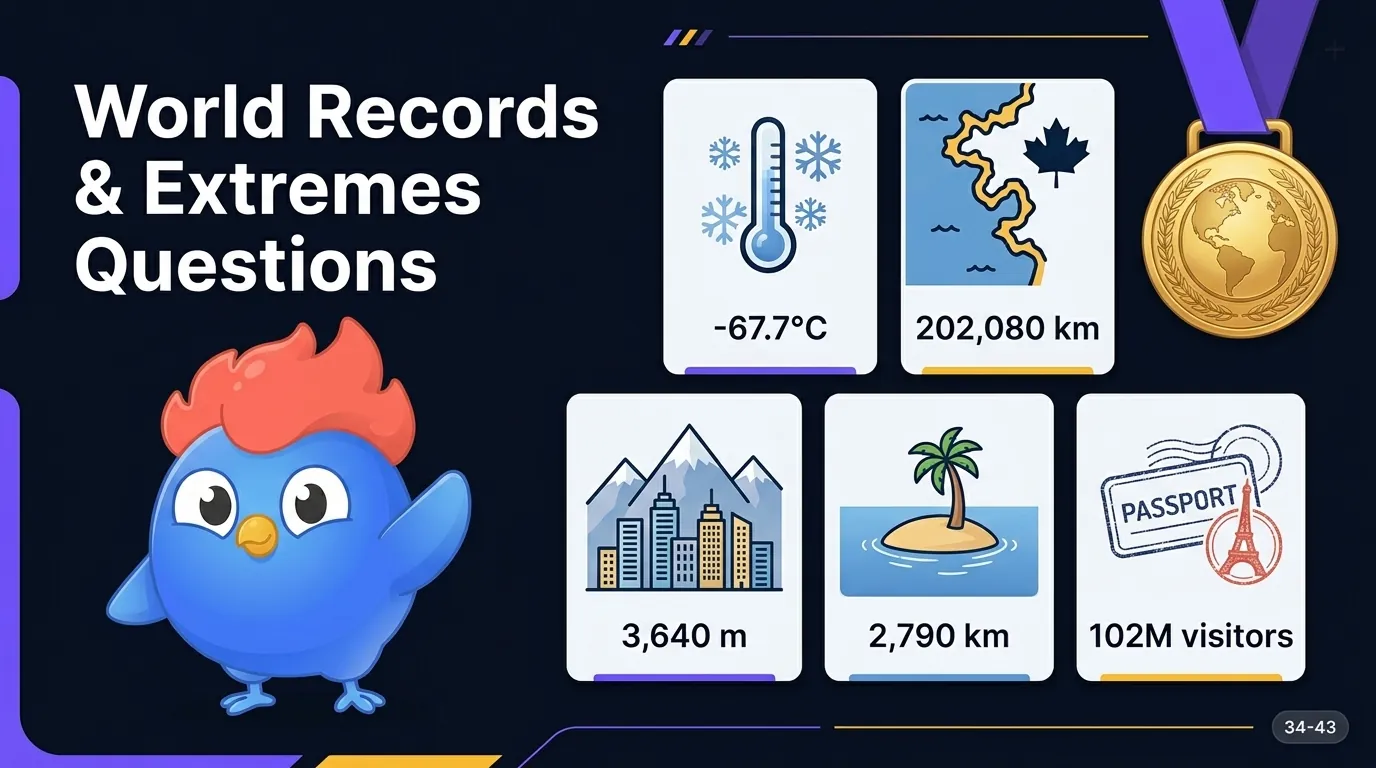
Answer: France, with a record 102 million international visitors in 2025.
Why it trips people: The United States and China are the usual guesses. France has held the top spot for more than three decades on the strength of Paris, the Riviera, and its position as the front door to European travel. Spain is closing the gap, though, at about 97 million in 2025.
35. What is the most spoken language in the world by native speakers? Easy
Answer: Mandarin Chinese, with close to a billion native speakers.
Why it trips people: English feels like the obvious answer, since it’s everywhere. Count native speakers only and Mandarin runs away with it. Ethnologue’s 2026 edition puts Mandarin at about 988 million native speakers, Spanish at 487 million, and English at 372 million, which leaves English third. English only takes the lead once you count every speaker, native and learned combined, at roughly 1.5 billion.
36. What country has the longest coastline in the world? Easy
Answer: Canada, with roughly 202,080 km (125,567 mi) of coastline.
Why it trips people: Australia, Indonesia, and Russia all feel like strong picks. Who comes second depends entirely on who is measuring, because of the coastline paradox: the finer you trace every inlet, the longer the line gets. The CIA World Factbook hands second place to Norway at about 83,000 km once its fjords and islands are counted, while the World Resources Institute’s method puts Russia second at about 110,000 km. Neither is remotely close to Canada, whose Arctic archipelago of more than 36,000 islands carves out shorelines no other country can match.
37. What is the coldest inhabited place on Earth? Medium
Answer: Oymyakon, Russia, where temperatures hit a record -67.7°C (-89.9°F) in February 1933.
Why it trips people: Nobody expects a village where a few hundred people live year-round at those temperatures. Verkhoyansk, also in Siberia, is a competing claimant with a near-identical record (-67.8°C in 1892), and the two towns have argued about the title ever since.
38. What is the highest capital city in the world? Medium
Answer: La Paz, Bolivia, sitting at roughly 3,640 m (11,975 ft) above sea level.
Why it trips people: The usual miss is Quito, Ecuador (about 2,850 m). Then comes a twist. La Paz is Bolivia’s administrative capital (seat of government), while Sucre is the constitutional capital, so whether La Paz counts depends on how you define “capital.” Guinness World Records gives it to La Paz, and most quizmasters follow.
39. Which country has the most islands? Medium
Answer: Sweden, with 267,570 islands on Statistics Sweden’s official inventory.
Why it trips people: Indonesia and the Philippines are the instinctive picks. Sweden’s count climbs so high because Statistics Sweden counts every patch of land the national map shows fully enclosed by water, down to rocks of a few square meters, and only around 0.4% of those islands have anyone living on them. Counted just as generously, Norway lands second at roughly 239,000, and Finland’s total lands somewhere around 200,000 depending on the minimum size used. The answer rides on method, and Sweden holds the record under the broadest accepted one.
40. What is the most remote inhabited island on Earth? Medium
Answer: Tristan da Cunha, a British Overseas Territory in the South Atlantic, roughly 2,790 km (1,730 mi) from Cape Town.
Why it trips people: Easter Island wears the “remote island” reputation, but it has an airport with regular flights from Chile. Tristan da Cunha has no airport, no runway, and no helicopter pad. The only way in to its two hundred-odd residents is a six-day voyage from Cape Town, and that boat runs only a handful of times a year.
41. What is the largest island in the world? Hard
Answer: Greenland, at roughly 2.17 million km² (836,330 mi²).
Why it trips people: The deeper puzzle is why Greenland is an island and Australia is a continent. Australia is about 3.5 times larger, so size alone can’t draw the line. The convention is tectonic: Australia sits on its own plate, while Greenland rides the North American plate.
42. Which famous city straddles two continents? Hard
Answer: Istanbul, Turkey, split between Europe and Asia by the Bosphorus strait.
Why it trips people: Everyone places Istanbul in Turkey. The part that gets lost is that the city physically straddles two continents. The European side holds the historic center (Sultanahmet, Hagia Sophia), while the Asian side houses about a third of the city’s nearly 16 million residents. Other transcontinental cities exist (Suez, Atyrau), and none come close on size or fame.
43. What hill has the longest single-word place name on official maps? Hard
Answer: Taumatawhakatangihangakoauauotamateaturipukakapikimaungahoronukupokaiwhenuakitanatahu, a hill in New Zealand with an 85-letter Māori name.
Why it trips people: The name translates roughly to “The summit where Tamatea, the man with the big knees, the slider, climber of mountains, the land-swallower who travelled about, played his kōauau to his loved one.” It appears on official New Zealand maps and road signs. Bangkok’s full ceremonial name runs longer (168 characters), but it’s multiple words and barely used.
Running These 43 at a Quiz Night
The best geography rounds run like a world tour. Open with countries and capitals as the warm-up, work through physical geography and borders, then close on world records, where the answers are most likely to start an argument.
If you’re hosting live, here is a setup that keeps every team in the fight:
- Teams of 3 to 5. Big enough to argue, small enough that nobody hides.
- Four rounds, one per category. Mix easy and hard questions inside each round.
- Score by difficulty. 1 point for easy, 2 for medium, 3 for hard. That rewards the teams with deep knowledge while keeping the weaker ones in the game.
- Date your records round. Questions 4, 9, 34, and 35 carry numbers that move. Say “as of 2026” out loud and you’ll avoid the one argument you can’t win.
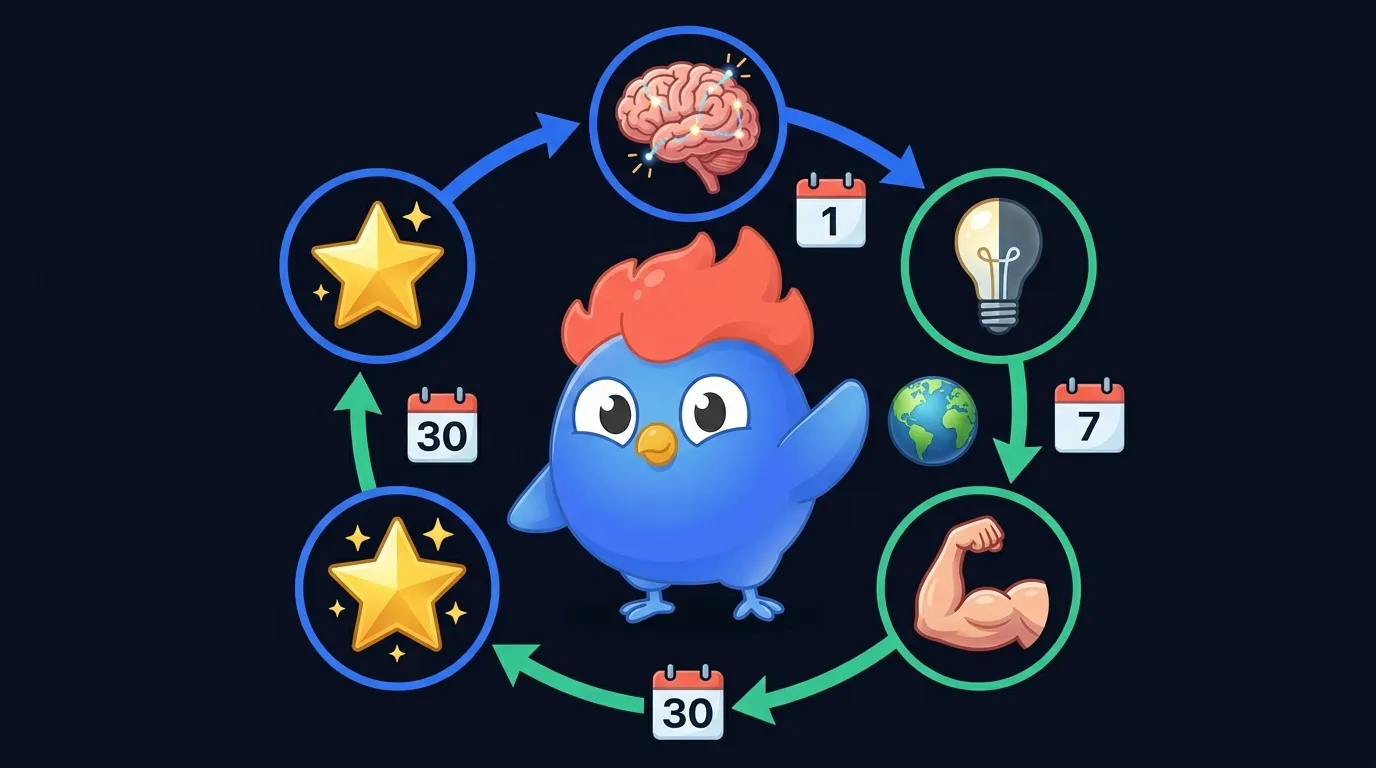
For solo practice, LearnClash runs every geography question through a three-stage spaced repetition schedule. Miss a borders question today and it comes back in 7 days. Get it right and it waits 90 days; get it right again at that 90-day check and it graduates to Mastered, which parks it until a future miss pulls it back down a stage.
Solo sessions are six questions each, so a single session is closer to a coffee break than a study block. We wrote up why we settled on 7 and 90 instead of the textbook 1/3/7/21 ladder in a separate post.
“Retrieval practice produces more learning than elaborative studying with concept mapping.” Karpicke & Blunt, Science (2011)
That finding is the reason a quiz beats rereading an atlas. Trying to recall an answer and getting it wrong teaches you more than reading the right answer ten times, which is why the questions you miss here are the ones worth writing down. The borders round is where that will happen most.
If you want more variety, try 43 general knowledge questions with answers, 43 sports trivia questions, or 37 science trivia questions.
Frequently asked questions
What are the hardest geography trivia questions?
The hardest geography trivia involves counterintuitive borders, surprising population stats, and obscure world records. Questions about which African country is entirely surrounded by another or which hill has an 85-letter name trip up even geography buffs. LearnClash ranks geography questions by difficulty so you can progress from easy to expert.
How many geography questions do I need for a trivia night?
A solid trivia night needs 30 to 50 questions split across 4 to 6 rounds. Mix easy capital city questions with hard physical geography to keep every team engaged. LearnClash generates fresh geography trivia at every difficulty level, perfect for building custom rounds.
Is there a geography trivia app with ranked matchmaking?
LearnClash shows an ELO-style rating across 8 tiers from Iron to Phoenix and computes it with Glicko-2 under the hood. You get matched against players near your skill level on any topic including geography. Spaced repetition helps you remember capitals, borders, and records long after the quiz ends.
What geography categories work best for pub quiz rounds?
Countries and capitals, physical geography like mountains and rivers, borders and neighbors, and world records make the strongest pub quiz rounds. LearnClash covers all of these and lets you create custom geography topics on anything from African capitals to island nations.
Can I use these geography questions for a pub quiz?
Yes. Split the 43 questions into 4 rounds by category. Award 1 point for easy, 2 for medium, 3 for hard. This scoring keeps weaker teams in the game while rewarding deep knowledge. For more questions, LearnClash generates fresh geography trivia.