
67 Bar Trivia Questions [6 Rounds, Answers, Stumpers]
67 bar trivia questions across 6 rounds with answers and why each stumps people. Test your bar trivia team on LearnClash.
How many do you know?
Think of your answer, then reveal it.
Did you know it before revealing the answer?
Read this answer in the articleRound complete
Turn what you know into a quiz duel.
Start a new duel in LearnClash and learn from every answer.
Get LearnClashFree to play on iPhone and Android. No ads.
Try the questions you missed once more.

A Yorkshire pub ran the first recorded pub quiz back in 1946. Fast forward to 2024 and the same idea had grown into a $3.4 billion industry.
What follows is 67 bar trivia questions with answers, split into six themed rounds: Sports, Music, Movies & TV, Food & Drink, Geography, and a Pop Culture Wildcard. Every question carries a short note on why teams trip over it, because the miss patterns are half the fun of hosting. Everything here got another pass in August, and a few answers the old version was sloppy on, from Michael Jackson’s first MTV video to Canada’s coastline math, are now fixed.
Duel me on bar trivia classics
Quick Overview
Five themed rounds of 11 questions, then a 12-question Pop Culture Wildcard: 18 easy, 30 medium, 19 hard. More than two thirds of the set sits at medium or hard, because wager rounds, not easy openers, are what win a close night.
| Round | Questions | Easy | Medium | Hard |
|---|---|---|---|---|
| Round 1: Sports | 11 | 3 | 5 | 3 |
| Round 2: Music | 11 | 3 | 5 | 3 |
| Round 3: Movies & TV | 11 | 3 | 5 | 3 |
| Round 4: Food & Drink | 11 | 3 | 5 | 3 |
| Round 5: Geography | 11 | 3 | 5 | 3 |
| Round 6: Pop Culture Wildcard | 12 | 3 | 5 | 4 |
| Total | 67 | 18 | 30 | 19 |
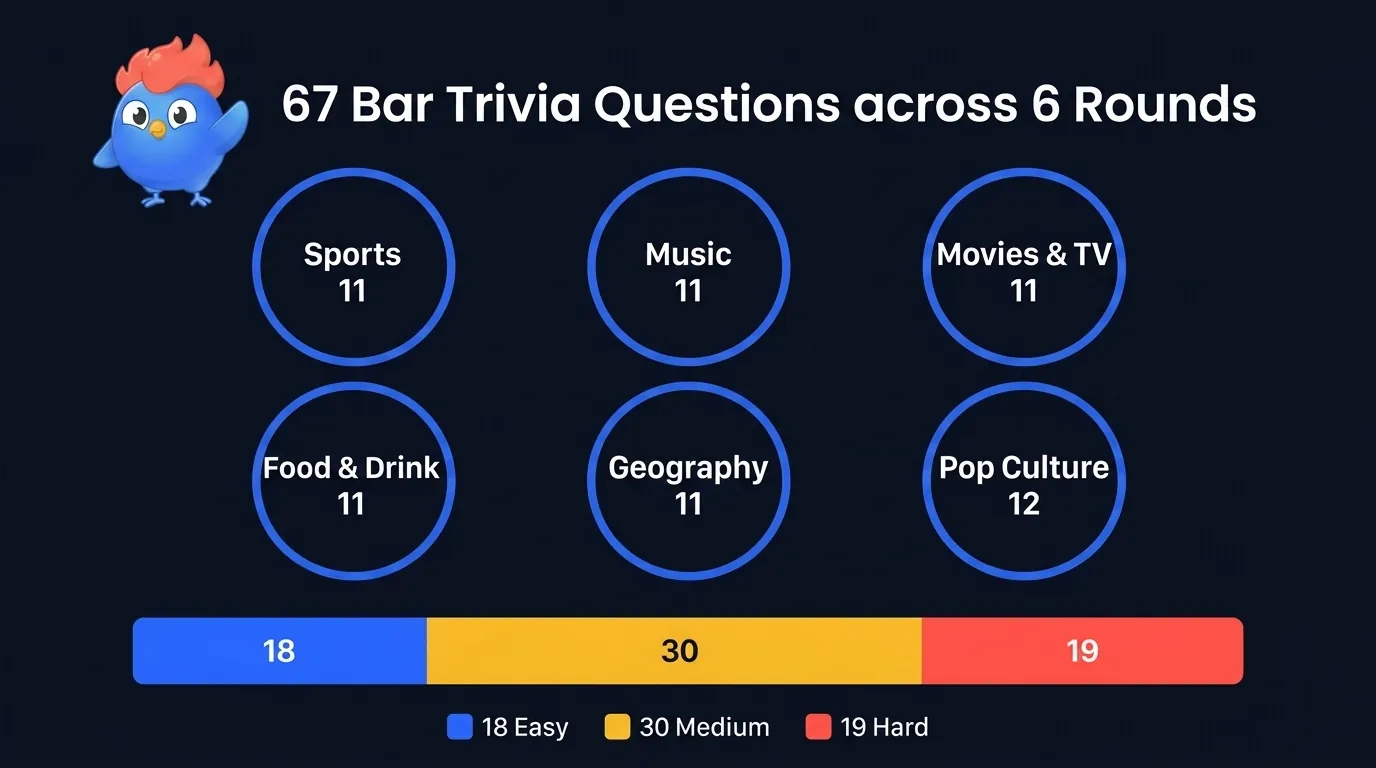 67 questions, six rounds, weighted toward medium and hard.
How Bar Trivia Works
Strip it down and a pub quiz is a timed team contest. It runs 4 to 6 rounds with 5 to 12 questions each, which puts the full set somewhere between 20 and 72 questions across a 90 to 120 minute night. The host reads aloud, teams of three to five scribble answers on paper, and near the end a wager round lets teams bet points on a question they pick blind.
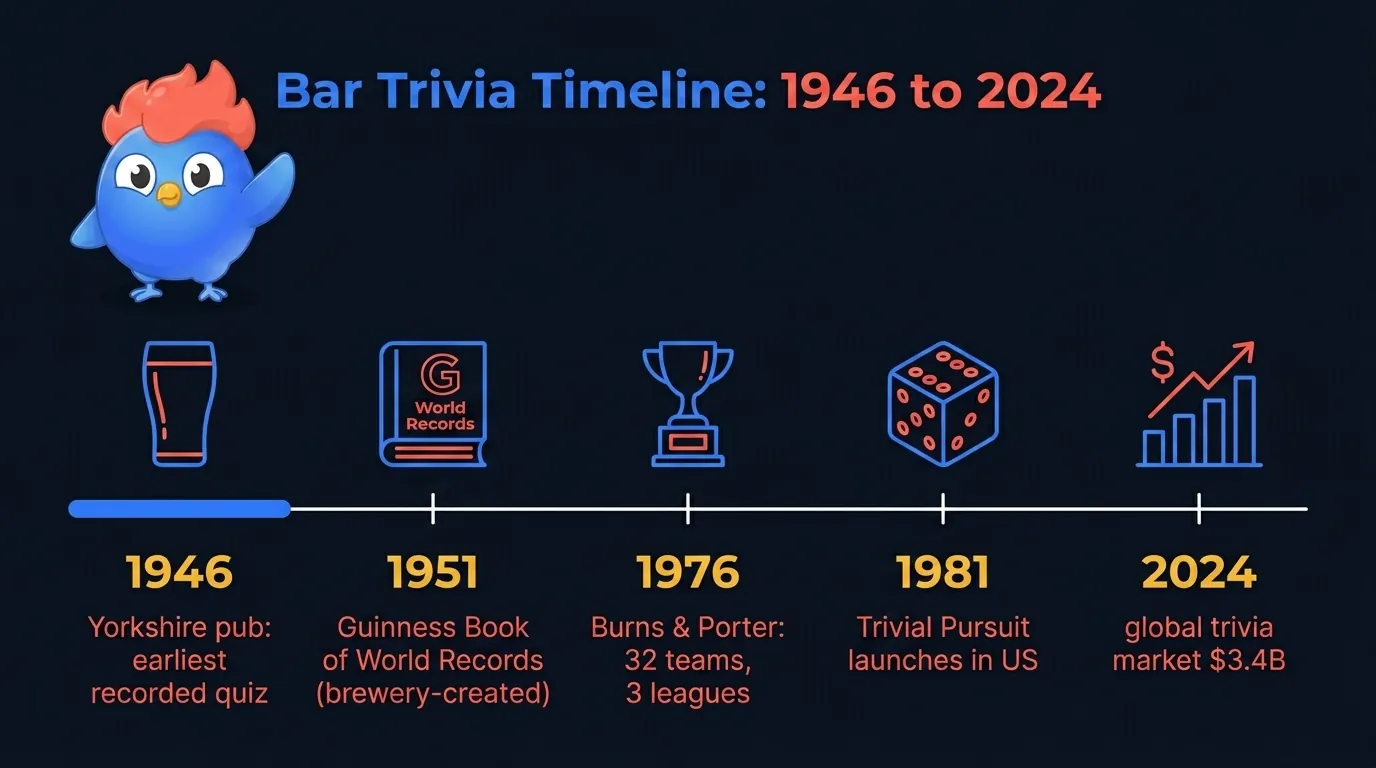 From a 1946 Yorkshire pub night to a $3.4 billion industry.
Bar trivia’s lineage runs through British pub culture:
- 1946: the earliest recorded pub quiz night takes place in a Yorkshire pub.
- 1976: Sharon Burns and Tom Porter formalise the modern format with 32 teams across three southern-England leagues, pitching breweries on quizzes as a way to fill slow Tuesdays.
- 1981: Trivial Pursuit launches and turns casual trivia into a household habit.
- Mid-1980s: US bars start running weekly trivia nights, borrowing the British format.
- 2024: the global trivia games market reaches $3.4 billion (Dataintelo).
The business case is blunt enough that operators publish it. Geeks Who Drink, one of the bigger US quiz companies, lists 800+ weekly events and $1,000+ average increased sales on its bar-owner page, and a 2023 CNBC piece on the company, then at 650 active US venues, put trivia-night takings at three to ten times a normal night. Quiz nights fill slow shifts with groups who come back weekly.
A common host rule of thumb splits difficulty 30/50/20: thirty percent easy so everyone scores, fifty percent medium where teams argue it out, twenty percent hard for the diehards who swing the round. The 67 below tip a little heavier toward medium and hard.
I should admit the format shaped my own product. A LearnClash duel is 18 questions across six topics, which is a pub quiz night compressed into about three minutes, and the resemblance is not a coincidence. One pub-world habit survived into the app on purpose: the rating players climb is labeled ELO on screen, because that is the word quiz people actually use, while the math underneath is Glicko-2, which copes better with players who vanish for a month and come back rusty.
Round 1: Sports
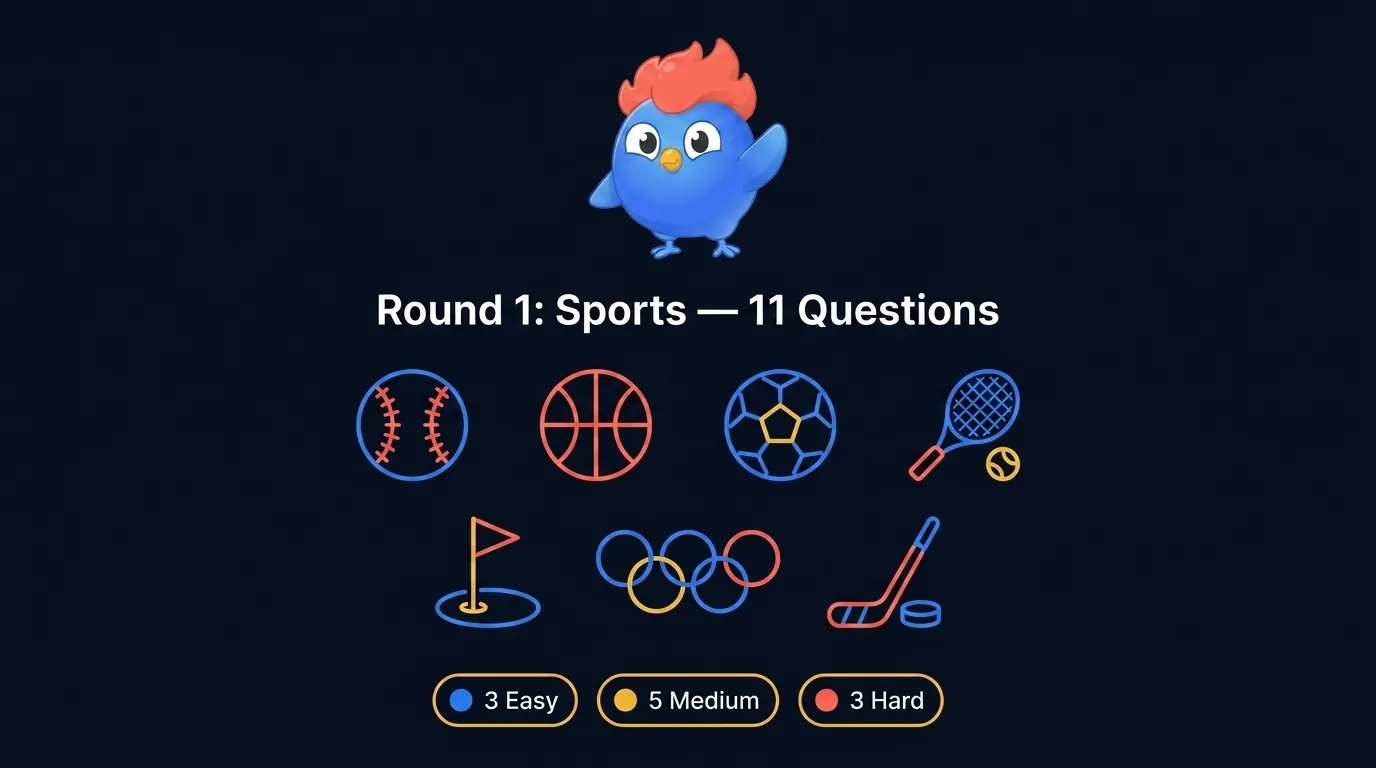
Few rounds split a room like sports. The fans run the table; everyone else guesses and hopes. The 11 questions here lean on classics that fool even the fans, mostly because half the table muddles rules, dates, and record-holders. For a longer grind, our full sports trivia deep dive runs a separate 43-question set with deeper biographical stumpers.
1. How many players are on the field for one baseball team at a time? Easy
Answer: Nine.
Ten slips out because softball sometimes runs a short fielder. Baseball holds at nine: pitcher, catcher, four infielders, three outfielders.
2. What sport is the Ryder Cup? Easy
Answer: Golf.
Your gut says tennis because the name sounds like a posh racquet trophy. It isn’t. The Ryder Cup is a biennial golf tournament between the United States and Europe, first contested in 1927.
3. How many holes are on a standard golf course? Easy
Answer: Eighteen.
The split used to be nine holes played twice, which is why the full round is still 18. Early Scottish courses ran anywhere from 7 to 25 holes before St Andrews locked the 18-hole standard in place during the 1760s.
4. Which country has won the most FIFA men’s World Cups? Medium
Answer: Brazil.
Germany and Italy sit at four titles each. Brazil holds five (1958, 1962, 1970, 1994, 2002). The 2014 win in Rio pulls a lot of teams toward Germany, but Brazil’s record was already half a century old by then.
5. In tennis, what score follows “40-40”? Medium
Answer: Deuce.
Not 50-50. Tennis scoring freezes at 40-40 and becomes deuce, requiring a two-point gap to win the game. After deuce, the server’s lead is called “ad-in” and the receiver’s is “ad-out”. The 15-30-40 numbers come from a medieval clock-face metaphor nobody quite agrees on.
6. The modern Olympic Games began in what year? Medium
Answer: 1896.
People swear the Olympics started in 1900 or 1904 because those were the first Paris and St Louis games. Wrong. Athens hosted the first modern Games in 1896, with 241 athletes from 14 nations, all of them men; women were first admitted at Paris 1900.
7. What three races make up horse racing’s Triple Crown in the US? Medium
Answer: Kentucky Derby, Preakness Stakes, Belmont Stakes.
Only 13 horses have ever swept all three in the same year. Secretariat’s 1973 run remains the benchmark. The British Triple Crown is a different set (2000 Guineas, Derby, St Leger); mixing them up costs points almost every trivia night.
8. How many points is a safety worth in American football? Medium
Answer: Two.
Not three. A safety scores when the offense is tackled in its own end zone: the defense gets 2 points plus the ball back on a free kick.
9. Who held the men’s 100m world record right before Usain Bolt broke it? Hard
Answer: Asafa Powell.
Track fans guess Maurice Greene, who held it in the late 1990s. Jamaican sprinter Asafa Powell lowered it to 9.74 seconds in 2007 before Bolt ran 9.72 in 2008, then 9.58 in 2009. Bolt broke his own record twice, and Powell’s name gets lost between those runs.
10. Which country topped the medal table at the Tokyo Olympics (held in 2021)? Hard
Answer: The United States.
China finished with 38 golds, the USA with 39. One single gold medal decided first place; on total medals the USA led 113 to 88.
11. Who holds the record for most Formula One world championships? Hard
Answer: Lewis Hamilton and Michael Schumacher, tied at 7.
Schumacher won seven titles between 1994 and 2004. Hamilton matched him in 2020. Teams that write only one name lose the point.
Round 2: Music
Range beats depth in a music round. Classic rock heads sweep the 70s, streaming kids own the 2010s, and then the 80s arrive and split every team down the middle. These 11 cover artists, albums, and chart history, and they tend to separate the casual hummers from the people who actually read liner notes. Another 43 with deeper album-cut traps live in the full music trivia questions set.
 Round 2 tests genre breadth from Beatles to Beyoncé.
12. Which Beatles album features “Here Comes the Sun”? Easy
Answer: Abbey Road.
Sounds right. Isn’t, if you pick Let It Be. The song released on Abbey Road in September 1969, written by George Harrison. Let It Be came out in 1970 but was recorded earlier, which flips the order in most people’s memory.
13. What instrument did Louis Armstrong play? Easy
Answer: Trumpet.
That gravel voice sends people toward trombone instead of the horn. Armstrong actually started on cornet, moved to trumpet in the 1920s, and fell into singing almost by accident.
14. What band recorded “Bohemian Rhapsody”? Easy
Answer: Queen.
No trick on the band. The stump is the follow-up fact: the song runs 5 minutes 55 seconds, almost three times the 1975 radio-friendly norm. DJs told Freddie Mercury it would fail. It hit number one in the UK twice, once in 1975 and again in 1991.
15. As of 2026, which artist has won the most Grammy Awards? Medium
Answer: Beyoncé.
The confident answer is Michael Jackson or Stevie Wonder. Neither. Beyoncé passed conductor Sir Georg Solti’s long-standing record in 2023 with her 32nd Grammy and has kept winning since.
16. In what year was MTV launched? Medium
Answer: 1981.
1979 gets a lot of votes, mostly because disco was peaking then. But MTV did not launch until August 1, 1981, younger than most people remember. The first clip up was Video Killed the Radio Star by The Buggles, which is why hosts love running this and the next question back-to-back.
17. What was the first music video played on MTV? Medium
Answer: “Video Killed the Radio Star” by The Buggles.
A surprising number of teams write Michael Jackson. He did not appear on MTV until Billie Jean in 1983. The 1979 Buggles single was a prophetic pick: it predicted exactly what MTV would do to radio over the next decade.
18. Which pop star’s real name is Stefani Joanne Angelina Germanotta? Medium
Answer: Lady Gaga.
The stage name comes from Queen’s Radio Ga Ga, not from “gaga” as baby talk. Germanotta picked it in 2006 after producer Rob Fusari kept texting her the song title.
19. What is the best-selling album of all time worldwide? Medium
Answer: Michael Jackson’s Thriller.
Domestic US certifications list the Eagles’ Their Greatest Hits 1971-1975 at 38x Platinum, which leads some outlets to call it the US number one. Worldwide, Thriller still leads at an estimated 70 million copies sold since 1982.
20. The English lyrics to Frank Sinatra’s “My Way” were written by which singer? Hard
Answer: Paul Anka.
The tune is French (Comme d’habitude, 1967, by François and Jacques Revaux). Paul Anka wrote the English lyrics in 1968 for Sinatra, who recorded it that December. By his daughter’s account, Sinatra came to detest the song.
21. How many consecutive weeks did Pink Floyd’s “The Dark Side of the Moon” spend on Billboard’s Top 200? Hard
Answer: 741.
Most guess 100, maybe 200. 741 consecutive weeks, from 1973 to 1988; re-entries have pushed the cumulative total past 950 weeks since.
22. Who played the guitar solo on Michael Jackson’s “Beat It”? Hard
Answer: Eddie Van Halen.
Producer Quincy Jones called Van Halen at home, and Eddie cut the solo as a favor, refusing payment. By his own telling he finished it in two takes while the rest of his band was out of town.
Round 3: Movies & TV
Half the famous movie lines people recite at the table were never said that way, and the plot details are worse. These 11 dig into classics, Oscar history, and the details even die-hard fans flub under pressure. Our longer movie trivia questions with answers set piles on 43 more stumpers built around lines nobody ever actually delivered.
 From Wings to Pulp Fiction.
23. Who directed Jaws, E.T., and Jurassic Park? Easy
Answer: Steven Spielberg.
George Lucas gets the guess because of Star Wars. Spielberg directed all three. He and Lucas collaborated heavily in the 1980s (Indiana Jones was their shared baby), which is why their filmographies blur in people’s memory.
24. What city is the sitcom Friends set in? Easy
Answer: New York City.
Specifically Manhattan. Central Perk is fictional. Joey and Chandler’s apartment sits opposite Monica’s. The entire show shot on Stage 24 at Warner Bros. in Burbank, California. Even the iconic fountain from the opening credits is in LA, not NYC.
25. Which actor voices Buzz Lightyear in the original Toy Story? Easy
Answer: Tim Allen.
Not Tom Hanks (that is Woody). Tim Allen has voiced Buzz in every mainline Pixar film since 1995. Chris Evans took over for the 2022 spinoff Lightyear.
26. Which film won the first Academy Award for Best Picture? Medium
Answer: Wings.
The first ceremony in 1929 honored films from 1927 and 1928 with two top winners: Wings took Outstanding Picture, the ancestor of today’s Best Picture, and Sunrise took Unique and Artistic Picture, a category dropped the very next year.
27. In The Godfather, what is the Corleone family’s business front? Medium
Answer: Olive oil (Genco Olive Oil).
Mob movies blur together. The Genco Pura Olive Oil Company, named for family friend Genco Abbandando, was the legitimate face that covered the family’s real income from bootlegging and protection.
28. Which Pixar feature was the first fully computer-animated movie? Medium
Answer: Toy Story.
The 1995 release is the answer. Pixar’s short film Tin Toy won an Oscar in 1988, and Luxo Jr. in 1986 is often called the first CGI short. Toy Story is specifically the first full-length CGI feature film, and it took four years to make.
29. What is the name of the coffee shop in Friends? Medium
Answer: Central Perk.
“Central Park” is the park. Central Perk is the coffee shop, a pun on the park name and coffee percolators. The owner, Gunther, appears in 185 of 236 episodes across ten seasons and his last name is never revealed.
30. How many Oscars did Alfred Hitchcock win for Best Director? Medium
Answer: Zero.
Book readers nail this. Film-only fans do not. Hitchcock was nominated five times (Rebecca, Lifeboat, Spellbound, Rear Window, Psycho) and lost every time. He received an honorary Irving Thalberg Memorial Award in 1968, not a competitive Best Director trophy.
31. Which film was the highest-grossing of the 1990s worldwide? Hard
Answer: Titanic.
Teams guess Jurassic Park or The Lion King for the decade crown. Titanic (1997) grossed $1.84 billion in its original theatrical run, nearly double Jurassic Park’s $914 million. Re-releases have since pushed it past $2.2 billion.
32. How did The Sopranos series finale end in 2007? Hard
Answer: A sudden cut to black, mid-scene.
No final shot. No goodbye. Tony Soprano sits in a diner. Don’t Stop Believin’ plays. The bell rings. The screen cuts to black for 10 full seconds before the credits. Creator David Chase has refused to say whether Tony died.
33. In Pulp Fiction, what is inside the mysterious briefcase? Hard
Answer: Unknown. Never revealed.
The briefcase glows orange when opened. Quentin Tarantino has said publicly there is no canonical answer. The briefcase combination 666 and the missing band-aid on Marsellus Wallace’s neck have fuelled the soul-theft fan theory for over 30 years.
Round 4: Food & Drink
Ask any regular which round decides the night and they’ll point straight at food and drink. Origin stories blur together, etymology traps sit behind half the answers, and good luck getting a table to agree on what actually goes in a classic cocktail. An even nastier set of stumpers waits in our longer food and drink category breakdown.
Test yourself on the stumper round →
34. What country is credited with inventing pizza in its modern form? Easy
Answer: Italy.
Flatbread with toppings existed across the Mediterranean for centuries. The Margherita pizza in Naples (1889), named for Queen Margherita of Savoy, is the modern version’s origin. Tomato, mozzarella, basil: the Italian flag, on bread.
35. What is the main ingredient in guacamole? Easy
Answer: Avocado.
No trick, but the name catches people. Guacamole comes from Nahuatl ahuacamolli: ahuacatl (avocado) plus molli (sauce). The Nahuatl word for avocado also doubled as slang for “testicle”.
36. Tequila is made from which plant? Easy
Answer: Blue agave.
Cactus is the confident wrong answer. Blue agave is a succulent, not a cactus. To be labeled tequila, a spirit must contain at least 51% blue agave and be produced in five specific Mexican states, primarily Jalisco.
 The stumper round.
37. What is the world’s most consumed beverage besides water? Medium
Answer: Tea.
Nearly everyone says coffee. By cups drunk, tea wins: a kilogram of leaves brews far more servings than a kilogram of beans, it costs less per cup, and it is the default daily drink across China and India, which between them hold over a third of the world’s population.
38. Which English queen gave her name to the Bloody Mary cocktail? Medium
Answer: Mary I.
“Bloody Mary Tudor” ruled from 1553 to 1558 and executed nearly 300 Protestants, which earned the nickname. The cocktail appeared in 1920s Paris and New York, and the name attached later: the colour is tomato juice, the etymology is the Tudor purge.
39. What spice is the most expensive by weight in the world? Medium
Answer: Saffron.
Vanilla and cardamom get guessed. Neither comes close. Wholesale saffron sits between $5,000 and $10,000 a kilogram because it takes around 150 flowers to produce one gram of dried stigmas, harvested by hand, and the harvest window is three weeks in autumn.
40. Which country produces the most coffee in the world? Medium
Answer: Brazil.
Colombia has the brand recognition. Brazil has the volume, producing close to 40% of the world’s coffee, more than double second-place Vietnam’s output. The state of Minas Gerais grows more than half of Brazil’s total.
41. In which country was the Caesar salad invented? Medium
Answer: Mexico.
Two words trip people up: Caesar salad. It sounds Italian, and the name invites Roman associations. It was invented in Tijuana, Mexico in 1924 by Caesar Cardini, an Italian immigrant running a restaurant for American tourists during Prohibition.
42. What separates whiskey spelled with an ‘e’ from whisky without? Hard
Answer: Geographic origin.
The spelling tracks country of origin. Whiskey (with an ‘e’) is used by Ireland and the United States. Whisky (no ‘e’) is used by Scotland, Canada, and Japan. The rule holds on almost every major label, with occasional marketing exceptions like Maker’s Mark.
43. Name the three ingredients of a classic Negroni. Hard
Answer: Gin, Campari, sweet vermouth.
The 1:1:1 ratio is the catch. Count Camillo Negroni asked a Florence bartender in 1919 to strengthen his Americano by swapping soda for gin. The result: equal parts gin, Campari, and sweet vermouth, stirred over ice, with an orange peel.
44. Champagne must legally come from which specific region of France? Hard
Answer: Champagne.
The name has been legally protected since the Madrid Agreement of 1891. The Champagne AOC, with its strict production rules, followed in 1936. Sparkling wine from anywhere else goes by other names. Crémant, Cava, Prosecco, and Sekt are the best-known examples. Only wine from the Champagne region northeast of Paris, made under the AOC rules including the méthode champenoise, carries the name legally.
Round 5: Geography
Borders, capitals, and record-holders have moved around more since 1990 than most people clock. The 11 below chase the extremes and the trick capitals, the kind that veterans miss about as often as first-timers.
45. What is the capital of Australia? Easy
Answer: Canberra.
Sydney and Melbourne fought over the honour in the early 1900s. Canberra was purpose-built in 1913 as a compromise, roughly halfway between them. It now houses Parliament, the High Court, and about 450,000 people.
46. Which is the longest river in Africa? Easy
Answer: The Nile.
The Nile runs about 6,650 kilometres from the East African highlands to the Mediterranean, crossing 11 countries. Some hydrologists argue the Amazon is longer overall. The Nile held the “longest river in the world” title for most of the 20th century before the source debate opened up.
47. Which US state has the largest total area? Easy
Answer: Alaska.
Texas owns the cultural space. Alaska is physically larger than Texas, California, and Montana combined, covering 665,384 square miles. Russia sold it to the US in 1867 for $7.2 million, roughly two cents per acre at the time.
48. Which country has the most natural lakes? Medium
Answer: Canada.
The guess is almost always Finland or Russia. Canada holds the record with an estimated 2 million lakes, containing about 20% of the world’s freshwater.
49. How many African countries does the Sahara Desert touch? Medium
Answer: Eleven.
Teams guess three or four. Eleven: Algeria, Chad, Egypt, Libya, Mali, Mauritania, Morocco, Niger, Sudan, Tunisia, and Western Sahara. At 9.2 million square kilometres, the Sahara is roughly the size of the lower 48 US states.
50. What is the smallest country in the world by area? Medium
Answer: Vatican City.
Plenty of teams write Monaco, which is actually second smallest. Vatican City wins at 0.49 square kilometres inside Rome, with fewer than 800 permanent residents. It runs its own postal service, railway station, and army (the Swiss Guard).
51. Which continent has the most countries? Medium
Answer: Africa.
Europe feels like the obvious pick. It isn’t. Africa has 54 UN-recognised countries, against Europe’s roughly 44, depending on which Caucasus states you count. South Sudan, the newest African country, declared independence in 2011.
52. The Great Barrier Reef sits off the coast of which Australian state? Medium
Answer: Queensland.
New South Wales feels right because Sydney sits there. Wrong coast. The Great Barrier Reef runs about 2,300 kilometres along Queensland’s northeast coast, the largest living structure on Earth, big enough to be seen from orbit.
53. The longest place name in the world, at 85 letters, is a hill in which country? Hard
Answer: New Zealand.
Thailand and Wales get pitched because Bangkok’s ceremonial name and Llanfairpwllgwyngyll are both famous. Neither wins. Taumatawhakatangihangakoauauotamateaturipukakapikimaungahoronukupokaiwhenuakitanatahu, a 305-metre hill in Hawke’s Bay, New Zealand, carries 85 letters in the standard Māori spelling.
54. Which country has the longest coastline in the world? Hard
Answer: Canada.
People expect Russia or Indonesia. Canada’s coastline runs 202,080 kilometres, more than five times Russia’s. The Arctic archipelago does most of the work, adding thousands of small islands whose shorelines all count in the total.
55. Mount Everest straddles the border of which two countries? Hard
Answer: Nepal and China.
India trips people up, since the Himalayas cut right through it. Everest actually sits on the Nepal-China border, north face in Tibet (China), south face in Nepal. India’s highest peak, Kanchenjunga, stands 130 kilometres east as the world’s third-highest mountain.
Round 6: Pop Culture Wildcard
Here’s the round nobody could have answered a generation ago: memes, startups, emoji, internet history. Twelve questions instead of eleven, because this is where tie-breakers come from. Bring a player under 30 and you’ll feel the edge. The older-school classics live in our general knowledge trivia questions set.
 The tie-breaker round.
56. What colour is Sesame Street’s Cookie Monster? Easy
Answer: Blue.
Brown shows up on more answer sheets than you’d think. Cookie Monster has been blue since his 1969 Sesame Street debut; the proto-monster in 1966 General Foods cookie commercials wore different fur.
57. What company makes the iPhone? Easy
Answer: Apple.
No trap on company. The stump is the year: the first iPhone launched on June 29, 2007, later than most people remember. It had no App Store (that came in 2008), no copy-paste (until 2009), and no 3G (until the iPhone 3G in 2008).
58. What is the name of the coffee shop in Friends? Easy
Answer: Central Perk.
This overlaps with Round 3 on purpose. The pop culture version of the stump is the spelling. Not “Park”. Perk, a pun on coffee percolators. The recreated set is now a permanent exhibit at the Warner Bros. studio tour in Burbank.
59. What year did the first Harry Potter book come out? Medium
Answer: 1997.
Teams default to 1998, because the US release landed in September 1998 as Sorcerer’s Stone. The UK first edition, Harry Potter and the Philosopher’s Stone, actually came out June 26, 1997, in a print run of only 500 copies. Those now go for over £100,000 at auction.
60. In what year did the Berlin Wall fall? Medium
Answer: 1989.
1990 is the trap, since that is when German reunification happened. But the physical wall came down in 1989, on the night of November 9, after East German spokesman Günter Schabowski announced open borders at a press conference, by accident. Reunification followed politically on October 3, 1990.
61. Who is the most-subscribed individual creator on YouTube as of 2026? Medium
Answer: MrBeast.
T-Series, the Indian music label, held the top overall slot from 2019 to mid-2024. MrBeast (Jimmy Donaldson) passed T-Series in 2024 and kept climbing. PewDiePie, the long-reigning number one among individual creators, had been overtaken years earlier.
62. Which social media platform was first called FaceMash? Medium
Answer: Facebook.
FaceMash (2003) was Mark Zuckerberg’s Harvard-only precursor that let students rate each other’s appearance. He took it down within a week under university pressure and launched TheFacebook in February 2004. The “The” dropped in 2005 when Zuckerberg bought the domain.
63. The hashtag symbol entered mainstream social media after a 2007 tweet on which platform? Medium
Answer: Twitter.
Chris Messina tweeted on August 23, 2007: “how do you feel about using # (pound) for groups?” The first big real-world use came two months later, when San Diego residents tracked the October 2007 wildfires under #sandiegofire. Twitter itself did not turn hashtags into links until 2009, and Instagram did not add hashtag search until 2011.
64. Who created the first emoji set in 1999? Hard
Answer: Shigetaka Kurita.
Apple or Unicode is the usual answer, and both miss. Kurita designed 176 emoji at NTT DoCoMo in Japan in 1999 for an early mobile messaging product. MoMA in New York acquired the original set for its collection in 2016.
65. Which novel coined the phrase “Big Brother is watching you”? Hard
Answer: Nineteen Eighty-Four, by George Orwell.
Say Brave New World (Huxley, 1932) and you’ve gone for the wrong dystopia, different themes entirely. Orwell published 1984 in 1949, one year before his death. The phrase “Big Brother is watching you” appears on posters across Oceania and slid into English as shorthand for state snooping.
66. What was Google called when Larry Page and Sergey Brin started building it at Stanford in 1996? Hard
Answer: BackRub.
BackRub ran on Stanford servers from 1996 to 1997 and ranked pages by counting backlinks (hence the name). Page and Brin renamed it Google in September 1997, a play on “googol” (10^100), and incorporated the company a year later. They nearly sold the whole thing for $1 million to Excite in 1999.
67. Before Jeff Bezos settled on “Amazon” in 1994, what other name did he briefly register for his company? Hard
Answer: Cadabra.
As in abracadabra. Bezos registered Cadabra Inc. in July 1994, then changed the name three months later after a lawyer misheard it over the phone as “cadaver”. He also liked that the new name sorted near the top of the alphabetical web directories of the day. Amazon fit.
Running the Night
To host a full evening with this set, run the six rounds in order. Read each question twice, allow a minute of huddle time, and keep the running totals public between rounds. Slot the wager round near the end and let teams bet 1 to 5 points on a topic they commit to blind; that single round swings most nights, because a spread-thin team has no other way to close a five-point gap in the final stretch. For an office offsite or retreat, our team-building trivia guide reworks the format into 73 workplace-safe questions, remote-async mode included.
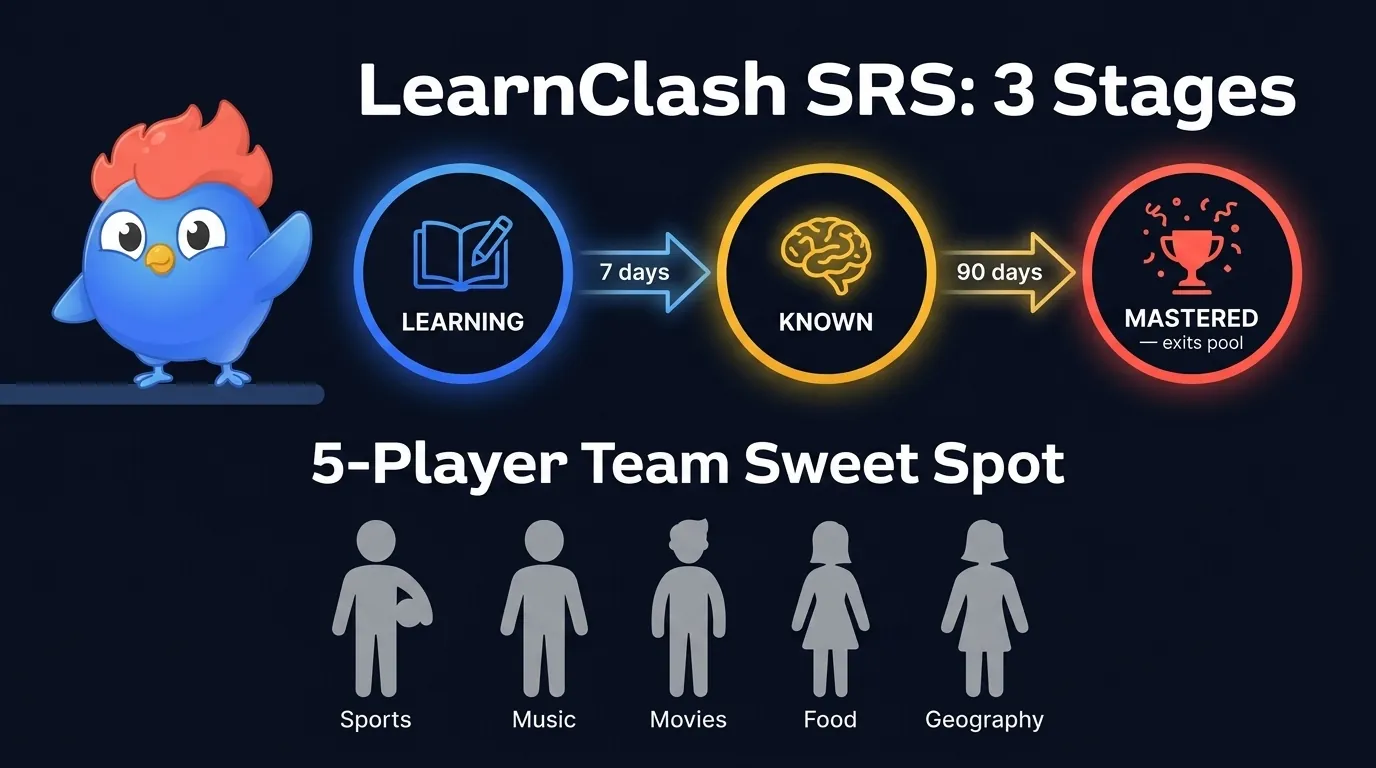
Teams win on coverage, not headcount. Four to six players is plenty; past that, one pen serves too many voices and the quiet specialist stops being heard. So recruit for holes, not bodies. If your bench is already deep on sports and music, grab a food-and-drink person before you add a ninth sports fan.
The unglamorous part is practicing before the night. In LearnClash, every question you miss comes back on a spaced repetition schedule, at 7 days and again at 90, so the stumpers from this page actually stick by next week’s quiz. Solo sessions run 6 questions, duels run the full 18 across six topics, and duels match you against players at your own rating. I skewed this set toward the harder tiers for the same reason hosts do: an easy round warms the room up, but nobody is still quoting the warmup at last call.
 Missed questions return at 7 and 90 days, then leave the review pool.
Frequently Asked Questions
How many rounds does bar trivia usually have?
Bar trivia typically runs 4 to 6 rounds with 5 to 12 questions each, totaling 20 to 72 questions across 90 to 120 minutes. This guide covers 67 questions split across 6 rounds (Sports, Music, Movies & TV, Food & Drink, Geography, Pop Culture) with answers, difficulty tags, and stumper explainers. LearnClash mirrors the format with 18-question duels across 6 different topics, playable in roughly 3 minutes.
What are the best categories for bar trivia?
Sports, music, movies and TV, food and drink, geography, and a pop culture wildcard carry the most broad-appeal bar trivia questions and answers. LearnClash generates bar trivia questions across these six categories plus dozens more (history, science, marvel, bible, video games) with difficulty tiers at every level.
Who invented bar trivia?
Sharon Burns and Tom Porter are credited with formalising the modern bar trivia format in 1976, launching 32 teams across three southern-England leagues to fill slow pub nights. The earliest recorded pub quiz predates them in a 1946 Yorkshire pub. Bar trivia arrived in the US in the mid-1980s after Trivial Pursuit's 1981 launch made casual trivia a household habit.
What is the ideal bar trivia team size?
Four to six people. A team of five covers sports, music, movies, food, and geography with one odd voice to break 50/50 arguments, and past six or seven the sheet has one pen and too many opinions. Recruit for coverage rather than headcount. LearnClash plays 1v1 duels at every rating tier, which covers the gaps when your team is short a specialist.
Can I use LearnClash to practice for bar trivia?
Yes. LearnClash generates bar-trivia-ready questions on any topic at every difficulty tier. Practice mode runs 6 questions per solo session and duel mode runs 18 questions across 6 topics. Our spaced repetition engine brings missed questions back at 7 days and 90 days so the stumpers stick before your next trivia night.