
Team Building Trivia: 73 Questions [8 Rounds + Answers]
73 team building trivia questions across 8 rounds with answers. Team-size rules from Ringelmann and Bezos, a remote-team format, and LearnClash async duels.
How many do you know?
Think of your answer, then reveal it.
Did you know it before revealing the answer?
Read this answer in the articleRound complete
Turn what you know into a quiz duel.
Start a new duel in LearnClash and learn from every answer.
Get LearnClashFree to play on iPhone and Android. No ads.
Try the questions you missed once more.

In 1913, a French engineer asked groups to pull a rope. Eight people pulled only 392 units where the sum of their solo pulls said 800, so each person worked at 49% of individual capacity. Bigger team, smaller share.
That number shapes everything on this page. These 73 team building trivia questions and answers run as eight rounds for workplace play: Icebreaker, Pop Culture, Science & Tech, Workplace History, Geography, Food & Drink, Sports, and a Wildcard tiebreaker. Every question ships with an answer and a short note on where the room goes wrong.
Ahead of this August update, every one of the 73 answers went back under review, and what failed got cut. A hot dog “patent” attributed to one John T. Dorgan turned out not to exist, a factoid about the chemical symbol for gold collapsed the moment I looked at iron, and a Microsoft stock-split calculation was off by a factor of 30. Each fix is noted where it happens.
Jump to whichever round fits your crew, or start a team trivia duel on any topic in LearnClash. This guide sits inside our full trivia questions library; for a broader remote menu than trivia, the virtual team building games ranking covers Zoom games, async rituals, and no-camera options.
Duel me on team trivia classics
Round Lineup at a Glance
73 questions, 8 rounds, weighted toward the middle and the top: 20 easy, 33 medium, 20 hard. Warm-up rounds keep nobody at zero, and the wildcard at the end is what actually decides who wins.
| Round | Questions | Easy | Medium | Hard |
|---|---|---|---|---|
| Round 1: Icebreaker | 7 | 3 | 3 | 1 |
| Round 2: Pop Culture | 11 | 3 | 5 | 3 |
| Round 3: Science & Tech | 12 | 3 | 6 | 3 |
| Round 4: Workplace History | 11 | 3 | 5 | 3 |
| Round 5: Geography | 9 | 2 | 3 | 4 |
| Round 6: Food & Drink | 9 | 3 | 4 | 2 |
| Round 7: Sports & Games | 7 | 2 | 3 | 2 |
| Round 8: Wildcard Tiebreaker | 7 | 1 | 4 | 2 |
| Total | 73 | 20 | 33 | 20 |
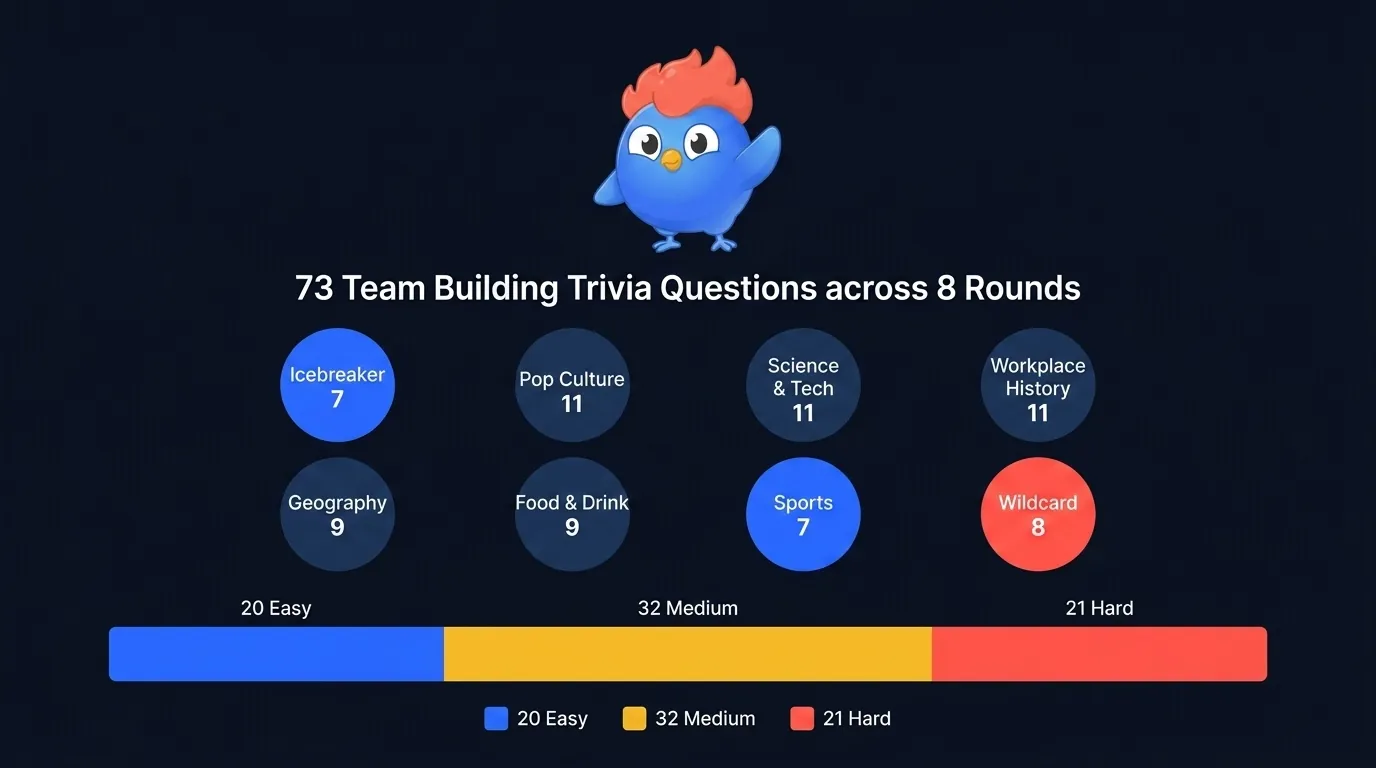 Medium and hard carry the weight, since that is where the wildcard tiebreaker lives.
How Team Building Trivia Works
Team building trivia is a short team contest: 4 to 8 rounds of 7 to 12 questions each, budgeted at 45 to 75 minutes for a live night. Hosts read aloud, teams of 3 to 8 write answers, and a wildcard round near the end lets teams bet points. LearnClash runs the same shape as an 18-question async duel across 6 rotating topics, at about three minutes per turn.
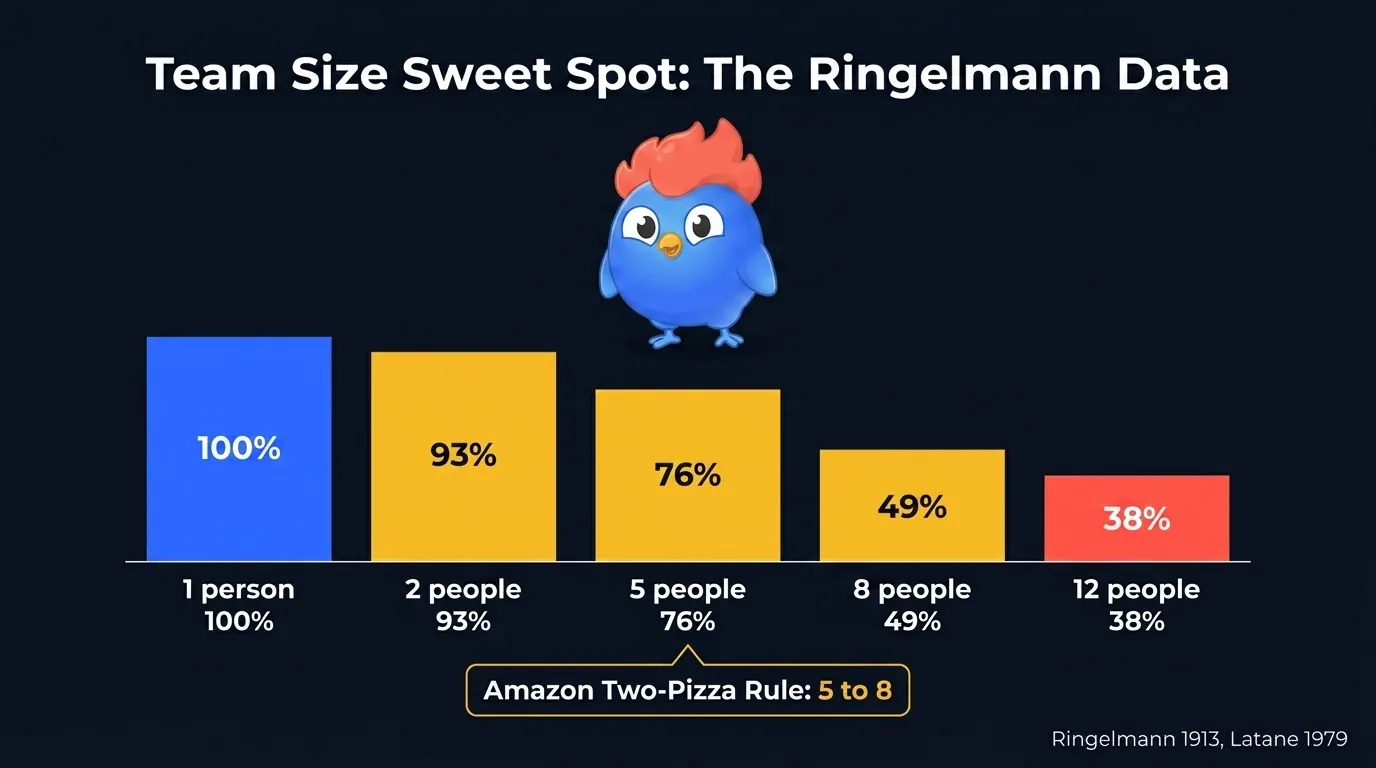 The Ringelmann curve: per-person effort falls as the team grows.
The team-size research has been repeating itself for a century:
- Ringelmann, 1913: 8 people pull 392 units against a theoretical 800. Effort drops 51%.
- Amazon’s Two-Pizza Rule: Bezos capped teams at what two pizzas can feed, usually 5 to 8 people.
- Bibb Latané, 1979: people in 6-person shouting groups produced only 36% of their solo volume. Social loafing, measured in decibels.
- Robin Dunbar: relationship layers at 5, 15, 50, and 150. Past 15, shared context thins fast.
- W. L. Gore, the Gore-Tex company, capped plants near 150 people, because past that point names and faces stop attaching.
So the sweet spot for a trivia team sits at 5 to 8 people. Small enough that the quiet one speaks up, big enough to cover four or five topics without a blind spot. Push past 10 and the loudest voice answers everything while the rest coast.
Whether any of this matters at work is a fair question. Gallup’s 2024 report put global engagement at 21%, with 25% of fully remote workers reporting loneliness the previous day, and since manager quality drives 70% of team engagement, a weekly quiz will not fix a bad manager. But a 10-minute Friday round is cheap, and it leaves behind a shared joke that survives the week.
Round 1: Icebreaker Warm-Up
Seven questions with a 3/3/1 split, built so nobody goes home at zero after the warm-up. If you want open prompts with no factual answer key, the 163 ice breaker questions list, the 211 this-or-that questions set, and the work-safe would you rather questions section all trade accuracy for conversation.
 Low stakes on purpose: the warm-up exists so every team scores early.
1. How many days are in a leap year? Easy
Answer: 366.
The extra day lands on February 29. Leap years run every 4 years, except century years not divisible by 400. So 1900 was not a leap year, but 2000 was.
2. What colour do you get when you mix blue and yellow? Easy
Answer: Green.
Simple paint-mixing fact the whole room nails. Use it to test that your host’s microphone works.
3. How many continents are there? Easy
Answer: Seven.
Africa, Antarctica, Asia, Australia, Europe, North America, South America. Some geographers argue for six (merging Europe and Asia into Eurasia) or five (adding the Oceania lump), so expect a debate at table 3.
4. What is the capital of Australia? Medium
Answer: Canberra.
Sydney is the trap, because Sydney is the biggest city and the one everyone pictures. Canberra got the job as a compromise capital in 1908, sited between Sydney and Melbourne because neither would let the other win.
5. What element has the chemical symbol “Au”? Medium
Answer: Gold.
From the Latin aurum. This page once claimed Au is the only symbol that shares no letters with its element’s English name; that is false (iron’s Fe, potassium’s K, and mercury’s Hg all qualify), so the claim is gone. The Latin holdovers are simply their own genre of trivia question, and one of them returns in Round 3.
6. How many keys are on a standard piano? Medium
Answer: 88.
52 white keys and 36 black keys. Harpsichords and early pianos had fewer; 88 became standard around 1880 when Steinway pushed the full seven-octave range as the professional default.
7. In Greek mythology, who was the king of the gods? Hard
Answer: Zeus.
Easy if you had a Percy Jackson phase. Hard if you mix up myths. Roman Jupiter is the match. Norse Odin is not, though plenty of players reach for him first.
Round 2: Pop Culture
Music, film, and TV that cross generations, split 3/5/3 because the mediums are where the table starts arguing. Our pub quiz questions set runs a parallel 97-question UK-slanted version.
 Eleven workplace-appropriate pop-culture questions across music, film, and TV.
Settle the argument in a pop culture duel →
8. What is the highest-grossing film of all time (unadjusted)? Easy
Answer: Avatar.
James Cameron’s 2009 sci-fi, re-released for the 2022 bump. Avengers: Endgame briefly held the top spot in 2019. Then the Avatar re-release took it back. On inflation-adjusted lists, Gone with the Wind has never been caught.
9. Who sang “Shake It Off” in 2014? Easy
Answer: Taylor Swift.
Lead single from 1989. Workplace-safe because the lyrics target critics, not exes. The Eras Tour later became the first concert tour in history to gross over $1 billion.
10. What does “HBO” stand for? Easy
Answer: Home Box Office.
Launched 1972 as the first subscription cable channel. The original plan was to broadcast movies directly into homes, skipping cinemas. The streaming service became HBO Max in 2020, was renamed to just Max in 2023, and reverted to HBO Max in 2025.
11. Which band released “Bohemian Rhapsody” in 1975? Medium
Answer: Queen.
Written by Freddie Mercury. Six minutes long. Radio said it was too long to chart. It spent nine weeks at UK number one, then the same recording topped the UK chart again in 1991 after Mercury’s death, a double no other single had pulled off.
12. Who directed Pulp Fiction (1994)? Medium
Answer: Quentin Tarantino.
The snappy dialogue sends a lot of players to Scorsese. Not him. Tarantino was 31 when Pulp Fiction won the Cannes Palme d’Or. The film made $213M on an $8M budget.
13. What was the first feature-length animated film? Medium
Answer: Snow White and the Seven Dwarfs (1937).
Disney bet the studio on it and nearly went broke during production. The gamble paid: its first release earned about $8 million, more than any other sound film had grossed to that point, and the money carried Disney through to Pinocchio.
14. Which 1990s sitcom was set in a coffee shop called Central Perk? Medium
Answer: Friends.
NBC, 1994 to 2004. Ten seasons. 236 episodes. The six lead actors negotiated pay as a bloc from season 3 on, and by season 9 they were pulling $1 million each per episode. Central Perk was a Warner Bros lot, not a real café.
15. Who painted the Mona Lisa? Medium
Answer: Leonardo da Vinci.
Painted between 1503 and 1519. An Italian handyman stole it from the Louvre in 1911, and the two-year hunt for it is a big part of how the portrait became the most famous painting in the world.
16. Who wrote the Harry Potter series? Hard
Answer: J.K. Rowling.
Seven books. 1997 to 2007. The first book was rejected by 12 publishers. Bloomsbury took it on the editor’s daughter’s say-so.
17. Which director made Parasite, the first non-English Best Picture Oscar winner? Hard
Answer: Bong Joon-ho.
South Korean. 2019. Parasite swept Best Picture, Best Director, Best Original Screenplay, and Best International Feature at the 2020 Oscars. Bong’s previous film in English, Snowpiercer, was a niche hit in 2013.
18. What year did Instagram launch, and who bought it in 2012? Hard
Answer: 2010; Facebook bought it for $1 billion.
Launched October 6, 2010 by Kevin Systrom and Mike Krieger. Facebook bought it in April 2012 for $1B in cash and stock. At the time Instagram had 13 staff and zero sales.
Round 3: Science & Tech Firsts
Invention dates are where teams bleed points in this round: overshoot a decade and the round is gone. My favourite fact in the set is ENIAC, 30 tons of computer sprawled across 1,800 square feet of floor.
 140 years of firsts, from the typewriter to the web.
19. What planet is closest to the sun? Easy
Answer: Mercury.
36 million miles out. Venus is hotter (450°C surface) thanks to greenhouse gases. But Mercury still wins on distance. A Mercury year is 88 Earth days.
20. What force keeps you on the ground? Easy
Answer: Gravity.
Newton wrote the math in 1687. Einstein reframed it as bent spacetime in 1915. Both work. Neither is the full story. Physicists still argue about gravitons.
21. What is the largest organ in the human body? Easy
Answer: The skin.
Adult skin weighs about 8 pounds and covers roughly 22 square feet. Liver is the reflex answer, and it is the biggest internal organ. But nobody said internal.
22. The ENIAC, the first general-purpose electronic computer, weighed how much? Medium
Answer: About 30 tons.
Also 1,800 square feet of floor. 18,000 vacuum tubes. 5 million hand-soldered joints. A single ballistics math run took a human 20 to 40 hours; on ENIAC it took 30 seconds. One tube blew every 1 to 2 days, and the team learned to swap a dead one in 15 minutes flat.
23. Who invented the @ symbol in email addressing, and when? Medium
Answer: Ray Tomlinson, 1971.
Tomlinson sent the first network email in 1971. He worked at BBN on ARPANET. He picked @ because it did not appear in names. In typed commerce, it meant “at”. He later said the first message was likely “QWERTYUIOP” or similar junk. He did not save logs.
24. In what year did humans first land on the moon? Medium
Answer: 1969.
July 20, 1969. Apollo 11. Armstrong and Aldrin walked. Collins stayed in orbit. 12 astronauts walked the moon across 1969 to 1972. Nobody has been back since Apollo 17 in December 1972.
25. What does “DNA” stand for? Medium
Answer: Deoxyribonucleic acid.
Found in 1869. The shape was cracked in 1953 by Watson, Crick, and Rosalind Franklin, whose X-ray image was the key piece of evidence and whose credit was underplayed for years. Franklin died of cancer in 1958 at age 37. The 1962 Nobel went to the other three.
26. Who is credited with inventing the World Wide Web in 1989? Medium
Answer: Tim Berners-Lee.
A British computer scientist at CERN. He wrote the first proposal in March 1989, built the first web browser in 1990, and posted the first public web page on August 6, 1991. Berners-Lee made no money from it. He gave the protocols away.
27. How many time zones does Russia have? Medium
Answer: 11.
The widest zone span of any country. The US has 9 (with Pacific territories). France has 12 across its overseas areas. So France sometimes wins this on a technicality.
28. In what year was the QWERTY keyboard layout designed, and by whom? Hard
Answer: 1870s, by Christopher Latham Sholes.
Sholes was a Milwaukee newspaperman. The layout was set by 1873, when he sold it to E. Remington & Sons, then a sewing-machine maker, and it became the standard in 1893 when the big typewriter makers merged. By one historian’s count, the typewriter itself was invented 52 times before a workable design stuck.
29. What is the chemical symbol for potassium? Hard
Answer: K.
From the Latin kalium, the Round 1 gold question’s promised sequel. Write P here and you’ve answered phosphorus instead. Potassium gets its name from “potash”, because early chemists pulled it from ashes in a pot.
30. How many bones does an adult human have? A newborn? Hard
Answer: 206 (adult); about 270 (newborn).
Newborns have roughly 270 bones. They fuse in childhood, mostly in the skull and pelvis, and adults settle at 206. Say 206 for both and you drop half a point on the newborn half.
Round 4: Workplace History & Culture
The stumper round: Post-it Notes, the 40-hour week, 15% time, and two company origin stories. Nobody studies where the office came from, which is exactly what makes it fair, and the fact that earns the most groans every time is that the Post-it started as a 1968 accident that took 12 years to reach stores. If your team wants a custom version of this round, LearnClash will generate questions for any topic you type in, including one as narrow as “history of the office”.
 The modern office hides more invention stories than most people expect.
31. What colour are classic Post-it Notes? Easy
Answer: Canary yellow.
And the colour was an accident. The scrap-paper lab next door to the Post-it team happened to use canary yellow for their sample sheets. 3M shipped the test batches on that paper, the yellow stuck (figuratively), and by product launch in 1980 it was the default.
32. How many hours make up a standard US workweek? Easy
Answer: 40.
The Fair Labor Standards Act of 1938 set the overtime threshold that phased down to 40 hours by 1940. Henry Ford had already moved his factories to a five-day, 40-hour week in 1926, years before the law required it.
33. What company makes the Post-it Note? Easy
Answer: 3M.
Minnesota Mining and Manufacturing. Founded 1902 as a mining prospect that failed. 3M now ships roughly 50 billion Post-it Notes per year.
34. Who invented Post-it Notes, and in what year did 3M launch them nationally? Medium
Answer: Spencer Silver (accidental adhesive, 1968) + Arthur Fry (bookmark use, 1974); launched April 6, 1980.
Silver was trying to make a super-strong glue at 3M in 1968 but got the exact opposite: a low-tack reusable one that nobody could figure out how to use. For five years he promoted his “solution without a problem” internally. Fry sat through one of those seminars, and in 1974 he used the weird glue to anchor hymn bookmarks in his church choir book. 3M rolled it out in 1977 as “Press ‘n Peel”; national launch as Post-it came on April 6, 1980.
35. What is “bootlegging” or “15% time” at 3M? Medium
Answer: Employees spend up to 15% of their work time on projects of their choosing.
Established in the 1940s at 3M. Arthur Fry used it to develop the Post-it. Google’s later 20% time policy (pre-2013) borrowed the same logic and produced Gmail, Google News, and AdSense.
36. What does “QWERTY” actually refer to, and what problem was it solving? Medium
Answer: The top-left six letters on a typewriter keyboard, designed to reduce typebar jamming.
Christopher Sholes placed frequently paired letters far apart so the physical typebars did not tangle. The layout had no ergonomic basis. Once the QWERTY typewriter was adopted by Remington in 1873 and standardised by 1893, it was too expensive to retrain typists for any other layout.
37. Who sent the first email, and in what year? Medium
Answer: Ray Tomlinson, 1971.
He sent it to himself across two adjacent ARPANET machines at BBN. Tomlinson said the message was probably random gibberish. He also chose @ as the address separator. Statista put daily worldwide email volume at 347 billion for 2023.
38. What was Jeff Bezos’s original company name before “Amazon”, and why did he change it? Medium
Answer: Cadabra; a lawyer misheard it as “cadaver” over the phone.
Bezos registered Cadabra Inc. in July 1994. After the cadaver mishearing, he went looking for something sturdier and registered the Amazon.com domain on November 1, 1994. He specifically wanted a name that would appear early in A-to-Z lists, back when alphabetical web directories still mattered.
39. What year did Microsoft IPO, and what was the starting share price? Hard
Answer: 1986; $21 per share.
March 13, 1986. Microsoft raised $61 million. Nine stock splits later, a single IPO share has become 288 shares (the 9,216 that used to sit here was bad math). Bill Gates was 30 at IPO.
40. Who founded Amazon, and in what year? Hard (Cadabra callback)
Answer: Jeff Bezos, 1994.
Bezos started Amazon in his Bellevue garage in July 1994 after reading that internet usage was growing 2,300% per year. Amazon went public May 15, 1997 at $18 per share.
41. What is the Ringelmann effect, first observed in what year? Hard
Answer: Per-person group output drops as the group grows; 1913.
French engineer Maximilien Ringelmann showed it with rope-pull tests, where two people pulled 186 units against a theoretical sum of 200 and eight people pulled only 392 against a sum of 800. Bibb Latané’s 1979 shouting study confirmed the pattern: 6-person teams hit only 36% of solo volume.
Round 5: Geography & World
Capitals, oceans, and definitional traps, split 2/3/4. Four hard questions at the end make this the round teams tend to save their wildcard for.
 Four of nine are hard, and the definitional traps do the damage.
Test your team’s map knowledge in a duel →
42. What is the largest country in the world by area? Easy
Answer: Russia.
17.1 million square kilometres. Canada is second at 9.98M, the US third at 9.83M, China fourth at 9.6M. Russia spans 11 time zones, which is the same question from a different angle.
43. Which ocean is the largest? Easy
Answer: The Pacific.
63.8 million square miles, covering roughly a third of Earth’s surface. Larger than all the land on Earth combined.
44. What is the longest river in South America? Medium
Answer: The Amazon.
Depending on which source of the Amazon you count, the Amazon and Nile swap number-one spots on “longest river” lists. On water volume there is no contest: the Amazon discharges more than the next seven largest rivers combined.
45. Which city is known as “The Big Apple”? Medium
Answer: New York City.
The nickname comes from 1920s horse-racing slang where “the big apple” meant the top tier of prizes. Sportswriter John J. Fitz Gerald of the New York Morning Telegraph picked it up around 1921 and popularised it in his racing column.
46. What is the smallest country in the world by area? Medium
Answer: Vatican City.
0.49 square kilometres, with a population of roughly 825. New York’s Central Park is about seven times larger.
47. Which desert is the largest in the world? Hard (polar counts)
Answer: The Antarctic desert.
Technically a desert because it receives less than 200 mm of precipitation per year. 14.2 million square kilometres, beating the Sahara by a factor of 1.6. The Sahara wins this table every time, because in most heads “desert” means “hot”.
48. What is the deepest point in the ocean, and how deep? Hard
Answer: The Challenger Deep in the Mariana Trench, about 36,000 feet (10,935 metres).
Deeper than Mount Everest is tall. The bathyscaphe Trieste made the first crewed dive in 1960, James Cameron made the first solo descent in 2012, and dozens of people have reached the bottom since commercial expeditions began in 2019.
49. Which country has the most official languages? Hard
Answer: Zimbabwe, with 16.
Zimbabwe’s 2013 constitution recognised 16 officially. South Africa has 12. India lists 22 at the national level plus hundreds at the state level, depending on how you count. South Africa is the answer half the room remembers from an old textbook, and it’s out of date.
50. What is the tallest mountain in the world measured from base to peak (not above sea level)? Hard
Answer: Mauna Kea in Hawaii.
33,500 feet from seafloor base, though only 13,803 feet above sea level. Everest is the tallest above sea level (29,032 feet), but Mauna Kea beats it by 4,500 feet if you start counting from the ocean floor.
Round 6: Food & Drink
The two-pizza rule earns its callback round. Nine questions on cuisine, drinks, and brand origins, kept deliberately accessible because food questions double as icebreakers. Deeper versions live in the food trivia questions set.
 Cuisine, beverages, and brand origin stories across nine questions.
51. What is the most consumed beverage in the world after water? Easy
Answer: Tea.
Coffee is the louder office presence, but tea wins on global volume, carried by China and India. Per capita, Turkey tops the charts at about 3.1 kg per person annually.
52. Which country invented pasta? Easy
Answer: China, most likely, with Italy perfecting it.
Archaeological evidence: a 4,000-year-old bowl of noodles was found in northwest China at Lajia. Italy formalised the dried-pasta production chain in Sicily around the 12th century under Arab influence. Marco Polo did not bring pasta to Italy; that is a 1920s marketing myth.
53. What coffee drink has equal parts espresso, steamed milk, and milk foam? Easy
Answer: Cappuccino.
1:1:1 ratio, traditionally served in a 5 to 6 oz cup. Latte uses more milk, flat white uses micro-foam, macchiato uses only a splash. The drink is named after the Capuchin friars’ brown robes.
54. In what year did McDonald’s serve its first Big Mac? Medium
Answer: 1967 (franchise test); 1968 (nationwide).
Invented by Jim Delligatti, a Pittsburgh-area franchisee, in 1967. McDonald’s rolled it nationwide in 1968 at 45 cents. The jingle came in 1975. The Big Mac index (The Economist, 1986) is still used as an informal purchasing-power parity measure.
55. Which country consumes the most coffee per capita? Medium
Answer: Finland.
12 kg per person per year, far ahead of Italy (5.5 kg) and the US (4.2 kg). Finnish collective bargaining agreements guarantee two 10-minute coffee breaks per working day.
56. Nathan’s Famous started selling hot dogs at Coney Island in 1916. What did one cost? Medium
Answer: 5 cents.
Nathan Handwerker had worked at Feltman’s, the established Coney Island hot dog house, and undercut his old employer’s 10-cent dog by half. The nickel price built the brand that still runs the July 4th hot dog eating contest. (This slot used to hold a hot dog “patent” question sourced to a John T. Dorgan; no such patent exists, so the question is retired.)
57. What is the origin of Jeff Bezos’s Two-Pizza Rule? Medium
Answer: No Amazon team should be bigger than two pizzas can feed (typically 5 to 8 people).
The rule dates to Amazon’s early years and was in circulation by the early 2000s. It survives even with Amazon past 1.5 million employees; teams stay small, and the org chart grows wide and shallow instead.
58. What is the world’s most expensive spice by weight? Hard
Answer: Saffron.
Roughly $5,000 to $10,000 per kilogram, depending on source region (Iranian saffron is the benchmark). 150,000 to 170,000 crocus flowers are needed to produce one kilogram, and every stigma must be hand-picked.
59. Which soft drink was originally sold as a medicine and formulated with cocaine? Hard
Answer: Coca-Cola.
John Stith Pemberton created it in Atlanta in 1886 as a patent medicine. The original contained roughly 9 mg of cocaine per glass (coca leaf extract) plus caffeine from kola nuts. Cocaine was fully removed in 1903, though trace de-cocainised coca leaf is still part of the secret formula.
Round 7: Sports & Games [Optional]
Optional, and deliberately short at 7 questions. Sports splits a room cleanly into fans and hostages, so read your crew: run it if you have fans, swap in a second wildcard if half the table is a sports-avoidant engineering team. Our bar trivia questions set and sports trivia questions set run deeper versions.
 Seven questions, flagged optional for a reason.
60. How many players are on a basketball team during a game? Easy
Answer: Five.
Per side, on the court. Rosters can be much larger (NBA teams carry 15 to 17). Five per side became the standard in 1897, and the 24-second shot clock arrived in 1954.
61. What sport is called “the beautiful game”? Easy
Answer: Soccer (association football).
The phrase was popularised by Pele’s 1977 autobiography, My Life and the Beautiful Game, and travelled globally with him.
62. Which board game, released in 1935, teaches players about real-estate markets? Medium
Answer: Monopoly.
Patented by Charles Darrow in 1935. The game was actually designed in 1903 by Elizabeth Magie as “The Landlord’s Game” to illustrate the dangers of rent-capture. Darrow copied most of her design. Parker Brothers bought the rights in 1935.
63. What chess piece can only move diagonally? Medium
Answer: The bishop.
Both bishops on the same colour stay on that colour the entire game, which is why endgame guides talk about “good” and “bad” bishops.
64. Which athlete holds the record for most Olympic gold medals? Medium
Answer: Michael Phelps, 23.
Across Athens 2004, Beijing 2008, London 2012, and Rio 2016. Second is Larisa Latynina with 9 (gymnastics, USSR, 1956 to 1964). Phelps also holds the overall Olympic medals record at 28 (23 gold, 3 silver, 2 bronze).
65. What year did the first modern Olympic Games take place, and where? Hard
Answer: 1896, in Athens.
14 nations and 241 male athletes. Women did not compete until Paris 1900. The revival was driven by Pierre de Coubertin, and only the World Wars have cancelled a Games since; the 2020 Tokyo edition slipped a year to 2021 instead.
66. Who invented basketball, and in what year? Hard
Answer: James Naismith, 1891.
A Canadian physical-education teacher at Springfield College in Massachusetts. Naismith wrote the original 13 rules on two pieces of paper and nailed them to a wall. The first hoops were peach baskets; somebody had to climb a ladder to retrieve the ball after every score.
Round 8: Wildcard Tiebreaker
Teams wager 1 to 5 points on a single question they pick before the host reveals the topic. The 1/4/2 split gives the wildcard its bite: nobody goes into Round 8 leading by enough to coast.
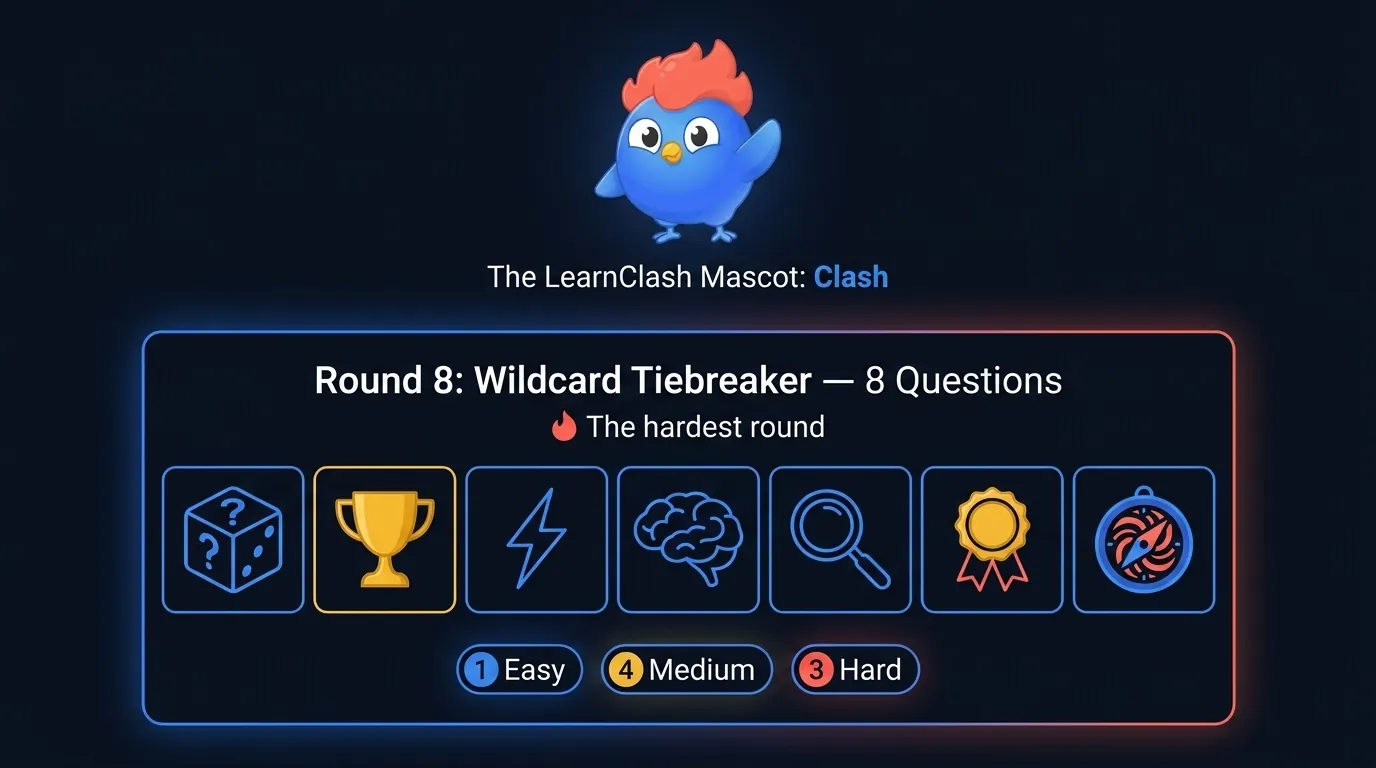 The wager round: 2 of 7 are hard, and the bet multiplies the gap.
67. How many sides does a hexagon have? Easy
Answer: Six.
From the Greek hex (six) + gon (angle). Honeycomb cells are hexagonal because the shape packs space with the least wall material. Pappus made that argument around 320 CE; the airtight mathematical proof waited for Thomas Hales in 1999.
68. What is a group of crows called? Medium
Answer: A murder.
A “murder of crows”. The term is medieval English and probably folkloric. Ornithologists today still use “flock” in scientific literature; “murder” is pure trivia-night fuel.
69. What language has the most native speakers in the world? Medium
Answer: Mandarin Chinese.
Roughly 940 million native speakers. Spanish is second at 485M. English is third at about 380M native speakers but leads all languages in total speakers (1.5B) when including second-language users.
70. What was the original purpose of bubble wrap, invented in 1957? Medium
Answer: Textured wallpaper.
Alfred Fielding and Marc Chavannes fused two shower curtains into a plastic-air sheet intended as 3D wall covering. It flopped as wallpaper. They repurposed it as insulation, then as protective packaging, and IBM became the first big customer, wrapping its 1401 computer for shipment.
71. The number pi (π) is the ratio of a circle’s circumference to its what? Medium
Answer: Diameter.
π ≈ 3.14159. Archimedes squeezed it between 3.1408 and 3.1429 around 250 BCE using polygons. Computers have now calculated pi to over 100 trillion digits; for most engineering, eight is plenty.
72. What is the only US state that grows coffee commercially? Hard
Answer: Hawaii.
Kona coffee from the Big Island is the famous name, though Kauai grows more volume. Puerto Rico grows far more but is a territory, not a state, and a handful of California farms started small commercial plantings in the 2010s, so a pedant at table 2 has an opening. Quizmasters still score Hawaii.
73. Who was the first woman to win a Nobel Prize, and in what field? Hard
Answer: Marie Curie, Physics (1903).
Curie won two Nobels (Physics 1903, Chemistry 1911), the only person ever to win in two different sciences. She was also the first woman to teach at the Sorbonne, and she died in 1934 from aplastic anaemia linked to her radiation research.
Team Sizes, Remote Play, and Hosting Notes
Three ways to run the 73: a hosted in-office night, a shared pool for a Slack async game, or solo prep before the next session. Format follows team size, so start there.
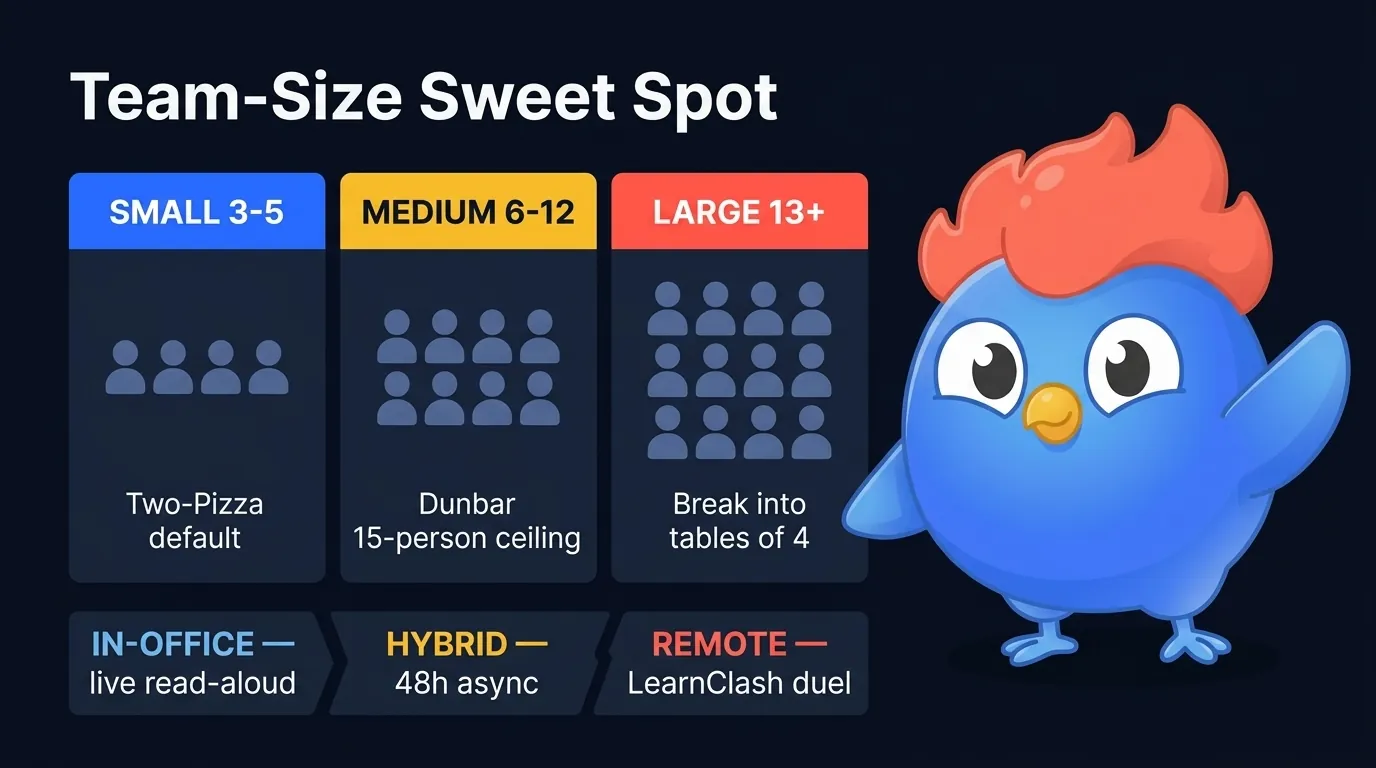 Three delivery modes, and a team-size tier for each.
Picking a team size
Five is the sweet spot. Everyone pitches in, nobody free-rides, and a team of five covers four or five categories without a gap. Ringelmann’s rope tests show per-person pull dropping 15% at 3 people and 30% at 5, and past that point the team’s total pull barely grows at all, which is precisely why the two-pizza ceiling sits where it does. Pair this guide with our how-to-memorize-faster guide if you want the answers to stick past the night itself.
From 6 to 12 people, keep one scoreboard but split answer discussion into huddles of 3 to 4, then consolidate onto one sheet. Above 10 the pen-holder problem sets in and the loudest voice dominates, so rotate the pen every round. Past 13, break into tables of four running the same questions simultaneously; Dunbar’s research says a single-thread whole-room quiz stops working around 15, and the winning table eats the first pizza.
Remote and hybrid teams
In Gallup’s 2024 data, 25% of fully remote workers reported daily loneliness. A quiz will not fix that on its own, but informal contact is exactly the gap it fills, and it should not cost a meeting slot.
The async format is personal for me. Before I built LearnClash I played a daily quiz duel with my mum for twelve years, and the habit survived every move and busy stretch precisely because neither of us ever had to be online at the same moment. That is the shape I gave LearnClash duels: 18 questions across 6 rotating topics, with each side taking turns inside a 72-hour window. Drop a duel link in Slack on Monday morning and close the round by Friday; nobody joins a call.
Hybrid nights work by streaming the host over video while remote players answer on mobile. LearnClash’s 45-second per-question timer happens to match a natural read-aloud pace, so in-office paper teams and remote app players stay in sync.
For hosts
Run rounds in order, read every question twice, give 60 seconds per answer, and post running totals after each round. Hold the wildcard for the end. A trailing team cannot claw back a 5-point gap on general knowledge alone, so the wager is where the drama lives.
Be strict about one thing: pre-screen any outside questions for religion, politics, and cultural insider references before they hit the room. Everything above already passed that filter. If your team wants to actually learn from the questions rather than just play them, how to study effectively covers the follow-up.
Solo prep
Anyone who wants to walk in sharp can drill first: LearnClash’s Solo mode runs 6-question sessions, duels run 18, and both feed the same spaced repetition pool. Miss a question and it returns in 7 days; answer it correctly and the second check comes 90 days later; pass that one and the question is Mastered and drops out of rotation. I picked those two intervals myself rather than taking a library default, tuned so reviews never swallow the fun.
The reason this beats cramming the night before is the testing effect. Karpicke and Roediger’s 2008 study measured one-week recall at 36% after re-reading versus 80% after active retrieval, and a duel is retrieval all the way down. Premium runs $7.99 a month or $59.99 a year with a 7-day free trial on the annual plan, there are no ads in any tier, and the ELO-style ladder climbs 8 tiers from Iron to Phoenix so duels land roughly even.
The trivia night people still talk about on Monday is the one the wildcard decided. These 73 questions are tuned for exactly that moment, at the team size the 1913 rope data still recommends: 5 to 8.
Frequently Asked Questions
What are good team building trivia questions?
Good team building trivia questions balance universal appeal (pop culture, geography) with workplace-adjacent facts (computing firsts, office history). This set mixes 7 to 12 questions per round across 8 categories, opening with easy icebreakers and closing with harder wildcard tiebreakers that decide the night.
How many rounds should team building trivia have?
Six to eight rounds with 7 to 12 questions each is the sweet spot. Teams of 5 to 8 (Amazon's Two-Pizza Rule) complete 8 rounds in about 45 minutes. LearnClash compresses the same structure into 18-question async duels across 6 rotating topics, at roughly 3 minutes per turn.
What trivia questions work for remote teams?
Remote teams need async-friendly formats that do not force everyone onto the same call. LearnClash's 72-hour turn window lets remote coworkers play the same 18-question duel across time zones. In 2024, 25% of fully remote workers reported daily loneliness, and informal game contact is one of the gaps.
How do you keep team trivia work-appropriate?
Work-appropriate trivia avoids religion, politics, and cultural insider references. Questions should be verifiable in 10 seconds on Wikipedia. LearnClash generates questions on any custom topic you create and runs a work-safe filter over the wording before questions reach a duel.
How often should teams do trivia?
Weekly 10-minute trivia on a Friday beats a quarterly 90-minute event for retention, per spaced-practice research (Roediger and Karpicke's testing-effect studies). LearnClash's 6-question Solo sessions and 18-question duels feed the same spaced-repetition pool, so a short weekly rhythm is easy to keep.