
43 Food Trivia Questions [With Answers]
43 food trivia questions on fast food, ingredients, global cuisine, and nutrition. Answers included, plus why each one stumps.
How many do you know?
Think of your answer, then reveal it.
Did you know it before revealing the answer?
Read this answer in the articleRound complete
Challenge friends on this topic.
Start a new duel in LearnClash and learn from every answer.
Get LearnClashFree to play on iPhone and Android. No ads.
Try the questions you missed once more.

Carrots were purple until the 1600s. The can was invented nearly 50 years before the can opener. Your taste buds regenerate every two weeks, and at 35,000 feet they lose roughly a third of their sweet-and-salt sensitivity.
These 43 food trivia questions cover fast food origins, ingredients, food history, global cuisine, and nutrition. Every answer comes with the reason people get it wrong, because with food that reason is usually the interesting part.
Food is not the hardest category in our data, and I want to be straight about that. When I pulled LearnClash’s June 2026 difficulty index by topic (the export that tallies every recorded answer in the app), Nutrition ran a 39.7% wrong rate across 2,351 recorded answers and Italian Food 38.8% across 824. Both sit a few points under the 43.5% app-wide average; Nutrition lands 107th of the 156 ranked topics, nowhere near Culture, Law, and Art at the top of that table.
What food has instead is confidence. Nobody hesitates before the ketchup question, because eating three times a day feels like qualification, and “China” still surprises the room. The topic ranking, and the Kaggle dataset behind it, is in LearnClash by the numbers.
If you are prepping a live quiz night, pair this list with the Food & Drink round in our 67 bar trivia questions. The trivia questions hub indexes all 37 topic sets, 1,899 questions in total.
Challenge a friend to food trivia on LearnClash
How These 43 Questions Break Down
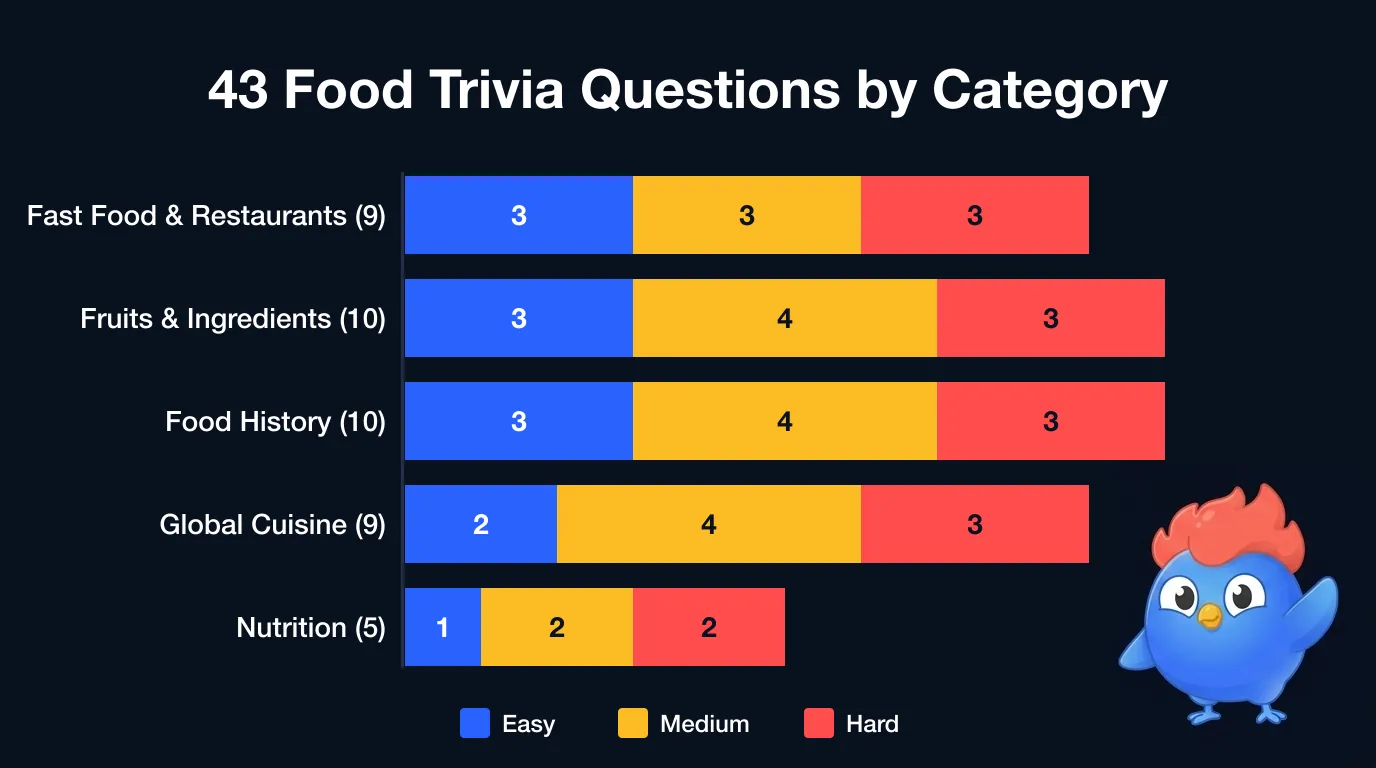
Forty-three questions in five categories, tagged 12 easy, 17 medium, and 14 hard. The split leans medium and hard on purpose, since the easy food facts almost never catch anyone out.
| Category | Questions | Easy | Medium | Hard |
|---|---|---|---|---|
| Fast Food & Restaurant Origins | 1-9 | 3 | 3 | 3 |
| Fruits, Vegetables & Ingredients | 10-19 | 3 | 4 | 3 |
| Food History & Inventions | 20-29 | 3 | 4 | 3 |
| Global Cuisine & Culture | 30-38 | 2 | 4 | 3 |
| Nutrition & The Human Body | 39-43 | 1 | 2 | 2 |
Fast food is the clearest case: people feel surest about the burgers and fries they buy every week, and that is precisely where they trip. Nobody walks into a science or geography round expecting it to be easy.
Fast Food & Restaurant Origins Questions (1-9)
Start where the confidence is highest. You have bought these products a thousand times, which is exactly why the origin stories land sideways: the brands feel eternal, and almost none of them are.
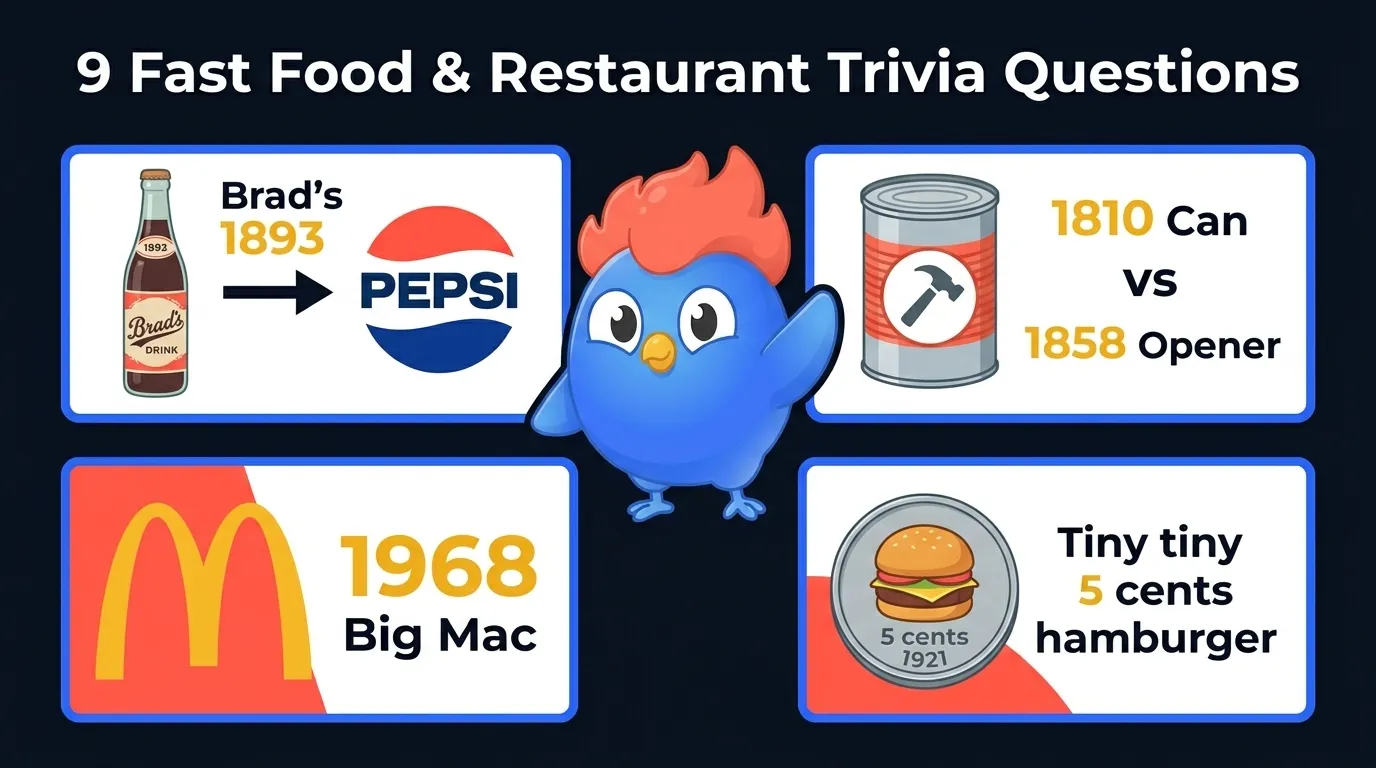 Four origin stories people get wrong at the counter.
1. What was the original name of Pepsi? Easy
Answer: “Brad’s Drink,” created by pharmacist Caleb Bradham in 1893 in New Bern, North Carolina. He renamed it Pepsi-Cola in 1898.
Why it stumps people: Pepsi has supposedly always been Pepsi. The name actually came from pepsin, a digestive enzyme, plus the kola nuts in the original recipe, and Bradham was a pharmacist mixing flavored soda water behind his own counter, not a beverage executive.
2. What fast food chain serves the most customers per day worldwide? Easy
Answer: McDonald’s, serving roughly 69 million customers daily across more than 45,000 locations in over 100 countries.
Why it stumps people: Subway held the store-count crown for years, and that stale fact lingers in people’s heads. Subway’s footprint has been shrinking since the mid-2010s while McDonald’s kept growing, and on customers served per day the race was never close anyway.
3. What country invented ketchup? Easy
Answer: China, or more precisely southern China and Southeast Asia. The original “ke-tsiap” was a fermented fish sauce from the Fujian region. British traders brought it to Europe in the 1700s, and American cooks added tomatoes in the early 1800s.
Why it stumps people: Nothing reads more “American” than ketchup. It sat beside the hot dogs at every backyard barbecue of your childhood. And the original version had no tomatoes at all.
4. What year did McDonald’s introduce the Big Mac? Medium
Answer: 1968. Franchisee Jim Delligatti created it at his Uniontown, Pennsylvania restaurant in 1967. It went nationwide in 1968.
Why it stumps people: Guesses scatter toward the 1950s, when McDonald’s was founded, or the mid-1970s. The Big Mac feels timeless, so pinning it to a single decade gets slippery. It cost 45 cents at launch.
5. Which came first: the can or the can opener? Medium
Answer: The can, by roughly 50 years. Peter Durand patented the tin can in 1810. Ezra Warner invented the first dedicated can opener in 1858.
Why it stumps people: Sealing food in metal with no way to open it sounds absurd, yet that is how it ran for five decades. Early cans were thick, heavy, and practically indestructible, and they shipped with instructions: “Cut round the top near the outer edge with a chisel and hammer.” Soldiers used bayonets; some used rocks. When Warner finally patented his opener, grocery stores opened the cans at the counter because the tool was considered too dangerous to hand a household.
6. What is the most ordered item at restaurants in the United States? Medium
Answer: French fries. Americans eat roughly 4.5 billion pounds of them a year, and they land on more restaurant orders than any other single menu item.
Why it stumps people: Burgers grab the glory and chicken keeps its fans, but fries ride along on nearly every fast food order, slide in as sides at sit-down restaurants, and get ordered alone as snacks.
7. What fast food item was originally sold for 5 cents? Hard
Answer: The White Castle slider, first sold in 1921. White Castle was the first fast food hamburger chain in the United States.
Why it stumps people: Ask ten people and nine will say McDonald’s or hot dogs. White Castle predates every major chain by decades, and it built the standardized fast food hamburger first: identical small square patties, identical buns, identical price.
8. What restaurant tradition originated from the French Revolution? Hard
Answer: The restaurant as an industry. Paris had its first restaurants by the 1760s, but before 1789 most skilled chefs cooked for aristocratic households. When the Revolution scattered the aristocracy, their unemployed chefs opened public dining rooms, and the count exploded.
Why it stumps people: Restaurants feel ancient. But choosing from a menu at your own table is barely 250 years old; before then, eating out meant taverns, inns, or street vendors, with no menus, no private tables, and no courses.
9. What is the oldest continuously operating restaurant in the United States? Hard
Answer: The Union Oyster House in Boston, Massachusetts, serving food since 1826.
Why it stumps people: Everyone reaches for New Orleans or New York. Boston barely registers as a food city, so nobody bets on it. Daniel Webster was a regular, eating there while he served in the Senate, and the building itself dates to the early 1700s.
Fruits, Vegetables & Ingredients Questions (10-19)
How long does a pineapple take to grow? What plant family is cumin in? What color is a carrot? That last one has a different answer depending on the century you ask about. These ten questions live in the gap between eating something every day and knowing the first thing about it.
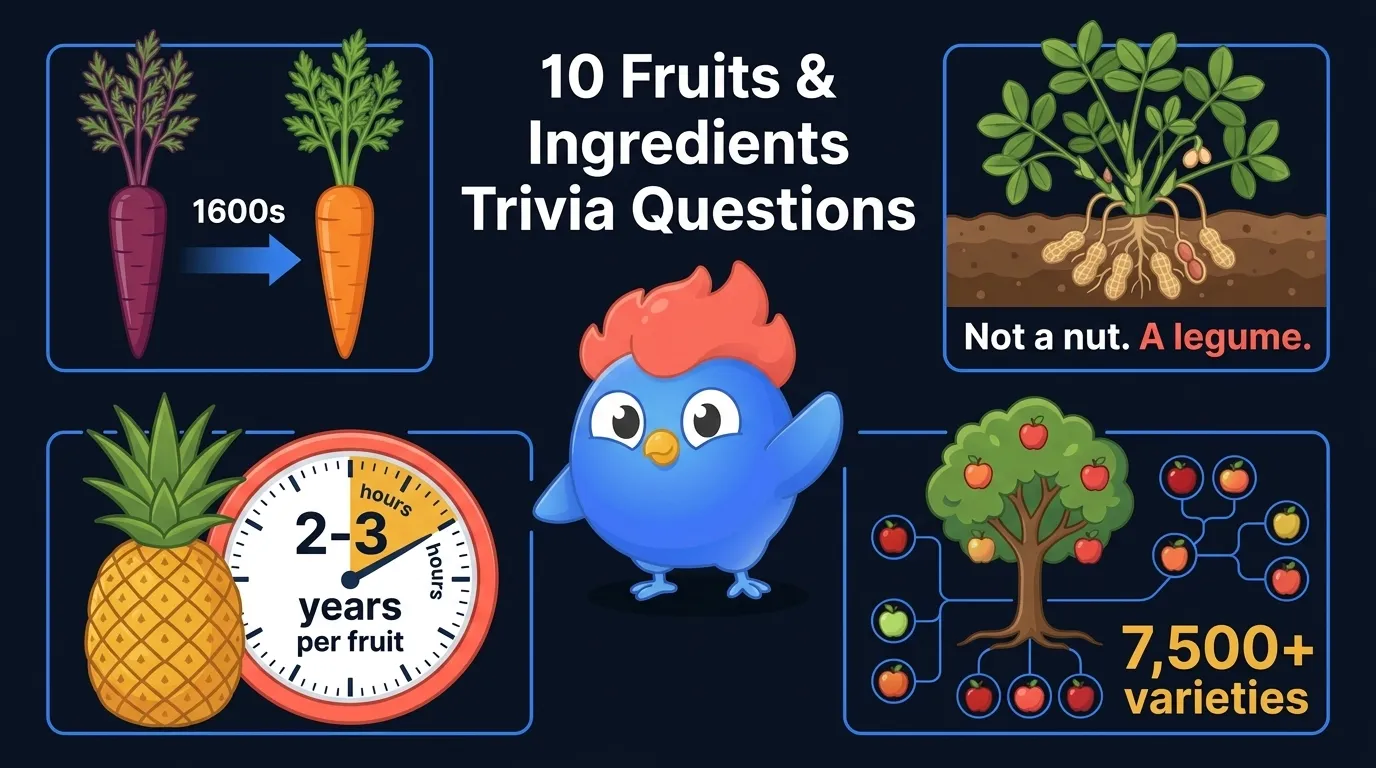 Everything here is in a normal grocery store.
10. What is the most consumed fruit in the world by production volume? Easy
Answer: The tomato, at over 180 million metric tons produced annually. Yes, it is botanically a fruit.
Why it stumps people: Two reactions fire at once: “tomatoes are vegetables” (botanically, no), and bananas or watermelons feel like the safe pick. But the sheer volume of tomatoes going into sauces, pastes, ketchup, and fresh eating buries every rival in the FAO production tables.
11. What nut is not actually a nut? Easy
Answer: The peanut. Peanuts are legumes, in the same family as beans, lentils, and peas. They grow underground in pods, not on trees.
Why it stumps people: Blame the name. The word “nut” sits right there, and it has fooled everyone who ever cracked one open. Almonds, cashews, and walnuts are not true botanical nuts either (they are drupes or seeds). The genuine nuts are chestnuts, hazelnuts, and acorns.
12. What common spice was once used to pay rent in medieval Europe? Easy
Answer: Black pepper. Peppercorns were valuable enough to serve as currency, collateral for loans, and rent payments; the term “peppercorn rent” survives in legal language today.
Why it stumps people: There is a half-empty jar of it on your counter that cost three dollars. The notion that the same spice once funded ocean voyages feels ridiculous, and yet Portuguese and Dutch trading empires were built substantially on pepper money.
13. What color were carrots before the 17th century? Medium
Answer: Purple (and also white, yellow, and red). Orange carrots were selectively bred by Dutch growers in the 17th century.
Why it stumps people: You have eaten carrots a thousand times and every one was orange. That uniformity is the result of a 400-year breeding campaign. The Dutch may have pushed orange carrots to honor William of Orange during the revolt against Spain; historians still argue over it. The color may have been political, or just a happy accident.
14. What fruit has its seeds on the outside? Medium
Answer: The strawberry, with roughly 200 seeds (technically called achenes) dotting its exterior surface.
Why it stumps people: Those tiny yellow dots barely register as seeds while you eat. The stranger part is that each achene counts as its own individual fruit, while the fleshy red bit is swollen stem tissue. A strawberry is a “false fruit” wearing 200 tiny real fruits on its skin.
15. Where did vanilla originally come from? Medium
Answer: Mexico. The Totonac people of eastern Mexico were the first to cultivate vanilla from the Vanilla planifolia orchid. The Aztecs added it to chocolate drinks centuries before Europeans tasted either ingredient.
Why it stumps people: Madagascar grows roughly 80% of the world’s vanilla today, so it owns the mental shortcut, and the bottle in your pantry probably says “Madagascar.” The plant itself is Mexican.
16. What is the hottest chili pepper in the world as of 2026? Medium
Answer: Pepper X, measuring an average of 2.69 million Scoville Heat Units (SHU), verified at Winthrop University and certified by Guinness World Records in October 2023. Created by Ed Currie, who also bred the Carolina Reaper.
Why it stumps people: The Carolina Reaper held the title long enough to lodge itself as the obvious answer. Pepper X knocked it off in October 2023 and still holds the record. A jalapeño tops out around 8,000 SHU; Pepper X runs over 300 times hotter. Our science trivia set gets into capsaicin, the compound behind the burn.
17. How many named varieties of apples exist worldwide? Hard
Answer: Over 7,500. Only about 100 are commercially grown in the United States.
Why it stumps people: Your grocery store shows maybe 10 types. The USDA Apple Collection in Geneva, New York holds over 2,500 varieties on its own. Thousands of heirloom apples are vanishing because they bruise easily, travel badly, or just look too lumpy for a supermarket shelf.
18. What spice comes from the same plant family as carrots? Hard
Answer: Cumin. Also coriander, dill, fennel, and parsley. They all belong to Apiaceae, the same botanical family as carrots.
Why it stumps people: Cumin tastes nothing like a carrot, so the family link sounds invented. But Apiaceae is huge, holding plants as different as celery, parsnip, and poison hemlock.
19. What fruit takes 2-3 years to grow from planting to harvest? Hard
Answer: The pineapple. A single pineapple plant produces exactly one fruit per growing cycle, and the process from planting to harvest takes 18-36 months.
Why it stumps people: A pineapple sits in every grocery store for a few dollars, and nothing on the price tag hints at a plant that spends two to three years on a single fruit. Pineapples were so expensive in 18th-century Europe that wealthy families rented them as table centerpieces for dinner parties rather than eating them.
Food History & Inventions Questions (20-29)
Food history trivia asks where the things on your plate actually came from, and the answers are mostly accidents: medicine that became candy, a radar part that became a kitchen appliance, a military prize that produced the tin can. These ten questions cover the inventions and ancient staples with the strangest paper trails.
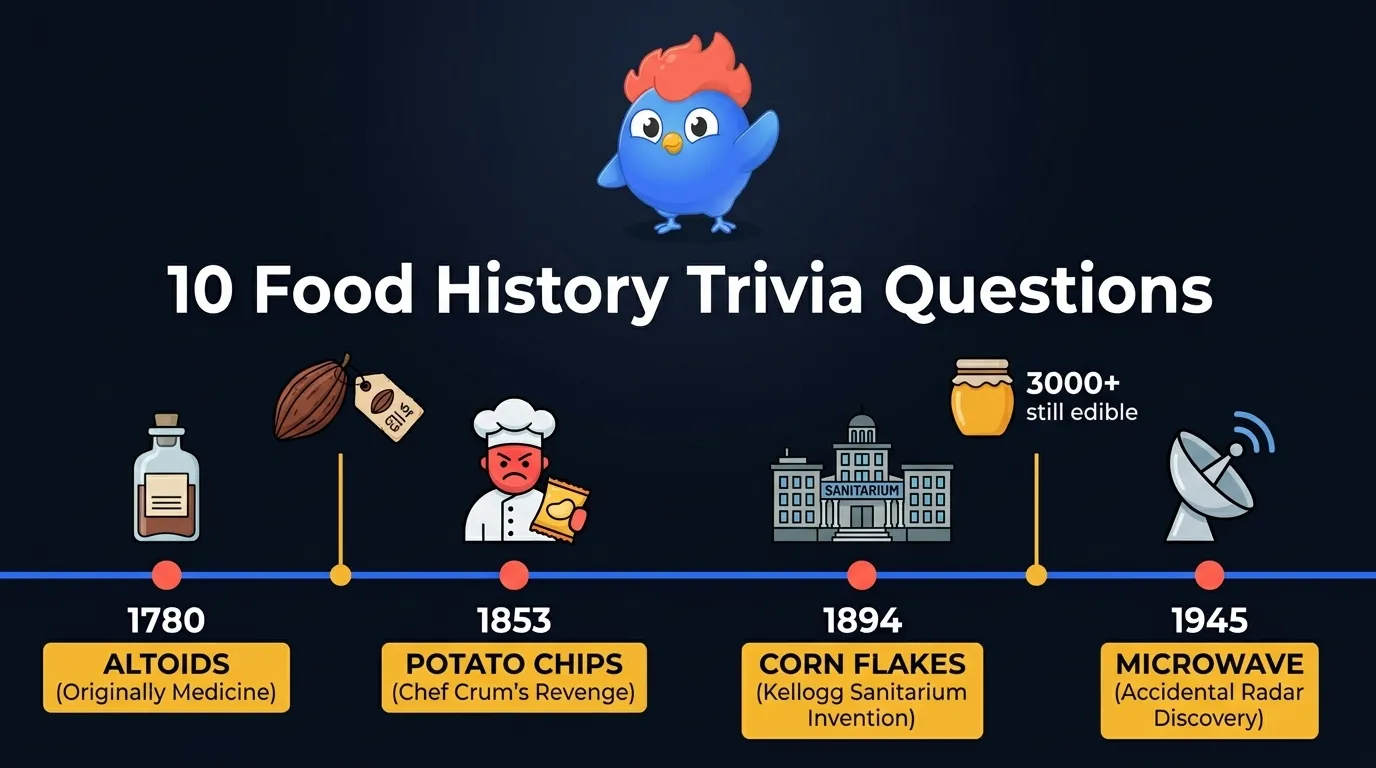 The four dated inventions from this round, Altoids in 1780 to the microwave in 1945, plus cacao currency and tomb honey.
20. What popular snack was, according to legend, invented by a frustrated chef? Easy
Answer: Potato chips. The popular story credits chef George Crum at Moon’s Lake House in Saratoga Springs, New York, around 1853. A customer kept sending back thick-cut fried potatoes as too soggy, so Crum sliced them paper-thin and fried them crispy out of spite.
Why it stumps people: Everybody half-knows that potato chips have an origin story, but the details they supply are almost always off. Historians have poked holes in this account (thin-fried potatoes existed earlier, and Crum himself never claimed the invention), but the “angry chef” version stuck. It beats “gradual culinary evolution” as a story.
21. What was the first food an American ate in space? Easy
Answer: Applesauce, consumed by John Glenn during the Mercury-Atlas 6 mission (Friendship 7) in February 1962. It was squeezed from an aluminum tube.
Why it stumps people: Freeze-dried ice cream owns the “space food” name. But Glenn ate pureed applesauce because NASA was not sure a human could even swallow in microgravity, and the tube proved eating worked in orbit. Soviet cosmonaut Yuri Gagarin had eaten pureed food in space a year earlier.
22. What method of food preservation was invented because of a military prize? Easy
Answer: Canned food. In 1795 the French government offered a 12,000-franc prize for a way to preserve food for its armies. Nicolas Appert collected it in 1810, under Napoleon, with heat-sealed glass jars; Peter Durand patented the tin can the same year.
Why it stumps people: A can of beans does not exactly scream military technology. But canning came straight out of a wartime logistics crisis, feeding armies stranded far from supply lines, and the prize sat unclaimed for fifteen years before Appert cracked it.
23. What popular candy was originally sold as medicine? Medium
Answer: Altoids. The mints were created in 1780 by London confectioner Smith & Company as lozenges to relieve intestinal discomfort.
Why it stumps people: “Curiously Strong Mints” reads as a marketing slogan, not a medical label. Yet the tin and the medicinal branding are leftovers from the original pharmaceutical job.
24. What food was used as currency in ancient Mesoamerica? Medium
Answer: Cacao beans. The Aztecs and Maya used cacao beans as standardized currency. A turkey cost about 100 beans; a tomato cost 1 bean.
Why it stumps people: Salt is the first guess every time. But cacao beans got valuable enough that counterfeiting took off: people hollowed them out and packed them with mud. Spanish conquistadors waved cacao off as worthless before the penny dropped that the whole Aztec economy ran on it.
25. What food have archaeologists found in Egyptian tombs, still edible after 3,000 years? Medium
Answer: Honey. Sealed pots of honey over 3,000 years old have been found in ancient tombs, still chemically intact.
Why it stumps people: Bread? Wine? Dried meat? All reasonable, all wrong. Honey is close to immortal: its low moisture, high acidity, and natural hydrogen peroxide shut down bacterial growth, which is why sealed pots survive three millennia in a tomb.
26. What breakfast food was invented by a sanitarium doctor? Medium
Answer: Flaked cereal. Dr. John Harvey Kellogg accidentally created wheat flakes in 1894 at the Battle Creek Sanitarium in Michigan while developing a bland diet for patients. Corn Flakes specifically followed in 1898.
Why it stumps people: Picture the Corn Flakes box; the whole thing looks like a focus group built it. A health reformer invented it instead, convinced that bland food curbed “unhealthy urges.” His brother Will Keith Kellogg spotted the commercial upside, added sugar against John’s wishes, and founded the Kellogg Company. The brothers then feuded for decades over the recipe: John sued Will, Will sued John, and the fight shaped the entire American breakfast cereal industry.
27. What is the oldest surviving recorded recipe in the world? Hard
Answer: A beer recipe. The Hymn to Ninkasi, a roughly 4,000-year-old Sumerian poem dedicated to the goddess of brewing (circa 1800 BCE), describes a beer-making process. Older evidence of beer production (residue on pottery) dates to roughly 13,000 years ago.
Why it stumps people: Everyone says bread. Beer may have come first. Some archaeologists argue the urge to brew drove the Agricultural Revolution, that humans started farming grain for beer rather than bread. Patrick McGovern’s beer-before-bread explanation backs the hypothesis.
28. What continent had no citrus fruits before the 15th century? Hard
Answer: The Americas. Oranges, lemons, and limes arrived with Spanish and Portuguese explorers beginning in the late 1490s. Florida’s orange industry traces directly to Spanish colonial plantings.
Why it stumps people: Florida and Brazil now lead the world in oranges, which sells the illusion that citrus is native to the Western Hemisphere. Before European contact the Americas also had no wheat, no cattle, no horses, no chickens and no sugar.
29. What common kitchen appliance was invented using military radar technology? Hard
Answer: The microwave oven. In 1945, Raytheon engineer Percy Spencer noticed a chocolate bar in his pocket melting while he stood near an active magnetron (a radar component). The first commercial microwave, the “Radarange,” was sold in 1947.
Why it stumps people: The melted-chocolate story rings a faint bell, but the radar link is the part almost nobody has heard. The first commercial microwave stood 5.5 feet tall, weighed 750 pounds, and cost $5,000, roughly $70,000 in today’s dollars. They built it for restaurants and ships, not kitchens.
Global Cuisine & Culture Questions (30-38)
The most-missed question on our Italian Food topic is not about pasta shapes. It asks where Caesar Cardini invented the Caesar salad, and 12 of the 14 recorded answers got it wrong. The answer is Tijuana, Mexico, where the Italian immigrant ran a restaurant during Prohibition.
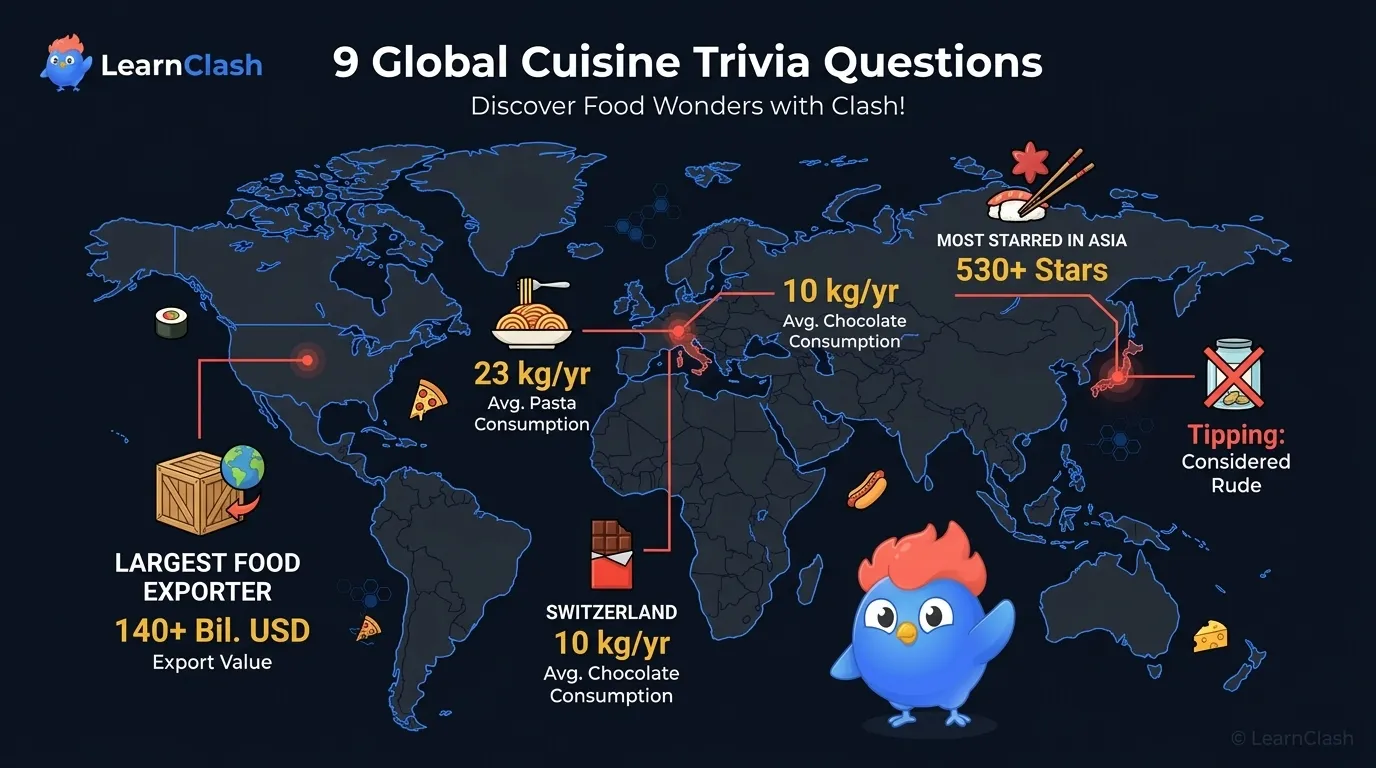 Which country eats what, and how much of it.
30. What country eats the most pasta per capita? Easy
Answer: Italy, at roughly 23 kilograms per person per year (about 51 pounds).
Why it stumps people: Nearly everyone nails this, which is the point of an easy warmup. The scale is the shock: Italians put away roughly three times more pasta per head than Americans, and the countries usually next on the list are Tunisia and Venezuela, a pairing nobody sees coming.
31. Where did pizza margherita get its name? Easy
Answer: According to tradition, it was named after Queen Margherita of Italy. In 1889, pizzaiolo Raffaele Esposito reportedly created a pizza with tomato, mozzarella, and basil (representing the Italian flag) for the queen’s visit to Naples.
Why it stumps people: The story itself is not the hard part. The twist is that food historians have torn into the whole tale: pizza with those exact toppings was sold in Naples decades before the queen ever showed up.
32. What country consumes the most chocolate per capita? Medium
Answer: Switzerland, at roughly 10 kilograms per person per year (about 22 pounds) according to Chocosuisse industry data.
Why it stumps people: Belgium wears the “chocolate country” crown in everyone’s head, but Switzerland out-eats it by a comfortable margin. The Swiss also invented milk chocolate (Daniel Peter, 1875, using Henri Nestle’s condensed milk) and the conching process that makes modern chocolate smooth (Rodolphe Lindt, 1879).
33. What is the world’s most expensive edible mushroom? Medium
Answer: The white truffle (Tuber magnatum), selling for thousands of dollars per pound at retail and topping $200,000 at auction for exceptional specimens.
Why it stumps people: Truffles are the food everyone has heard of and almost nobody has tasted. White truffles refuse to be farmed: they grow only in specific Italian and Croatian forest soils, get sniffed out by trained dogs, and last about five days once pulled.
34. In which country is it considered rude to tip at a restaurant? Medium
Answer: Japan. Leaving a tip can be seen as implying the server needs charity or that their employer does not pay fairly.
Why it stumps people: Americans carry their tipping habits abroad and get baffled when the math falls apart. In Japan, staff may chase you down the street to hand back what they assume you left by mistake. South Korea, China, and several other countries also treat tipping as unnecessary or insulting.
35. What is the most consumed grain in the world? Medium
Answer: Rice. It is a staple food for more than half the world’s population and appears in the traditional cuisines of every inhabited continent.
Why it stumps people: Wheat owns the Western grocery aisle, so it gets named first. Rice feeds far more people across the planet.
36. What single country is the world’s largest food exporter? Hard
Answer: The United States, exporting roughly $170 billion in agricultural products annually.
Why it stumps people: Brazil and the Netherlands both look like the right answer, and depending on the year and the counting method they trade second place between them. The Netherlands competes from a country smaller than West Virginia, on hyper-efficient greenhouses and the Rotterdam port; Brazil tops individual commodities like soybeans, sugar, and coffee yet lands behind on total value.
37. What Asian country has the most Michelin-starred restaurants? Hard
Answer: Japan, with over 350 Michelin-starred restaurants. Tokyo alone has held more Michelin stars than Paris since the first Tokyo guide was published.
Why it stumps people: The Michelin Guide is French, and that fact alone makes France the automatic pick. But Japan passed Paris on starred restaurants in 2007 and never looked back. Tokyo has held the most-starred city title for nearly two decades.
38. What traditional food is illegal to import into the United States? Hard
Answer: Haggis (the traditional Scottish version). The USDA has banned imports of haggis containing sheep lung since 1971, as American food safety regulations prohibit lungs from being used as food.
Why it stumps people: Kinder Surprise eggs are the famous “banned food,” but that hollow-egg design got reworked to clear US rules. Traditional haggis stays genuinely off-limits. Scottish butchers and producers have lobbied for decades against the sheep-lung rule, with nothing to show for it.
Nutrition & The Human Body Questions (39-43)
Five questions, and your own body is the exam. Most of what it does with food happens while you notice nothing at all.
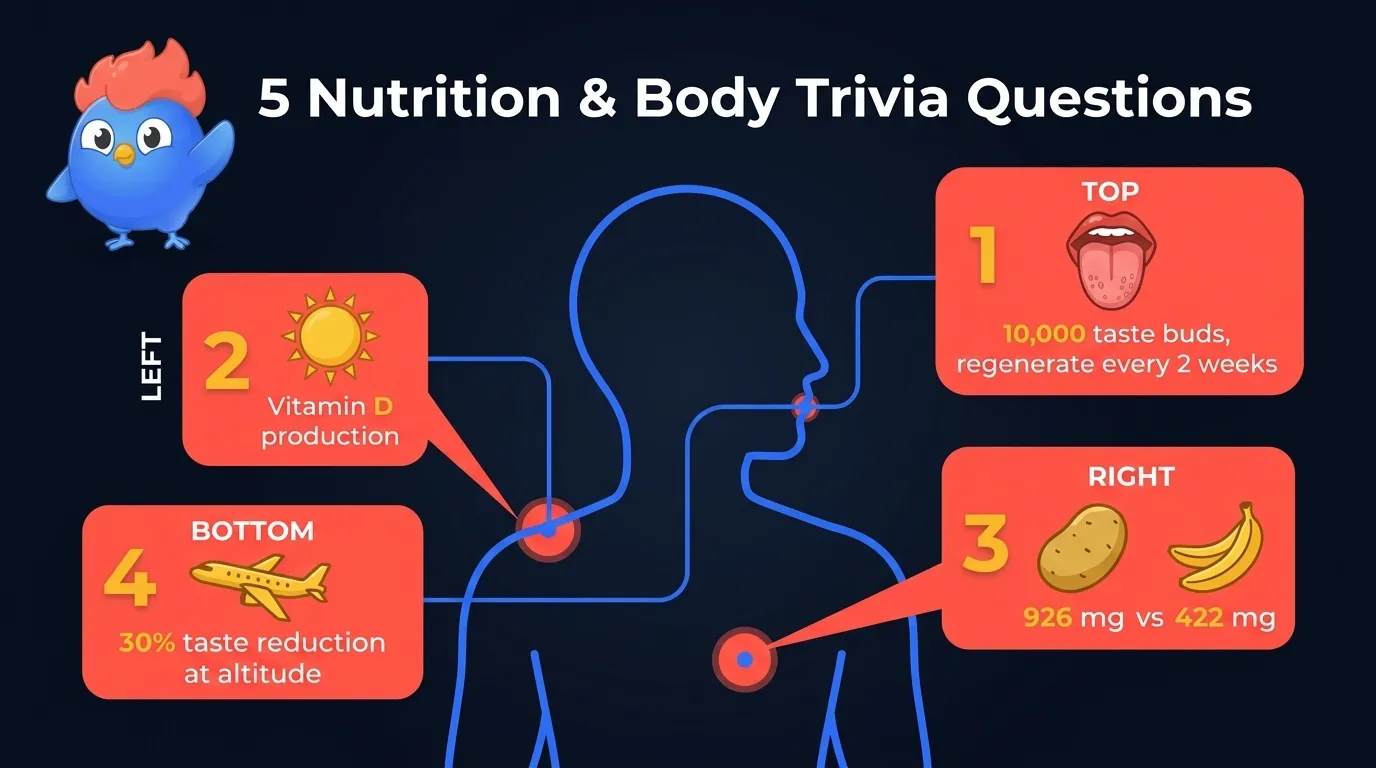 What questions 39 to 43 cover: taste bud counts, vitamin D, potassium, and taste at cruising altitude.
39. How many taste buds does the average human tongue have? Easy
Answer: Roughly 10,000, and they regenerate every two weeks.
Why it stumps people: The count rarely throws anyone; guess 5,000 or 15,000 and you are in range. The regeneration cycle is the real jolt. Every 10 to 14 days your whole set of taste buds dies and grows back without you ever feeling it, and with age some stop regenerating, which is why older adults often find food flat and reach for the salt.
40. What vitamin can your body produce from sunlight? Medium
Answer: Vitamin D. Your skin synthesizes it when exposed to UVB radiation.
Why it stumps people: The sun-vitamin link floats around as background knowledge, but under quiz pressure, naming which vitamin gets slippery. Stranger still, vitamin D behaves like a hormone rather than a vitamin; it was classified as a vitamin on its discovery in 1922 and the name stuck.
41. What common food has more potassium than a banana? Medium
Answer: A baked potato (with skin) contains roughly 926 mg of potassium, compared to about 422 mg in a medium banana. Spinach, avocado, and sweet potatoes also beat bananas.
Why it stumps people: “Banana equals potassium” is one of the most baked-in food beliefs there is. Bananas are a decent source but do not crack the top ten; the reflex owes more to a century of banana marketing than to nutrition tables.
42. What happens to your ability to taste food when you fly in an airplane? Hard
Answer: You lose approximately 30% of your ability to taste sweet and salty flavors at cruising altitude. Low humidity, low air pressure, and background noise all suppress taste perception.
Why it stumps people: Airline food has a bad name, and the blame usually lands on the catering. The cabin matters more. A 2010 Fraunhofer Institute study found that cabin pressure dulls sweet and salty taste while umami, sour, and bitter come through mostly intact. That is why tomato juice sells so well at altitude: its umami survives the flight.
43. What percentage of the world’s food supply is wasted each year? Hard
Answer: Roughly one-third. The United Nations Environment Programme (UNEP) estimates over 1 billion metric tons of food waste annually across households, food service, and retail.
Why it stumps people: The figure sounds inflated because it is so big. In the United States, 30-40% of the food supply goes uneaten, and food waste is the single largest category of material in American landfills. The FAO and UNEP numbers behind it have barely improved in a decade.
Take the nutrition topic for a spin
Turning These 43 Food Trivia Questions Into a Quiz Night
Split the questions into rounds by category. Fast food opens as the warmup, ingredients and food history fill the middle, and global cuisine closes the night. Score 1 point for easy, 2 for medium, 3 for hard so the weaker teams stay alive into the final round.
Why does a corrected food fact stick? Surprise. Guess “France” for ketchup with full confidence, learn it is China, and that correction holds harder than any fact read in passing. Richland, Kornell, and Kao documented the mechanism in a 2009 Journal of Experimental Psychology: Applied paper on the pretesting effect: an unsuccessful retrieval attempt before learning the answer improves how well the answer sticks.
LearnClash’s version of that loop is mechanical. Miss the ketchup question on a Saturday and it is back the following Saturday, seven days on the dot. Get it right that time and the next look comes about three months later (90 days in the code); get that one too and ketchup is Mastered and drops out of the review rotation. One wrinkle: a question you had already mastered and then miss falls back to Known and waits the 90 days, not the 7.
 Learning, Known, Mastered: miss a question and the 7-day clock starts.
For more trivia across other categories, take your pick:
- Geography trivia: countries, borders, and world records
- 37 science trivia questions: the chemistry and biology behind the food facts
- 43 general knowledge questions: a broad mix that crosses into food
- Sports trivia: records, athletes, and odd rules
And if you want to see how LearnClash measures up against other quiz apps, our best trivia apps ranking lays it out.
Frequently Asked Questions
What are good food trivia questions for a dinner party?
The best dinner party food trivia questions have answers that spark debate. Questions like 'What country invented ketchup?' (China) or 'What color were carrots before the 1600s?' (purple) get the table talking. This list includes 43 verified questions across five food categories at easy, medium, and hard difficulty.
What is the hardest food trivia category?
LearnClash's June 2026 difficulty index gives a measured answer: the worst-answered food topics with enough recorded answers to qualify were Chicken Tenders and Indian Food, both at a 42.8% wrong rate. Among mainstream categories, Nutrition led at 39.7% wrong across 2,351 answers, with Italian Food close behind at 38.8%.
Is there a food trivia app with spaced repetition?
LearnClash covers food and cooking trivia with a three-stage spaced repetition system: Learning, Known, and Mastered. Miss a question and it drops one stage: Learning and Known misses resurface a week later, and even a Mastered question that slips comes back for a fresh 90-day check. Pass the 7-day and 90-day reviews and the question exits the pool as Mastered.
How many food trivia questions do I need for quiz night?
A solid quiz night needs 30 to 50 questions split across 4 to 6 rounds. This list gives you 43 questions across five food categories with built-in difficulty ratings. Award 1 point for easy, 2 for medium, 3 for hard to keep every team competitive.
What food facts surprise people the most?
The most surprising food facts involve things people eat daily without knowing the backstory. Carrots were purple before the 17th century. Pineapples take 2-3 years to grow a single fruit. Your taste buds lose 30% sensitivity on airplanes. LearnClash builds on these surprises with food trivia at every difficulty level.