
ELO Matchmaking & Win Rates: Why Skill Matching Wins [2026]
ELO matchmaking pairs LearnClash duels by skill so each lands near the desirable-difficulty zone where retrieval becomes durable memory.

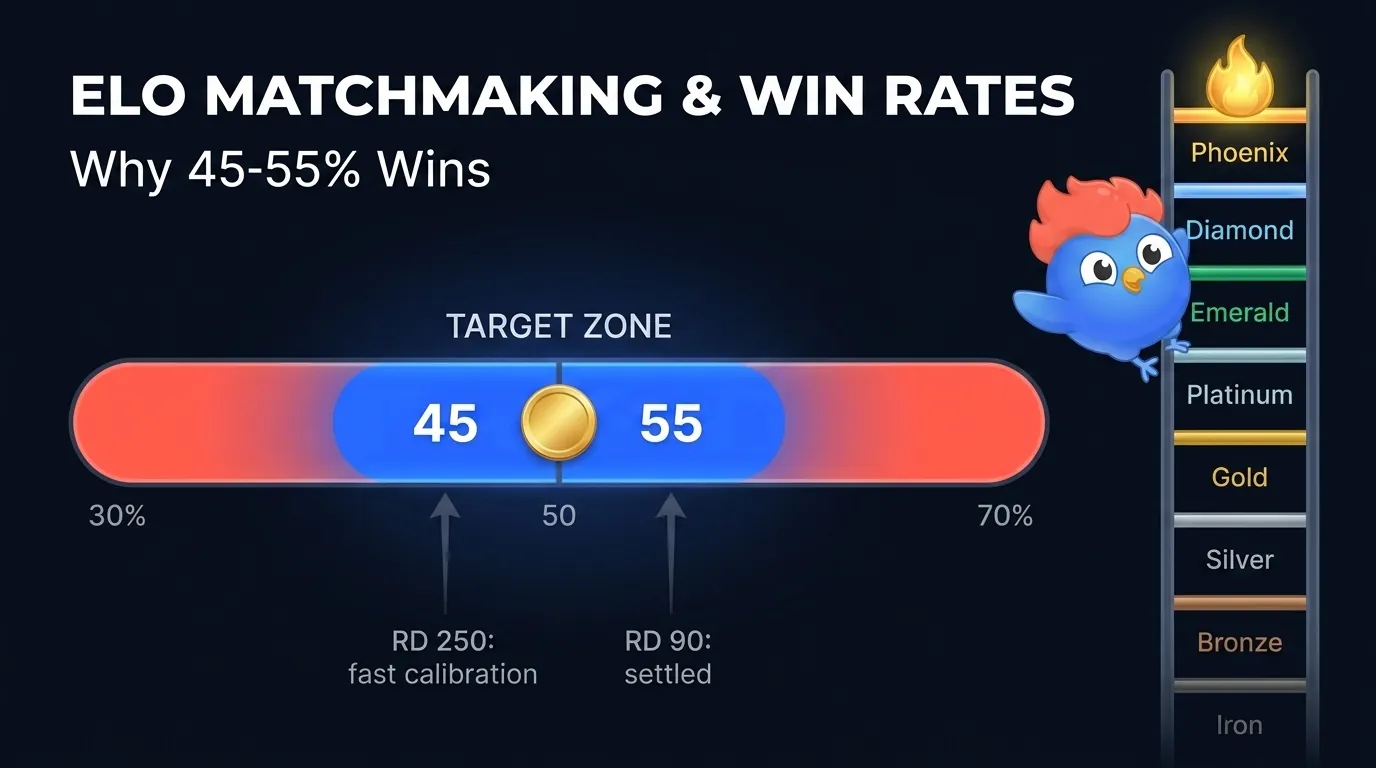
Skill-matched duels trend toward a balanced win rate. Random pairings do not, and the difference shows up in our own numbers: in a May 2026 export of LearnClash production duels, the higher-rated player had won 67.5 percent of all decided duels, but only 58.3 percent of the duels where the two ratings sat within 80 points of each other.
An ELO-matched win rate is the win probability when both players sit within a tight rating gap. LearnClash’s matchmaker ranks every open duel on a composite score, half rating proximity and half category overlap, and applies no hard rating-range gate. What follows is the math behind the balanced band, what the matchmaking code does step by step, why the “forced 50” complaint from MOBA forums is the wrong frame for a learning app, and how a close duel feeds spaced repetition.
What Is an ELO-Matched Win Rate?
An ELO-matched win rate is the share of duels you can expect to win against an opponent of similar skill. When the rating gap is near zero, that share sits near 50 percent, because the expected-score formula Arpad Elo built his system around has nothing else to work with.
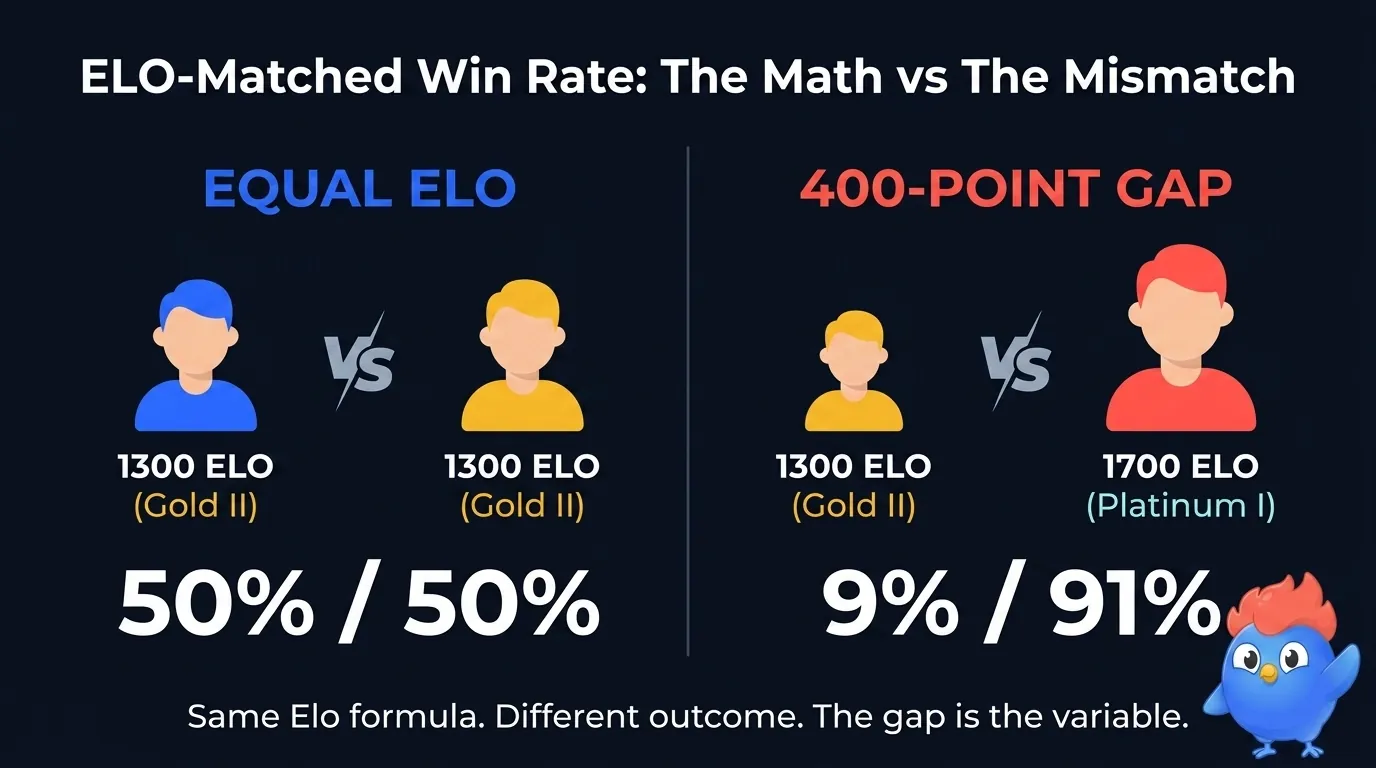 Figure 1: An evenly matched duel sits at 50% win probability by definition. Add a 400-point gap and the classic formula drops the lower-rated player to 9%.
The formula is short. Your expected score is 1 divided by (1 + 10^(gap/400)), where the gap is the opponent’s rating minus yours. Two equal ratings return 0.5 each; a 400-point gap pushes the stronger player to 0.91 and the weaker one to 0.09.
| Scenario | Player A | Player B | A’s expected win (classic Elo) |
|---|---|---|---|
| Equal | 1300 | 1300 | 50% |
| Slight favorite | 1400 | 1300 | 64% |
| Heavy favorite | 1700 | 1300 | 91% |
| Underdog | 1300 | 1700 | 9% |
LearnClash computes that probability with Glicko-2 rather than the classic formula, and the difference is small but real. Glicko-2 shrinks the effective gap by how uncertain the opponent’s rating is, so a 400-point favorite is expected to score about 0.90 against a settled opponent and about 0.86 against a brand-new one whose rating the engine barely trusts yet. The shape is the same. The engine is simply more careful about ratings it has not seen play out.
Nothing in either formula looks at a win streak, a time of day, or how many duels you have lost in a row. The probability comes from the rating gap and nothing else, which matters for the next section, because most of the folklore about rigged matchmaking assumes an extra input that is not there.
Why a Balanced Band Is the Feature, Not the Bug
A balanced win-rate band is the natural output of skill-matched competition, and in a learning product it is also the target. Easy wins teach little. Blowout losses teach less. The middle is where retrieval takes effort, and effortful retrieval is what the memory literature keeps rewarding.
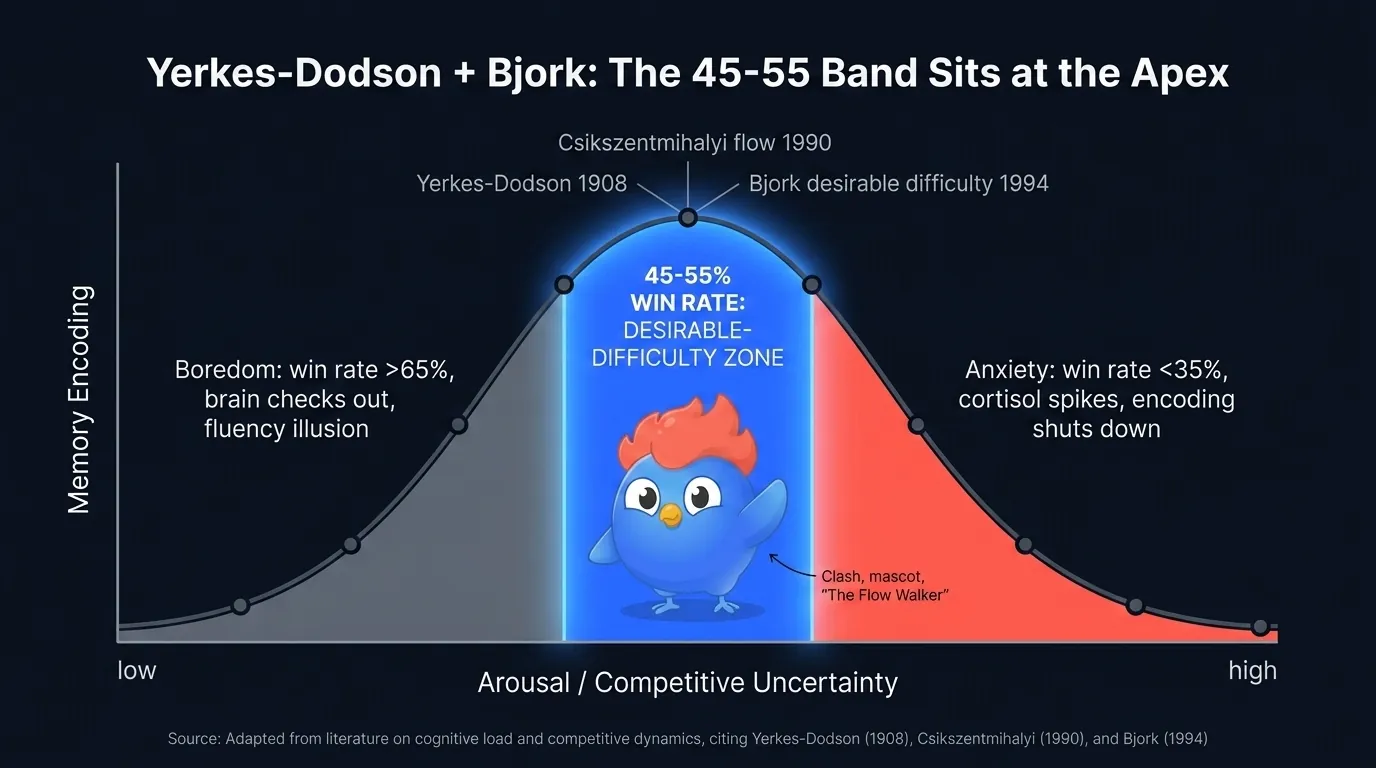 The inverted U, with the balanced win-rate band at the apex. A blowout in either direction slides off the peak.
Search any League of Legends forum and you will find the claim that Riot forces a 50 percent win rate. Riot’s own matchmaking post from September 2024 states the goal out loud: new players should be placed with similarly skilled opponents and land near a 50 percent win rate, and at the time of writing they were sitting around 46 percent. That is a placement target, not a thumb on the scale. Two equal players cannot help but trend toward 50 percent across hundreds of games, whatever the matchmaker wants.
In a learning context the same band flips from suspicious to useful. Three lines of research converge on it:
- Yerkes-Dodson (1908): moderate arousal gives the best performance on hard tasks. The original study was on mice, and the curve has been stretched well beyond its data since, but the inverted U is the shape most people recognize.
- Csikszentmihalyi’s flow (first described in 1975, popularized by the 1990 book): absorbed attention requires perceived challenge to sit close to perceived skill.
- Bjork’s desirable difficulties (1994 onward): learning conditions that slow apparent progress tend to produce better long-term retention.
“Conditions of learning that make performance improve rapidly often fail to support long-term retention and transfer, whereas conditions that create challenges and slow the rate of apparent learning often optimize long-term retention and transfer.” Elizabeth L. Bjork and Robert A. Bjork, Making Things Hard on Yourself, But in a Good Way (2011)
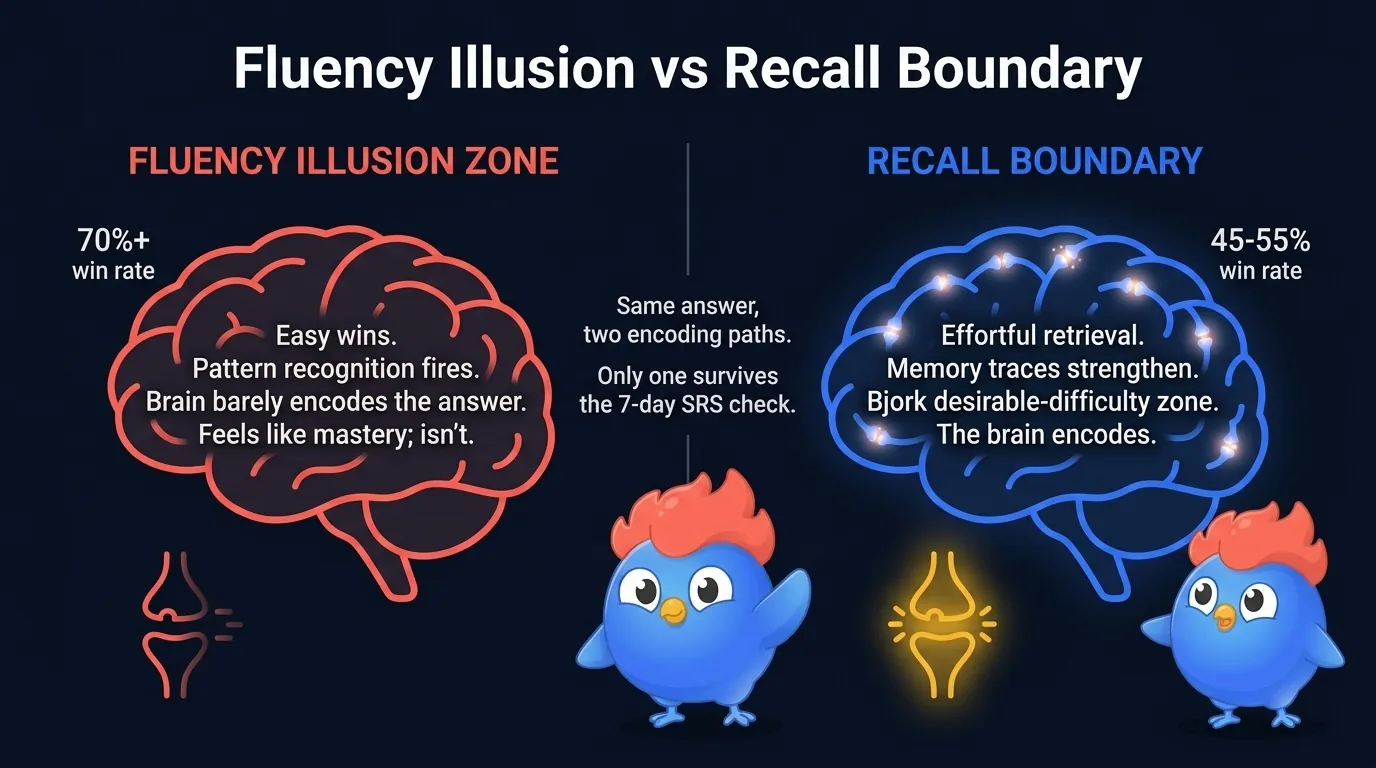 Easy wins feel like mastery. The answers that form memory traces are the ones retrieved at the boundary, with effort.
Flow is the one players feel directly. Below the edge of your skill a duel is boring, above it a duel is stressful, and the band between is narrow. A matchmaker that hunts for the smallest rating gap it can find is, in effect, hunting for that band on your behalf.
So the MOBA crowd is right that skill-based matchmaking pushes win rates toward 50. A competitive shooter can reasonably argue about whether that feels good. A quiz app cannot afford to disagree, because the balanced band is where the answers you retrieve are most likely to stay retrieved.
How Does LearnClash’s Composite Matchmaker Score a Duel?
LearnClash scores every open duel a player could join on a composite: 50 percent rating proximity plus 50 percent category cosine similarity. The highest-scoring candidate wins, provided it clears a time-based quality bar. An earlier version of this article got the numbers wrong, so here is what the code does.
Rating proximity is linear, not a curve. It scores 1.0 at a zero gap and loses 0.25 for every 100 points of distance, reaching 0 at a 400-point gap. A 40-point gap scores 0.90, a 100-point gap 0.75, and a 200-point gap 0.50.
| Rating gap | Proximity score |
|---|---|
| 0 | 1.00 |
| 40 | 0.90 |
| 100 | 0.75 |
| 200 | 0.50 |
| 400 or more | 0.00 |
The second half is the part most matchmakers skip. Every time you pick a topic for a duel round, the app adds one to that topic’s category in your profile, across the 18 categories LearnClash uses (science, history, geography, music, gaming, mythology, and so on). Cosine similarity compares two of those count vectors: 1.0 when both players spread their picks the same way, 0 when they share no category at all. Until both players have at least 5 recorded picks, the engine ignores the category half entirely and matches on rating proximity alone, because a profile with one or two picks produces misleading perfect matches.
A worked example. Player A sits at 1340 and Player B at 1380, a 40-point gap, and their category vectors come out at a cosine of 0.83 because both lean on geography and history while one side adds music. Proximity 0.90 times 0.5, plus cosine 0.83 times 0.5, gives a composite of 0.865.
Whether 0.865 is enough depends on how long the open duel has been waiting. A freshly created duel requires a composite of at least 0.7 to be joined, and that threshold decays linearly to 0 over 60 minutes: a duel that has waited 30 minutes accepts anything above 0.35, and after an hour it accepts any joiner at all. Our pair above joins immediately. A pair 40 points apart with zero category overlap scores 0.45 and has to wait about 21 minutes, while a pair 400 points apart with identical interests scores 0.50 and waits about 17.
That decay is the whole reason LearnClash has no hard rating gate. A hard gate on a small queue means some players wait forever. A decaying quality bar means the matchmaker holds out for a good pairing first and settles for a playable one later, and Glicko-2 already weighs a result against a much weaker opponent as the low-information event it is.
What Pushes a Duel Outside the Balanced Band
Even with all of that, individual duels land in the tails. Three forces do it, and each is a property of the system rather than a defect.
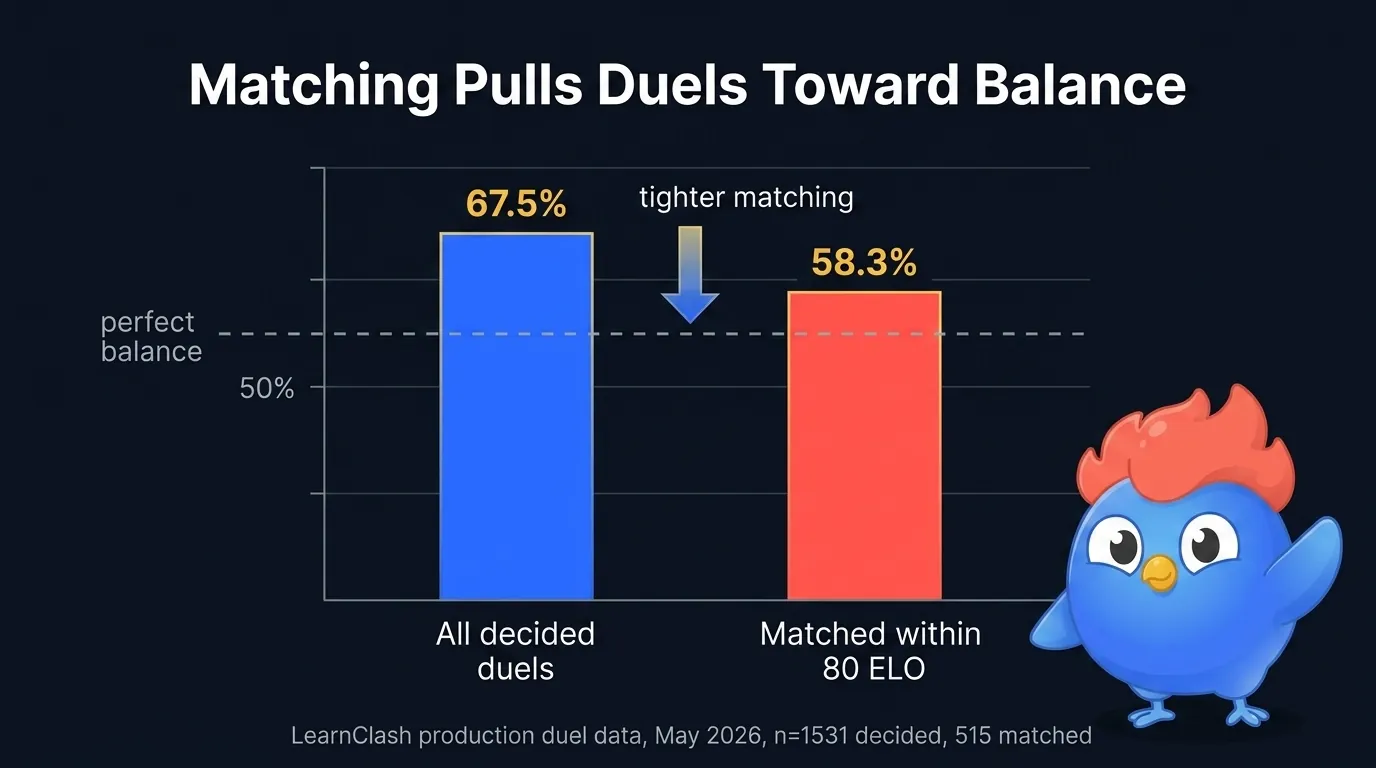 Higher-rated player’s win rate in LearnClash duels, May 2026 export: 67.5% across all decided duels, 58.3% when the pairing sat within 80 rating points.
We pulled those numbers in May 2026 from a read-only export of production duels. Across 1,531 decided duels, the higher-rated player won 67.5 percent. In the 515 duels where the two players sat within 80 rating points of each other, that fell to 58.3 percent. Tight matching pulls outcomes toward balance without erasing skill, which is the band we want: closer than a random pairing, still a real contest.
The first force is calibration. A new LearnClash account starts at 1300, which is Gold II on the 22-rank ladder, with a rating deviation of 250. The engine treats that number as a guess, so the first duels move it a long way, and until the deviation falls the matchmaker is pairing on a rating it does not yet trust.
The second is the decaying quality bar from the previous section. A duel that has sat in the queue for 40 minutes accepts a joiner the fresh duel would have refused, so some share of pairings are wider than the composite would normally allow.
The third is topic familiarity, which is hidden skill. Two players who spent the last month on European geography arrive at a European-geography duel with similar exposure, and recall decides it. Two players matched on molecular biology where only one has ever played biology see exposure outweigh rating, and even at a zero gap the outcome tilts. Category cosine is the layer that catches this; a cold-start profile under 5 picks, or a low-overlap pair the decay let through, is where it leaks.
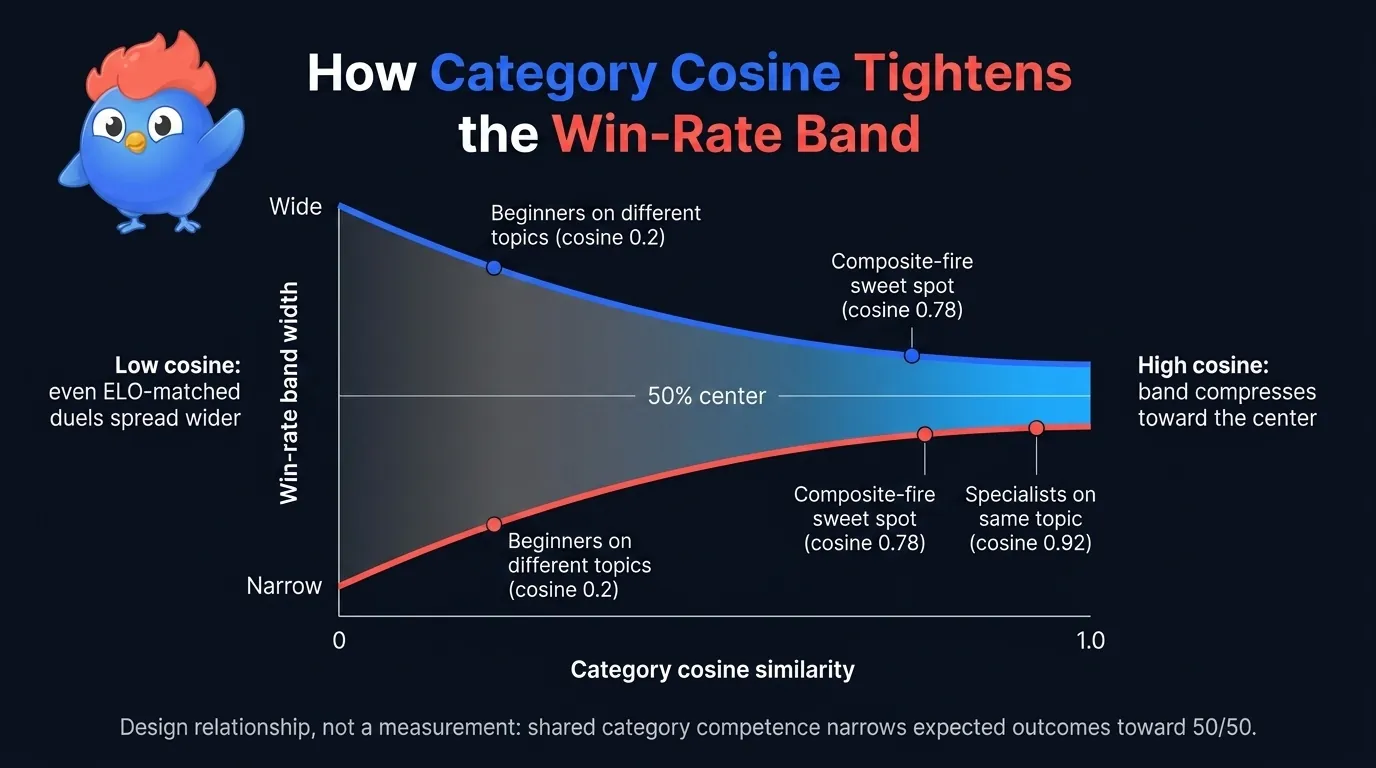 Category overlap against band tightness. High cosine means both players draw on the same exposure; low cosine lets familiarity bleed into a rating-only match.
The pattern is monotonic. The more two category vectors overlap, the more a duel is decided by recall rather than by who happened to have studied the material, and the tighter the band gets. Classroom quiz platforms like Kahoot and Blooket do no skill matching at all; Blooket’s Gold Quest mode even lets a student with 5 correct answers beat one with 50 on chest luck, a design choice our Kahoot vs Blooket comparison goes into.
How Calibration Bends the Curve
Rating deviation controls how hard each duel moves a rating. LearnClash’s engine is Glicko-2: a new rating carries a deviation of 250, and about 10 duels bring it toward the floor of 90, where an even-rating win or loss moves the number by about 20 points. The app mirrors that window directly, treating the rating as provisional until the deviation drops under 100 and revealing the public rating after 10 rated duels.
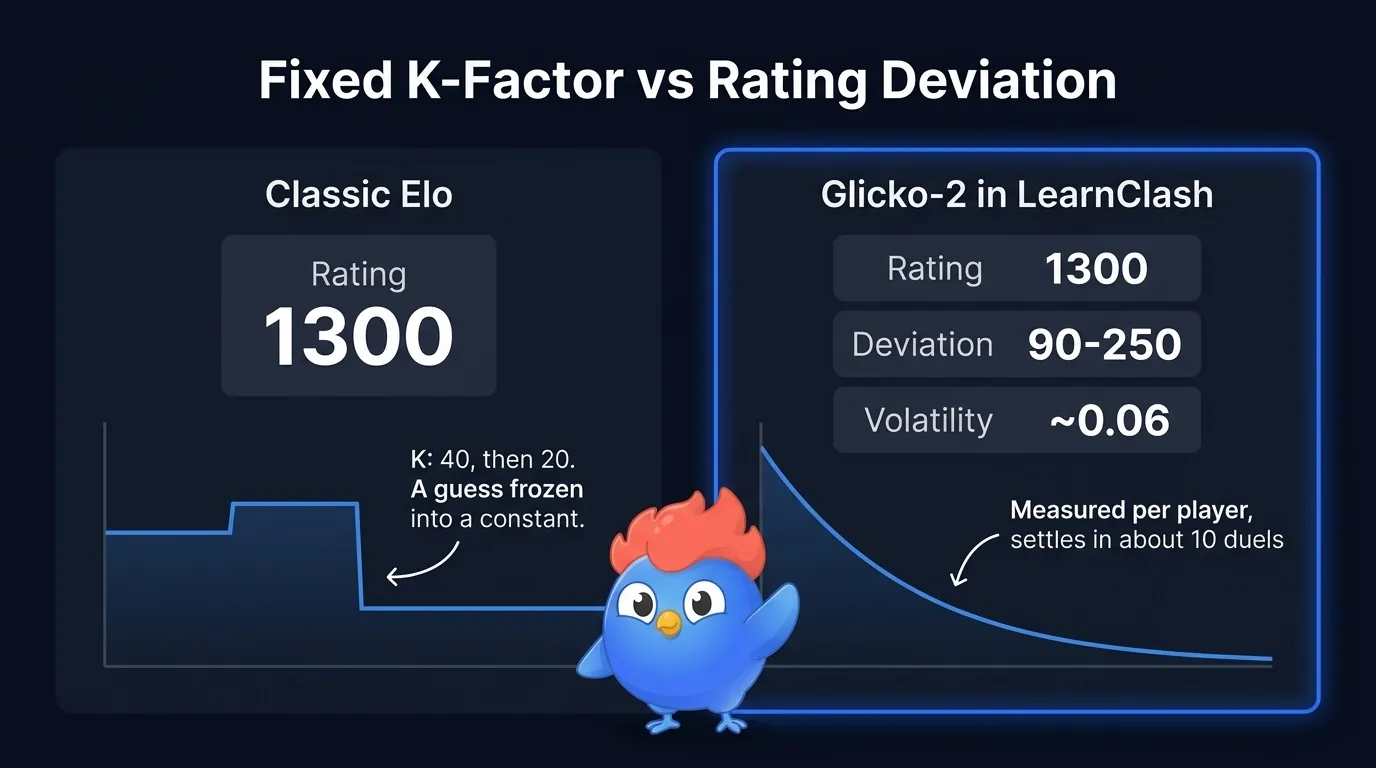 Classic chess Elo freezes calibration into a K-factor. Glicko-2 measures it per player as a deviation that starts at 250 and settles toward 90.
Wide early swings are deliberate. Every new player begins at 1300 whether they are a pub-quiz regular or a complete beginner, so the first duels have to move the rating far enough to peel off that shared starting bias. The deviation does that job continuously, and there is no K-factor anywhere in the code.
Classic chess Elo gets a similar shape from a K schedule. FIDE gives a new player K=40 until they have completed 30 rated games, keeps K=40 for under-18s rated below 2300, then applies K=20 below 2400 and K=10 from 2400 on. Glicko-2 replaces the step function with a per-player uncertainty that shrinks with play and grows again with inactivity. Microsoft’s TrueSkill took the same idea further by treating skill as a full probability distribution.
Here is a number I can date from the commit history. The deviation floor was 50 until May 12, 2026, when we raised it to 90. At 50, an established even-rating result moved a rating by roughly 7 to 13 points, which is chess-like and, in a quiz app where one duel samples a thin slice of what you know, felt unrewarding; the comment we left on the constant in that commit says exactly that. At 90 the same result moves about 20, and that is the settled band every established player now lives in.
Once the deviation sits at its floor, volatility stops driving the band and skill drives it. The matchmaker is also reading a rating it trusts by then, so the composite score means what it says, and most duels between settled players finish close.
How ELO-Matched Wins Compound 3-stage SRS Retention
This is why the matchmaker is a memory system and not just an engagement system. A win in a skill-matched duel is earned at the edge of recall, which is the condition the learning literature links to durable memory. A win in a blowout is not, and that distinction is the design reason the composite exists.
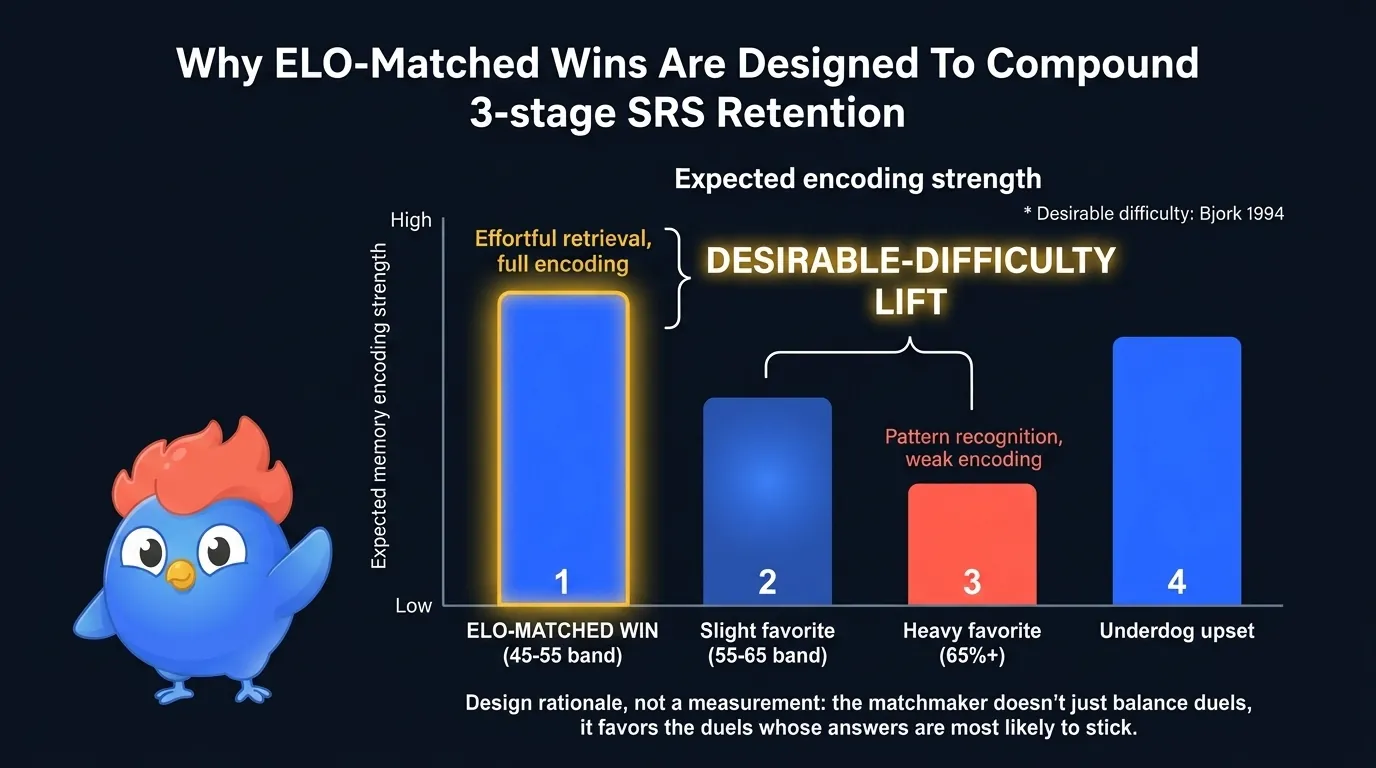 A skill-matched win is earned through effortful retrieval. A blowout win is answered by pattern recognition, and the brain barely encodes it.
Three things happen in a close duel that do not happen in a lopsided one. Attention stays up until the last question, because the result is in doubt. The questions you barely get right sit at the edge of your recall, the desirable-difficulty zone where retrieval that succeeds with effort lays down stronger memory. And fewer answers arrive by pattern recognition, which is how a player who is dominating tends to answer: correctly, without engaging recall, and without encoding much.
The stress angle is real but narrower than the folklore. A 2019 study in Learning & Memory (Jiang, Tran, Madison, and Bakker) found that a stressor applied right after encoding improved participants’ later ability to tell similar items apart, while the same stressor applied before retrieval changed nothing. A close duel may provide mild pressure at the consolidation end of that window, though the study induced stress with a Trier Social Stress Test, not a quiz margin, so that link is my inference. I would not build a product on one result, but it points the same way as the Bjork work.
What the matchmaker hands to the spaced-repetition layer is the part we control. Every question you answer enters a 3-stage schedule: a wrong answer drops the card one stage and brings it back after 7 days, a correct answer moves it to Known and schedules a 90-day check, and a second clean pass retires it as Mastered. A question retrieved with effort in a close duel is more likely to survive those checks than one answered on autopilot. Systems built for one-session cramming, like Quizlet’s free Learn mode capped at 5 rounds per set or Kahoot’s host-led live format, never schedule the check at all.
How LearnClash Differs from MOBAs and TrueSkill
LearnClash borrows the expected-score idea from Elo, the rating deviation from Glicko, and adds the category layer itself. The four systems below solve different problems and arrive at different answers.
| League of Legends | Halo 5 (TrueSkill 2) | Chess platforms (Glicko-2) | LearnClash | |
|---|---|---|---|---|
| Rating engine | Internal MMR | TrueSkill 2, Bayesian | Glicko-2 | Glicko-2, shown as an ELO-style number |
| Matchmaking input | Skill | Skill plus uncertainty | Skill plus rating deviation | Rating proximity plus category cosine |
| Stated target | About 50% win rate for new players (Riot, 2024) | Outcome prediction accuracy | Rating accuracy over time | Balanced band plus retention |
League of Legends matches on an internal MMR, and Riot’s 2024 post names a roughly 50 percent win rate for new players as the goal while reporting a current figure near 46 percent. The forum conspiracy reflects a real design aim applied to the wrong frame. MOBAs target balanced queues, not balanced learning.
Microsoft’s TrueSkill 2 (Minka, Cleven, and Zaykov, 2018) is the most mathematically ambitious of the four. It treats each player’s skill as a probability distribution and updates the variance after every match, and on Halo 5 data it predicted historical match outcomes with 68 percent accuracy, against 52 percent for the original TrueSkill. That gain came from feeding the model more than win/loss, which is a luxury a two-player quiz does not need.
Glicko, published by Mark Glickman in 1995, added the rating deviation term that Glicko-2 later extended with volatility. The deviation measures how confident the system is in your rating right now. It grows after inactivity, shrinks with regular play, and lets the engine discount a result against an opponent it barely knows.
LearnClash runs Glicko-2 for the rating and layers category cosine on top for matchmaking. The number on your profile reads like ELO because tiers and a four-digit rating are what players already understand; the rating-system article covers the migration from classic Elo in detail. The category layer is the LearnClash addition, and it is the reason the win-rate band stays tight instead of widening into topic-driven mismatches.
Where That Leaves the Forced-50 Complaint
The complaint is good math attached to the wrong product. A skill-matched queue does push win rates toward 50, in League and in LearnClash alike, because that is what removing the rating gap does. In a shooter, whether that feels fair is a matter of taste. In a quiz app it is the point, since the duels that finish close are the ones where the answers were retrieved with effort and the 7-day and 90-day reviews have something to confirm.
Pick a topic and play ten rated duels. The first few will swing your rating hard while the deviation is high, and then the composite matchmaker will start handing you opponents who share your level and your interests. Duel me on study techniques and watch the swings settle.
Frequently Asked Questions
What is an ELO-matched win rate?
An ELO-matched win rate is the win probability when both players sit within a tight rating gap. Remove the gap and both players have roughly equal chances, so outcomes trend toward a balanced band. Skill-based matchmaking targets that band by pairing on skill; it never manipulates the result.
Is LearnClash's matchmaking forcing a 50 percent win rate?
No. The matchmaker ranks open duels by a composite of rating proximity and category overlap and never touches the outcome. Skill-matched opponents trend toward balanced results because their chances are roughly equal. Riot's September 2024 matchmaking post states the same thing for League of Legends: a roughly 50 percent win rate for new players is a placement goal, and at the time they were sitting near 46 percent.
Why does LearnClash use a 50/50 composite of ELO proximity and category overlap?
Pure rating matching ignores what each player has actually studied. A Phoenix-tier history player and a Phoenix-tier physics player are equals on paper and strangers on content. Weighting category cosine similarity at 50 percent keeps duels on shared ground without a hard rating gate, and the engine falls back to pure rating proximity until both players have 5 recorded topic picks.
How does ELO matchmaking compare to TrueSkill or Glicko-2?
TrueSkill 2 (Microsoft Research, 2018) tracks skill uncertainty alongside the rating mean and predicted Halo 5 match outcomes with 68 percent accuracy, against 52 percent for the original TrueSkill. Glicko and Glicko-2 add a rating deviation that grows with inactivity. LearnClash computes ratings with Glicko-2, shows them as an ELO-style number, and adds category cosine similarity to matchmaking, because learning value depends on topic match as well as skill.
Does winning more often in ELO-matched duels improve memory retention?
Skill-matched duels sit in Bjork's desirable-difficulty zone, where retrieval succeeds with effort. That effort is what turns a correct answer into durable memory, so a hard-but-fair win encodes more strongly than an easy blowout. The 3-stage spaced repetition then schedules the 7-day and 90-day reviews that confirm it stuck.