
53 TV Trivia Questions That Stump Everyone [With Answers]
53 tv trivia questions across sitcoms, dramas, reality TV, and classic shows. Answers included, plus why each one stumps.
How many do you know?
Think of your answer, then reveal it.
Did you know it before revealing the answer?
Read this answer in the articleRound complete
Challenge friends on this topic.
Start a new duel in LearnClash and learn from every answer.
Get LearnClashFree to play on iPhone and Android. No ads.
Try the questions you missed once more.

The show about the Korean War ran four times longer than the war itself. The most-watched series in history was cancelled after one season. And Seinfeld wasn’t pitched as “a show about nothing.”
These 53 TV trivia questions on LearnClash cover classic television, sitcoms, prestige dramas, reality shows, behind-the-scenes secrets, and theme songs that trip up even the most committed binge-watchers. Every question includes the answer and a breakdown of why it catches people off guard, with facts cross-checked against IMDb and Emmy records.
Six groups, three levels, zero filler. TV is part of our trivia questions roundup with 22 categories and nearly 1,000 questions. Test your TV knowledge on LearnClash →
Challenge a friend to TV trivia on LearnClash
Quick Overview
LearnClash sorts TV trivia questions by group and level so you face the right challenge. These 53 television trivia questions lean toward medium and hard because “what channel was Friends on?” doesn’t stump anyone past high school.
| Category | Questions | Easy | Medium | Hard |
|---|---|---|---|---|
| Classic TV Trivia | 1-9 | 3 | 3 | 3 |
| Sitcom Trivia | 10-20 | 3 | 4 | 4 |
| Prestige Drama TV Trivia | 21-31 | 2 | 5 | 4 |
| Reality TV & Game Show Trivia | 32-40 | 2 | 4 | 3 |
| Behind-the-Scenes TV Trivia | 41-48 | 2 | 3 | 3 |
| TV Theme Song & Catchphrase Trivia | 49-53 | 1 | 2 | 2 |
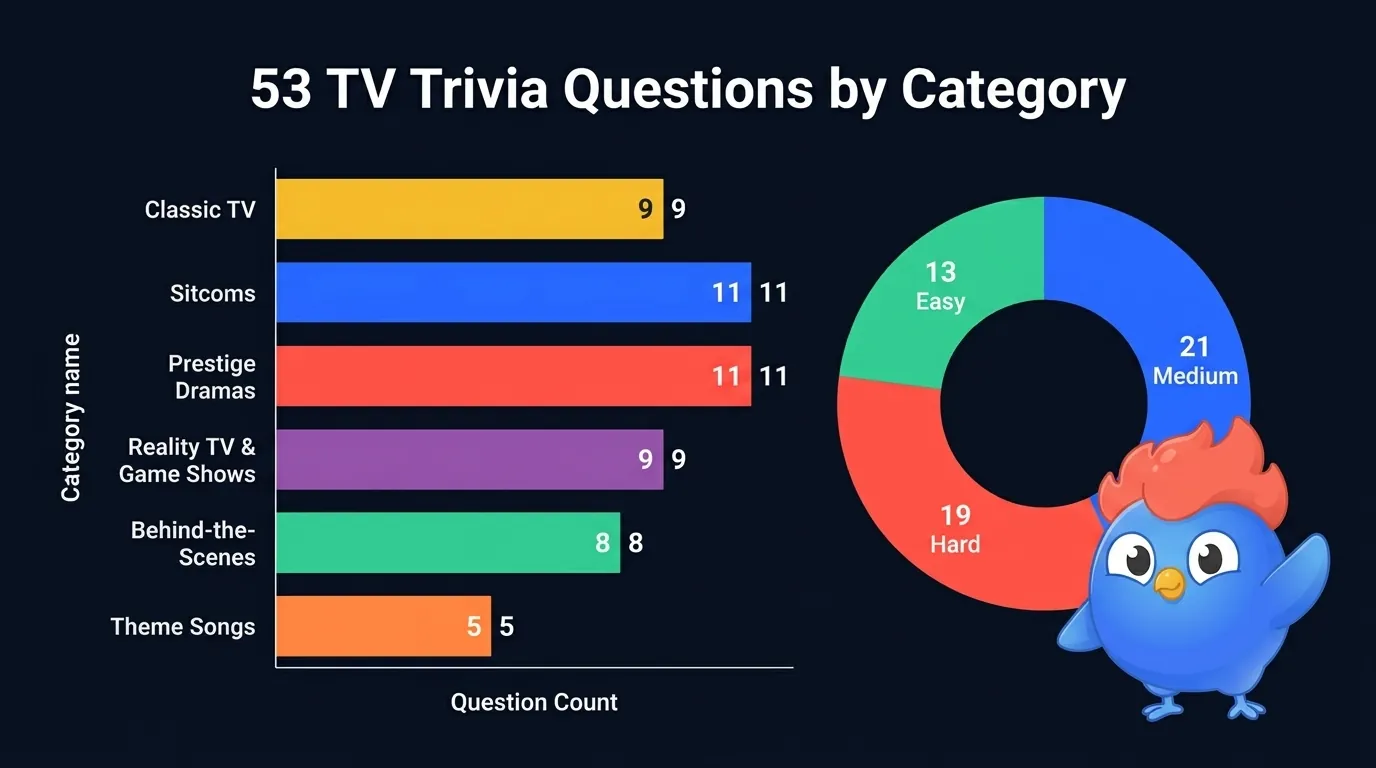 53 TV trivia questions across six categories. Difficulty skews medium and hard because that’s where the real stumpers live.
TV trivia has a pattern worth knowing: players are most confident about the shows they grew up watching. Sitcoms, dramas, reality TV. That confidence is exactly what makes corrections stick through spaced repetition. The wider the gap between what you think you know and what’s actually true, the stronger the memory trace.
Classic TV Trivia Questions (1-9)
Classic TV trivia questions on LearnClash produce some of the widest confidence gaps in the entire game. Players assume they know everything about shows that ran for decades on three networks. But the real stories behind these shows are stranger than anything that aired on screen.
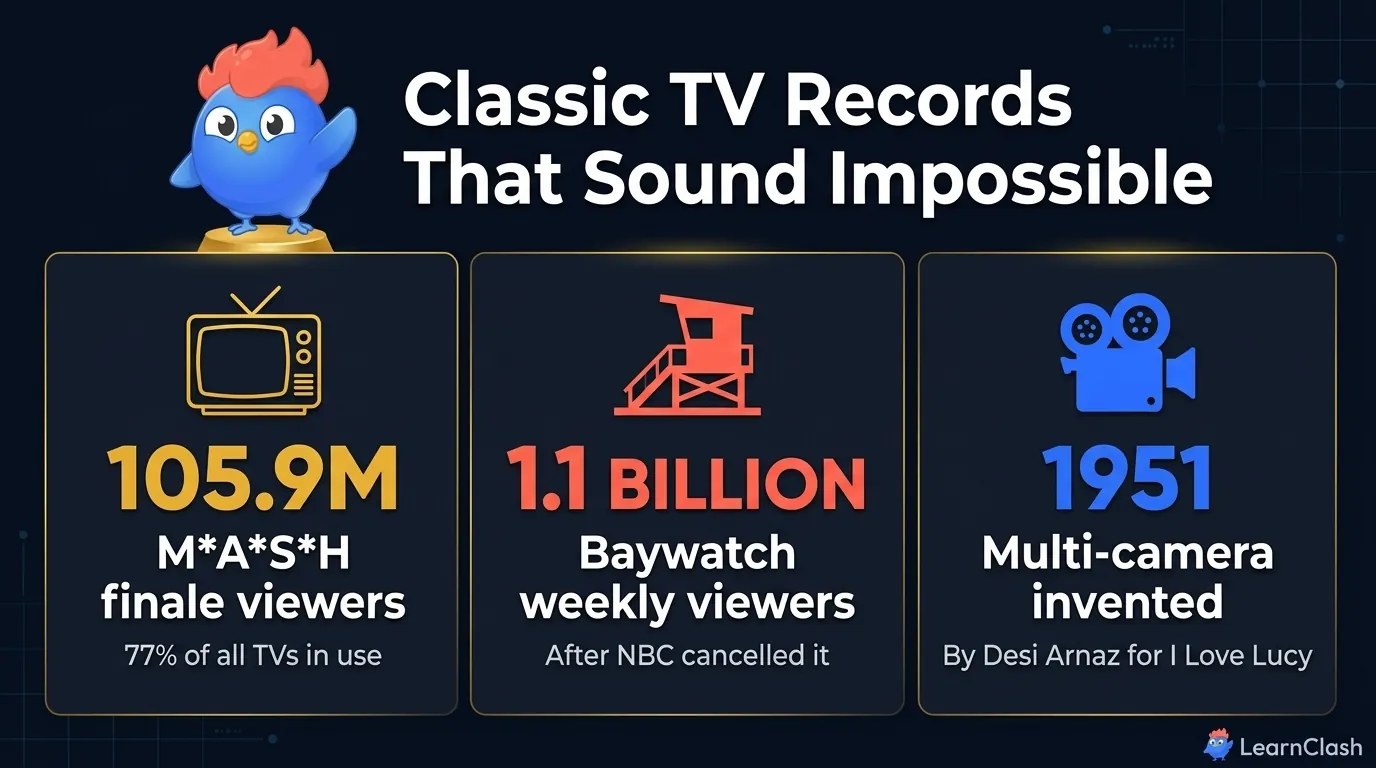 Classic TV: 9 questions covering records, innovations, and origin stories from the 1950s through the 1980s.
1. Which TV finale is the only single episode ever watched by over 100 million Americans? Easy
Answer: The M*A*S*H finale “Goodbye, Farewell and Amen” (1983). 105.97 million viewers tuned in, capturing 77% of all TVs turned on. The show itself ran for 11 seasons. The war it showed lasted three years.
Why it stumps people: Nearly everyone guesses a Super Bowl or some big drama. No scripted episode has come close since, and the streaming era makes it nearly impossible to repeat. And here’s the kicker: a show about a three-year war ran four times longer than the war itself.
2. CBS required approval from which three religious figures before allowing a pregnancy storyline on I Love Lucy? Medium
Answer: A priest, a rabbi, and a minister. CBS was so nervous about Lucille Ball’s real-life pregnancy in 1952 that each script draft was reviewed by all three. The word “pregnant” was banned from the air. Only “expecting” was allowed.
Why it stumps people: It sounds like the setup to a joke. It isn’t. The episode depicting the birth drew 44 million viewers, and Ball gave birth to her real son on the same day it aired. TV’s first pregnancy storyline needed a religious panel to approve it.
3. How many episodes was Steve Urkel meant to appear in on Family Matters? Medium
Answer: One. Jaleel White was cast for a single guest appearance. The live studio audience reacted so strongly that producers brought him back. Within two seasons, Urkel was Family Matters. The original Winslow family got pushed to the background of their own show.
Why it stumps people: Urkel is so synonymous with Family Matters that people assume the show was built around him. It was built around the Winslow family. He hijacked it with a single episode.
4. What was Saved by the Bell first called, and what network aired it? Hard
Answer: Good Morning, Miss Bliss on the Disney Channel. It starred Hayley Mills, ran 13 episodes, and got cancelled. NBC retooled it, dropped the teacher as the lead, moved the focus to the students, and relaunched it as Saved by the Bell.
Why it stumps people: Saved by the Bell is iconic NBC Saturday morning TV. Nobody connects it to a failed Disney Channel show about a schoolteacher. The change was so total that the first show barely exists in pop culture memory.
5. What happened to Baywatch after NBC cancelled it following its first season? Hard
Answer: David Hasselhoff and the producers funded it with their own money. They struck a direct syndication deal and the show ran for ten more seasons. At its peak in 1996, Baywatch reached 1.1 billion viewers per week across 142 countries, making it the most-watched TV series in world history per Guinness World Records.
Why it stumps people: The numbers break brains. A billion per week? From a show NBC dumped after one season? The most-watched show in TV history is the one most people dismiss as “the one with the slow-motion running.”
6. The Andy Griffith Show theme is famous for its whistling. What don’t most people know about it? Easy
Answer: The song has full lyrics. Andy Griffith recorded a vocal version called “The Fishin’ Hole,” but producers decided the whistled version was catchier. The lyrics were never aired during the show’s original run.
Why it stumps people: People have heard that whistle a thousand times. Almost nobody knows there are words to go with it.
7. What TV production method did Desi Arnaz invent for I Love Lucy? Easy
Answer: Multi-camera filming in front of a live studio audience on 35mm film. Before 1951, sitcoms were either performed live or shot with a single camera. Arnaz’s innovation became the standard for sitcoms for the next 70 years.
Why it stumps people: The format that defined sitcom production was invented by a Cuban bandleader, not a Hollywood studio executive. People don’t associate technical innovation with a 1950s comedy star.
What does that look like in practice?
Every sitcom you’ve ever watched with a laugh track, a living room set, and three cameras running at once? That started with Lucy and Desi in a converted soundstage.
8. Which Happy Days character started as a minor role who almost got the show renamed after him? Medium
Answer: Fonzie (Arthur Fonzarelli). Henry Winkler wasn’t in the opening credits initially. By Season 3, he was top-billed, and producers seriously considered renaming the show “Fonzie’s Happy Days.”
Why it stumps people: Fonzie is Happy Days in most people’s minds. They don’t realize he started as a supporting character who wasn’t even considered important enough for the credits.
9. All in the Family was adapted from a show in another country. Which one? Hard
Answer: Till Death Us Do Part (BBC, 1965). Norman Lear adapted the British sitcom about a working-class bigot for American audiences. The original ran on the BBC for nearly a decade before Lear brought the concept stateside.
Why it stumps people: This is one of the hardest classic TV trivia questions because All in the Family feels deeply American. Archie Bunker’s worldview, the Queens row house, the political arguments. The idea that it started as a British show catches people completely off guard.
Play classic TV trivia on LearnClash
Sitcom Trivia Questions (10-20)
Sitcom TV trivia questions on LearnClash have the highest replay rate in the entertainment category. Players watch these shows over and over, absorb years of reruns, and arrive dead certain about facts they’ve never checked. That false confidence is the trap.
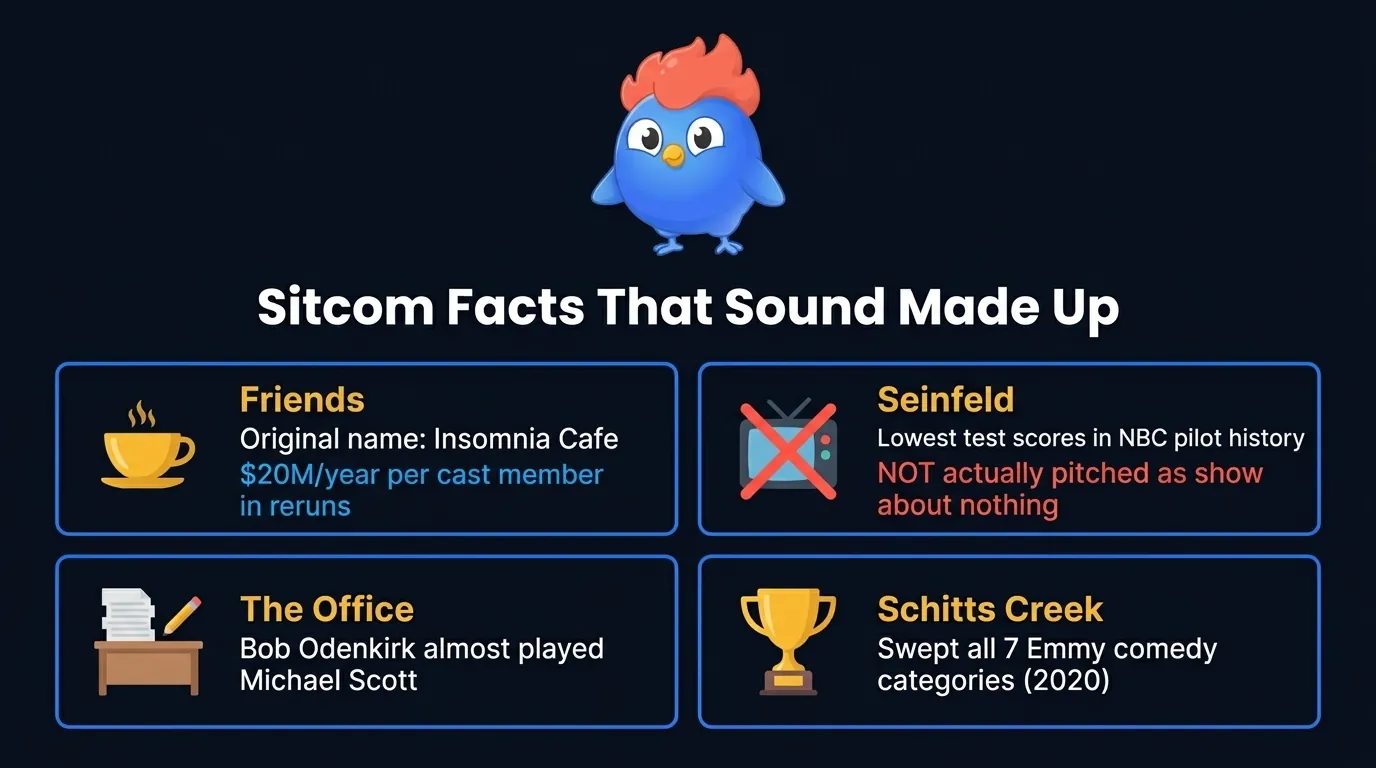 Sitcoms: 11 questions spanning Friends, Seinfeld, The Office, and beyond. The confidence gap is widest here.
10. What was Friends first called in its pilot script? Medium
Answer: Insomnia Cafe. The show cycled through four names: Insomnia Cafe, Six of One, Friends Like Us, and Across the Hall before NBC settled on Friends.
Why it stumps people: “Six of One” is the most common wrong guess because it’s been widely cited. But the first name was Insomnia Cafe. The coffee shop connection runs deeper than Central Perk.
11. What song was the placeholder theme for the Friends pilot before “I’ll Be There for You”? Hard
Answer: R.E.M.’s “It’s the End of the World As We Know It (And I Feel Fine).” Producers sent The Rembrandts the pilot with that song as a reference, hoping they’d create something similar. The actual Friends lyrics were co-written by Allee Willis, who also co-wrote Earth, Wind & Fire’s “September.”
Why it stumps people: Two surprises in one. The R.E.M. connection is obscure enough, but the link to “September”? That catches even hardcore fans.
12. How much does each Friends cast member earn per year from reruns alone? Easy
Answer: Roughly $20 million per year, each. The show still generates around $1 billion annually for Warner Bros. All six cast members negotiated collective salaries, led by Jennifer Aniston and David Schwimmer, setting a Hollywood precedent for ensemble pay parity.
Why it stumps people: People guess a few hundred thousand, maybe a million. Twenty million dollars a year per person, from a show that ended in 2004, is the kind of number that doesn’t feel real.
13. Was Seinfeld actually pitched to NBC as “a show about nothing”? Medium
Answer: No. Larry David confirmed the phrase was invented for the Season 4 meta episode “The Pitch,” where Jerry and George try to sell a show within the show. The real pitch was “how a comedian gets his material.” The phrase caught on after the episode aired, and everyone assumed it was the actual origin.
Why it stumps people: This is one of TV’s most stubborn myths. Saying “actually, it wasn’t” in a room full of sitcom fans will start an argument every time.
14. How did Seinfeld’s pilot perform with NBC test audiences? Medium
Answer: It received what executives described as the lowest test scores in NBC pilot history. The audience research report stated: “No segment of the audience was eager to watch the show again.” NBC ordered just four episodes, the smallest order in TV history.
Why it stumps people: People know Seinfeld was massive. They don’t know it was the closest thing to dead on arrival that TV has ever produced. The gap between those scores and the show’s $3.1 billion in reruns is wild.
Did you know? LearnClash uses spaced repetition to turn wrong TV trivia questions into long-term knowledge. The questions you miss come back at increasing intervals until you’ve mastered them, just like the corrections that stick hardest at trivia night.
15. Which main character was missing from the first Seinfeld pilot? Hard
Answer: Elaine Benes. The pilot, titled “The Seinfeld Chronicles,” had no Elaine. The female lead was a waitress named Claire. Julia Louis-Dreyfus wasn’t cast until after NBC ordered the series.
Why it stumps people: Seinfeld without Elaine is like toast without butter. But the first draft had no room for her. She exists only because NBC gave the show a second shot it almost didn’t earn.
16. Which future Better Call Saul star almost played Michael Scott on The Office? Medium
Answer: Bob Odenkirk. Steve Carell was committed to another NBC show called Come to Papa, which was quickly cancelled, freeing him up. Odenkirk described his own audition as “a terrible Ricky Gervais impersonation.”
Why it stumps people: Knowing the man who became Saul Goodman almost became Michael Scott casts both shows in a new light. And Carell only got the role because his other show tanked. Pure luck.
17. Why was Oscar’s reaction to Michael kissing him so genuine in The Office episode “Gay Witch Hunt”? Easy
Answer: Steve Carell improvised the full kiss. Oscar Nunez was only expecting a peck on the cheek. His stunned, uncomfortable reaction is completely real, not acted.
Why it stumps people: The scene looks scripted because the camera stays steady and the other actors hold character. But Oscar’s shock is 100% authentic.
18. Which show holds the record as the longest-running live-action comedy series in US television history? Easy
Answer: It’s Always Sunny in Philadelphia (2005-present). It surpassed The Adventures of Ozzie and Harriet for the record.
Why it stumps people: People guess Friends, Seinfeld, or The Simpsons (which is animated, not live-action). Always Sunny rarely enters the conversation because it never won a major Emmy, but it outlasted everything.
Think you know your sitcoms? Prove it on LearnClash
19. Where was the Big Bang Theory theme song written, and how long did it take? Hard
Answer: Ed Robertson of Barenaked Ladies wrote it in the shower in about 15 minutes. He recorded a scratch demo on GarageBand while wearing a towel. The producers loved the raw demo so much they nearly used it as-is. The connection happened because show creators heard Robertson freestyle rap about a Big Bang book at a concert.
Why it stumps people: The song sounds polished and intentional. Fifteen minutes, in a shower, on a laptop? For a show that ran 12 seasons? People expect months of studio work, not a towel-wrapped GarageBand session.
20. What Emmy record did Schitt’s Creek set in 2020? Hard
Answer: It swept all seven comedy categories, including all four acting awards. No show in Emmy history had ever done this. It also became the first basic cable series to win Outstanding Comedy, airing on Pop TV, a network most people had never heard of.
Why it stumps people: The sweep itself is historic. But the fact that it happened on Pop TV? A network so small that most cable packages didn’t carry it? That’s the real surprise.
Prestige Drama TV Trivia Questions (21-31)
Prestige drama TV trivia questions on LearnClash consistently produce the hardest difficulty ratings in the entertainment category. Players who’ve watched every episode of Breaking Bad or Game of Thrones feel sure about plot twists and story arcs. They don’t know the real stories that almost killed these shows before they aired.
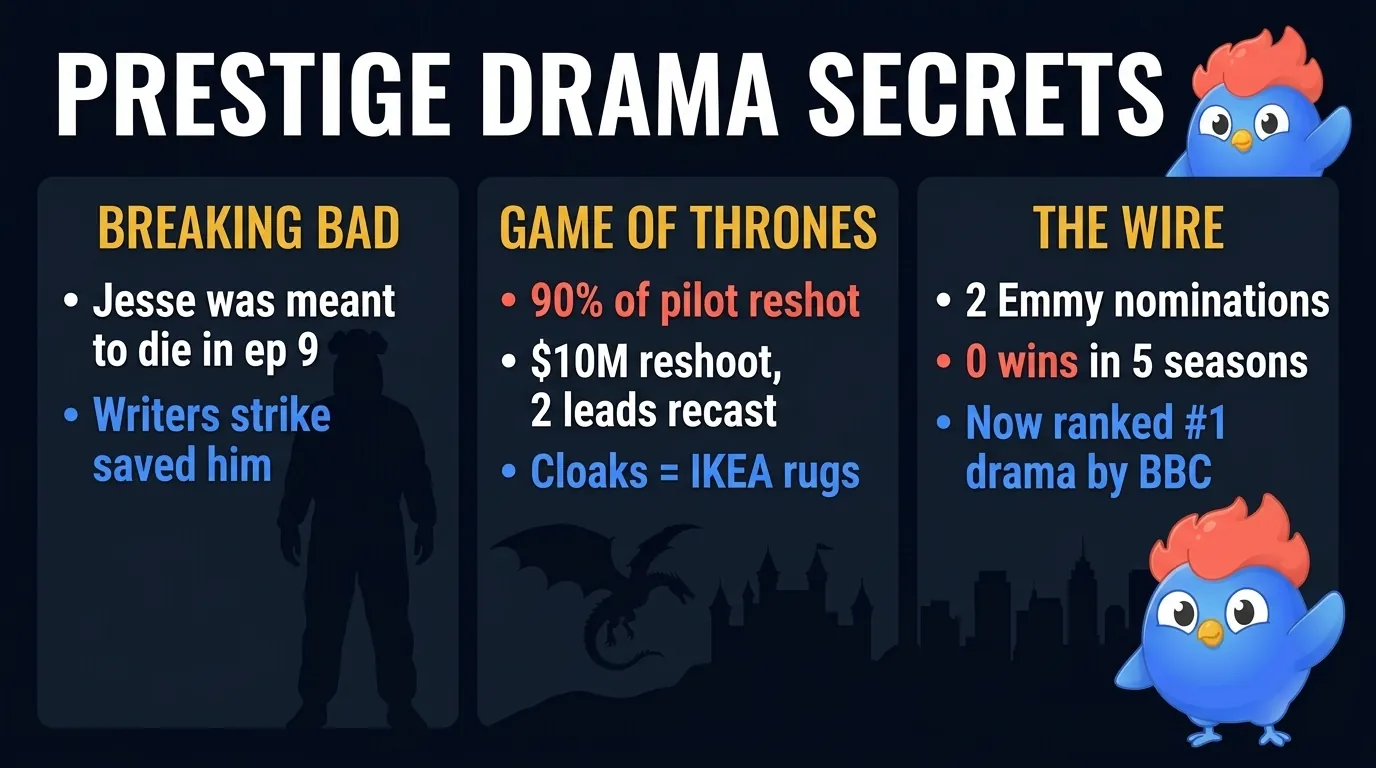 Prestige Dramas: 11 questions from Breaking Bad, Game of Thrones, Stranger Things, The Wire, and more.
21. In which episode was Jesse Pinkman meant to die in Breaking Bad? Medium
Answer: Episode 9, Season 1. The 2007-2008 writers’ strike gave Vince Gilligan time to rethink. Aaron Paul’s on-screen chemistry with Bryan Cranston convinced Gilligan to keep Jesse alive. He stayed for all 62 episodes and eventually got his own spinoff film, El Camino.
Why it stumps people: Jesse Pinkman is so central to Breaking Bad that imagining the show without him feels absurd. But he was written as a disposable character. A labor dispute saved him.
22. Which two A-list actors turned down the role of Walter White before Bryan Cranston? Hard
Answer: Matthew Broderick and John Cusack. AMC executives were already skeptical of Cranston because they only knew him as the goofy dad from Malcolm in the Middle. Gilligan had to show them a specific X-Files episode to prove Cranston could play menacing.
Why it stumps people: Nobody guesses comedic actors. People reach for dramatic types. But the role was offered to Ferris Bueller and the guy from Say Anything before it went to Hal from Malcolm in the Middle.
23. Whose idea was Walter White’s “Heisenberg” hat, goatee, and look? Medium
Answer: Bryan Cranston’s. He suggested the pork pie hat, the mustache, and the slightly overweight physique. The hat started as a practical solution for sun protection during outdoor filming in Albuquerque.
Why it stumps people: The Heisenberg look is so famous that people assume Vince Gilligan planned every detail. Cranston built it himself, piece by piece, starting with a hat he needed for sun.
24. What percentage of the original Game of Thrones pilot was reshot before the series aired? Hard
Answer: Roughly 90%. The first pilot was so bad that the showrunners’ own friends couldn’t say one nice thing about it. Test audiences couldn’t tell Jaime and Cersei were twins or that Robert Baratheon was king. Both Daenerys (first played by Tamzin Merchant) and Catelyn Stark (first played by Jennifer Ehle) were recast. The reshoot cost HBO $10 million.
Why it stumps people: The biggest fantasy show in TV history almost died before it aired. People assume HBO greenlit a hit. They greenlit a disaster, then spent $10 million fixing it.
25. What everyday household item were the Night’s Watch cloaks in Game of Thrones made from? Medium
Answer: IKEA sheepskin rugs (the SKOLD model). The costume team cut, shaved, waxed, and frosted them with Fuller’s earth to look like worn fur cloaks.
Why it stumps people: HBO spent hundreds of millions on production design. The cloaks that defined the Wall’s aesthetic came from a furniture store. Cost per rug: about $30.
But here’s where it gets interesting.
Clapton won three Emmy Awards for costume design on Game of Thrones. Part of her award-winning work involved scissors and a trip to IKEA.
26. Which Game of Thrones villain first auditioned for Jon Snow, making it to the final two? Medium
Answer: Iwan Rheon, who played Ramsay Bolton. It came down to Rheon and Kit Harington. One audition round separated one of TV’s greatest heroes from one of its most hated villains.
Why it stumps people: Jon Snow and Ramsay Bolton are polar opposites. The idea that the same actor nearly played both forces you to rethink every scene between them.
27. What was Stranger Things first called, and where was it set? Easy
Answer: “Montauk.” The show was set in Montauk, New York, inspired by the Montauk Project conspiracy theory. Netflix rejected the name (too much like a documentary) and the setting moved to Hawkins, Indiana.
Why it stumps people: “Stranger Things” feels so perfect as a title that people assume it was always the plan. It wasn’t. A Netflix executive’s feedback changed the entire identity.
28. Which Stranger Things fan-favorite was written as a throwaway bully who’d die in Season 1? Easy
Answer: Steve Harrington. The Duffer Brothers planned for him to be a one-dimensional jerk who gets killed. Joe Keery brought so much unexpected charm to the role that they rewrote him into the beloved “babysitter” arc.
Why it stumps people: Steve became arguably the most popular character on the show. His whole arc, from bully to fan favorite, exists only because an actor beat the script.
29. How many Emmy nominations did The Wire receive in its entire five-season run? Hard
Answer: Two. Both for writing. It won zero. No actor from its ensemble was ever nominated. The BBC ranks it #1 on its list of the 100 greatest TV series of the 21st century. Barack Obama called it “one of the greatest pieces of art in the last couple of decades.”
Why it stumps people: This is one of the most jaw-dropping TV trivia questions and answers on this list. The show almost universally considered the finest drama ever produced was nearly invisible to the Television Academy. Two nominations. Zero wins. Five seasons. The gap between its legacy and its awards record is the widest in Emmy history.
30. Which famous Goodfellas actor turned down the role of Tony Soprano? Hard
Answer: Ray Liotta. He turned it down because he wanted to focus on his movie career and didn’t want a multi-year TV commitment. David Chase had first planned it as a film with Robert De Niro, not a series at all.
Why it stumps people: People reach for De Niro or Al Pacino. But Liotta is the one who actually had the offer and said no. And the fact that The Sopranos was conceived as a De Niro movie? That recasts the entire show.
31. What subtle performance detail does Sae-byeok use when speaking to different people in Squid Game? Medium
Answer: She switches accents. As a North Korean defector, she speaks with a South Korean accent when talking to other players but quietly reverts to her native North Korean accent when alone with her younger brother.
Why it stumps people: Most viewers focus on visual clues and plot twists. The linguistic detail flies past non-Korean speakers entirely, and even Korean speakers don’t always catch the switch on first viewing.
Reality TV & Game Show Trivia Questions (32-40)
Reality TV trivia questions on LearnClash catch players off guard because people treat reality shows as guilty fun, not topics worth knowing. That’s why the facts hit harder. The gap between what’s “real” and what’s produced is wider than anyone expects.
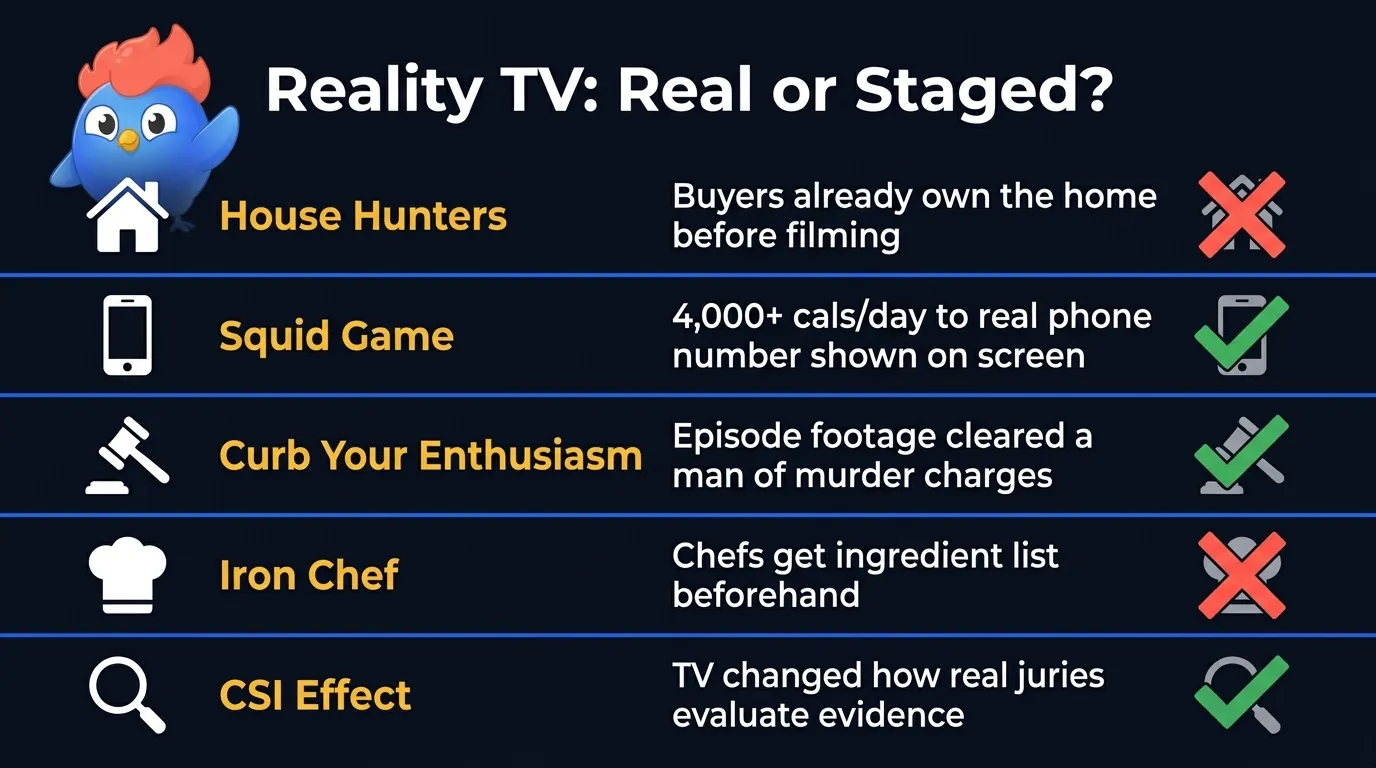 Reality TV & Game Shows: 9 questions on staged premises, legal consequences, and production secrets.
32. On House Hunters, have the buyers already purchased their home before filming begins? Easy
Answer: Yes. Participants are typically already in escrow on one of the three houses. The other two “options” are often not on the market, already sold, or found by the realtor specifically for filming.
Why it stumps people: The whole premise of House Hunters is “watch someone pick between three homes.” Most people never question it. The picking already happened.
33. How many years did Squid Game’s creator spend trying to get it produced before Netflix picked it up? Medium
Answer: Ten years (conceived in 2009, released in 2021). Hwang Dong-hyuk was rejected by every Korean studio and network. They called the concept too violent and unrealistic.
Why it stumps people: People assume Netflix spotted a hit immediately. In reality, the show that became the biggest series launch in Netflix history sat in rejection piles for a decade.
34. What happened to the real owner of the phone number shown on screen in Squid Game? Easy
Answer: They received over 4,000 calls per day. Korean phones automatically added the “010” prefix to the 8-digit number shown on screen, turning it into a real working phone number. Netflix eventually edited the number out.
Why it stumps people: Most people assume TV shows use fake numbers. This one didn’t, and a real person paid the price.
35. Which comedy show’s episode served as a real alibi in a murder investigation, saving a man from death row? Hard
Answer: Curb Your Enthusiasm. In 2003, Juan Catalan was charged with murder in Los Angeles. His lawyer discovered that HBO had been filming a Curb episode at Dodger Stadium on the night of the killing. Background footage showed Catalan in the stands with his daughter. He was cleared and awarded $320,000 for wrongful imprisonment. The story became a Netflix doc called Long Shot.
Why it stumps people: A Larry David comedy saving someone from death row sounds like a Curb plotline, not real life. But it happened, and the footage is chilling.
36. Who holds the Guinness record as the longest-serving game show host on the same show? Medium
Answer: Pat Sajak, who hosted Wheel of Fortune from 1981 to 2024: 43 years. He surpassed Bob Barker’s 35-year run on The Price Is Right. Alex Trebek hosted Jeopardy! for 37 years, still shorter than Sajak.
Why it stumps people: Everyone guesses Trebek first. Sajak outlasted him by six years, and Barker by eight.
37. On Iron Chef America, are the chefs truly surprised by the secret ingredient? Medium
Answer: No. Chefs receive a list of possible secret ingredients beforehand so they can prepare potential recipes. Matchups are also planned in advance. The “surprise” is which ingredient from the shortlist gets selected.
Why it stumps people: The whole drama of Iron Chef rests on that reveal moment. Knowing it’s partly staged pops the bubble.
38. What real-world legal phenomenon did CSI create? Hard
Answer: The “CSI Effect.” Real-life jurors began demanding forensic evidence in every criminal case, expecting DNA results in hours instead of the actual 50+ hours of lab work. Juries started letting people walk when no DNA or prints were shown, even when such proof was beside the point. The National Institute of Justice has studied the phenomenon extensively.
Why it stumps people: A show about made-up crime scenes changed how real juries weigh real proof. Most people never consider that a TV drama could alter the justice system.
Play TV & entertainment trivia duels on LearnClash
39. Which specific dollar amounts are banned as wagers on Jeopardy!? Hard
Answer: $69, $666, $14, $88, and $1,488. The first is for obvious reasons. The last three are banned because they’re numerical codes associated with white supremacist groups.
Why it stumps people: Jeopardy! seems like the most wholesome show on TV. Its anti-hate wager rules reveal a layer most viewers never see.
40. What saved Family Guy from permanent cancellation after Fox axed it in 2003? Medium
Answer: DVD sales. The first three seasons sold so many DVD boxsets that Fox brought the show back in 2004. Adult Swim reruns built awareness, but the sales numbers sealed the deal. It’s since run for 23+ seasons.
Why it stumps people: Streaming gets all the credit for reviving cancelled shows today. Family Guy proved DVD sales could do the same thing back in 2004.
Behind-the-Scenes TV Trivia Questions (41-48)
Behind-the-scenes TV trivia questions are among the toughest on first attempt. Players know lines, roles, and plot twists. They rarely know who paid for what, which lucky breaks shaped casting, or which props caused real-world chaos. These facts don’t come from watching.
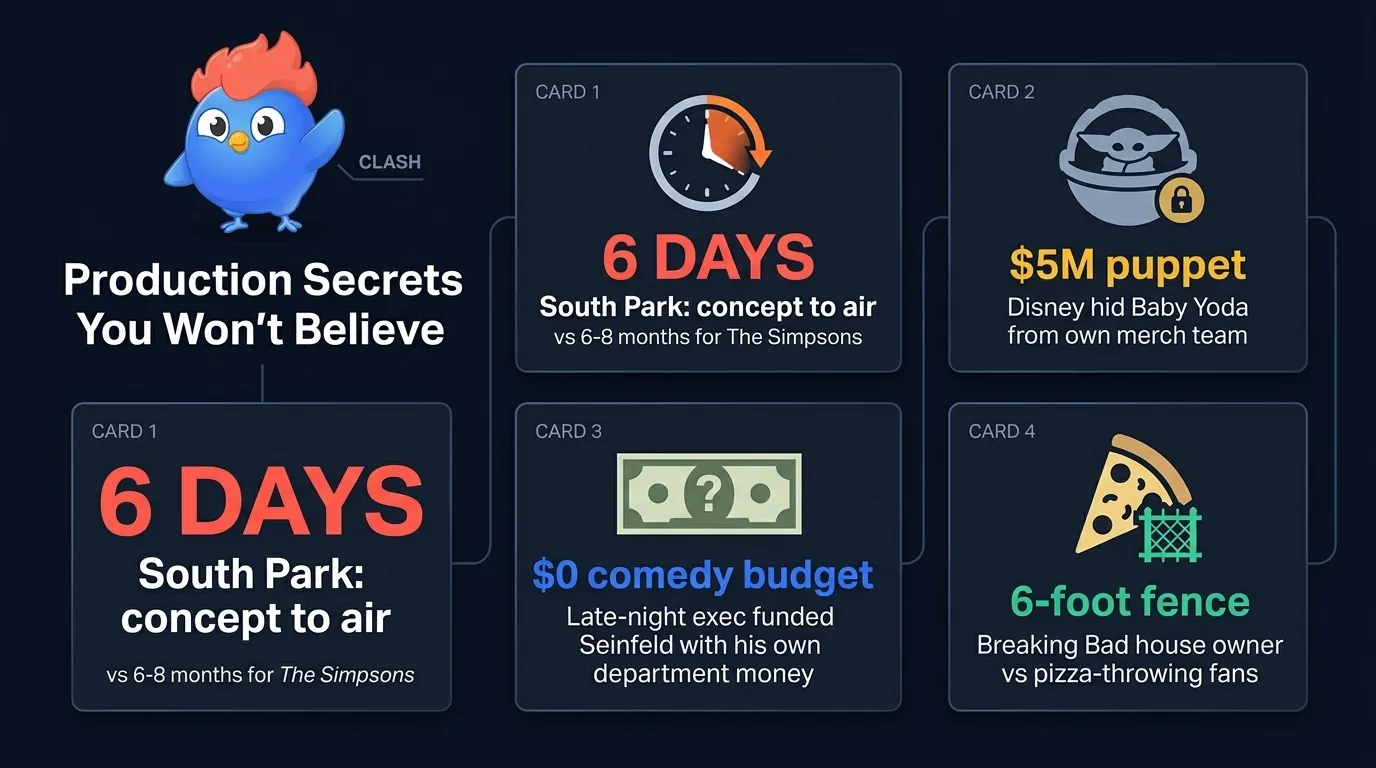 Behind-the-Scenes: 8 questions about production secrets, budget miracles, and real-world consequences.
41. How was Seinfeld saved from cancellation after its catastrophic pilot test? Hard
Answer: A late-night programming executive named Rick Ludwin used his own department’s specials budget to fund four more episodes. Nobody in NBC’s comedy wing wanted the show. Ludwin, who ran late-night (not sitcoms), put up money from his own budget. One of TV’s most profitable sitcoms lived because a late-night exec spent money he shouldn’t have.
Why it stumps people: The story isn’t just that someone saved Seinfeld. It’s that the person who saved it had nothing to do with comedy. He ran late-night. He acted alone, against the whole building.
42. Why didn’t House creator David Shore realize Hugh Laurie was British during auditions? Medium
Answer: Laurie’s American accent was so convincing that Shore had no idea. Laurie, known in the UK for shows like Blackadder and Jeeves and Wooster, sent in an audition tape from a hotel bathroom in Namibia. Shore watched it and said he was exactly the kind of “American actor” they needed.
Why it stumps people: One of TV’s most iconic American roles was played by a deeply British actor who taped his audition in a hotel bathroom in Africa.
43. What can you catch Will Smith doing in early episodes of The Fresh Prince of Bel-Air? Easy
Answer: Mouthing the other actors’ lines while they speak. As a first-time actor, Smith memorized everyone’s dialogue to learn his own cues. You can visibly see him silently saying his co-stars’ lines, especially in Season 1.
Why it stumps people: People assume Smith was a natural from day one. He wasn’t. The man who became one of the biggest movie stars in the world was so new that he couldn’t stop lip-syncing his co-stars’ words on set.
44. Which department at Disney was deliberately kept in the dark about Baby Yoda before The Mandalorian premiered? Hard
Answer: Disney’s own merchandise and marketing team. Showrunner Jon Favreau insisted on total secrecy. No Baby Yoda toys were available at launch, despite the character becoming a global sensation overnight. Disney willingly lost millions in potential holiday merchandise sales to protect the surprise.
Why it stumps people: Disney is the most merch-driven company on Earth. The idea that they hid their biggest new character from their own product teams is wild. They did it anyway.
45. How long does South Park take to produce a single episode, start to finish? Hard
Answer: Six days. Sometimes as few as three or four. The finished episode is often satellite-uplinked to Comedy Central just hours before its 10 PM airtime. A 2011 documentary called 6 Days to Air captured the process. For comparison, The Simpsons takes 6 to 8 months per episode.
Why it stumps people: Six days versus six months. That ratio is so extreme that people think you’re making it up. The gap between “looks rushed” and “looks polished” has nothing to do with time.
46. What real-world problem did Breaking Bad’s pizza-throwing scene create? Medium
Answer: Fans started throwing pizzas at the real Albuquerque house. After Walter White hurled an unsliced pizza onto a roof (nailed in one take by Bryan Cranston), tourists began making pilgrimages to recreate the moment. The homeowner eventually built a 6-foot iron fence to stop them.
Why it stumps people: The scene is funny on rewatch. The homeowner’s fence is not.
47. What detail about the Central Perk couch on Friends did most viewers never notice? Easy
Answer: There’s a “Reserved” sign on the table in front of it. It’s visible in dozens of episodes. Fans debated for years how six people always got the same prime spot in a busy New York coffee shop. The answer was there the whole time.
Why it stumps people: Once you see it, you can’t unsee it. But millions of viewers watched 236 episodes without ever noticing the small sign that explains everything.
48. What was HBO’s official response when a modern coffee cup appeared in a Game of Thrones Season 8 scene? Medium
Answer: “The latte that appeared in the episode was a mistake. Daenerys had ordered an herbal tea.” The cup, widely called a “Starbucks cup” (it was actually from a local craft services table), was left on screen during a feast scene. HBO digitally removed it after the episode aired.
Why it stumps people: The response itself isn’t the surprise. The surprise is that a show spending $15 million per episode, with hundreds of crew members doing continuity checks, missed a disposable coffee cup sitting in the middle of a medieval banquet.
TV Theme Song & Catchphrase Trivia (49-53)
TV trivia questions about theme songs on LearnClash reveal the strangest origin stories in the medium. The sounds that defined entire shows, entire decades, entire childhoods, came from places nobody would ever guess. Lullabies. Hair gel jingles. Lawsuits. A teen’s homework.
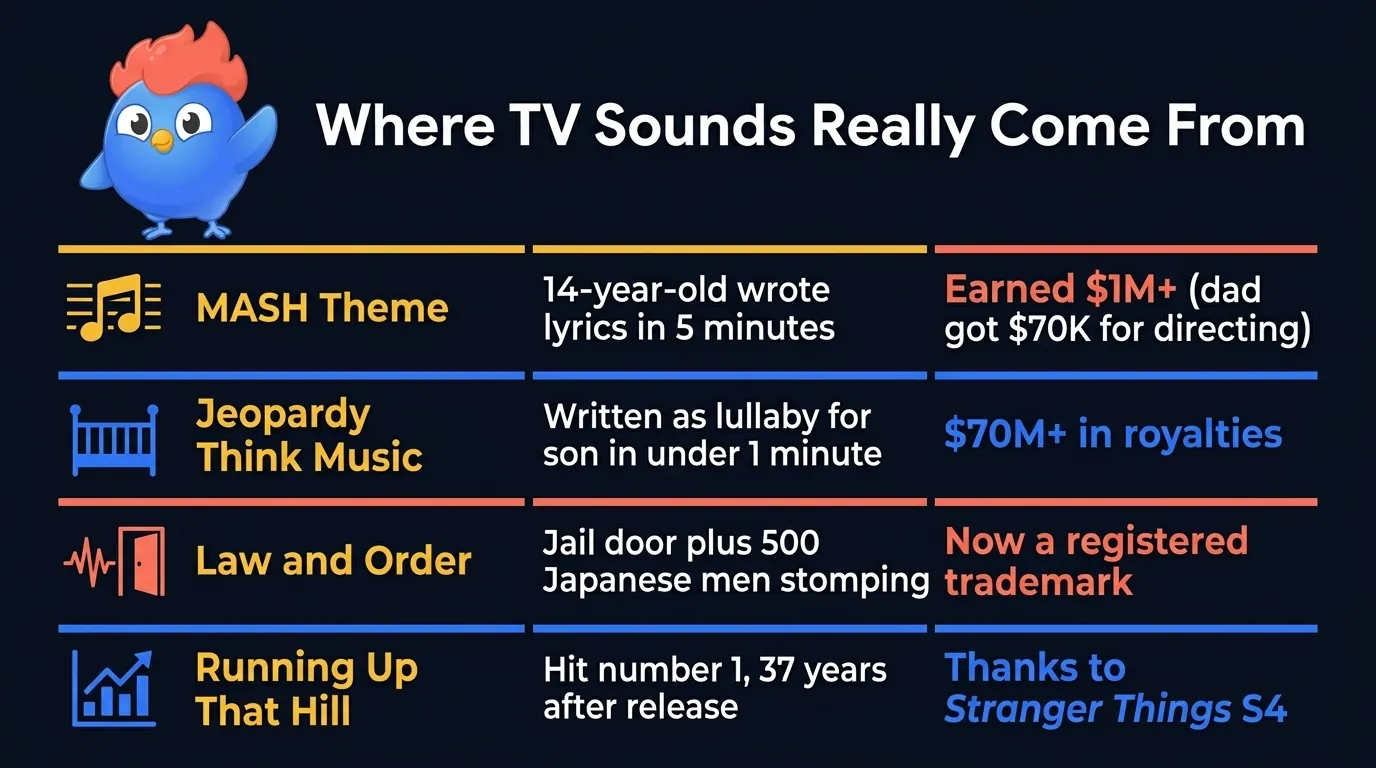 Theme Songs & Catchphrases: 5 questions on the bizarre origins of TV’s most iconic sounds.
49. Who wrote the lyrics to the M*A*S*H theme song “Suicide Is Painless,” and how long did it take? Hard
Answer: Director Robert Altman’s 14-year-old son, Mike. Altman needed lyrics that were “stupid enough” for a faux-suicide scene in the 1970 film. He couldn’t write them himself. His teenage son wrote them in about five minutes. Mike Altman earned over $1 million in royalties. His father earned $70,000 for directing the entire film.
Why it stumps people: A teenager made more money from five minutes of lyric writing than an Oscar-nominated director made from directing the movie. The TV version is instrumental, so most people don’t know the song has lyrics at all.
50. Which 1985 song hit #1 on the US iTunes chart for the first time ever, 37 years after its original release, because of a TV show? Easy
Answer: “Running Up That Hill” by Kate Bush, thanks to Stranger Things Season 4. The song had never reached #1 in the US upon its original 1985 release. One scene in a Netflix show did what 37 years of radio play couldn’t.
Why it stumps people: People know the song was in Stranger Things. They rarely know it never reached #1 in America before that. The chart history makes the TV impact feel even more dramatic.
51. What sounds make up Law & Order’s iconic “chung-chung”? Medium
Answer: A jail door slamming combined with the sound of 500 Japanese men stomping their feet on a wooden floor, among other layered samples. Composer Mike Post created the two-note signature. It’s now a registered trademark of Universal.
Why it stumps people: Most people assume it’s a simple synthesizer hit or two drum samples. Five hundred people stomping on a wooden floor in Japan is the last thing anyone guesses. And “registered trademark” for a sound effect? That’s a first for most people too.
52. What did Merv Griffin first write the Jeopardy! “Think” music for, and how much has it earned? Hard
Answer: He wrote it in under a minute as a lullaby to help his son fall asleep in 1963. The song has since earned over $70 million in royalties. One of the most stressful, tension-building sounds in TV history was written as a children’s bedtime melody.
Why it stumps people: Of all the TV trivia questions on this list, this contrast might be the most perfect. The song that makes contestants sweat under studio lights was meant to put a toddler to sleep. And $70 million from a tune written in under 60 seconds? People assume you’re inventing numbers.
53. What inspired Fred Flintstone’s catchphrase “Yabba Dabba Doo”? Medium
Answer: Voice actor Alan Reed improvised it from his mother’s habit of repeating the Brylcreem jingle “A little dab’ll do ya.” The line wasn’t scripted. Reed ad-libbed it during a recording session and it stuck permanently.
Why it stumps people: One of the most quoted catchphrases in animation history came from a 1950s hair gel commercial. Nobody guesses Brylcreem.
How to Use These TV Trivia Questions
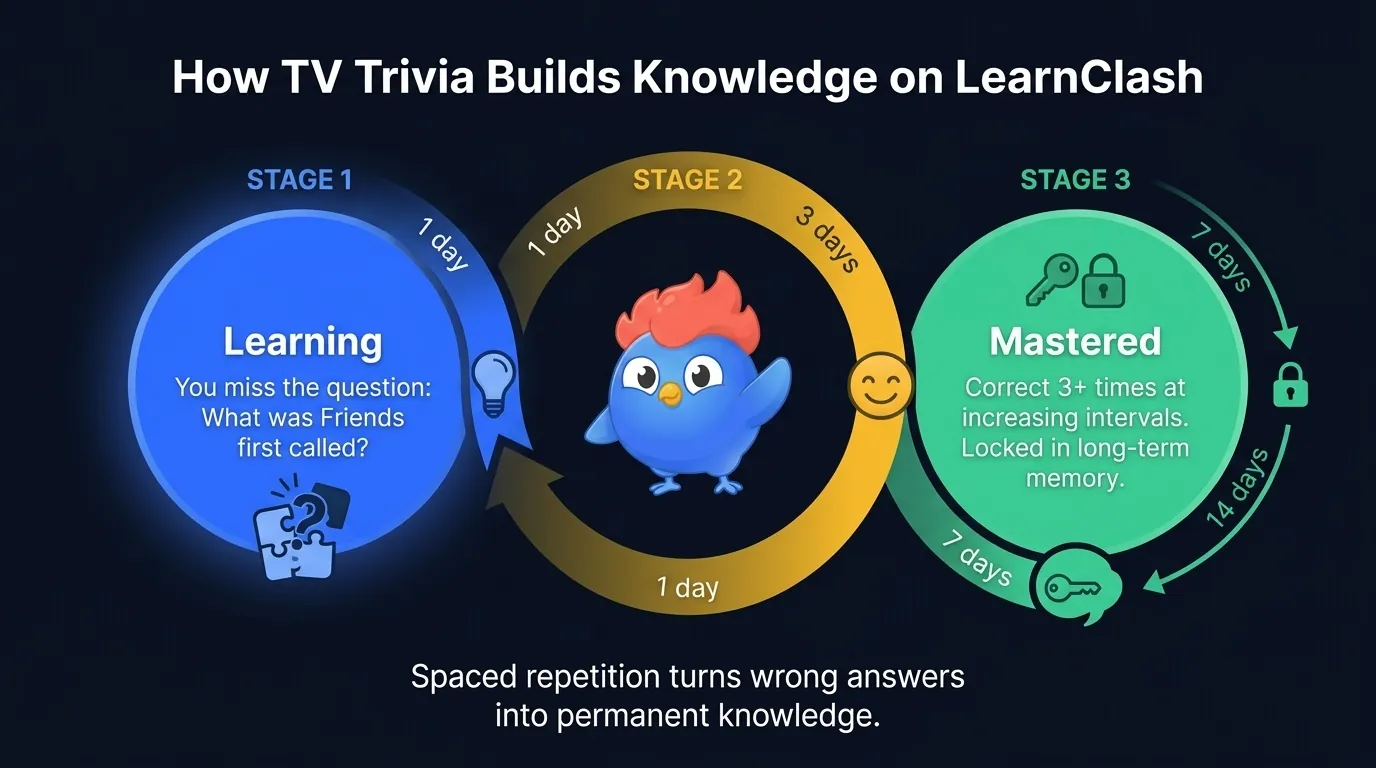 How LearnClash turns wrong answers into long-term knowledge through spaced repetition.
Split these TV trivia questions into rounds of 7 for quiz night, one round per category. Award 1 point for easy, 2 for medium, 3 for hard. The classic TV round works as a warmup because it bridges generations. Save behind-the-scenes for the closer because those facts spark the best arguments.
For something more competitive, challenge a friend to a TV trivia duel on LearnClash. These TV trivia questions adapt to your skill level, and spaced repetition brings back the ones you miss until you’ve actually learned them. Getting it wrong once at trivia night is funny. Getting it wrong twice is embarrassing.
Explore all trivia question categories on LearnClash
“Spacing produces better long-term retention than massing. The optimal gap grows as the retention interval grows.” Cepeda et al., Psychological Bulletin (2006)
If you enjoyed these 53 TV trivia questions and answers, try our 43 movie trivia questions for cinema deep cuts, the 43 Disney trivia questions for the Disney Channel and animation eras, the 90s trivia questions that only true 90s kids pass for decade-specific nostalgia, our 47 video game trivia questions for the game-to-TV adaptations behind The Last of Us, Fallout, and Arcane, or test yourself across every category with our general knowledge questions that stump everyone.
Frequently Asked Questions
What TV trivia question does everyone get wrong?
The most missed TV trivia question: what was Friends originally called? Most people guess Six of One or Across the Hall, but the first pilot script was titled Insomnia Cafe. The show cycled through four names before landing on Friends. LearnClash tracks which TV questions have the widest gap between confidence and accuracy.
What is the hardest TV trivia question?
One of the hardest: how many Emmy nominations did The Wire receive in five seasons? Just two, and it won zero. The show universally ranked among the greatest ever made was almost completely ignored by the Television Academy. On LearnClash, hard-tier TV trivia like this stumps most players on the first attempt.
What TV show has the most Emmy awards?
Saturday Night Live leads all programs overall. For comedies, Frasier holds the record with 37 total Emmys, including five consecutive Outstanding Comedy Series wins. Game of Thrones leads dramas with 59 wins. LearnClash covers Emmy records in its entertainment trivia topics.
How many TV trivia questions do you need for game night?
30 to 40 questions split into rounds of 7 work best for a two-hour game night. Mix categories: sitcoms for warmup, prestige dramas for the middle, behind-the-scenes secrets as the closer. LearnClash adapts TV trivia difficulty to each player automatically.
Where can I play TV trivia against friends?
LearnClash lets you duel friends or matched opponents on TV trivia with ELO ranking across 8 tiers and built-in spaced repetition. Pick any topic, challenge someone, and the questions you miss come back until you master them. Free on iOS and Android.