
67 Bible Trivia Questions [With Answers]
67 bible trivia questions across Old Testament, New Testament, hard, easy, and Bible facts. With answers and the misconceptions everyone repeats.
How many do you know?
Think of your answer, then reveal it.
Did you know it before revealing the answer?
Read this answer in the articleRound complete
Turn what you know into a quiz duel.
Start a new duel in LearnClash and learn from every answer.
Get LearnClashFree to play on iPhone and Android. No ads.
Try the questions you missed once more.

Lifelong readers miss more Bible trivia than you’d expect.
These 67 questions run across the Old Testament, the New Testament, hard adult-level facts, easy starters, famous people and places, Bible statistics, and the misconceptions almost everyone repeats. Every answer is checked against the text and cited by book, chapter, and verse, drawing on Bible Gateway and Blue Letter Bible.
You’ll find seven sections and three difficulty levels below, including the surprises that catch Sunday School champions off guard. Bible trivia also sits inside our full list of trivia questions, which spans 22 topics.
Challenge a friend to bible trivia on LearnClash
Quick Overview
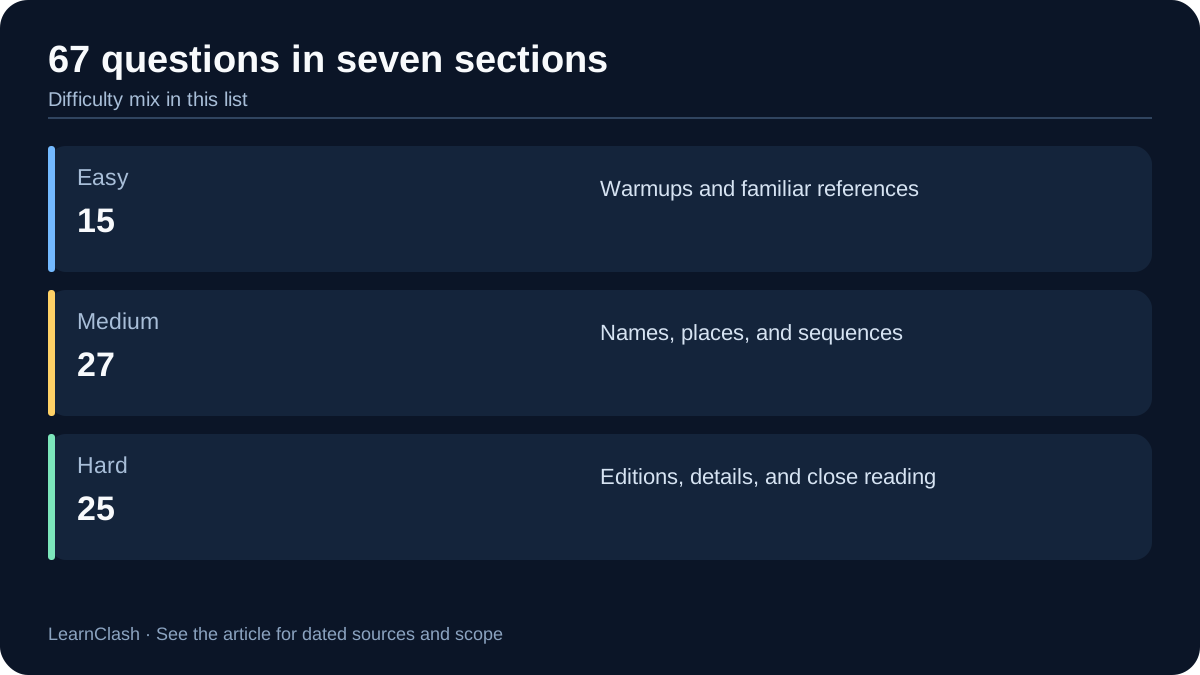
All 67 are sorted by section and difficulty, and the set deliberately skews medium and hard. Anyone who’s been to church a few times sails through the easy ones, so we weighted the count toward the questions that actually trip people up. A casual reader and a lifelong student can both find their level inside the same list. Use the table as a jump menu.
| Section | Questions | Easy | Medium | Hard |
|---|---|---|---|---|
| Old Testament | 1-13 | 2 | 8 | 3 |
| New Testament | 14-26 | 2 | 7 | 4 |
| Hard Bible Trivia for Adults | 27-38 | 0 | 3 | 9 |
| Easy Bible Trivia | 39-47 | 9 | 0 | 0 |
| People & Places | 48-55 | 2 | 4 | 2 |
| Facts, Numbers & Records | 56-62 | 0 | 4 | 3 |
| Famous Misconceptions | 63-67 | 0 | 1 | 4 |
 Difficulty mix in this list.
One pattern is worth knowing before you start. People are most confident on exactly the questions they get wrong, because they’ve heard these stories since childhood and never had a reason to reread them.
That overconfidence is what makes the correction stick through spaced repetition. Check the explanation after a miss, then try recalling the corrected detail in a later session.
Old Testament Bible Trivia Questions (1-13)
Everyone has heard these stories, and almost no one remembers them correctly. Pop culture flattens the patriarchs, judges, kings, and prophets into cardboard cutouts, while the actual text has left-handed assassins, a talking donkey, and a tent-peg killing.
These 13 questions go after the surprising details. We saw the same effect in our history trivia questions collection, where the famous version of an event rarely matches the source.
 Textual ages, not historically verified lifespans.
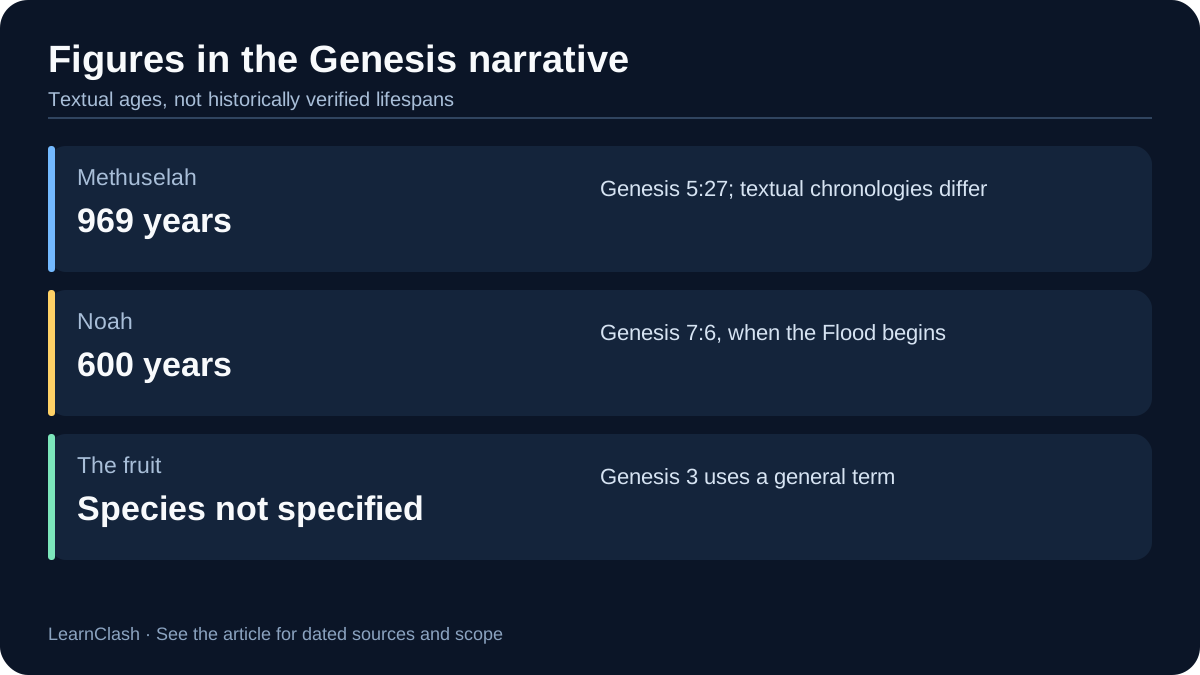
1. How old was Methuselah when he died, according to Genesis 5:27? Easy
Answer: 969 years old. Your gut says “really old” or maybe 900. The exact number is 969, which makes him the oldest person named in the Bible.
Why it stumps people: The Masoretic chronology places Methuselah’s death in the Flood year, while other textual traditions differ. The name’s popular prophetic interpretation is not needed to establish the age stated in Genesis 5:27.
2. What does the Hebrew word for the forbidden fruit in Genesis 3 actually mean? Medium
Answer: “Fruit” in the most generic sense. The Hebrew word peri (פְּרִי) is the same word used for any tree fruit in the Old Testament. Genesis never specifies a species.
Why it stumps people: Two thousand years of paintings, Sunday School coloring books, and English idioms drilled in the apple. But the link came from medieval Latin: malum meant both “apple” and “evil.” Jewish rabbinic tradition has proposed figs, grapes, wheat, and pomegranates instead. Michelangelo even painted it as a fig on the Sistine Chapel ceiling.
3. Which left-handed Israelite judge killed King Eglon of Moab with a hidden dagger? Hard
Answer: Ehud, in Judges 3. He’s described as a left-handed Benjaminite, which let him hide a short sword on his right thigh, the side palace guards never checked.
Why it stumps people: Ehud is one of the forgotten judges. Most readers stop at Samson and Deborah. But the left-handed detail is the whole reason the assassination worked, and it almost never gets taught.
4. Who actually killed the Canaanite general Sisera, and how? Hard
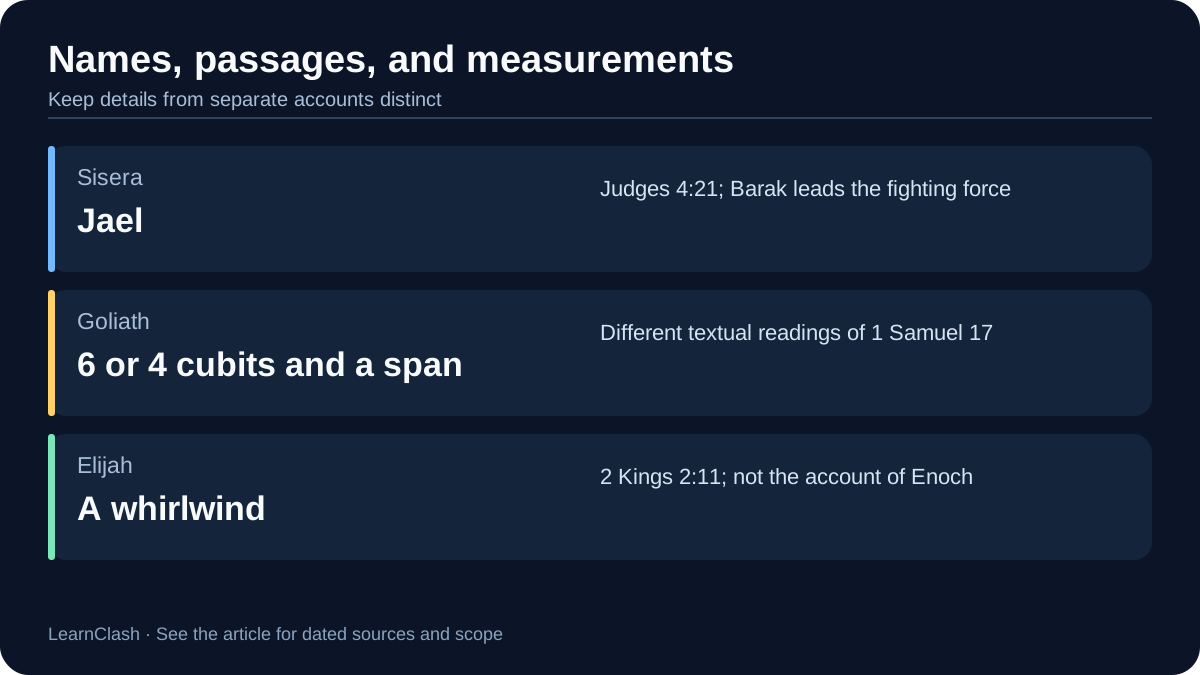
Answer: Jael, a Kenite woman, drove a tent peg through his skull while he slept (Judges 4:21). She isn’t even an Israelite.
Why it stumps people: Nearly everyone reaches for Deborah, the prophetess who summoned Barak. Barak led the fighting force. Deborah’s prophecy in Judges 4:9 said a woman would defeat Sisera, but the woman in question was Jael, not the prophetess. The army won the battle. Jael won the kill.
5. What were the names of the two Hebrew midwives who defied Pharaoh’s order to kill newborn boys? Hard
Answer: Shiphrah and Puah (Exodus 1:15). They told Pharaoh the Hebrew women gave birth too quickly for them to arrive in time.
Why it stumps people: They’re the first named conscientious objectors in the Bible, and almost no Sunday School lesson names them. Most retellings skip straight from Pharaoh’s order to the Moses-in-the-basket scene.
6. According to 1 Samuel 17:4, how tall was Goliath? Medium
Answer: Six cubits and a span, which works out to roughly 9 feet 9 inches in the standard Masoretic Hebrew text. The Dead Sea Scrolls and the Greek Septuagint say four cubits and a span, about 6 feet 9 inches.
Why it stumps people: Even lifelong readers don’t realize there are two competing measurements. The shorter version is closer to historically plausible Iron Age heights. The taller one is what made the David story legendary.
7. What was the actual source of Samson’s strength? Medium
Answer: His Nazirite vow to God, with his uncut hair as the physical sign. Cutting the hair broke the vow, and the broken vow is what cost him his strength, not the haircut itself.
Why it stumps people: Pop culture treats the hair like a magic switch. But Judges 16 frames it as a covenant with God where the hair is just the marker. The distinction matters, because Samson briefly recovers his strength at the end of the story, after his hair grows back and he prays.
8. How many days did the Israelites march around Jericho before the walls fell? Medium
Answer: Seven days. They circled the city once a day for six days, then seven times on the seventh day before the trumpets and the shout (Joshua 6).
Why it stumps people: The trap here is the “seven times around Jericho” line, which people remember as the total. The total is much higher: six laps over six days plus seven on the last, for thirteen circuits across a week.
9. Which Old Testament book never mentions God by name? Medium
Answer: Esther. The only other book that does the same is Song of Solomon. Esther is the Old Testament one.
Why it stumps people: It’s a Bible book about divine providence that never names the divine. Hebrew scholars point out that the name of God is hidden in acrostic form at four key moments in the Hebrew text, but the surface reading contains zero mentions.
10. Which talking animal rebuked the prophet Balaam in Numbers 22? Medium
Answer: A donkey. The donkey saw an angel blocking the path that Balaam couldn’t see, and after being beaten three times, opened its mouth to ask why.
Why it stumps people: Almost everyone names exactly one talking animal in the Bible: the serpent in Eden. The donkey is the second, and the only animal in the Bible that rebukes its owner. Balaam’s complete lack of surprise at hearing it speak is its own running joke among scholars.
11. How old was Noah when the Flood began? Easy
Answer: 600 years old (Genesis 7:6).
Why it stumps people: Genesis 5 ages get rounded down in memory because the numbers seem unreal. 600 is a perfectly clean number that nobody guesses on the first try.
12. What was the first question God ever asked a human, according to Genesis 3:9? Medium
Answer: “Where art thou?” It’s God speaking to Adam after the fall.
Why it stumps people: Your gut says “Why did you eat the fruit?” or “What have you done?” Both come later in the chapter. The first divine question in the Bible is a search for the hiding human, not an interrogation.
13. Which Old Testament prophet was taken up to heaven in a whirlwind without dying? Medium
Answer: Elijah (2 Kings 2:11). A chariot of fire and horses of fire separated him from his successor Elisha, and a whirlwind carried him up.
Why it stumps people: Enoch also “walked with God and was no more” in Genesis 5:24, which gets confused with Elijah’s story. Elijah’s whirlwind is the explicit ascent. Enoch’s verse is more cryptic.
 Keep details from separate accounts distinct.
Play Old Testament trivia on LearnClash
New Testament Bible Trivia Questions (14-26)
Few texts have been read and retold more than the Gospels, so you’d expect the details to be locked down. They aren’t. Numbers get rounded, names get swapped, and famous quotes land on the wrong speaker.
These 13 questions chase the small details that centuries of retelling smoothed out.
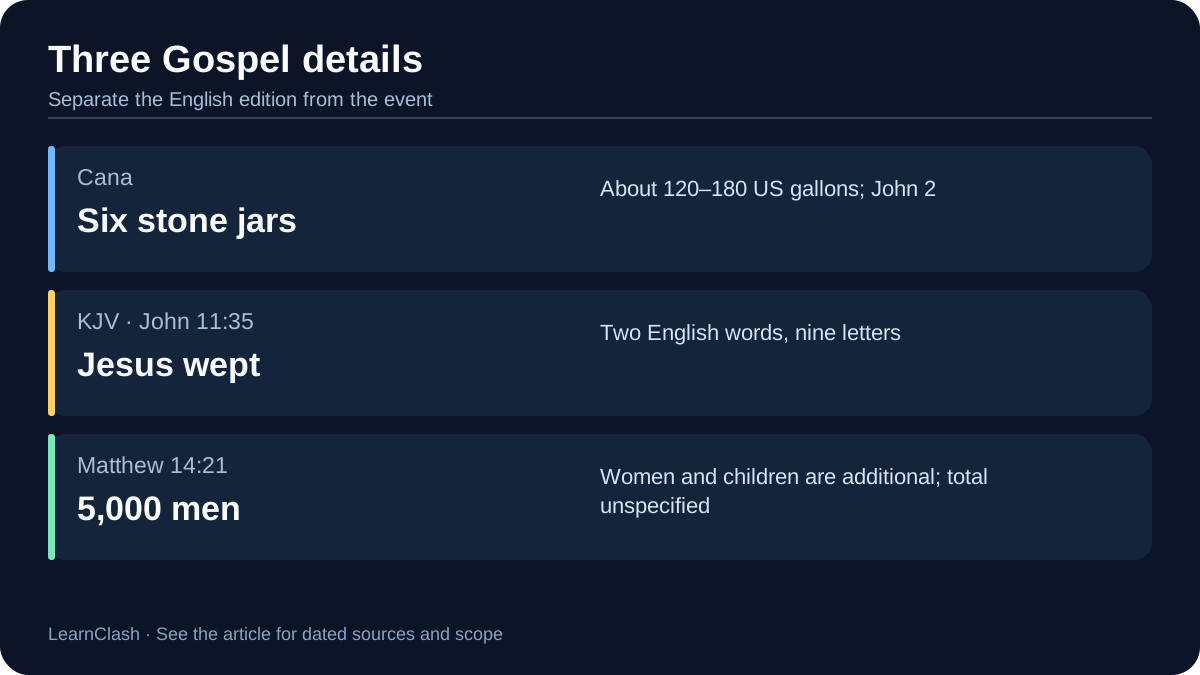 Separate the English edition from the event.
14. At whose wedding did Jesus perform his first public miracle? Medium
Answer: An unnamed couple in Cana of Galilee (John 2:1-11). The Bible never identifies the bride or the groom. The wedding’s only function in the text is as the setting for the miracle.
Why it stumps people: Generations of legend tried to fill the gap. Some traditions name John the Apostle as the groom. Others name Mary’s nephew. The text itself is silent.
15. What did Jesus turn water into at the wedding in Cana, and roughly how much? Medium
Answer: Wine, and roughly 120 to 180 US gallons of it (about 450–680 litres). The six stone jars each held “two or three measures” (John 2:6), which works out to between 20 and 30 gallons each.
Why it stumps people: The miracle sticks, but the volume doesn’t. Six jars holding two or three measures each provide the approximate conversion. The passage does not give a guest count; the volume alone cannot establish one.
16. What is the shortest verse by word count in the King James Version? Easy
Answer: “Jesus wept.” John 11:35. Two words. Nine letters total.
Why it stumps people: Sunday School graduates know this one cold. But it does catch readers who assume the shortest verse must hide somewhere in Psalms or Proverbs. The verse sits in the Gospel of John, right before Jesus raises Lazarus from the dead.
17. Jesus fed 5,000 with five loaves and two fish. What does Matthew 14:21 add as a footnote? Hard
Answer: “Besides women and children.” The total crowd was much larger than 5,000.
Why it stumps people: The famous number counts only the men. Matthew does not supply a total for the women and children. Adding a precise estimate would go beyond the passage.
18. Who replaced Judas Iscariot as the twelfth apostle? Hard
Answer: Matthias (Acts 1:26), chosen by lot from two candidates. The other candidate was Joseph called Barsabbas, also known as Justus.
Why it stumps people: Most readers can name eleven of the twelve and stall there. Matthias never appears again in the New Testament after his selection. Some traditions confuse him with Matthew the tax collector. They’re different people.
19. Which physician is traditionally identified as the author of Luke and Acts? Medium
Answer: Luke. Paul’s letter to the Colossians (4:14) calls him “the beloved physician.”
Why it stumps people: The Gospel and Acts do not name their author. Christian tradition identifies that author with Luke, the physician mentioned in Colossians 4:14. The letter’s description and the later attribution are separate pieces of evidence.
20. What was the name of the garden where Jesus prayed the night before his arrest? Easy
Answer: Gethsemane, on the Mount of Olives (Matthew 26:36).
Why it stumps people: Easter regulars hit this one. But it catches readers who assume “Garden of Gethsemane” and “Mount of Olives” are two different places. Gethsemane sits at the foot of the Mount of Olives, just outside Jerusalem.
21. Which two disciples did Jesus nickname “Sons of Thunder”? Medium
Answer: James and John, the sons of Zebedee (Mark 3:17). The original Aramaic nickname is Boanerges.
Why it stumps people: The nickname is famous but rarely connected to specific apostles. Mark gives the names in passing and never explains exactly why Jesus chose the nickname. Theories range from their tempers to their preaching style.
22. How many days passed between the Resurrection and the Ascension? Medium
Answer: 40 days (Acts 1:3).
Why it stumps people: The number 40 shows up so often in the Bible (Noah’s rain, the wandering in the desert, Jesus’s fast in the wilderness) that people lose track of which 40 belongs to which event. The Resurrection-to-Ascension count is one of the cleanest examples.
23. Whom did Jesus raise after four days in the tomb in John 11? Medium
Answer: Lazarus. John 11:17 says he had been in the tomb four days.
Why it stumps people: Jesus also raises Jairus’s daughter and the widow’s son at Nain. The four-day detail identifies Lazarus without incorrectly making him the only person raised in the Gospels.
24. What language did Jesus most likely speak in daily life? Medium
Answer: Aramaic. A handful of Aramaic phrases survive in the Greek Gospel texts: Talitha koum (Mark 5:41), Eli, Eli, lema sabachthani (Matthew 27:46), and Abba (Mark 14:36).
Why it stumps people: Some assume Hebrew because of the Old Testament. Some assume Greek because of the New Testament. Aramaic was the common spoken language of first-century Judea.
25. How many books does the apostle Paul traditionally get credit for writing? Hard
Answer: 13 epistles, traditionally. Hebrews is sometimes counted, which would make 14, but its authorship is disputed in early church history.
Why it stumps people: Counts of “Paul’s letters” range from 7 (the undisputed letters in modern academic consensus) to 14 (the maximum traditional count). The standard answer in most Christian education is 13.
26. Which is the shortest letter in the New Testament by word count? Hard
Answer: 3 John. Common counts give 219 Greek words and 299 in the KJV; an exact total depends on the edition and counting method. 2 John has the fewest verses (13), but 3 John is shorter by total word count.
Why it stumps people: 2 John gets tagged “the short one” and that’s where most memories stop. The verse-count versus word-count distinction trips up almost everyone who hasn’t compared the two side by side.
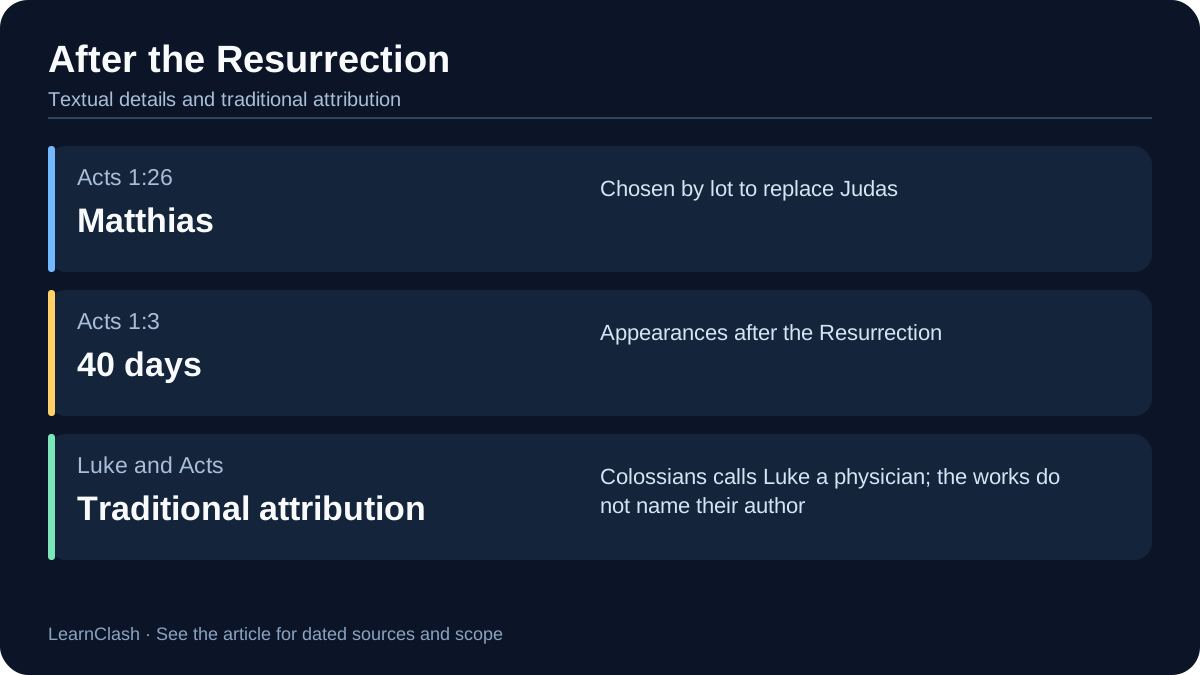 Textual details and traditional attribution.
Play New Testament trivia on LearnClash
Hard Bible Trivia Questions for Adults (27-38)
This is the round that separates Sunday School graduates from people who actually studied: obscure prophets, off-counted books, exact numbers, and the original-language details that rarely surface in a sermon. Almost nobody clears all twelve on a first try.
One structural fact is worth holding onto before you start. The Protestant Bible has 66 books, the Catholic Bible has 73 with the deuterocanonical books, and Eastern Orthodox Bibles carry 76 or more, yet all three traditions share the same 27 New Testament books. Several of the questions below turn on exactly those seams between canons.
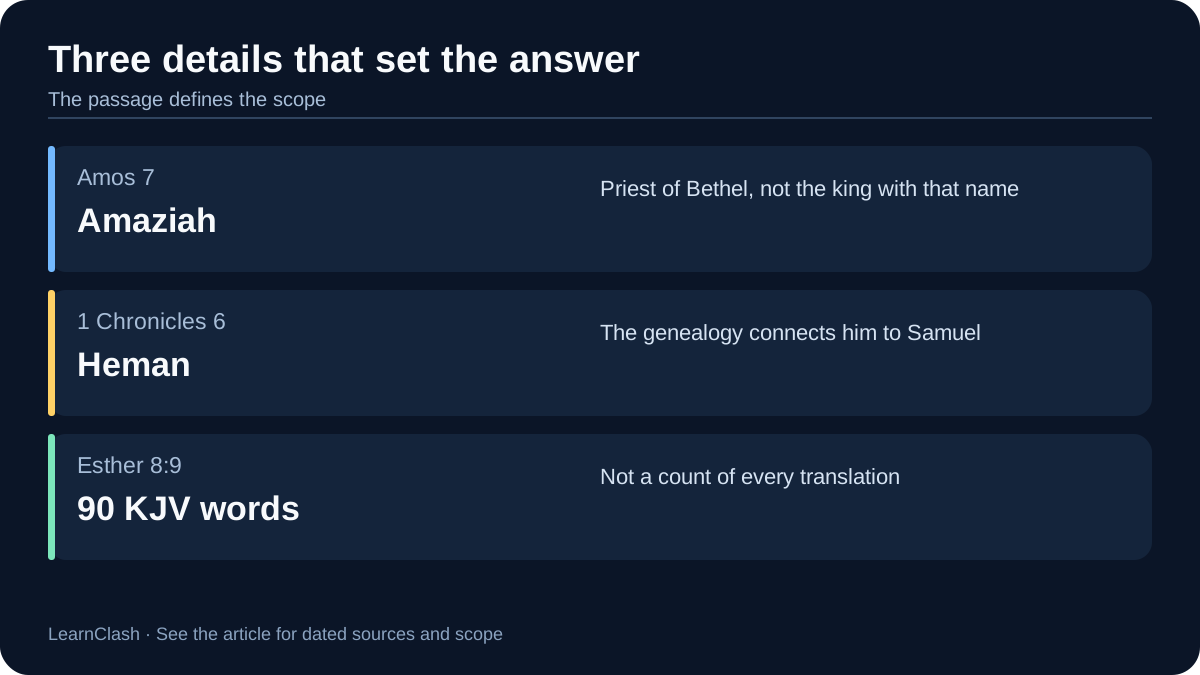 The passage defines the scope.
27. Who was the priest of Bethel that opposed the prophet Amos? Hard
Answer: Amaziah (Amos 7:10). He sent a complaint to King Jeroboam II accusing Amos of conspiracy.
Why it stumps people: Amos is one of the twelve Minor Prophets, and his opponent gets a single named scene before disappearing. Most modern Bible curricula skip the Minor Prophets almost entirely.
28. Who was the grandson of Samuel listed among the Levitical musicians in 1 Chronicles? Hard
Answer: Heman (1 Chronicles 6:33). Psalm 88 names Heman the Ezrahite in its heading, but that does not securely establish that both references identify the same person.
Why it stumps people: Heman is mostly known as a psalmist, not as Samuel’s grandson. The genealogy in Chronicles is where the family connection lives, and Chronicles is the book modern readers skip the most.
29. What is the longest verse in the English Bible by word count? Hard
Answer: Esther 8:9. 90 words in the King James Version. This is an edition-specific count, not a total for every translation.
Why it stumps people: Most guesses go to the Psalms or to the Pauline epistles. Esther 8:9 is a legal proclamation about Persian provinces, which is exactly the kind of administrative passage modern readers skim.
30. Which Minor Prophet has only one chapter? Hard
Answer: Obadiah. Just 21 verses, which makes it the shortest book in the Old Testament.
Why it stumps people: Obadiah is a single chapter denouncing Edom for its role in the fall of Jerusalem. Five Bible books have only one chapter total: Obadiah, 2 John, 3 John, Jude, and Philemon. Obadiah is the only Old Testament book on that list.
31. Which figure is traditionally credited with the Pentateuch, the Bible’s first five books? Hard
Answer: Moses. The Pentateuch runs from Genesis through Deuteronomy.
Why it stumps people: Traditional attribution does not establish that one historical author wrote every word. Comparing Moses and Paul by an exact word total mixes attribution with edition-dependent counting.
32. Which two nuts appear among the gifts in Genesis 43:11 in the NIV? Hard
Answer: Pistachios and almonds.
Why it stumps people: The named nuts depend on the translation. The NIV’s wording identifies these gifts, but it does not prove that only two kinds of nuts are named anywhere in every biblical canon.
33. Which book’s Hebrew text does not explicitly name God? Hard
Answer: Esther. Its Greek additions do name God.
Why it stumps people: Song of Songs is often added to the answer, but Song 8:6 contains a form that some translations render as a flame of the Lord. Naming the Hebrew Esther text makes the question clearer than claiming two books universally omit the divine name.
34. How many books does the Catholic Bible contain that the Protestant Bible does not? Hard
Answer: Seven deuterocanonical books: Tobit, Judith, 1 Maccabees, 2 Maccabees, Wisdom of Solomon, Sirach (also called Ecclesiasticus), and Baruch. Catholic Bibles also include extra material in Esther and Daniel.
Why it stumps people: The Protestant Bible has 66 books. The Catholic Bible has 73. The Eastern Orthodox Bible has 76 or more, depending on tradition. Most Bibles in those three traditions share the same 27 New Testament books; other canons and textual additions require their own accounting.
35. In what year was the King James Bible first published? Medium
Answer: 1611, after seven years of translation work commissioned by King James I of England.
Why it stumps people: The King James Version is so embedded in English literature that people forget it has a publication date at all. The translation itself took 47 scholars working in committees from 1604 to 1611.
36. Who was the last king of Judah, blinded by Nebuchadnezzar before being taken to Babylon? Hard
Answer: Zedekiah (2 Kings 25:7). His sons were killed in front of him, and that was the last thing he saw before his eyes were put out.
Why it stumps people: The end of the kingdom of Judah is grim and rarely covered in detail. Lifelong readers remember David and Solomon at the start of the monarchy, not Zedekiah at the end. The story is one of the most violent in the Old Testament historical books.
37. Who was Abraham’s first son, and who was his mother? Medium
Answer: Ishmael, son of Hagar (Genesis 16). Hagar was Sarah’s Egyptian servant. Ishmael was born when Abraham was 86, fourteen years before Isaac.
Why it stumps people: Most retellings jump from “Abraham believed God” to “Sarah had Isaac.” The Hagar and Ishmael story sits between them and gets treated as a footnote, despite being a core narrative in three world religions.
38. What language was most of the Old Testament originally written in? Medium
Answer: Hebrew. Small sections of Daniel, Ezra, and one verse in Jeremiah were written in Aramaic. The New Testament was written in Koine Greek.
Why it stumps people: Hebrew gets the all-the-way answer, then the Aramaic sections throw everyone. Those parts are short but they matter: most of Daniel 2 through 7, parts of Ezra, and Jeremiah 10:11.
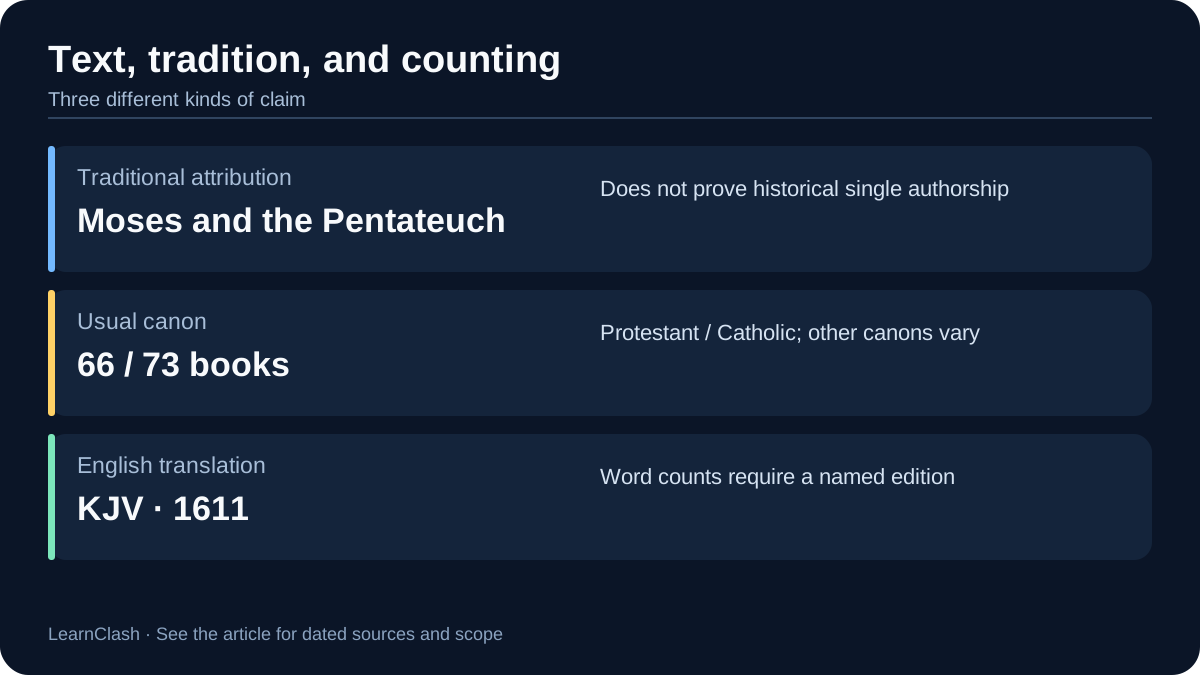 Three different kinds of claim.
Play biblical history trivia on LearnClash
Easy Bible Trivia Questions (39-47)
These are the warmup rounds: cornerstone facts that anyone with a Sunday School background should hit on the first try. In the app, questions from this tier are what LearnClash deals you after a streak of hard misses, so a rough round never stays rough for long. Open a church trivia night here, then escalate to the harder sections later in this list.
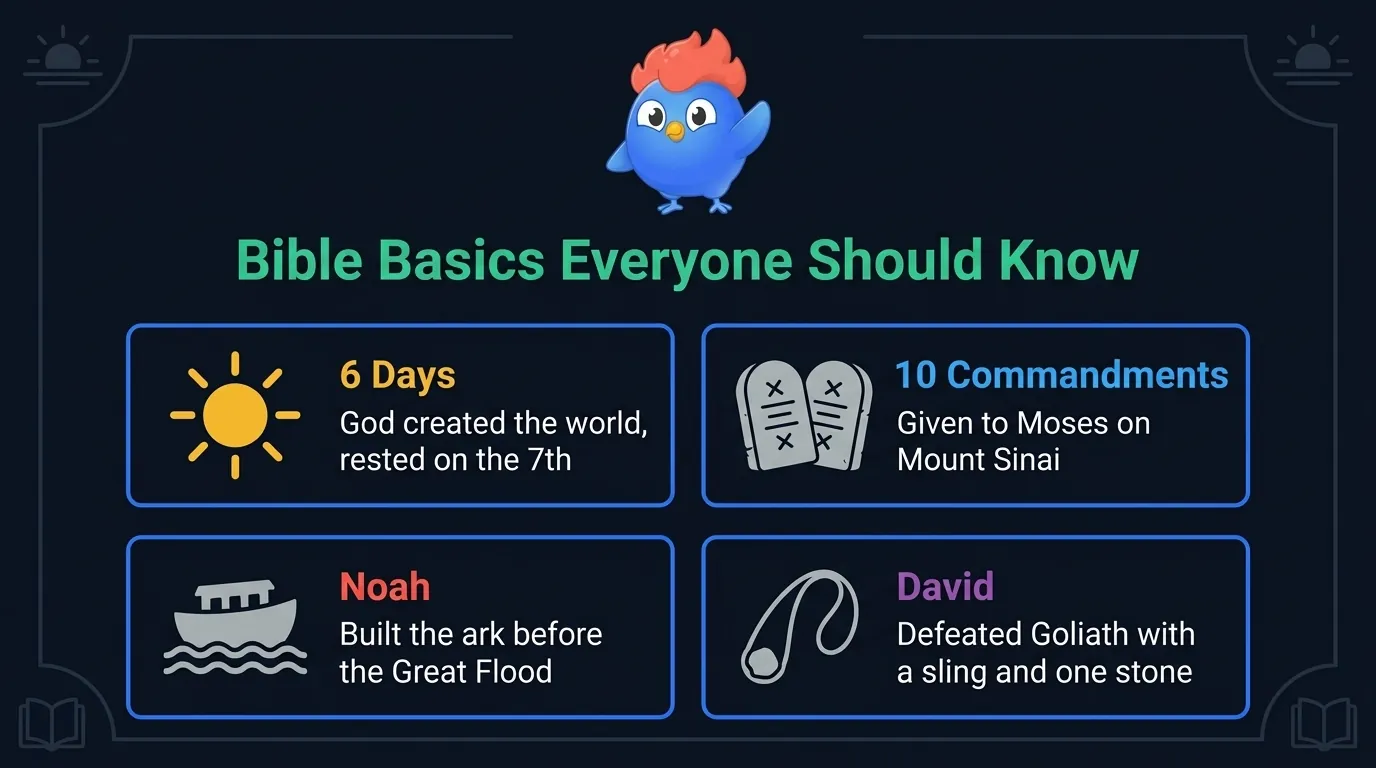 Bible basics every Sunday School student should hit on the first try.
39. How many days did God take to create the world according to Genesis 1? Easy
Answer: Six days. God rested on the seventh.
40. How many Commandments did God give Moses on Mount Sinai? Easy
Answer: Ten. Recorded in Exodus 20 and Deuteronomy 5.
41. How many apostles belonged to Jesus’s group called the Twelve? Easy
Answer: Twelve. After Judas Iscariot’s betrayal and death, Matthias was chosen to keep the count at twelve.
42. What was the name of the first man God created? Easy
Answer: Adam. His wife was Eve.
43. Who built an ark to survive a great flood? Easy
Answer: Noah. He brought his wife, his three sons and their wives. Genesis 7:2–3 distinguishes clean animals and birds from the other animals; the familiar “one pair of everything” summary misses that distinction.
44. In what city was Jesus born? Easy
Answer: Bethlehem, in a manger because there was no room at the inn (Luke 2).
45. Who was thrown into a den of lions but survived the night unharmed? Easy
Answer: Daniel. The story is in Daniel 6.
46. Who led the Israelites out of slavery in Egypt? Easy
Answer: Moses. He parted the Red Sea so the Israelites could cross.
47. What did David use to defeat Goliath? Easy
Answer: A sling and a single smooth stone. He chose five stones from a brook but only used one (1 Samuel 17).
Bible People and Places Trivia (48-55)
The Bible takes its geography for granted. Original audiences knew exactly where these cities sat and which mountain Moses climbed, and modern readers usually don’t. These eight questions cover Old Testament locations, New Testament cities, and the figures who lived in them.
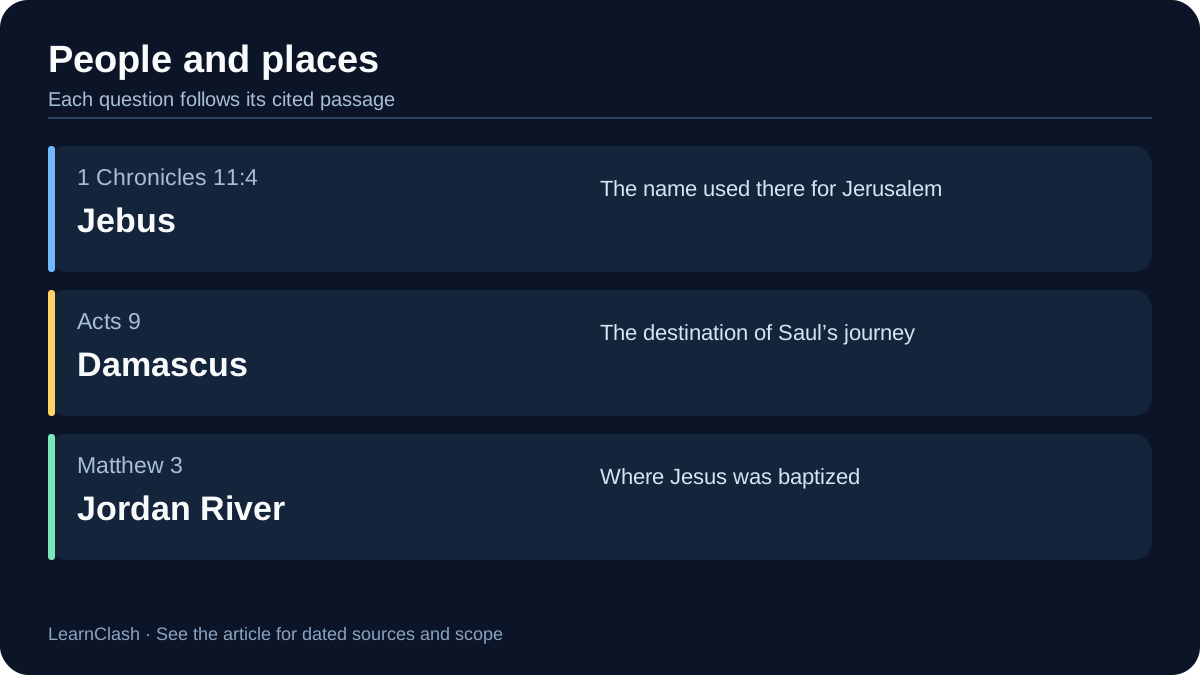 Each question follows its cited passage.
48. Which judge’s rash vow concerned the first person to greet him from his house? Hard
Answer: Jephthah (Judges 11). He vowed to sacrifice the first thing that came out of his house if God gave him victory in battle. His daughter came out to greet him. Readers dispute whether the ending describes a sacrifice or permanent dedication; the vow’s consequence is the central difficulty.
Why it stumps people: It’s one of the darkest stories in the Old Testament and rarely gets taught. Jephthah is mentioned in Hebrews 11 alongside the heroes of the faith, which makes the Judges 11 story even more uncomfortable.
49. What name does 1 Chronicles 11:4 use for Jerusalem before David’s capture? Hard
Answer: Jebus (1 Chronicles 11:4). It was inhabited by the Jebusites.
Why it stumps people: Jerusalem is so iconic that people forget it had any other name. The Jebusite era predates David by centuries. The passage uses Jebus for the city and City of David for the captured stronghold. It does not establish the oldest name ever used for Jerusalem.
50. On which mountain did Moses receive the Ten Commandments? Easy
Answer: Mount Sinai, also called Mount Horeb in Deuteronomy.
Why it stumps people: It rarely stumps anyone who’s seen The Ten Commandments film. It does catch readers who confuse Sinai with Mount Zion (Jerusalem) or Mount Carmel (Elijah’s contest with the prophets of Baal).
51. Which city was Paul traveling to when he had his conversion vision? Medium
Answer: Damascus (Acts 9:1-9). Paul, then known as Saul, was on his way to arrest Christians in the city when he was struck blind by a vision of Jesus.
Why it stumps people: “Road to Damascus” is so common as an English idiom that people remember the phrase without remembering the actual destination or the journey’s purpose.
52. Who was Abraham’s nephew, rescued from the destruction of Sodom? Medium
Answer: Lot (Genesis 19). His wife was turned into a pillar of salt for looking back at the burning cities.
Why it stumps people: Nearly everyone remembers Lot’s wife, not Lot himself. The relationship to Abraham is also frequently forgotten. Lot was Abraham’s nephew, the son of Abraham’s brother Haran.
53. Which Persian queen risked her life to save the Jews from a plot by Haman? Medium
Answer: Esther, also called by her Hebrew name Hadassah (Book of Esther). She was the queen of King Ahasuerus, traditionally identified with Xerxes I.
Why it stumps people: In the usual Protestant canon, Esther and Ruth are the two books named after women; Catholic Bibles also include Judith. Esther herself is Jewish. She also gets confused with Jezebel, Bathsheba, and Vashti, all queens with similar period dramas.
54. In which river did John the Baptist baptize Jesus? Easy
Answer: The Jordan River (Matthew 3).
55. Which disciple briefly walked on water toward Jesus before sinking? Medium
Answer: Peter (Matthew 14:29). He walked a few steps before fear took over and he started to sink.
Why it stumps people: The story is famous but the protagonist often gets misremembered as a generic “one of the disciples.” It’s specifically Peter, and John 18:10 identifies him as the disciple who cut off the high priest’s servant’s ear; Matthew does not name that disciple.
Bible Facts, Numbers and Records (56-62)
Now for the structure of the text itself. The Protestant Bible runs 1,189 chapters and 31,102 verses, and the grid you navigate by is a late addition: chapter divisions arrived in the 13th century, verse numbers in the 16th. The figures below name their scope. Chapter totals use the usual 66-book arrangement; verse and word counts depend on the edition.
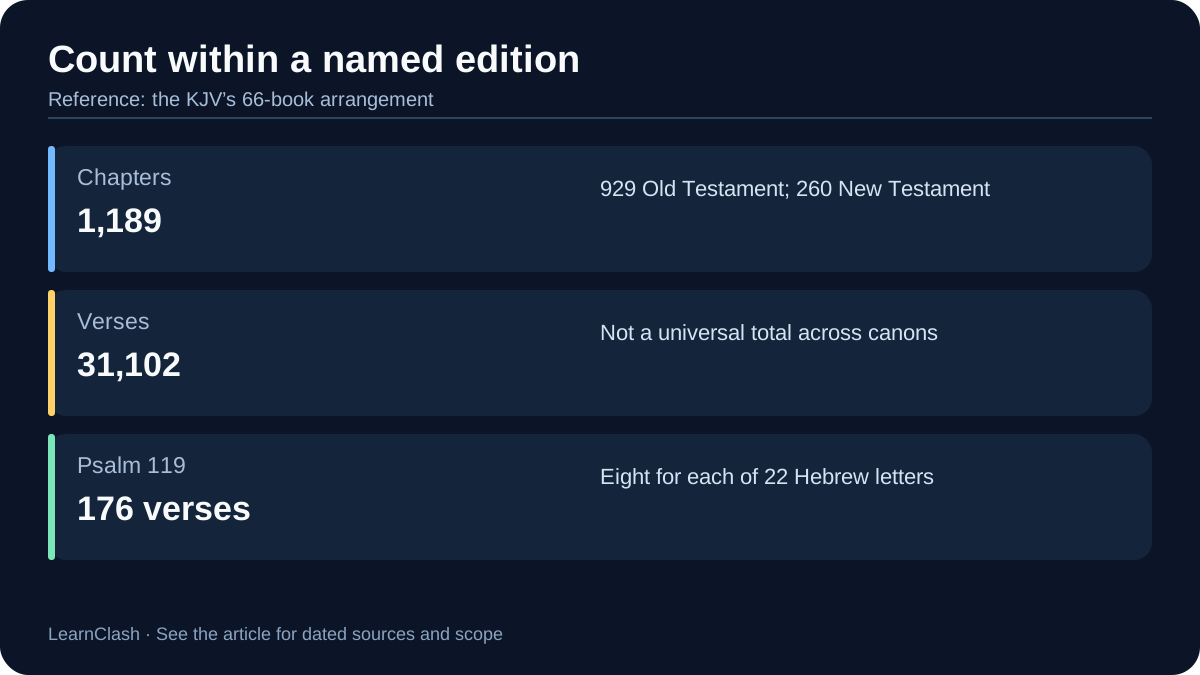 Reference: the KJV’s 66-book arrangement.
56. How many chapters does the Protestant Bible contain in total? Medium
Answer: 1,189 chapters. That’s 929 in the Old Testament and 260 in the New Testament.
Why it stumps people: Almost no one has counted. The standard guesses are 1,000 or “around 1,200.” The exact number is 1,189, which is a memorable trivia answer but a hard one to land cold.
57. How many verses are in the Protestant Bible? Medium
Answer: 31,102 verses in the usual KJV 66-book arrangement. This is not a universal total across translations and canons.
Why it stumps people: People throw out 30,000 or 50,000. The actual answer is closer to 31,000. The chapter and verse numbering wasn’t added to the Bible until the 13th century (chapters) and 16th century (verses).
58. What is the longest chapter in the Bible? Medium
Answer: Psalm 119, with 176 verses. It’s also an alphabetical acrostic in Hebrew, with eight verses for each letter of the 22-letter Hebrew alphabet (8 × 22 = 176).
Why it stumps people: Psalm 119 is the longest chapter and the longest poem in the Bible. People often guess Genesis 1, Isaiah, or one of the long Pauline chapters. None of those come close.
59. What is the shortest chapter in the Bible? Medium
Answer: Psalm 117, with just 2 verses.
Why it stumps people: Psalm 117 is two verses long and gets passed over because it sits next to Psalm 118 (a long song of thanksgiving) and Psalm 119 (the giant). It’s easy to miss when reading straight through.
60. How many times is the word “love” used in the King James Bible compared to “hate”? Hard
Answer: 310 times for “love” and 87 times for “hate” (KJV).
Why it stumps people: The ratio is roughly 3.5 to 1, which sounds about right intuitively, but the exact numbers are nearly impossible to guess. This counts the exact English forms in the KJV, not related words or every translation.
61. How often do the exact English words “salt” and “pepper” occur in the KJV? Hard
Answer: Salt appears 41 times; pepper appears zero times in this KJV word count.
Why it stumps people: This compares exact English forms in one edition. It is not a count of every related word or every translation, and a missing English word cannot by itself date the history of Mediterranean spice trade.
62. Which Old Testament book is longest by Hebrew word count, not chapter count? Hard
Answer: Jeremiah. Psalms has more chapters (150), but Jeremiah has more total words. Jeremiah is the longest book in the Bible by sheer word count.
Why it stumps people: Everyone guesses Psalms because of the chapter count. Jeremiah’s chapters are much longer on average, which puts it ahead in total volume. Genesis is also a contender, but Jeremiah edges it out.
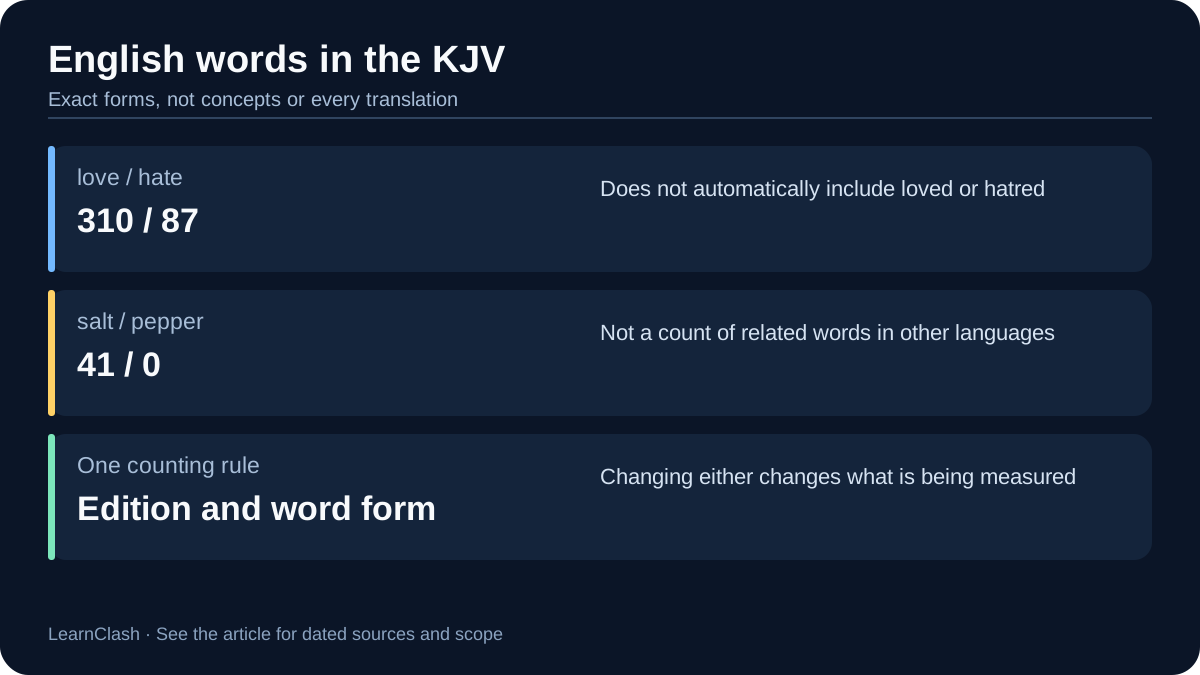 Exact forms, not concepts or every translation.
Play Bible facts trivia on LearnClash
Famous Bible Misconceptions (63-67)
These are the questions that catch people who think they know the stories. The popular version sits so deep that it overrides the actual text. None of the five answers below match the version everyone repeats, and every one of them is verifiable in any standard translation.
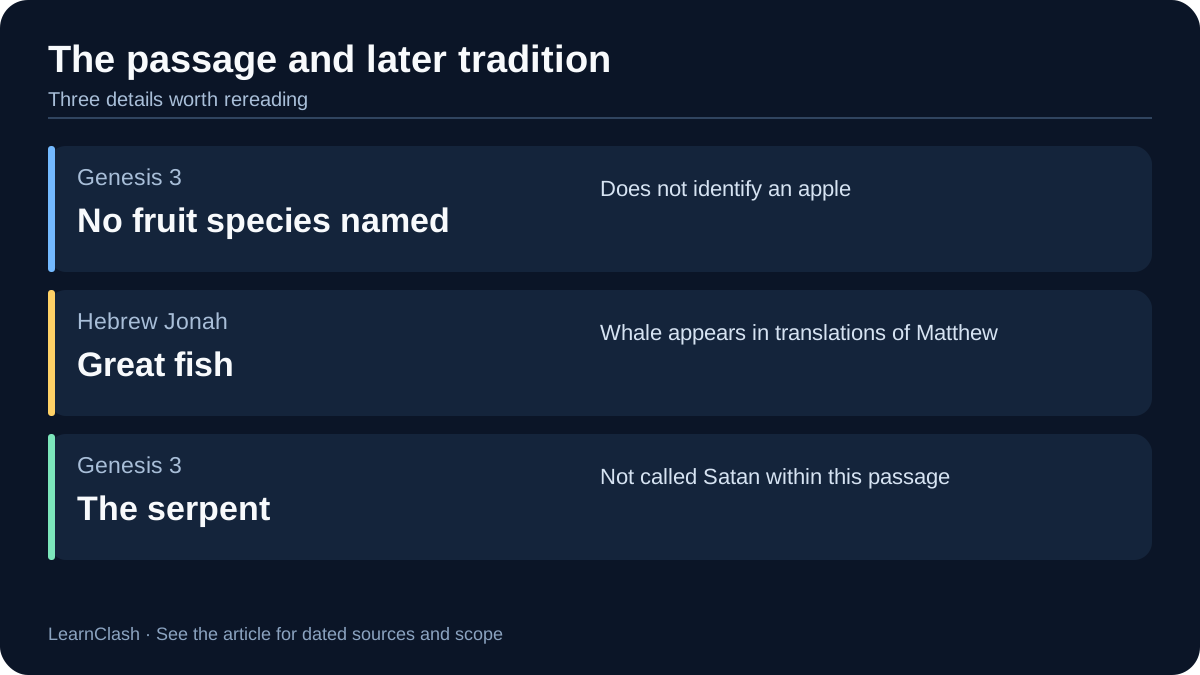 Three details worth rereading.
63. Does the Bible say there were exactly three wise men at Jesus’s birth? Hard
Answer: No. Matthew 2 mentions three gifts (gold, frankincense, and myrrh), but never gives a number of magi. Syriac Christian tradition lists twelve. The earliest catacomb paintings of the Nativity show two.
Why it stumps people: Centuries of Christmas pageants made “three” the default. The “three kings” tradition predates the nineteenth-century carol, but it does not come from a count or royal title in Matthew 2. And Matthew never calls them kings either. He calls them magoi, meaning wise men or astrologers.
64. Does the Bible say that Jonah was swallowed by a whale? Hard
Answer: No. The Hebrew text uses the phrase dag gadol (דָּג גָּדוֹל), which translates as “great fish.” Jonah 2:1 in Hebrew is Jonah 1:17 in most English translations.
Why it stumps people: The English “whale” belongs to Matthew 12:40, not to the Book of Jonah: Wycliffe’s Bible rendered the verse’s sea creature as “whal” in the 1390s, Tyndale’s 1534 translation of the Greek kétos kept “whale,” and the King James Bible followed. The original Hebrew never specifies whale.
65. Does Genesis call the serpent in the Garden of Eden “Satan”? Hard
Answer: No. Genesis 3 calls it “the serpent” and describes it only as “more crafty than any of the wild animals the Lord God had made.” The identification with Satan comes from Revelation 12:9 and later Christian tradition.
Why it stumps people: John Milton’s Paradise Lost (1667) cemented the snake-equals-Satan reading in Western imagination. Bible Odyssey traces how later readers connected the serpent with Satan after the original Genesis story. Genesis itself is silent on the serpent’s identity.
66. Were the magi who visited Jesus ever called “kings” in the Bible? Hard
Answer: No. Matthew 2 calls them magoi, the Greek word for wise men or astrologers. The “kings” label was a later Christian addition, dated by tradition to the 3rd century, designed to align with Old Testament prophecies that the messiah would be worshiped by kings.
Why it stumps people: The famous Christmas carol “We Three Kings” hardcodes the misconception. The Bible’s only specific detail about the magi is that they came from “the east” and gave three gifts.
67. Is “Money is the root of all evil” a direct quote from the Bible? Medium
Answer: No. The actual verse is 1 Timothy 6:10: “The love of money is a root of all kinds of evil.” Most modern translations also drop “the” and use “a root.”
Why it stumps people: The misquote drops both “love of” and “all kinds of.” The original makes a much narrower claim. Money itself isn’t condemned in the Bible. The attachment to money is.
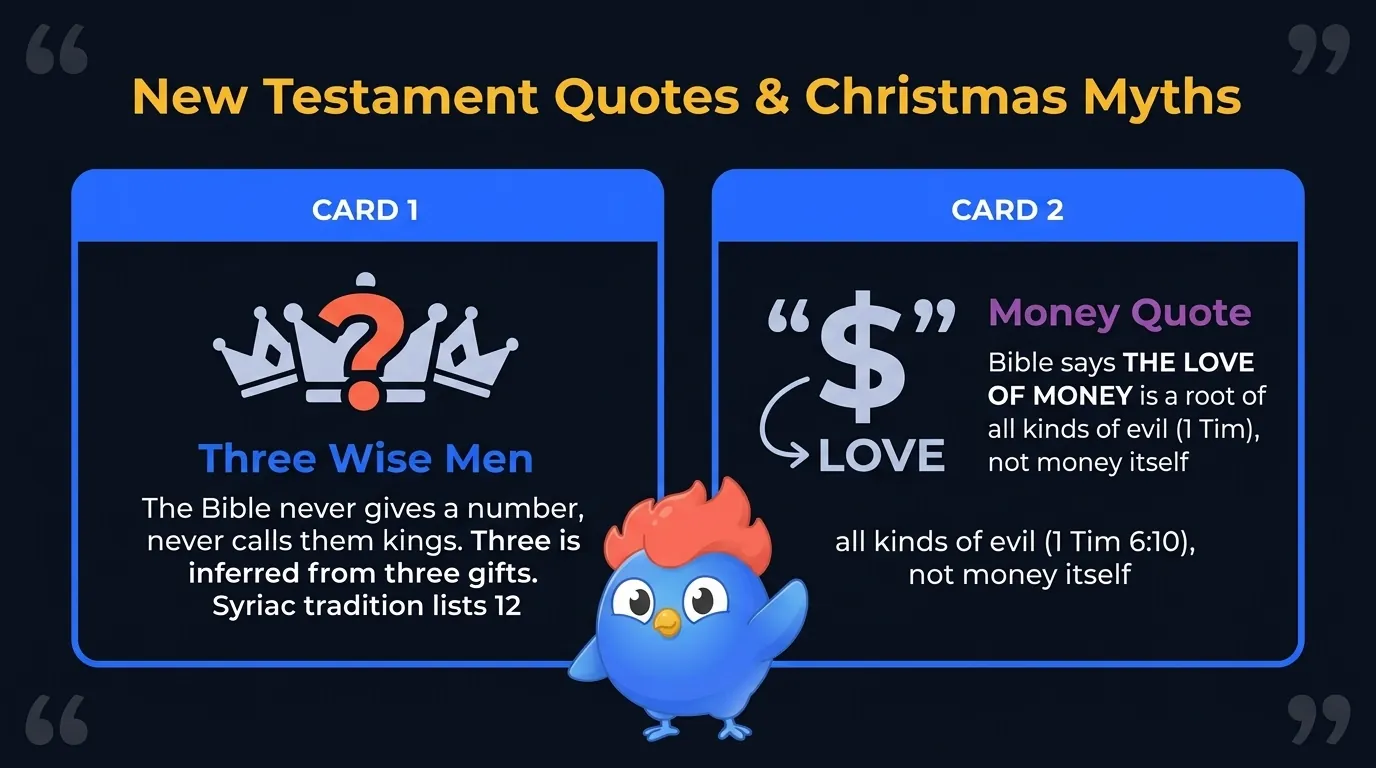 Two of the most-repeated New Testament misconceptions, side by side with what the text actually says.
Play Bible misconception trivia on LearnClash
Running These 67 at Church Trivia Night (or Alone)
For church trivia night, pull nine questions per round and mix the difficulty: three easy, four medium, two hard. Open with the Easy section as the warmup, run Old Testament and New Testament for the main rounds, and close on Misconceptions as the tiebreaker. A full evening covering all 67 runs about two and a half hours with discussion time.
For solo Bible study, try recalling an answer before rereading it. The testing effect concerns retrieval practice. The 2008 Karpicke and Roediger study found benefits in its experimental task; it did not establish an 80-percent recall rate for Bible questions or prove that every wrong answer helps memory.
LearnClash uses three spaced-repetition stages: Learning, Known, and Mastered. Correct answers can advance questions after 7-day and 90-day cooldowns. A miss drops one stage. These are promotion rules, not promises that a question will reappear exactly seven or ninety days later, and mastered questions are not permanently retired.
The Bible topic itself wasn’t commissioned, by the way. LearnClash generates a topic’s question pool when players search for it, and Bible trivia grew the same demand-driven way as the rest of the catalog, which our July 21, 2026 census put at 34,157 questions across 655 live topics.
For family game night, the general knowledge questions collection pairs naturally here: alternate the rounds to keep the energy up and the topics varied. The Easy and People & Places sections fit mixed-age groups best, and the hard set closes out the adult round.
Frequently Asked Questions
What is the shortest verse in the Bible?
The shortest verse in the Bible is John 11:35: 'Jesus wept.' Two words in English, nine letters total. The verse appears at the tomb of Lazarus, moments before Jesus raises him from the dead. The wording and length depend on the translation; “Jesus wept” is the KJV English text.
Was the forbidden fruit in the Bible an apple?
No. The Bible never identifies the forbidden fruit as an apple. Genesis 3 uses the Hebrew word 'peri,' which simply means 'fruit.' The apple association comes from medieval Latin, where 'malum' meant both 'apple' and 'evil.' Jewish and Christian commentators have proposed figs, grapes, wheat, and pomegranates as candidates.
Who lived the longest in the Bible?
Methuselah lived the longest in the Bible, dying at 969 years old according to Genesis 5:27. He was the grandfather of Noah. The Masoretic genealogy places his death in the Flood year; other textual chronologies differ. His name is now English shorthand for extreme old age.
How many books are in the Bible?
The Protestant Bible has 66 books (39 Old Testament, 27 New Testament). The Catholic Bible has 73 books, adding 7 deuterocanonical books. The Eastern Orthodox Bible has 76 or more. Most Protestant, Catholic, and Eastern Orthodox Bibles share 27 New Testament books. Other canons vary, and translation-specific questions still need a named edition.
What is the hardest Bible trivia question?
The hardest bible trivia questions test obscure Old Testament figures like Ehud the left-handed judge, Jael who killed Sisera with a tent peg, or Shiphrah and Puah, the Hebrew midwives who defied Pharaoh. Specific numeric answers also stump lifelong readers, like Methuselah's 969 years or the 176 verses in Psalm 119.