
47 Marvel Trivia Questions [With Answers]
47 Marvel trivia questions across the Infinity Saga, comics origins, casting secrets, and villains. Answers included, plus why each one stumps.
How many do you know?
Think of your answer, then reveal it.
Did you know it before revealing the answer?
Read this answer in the articleRound complete
Turn what you know into a quiz duel.
Start a new duel in LearnClash and learn from every answer.
Get LearnClashFree to play on iPhone and Android. No ads.
Try the questions you missed once more.

“I am Iron Man” was never in the script. The Hulk was grey. And Michael Jackson tried to buy Marvel to play Spider-Man.
These 47 Marvel trivia questions and answers cover the Infinity Saga, the Multiverse Saga, comics origins, casting secrets, villains, Spider-Man, and box office records, with sources like IMDb and Box Office Mojo behind the screen facts. Every question comes with a short note on why it catches people off guard, the same format as the other sets in our trivia questions directory.
First, what changed since April: I went back through all 47 answers on 15 August 2026, and two of them had been overtaken by real-world events before this page ever went up. Marvel and DC no longer own the “Super Hero” trademark, and Avengers: Doomsday no longer opens in May. Both corrections are below, and both make better trivia than the originals. I tightened several other answers while I was in there, mostly where a casting or production story had drifted from what the people involved actually said.
Challenge a friend to Marvel trivia on LearnClash
How These 47 Questions Break Down
The split: 9 easy, 20 medium, 18 hard, sorted into seven categories. The April version of this page put the easy count at 11; counted tag by tag this August, the real number is 9. Easy MCU facts don’t stump anyone who has watched the films once, so the set deliberately leans medium and hard.
| Category | Questions | Easy | Medium | Hard |
|---|---|---|---|---|
| The Infinity Saga (Phases 1-3) | 1-7 | 2 | 3 | 2 |
| The Multiverse Saga (Phases 4-6) | 8-14 | 1 | 3 | 3 |
| Marvel Comics Origins | 15-21 | 0 | 3 | 4 |
| Behind the Scenes & Casting | 22-28 | 2 | 2 | 3 |
| Villains & Anti-Heroes | 29-34 | 0 | 4 | 2 |
| Spider-Man Universe | 35-40 | 2 | 2 | 2 |
| Box Office, Records & Easter Eggs | 41-47 | 2 | 3 | 2 |
The hard tier is not padding. The 21 July 2026 export behind our statistics page has the Marvel Cinematic Universe topic at 538 recorded answers, 44.4% of them wrong, and the single most missed question in that topic was “Why was Janet van Dyne trapped in the Quantum Realm?”, wrong on 12 of 15 attempts.
Fans who have watched Endgame five times still whiff on the thing they were surest about, and that gap between certainty and fact is exactly what makes a wrong answer worth more than ten lucky guesses. It is also the mechanic spaced repetition exists to exploit.
The Infinity Saga (Phases 1-3) Questions (1-7)
Everyone has seen these films. Almost nobody has caught all of what happened around them, because the most quotable era of the MCU is also its most mythologized. Our movie trivia questions set shows the same pattern: one behind-the-scenes fact can topple a self-described film buff.
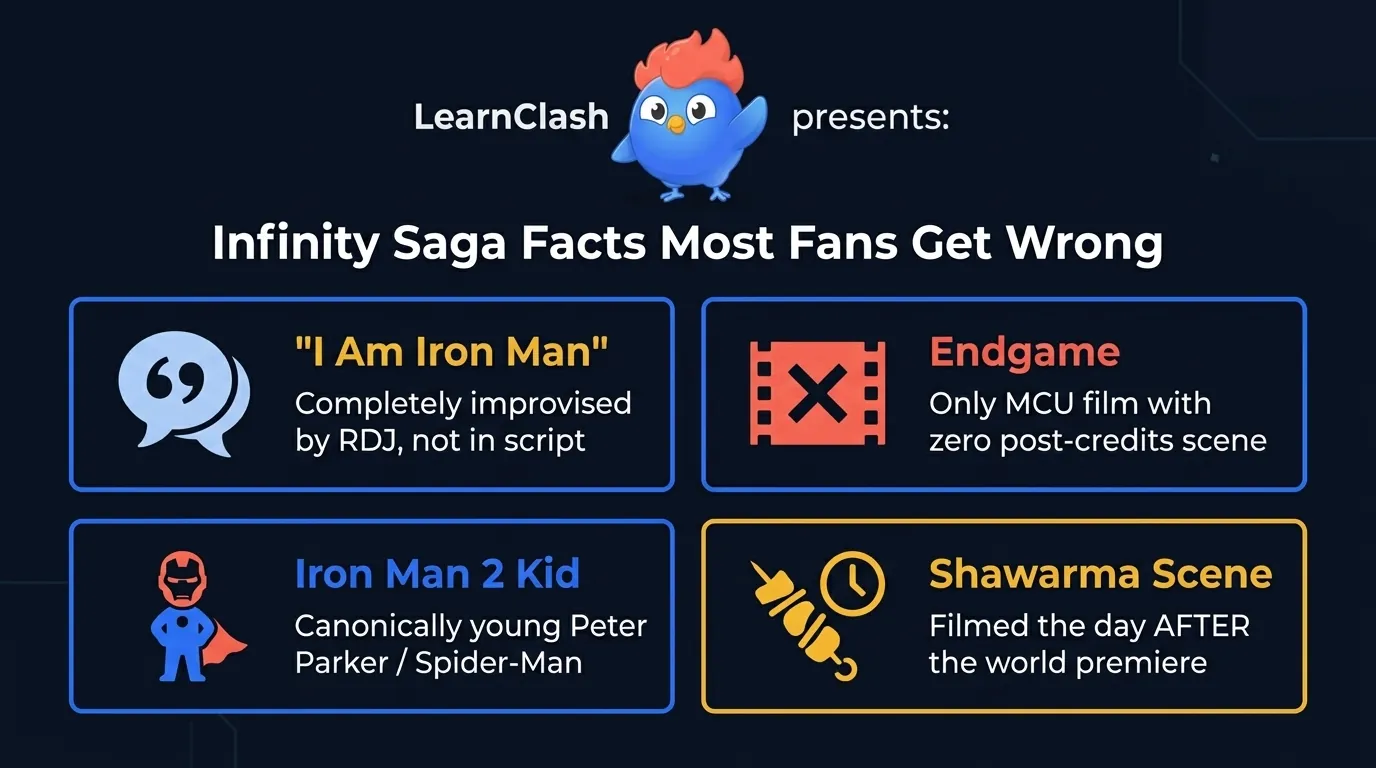
1. The line that launched the entire MCU was never in the script. What was it? Medium
Answer: “I am Iron Man.” Robert Downey Jr. improvised it at the end of Iron Man (2008). The script had Tony Stark sticking to the cover story; Favreau kept the cameras rolling.
Everyone assumes a franchise-defining moment was planned from the start. Instead, one ad-lib broke a decades-long tradition of secret identities in superhero films, and Marvel’s whole “heroes out in the open” approach traces back to it.
2. Which MCU film has absolutely no post-credits scene? Medium
Answer: Avengers: Endgame. The only thing after the credits is the faint sound of Tony Stark hammering his first Iron Man suit in a cave. No visuals, no tease, just audio.
A decade of post-credits stingers trained audiences to sit through every credit roll. Endgame broke the pattern on purpose. The clanging is a tribute, not a setup, and half the theater sat waiting for something that never came.
3. The kid in the Iron Man mask at the Stark Expo in Iron Man 2 is canonically which future Avenger? Hard
Answer: Peter Parker. Tom Holland and Kevin Feige have both acknowledged this. The timeline fits: Peter would have been around 8 years old in 2010, and he shows up six years later in Captain America: Civil War.
Nobody planned that Easter egg. Iron Man 2 came out in 2010 and Spider-Man didn’t join the MCU until 2016, but the timeline worked retroactively, so Marvel ran with it.
4. Iron Man 2, The Incredible Hulk, and Thor all take place during the same span of MCU time. How long? Hard
Answer: One week. All three films overlap within the same seven days. Agent Coulson leaves Tony Stark’s lab in Iron Man 2 and drives straight to the Thor hammer crash site in New Mexico.
These films released over three years, 2008 to 2011, and nobody watching them in theaters clocked that the events were nearly simultaneous.
5. The shawarma post-credits scene in The Avengers required something unusual. What? Medium
Answer: It was filmed the day after the world premiere. The cast reunited the next morning for a 30-second scene. Chris Evans had grown a beard for another role, so he wore a facial prosthetic and hid it behind his fist for the whole shot.
Post-credits scenes feel like normal production work. This one was bolted on barely 12 hours after the film debuted, with Captain America literally hiding half his face.
6. In release order, who was the first Avenger to appear in the MCU? Easy
Answer: Tony Stark / Iron Man in Iron Man (2008). Captain America holds the title of “First Avenger” in the MCU timeline, the 1940s, but Tony hit theaters first. The title Captain America: The First Avenger exists to make you second-guess exactly this question.
7. What scene launched the entire concept of the MCU, and was it planned? Easy
Answer: Nick Fury’s post-credits appearance in Iron Man. Samuel L. Jackson walks out of the shadows and says, “I’m here to talk to you about the Avenger Initiative.” It was written with no actual plan for a cinematic universe; Marvel was testing the waters.
The MCU feels so carefully planned that fans assume a master blueprint existed from day one. There wasn’t one. That scene was a gamble.
The Multiverse Saga (Phases 4-6) Questions (8-14)
Deadpool & Wolverine, Thunderbolts*, Captain America: Brave New World, Fantastic Four: First Steps. These are the freshest questions in the set, and most fans haven’t had time to soak up the details yet. Four of the answers below were tightened in the August 2026 re-check, and one of them changed because Marvel itself moved a release date, which tells you something about writing trivia for a franchise that is still moving.
8. Robert Downey Jr. returns to the MCU, but not as Iron Man. Who does he play? Hard
Answer: Doctor Doom in Avengers: Doomsday, now scheduled for December 18, 2026 after Marvel moved it off its original May 2026 date. The casting was announced at San Diego Comic-Con 2024.
RDJ is Iron Man in most people’s minds, so the idea of him walking back in as the main villain feels wrong on first hearing, and that discomfort is presumably a large part of the point.
9. What does the asterisk in Thunderbolts* mean? Medium
Answer: The team becomes “The New Avengers.” The asterisk is a footnote that gets revealed in the end credits. The whole film is an origin story for the next generation of Avengers, built from antiheroes and former villains.
Your gut says marketing gimmick or legal footnote. Wrong on both counts: it’s a plot point, and the asterisk is the twist.
10. Deadpool & Wolverine broke which box office record? Medium
Answer: Highest-grossing R-rated film of all time, at over $1.3 billion worldwide. It surpassed Joker ($1.07 billion) by a wide margin.
R-rated superhero films weren’t supposed to be blockbusters. The original Deadpool proved the model in 2016, yet nobody expected a sequel to lap Joker’s record without a single PG-13 compromise.
11. Red Hulk barely speaks in Captain America: Brave New World. Why? Hard
Answer: Director Julius Onah decided a Hulk with language stops being pure rage. Onah has said the question of whether Red Hulk should talk “came up quite a bit” and that giving him dialogue would have moved the character away from pure id; Harrison Ford backed the choice.
Ford is one of the biggest movie stars alive, so you’d assume his MCU debut came with pages of dialogue; what he got instead was a Hulk who barely speaks and makes his points with whatever he breaks.
12. Fantastic Four: First Steps isn’t set in present-day MCU Earth. When and where is it set? Hard
Answer: A retro-futuristic 1960s on Earth-828, an alternate universe rather than the main MCU timeline. Director Matt Shakman aimed the production design at the middle of that decade, though the film never states an exact year on screen. The setting mirrors the Fantastic Four’s original 1961 comic debut.
Every prior MCU film lived on the same Earth in the same timeline. Audiences walked in expecting modern-day New York and got the 1960s in another universe.
13. One of Ryan Reynolds’ early pitches for what became Deadpool & Wolverine looked nothing like the finished film. What was it? Medium
Answer: A tiny road-trip movie with almost no effects. By Reynolds’ own telling, one of his rejected Deadpool 3 pitches was a $5 to $6 million two-hander with no special effects, essentially Deadpool and Karan Soni’s Dopinder talking their way across the country. Hugh Jackman’s decision to return as Wolverine turned the project into a roughly $200 million team-up instead.
The counterintuitive part is the direction of travel. Actors usually lobby the studio for more budget, not a fraction of it.
14. After 24 years of X-Men films, what appeared on screen for the first time in Deadpool & Wolverine? Easy
Answer: Wolverine’s comic-accurate yellow and blue suit. Hugh Jackman wore the classic costume for the first time after playing the character across nine previous films spanning more than two decades.
Hardcore fans cheered the second the suit appeared. Casual viewers never noticed anything was missing, because the black leather X-Men look had become the norm.
Marvel Comics Origins Questions (15-21)
Comics origins is the most hard-weighted category in this set, four hard questions out of seven and no easy ones, and our play data points the same direction. In the July 2026 difficulty index, the one Marvel comics topic with enough answers to qualify, X-Men (comics), ranked 11th-hardest of 187 with a 54.6% wrong rate across 130 recorded answers, while the MCU film topic sat at rank 91 with 44.4%. The reason is simple: almost nobody reads the source material anymore. If you want to test yourself where it hurts, the Marvel Comics topic is the one to duel on.
15. What color was the Hulk when he first appeared in 1962? Medium
Answer: Grey. The Hulk debuted as a grey-skinned monster in The Incredible Hulk #1, but the grey ink was inconsistent across print runs, shifting between grey, green, and black depending on the press. By issue #2, Stan Lee switched to green for good because it reproduced more reliably.
Green Hulk is so iconic that the original grey version sounds like a myth. It’s not; grey Hulk is right on the cover of issue #1. The color everyone pictures exists because of a printing limitation, not a creative choice.
16. Wolverine was originally meant to be an actual mutated wolverine animal, evolved into humanoid form. True or false? Hard
Answer: False, and the myth’s persistence is the real trivia. The story that Wolverine began as a literal wolverine cub evolved by the High Evolutionary has been printed for decades, but creator Len Wein flatly denied it, writing that the claim made him “quite crazy.” The evolved-animal notion is usually traced to early X-Men artist Dave Cockrum’s recollections, not to Wein’s intent.
This one is a trap question in the best sense. Confident fans “know” the animal origin because they’ve read it somewhere, and the somewhere was wrong.
17. Why did Marvel’s publisher try to prevent Spider-Man from ever being created? Medium
Answer: Martin Goodman believed “kids hate spiders.” By Stan Lee’s account, when he pitched a teen hero who got powers from a spider bite, Goodman said no. Lee snuck Spider-Man into the final issue of Amazing Fantasy (#15) because the series was already being canceled and Goodman didn’t care what went in it.
Spider-Man is the most popular superhero on the planet. He almost didn’t exist because of one man’s hunch about kids and spiders.
18. Which pop star tried to buy Marvel Comics in the 1990s just to play Spider-Man? Hard
Answer: Michael Jackson. During Marvel’s 1990s financial collapse, Jackson explored purchasing the company so he could star as Spider-Man. Stan Lee confirmed it directly in a 2012 interview: “He felt that would be the only way that he could play Spider-Man.”
Michael Jackson and Spider-Man live in completely separate mental boxes. But Jackson was a serious comics fan, and the bankruptcy era made Marvel cheap enough for an individual buyer to circle.
19. Marvel and DC jointly owned the trademark on one everyday word for decades. Which word, and why is that answer now past tense? Hard
Answer: “Super Hero,” and they lost it in 2024. The two rivals co-owned registrations on the term for decades, the oldest dating to 1967. When a small UK publisher behind a comic called The Super Babies challenged the marks, neither company responded, and the US Patent and Trademark Office’s tribunal canceled them in September 2024.
For years the surprise here was that two bitter rivals shared intellectual property at all. Now the surprise is that they let it go without a fight, and “super hero” belongs to everyone again.
20. The Infinity Stones have completely different colors in the original comics. How different? Medium
Answer: Every single color was different. The Mind Stone was blue (not yellow), the Space Stone was purple (not blue), the Reality Stone was yellow (not red), and so on. After the MCU films became dominant, Marvel changed the comics to match the movie colors.
Fans assume the MCU faithfully copied the source material. On the Infinity Stones it ran the other way: the movies invented new colors, then the comics rewrote decades of continuity to match.
21. Martin Goodman, Marvel’s founder, narrowly avoided which historical disaster? Hard
Answer: The Hindenburg. Goodman was booked on the airship’s final 1937 voyage and, by the account he told, changed his travel plans at the last minute. If he hadn’t, Marvel Comics (then Timely Publications) might never have existed.
The margin between Marvel existing and not existing came down to one canceled ticket.
Behind the Scenes & Casting Questions (22-28)
The MCU almost looked nothing like it does. Swapped actors, wild salary jumps, and lucky accidents shaped the franchise as much as any script, and the space between what almost happened and what did is where the best trivia hides.
22. Tom Cruise really was in the frame to play Tony Stark, just not when most people think. When? Medium
Answer: In the late 1990s, when the Iron Man film rights sat at 20th Century Fox. Cruise expressed interest in producing and starring in 1998, years before Marvel Studios got the character back in 2005; by the time Jon Favreau cast the 2008 film, Cruise was long out of the picture. Favreau screen-tested Robert Downey Jr. over studio nerves about his insurability and personal history, arguing that Downey’s real-life redemption arc mirrored Tony Stark’s, and Cruise himself later said he was “not close” to playing the part.
The pub-quiz version of this question (“Tom Cruise was the first choice for the 2008 film”) is wrong, which makes the accurate version a double trap.
23. Emily Blunt was offered which MCU role before it went to Scarlett Johansson? Medium
Answer: Black Widow. Blunt was the first choice but was contractually locked into filming Gulliver’s Travels with Jack Black. She couldn’t take the role even though she wanted it.
Blunt went on to become a major action star with Edge of Tomorrow and A Quiet Place. One Gulliver’s Travels contract reshaped two careers.
24. How did Samuel L. Jackson end up as Nick Fury? Hard
Answer: Marvel drew Nick Fury as Jackson in the 2002 Ultimates comics without asking him first. Writer Mark Millar has admitted he and artist Bryan Hitch “just liberally used him without asking any kind of permission.” Jackson found the redesign in a comic store, and instead of suing, he negotiated: Marvel could keep his face if he got the role in any future film.
Casting usually starts with auditions. This started with an artist borrowing a real person’s face and hoping he wouldn’t sue.
25. What was Robert Downey Jr. paid for Iron Man (2008) vs. Avengers: Endgame (2019)? Hard
Answer: A reported $500,000 for Iron Man, and roughly $75 million for Endgame once backend profit participation is counted. That’s a 150x increase over 11 years. Chris Evans reportedly earned just $300,000 for Captain America: The First Avenger in 2011.
MCU salaries being huge is common knowledge; how tiny they started is not. Half a million dollars for the lead of a $140 million bet.
26. Sebastian Stan auditioned for which MCU role before being cast as Bucky Barnes? Easy
Answer: Captain America. Stan read for the lead, lost it to Chris Evans, and impressed the casting team enough to land Bucky. Evans and Stan later joked that the audition rivalry gave their on-screen friendship genuine chemistry.
27. Chris Pratt’s failed audition for one MCU role led directly to which casting? Easy
Answer: Star-Lord. Pratt sent in audition material for Captain America and never got a callback, but casting director Sarah Finn remembered him and pushed him for Guardians of the Galaxy years later.
The tonal gap is the fun part: he lost a stiff military hero role and landed a wisecracking space outlaw instead.
28. Which future DC icon described being up for a role widely identified as Nebula? Hard
Answer: Gal Gadot. Before Wonder Woman, Gadot told an Israeli interviewer in May 2013 that she had “the option now for a role” that meant shaving her head and being painted blue; outlets identified it as Nebula, and Karen Gillan was announced in the role 12 days after the interview was posted. Director James Gunn later said Gadot was “definitely never offered the role” and that he could not remember whether she auditioned, which is why careful quiz hosts say she was “up for” the part, never that she was offered it.
Had the Marvel part worked out, DC’s most iconic modern casting might never have happened.
Villains & Anti-Heroes Questions (29-34)
The snap needs no introduction. Where Thanos came from, why he looks the way he does, and how close his most famous prop came to not existing all do.
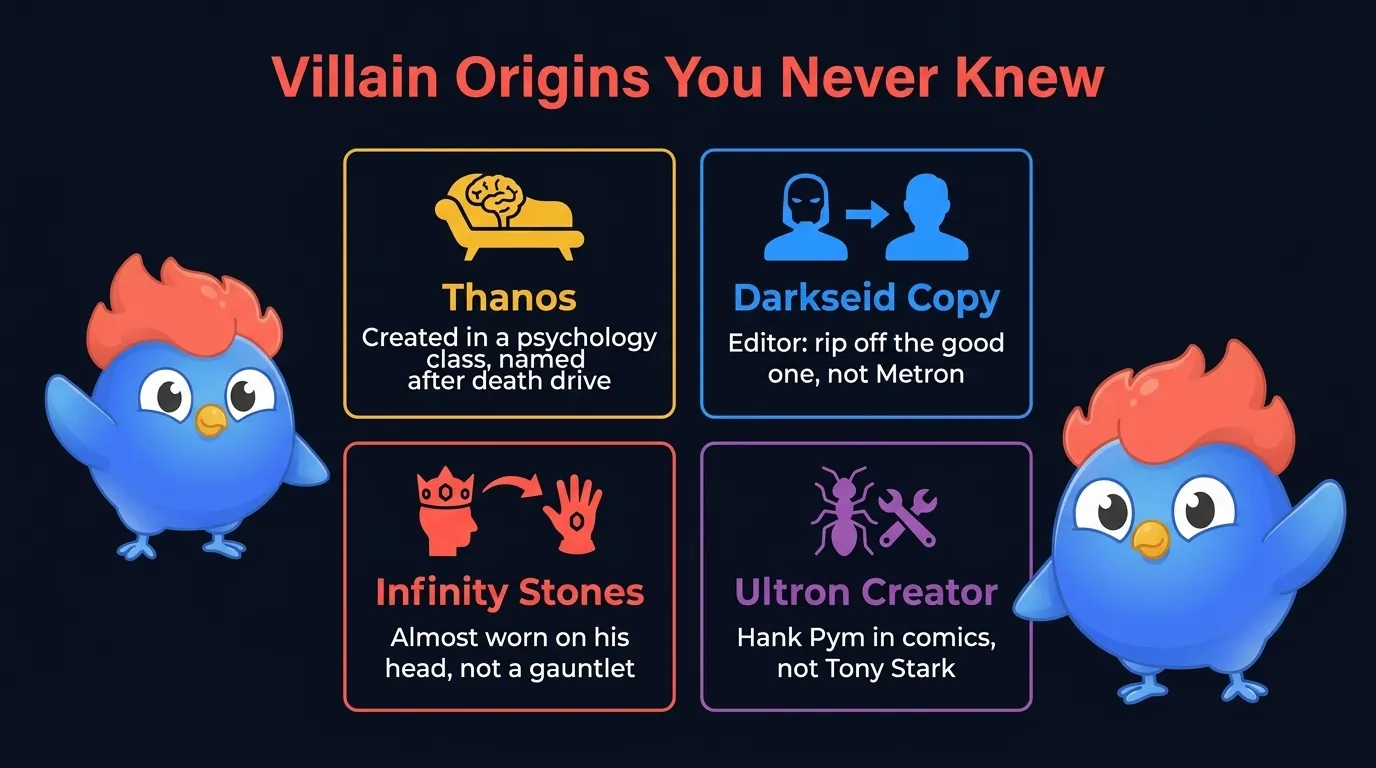 The biggest villain in film history started as a lecture-hall doodle.
29. Where was Thanos created, and what inspired his name? Medium
Answer: A college psychology class. Creator Jim Starlin sketched Thanos during a lecture, and the name comes from Thanatos, the death drive in Freudian psychology. Starlin was studying the material at the time and merged it with his comic art.
Fans expect a grand creative origin for the biggest villain in film history. They get a student doodling in a notebook.
30. Thanos originally resembled a DC character. Which one, and why did his design change? Hard
Answer: Metron, a relatively obscure member of DC’s New Gods. Starlin’s editor, Roy Thomas, looked at the design and reportedly said: “If you’re going to steal one of the New Gods, at least rip off Darkseid, the really good one.” Starlin bulked up the design, and Thanos became the Darkseid-adjacent titan we know.
Anyone who clocks the Thanos/Darkseid resemblance assumes Darkseid was the original inspiration. By Starlin’s own account it ran the other way. His first sketches borrowed from Metron, the New God who rides a floating chair, and the extra bulk went on at Thomas’s request before the character ever saw print, which happened in Iron Man #55, cover-dated February 1973.
31. The Infinity Stones were almost displayed on a different part of Thanos’s body. Where? Medium
Answer: His head. Jim Starlin’s early comics sketches placed the stones in a crown, but the look reminded him of Superman’s enemy Brainiac, so he moved them onto a gauntlet instead. That backup idea became one of the most recognizable props in film history.
“Thanos with gems on his forehead” was a real design direction. The pivot happened because the first version looked like a different company’s villain.
32. In Marvel comics, who actually created Ultron? Medium
Answer: Hank Pym (Ant-Man). In the comics, Pym built Ultron, and the AI’s personality is based on Pym’s own brain patterns. The MCU handed the job to Tony Stark for Avengers: Age of Ultron because Ant-Man hadn’t been introduced to the film universe yet.
The MCU version is so well known that the comic origin reads as a mistake. It isn’t, and the father-son tragedy between Pym and Ultron is one of the saddest threads in Marvel comics.
33. Scarlet Witch first appeared in Marvel comics as a hero or a villain? Medium
Answer: A villain. Wanda Maximoff debuted in X-Men #4 (1964) as a member of Magneto’s Brotherhood of Evil Mutants, the opposite of the likable-from-frame-one Wanda the MCU introduced. She fought the X-Men before switching sides and joining the Avengers.
34. What did Thanos’s own creator think about the character’s commercial potential? Hard
Answer: Very little. Jim Starlin has said he “always thought he was just too weird and esoteric” to ever reach the mainstream. He created Thanos for niche cosmic comics and never expected the character to leave that corner of the Marvel universe. Thanos went on to anchor the highest-grossing film event in history.
In hindsight, purple skin and a golden gauntlet look built for the big screen. Starlin’s read on the character was formed decades earlier, back when Thanos was a new face in a 1973 Iron Man issue and cosmic Marvel was a niche within a niche.
Spider-Man Universe Questions (35-40)
Peter Parker has been around since 1962, has headlined nine live-action films, and has spawned more spin-offs than any other Marvel hero. That much lore hides deep cuts even devoted fans miss, and two of the questions below reach back into the comics record for them. There’s a dedicated Spider-Man topic if this section turns out to be your strong suit.
35. Miles Morales debuted in which comic, and under what circumstances? Medium
Answer: Ultimate Fallout #4, August 2011, created by writer Brian Michael Bendis and artist Sara Pichelli. Miles takes up the mask in the aftermath of the Ultimate universe’s Peter Parker dying, which is why his debut issue carries the emotional weight it does.
Most fans date Miles to the 2018 Spider-Verse film. By then the character had been carrying comics for seven years, and his first appearance had already become one of the most sought-after modern issues.
36. How long does Spider-Man’s synthetic web last before dissolving? Medium
Answer: About one hour. Peter Parker designed the web fluid to dissolve on a timer so it wouldn’t coat New York City for good.
Nobody thinks about web cleanup logistics. Parker did, and the comics have kept the detail canon for decades: the timer is a design choice, not a weakness.
37. Spider-Man’s black suit first appeared in which comic? Hard
Answer: The Amazing Spider-Man #252 (1984) in publication order, months before Secret Wars #8 told the story of where the suit actually came from. The idea originated outside Marvel entirely: a fan named Randy Schueller submitted a black-costume concept in 1982, and Marvel bought it.
The order trips people up in both directions. The origin story shipped after the debut, and the most famous costume change in comics started as fan mail.
38. In the original 2002 Spider-Man film, what “auditioned” for the spider-bite scene? Easy
Answer: Real spiders. The crew brought in live spiders of multiple species and filmed each one to find the best look on camera. The winner was a Steatoda, a relative of the black widow, painted with red and blue markings.
Painting a live spider to look more cinematic is bizarre enough to lodge in your memory for good.
39. The three-Spider-Man lab scene in No Way Home is famous for what production detail? Easy
Answer: Large stretches of it were improvised. Tom Holland, Andrew Garfield, and Tobey Maguire have described going off-script through the scene, riffing on each other rather than reading lines. The chemistry that made it iconic was found on set, not written.
The scene is so well built that it feels scripted to the comma. Three actors who had never shared a frame found the rhythm live.
40. Peter Quill’s ship “Milano” in Guardians of the Galaxy is named after whom? Hard
Answer: Actress Alyssa Milano. Quill named his ship after his childhood crush, and writer-director James Gunn confirmed the reference. It’s not named after the Italian city.
The elegant-sounding name and the mundane celebrity-crush origin sit about as far apart as trivia allows, which is what makes it a stumper.
Box Office, Records & Easter Eggs Questions (41-47)
The MCU rewrote how Hollywood greenlights, markets, and milks a franchise, and its record book is still being edited: in July 2026, Spider-Man: Brand New Day opened to $360 million domestically, taking the opening-weekend record Endgame had held since 2019. Disney’s $4 billion Marvel purchase in 2009 may be the best deal in entertainment history (for the Disney side of that story, see our Disney trivia questions).
41. What is the total worldwide gross of the entire MCU franchise? Easy
Answer: Over $31 billion, making it the highest-grossing film franchise in history, ahead of Star Wars, Harry Potter, and James Bond. The MCU reached that with 38 films across 18 years.
Everyone knows the MCU is huge; few can name the number. Framed once, it sticks: that figure tops the GDP of over 100 countries.
42. Which MCU character has the most total screen time across all films? Medium
Answer: Tony Stark / Iron Man, with just under six hours by the fan-run tallies that track this, spread over ten appearances from Iron Man (2008) to Avengers: Endgame (2019).
Thor has been in more films, and Captain America has three solo outings plus the team-ups. Stark’s minutes per film run higher every time, and total minutes settle the question.
43. How quickly did Avengers: Endgame surpass Infinity War’s entire theatrical run? Medium
Answer: 11 days. Infinity War earned $2.05 billion across its full run; Endgame crossed $2 billion inside 11 days and finished near $2.8 billion worldwide. Its domestic opening-weekend crown stood for seven years, until Brand New Day took it in July 2026.
Infinity War was already one of the biggest films ever made. Endgame treated its whole gross as a warmup lap.
44. What was the original Deadpool’s budget-to-gross ratio? Hard
Answer: $58 million budget, $783 million gross, roughly a 13.5x return and one of the most profitable superhero films ever made. The low budget was deliberate: Ryan Reynolds and the filmmakers spent years convincing Fox to greenlight a cheap, R-rated superhero film.
Marvel films typically cost $150 to $250 million. Deadpool spent less than a third of that and outgrossed most of them, which is what forced studios to take R-rated superhero films seriously.
45. Benedict Cumberbatch voiced two characters in Doctor Strange. Which two? Easy
Answer: Doctor Strange and Dormammu. The “Dormammu, I’ve come to bargain” scene is Cumberbatch talking to himself, with motion capture and vocal effects layered over his base performance.
Dormammu’s voice is so distorted it sounds alien, and Strange’s is calm and precise, so your brain refuses to link them.
46. Actors from the unreleased 1994 Fantastic Four film make a special appearance in which MCU movie? Hard
Answer: Fantastic Four: First Steps (2025). Four members of Roger Corman’s infamously unreleased 1994 cast appear in cameos: Rebecca Staab and Alex Hyde-White as newscasters, Jay Underwood and Michael Bailey Smith as power plant workers rescued by the Human Torch.
The 1994 film is a piece of Marvel trivia all on its own. It was made largely to retain the film rights and never officially released, so slotting its actors into the MCU version thirty years later is a genuinely sweet piece of housekeeping.
47. Wolverine’s comic-accurate yellow and blue costume took how many years to finally appear in a live-action film? Medium
Answer: 24 years. Hugh Jackman first played Wolverine in X-Men (2000) wearing black leather, and the yellow suit didn’t appear until Deadpool & Wolverine (2024). Studio executives reportedly considered the classic costume too cartoonish for live action.
The suit itself isn’t shocking; the math is. Twenty-four years outlasts how long many Marvel fans have been alive.
Running These at Game Night
Pull 7 questions per round from different categories. Open on the Infinity Saga, where every table has a foothold, climb into Comics Origins, where confidence cracks, and finish on Behind the Scenes, the crowd favorites. All 47 stretch to about two hours once you add argument time.
Studying solo is a different game, and the “why it stumps” notes are where the answers earn their keep. In Karpicke and Roediger’s 2008 testing-effect study, students who kept quizzing themselves on freshly learned vocabulary still knew about 80 percent of it a week on; the group that only reread the material managed 36. Getting the grey Hulk question wrong once is how you end up never getting it wrong again. More on why that works in our testing effect guide.
LearnClash builds that wrong-then-right loop into every Marvel duel: get a question wrong and it lands back in your queue a week out, then ninety days out, and answering right at both checkpoints marks it mastered. The queue adapts to what you personally don’t know, not to a generic Marvel checklist.
Frequently Asked Questions
What Marvel trivia question does everyone get wrong?
In LearnClash play data, the single most missed MCU question asks why Janet van Dyne was trapped in the Quantum Realm; it went wrong on 12 of 15 attempts. The classic stumper is the Hulk's original color: he debuted grey in 1962, and printing limitations forced the switch to green by issue two. Comics origin questions stump fans hardest because almost nobody reads the source material anymore.
What are the hardest MCU trivia questions?
The hardest MCU trivia tests behind-the-scenes details: 'I am Iron Man' was completely improvised by Robert Downey Jr., Endgame is the only MCU film with no post-credits scene, and the kid in Iron Man 2 is canonically young Peter Parker. These hard-tier questions trip up even fans who have seen every film.
How many movies are in the Marvel Cinematic Universe?
The MCU has 38 films as of August 2026, through Spider-Man: Brand New Day (July 2026). They split into the Infinity Saga (Phases 1-3, 23 films) and the ongoing Multiverse Saga (Phases 4-6, 15 films so far). LearnClash covers MCU trivia across all phases with questions matched to your skill level.
How many Marvel trivia questions do I need for game night?
30 to 40 Marvel trivia questions split into rounds of 7 work best for a two-hour game night. Start with easy MCU movie questions, escalate to comics origins and casting secrets, and keep the stump notes handy for the arguments the hard tier starts.
Where can I play Marvel trivia against friends?
LearnClash lets you duel friends or matched opponents on Marvel trivia with ELO ranking across 8 tiers and built-in spaced repetition. Pick any Marvel topic, challenge someone, and the questions you miss come back until you master them. Free on iOS and Android.