
47 Animal Trivia Questions [With Answers]
47 animal trivia questions on mammals, ocean life, birds, reptiles, and insects. Answers included, plus why each one stumps.
How many do you know?
Think of your answer, then reveal it.
Did you know it before revealing the answer?
Read this answer in the articleRound complete
Challenge friends on this topic.
Start a new duel in LearnClash and learn from every answer.
Get LearnClashFree to play on iPhone and Android. No ads.
Try the questions you missed once more.

A shrimp punches hard enough to boil water. An octopus rewrites its own RNA on the fly. And the oldest animal ever recorded was killed by the scientists studying it.
These 47 animal trivia questions on LearnClash cover mammals, ocean creatures, birds, reptiles, insects, and deep-cut zoology that stumps even biology majors. Under every question sits the answer plus the specific reason people get it wrong. A couple of the strangest facts link straight to the primary research, and the Smithsonian National Zoo covers most of these animals in more depth.
Six groups, three challenge levels, answers under every question. The list works for adults and kids alike, from common pets to facts that sound made up. Put these 47 to the test in an animal duel →, or browse the full directory of trivia topics with answers for more topics.
Quick Overview
The 47 below are grouped by animal type and challenge level, so you can pick your lane before diving in. The list runs harder than most because “a dog has four legs” doesn’t stump anyone past kindergarten.
| Category | Questions | Easy | Medium | Hard |
|---|---|---|---|---|
| Mammal Trivia | 1-9 | 2 | 4 | 3 |
| Ocean & Marine Life | 10-17 | 2 | 3 | 3 |
| Bird Trivia | 18-24 | 1 | 3 | 3 |
| Reptile & Insect Trivia | 25-32 | 2 | 3 | 3 |
| Hard Animal Trivia | 33-40 | 0 | 0 | 8 |
| Easy Animal Trivia for Beginners | 41-47 | 7 | 0 | 0 |
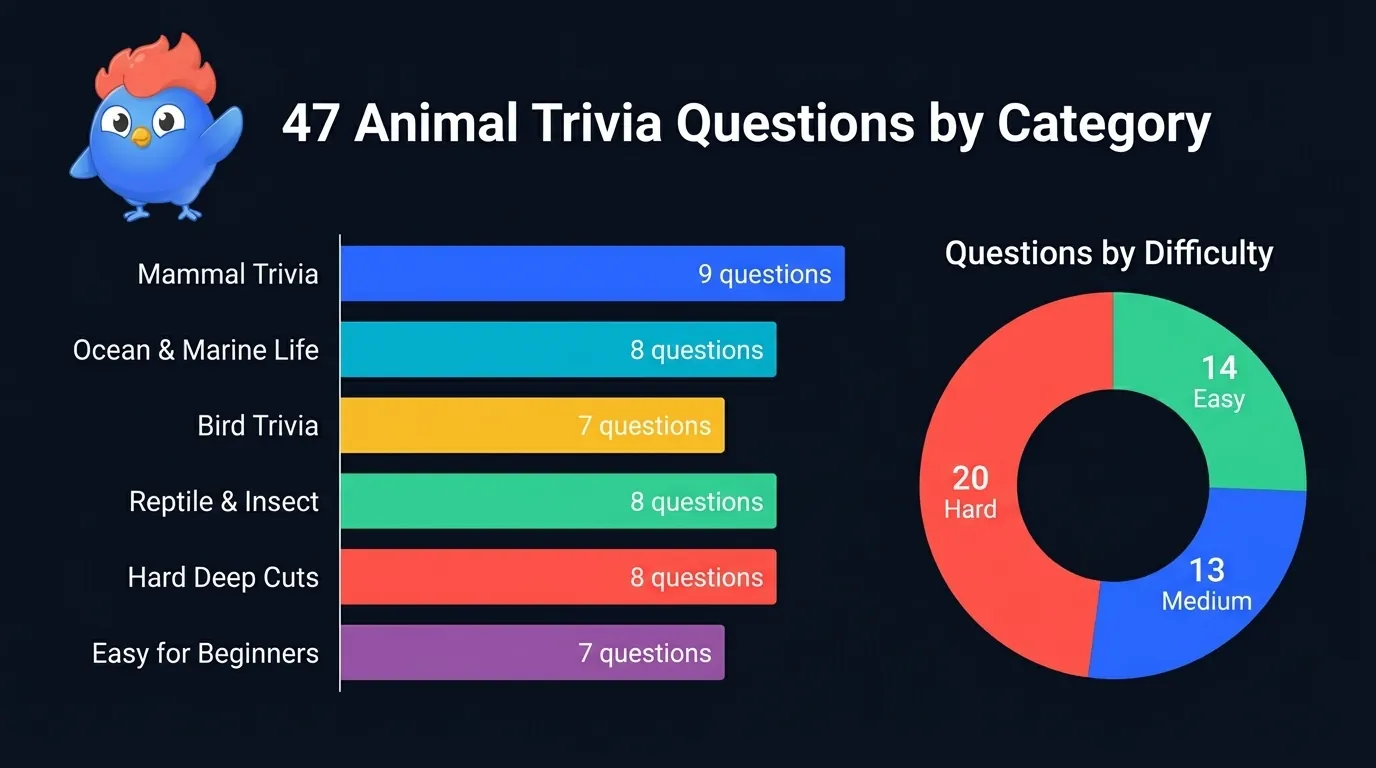 How the 47 questions split across groups and challenge levels.
One trap runs through the whole set: the animals you see every day are the ones you’re surest about, and that misplaced confidence is exactly what makes a correction stick through spaced repetition.
Mammal Trivia Questions (1-9)
We have lived around mammals our whole lives, which is exactly the problem: the guesses come fast, confident, and frequently wrong.
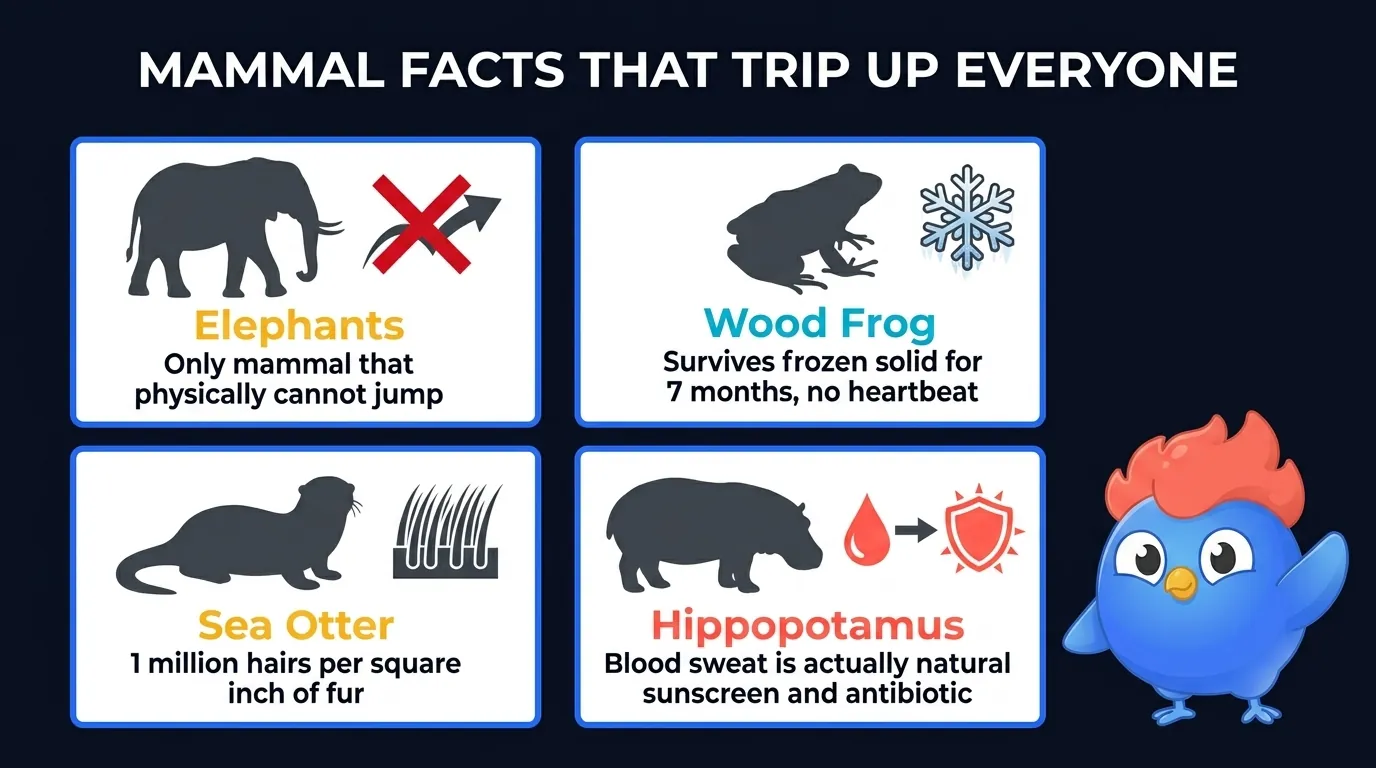
1. What’s the only mammal that can’t jump? Easy
Answer: Elephant. Despite weighing up to 14,000 pounds, elephants are the only mammals bodily incapable of jumping. Their leg bones are built for weight support, not spring.
Everyone tries to think of small or awkward animals first, which is why the elephant catches people: it is the counterintuitive pick precisely because the limitation is structural, not behavioral.
2. How many months can a wood frog stay frozen solid, heart stopped, and still live? Hard
Answer: Up to 8 months. Each winter the wood frog shuts down completely: heart still, lungs still, brain silent. Glucose and specialized proteins flood its cells and work like antifreeze, keeping ice crystals from shredding them. Come spring, the frog thaws and hops away within hours.
Nearly everyone assumes freezing kills all vertebrates, and it kills most of them. The wood frog loads its cells with glucose at concentrations around 10 times normal, turning its body into something closer to a sugar-preserved specimen than a living animal, then thaws out in spring as if nothing happened.
3. Which animal’s fingerprints could pass for a human’s? Medium
Answer: Koala. Their prints are so close to human ones that forensic experts have warned they could mess up crime scenes. Even under a microscope, telling them apart takes an expert.
Your gut says chimpanzee. Chimps are our closest relatives, so it seems obvious. But koalas grew their prints through convergent evolution, with zero link to primates: two unrelated species arrived at the same solution for gripping branches.
4. Which mammal has the densest fur of any animal? Medium
Answer: Sea otter, with roughly 1 million hairs per square inch. For comparison, a human head averages about 100,000 hairs total. The otter packs ten times that into a single square inch.
Everyone reaches for polar bear or arctic fox. But sea otters have no blubber at all, so surviving frigid Pacific water depends entirely on that fur trapping a layer of air against the skin for insulation.
5. What’s unique about a naked mole rat’s body temperature? Hard
Answer: It’s the only mammal that can’t maintain a constant body temperature. Naked mole rats are thermoconformers, meaning their body heat tracks the air around it rather than staying fixed internally. They also appear virtually immune to cancer and can survive 18 minutes without oxygen.
Nobody pictures a mammal when they think “cold-blooded.” The whole definition of mammals includes internal temperature control. But naked mole rats broke the rule. They huddle together for warmth like insects and live in colonies with a queen and workers, the only mammal with that social structure.
6. How many compartments does a cow’s stomach have? Easy
Answer: Four. The rumen, reticulum, omasum, and abomasum. Each chamber handles a different stage of breaking down tough plant cellulose that a single stomach couldn’t process.
Two or three feels right. It’s four, each with a specific job in sequence, and the rumen alone holds up to 40 gallons of partially digested food at any given time.
7. What percentage of a panda’s day is spent eating? Medium
Answer: About 55%, or 12 to 14 hours. Bamboo is so low in nutrients that pandas need to eat roughly 26 to 84 pounds per day just to survive. Their digestive system is still built for meat, which makes the whole arrangement wildly inefficient.
The catch is that pandas look lazy. They sit, they chew, and none of it looks like effort, but eating is their full-time job. A carnivore’s gut processing an herbivore’s diet means pandas extract only about 17% of the nutrients from what they consume, so they compensate with sheer volume.
8. Which land mammal has the strongest bite force? Hard
Answer: Hippopotamus, at roughly 1,800 PSI. That’s enough to snap a canoe in half, which hippos have actually done. A lion’s bite clocks in around 650 PSI. A grizzly bear hits about 975.
The guesses pile up on big cats and bears, because lions look dangerous and grizzlies look powerful. But hippos carry massive jaw muscles and 20-inch canine teeth that evolved for territorial combat, not for chewing food.
9. What animal’s sweat looks like blood but is actually built-in sunscreen? Medium
Answer: Hippopotamus. Hippos secrete a reddish fluid called “blood sweat” that contains hipposudoric acid and norhipposudoric acid. Despite the alarming color, none of it is blood, and none of it is sweat. The fluid works as a natural UV-absorbing, antibacterial moisturizer, protecting their sensitive skin from sun damage and infection.
Two hippo questions in a row. The blood sweat one sounds like a horror movie detail, but the fluid is a genuinely effective natural sunscreen: it absorbs UV light, kills bacteria on contact, and keeps the skin from cracking in dry air. Researchers have tried to copy it for human sunscreen use.
Ocean & Marine Life Trivia Questions (10-17)
Questions 10 to 17 are sea animal questions with answers: octopus hearts, a clam born in 1499, a shrimp whose punch heats water toward the sun’s surface temperature. All of them are playable as timed duels on LearnClash. The deep sea ignores most rules you learned on land, and the same confidence trap runs through our science trivia questions.
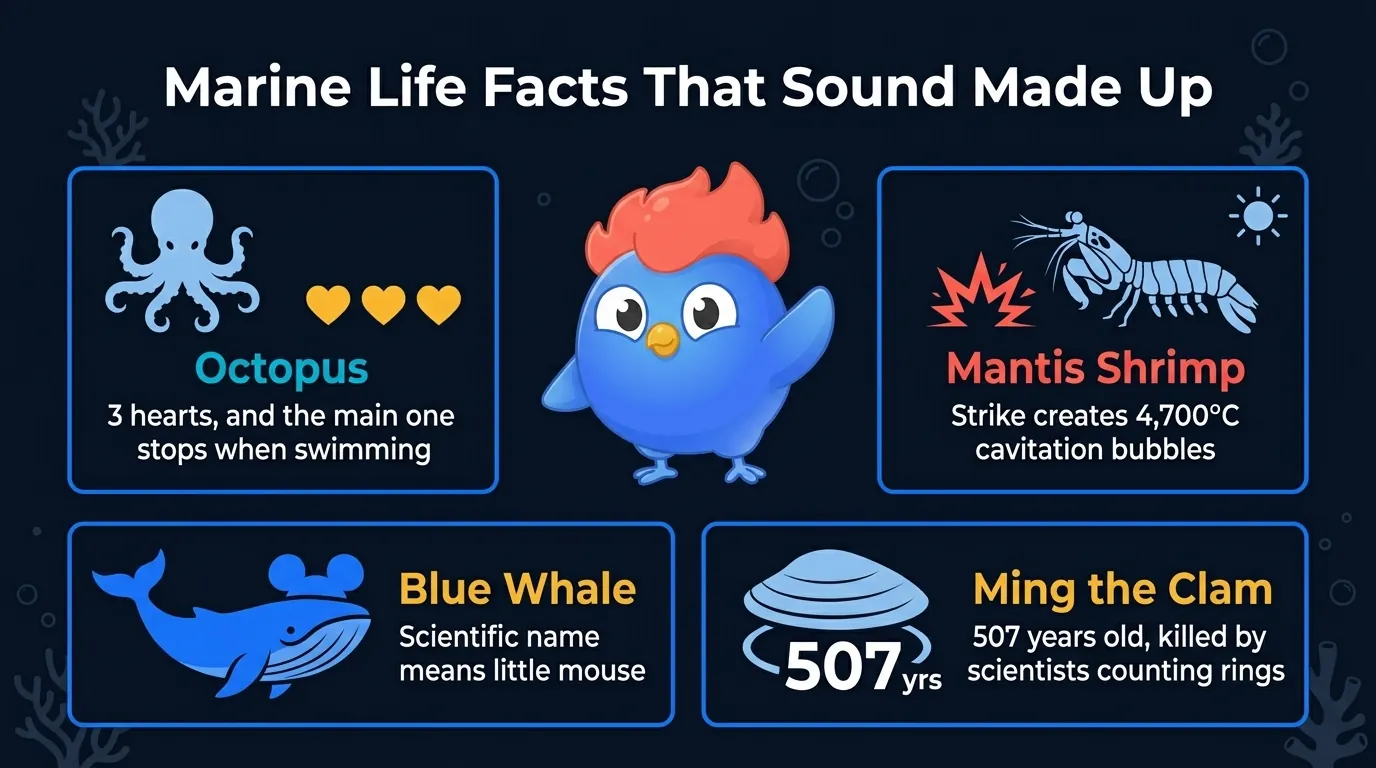 Questions 10 to 17 at a glance.
10. An octopus has how many hearts? Easy
Answer: Three. Two branchial hearts feed the gills while a third, systemic heart drives blood around the body. Swimming shuts that third heart down, so an octopus would rather crawl and keep it running.
This question shows up everywhere, but the “why” still surprises people. The systemic heart stops during swimming. That’s not a glitch. It’s why octopuses tire so quickly in open water and avoid swimming unless they have to.
11. What sea creature can regenerate its entire body from a tiny fragment? Medium
Answer: Sea sponge. Push a living sponge through a sieve, and the individual cells will crawl back together and reform into a functioning organism. Some starfish can regenerate from a single arm, but sponges take it further: they reassemble from disaggregated cells.
Starfish get all the regrowth credit, and they are impressive. But sponges can be blended, separated at the cellular level, and still pull themselves back into shape, because a sponge is closer to a colony of cells than a single tightly integrated organism.
12. What’s the scientific name of the blue whale, and why is it ironic? Hard
Answer: Balaenoptera musculus, which translates to “little mouse.” Linnaeus, the taxonomist who named it in 1758, apparently had a sense of humor. The largest animal that has ever existed on Earth carries a name meaning “little mouse.”
Even zoology majors blink at this one. The blue whale can reach 100 feet and 200 tons, heavier than any dinosaur, and its Latin name is a joke from the 18th century that nobody bothered to fix.
13. How fast can a mantis shrimp strike, and what happens to the water around it? Hard
Answer: About 50 mph, fast enough that the water around the strike forms cavitation bubbles reaching temperatures exceeding 4,700°C at collapse. That’s approaching the surface temperature of the sun. The strike produces a shockwave that can stun or kill prey even if the claw misses.
A crustacean the size of your hand generates near-sun temperatures as a side effect of punching. The bubbles collapse in microseconds and produce a brief flash of light, a phenomenon called sonoluminescence.
14. What common aquarium fish can change its sex during its lifetime? Medium
Answer: Clownfish. All clownfish are born male. The dominant female in a group is the only one who breeds. If she dies, the largest male changes sex and takes over. Finding Nemo would have been a very different movie if it followed the science.
Two words trip people up: “common” and “aquarium.” People think of exotic deep-sea species, but the clownfish sitting in your dentist’s waiting room tank is the one doing it. The trigger is social hierarchy: remove the female, and the biology responds.
15. How old was the oldest known animal when it was found? Medium
Answer: 507 years old. Ming, an ocean quahog clam, was dredged from Icelandic waters in 2006. Researchers at Bangor University pried it open to count growth rings and determine its age. The act of measuring killed it. The oldest animal ever found, destroyed by curiosity.
A clam is the last thing anyone names for “oldest animal.” And the detail that breaks people is the ending: scientists killed it to find out how old it was. The initial count said 405 years; later analysis revised it to 507, meaning the clam was born in 1499.
16. What ocean creature has the largest eye of any living animal? Easy
Answer: Colossal squid, with eyes reaching roughly 11 inches across, about the size of a dinner plate. Each eye has a built-in headlight: a bioluminescent organ called a photophore that projects light forward in the deep ocean darkness.
The easy answer is “giant squid.” Close, but wrong species: the colossal squid holds the record. The detail that makes the fact stick is the photophore, a light-producing organ shining forward in water no sunlight ever reaches.
17. How many ganglia (nerve clusters that act like mini-brains) does a leech have? Hard
Answer: 32. A leech has 32 ganglia, one for each body segment, each containing about 400 neurons that process info and control movement on their own. Neuroscientists often describe these as “32 brains,” though each one is far simpler than a vertebrate brain.
One brain seems obvious. It’s 32. The leech’s nervous system is unusually well studied precisely because it’s spread out: each ganglion operates with real independence, which makes the leech a favorite model organism for researchers studying how neurons coordinate across a decentralized system.
Ocean questions are their own topic in the app, so if this round was your favorite, duel me on marine life → before the birds arrive.
Bird Trivia Questions (18-24)
Pigment-free color, organ-shrinking migration: almost nothing about how birds actually work is visible from a park bench.
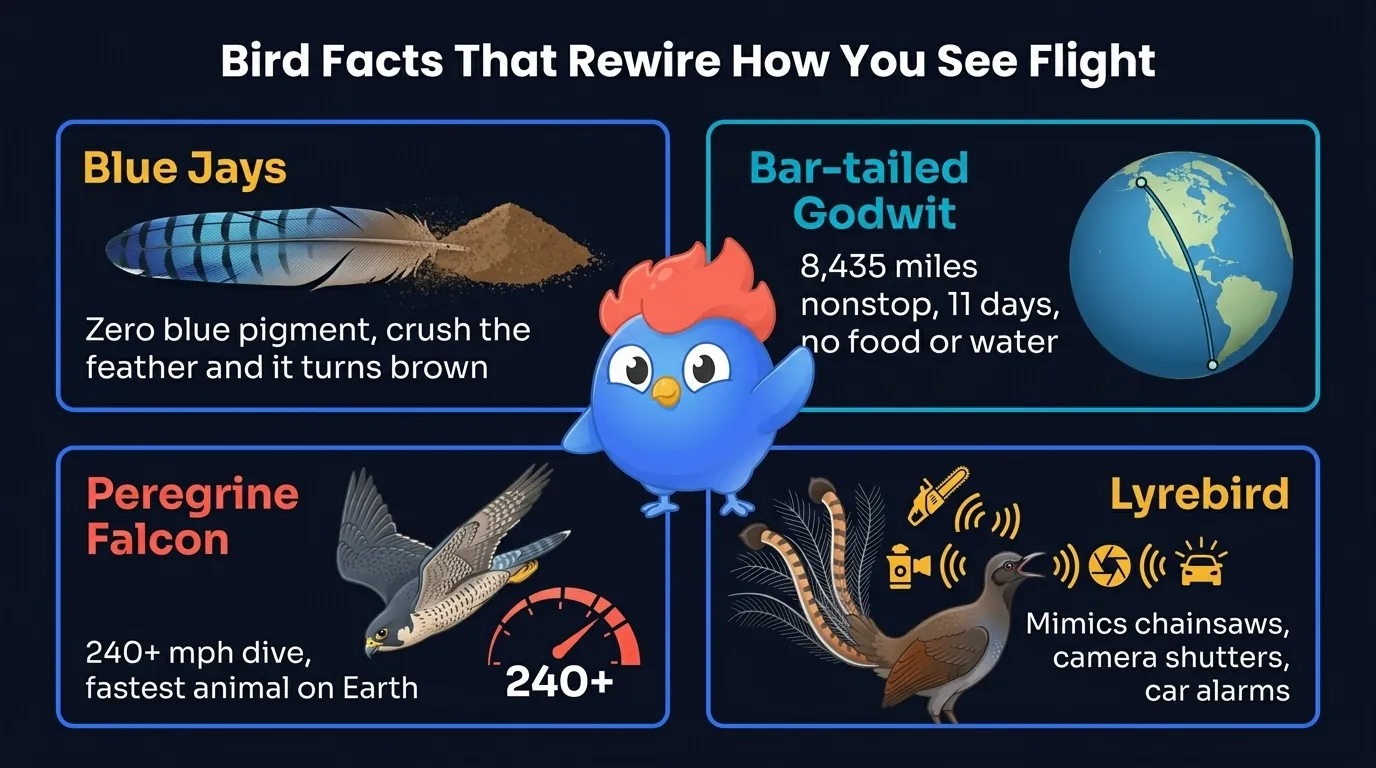
18. Why do blue jays appear blue even though they contain zero blue pigment? Hard
Answer: Structural coloration. Microscopic air pockets in the feather scatter light so that only blue wavelengths reach your eye. Crush the feather, and it turns brown. The blue was never “in” the feather. It was a trick of physics.
Seasoned birdwatchers miss this. We assume color comes from pigment, and for most animals it does, but blue jays, bluebirds, and morpho butterflies all make blue through nanostructure rather than chemistry.
19. How far did the bar-tailed godwit fly nonstop in the longest recorded bird flight? Hard
Answer: 8,435 miles in about 11 days, from Alaska to Tasmania without landing, eating, or drinking. Before departure, the bird shrank its own intestines and liver to make room for extra fat reserves.
The distance is shocking, but the biology is stranger: the godwit consumes parts of its own organs to fuel the trip, with some internal organs shrinking by up to 25% before takeoff and rebuilding after landing.
20. What bird can fly backwards? Easy
Answer: Hummingbird. Their shoulder joints rotate 180 degrees, allowing full reverse flight. Hummingbirds can also hover perfectly still and fly upside down briefly during aerial displays.
Most people assume plenty of birds can fly in reverse. They can’t. Hummingbirds are the only birds with a ball-and-socket shoulder joint allowing a figure-eight wing stroke that generates lift on both the upstroke and downstroke, and that backward flight is what lets them feed mid-air without ever landing.
21. How long does it take for flamingo chicks to turn pink? Medium
Answer: About 2 to 3 years. Flamingos are born gray or white. The pink comes fully from carotenoid pigments in their diet of shrimp, algae, and crustaceans. Zoo flamingos that don’t eat the right food stay pale.
Everyone pictures them hatching pink. They don’t. Baby flamingos look like awkward gray puffballs for years, and the pink isn’t genetic: feed a flamingo a carotenoid-free diet and it fades to white. The color is eaten, not inherited.
22. What’s the fastest animal on Earth in a dive? Medium
Answer: Peregrine falcon, clocking over 240 mph in a hunting stoop (high-speed dive). That’s faster than a Formula 1 car. During the dive, special baffles in the falcon’s nostrils prevent its lungs from being damaged by air pressure.
Cheetah, says almost everyone, and cheetahs do win on land. But the peregrine falcon is the fastest animal, period. The nostril baffles are the detail that sticks: built-in air management so the dive doesn’t damage the bird’s lungs.
23. Which bird has the largest wingspan of any living bird? Medium
Answer: Wandering albatross, with a wingspan reaching 11.5 feet (3.5 meters). They can fly thousands of miles without flapping by locking their wings and riding wind currents. Some individuals have been tracked circumnavigating the globe.
The number alone isn’t what trips people, it’s the scale: an albatross wingspan is wider than most cars are long. And they use it for gliding, not flapping. A wandering albatross can cover 500 miles in a single day without a wingbeat, using a technique called dynamic soaring.
24. What bird can mimic chainsaws, camera shutters, and car alarms with dead-on precision? Hard
Answer: Superb lyrebird of Australia. Males spend years learning complex sound sequences to attract mates. They don’t just imitate other birds. They copy construction equipment, camera shutters, and even human speech. Each male’s repertoire is unique and region-specific.
This one sounds made up. Search YouTube for lyrebird mimicry and the results are unnerving: a bird in the bush producing the exact sound of a camera’s motor drive, then switching to a chainsaw, then to a kookaburra, and nothing about it sounds approximate.
Reptile & Insect Trivia Questions (25-32)
Insects make up most of the animal kingdom and get the least attention at quiz night, which is roughly why this group plays harder than it looks. If the reptile half pulls you in, our dinosaur trivia questions covering 165 million years of prehistory picks up where this section leaves off.
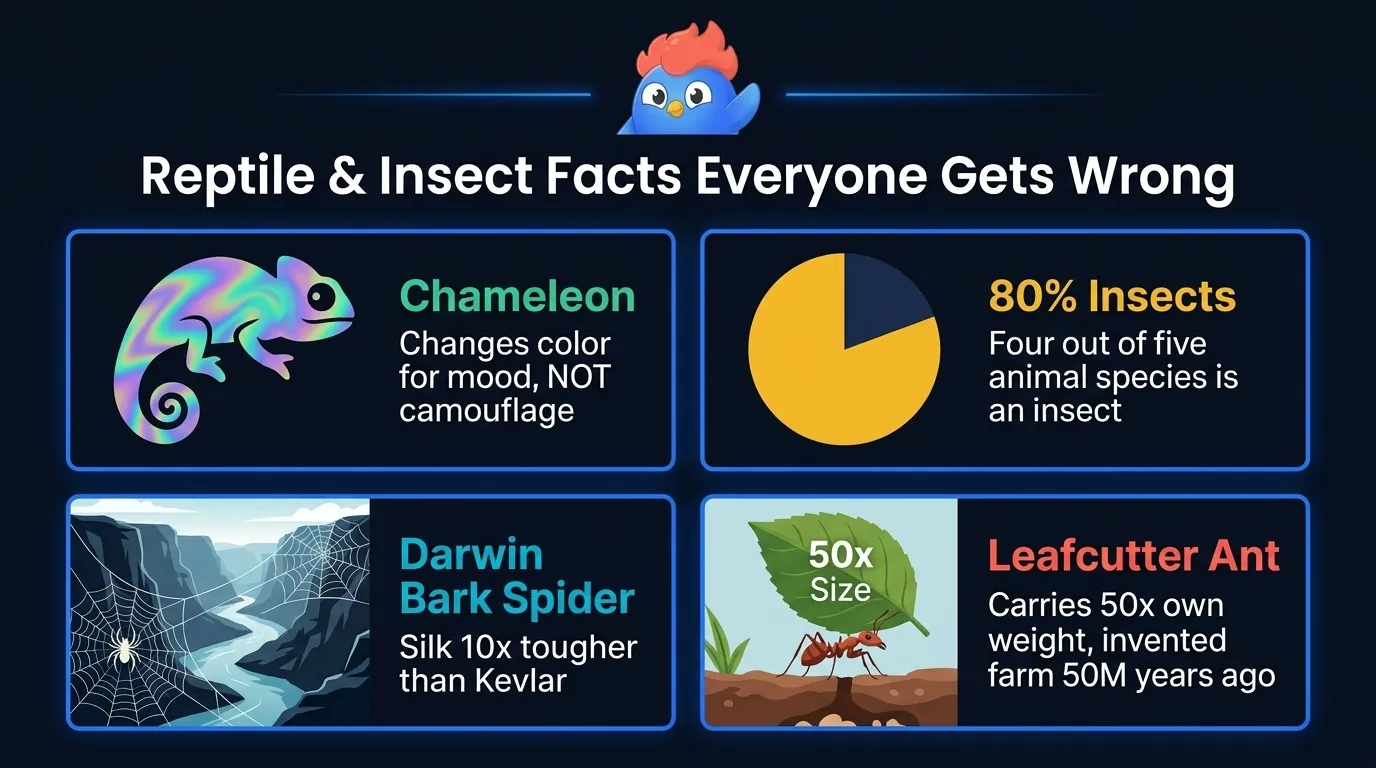 Questions 25 to 32 cover reptiles, insects, and a chameleon myth that refuses to die.
25. Why do chameleons actually change color? Medium
Answer: Communication, mood, and temperature control. Not camouflage. Chameleons shift color to signal aggression, attract mates, and thermoregulate. A stressed chameleon turns dark. A dominant male turns bright. Hiding from predators is barely part of it.
Every children’s book, every cartoon, every nature documentary narration repeats “chameleons change color to blend in.” The actual research from the University of Geneva showed they manipulate nanocrystals in their skin cells, tuning the spacing to reflect different wavelengths. It’s a mood ring, not camo.
26. How many times per second does a housefly beat its wings? Hard
Answer: About 200 times per second. That wing speed creates the buzzing sound you hear. A mosquito beats even faster, around 600 times per second, which produces a higher-pitched whine.
Nobody guesses this high. Two hundred times per second means the fly’s flight muscles contract and relax in under 5 milliseconds each cycle, and they operate semi-automatically: the fly’s brain doesn’t command each stroke individually.
27. What insect can survive being decapitated and live for weeks afterward? Medium
Answer: Cockroach. A headless cockroach breathes through spiracles (body holes) and doesn’t need its mouth to breathe. It eventually dies of dehydration because it can’t drink, not from the missing head.
The detail that wrecks people is why it survives. Cockroaches don’t breathe through their heads, and their circulatory system doesn’t run on pressure the way ours does, so they don’t bleed out. The head simply stops being necessary for most functions, and the body wanders around for weeks until thirst kills it.
28. Which type of reptile can detach and regrow its tail? Easy
Answer: Lizards, especially geckos, skinks, and anoles. The tail has pre-formed fracture planes in the vertebrae that snap cleanly. The regrown tail uses cartilage instead of bone and is usually shorter and differently colored.
Sounds right. Is right. But the detail people miss is that the replacement tail is a downgrade: cartilage instead of bone, fewer muscles, a different color pattern. Meanwhile the original tail keeps twitching on the ground for several minutes to distract the predator.
29. What percentage of all known animal species are insects? Hard
Answer: Roughly 70%, and closer to 80% by some counts. Of the roughly 1.5 million identified animal species on Earth, over 1 million are insects. Beetles alone account for about 25% of all known animal species, prompting biologist J.B.S. Haldane’s famous quip about God having “an inordinate fondness for beetles.”
The number sounds too high. It isn’t. At least two out of every three described animal species are insects, and the real share is likely higher: entomologists estimate millions of insect species remain undiscovered in tropical canopies and soil ecosystems. Insects are their own dedicated topic on LearnClash too, under entomology.
30. How hot are the bubbles created by a pistol shrimp snapping its claw? Hard
Answer: Roughly 4,400°C, which is close to the surface temperature of the sun. The snap creates a cavitation bubble that collapses so violently it produces a flash of light (sonoluminescence) and a shockwave that stuns prey.
Same physics as the mantis shrimp, different mechanism. The pistol shrimp doesn’t punch: it snaps one oversized claw shut so fast that the water jet creates a vapor bubble, and when that bubble collapses, the heat spike is brief but real, measured in peer-reviewed work.
31. What spider builds the strongest natural material ever tested, tougher than steel by weight? Easy
Answer: Darwin’s bark spider of Madagascar. Its silk is roughly 10 times tougher than Kevlar by weight and can span rivers up to 80 feet wide. The webs are the largest orb webs ever documented.
Most guesses land on the famous golden silk orb-weavers. But Darwin’s bark spider silk sits in a different class entirely, and materials scientists study it because no other known biological material matches its toughness.
32. What insect can carry 50 times its own body weight? Medium
Answer: Leafcutter ant. Relative to body size, leafcutter ants are among the strongest animals on Earth. They carry leaf fragments back to underground fungus farms, where they use the leaves to cultivate the fungus they actually eat.
The strength number is attention-grabbing, but the farming detail is what makes it stick. Leafcutter ants don’t eat the leaves they carry; they grow fungus on them, then eat the fungus. These ants invented agriculture roughly 50 million years before humans did.
Hard Animal Trivia Questions (33-40)
Questions 33 to 40 are the deep cuts: extreme survivors, biological outliers, and record holders. If you want them to stick, commit to a guess before you read each answer.
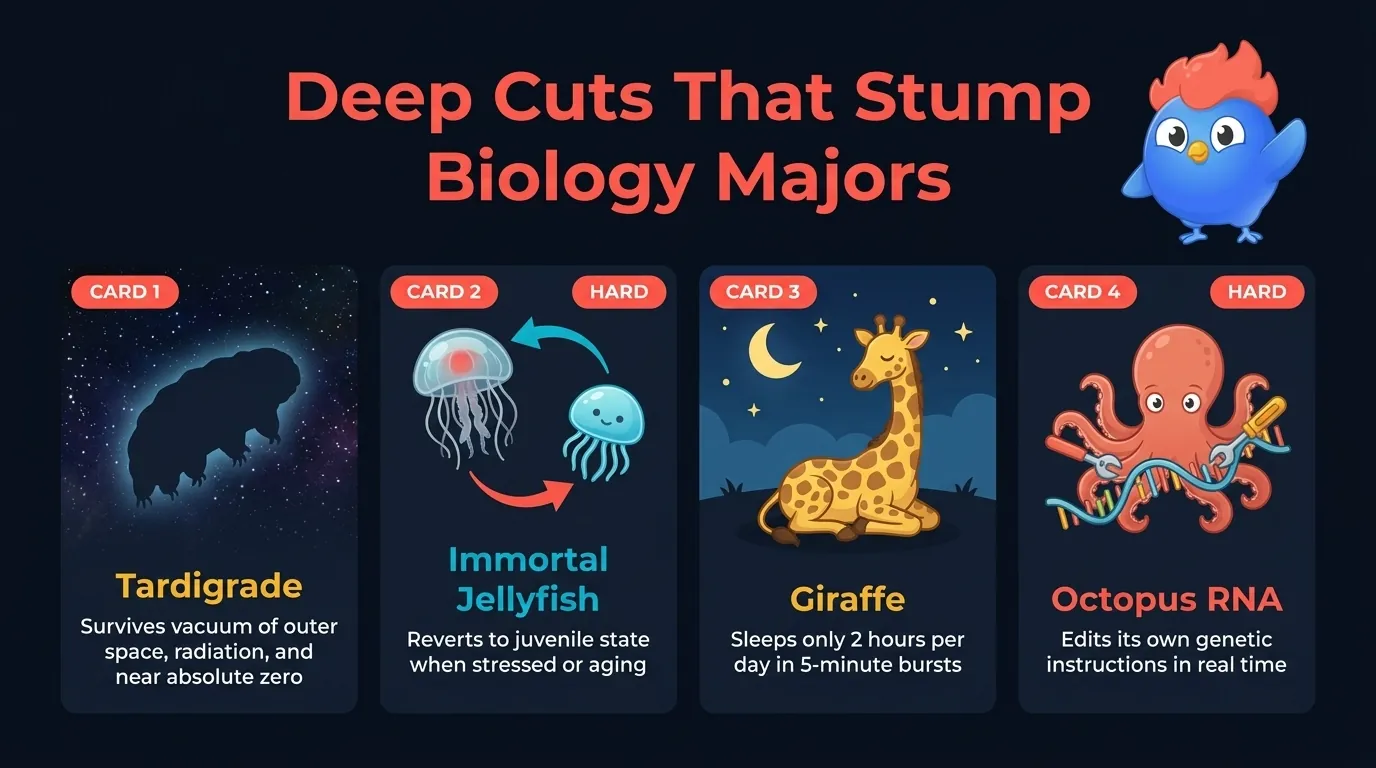
33. What animal can survive the vacuum of outer space? Hard
Answer: Tardigrade (water bear). In 2007, the European Space Agency exposed tardigrades to the vacuum, radiation, and extreme cold of low Earth orbit for 10 days. Many survived and some even reproduced afterward.
Tardigrades handle temperatures from -272°C to 150°C, pressures six times greater than the deepest ocean trench, and radiation doses hundreds of times lethal to humans. They do it by entering a state called cryptobiosis, where metabolism drops to 0.01% of normal: alive on paper, functionally dead, and ready to resume when conditions improve.
34. What creature is considered basically immortal because it can revert to its youngest form? Hard
Answer: Turritopsis dohrnii, the “immortal jellyfish.” When stressed, injured, or aging, it reverts its adult cells back into their youngest form and starts its life cycle over. No other known animal can reverse its own aging process this fully.
The word “immortal” triggers skepticism, and fair enough: they still get eaten, get sick, get caught in fishing nets. But the cellular mechanism is real. Adult cells undergo transdifferentiation, reverting to stem cell-like states.
35. How many neurons does an octopus have, and where are most of them? Hard
Answer: About 500 million neurons, and roughly two-thirds of them are in the arms, not the central brain. Each arm can taste, touch, and make basic choices on its own. Cut off an arm and it continues responding to stimuli for up to an hour.
Intelligence spread out like that breaks our mental model. We think of brains as command centers, but the octopus runs closer to a network: the central brain sets goals, and each arm executes with its own processing power. Plenty of people know the neuron count and still get the location wrong.
36. What mammal sleeps only about 2 hours per day? Hard
Answer: Giraffe. They sleep in short bursts of 5 to 10 minutes, often standing up. Lying down makes them vulnerable to predators, and getting up from the ground takes too long for a safe escape.
We tie big animals to long sleep, and that’s the mistake. Elephants sleep 4 to 5 hours, cats sleep 16, but giraffes face a geometry problem: folding those legs and that neck into sleeping position on the African savanna is a predation risk they can’t afford.
37. What percentage of a jellyfish’s body is water? Hard
Answer: About 95%. Jellyfish have no brain, no blood, no heart, and no bones. They’re a thin layer of living tissue holding saltwater. Despite this, some species deliver lethal venom and some glow in the dark.
The number feels too high, but jellyfish are, by mass, almost entirely seawater held in a living bag. The remaining 5% of tissue still manages to include box jellyfish venom, which can kill a human in minutes.
38. What’s the loudest animal relative to its body size? Hard
Answer: Pistol shrimp, producing snaps measured at roughly 218 decibels underwater (using the underwater reference scale of 1 micropascal). That’s louder than any other animal snap measured at the source. The snap also produces that nearly sun-hot cavitation bubble mentioned earlier.
The decibel number needs context. Underwater sound measurements use a different scale than air measurements, so you can’t compare 218 dB underwater directly to a jet engine’s 150 dB in air. But even adjusting for the difference, the pistol shrimp produces a staggering amount of acoustic energy from a two-inch body, and colonies of snapping shrimp are loud enough to interfere with military sonar systems.
39. Which animal makes the longest migration of any species on Earth? Hard
Answer: Arctic tern, traveling roughly 44,000 miles per year in a pole-to-pole round trip from Arctic to Antarctic and back. Over a 30-year lifespan, a single tern flies the equivalent of three round trips to the Moon.
The migration distance alone is a strong trivia answer, but the lifetime total is what breaks people: a bird weighing about 4 ounces covers roughly 1.5 million miles over its life.
40. What animal can edit its own RNA to adapt to cold water in real time? Hard
Answer: Octopus. Coleoid cephalopods (octopuses, squid, cuttlefish) can modify their RNA on the fly, recoding proteins to function in cold temperatures without waiting for DNA mutations across many lifetimes. This was shown by researchers at the Marine Biological Lab in Woods Hole.
This is the one that sounds like science fiction. DNA mutations take many lifetimes, while RNA editing happens in real time, within a single animal’s life: the octopus changes the instructions after they leave the nucleus, making proteins tuned for the current water temperature. No other animal group does this at the same scale.
Easy Animal Trivia for Beginners (41-47)
The last seven questions give beginners and kids a foothold: familiar animals, approachable facts, quick wins. For a full age-graded list, our 89 trivia questions for kids runs ages 5 to 13 with its own challenge tiers.
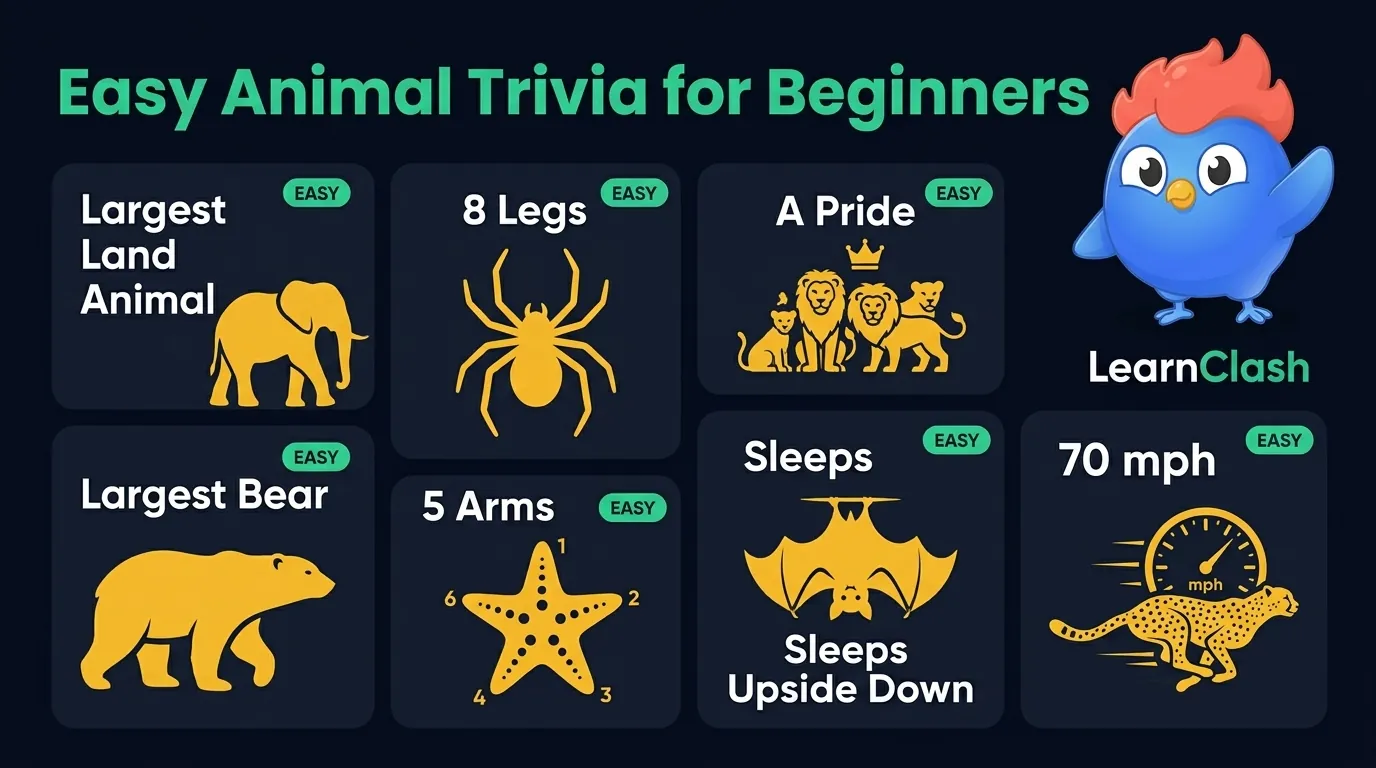 Seven starters for family game night.
41. What’s the largest land animal alive today? Easy
Answer: African bush elephant, weighing up to 14,000 pounds and standing up to 13 feet at the shoulder. The largest ever recorded weighed roughly 24,000 pounds.
Straightforward, but the weight is what people underestimate. Fourteen thousand pounds is seven tons, and the largest individual ever recorded came in closer to twelve. People know “elephant” and still rarely process the actual scale.
42. A spider walks on how many legs? Easy
Answer: Eight. Every species, from a jumping spider to a tarantula, without exception.
Quick and clean. The common mistake is confusing spiders with insects, and the giveaway is the leg count: every insect on Earth, from a beetle to a butterfly to an ant, runs on six, while every spider runs on eight. Adults second-guess it more than you’d expect.
43. What do you call a group of lions? Easy
Answer: A pride. Most prides consist of related females, their cubs, and one or two adult males. A pride typically ranges from 10 to 15 members, though some reach 30.
Most people know “pride.” But players who know this one often miss harder group names: a murder of crows, a parliament of owls, a flamboyance of flamingos.
44. Which bear species is the largest? Easy
Answer: Polar bear. Adult males weigh 900 to 1,600 pounds and measure up to 10 feet tall standing. They’re also the largest living land carnivore.
Grizzly is the instinctive answer, and grizzlies are big. But polar bears beat them on both weight and height, every time: the largest polar bear on record weighed 2,209 pounds.
45. What animal is known for sleeping upside down? Easy
Answer: Bat. Bats hang inverted from their roosts using specialized tendons that lock their toes in a gripping position. It takes zero muscle effort to hang. Letting go is what requires energy.
The surprise here isn’t the answer, since everyone knows bats hang upside down. The surprise is the mechanics: hanging is their resting state, the tendons lock passively, and dropping is what requires active muscle contraction. A dead bat still hangs from its perch.
46. How many arms does a starfish typically have? Easy
Answer: Five. Though some species, like the sunflower sea star, can have up to 24 arms. If a starfish loses an arm, it usually grows a new one within about a year.
Simple question, but the regrowth detail is the hook. In some starfish species the arm doesn’t just grow back: a whole new starfish grows from the detached arm.
47. Which animal holds the land speed record? Easy
Answer: Cheetah, reaching speeds up to 70 mph in short bursts. From a standing start one hits 60 mph in roughly three seconds, quicker than nearly every production sports car.
Everyone knows the answer, so the value here is in the details. Cheetahs can only hold top speed for about 20 to 30 seconds before overheating, and their success rate on hunts is roughly 50%, far from guaranteed.
Hosting an Animal Round
For a two-hour game night, split the list into rounds of 7 or 8: mammals as the warmup, ocean and birds in the middle, the hard section as the closer. The same split works in a classroom, where the “why it stumps people” notes turn each question into a teaching moment rather than a gotcha. If you want to mix in another category, our food trivia questions pair well with these.
On timing: allow 45 seconds per question, the same per-question timer LearnClash uses for duels. Nobody needs three minutes. People either know the mantis shrimp fact or they don’t, and the extra time just adds dead air.
If you’d rather not keep score by hand, all 47 questions and hundreds more are playable as timed 1v1 duels in the app, where every miss resurfaces on a spaced-repetition schedule until you stop missing it. That last part matters more than it sounds: the biggest head-to-head evaluation of study techniques (Dunlosky et al., 2013) graded practice testing as one of the two most effective methods of the ten it compared, well ahead of rereading and highlighting. Reading the answers feels productive, but the effect only kicks in when you make yourself guess first.
When you are ready to have the scoring handled for you, play animal trivia on LearnClash →.
Explore more trivia: All trivia question articles →
Frequently Asked Questions
What's the hardest animal trivia question?
The hardest animal trivia questions involve counterintuitive biology: the mantis shrimp's strike creates cavitation bubbles nearly as hot as the sun's surface, and the blue whale's scientific name translates to 'little mouse.' On LearnClash, hard-tier animal questions trip up even confident players.
What animal facts do people always get wrong?
Chameleons don't change color for camouflage. Blue jays have zero blue pigment. Hippo 'blood sweat' is actually sunscreen. And the naked mole rat is the only thermoconforming mammal. These are the animal facts where confidence and reality drift furthest apart, which is exactly what makes them stick.
How many animal trivia questions do I need for game night?
30 to 40 animal trivia questions split into rounds of 7 work best for a two-hour game night. Mix groups: mammals for warmup, ocean life for middle rounds, and hard deep cuts as the closer. LearnClash lets you play these as timed duels with automatic scoring.
What are easy animal trivia questions for kids?
Easy animal trivia for kids works best with familiar animals: the fastest land animal, how many legs a spider has, or what you call a group of lions. This list includes 7 easy questions designed for family game night. LearnClash adjusts challenge automatically for newer players.
Where can I play animal trivia against friends?
LearnClash lets you duel friends or matched opponents on animal trivia with ELO ranking across 8 tiers and built-in spaced repetition. Pick any animal topic, challenge someone, and the questions you miss come back until you master them. Free on iOS and Android.