
43 History Trivia Questions [With Answers]
43 history trivia questions from ancient civilizations to modern wars. Answers included, plus why each one trips people up.

Quiz yourself on these questions
How many do you know?
Think of your answer, then reveal it.
Did you know it before revealing the answer?
Read this answer in the articleRound complete
Challenge friends on this topic.
Start a new duel in LearnClash and learn from every answer.
Get LearnClashFree to play on iPhone and Android. No ads.
Here are 43 history trivia questions with answers, split into four eras: ancient civilizations, medieval and early modern, modern history, and American history. Each era runs easy to hard, every answer explains why people miss it, and the mix leans medium and hard on purpose, because easy dates rarely catch anyone.
Oxford University is older than the Aztec Empire. Cleopatra lived closer to the Moon landing than to the construction of the pyramids. History trivia runs on facts like these, where the truth sits at an angle to the story everyone carries in their head.
I also get to watch that collision happen at scale: LearnClash runs a ranked History topic, scored by an ELO-style rating, so I can see how thousands of real answers land. Some of that data is below, and it changed my mind about what makes a history question hard. For the August update I re-checked all 43 answers and fixed a handful of details the earlier version got wrong, including the year of the magazine article behind the Titanic “unsinkable” myth and a Soviet casualty figure that did not match the source it cited. In September I replaced the production data with our latest export. For other categories in this format, start with the full trivia question collection, or duel me on history trivia → when you want to test yourself.
The 43 Questions at a Glance
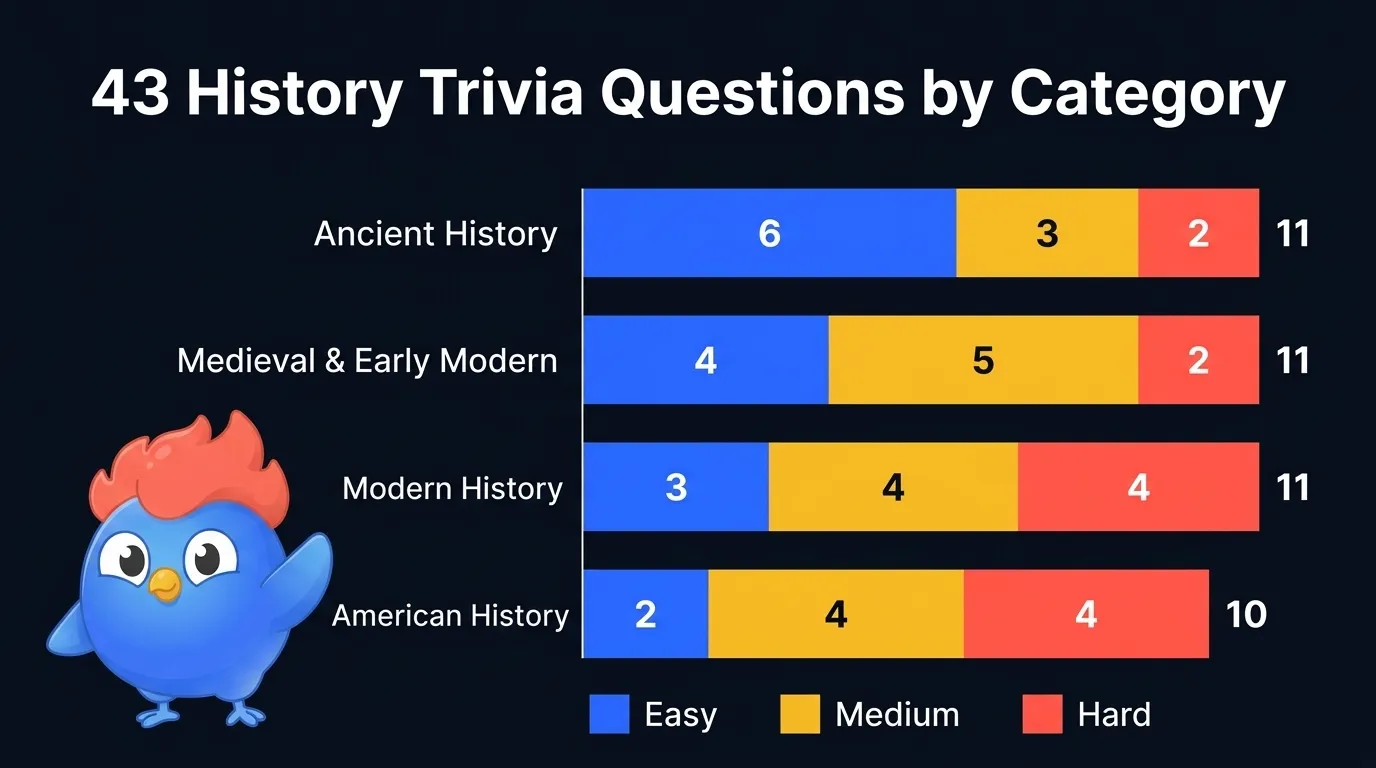
Four eras, three difficulty tiers, 43 questions: 15 easy, 16 medium, 12 hard. The warmup tier is there for scoring, not for surprises.
| Category | Questions | Easy | Medium | Hard |
|---|---|---|---|---|
| Ancient History | 1-11 | 4 | 4 | 3 |
| Medieval & Early Modern | 12-22 | 4 | 4 | 3 |
| Modern History | 23-33 | 4 | 4 | 3 |
| American History | 34-43 | 3 | 4 | 3 |
Before the questions, a short confession about that word “hard.”
The Hardest History Questions Are Not the Ones I Expected
The hardest history questions in our production data are look-alike answers, not date questions. That surprised me: an earlier version of this page said timeline questions were the killers, and then I pulled the numbers. The numbers below come from our September 26, 2026 production export of first-encounter duel answers, for the History topic and its neighboring history topics. Only questions with 30 or more first answers count. That leaves 128 questions and 7,337 answers, from 30 to 237 per question, with a median of 46. Of the 128 questions, 108 come from History, 18 from Seven Wonders of the Ancient World and 2 from Benjamin Franklin.
| Cut of the export | Questions | First answers | Correct |
|---|---|---|---|
| Every question with 30 or more answers | 128 | 7,337 | 67.8% |
| Names a year, a century or a dating term | 19 | 1,686 | 72.2% |
| Everything else | 109 | 5,651 | 66.5% |
| Most players got it wrong | 33 | 1,482 | 32.2% |
| A wrong answer out-polled the right one | 9 | 329 | 16.1% |
Dates are not where players lose points. I tagged the dated questions by keyword. The question text names a year, a century or a dating term such as BCE or the Julian calendar, or compares two points in time with words like “older than” and “closer to”. A question that only mentions a year counts too. Those 19 questions score about six points above the other 109. The most-answered question in the whole cut is one of them: “Woolly mammoths still existed when which Egyptian structures were built?” has 237 first-encounter answers, and 78 percent get it right. The mammoth fact went viral years ago. The internet already taught it.
The dated questions that do hurt show the real trap. The question behind this page’s opening line asks which Mesoamerican empire Oxford University predates. Only 36 percent of 45 first attempts landed on the Aztec Empire, and the most popular wrong answer was the Maya at 29 percent. Players swallowed the strange timeline without blinking. What sank them was the empire mix-up, the same Maya-Aztec-Inca scramble waiting in question 4 below.
| Question | First answers | Right answer (picks) | Top wrong answer (picks) |
|---|---|---|---|
| Which empire is Oxford University older than? | 45 | Aztec Empire, 16 | Maya, 13 |
| Who said those who forget the past are condemned to repeat it? | 35 | George Santayana, 1 | Winston Churchill, 17 |
| What was the primary weapon of early samurai? | 38 | Bow and arrow, 8 | Curved longsword, 19 |
| Woolly mammoths still existed when which Egyptian structures were built? | 237 | The Giza pyramids, 186 | Temple of Hatshepsut, 13 |
What actually kills people is a famous name sitting next to the right answer. Nine of the 128 questions had a wrong answer that out-polled the correct one, and two of the clearest are name-and-image mix-ups. Players hand Winston Churchill a line that paraphrases George Santayana: 17 of 35 first attempts picked Churchill and 1 picked Santayana. Our 12 questions players get wrong data pull breaks that one down with its own counts. And players arm early samurai with swords: 19 of 38 first attempts picked the curved longsword, while only 8 picked the honest answer, the bow.
A check on the answer keys. The third-hardest question in the cut asked what ancient Romans used as mouthwash. Only 4 of 34 first tries, 12 percent, picked urine, the answer the deck scores as correct. While re-checking this page I flagged that question for a rewrite: the one ancient source everyone leans on, Catullus, mocks a Celtiberian rival for that grooming habit, not his fellow Romans, and the evidence that Romans themselves swished urine is thin to nonexistent. The deck now asks what Roman writers said Celtiberians used as mouthwash. Those 34 answers date from the old wording, so I do not read them as evidence about the new question. The 88 percent who dodged the gross answer were closer to the truth than our old answer key.
These numbers count answers, not people. The players are self-selected app users aged 13 and up. A question counts only on a player’s first duel encounter with it. The counts are cumulative and cover every app language, while the question text is English. Every single-question figure carries its n, and a gap of a few points on 30 to 50 answers is inside sampling error.
So when a question below wears a Hard label, look for that shape: not an obscure date, but a familiar name or image parked next to the right answer.
Ancient History Questions (1-11)
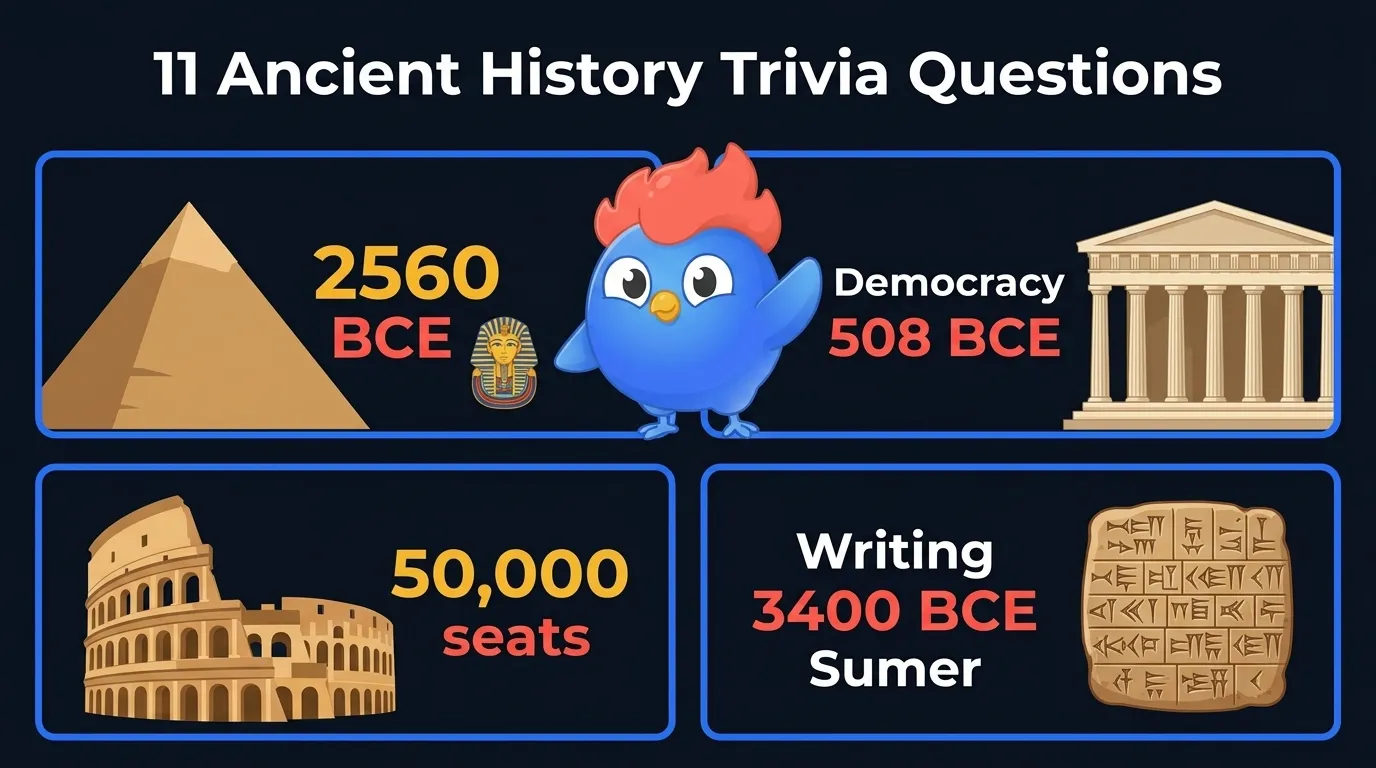
The ancient section spans roughly 3,900 years, from the first cuneiform tablets around 3400 BCE to the fall of Rome. These 11 questions open with monuments everyone knows, then push into the details that reshuffle your mental timeline of the ancient world.
1. What is the only surviving ancient wonder of the world? Easy
Answer: The Great Pyramid of Giza, built around 2560 BCE for Pharaoh Khufu. It was the tallest human-made structure on Earth for more than 3,800 years.
Where it goes wrong: Usually it doesn’t. The slip comes when players swap the Seven Wonders of the Ancient World for the New Seven Wonders voted in during 2007. The Colosseum, Taj Mahal and Machu Picchu belong to that modern list. From the original seven, only the Great Pyramid is still standing.
2. What writing system did ancient Sumerians use? Easy
Answer: Cuneiform, a system of wedge-shaped marks pressed into clay tablets. Developed around 3400 BCE in Mesopotamia, it remained in use for over 3,000 years.
The trap: the hand goes straight to hieroglyphics. Wrong region. That script was Egyptian. And cuneiform throws a second curveball, because it’s a script, not a language. Scribes used it to write Sumerian, Akkadian, Babylonian and a dozen other tongues across the ancient Near East.
3. Which ancient Greek city-state was famous for its military training? Easy
Answer: Sparta. Boys entered the agoge training program at age 7, and men remained in active military reserve until 60.
Where it goes wrong: rarely, on this phrasing. Pop culture handed everyone the answer. The harder cut asks which city-state owned the navy (Athens) or which hosted the original Olympic Games (Olympia in Elis, not Sparta and not Athens). For the full ancient-to-LA-2028 sweep, see our Summer Olympics trivia questions guide.
4. What ancient civilization built Machu Picchu? Easy
Answer: The Inca Empire, around 1450 CE. Built as a royal estate for Emperor Pachacuti at 2,430 meters elevation in the Andes of modern Peru.
The mix-up: three pre-Columbian civilizations run together in the head. The Maya sat in Central America. The Aztecs ruled in Mexico. Only the Inca built in South America. Geography settles it, but under quiz pressure the three names scramble anyway. Our production data above shows the same scramble sinking the Oxford-versus-Aztec question.
5. Who was the first Roman Emperor? Medium
Answer: Augustus (born Gaius Octavius), who took power in 27 BCE and ruled until 14 CE. The imperial system he established ran for centuries after him.
The reflex answer: Julius Caesar. But he was assassinated in 44 BCE, before the Empire formally existed. Caesar held the title “dictator perpetuo,” not emperor. Augustus, his adopted heir, built the imperial system that followed. Fame and formal title point at two different men here, and the gap between them is the whole trap.
6. How long did ancient Egyptian civilization last? Medium
Answer: Roughly 3,000 years, from unification under Menes around 3150 BCE to the Roman conquest in 30 BCE.
Why the number feels wrong: it sounds inflated. Run the comparison. The entire span from Jesus to now is about 2,000 years. Ancient Egypt outlasted that by a full millennium. The mind files “ancient Egypt” as one flat block. It wasn’t. Cleopatra lived closer in time to the smartphone than to the builders of the pyramids she’s associated with.
7. What was the largest library in the ancient world? Medium
Answer: The Library of Alexandria, founded in the 3rd century BCE under the Ptolemaic dynasty in Egypt. It aimed to collect every text in the known world.
The naming part is easy. The follow-up is the killer, and it’s about how the place was destroyed. Forget the stock image of one single catastrophic fire. That’s a myth. The library bled out over centuries through funding cuts, scattered fires, unrest and plain neglect. No single event finished it.
8. What metal ended the Bronze Age? Medium
Answer: Iron. The Iron Age began around 1200-1000 BCE, driven partly by the collapse of tin trade networks that made bronze production impossible in many regions.
Here’s the twist: bronze wasn’t swapped out for something better. A supply chain crisis in tin forced metalworkers into iron smelting. Early iron was actually worse than good bronze. Only once carbon steel arrived did iron tools beat bronze for good.
9. Who unified China for the first time? Hard
Answer: Qin Shi Huang in 221 BCE. He conquered six rival states, created the title “emperor” (huangdi), standardized weights, measures, and writing, and began construction of the Great Wall.
This one flips the usual problem. The Terracotta Army and the Great Wall are household names. The ruler behind both is not. Qin Shi Huang commissioned the army to guard his tomb, and he linked existing border walls into the first unified Great Wall system. Two famous things, one forgotten name.
10. Which civilization first used zero as a number with arithmetic rules? Hard
Answer: Ancient India. The mathematician Brahmagupta defined zero as a number with formal arithmetic operations (addition, subtraction, multiplication) in 628 CE.
Three civilizations got to zero on their own. The Babylonians used a placeholder symbol around the 3rd century BCE. The Maya built zero into their calendars by the 4th century CE. But only ancient Indian mathematicians gave zero a full mathematical identity. That version traveled through Islamic scholars to Europe. It became the number you use today.
11. What is the oldest surviving epic poem in the world? Hard
Answer: The Epic of Gilgamesh, written on clay tablets in ancient Sumer (modern Iraq). The earliest versions date to roughly 2100 BCE.
Guesses pile onto Homer’s Iliad (800 BCE) or the Bible. Both lose. Gilgamesh predates Homer by 1,300 years. It follows a king chasing immortality after his friend dies, and it carries a flood narrative that beats the biblical story of Noah by centuries. We unpack the Bible side of that overlap in our bible trivia questions collection.
Medieval & Early Modern Questions (12-22)
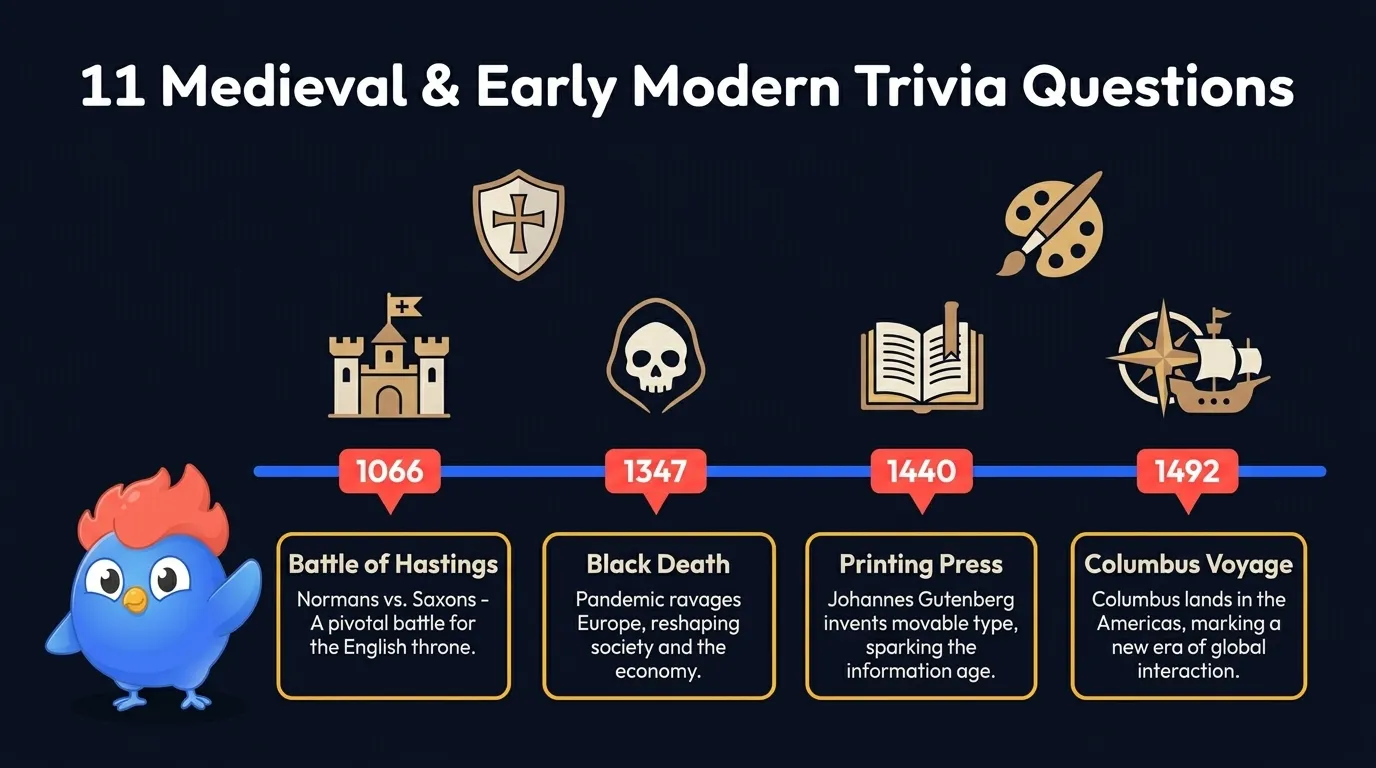
A thousand years sit in this section, and it ends on the roughest survival stat in the whole list: 18 of 270 crew members came home from the first circumnavigation of the globe. These 11 world history quiz questions cover the stretch between Rome’s fall and the Enlightenment, when plagues gutted the population and printing and navigation rewired how people learn and travel.
12. What percentage of Europe’s population died in the Black Death? Easy
Answer: Between 30% and 60%, depending on the region. The plague swept through Europe from 1347 to 1353, killing an estimated 25-50 million people.
The range looks impossibly wide. It isn’t a hedge. It’s what the record shows. Some areas lost three-quarters of their people. Others barely noticed the plague pass through. That spread is the answer, not a flaw in the question.
13. Who invented the movable-type printing press? Easy
Answer: Johannes Gutenberg, around 1440 in Mainz, Germany. His Gutenberg Bible, printed around 1455, was the first major book produced using movable type in Europe.
In Western trivia, Gutenberg is a gimme. Push harder, though. Movable type was first invented in China by Bi Sheng around 1040, nearly four centuries ahead of Mainz. What Gutenberg added was the fit to the Latin alphabet, plus a screw press and oil-based ink.
14. How long did the Hundred Years’ War actually last? Easy
Answer: 116 years, from 1337 to 1453. Fought between England and France, it was not continuous combat but a series of campaigns and truces.
The name is a round number that stuck. The usual guess is exactly 100 years, said with a knowing grin, as if that’s the “trick” answer. The real trick is that it ran 16 years longer than its name.
15. What was the largest contiguous land empire in history? Easy
Answer: The Mongol Empire, covering roughly 23 million square kilometers at its peak under Genghis Khan and his successors.
One word decides this question: “contiguous.” The British Empire held more total territory, which is why it gets blurted out so often. But contiguous means connected by land. The British Empire was scattered across oceans and continents. The Mongol Empire ran as a single unbroken mass from Korea to Hungary.
16. What year did the Byzantine Empire fall? Medium
Answer: 1453, when Constantinople fell to the Ottoman Empire under Sultan Mehmed II after a 53-day siege. It ended an unbroken Roman imperial line reaching back nearly 1,500 years to Augustus.
Two things tangle here. First, the Byzantine Empire never called itself that. It was the Eastern Roman Empire, and its citizens called themselves Romans to the end. Second, the date feels far too late. A Roman Empire of any kind surviving into the age of siege cannons breaks the gut sense that Rome belongs to the ancient world.
17. Who was the first European to reach India by sea? Medium
Answer: Vasco da Gama, who landed at Calicut (now Kozhikode) on May 20, 1498. He sailed from Portugal, around the Cape of Good Hope, across the Indian Ocean.
Wrong sailor, wrong ocean: the answer that pops out is Columbus. He was aiming for India and hit the Caribbean in 1492. Da Gama finished the actual route six years later. The two voyages smear together because both chased a sea route to the same destination.
18. What was the Magna Carta? Medium
Answer: A charter sealed by King John of England at Runnymede on June 15, 1215. It established the principle that the king was not above the law and required baronial consent for taxation.
Naming it is easy. Saying what it held is where answers go vague. The Magna Carta didn’t invent democracy or hand out personal rights in any modern sense. It was a deal struck between a struggling king and angry barons. The legacy grew far past anything in the first text.
19. Who wrote the 95 Theses? Medium
Answer: Martin Luther, a professor of theology at the University of Wittenberg, in 1517. He challenged the Catholic Church’s sale of indulgences, igniting the Protestant Reformation.
Luther is the gimme here. What he was trying to do is not. He never set out to split the Church. He wanted an academic debate. The 95 Theses were written in Latin and aimed at scholars, not the public square. The Reformation was an accident that spiraled past anyone’s control.
20. How old was Joan of Arc when she was executed? Hard
Answer: Approximately 19 years old. Born around January 1412, burned at the stake on May 30, 1431, in Rouen, France.
The honest answer is one word: nineteen.
She led armies and bent the course of a war before she could legally drink in most modern countries. The usual guesses land in the mid-twenties or even the thirties, because the sheer scale of what she pulled off warps how old she feels.
21. What palace served as home to 24 Chinese emperors? Hard
Answer: The Forbidden City in Beijing. It housed 14 Ming Dynasty and 10 Qing Dynasty emperors from its completion in 1420 until the last emperor abdicated in 1912; the deposed Puyi stayed on in the inner court until 1924.
The name itself misleads: “Forbidden City” reads like a place, not a palace. Plenty of players know the phrase and still can’t pin it to a dynasty, never mind two in a row. The compound holds 980 buildings across 72 hectares. Calling it a “city” was barely an exaggeration.
22. Whose expedition was the first to circumnavigate the globe? Hard
Answer: Ferdinand Magellan’s expedition, though Magellan himself was killed in the Philippines in 1521. Juan Sebastián Elcano completed the voyage, returning to Spain in September 1522 with just 18 of the original 270 crew members.
“Magellan circumnavigated the globe” is technically false. He died halfway through, in the Philippines. Elcano brought the survivors home. Textbooks still hand Magellan the credit, since he organized the expedition and steered most of the route. The real gut-punch is the survival rate: 18 out of 270 made it back.
Modern History Questions (23-33)
Modern history feels like home turf, which is exactly the trap. The shortest war on record was over in under 45 minutes, the Berlin Wall went up 16 years later than most people place it, and film and folklore have quietly rewritten much of the rest. These 11 questions check what survived.
23. What country suffered the most total casualties in World War II? Easy
Answer: The Soviet Union, by an enormous margin. The National WWII Museum counts roughly 24 million Soviet deaths, including 8.8 to 10.7 million military deaths; official Russian estimates run closer to 27 million.
Hollywood and the BBC frame the whole war for English speakers. So Germany and Japan get guessed, on the logic that the losers must have lost the most. They didn’t. The Soviet Union’s losses dwarfed every other nation’s, military and civilian combined. The Eastern Front was the deadliest theater of war in human history.
24. What treaty formally ended World War I? Easy
Answer: The Treaty of Versailles, signed June 28, 1919. The armistice of November 11, 1918, stopped the fighting; Versailles ended the legal state of war with Germany.
Two dates fight for the same slot in memory. The armistice (11/11/1918) is the famous one. The treaty isn’t. Even players who recall Versailles tend to misdate it, reaching for 1918 (the armistice) instead of 1919 (the treaty).
25. Who was the first person in space? Easy
Answer: Soviet cosmonaut Yuri Gagarin, who completed one orbit of Earth aboard Vostok 1 on April 12, 1961. The flight lasted 108 minutes.
In the US, the popular guess is Alan Shepard. He flew 23 days later. Gagarin is less of a name stateside because the American Cold War story fixed on the Moon landing and skipped the milestones the Soviets hit first.
26. What year did the Titanic sink? Easy
Answer: 1912. The RMS Titanic struck an iceberg on the night of April 14 and sank in the early hours of April 15, killing over 1,500 people on her maiden voyage.
Twenty lifeboats. That is the follow-up that bites, since the year itself is a warmup. The Titanic carried enough boats for roughly half the people aboard. And the “unsinkable” label was never official. It grew out of a 1911 issue of the trade journal The Shipbuilder that called the Olympic-class liners “practically unsinkable.” The legend dropped the qualifier.
27. How long did the Berlin Wall stand? Medium
Answer: 28 years, from August 13, 1961 to November 9, 1989.
The shock is the start date, not the end. The Wall went up in 1961, not at the close of WWII in 1945. Sixteen years sat between Germany’s division and the physical barrier. Anyone who remembers the fall (1989) but anchors the start to 1945 ends up guessing 40+ years of standing wall.
28. What was the shortest war in recorded history? Medium
Answer: The Anglo-Zanzibar War, lasting between 38 and 45 minutes on August 27, 1896. The British bombarded the Sultan’s palace and it was over before lunch.
“Shortest war” sounds like days. Maybe weeks.
Minutes. The whole thing fit inside a single class period.
The Sultan’s forces took roughly 500 casualties. The British lost one wounded sailor.
29. How many days did the Cuban Missile Crisis last? Medium
Answer: 13 days, from October 16 to October 28, 1962. President Kennedy was briefed on Soviet missiles in Cuba on October 16; Khrushchev agreed to remove them on October 28.
For something that nearly ended civilization, the count feels far too small. Thirteen days. The whole arc, from discovery to resolution, ran under two weeks. Robert Kennedy even titled his memoir Thirteen Days, the most famous source for the answer.
30. What year did women first vote in a national election? Medium
Answer: 1893, in New Zealand. The campaign was led by Kate Sheppard, whose petition gathered signatures from nearly a quarter of the adult European female population.
The guesses run to Scandinavia or the United States. Neither is right. New Zealand beat the US (1920), the UK (1928) and France (1944) by decades. The margin isn’t close.
31. What was the last country to legally abolish slavery? Hard
Answer: Mauritania, in 1981. Even after legal abolition, it wasn’t criminalized until 2007, and hereditary slavery persists in practice today.
The date does all the work here. 1981. Not 1865. Not the 1800s at all.
The twentieth century was nearly out. The Space Shuttle flew. Personal computers sat on desks. And slavery was still legal in one country. So nobody needs a trick clue. The year alone floors people.
32. Who was the youngest person to become US President? Hard
Answer: Theodore Roosevelt, at age 42 years and 322 days. He assumed office in September 1901 after President McKinley’s assassination.
One verb hides the whole answer: “elected” versus “became.” The reflex answer is John F. Kennedy, the youngest president ever elected (age 43). Roosevelt was younger when he served, because he inherited the office. That elected-versus-became split is the trap, and it springs hardest on the players most sure about JFK.
33. What event is commonly cited as the trigger for World War I? Hard
Answer: The assassination of Archduke Franz Ferdinand of Austria-Hungary on June 28, 1914, in Sarajevo, by Gavrilo Princip. Austria-Hungary declared war on Serbia one month later, and alliance obligations pulled in the other powers.
Knowing the event isn’t the same as knowing its job. The assassination was not the cause of WWI. It was the trigger that set off decades of stockpiled tension: alliance systems, imperial competition, militarism and nationalism. Call it “the cause” and you’ve fallen for one of the most worn-out oversimplifications in any history trivia quiz.
American History Questions (34-43)
American history closes the set: 10 US history trivia questions about the details hiding behind the dates you memorized in school. Alaska went for about 2 cents an acre, the Declaration of Independence was mostly signed a month after July 4, and the first woman ran for president 48 years before women could legally vote for her.
34. What city served as the first capital of the United States under the Constitution? Easy
Answer: New York City, from 1789 to 1790. George Washington was inaugurated at Federal Hall on Wall Street on April 30, 1789.
Philadelphia jumps out first, and you can see why. It carried the Revolution and hosted the Constitutional Convention. Philadelphia did take the capital, just later, after New York (1790-1800), before Washington, D.C. claimed it for good.
35. Which US President served more than two terms? Easy
Answer: Franklin D. Roosevelt, elected four times (1932, 1936, 1940, 1944). He served from 1933 until his death on April 12, 1945. The 22nd Amendment, ratified in 1951, capped future presidents at two terms.
It snags anyone who assumes the two-term limit was always law. It wasn’t. Washington set the custom by walking away after two terms. FDR shattered it under the twin pressures of the Depression and WWII. And Congress then made certain nobody could break it again.
36. What amendment abolished slavery in the United States? Easy
Answer: The 13th Amendment, ratified December 6, 1865.
Two documents get welded together in memory. The Emancipation Proclamation (1863) is the one that crowds in here. Lincoln’s proclamation freed slaves in Confederate states as a wartime measure. The 13th Amendment killed slavery nationwide for good, border states included, even the ones that had fought for the Union.
37. How much did the United States pay Russia for Alaska? Medium
Answer: $7.2 million in 1867, roughly 2 cents per acre. The deal was negotiated by Secretary of State William Seward.
The price sounds absurdly low. It was. Critics jeered it as “Seward’s Folly” and “Seward’s Icebox.” Alaska went on to yield billions in gold, oil and natural resources. Even adjusted for inflation, the purchase price is a rounding error next to what the state turned out to be worth.
38. Who was the first person to sign the Declaration of Independence? Medium
Answer: John Hancock, as President of the Continental Congress, on August 2, 1776. His signature was the largest and most prominent on the document.
Hancock is the layup. The date is where points die. The Declaration was adopted on July 4, 1776, but most delegates didn’t sign until August 2. The famous signing scene in the paintings smushes those two separate events into one.
39. Which US state existed as an independent republic for nearly a decade before joining the Union? Medium
Answer: Texas. The Republic of Texas existed from 1836 to 1845, with its own president, currency, and foreign embassies.
Texas isn’t even the only candidate. Vermont (independent republic 1777-1791) and Hawaii (a Kingdom, then a Republic, before annexation) both fit the question too. Texas wins the fame because it held full sovereignty for nine years, with formal recognition from France, the UK and the Netherlands.
40. What was the last state admitted to the Union? Medium
Answer: Hawaii, admitted as the 50th state on August 21, 1959. Alaska had been admitted as the 49th earlier the same year, on January 3.
Alaska and Hawaii both joined in 1959, so the order keeps getting flipped. Alaska came first, by about seven months. Other players reach for states that just feel “newer,” like Arizona (1912), mixing up statehood with how developed a place looks now.
41. Who assassinated Abraham Lincoln? Hard
Answer: John Wilkes Booth, who shot Lincoln at Ford’s Theatre on the evening of April 14, 1865. Lincoln died the following morning.
Everyone knows Booth. Almost nobody can say who Booth was. He was a well-known stage actor, not some random gunman, and he was one piece of a wider conspiracy aimed at three government officials the same night. Lincoln’s Secretary of State, William Seward, was stabbed in that coordinated attack and survived.
42. What was the Louisiana Purchase? Hard
Answer: The acquisition of approximately 828,000 square miles from Napoleonic France in 1803 for $15 million. It roughly doubled the size of the United States, stretching from the Mississippi River to the Rocky Mountains.
The scale is the trap. Say “Louisiana” and the brain pictures the single state. The actual purchase swallowed all or part of 15 current states, from Louisiana to Montana. Napoleon sold because he needed cash for European wars and had soured on a North American empire after the Haitian Revolution wrecked his Caribbean strategy.
43. Who was the first woman to run for US President? Hard
Answer: Victoria Woodhull, nominated by the Equal Rights Party in 1872. She ran against Ulysses S. Grant and Horace Greeley.
The names that surface are Hillary Clinton (2016) and Shirley Chisholm (1972). Woodhull ran a full century before Chisholm. She couldn’t even vote for herself, since women’s suffrage didn’t arrive until the 19th Amendment in 1920. And on Election Day 1872, she sat in jail on obscenity charges.
What Happens to the Ones You Miss
Running these as a quiz night is simple: one round per era, 1 point for easy, 2 for medium, 3 for hard, and the weaker teams stay in it to the last round. The more interesting question is what a wrong answer does to your memory afterward.
Blurt out “Julius Caesar” for the first Roman Emperor, get corrected to Augustus, and that correction lodges deeper than any fact you read in passing. That is not a motivational poster line. It is one of the most replicated findings in memory research:
“Tests enhance later retention more than additional study of the material, even when tests are given without feedback.” Roediger & Karpicke, Perspectives on Psychological Science (2006)
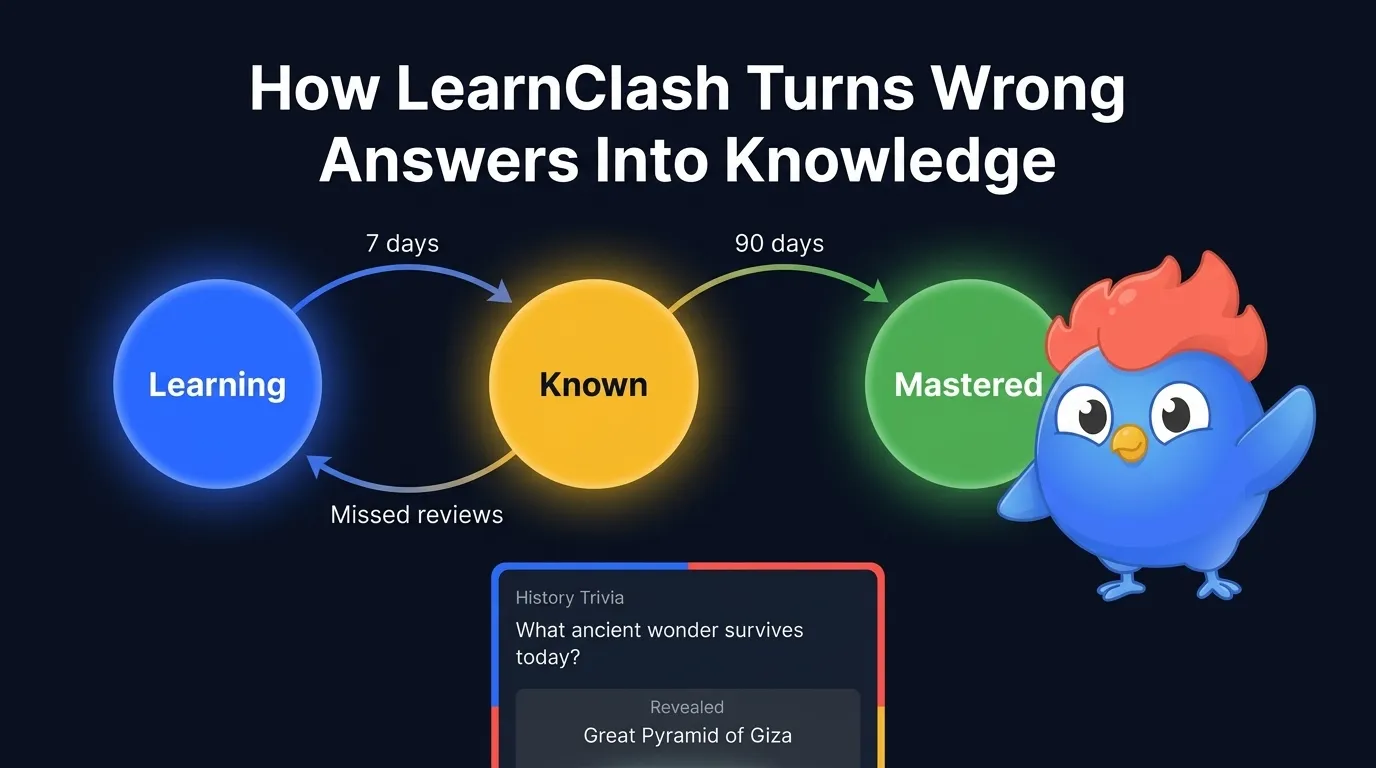
LearnClash is built around that effect, with spaced repetition doing the scheduling. Miss a history question in a duel or in practice and it drops a stage, with a fresh miss landing in the Learning stage and returning in 7 days. Answer it correctly and the next checkpoint waits 90 days out. Clear that one too and the question is Mastered: it leaves your review rotation unless you ever miss it again. Three stages, two checkpoints, no endless review grind, and the facts you already own stop taking up your practice time.
Two Questions on Borrowed Time
Forty-three questions survived this update’s fact re-check. Two of them survived on seniority alone, and honesty says I should name them.
- Number 3, the Sparta question, has stopped being a question. The movie 300 answered it for an entire generation, and our own data section explains what that does: when pop culture pre-loads the answer, accuracy soars and the trivia value evaporates. It stays because every quiz night needs a warmup the whole room can score on.
- Number 41 is the opposite problem. It wears a Hard label, but “Who assassinated Abraham Lincoln?” has one of the most famous answers in American history. The genuinely hard material sits in the follow-ups, the three-target conspiracy and the stabbing of Seward, not in the name Booth.
What would replace them? The data already wrote the shortlist: the samurai bow and the Santayana quote, two questions where the wrong answer is more famous than the right one. That is the shape of a great history question, and no date on the timeline beats it.
For more in other categories, try our 43 general knowledge questions, science trivia, or art trivia questions. To see how LearnClash stacks up against other quiz apps, check our best trivia apps ranking.
Frequently asked questions
What are the hardest history trivia questions?
In LearnClash production data, the hardest history questions are look-alike answers, not date questions. The worst performer asks who said those who forget the past are condemned to repeat it: 17 of 35 first attempts credited Winston Churchill, and only one picked George Santayana, whose 1905 line (those who cannot remember the past are condemned to repeat it) the question paraphrases. In the September 2026 export, the 19 questions that name a year, a century or a dating term scored about 72 percent right, against about 67 percent for the other 109 questions; the questions where a famous name or image sits next to the right answer score lowest.
How many history questions do I need for a trivia night?
A solid trivia night needs 30 to 50 questions split across 4 to 6 rounds. Mix easy ancient history with hard modern history to keep every team engaged. The 43 questions on this page divide cleanly into four era rounds, and LearnClash can generate fresh history trivia at every difficulty if you need more.
Is there a history trivia app with ranked matchmaking?
LearnClash shows an ELO rating across 8 leagues from Iron to Phoenix. You get matched against players near your skill level on any topic, including world history and American history, and spaced repetition brings back the dates, events, and figures you miss until they stick.
What history categories work best for pub quiz rounds?
Ancient civilizations, medieval empires, World Wars, and American history make the strongest pub quiz rounds because each era has its own surprise factor. LearnClash covers all of these and lets you create custom history topics on anything from Roman emperors to Cold War espionage.
Can I use these history questions for a classroom quiz?
Yes. Split the 43 questions into 4 rounds by era. Award 1 point for easy, 2 for medium, 3 for hard. This scoring keeps weaker students competitive while rewarding deep knowledge, and the short explanation under each answer doubles as a debrief after each round.