
31 Car Trivia Questions [With Answers]
31 car trivia questions spanning brand secrets, F1 records, strange laws, and automotive firsts. Answers and explanations included.
How many do you know?
Think of your answer, then reveal it.
Did you know it before revealing the answer?
Read this answer in the articleRound complete
Turn what you know into a quiz duel.
Start a new duel in LearnClash and learn from every answer.
Get LearnClashFree to play on iPhone and Android. No ads.
Try the questions you missed once more.

Here are 31 car trivia questions with answers, split into six categories: brand origins, history and firsts, driving inventions, records, racing, and the strange corners of driving law. Every question carries a difficulty rating, and every answer ends with the reason people miss it, because with cars the popular version of a story is usually the wrong one.
Volkswagen sells more sausages than cars. A blind engineer invented cruise control. The best-selling car of all time is not the Beetle, and it is not close.
This August’s fact-check pass caught two numbers the earlier version got wrong: the Corolla per-day arithmetic and the position Jack Brabham actually finished in after pushing his car over the line in 1959. Cars are one of the categories in our full trivia question collection, and this set leans hardest on the gap between confidence and accuracy.
Challenge a friend to car trivia on LearnClash
| Category | Questions | Easy | Medium | Hard |
|---|---|---|---|---|
| Brand Origins & Company Secrets | 1-5 | 1 | 2 | 2 |
| History & Firsts | 6-11 | 2 | 2 | 2 |
| Inventions That Changed Driving | 12-16 | 1 | 2 | 2 |
| Records & Mind-Boggling Numbers | 17-21 | 1 | 2 | 2 |
| Racing & Motorsport | 22-26 | 1 | 2 | 2 |
| Safety, Laws & Weird Facts | 27-31 | 1 | 2 | 2 |
Brand Origins & Company Secrets [1-5]
Every car logo carries two histories: the official one and the real one. Marketing departments have had a century to bury the second under the first, which is why this category opens the set. Nobody doubts their answer here, and that is exactly the problem.
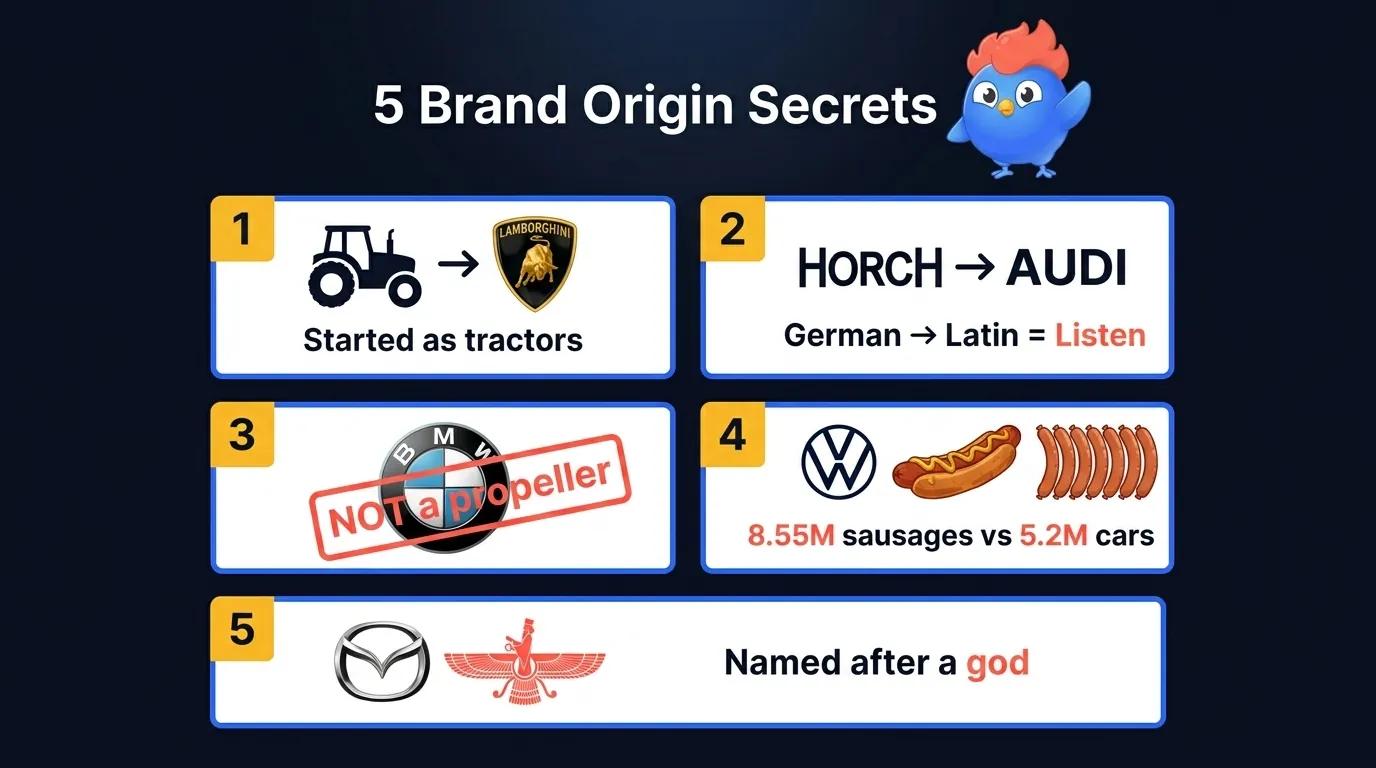 Five brand origin stories the ads leave out.
1. What did Lamborghini make before sports cars? Easy
Answer: Tractors. Ferruccio Lamborghini was a wealthy tractor manufacturer who owned two Ferraris. When he complained about a clutch problem, he discovered his Ferrari used the same cheap part as his tractors, and Enzo Ferrari reportedly told him to stick to farm equipment. Lamborghini hired away Ferrari’s own engineers and founded a rival company in 1963.
Why it stumps people: Lamborghini’s branding is so aggressive, so saturated with supercar imagery, that nobody pictures a field tractor behind it. Yet Lamborghini Trattori exists to this day and still builds them.
2. What does “Audi” mean? Medium
Answer: “Listen” in Latin. Founder August Horch was forced out of the company bearing his own name and lost the legal fight to keep using it. His surname is an old German imperative for “listen,” so he translated it into Latin and got Audi.
The trap: nearly everyone assumes Audi is a German word or an acronym. It is neither. It is one man’s surname taking a detour through Latin because a court took the German original away from him.
3. What do the BMW logo colors actually represent? Medium
Answer: The Bavarian state flag (blue and white quadrants). The “spinning propeller” story is a myth BMW itself accidentally created: a 1929 ad superimposed the logo over airplane propellers, and the company let the story run for decades.
Where it goes wrong: ask ten people and nine will say propeller. BMW eventually called that version a “self-propagating urban myth.” The company really did build aircraft engines during WWI, which is what keeps the myth feeling true. But the logo came first, and it is just the flag of Bavaria.
4. What product does Volkswagen produce more of than cars? Hard
Answer: Currywurst sausages. VW’s Wolfsburg plant has made its own currywurst since 1973, and in recent years the annual sausage count has topped eight million, more than the VW brand sells cars. The sausage even carries an official VW part number: 199 398 500 A.
Why it stumps people: it sounds like a joke, and it is not one. VW staff canteens across Germany serve the currywurst, and outside customers can order it through dealerships by part number, like a wing mirror.
5. Which automaker is named after a Zoroastrian god? Hard
Answer: Mazda, after Ahura Mazda, the Zoroastrian god of wisdom and harmony. The founders chose the name to signal a connection between Eastern and Western cultures.
The layered part: your gut says the name must be Japanese, and it half is. Founder Jujiro Matsuda’s surname became “Mazda” partly as a phonetic Westernization, partly as a deliberate nod to an ancient Persian deity.
Brand myths survive because they beat the truth on entertainment value, which is the same engine running under our history trivia questions.
Test your car brand knowledge →
History & Firsts [6-11]
The automobile is barely 140 years old. In that time it went from terrifying oddity to the most common machine on Earth, and the road there was stranger and more accidental than the textbook version lets on. These six questions are the detours.
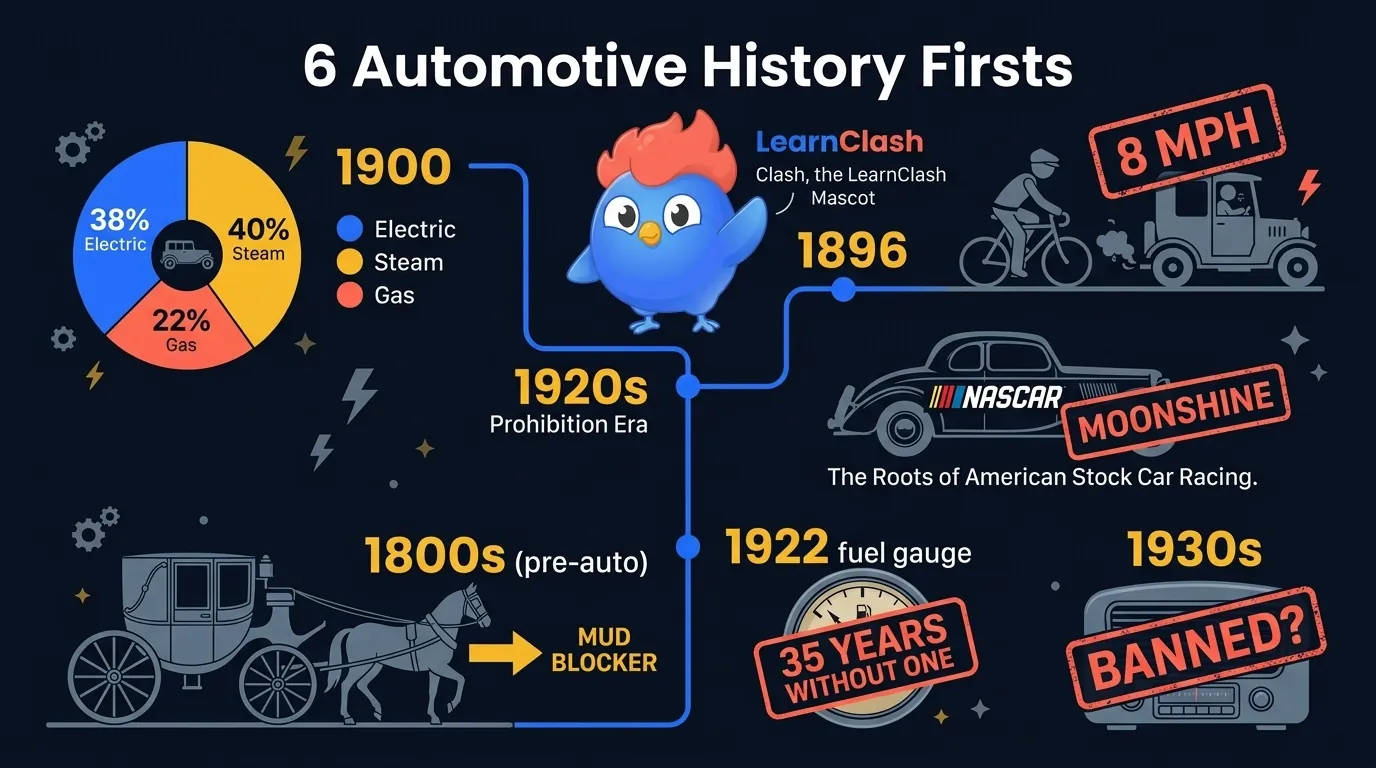 History & Firsts: 6 questions on the accidents and oddities behind automotive history.
6. What type of car dominated American roads in 1900? Easy
Answer: Electric. By 1900, 38% of US automobiles were electric, 40% ran on steam, and only 22% burned gasoline. At the first major American car show that year, a third of the vehicles on display were battery-powered. The U.S. Department of Energy documents this era in detail.
Why it stumps people: file the EV under 21st-century invention and you are a century off. Cheap oil and the electric starter motor, which killed off the dangerous hand crank, buried battery cars by 1920. The industry needed a hundred years to circle back.
7. What speed earned the world’s first speeding ticket? Easy
Answer: 8 mph. In 1896, Walter Arnold was caught doing 8 mph in a 2 mph zone in Kent, England. A police officer chased him for five miles on a bicycle. Arnold was also fined for not having a man walk ahead of the vehicle carrying a red flag.
Where it goes wrong: guesses land around 30 or 40 mph, which feels right for a speeding story and is nowhere close. The offense happened at walking pace, with a Victorian constable pedaling grimly behind.
8. What illegal activity led to the founding of NASCAR? Medium
Answer: Moonshine bootlegging. During Prohibition, runners modified their cars to outrun federal agents on mountain back roads. When the law changed, the drivers kept the cars and started racing each other on weekends. Hall of Famer Junior Johnson served prison time for moonshine running before his championship career.
Why it stumps people: NASCAR reads as mainstream American entertainment, and it is. Its roots are felonies, souped-up Fords full of illegal whiskey, and Appalachian dirt roads. The origin story the sport spent decades downplaying turned out to be its best material.
9. When did fuel gauges become standard in cars? Medium
Answer: 1922. For more than 35 years after the automobile was invented, drivers had no dashboard indicator for fuel. You estimated your range, or you physically measured the tank with a dipstick.
The trap: the fuel gauge feels like day-one equipment, so guesses land in the 1880s or 1890s. Drivers in 1910 ran out of gas constantly, with no warning it was coming.
10. What was the “dashboard” originally designed to block? Hard
Answer: Mud from horses’ hooves. On horse-drawn carriages, the dashboard was a literal board at the front that stopped muck being “dashed up” onto the driver. The name migrated to cars after the function had already vanished.
Where it goes wrong: everyone uses the word daily and nobody parses it. A panel full of instruments named after blocking flying mud is an etymological fossil hiding in plain sight.
11. Why were car radios almost banned in the 1930s? Hard
Answer: They were considered a dangerous distraction. Multiple US states proposed bans, and a 1934 poll found 56% of Americans agreed that car radios were unsafe.
Why it stumps people: the smartphone-distraction debate is a rerun. The same argument, the same polls, and the same proposed legislation played out 90 years ago over the radio, and drivers won that round.
Inventions That Changed Driving [12-16]
The inventions that made driving survivable rarely get any glory, and their inventors get even less. Dig into automotive engineering and a pattern surfaces fast: the breakthroughs came from people nobody would have picked for the job.
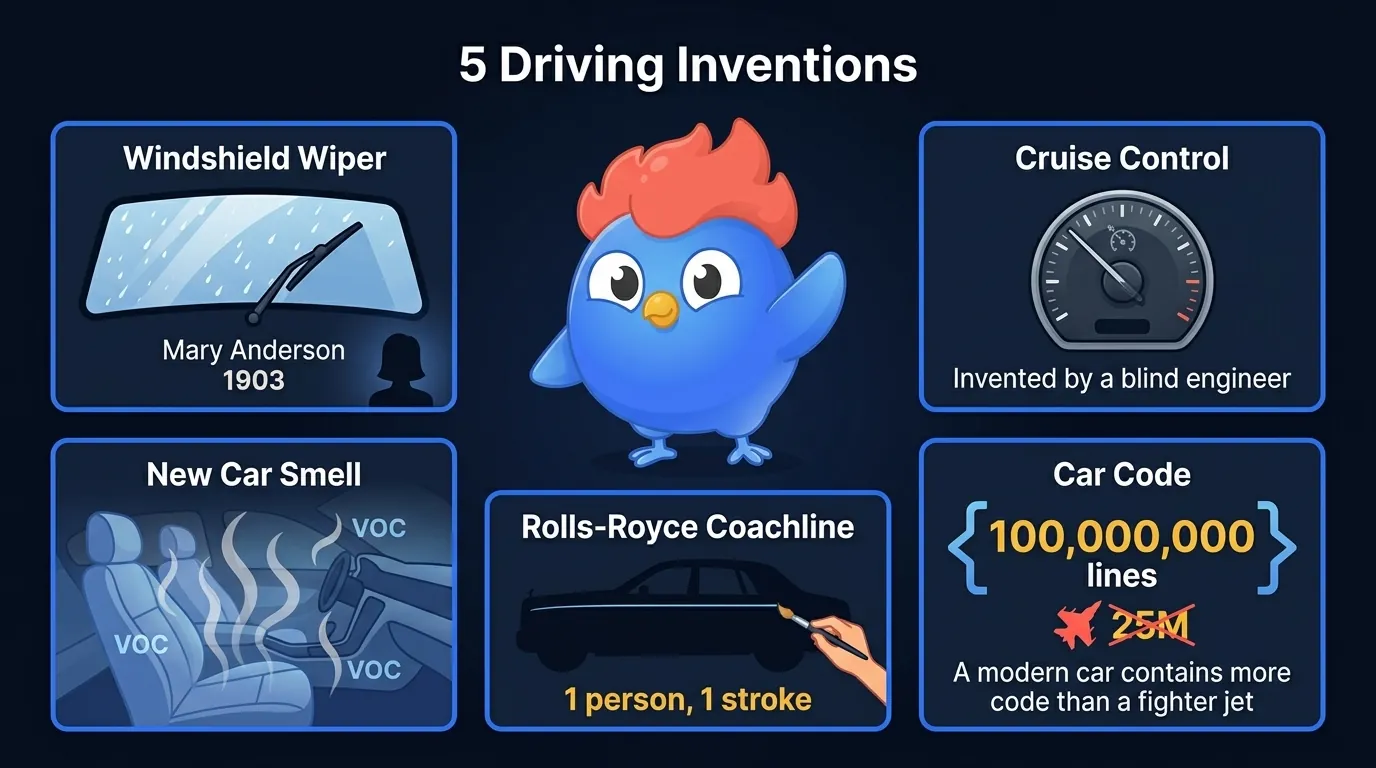 Inventions: 5 questions on the people and ideas that changed driving forever.
12. Who invented the windshield wiper? Easy
Answer: Mary Anderson, a woman from Alabama, in 1903. Watching New York City streetcar drivers climb out to wipe their windshields by hand in the rain, she designed and patented the first manual wiper. Florence Lawrence later devised an early turn signal, and Dorothy Levitt proposed what became the rearview mirror.
Why it stumps people: even car historians whiff on this one. Three of the most basic safety features in every car on Earth trace back to women, in an era when women were often barred from driving at all.
13. Who invented cruise control? Medium
Answer: Ralph Teetor, an engineer who had been blind since age five. Riding with his patent attorney, who sped up and slowed down with every turn in the conversation, Teetor decided the problem needed solving. He patented his “Speedostat” device in the 1940s, and by the end of the 1950s it was on production cars, including Cadillacs.
The part that lands: the invention barely raises an eyebrow, but the inventor does. A man who could never drive solved a problem about how speed feels, working entirely from the sensations of the passenger seat.
14. What actually causes “new car smell”? Medium
Answer: Volatile organic compounds (VOCs), more than 50 of them, off-gassing from the plastics, adhesives, sealants, and fabrics inside a new vehicle. About 80% dissipate within the first three months.
Why it stumps people: the guesses run to leather and fresh materials. The real answer is industrial chemistry: the smell people pay to bottle as air freshener is a cocktail of synthetic compounds evaporating, and much less romantic than the marketing suggests.
15. How many lines of software code does a modern car have? Hard
Answer: Over 100 million, roughly four times more than a fighter jet’s estimated 25 million lines. A current car is a computer that happens to have wheels.
Where it goes wrong: the mental image of a car as a purely mechanical object is years out of date, and any mechanic will confirm the job now leans on software diagnostics as much as wrenches. That code runs engine timing, lane keeping, and the climate you set once and forgot about.
16. Who paints the pinstripe on every Rolls-Royce? Hard
Answer: One person. Mark Court has been the only person at Rolls-Royce authorized to paint the coachline since 2003. He works with squirrel-hair brushes, drawing each line from headlight to taillight in a single continuous stroke; a slip means redoing the exterior. If a customer changes their mind after delivery, Rolls-Royce flies Court out to them.
Why it stumps people: everyone knows Rolls-Royce is handcrafted. That “handcrafted” means literally one human being with a brush, in an era when robots paint entire car bodies in seconds, is the part nobody expects.
Records & Mind-Boggling Numbers [17-21]
Guesses in this category anchor on what feels proportionate, and the real figures are off by multiples. If a number below reads like a typo, it survived this update’s fact check anyway.
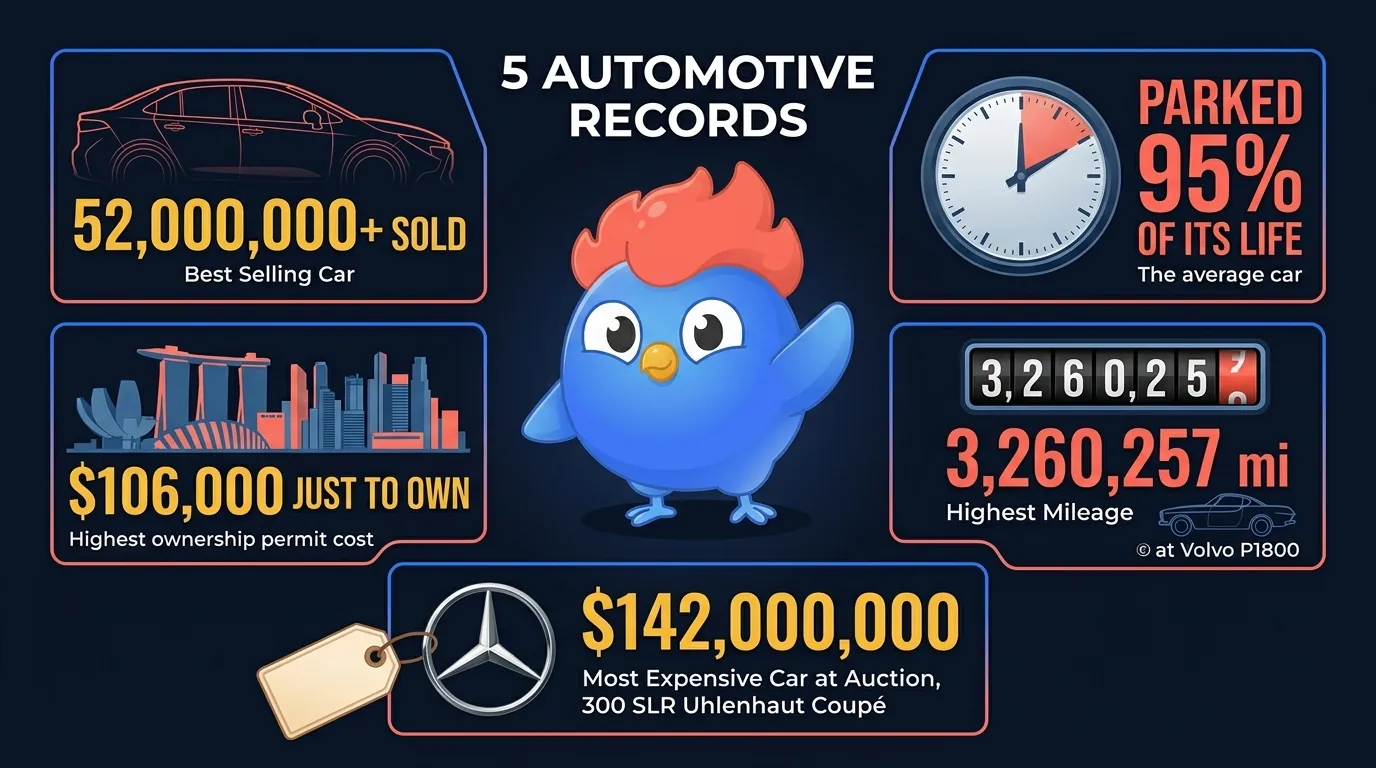 Records: 5 questions where the real numbers sound fake.
17. What is the best-selling car nameplate of all time? Easy
Answer: Toyota Corolla, with over 52 million units sold since 1966 across more than 150 countries. That averages out to roughly 2,400 Corollas a day, every day, for six decades. (The daily figure here used to read 3,180; the arithmetic fell apart on re-checking.)
Why it stumps people: everyone reaches for the Volkswagen Beetle or the Ford F-150. The Beetle sold about 21.5 million in total, and the F-150 moves around 800,000 a year. The Corolla passed the Beetle back in 1997 and never gave the lead up.
18. What percentage of its life is the average car parked? Medium
Answer: 95%. US Department of Energy household-travel data puts average driving time at about an hour a day. The rest of the time, the car sits.
The trap: the number feels too high until you run it. One hour out of 24 is about 4% of the day, so a $35,000 purchase does nothing 95% of the time. That math is the foundation of every car-sharing pitch deck.
19. How much does a license just to own a car cost in Singapore? Medium
Answer: Over $106,000. Before you buy the vehicle itself, you must win a Certificate of Entitlement (COE) at auction. A Toyota Camry that costs $28,855 in the US comes to around $183,000 all-in.
Why it stumps people: the permission slip costs more than most cars do. Singapore, a city-state with some of the best public transit on Earth, runs the COE auction precisely to keep its limited roads moving, and the price is the mechanism working as designed.
20. How far has the highest-mileage car ever been driven? Hard
Answer: 3.26 million miles. Irv Gordon, a retired teacher from Long Island, drove his 1966 Volvo P1800S over 3,260,257 miles before his death in 2018. The original clutch lasted 450,000 miles, and the engine was rebuilt only twice.
Where it goes wrong: most people retire a car at 150,000 miles and feel proud of it. Gordon covered the equivalent of 131 laps of the Earth, and not gently: daily commutes and cross-country road trips, not museum storage.
21. What is the most expensive car ever sold at auction? Hard
Answer: $142 million, paid in 2022 for a 1955 Mercedes-Benz 300 SLR “Uhlenhaut Coupe,” one of only two ever built. It beat the previous record by $93 million, and the full proceeds went into a Mercedes-Benz scholarship fund.
Why it stumps people: the brand throws people more than the price. Everyone guesses Ferrari, and the most expensive Ferrari ever auctioned, a 1962 250 GTO, brought $48.4 million. The margin by which the Mercedes broke the record is itself larger than any Ferrari sale in history.
Racing & Motorsport [22-26]
Television flattens motorsport into something smooth and corporate. These five questions cover what the broadcast smooths over: the physics, the heat, and one act of championship-deciding stubbornness.
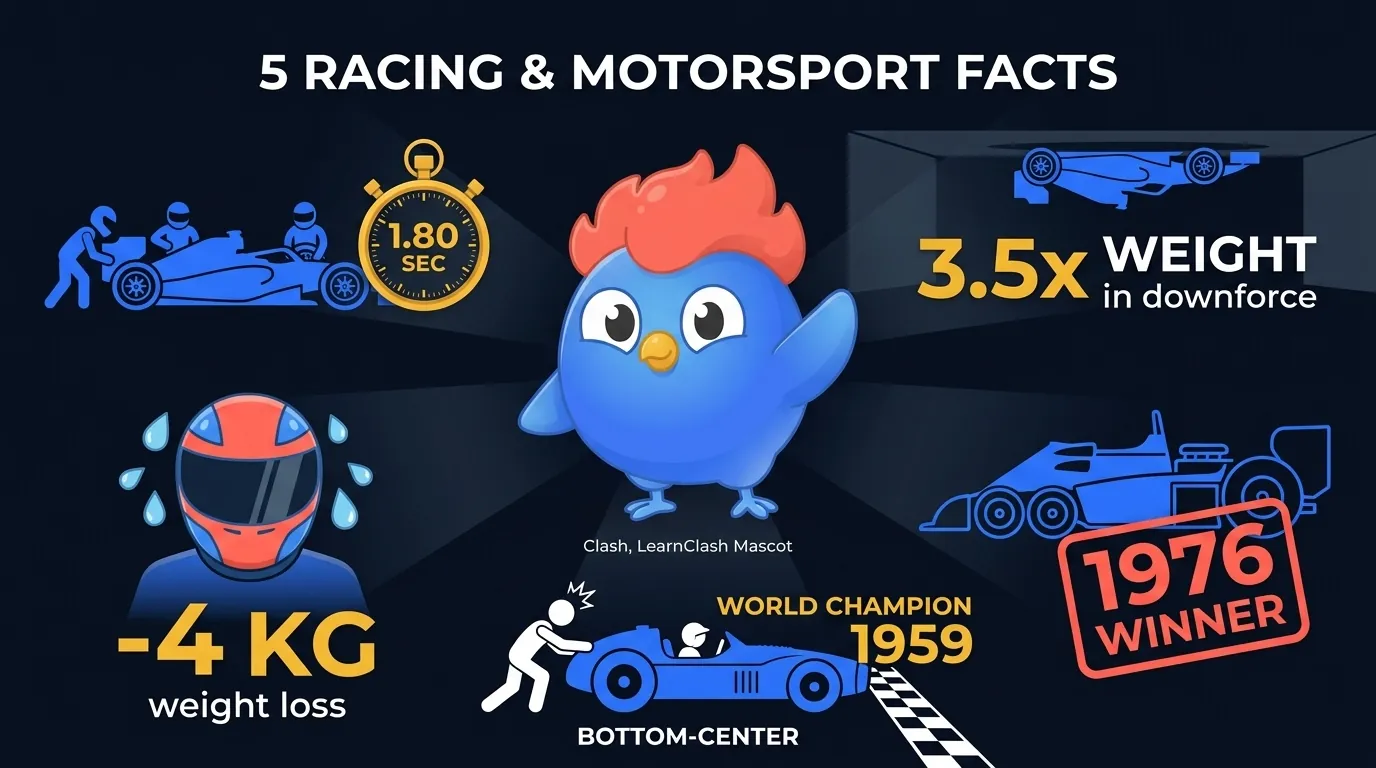 Racing: 5 questions that prove motorsport is wilder than fiction.
22. How fast can F1 pit crews change all four tires? Easy
Answer: 1.80 seconds, a record McLaren set for Lando Norris at the 2023 Qatar Grand Prix. All four tires off, four new ones on, car dropped, gone.
Why it stumps people: fast is expected; the scale of fast is not. Changing one tire in your driveway eats a quarter of an hour with a jack and a wrench. An F1 crew swaps all four in less time than it takes to read this sentence out loud.
23. Can an F1 car generate enough downforce to drive upside down on a ceiling? Medium
Answer: Yes, in theory. At racing speeds an F1 car produces about 3.5 times its own weight in downforce, more than enough to hold it against an inverted surface. Nobody has tried, because the engine’s oil and fuel systems rely on gravity and would starve upside down.
The trap: this gets filed as urban legend, but the physics holds. From around 93 mph the car generates downforce equal to its own weight, and it only climbs from there. The car presses itself into whatever surface it is on; a tunnel ceiling would qualify.
24. How much weight can an F1 driver lose during a single race? Medium
Answer: Up to 4 kg (8.8 lbs). Cockpit temperatures can reach 50°C (122°F), and the heat, G-forces, and physical exertion drain fluids over roughly 90 minutes with no break. There are no bathroom stops either, and some drivers handle that exactly how you think.
Why it stumps people: non-fans read F1 as sitting and steering. The reality is sustained G-loading that would gray out most people, threaded at over 200 mph, while sweating off nearly nine pounds. It sits closer to endurance sport than to driving.
25. What F1 car had six wheels and actually won a Grand Prix? Hard
Answer: The Tyrrell P34, which ran four small front wheels and two standard rears in 1976 and 1977. It won the 1976 Swedish Grand Prix and took 14 podium finishes across its two seasons.
Where it goes wrong: six wheels on a race car sounds like a sketch that never left the drawing board. The P34 raced two full seasons and won, and the FIA later banned cars with more than four wheels, which says something about how seriously the idea was taken.
26. How did Jack Brabham clinch the 1959 F1 World Championship? Hard
Answer: He pushed his car over the finish line. Brabham ran out of fuel on the final lap of the season’s last race, climbed out, and pushed the car to the line to finish fourth. The points were enough for the title.
Why it stumps people: a world championship decided by a man shoving his car by hand sounds like club racing, not the pinnacle of the sport. Brabham’s fuel gamble left him dry within sight of the line, and he settled the title with leg strength.
Challenge a friend to F1 trivia →
Safety, Laws & Weird Facts [27-31]
Rules written around a machine this dangerous swing between genius and absurdity, sometimes inside a single statute. The last five questions ask you to tell the real laws from the ones that sound completely invented.
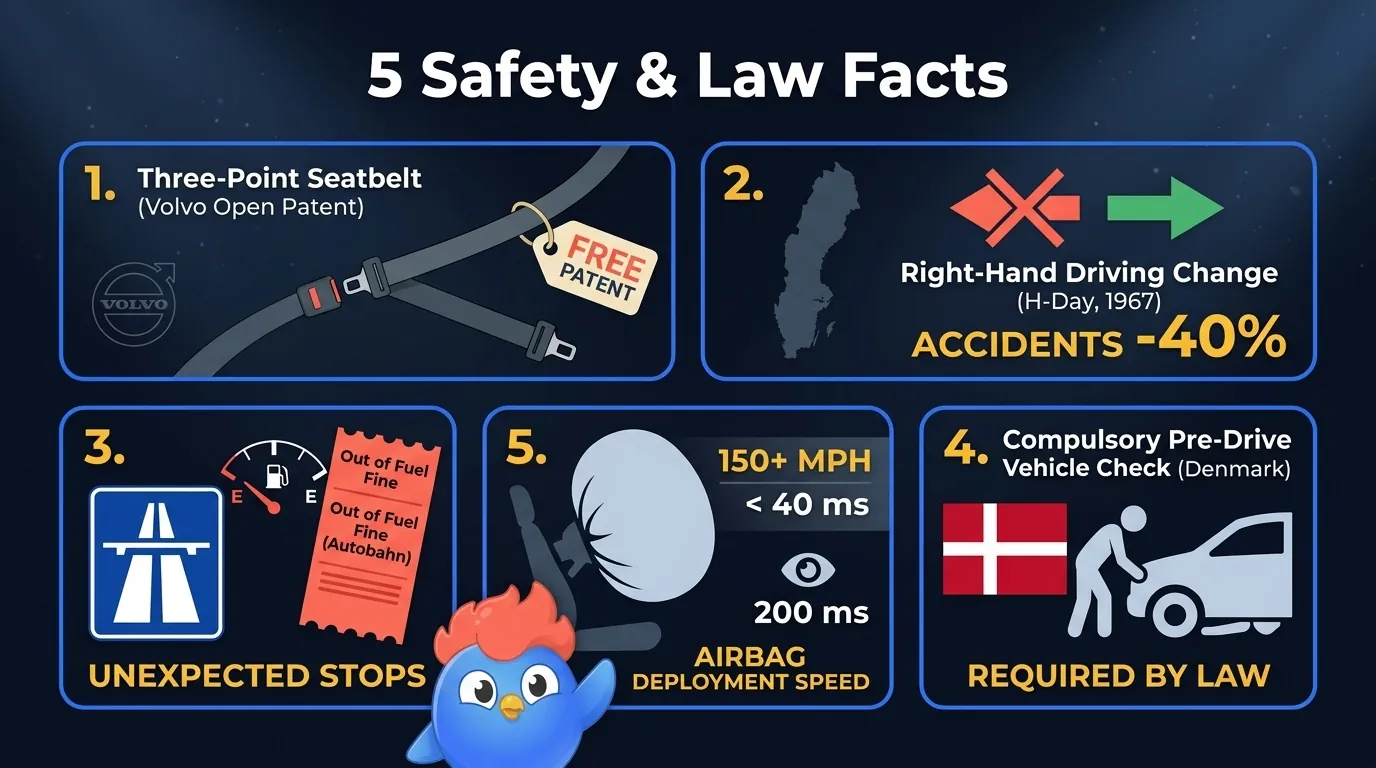 Safety & Laws: 5 questions where the true answers sound made up.
27. Which automaker invented the three-point seatbelt and then gave the patent away for free? Easy
Answer: Volvo. Engineer Nils Bohlin invented the modern three-point seatbelt in 1959, and Volvo made the patent freely available to every automaker, on the argument that the invention was worth more as a lifesaver than as revenue. It is credited with saving over a million lives.
Why it stumps people: the seatbelt part is common knowledge. The part almost nobody catches is that one company voluntarily walked away from billions in licensing fees, in an industry organized entirely around competitive advantage.
28. What happened when Sweden switched from left-side to right-side driving overnight? Medium
Answer: Accidents decreased. On September 3, 1967, known as Dagen H, all Swedish traffic stopped at 4:50 AM, switched sides, and resumed at 5:00 AM. Insurance claims fell about 40% in the months that followed.
The trap: every instinct says chaos. Instead, drivers were so afraid of making a mistake that Swedish roads temporarily became among the safest in Europe. The effect faded as confidence returned, which tells you the caution did the work, not the switch.
29. Is running out of fuel on the German Autobahn illegal? Medium
Answer: Yes. German law treats an empty tank as a preventable breakdown and therefore the driver’s fault. You can be fined for stopping on the Autobahn for any reason within your control, an empty tank included.
Why it stumps people: it sounds invented and is instead rigorously logical. You have a fuel gauge, you know your range, you passed gas stations, so running dry counts as negligence rather than bad luck. On a road with stretches of no speed limit, a stationary car is a serious hazard.
30. What must Danish drivers legally check before starting their car? Hard
Answer: Under the car, for children. Danish driving rules require inspecting beneath the vehicle before setting off, to make sure no one is hiding underneath.
Where it goes wrong: half of every quiz room calls this a parody. The reasoning is sober: children playing hide-and-seek near parked cars are a genuine risk, and a five-second glance underneath rules it out.
31. How fast does an airbag deploy? Hard
Answer: At over 150 mph, fully inflated in under 40 milliseconds, roughly four times faster than a human blink. The concept was patented in 1951, but the technology to trigger it reliably did not exist until the late 1960s, and the original patent expired before a single production car carried an airbag.
Why it stumps people: the speed is staggering, but the timeline is the real story. An inventor patented a lifesaving device, then watched for nearly two decades as the technology to build it crawled toward existence, arriving only after his claim had lapsed.
Three Ways to Run These Car Trivia Questions
Quiz night. Pick 10 to 15 questions across three categories and score by difficulty: 1 point for easy, 2 for medium, 3 for hard. Brand origins and weird laws reliably produce the loudest arguments. For a decade-themed round to follow, the 59 80s trivia questions run the same answers-plus-explanations format.
Road trip game. Read the questions aloud and make passengers commit to answers before anyone sees the reveal; the explanation under each answer doubles as a debate settler. For a version built around highway signs, roadside attractions, and driver-safe rules, use the road trip trivia questions guide.
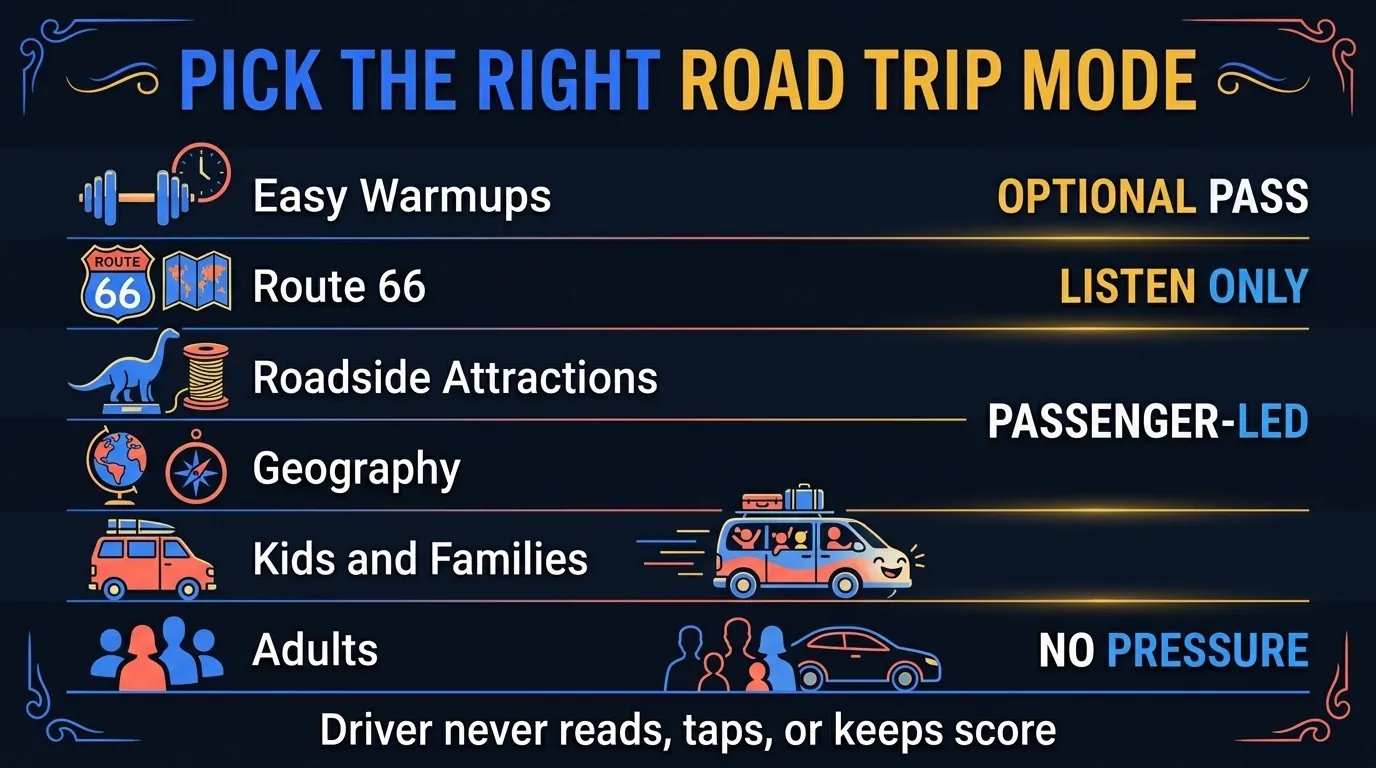 In the car, trivia works better when a passenger hosts and the driver can pass.
Ranked duel. Cars are a duel topic on LearnClash, and I built the app around what happens after a wrong answer. Miss the Corolla question in a duel and it comes back at you 7 days later; clear it there and it returns once more at a 90-day checkpoint before counting as Mastered. The ladder shows an ELO-style rating across 8 leagues from Iron to Phoenix, with Glicko-2 doing the math underneath.
Getting an answer wrong in front of friends and arguing about it does more for your memory than rereading a list ever will, which is why every answer above explains the miss instead of just naming the winner.
- Challenge a friend to car trivia on LearnClash →
- More categories in this format: science, sports, history, and the full trivia question collection.
Frequently Asked Questions
What are the hardest car trivia questions?
Brand origin questions stump the most people. 'What product does Volkswagen make more of than cars?' (currywurst sausages) and 'What do the BMW logo colors mean?' (Bavarian flag, not a propeller) catch even car enthusiasts. Every question on this page carries an easy, medium, or hard rating so you can balance a round.
What is the best-selling car of all time?
The Toyota Corolla is the best-selling car nameplate in history with over 52 million units sold since 1966. That averages out to roughly 2,400 Corollas per day across six decades. Most people guess the Volkswagen Beetle or Ford F-150.
Can I use these car trivia questions for pub quiz night?
Yes. Each question has a difficulty rating (easy, medium, hard). Use 10 to 15 questions across 3 categories. Award 1 point for easy, 2 for medium, 3 for hard to keep every team competitive. The brand origins and weird laws categories produce the best group debates.
Is there a car trivia app with ranked competition?
Yes. LearnClash ranks players on an ELO-style ladder, with Glicko-2 as the actual engine, through 8 leagues from Iron to Phoenix. Pick an automotive topic, challenge a friend to a quiz duel, and spaced repetition brings back what you miss: a missed question returns after 7 days, then at a 90-day checkpoint, until it counts as Mastered.