
73 Road Trip Trivia Questions [For Long Drives]
73 road trip trivia questions for long drives, families, and adults. Driver-safe setup, answers, Route 66 facts, and car-game tips.
How many do you know?
Think of your answer, then reveal it.
Did you know it before revealing the answer?
Read this answer in the articleRound complete
Challenge friends on this topic.
Start a new duel in LearnClash and learn from every answer.
Get LearnClashFree to play on iPhone and Android. No ads.
Try the questions you missed once more.

Long drives expose bad trivia fast. A question that needs a phone or a two-minute argument kills the car. The driver tunes out, the kids go quiet, and the game dies somewhere around exit 14.
These road trip trivia questions and answers are built for the car. Short answers. Passenger-hosted rules. Family-safe rounds, adult rounds, and real roadside facts you can verify out the window. I filtered the set in April 2026 against one rule: every prompt has to be safe to read aloud, answerable in 45 seconds, and good enough to replay later as an 18-question duel.
Pick a section, hand the phone to a passenger, and duel me on road trip facts -> when you want the rematch.
Quick Setup: Pick the Right Road Trip Trivia Mode
The format should change as the drive does. Run quick warmups for the first 30 minutes, route facts once everyone settles in, and family questions right before the screens come out. One rule stays constant for every round: the driver can ignore it. Passengers pick the mode off the table below.
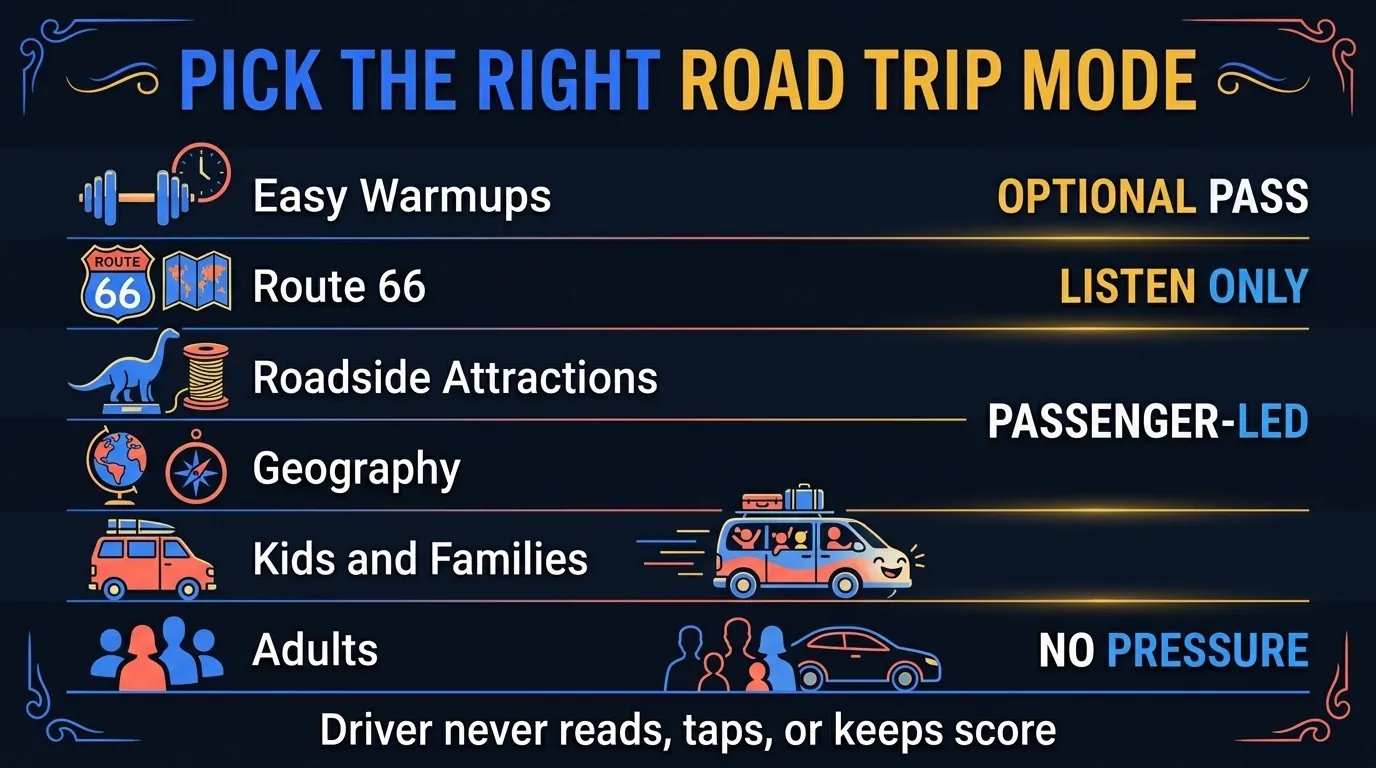 Whatever mode the car picks, the driver never needs to read, tap, or keep score.
| Mode | Best moment | Driver role | Questions |
|---|---|---|---|
| Easy warmups | First 30 minutes | Optional pass | 12 |
| US highways and Route 66 | Open-road stretches | Listen only | 13 |
| Roadside attractions | Weird signs and detours | Optional guess | 12 |
| Travel and geography | Map-check moments | Passenger-led | 12 |
| Kids and families | Before boredom hits | No pressure | 12 |
| Adults | Long-haul hours | Pass anytime | 12 |
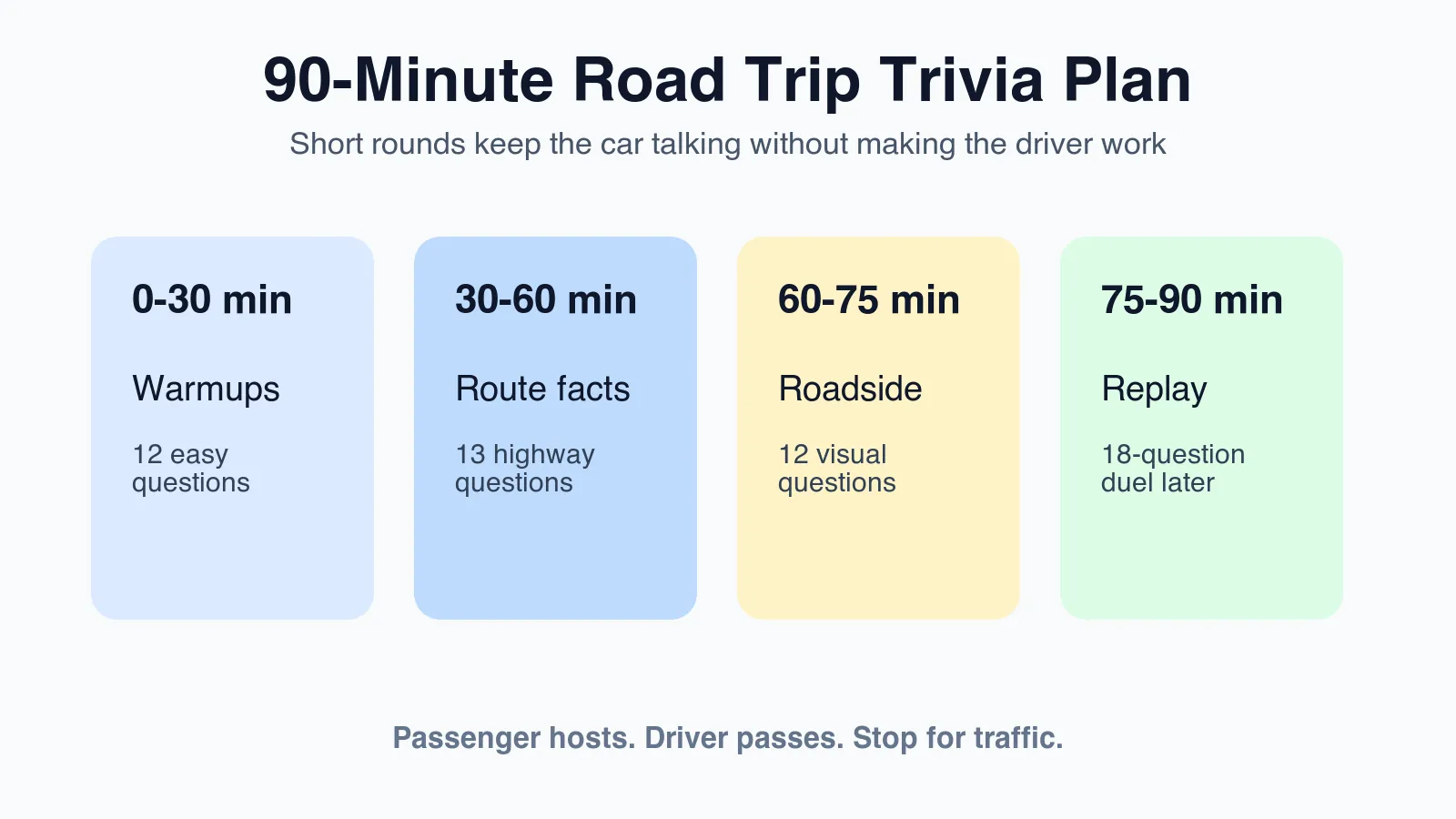
Use one section per hour. Do not read all 73 at once unless the car is crossing Kansas and everyone has accepted their fate. For broader road trip games, pair one trivia section with a this-or-that or would-you-rather warmup. If you want open-ended road trip questions, save those for rest stops or hotel check-in.
If your passengers want a faster A/B format, the this or that questions guide works as a warmup. If they want silly hypotheticals, use the would you rather questions set.
How to Run Road Trip Trivia Without Distracting the Driver
Trivia questions while driving stay driver-safe when they are passenger-hosted, slow enough to ignore, and never tied to a screen. The driver stays optional in every round. Distracted driving covers anything that pulls attention off the road, so the host reads, scores, and navigates while the driver keeps both hands on the wheel.
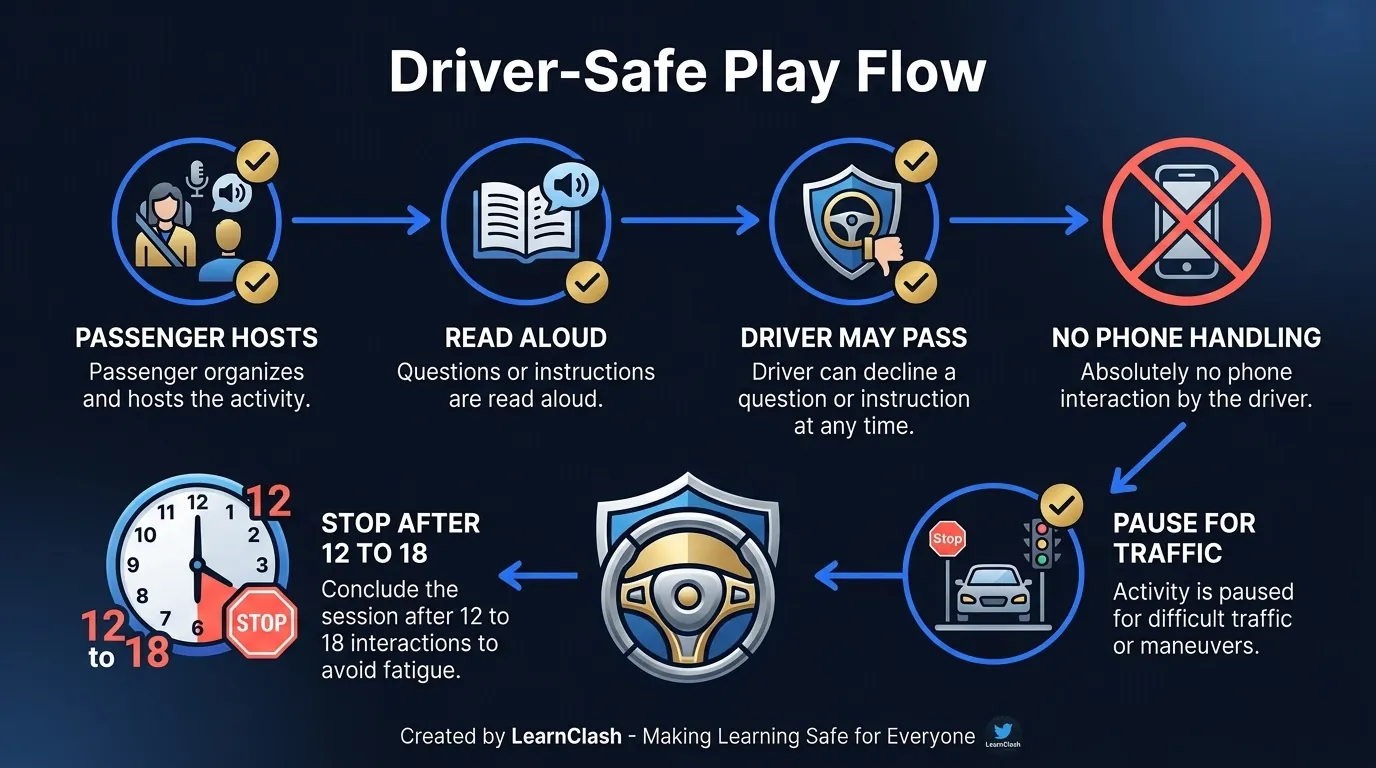 Passengers host, drivers pass, phones stay away from the wheel.
Use these house rules:
- Pick one passenger as the host.
- Keep the driver’s phone out of the driver’s hands.
- Let the driver pass any question without losing points.
- Pause the game for traffic, weather, parking, navigation, or fatigue.
- Avoid picture rounds, fast buzzers, and “look that up” questions.
- Stop after 12 to 18 questions if the car gets restless.
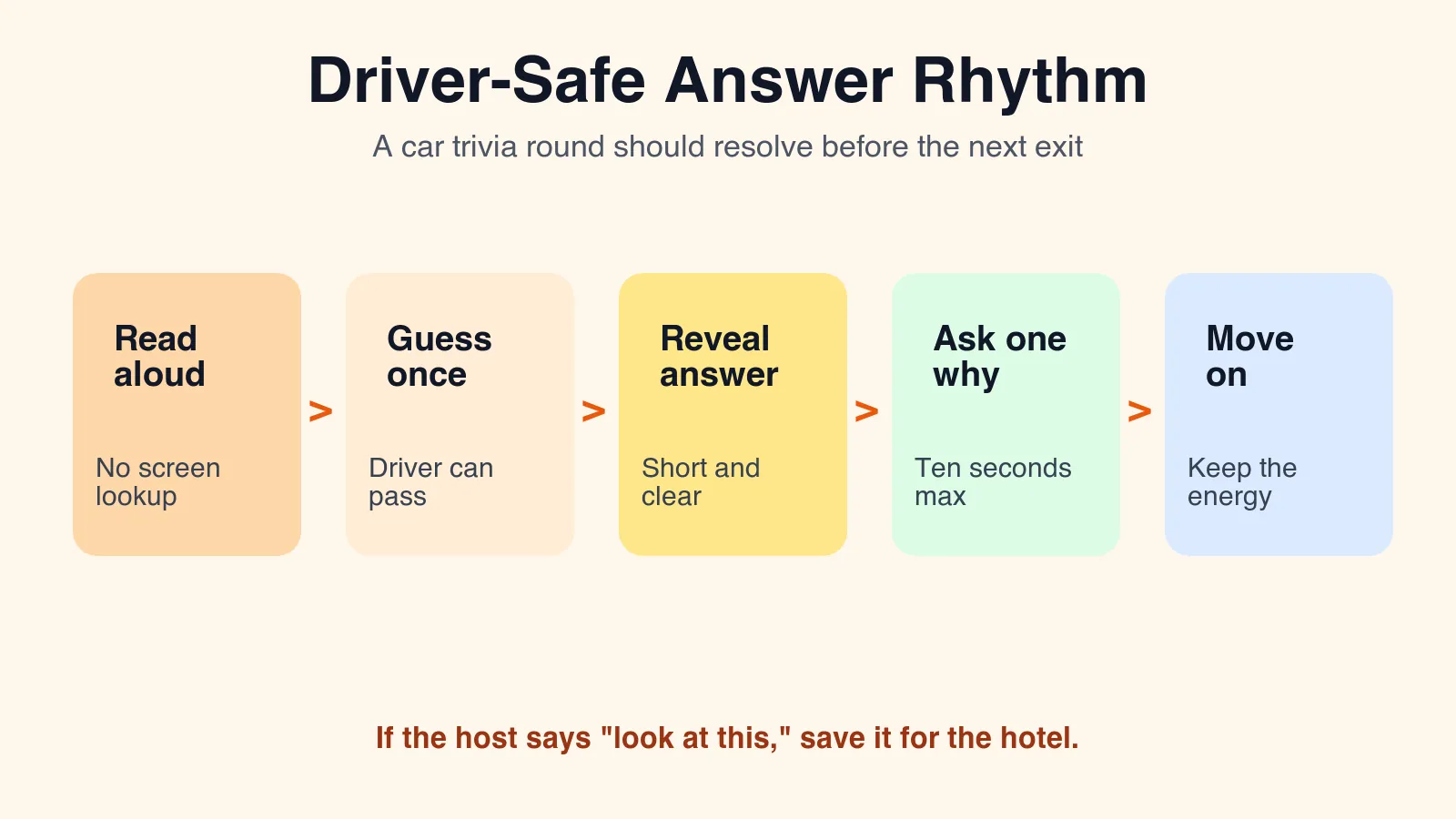
One test catches nearly everything the list misses: if the host has to say “look at this,” the question does not belong in a moving car. The rhythm that works is simple. Read the question aloud, take one guess per passenger, reveal the answer, move on.
NHTSA defines distracted driving broadly: phones, food, passengers, navigation, and in-car systems can all pull attention away from driving. That does not mean passengers sit in silence. It means the game gets built so the driver can ignore it without falling behind, which is why every question here can be skipped with zero penalty.
Motion sickness matters too. The CDC’s motion-sickness guidance recommends looking at the horizon, staying hydrated, and avoiding triggers where possible. That is why this article skips visual puzzle rounds and long reading passages.
If the car wants debate instead of facts, use icebreaker questions for safer open-ended prompts. If the car wants a scored night later, move into pub quiz questions after the trip.
The Four-Part Car Test
Every question on this page passed the same four checks before it made the list: the host has to be able to read it aloud, the answer has to fit in one sentence, the driver has to be able to skip it with zero penalty, and a passenger has to be able to answer it without touching a screen. Anything that read like homework, a private confession, or copied filler got cut.
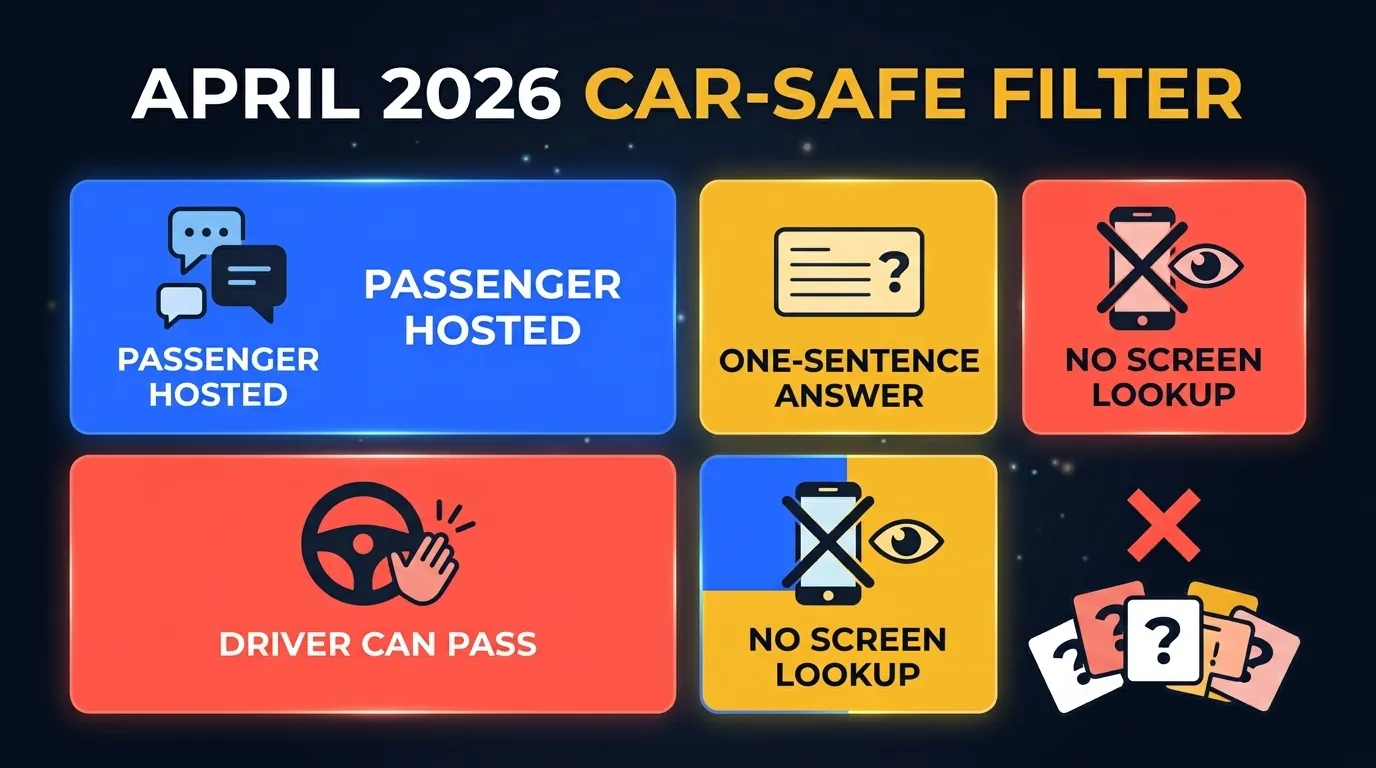 The April 2026 filter: fail any box and the question was out.
The test exists because a moving car is a hostile venue. Noise, motion, sudden navigation changes, kids asking for snacks, and one person whose attention matters more than any score. A good car question does one of four things: it makes someone look out the window, explains a sign the car just passed, drops a strange travel fact, or starts a quick argument that wraps up before the next exit.
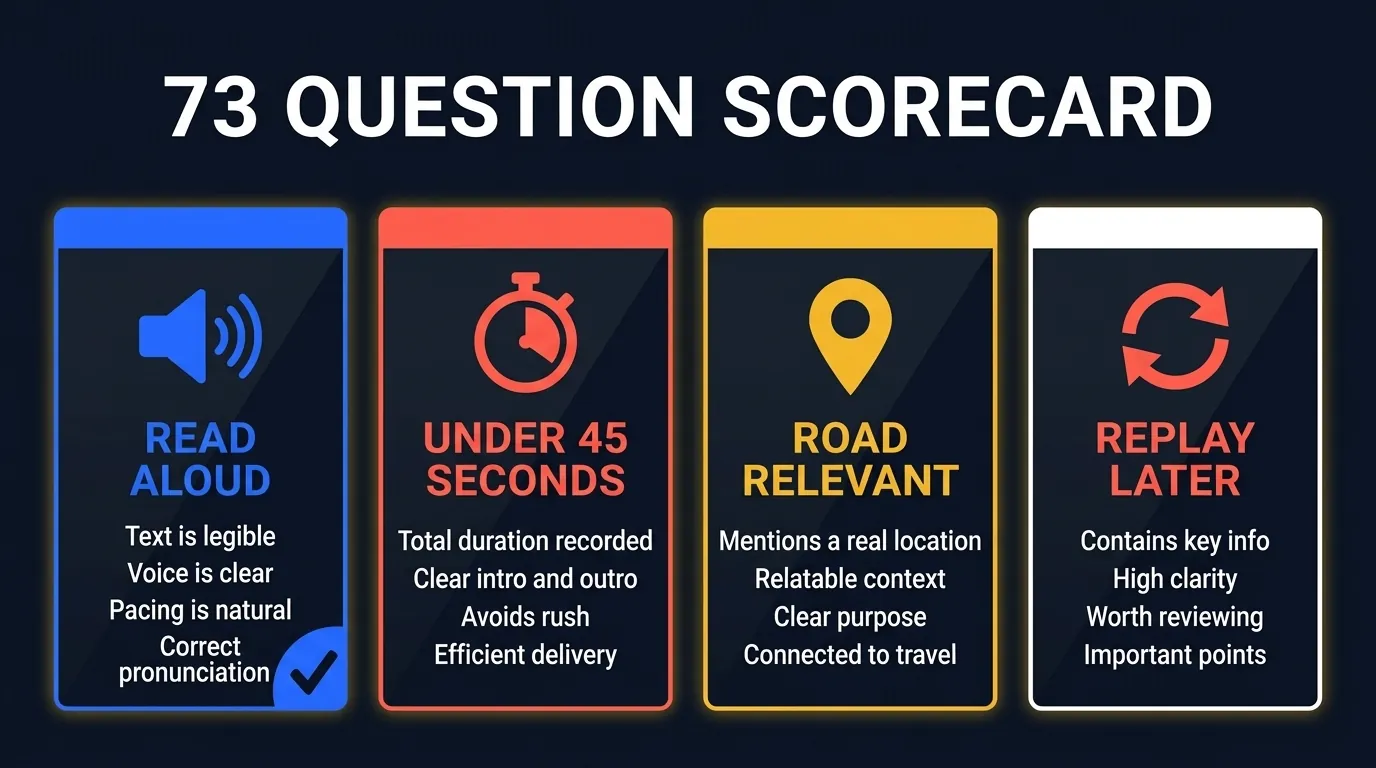
A note on upkeep: this page first went up on April 30, 2026, and I tightened the source citations in the first week. The August 20, 2026 update is a rewrite of the surrounding prose, not a question swap. The 73 questions are still the April set.
For broader topic coverage after the drive, the activities hub has more group formats, and the car trivia questions guide goes deeper on automotive brands, racing, safety, and weird car history.
Easy Road Trip Trivia Questions for the First 30 Minutes
These get everyone talking before anyone feels tested. They belong in the front of the drive, the part where snacks are still organized and nobody is carsick yet. All 12 work for mixed ages and short attention spans.
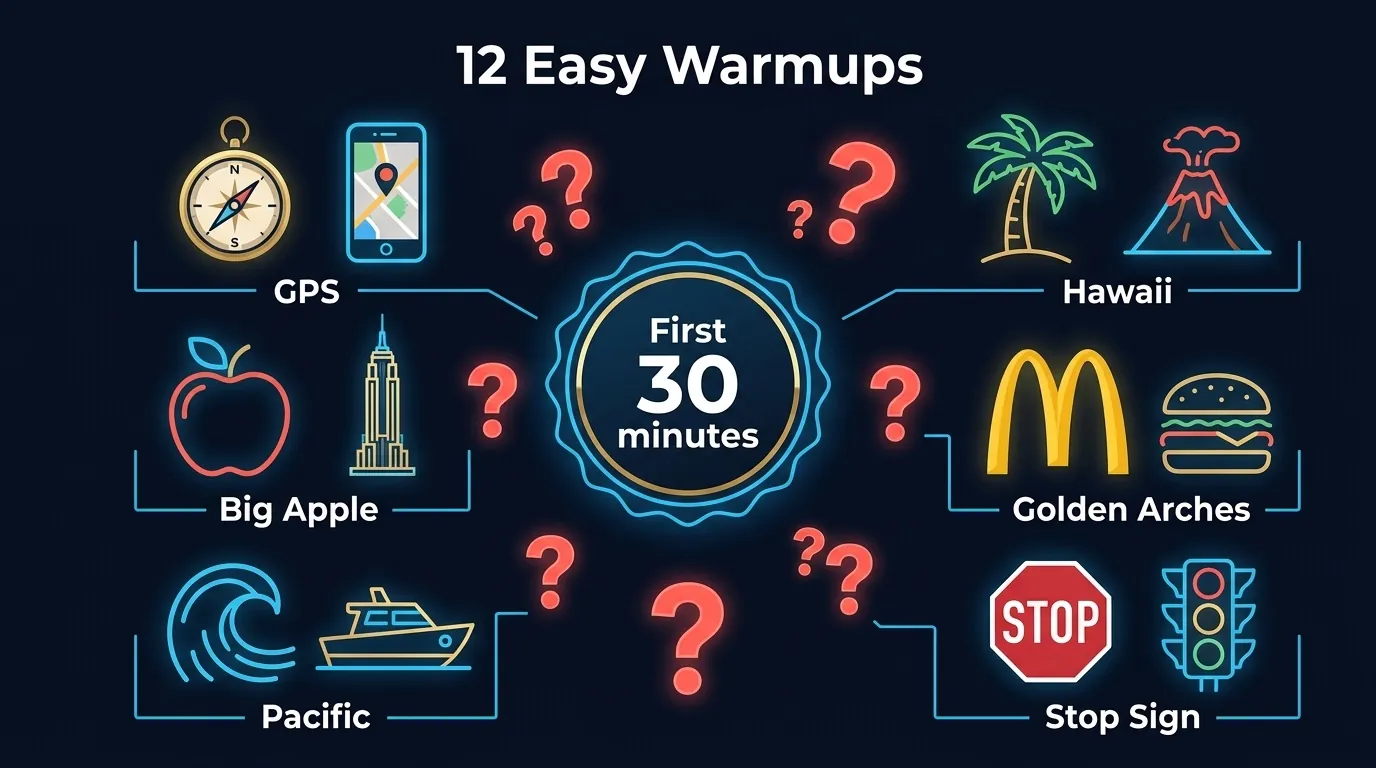
1. What does GPS stand for? Easy
Answer: Global Positioning System.
Why it lands: Everyone uses it. Plenty of people blank on the full name. Short answer, useful, and safe to ask while a passenger runs navigation.
2. Which US state is made up entirely of islands? Easy
Answer: Hawaii.
The trap here: Alaska has thousands of islands and Florida has the Keys, so the question feels rigged from the start, and somebody in the car will confidently argue for one of those two before the answer lands. But Hawaii is the only state made entirely of islands.
3. Which US city is nicknamed the Big Apple? Easy
Answer: New York City.
Why passengers like it: City nicknames are low-pressure, and they break up a round that would otherwise be all road signs and highway numbers.
4. Which fast-food chain is famous for the Golden Arches? Easy
Answer: McDonald’s.
In-car payoff: Someone spots the next set of arches within ten minutes and brings the question back up.
5. What is the paved area beside a highway lane called? Easy
Answer: The shoulder.
Bonus for kids: It teaches a word they hear in traffic reports, and it gives the host a chance to point out that the shoulder is for emergencies, not sightseeing.
6. Which ocean borders California? Easy
Answer: The Pacific Ocean.
Why it lands: Simple geography with a road-trip payoff. Anyone driving west can feel the coast getting closer.
7. Which national park is famous for the Old Faithful geyser? Easy
Answer: Yellowstone National Park.
What it does: National park questions age well, which is exactly what you want on a drive that might repeat the same playlist of trivia three summers running. Adults already know them, kids can pick them up, and nobody reaches for a screen.
8. In the United States, which side of the road do drivers use? Easy
Answer: The right side.
The hook: Sounds too obvious. Then someone who has driven in the UK, Ireland, Australia, or Japan chimes in, and suddenly there’s a debate.
9. Guacamole is mostly made from which fruit? Easy
Answer: Avocado. And yes, it counts as a fruit, which is worth a bonus argument on its own.
Timing tip: Food questions reset the room. Drop this one right before a lunch stop and watch everyone suddenly care.
10. Which planet is nicknamed the Red Planet? Easy
Answer: Mars.
Why passengers like it: It hands the non-travel fans a quick win before the highway-history round gets nerdier.
11. Which US state is often described as shaped like a mitten? Easy
Answer: Michigan.
The fun part: You can answer this one with your hand. The back-seat demonstrations that follow are bonus entertainment.
12. What shape is a standard US stop sign? Easy
Answer: An octagon.
Verify it live: This is one of the rare geometry facts you can confirm out the window. The next intersection is the answer key.
US Highway and Route 66 Trivia
Route 66 turns 100 in 2026, so highway history is having a moment. This section mixes the centennial with Interstate number patterns and scenic byways. Those beat another round of random state capitals when there is a highway right outside the window.
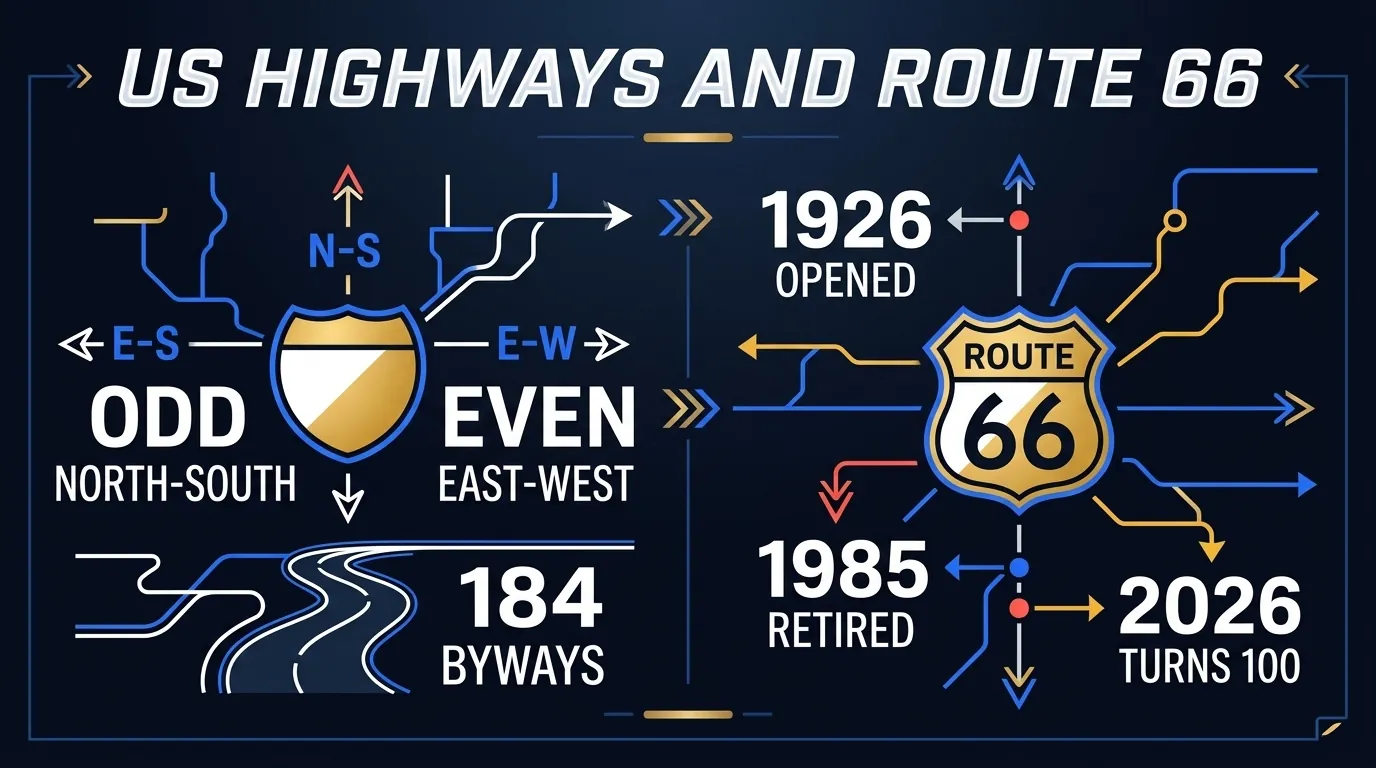 Route 66 is the hook, but the Interstate numbering rules are what passengers keep using after the game.
13. What year did Route 66 officially open? Medium
Answer: 1926.
The source: The National Park Service says Route 66 began in 1926 as part of the first federal highway system. That makes 2026 its 100th anniversary, which is exactly why this round exists.
14. What is Route 66’s most famous nickname? Easy
Answer: The Mother Road.
Why passengers like it: People who know the nickname feel clever. People who don’t usually remember it forever after one telling.
15. Route 66 ran from Chicago to which California city? Medium
Answer: Los Angeles, with Santa Monica often treated as the classic western endpoint.
The trap here: Road-trip culture says Santa Monica Pier, while official summaries usually say Chicago to Los Angeles. Give both, and let the car argue it out gently.
16. How many states did historic Route 66 cross? Medium
Answer: Eight states.
What trips people up: Illinois, Missouri, Kansas, Oklahoma, Texas, New Mexico, Arizona, and California. That tiny Kansas segment is the one everyone forgets.
17. What year was Route 66 removed from the US Highway System? Hard
Answer: 1985.
The twist: Route 66 didn’t disappear in 1985. It turned into history, tourism, local roads, and a lot of neon nostalgia.
18. On the Interstate system, odd-numbered major routes generally run which direction? Medium
Answer: North and south.
The source: The Federal Highway Administration lays out the numbering pattern. Once passengers know it, every Interstate sign turns into a clue.
19. On the Interstate system, even-numbered major routes generally run which direction? Medium
Answer: East and west.
The payoff: I-10, I-40, I-70, I-80, and I-90 all click into place, and passengers can test the rule on the next big junction sign.
20. For north-south Interstates, where do the lowest numbers begin? Hard
Answer: In the west.
Why it lands: I-5 hugs the West Coast. I-95 runs near the East Coast. That single pattern can carry a whole hour of sign-spotting.
21. For east-west Interstates, where do the lowest numbers begin? Hard
Answer: In the south.
The catch the car enjoys: I-10 runs across the southern US while I-90 runs far north near the Canadian border, so the latitude difference becomes obvious the moment somebody explains the numbering logic.
22. What federal umbrella name covers National Scenic Byways and All-American Roads? Hard
Answer: America’s Byways.
The source: The Federal Highway Administration counts 184 designated roads in 48 states under America’s Byways, and that count sets up the next question.
23. How many America’s Byways are federally designated? Hard
Answer: 184.
What trips people up: The guesses come in at 50, 100, or “one per state.” The real number shows just how deep the scenic-road network runs.
24. In 2026, how old does Route 66 turn? Easy
Answer: 100 years old.
The source: The Route 66 Centennial Commission has anchored 2026 for national anniversary events. So this question is timely all year.
25. What highway is often called the Main Street of America? Easy
Answer: Route 66.
What it does: Bundles a nickname, a history clue, and a road-trip cliche into one short answer, with a callback to question 14 built in.
Roadside Attraction Trivia
The answers in this round sound made up, which is exactly why the round exists. Buried Cadillacs. Free ice water. A giant catsup bottle, a ball of twine that keeps growing, and monuments that only survive because road trips need an absurd stop every few hundred miles.
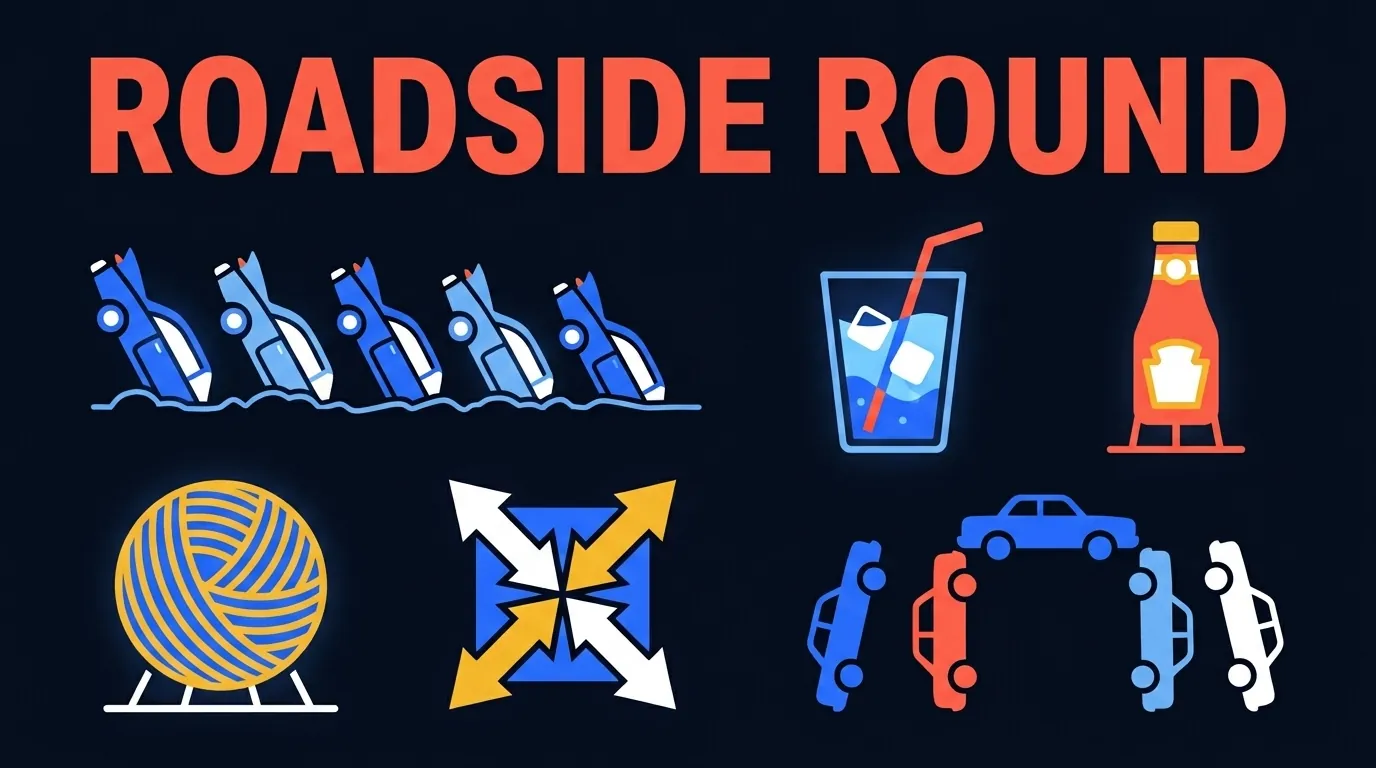 The mental pictures in this round are strange enough to stick.
26. How many cars are buried nose-first at Cadillac Ranch? Medium
Answer: Ten Cadillacs.
The source: Visit Amarillo describes the installation as ten Cadillacs buried nose-first. Tidy number, easy to remember.
27. Cadillac Ranch is near which Texas city? Easy
Answer: Amarillo.
Verify it live: On I-40, someone has probably already clocked the signs. For a lot of travelers, the attraction is more famous than the city it sits next to.
28. What free offer made Wall Drug famous? Medium
Answer: Free ice water.
The source: Wall Drug credits free ice water and a wall of highway signs for turning a small drug store into one of the most famous stops in the country. The offer was pitched straight at hot, thirsty drivers with hours of prairie left to cross.
29. Wall Drug is in which state? Easy
Answer: South Dakota.
Pair it up: This sits nicely beside the Mount Rushmore question in the geography round if the route runs through South Dakota.
30. The World’s Largest Catsup Bottle was built as what kind of structure? Hard
Answer: A water tower.
The twist: The official World’s Largest Catsup Bottle site says the 170-foot structure went up in 1949 for a bottling plant. It never held a drop of catsup.
31. The World’s Largest Catsup Bottle stands in which Illinois city? Hard
Answer: Collinsville.
The trap here: “Chicago” is the answer most people reach for, because a giant Illinois landmark sounds like it belongs to the biggest Illinois city. Collinsville actually sits near St. Louis and carries both Route 66 and Route 40 history.
32. Which Kansas city calls itself home of the World’s Largest Ball of Twine? Hard
Answer: Cawker City.
The source: The Cawker City website calls the town home of the World’s Largest Ball of Twine, so the host can answer the inevitable “that’s not real” objection with a citation.
33. The Corn Palace is in which South Dakota city? Medium
Answer: Mitchell.
Why it lands: That’s South Dakota’s second point after Wall Drug. Passengers start sketching a mental map of weird stops.
34. Four Corners Monument lets visitors stand in how many states at once? Easy
Answer: Four states.
The fun part: The answer hides in the name, but the photo idea keeps it alive. The states are Arizona, Colorado, New Mexico, and Utah.
35. What are the four states at Four Corners? Medium
Answer: Arizona, Colorado, New Mexico, and Utah.
What trips people up: Two or three come easily. The fourth one is where the question earns its spot.
36. Carhenge, a Stonehenge-style monument made from cars, is in which state? Hard
Answer: Nebraska.
The trap here: The name does the joke for you. The answer still catches people, because the guesses run Texas, Nevada, or California.
37. Which roadside attraction is famous for 5-cent coffee, free ice water, and hundreds of highway signs? Easy
Answer: Wall Drug.
What it does: Marketing trivia hiding inside travel trivia, and a callback that rewards whoever remembered question 28.
Somebody in the car is still wrong about Collinsville.
Once you park, send the road-trip topic as a LearnClash duel and settle it with a score.
Travel and Geography Trivia for Long Drives
This is the safest middle round: geography connects to maps, not private opinions, so nobody gets touchy. Run it after the warmups and before the harder adult prompts. Keep a paper map within reach if the kids want to point.
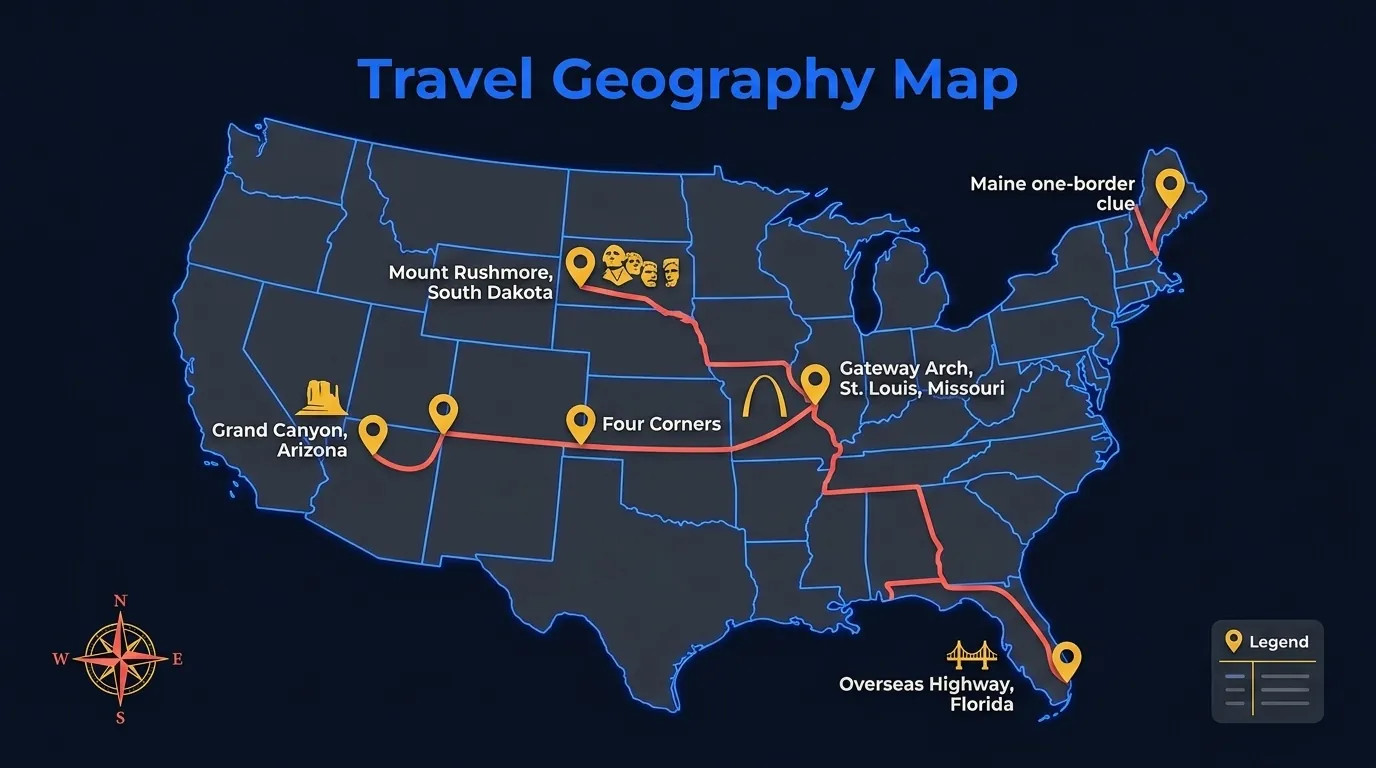
38. The Grand Canyon is in which US state? Easy
Answer: Arizona.
Why it lands: Easy, famous, and a good opener before the harder Southwest questions.
39. Mount Rushmore is in which state? Easy
Answer: South Dakota.
Pair it up: Stack it with the Wall Drug and Corn Palace questions and let the passengers sketch a South Dakota detour.
40. The Gateway Arch stands in which city? Medium
Answer: St. Louis, Missouri.
The hook: The arch turns geography into a skyline clue. Kids usually recognize the picture before they can name the city.
41. Great Smoky Mountains National Park straddles which two states? Medium
Answer: Tennessee and North Carolina.
Why passengers like it: Two-state answers stick. And they spark a good “which entrance would you use?” side conversation.
42. Which river forms much of the border between Texas and Mexico? Medium
Answer: The Rio Grande.
What it does: Spanish name, geography, and an international border, all in one short answer.
43. Denali is in which US state? Easy
Answer: Alaska.
Why it lands: Alaska questions feel big. This one stays easy enough for a family round.
44. Which ocean borders Florida’s east coast? Easy
Answer: The Atlantic Ocean.
Bonus for kids: Simple, but it helps younger passengers lock in the map.
45. Which US state borders exactly one other state? Hard
Answer: Maine.
The trap here: Florida is the popular wrong guess. Maine only touches New Hampshire by land, which makes it a clean map trap.
46. Which desert covers parts of California, Nevada, Utah, and Arizona? Hard
Answer: The Mojave Desert.
What trips people up: Desert names blur together on the road. Mojave, Sonoran, and Great Basin make a solid Southwest mini-round on their own.
47. Which state contains both Grand Teton and Yellowstone National Parks? Medium
Answer: Wyoming.
The hook: Plenty of travelers know Yellowstone. Far fewer connect both parks back to Wyoming.
48. Which state is famous for the Overseas Highway to Key West? Easy
Answer: Florida.
Why it lands: Bridges, islands, and ocean on both sides. Easy to picture, even from a landlocked highway.
49. What is the name for a map symbol that explains colors, lines, and icons? Easy
Answer: A legend.
Bonus for kids: Practical too. Hand a kid the paper map right after this one and they can start decoding the route.
For a deeper map round, the geography trivia questions guide gives you harder country, capital, river, and landmark prompts.
Car-Ride Trivia for Kids and Families
Clear wording and low stakes decide whether a family round works, so the kid questions stay concrete: signs, colors, states, maps, snacks, weather, and the words children already hear from the back seat. No scary facts, no private questions, no adult-history traps.
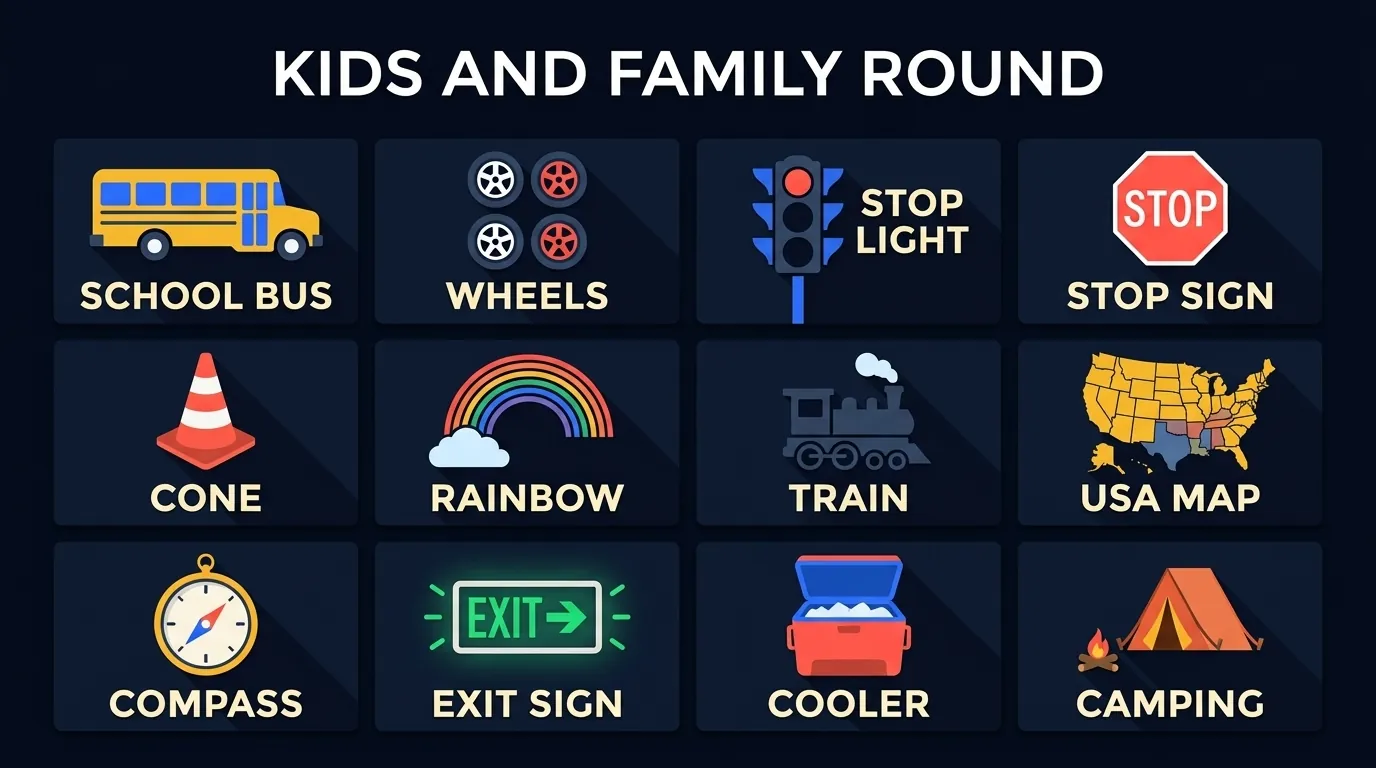 Kid questions work when the answer is visible from the car or easy to explain.
50. What color are most school buses in the United States? Easy
Answer: Yellow.
Verify it live: Kids can spot the answer on the road in real time. That makes it feel less like school.
51. How many wheels does a standard car have? Easy
Answer: Four.
Tiered for ages: Ask the younger kids first. Then let an older one jump in with “plus a spare” if the car carries one.
52. What does a red traffic light mean? Easy
Answer: Stop.
Host note: Simple safety language. Keep the tone playful, not lecture-y.
53. What shape is a standard stop sign? Easy
Answer: An octagon.
Host note: Yes, this repeats the warmup if you ran all the sections. With kids, the repeat is a feature.
54. What fruit name is also a traffic-cone color? Easy
Answer: Orange.
The fun part: Wordplay. Buys you ten seconds of back-seat giggles, and that’s worth a lot on hour four.
55. What two things do you usually need to see a rainbow? Medium
Answer: Rain and sunlight.
Verify it live: Catch the right weather out the window and this becomes an instant science lesson.
56. What kind of vehicle runs on tracks instead of roads? Easy
Answer: A train.
Timing tip: Save it for a crossing or a station, or for the passenger who would honestly rather be on rails.
57. How many states are in the United States? Easy
Answer: 50.
The fun part: A classic for a reason. Let the kids name as many as they can before you give the answer.
58. What tool points toward north? Easy
Answer: A compass.
What it does: Makes direction feel physical again. Hand a kid a real compass or the map’s compass rose and let them find north.
59. What does an exit sign tell drivers? Easy
Answer: Where to leave the highway.
Verify it live: Useful and right there. Have a kid read the next exit sign aloud and name where the car could leave the highway.
60. What frozen water might you put in a cooler? Easy
Answer: Ice.
Timing tip: It ties straight to snacks, drinks, and the cooler nobody packed quite well enough.
61. What do you call a trip where you sleep outside in a tent? Easy
Answer: Camping.
Host note: More vocabulary than trivia, really. For the youngest passengers, that’s the right level.
For more age-safe prompts, use the trivia questions for kids article. It uses a stricter filter for school, family, and mixed-age play.
Road Trip Trivia Questions for Adults
The adult round can get harder without turning edgy or private. It sticks to safety, travel behavior, fuel, roads, and driving terms. The fun lives in useful facts and confidently wrong guesses, not in anyone’s life choices.
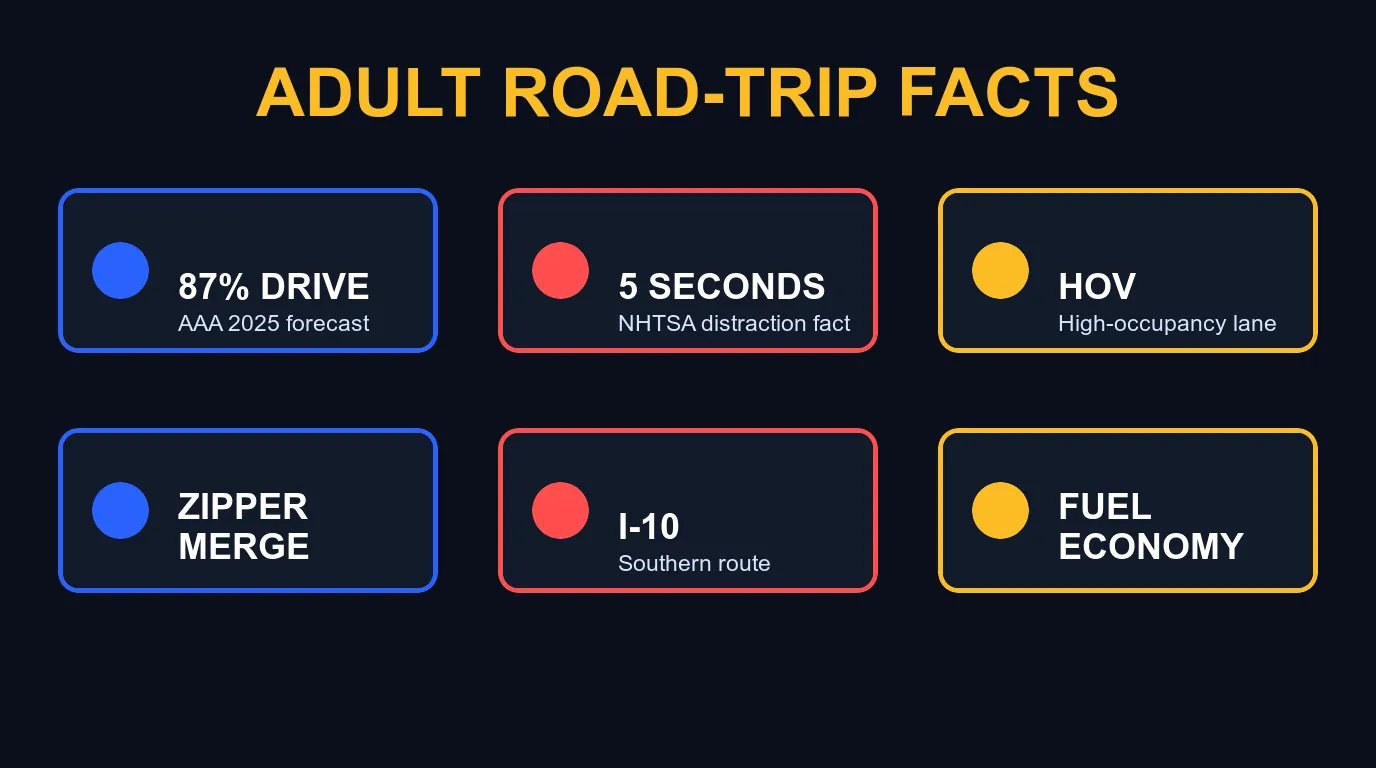
62. In AAA’s 2025 Memorial Day forecast, what share of travelers were expected to drive? Hard
Answer: 87%.
The source: AAA’s 2025 forecast put 39.4 million people on the road by car, or 87% of Memorial Day travelers.
63. US traffic-safety guidance compares reading a text for 5 seconds at 55 mph to driving about what distance with your eyes closed? Hard
Answer: The length of a football field.
The source: The New York Governor’s Traffic Safety Committee uses this exact comparison for distracted driving. It sticks because it’s uncomfortable to picture.
64. What does EV stand for? Easy
Answer: Electric vehicle.
Why it lands: EV signs, chargers, and range estimates show up on more routes every year. Easy acronym, useful on the road.
65. What does range anxiety mean? Medium
Answer: Worry that an electric vehicle will run out of charge before reaching a charger.
Where it earns its spot: Gas drivers get it instantly as “empty tank anxiety.” EV drivers feel a sharper version of the same dread, because a charging stop has to be planned around the route in a way that a two-minute gas fill-up never does.
66. What does HOV stand for in an HOV lane? Medium
Answer: High Occupancy Vehicle.
The trap here: Someone guesses “highway only vehicle.” Let them finish, then point to the lane sign.
67. What is a zipper merge? Medium
Answer: A merge where drivers use both lanes until the merge point, then alternate.
Where it earns its spot: Few driving topics light up a car faster. Keep the debate short unless traffic is fully stopped anyway.
68. Which Interstate runs across the southern United States from California toward Florida? Hard
Answer: Interstate 10.
Why it lands: It ties the Interstate numbering pattern to a route the car might actually be on.
69. What is a scenic byway recognized for? Medium
Answer: Archeological, cultural, historic, natural, recreational, or scenic qualities.
The source: That list of qualities comes straight from the Federal Highway Administration’s America’s Byways program, and it explains why certain stretches of road get protected and promoted as attractions in their own right.
70. According to AAA, what simple highway behavior can improve fuel economy? Medium
Answer: Reducing speed by 5 to 10 mph.
The source: AAA says slowing highway speeds by 5 to 10 mph can improve fuel economy by as much as 14%. Over a full day of Interstate driving, that difference shows up at the pump.
71. What is defensive driving? Easy
Answer: Driving in a way that anticipates hazards and leaves room to react.
What it does: Adults toss this term around without ever defining it, so the one-sentence definition usually surprises somebody in the car.
72. What US phone number should you call for an emergency? Easy
Answer: 911.
Why it lands: Everyone should know it cold. Road trips cross unfamiliar ground, which is what keeps basic safety trivia from feeling pointless.
73. What should the driver do if trivia starts pulling attention from traffic? Easy
Answer: Pass the question and focus on driving.
The house rule: This one is the whole point. The driver never falls behind in the game for doing the one job that actually matters.
After the Drive: The LearnClash Rematch
The car game does not have to end at the destination, because a full LearnClash duel runs 18 questions across 6 rounds, gives each player 45 seconds per question, and stays async on a 72-hour turn window. The rematch fits around dinner or hotel check-in, and a missed question enters spaced repetition.
One build detail matters on the road specifically: the screen counts down 45 seconds, but the server keeps accepting answers for 50. I set that five-second gap as a network buffer, so a tunnel or a dead zone between towns does not eat an answer somebody already picked.
 The in-car round becomes a rematch played in three-minute turns once everyone is out of the car.
| LearnClash setting | Road-trip fit |
|---|---|
| 18 questions | One tight rematch, not a whole evening |
| 45-second timer | Fast enough for trivia, slow enough to think |
| 72-hour turn window | Works after the drive, dinner, or hotel check-in |
| Spaced repetition | Missed facts come back later |
Pick Road Trips and Recreation as the topic, send the challenge once you park, and let each player take their three-minute turn whenever they want.
Getting Cawker City wrong somewhere in Kansas, then watching the same question resurface a week later, is how the ball of twine ends up permanent.
When everyone is out of the car, send a road-trip rematch and see who remembers the weird stops.
Frequently Asked Questions
What are good road trip trivia questions?
Good road trip trivia questions are short, safe to read aloud, and answerable without looking at a phone. The best mix includes easy warmups, highway facts, geography, roadside attractions, and family-safe prompts. LearnClash keeps each question tight enough for a 45-second turn.
How do you play trivia on a road trip?
Choose one passenger as host, read each question aloud, let the driver pass without penalty, and reveal the answer after one guess per player. Keep the phone out of the driver's hands. LearnClash turns the same set into an 18-question async duel after the drive.
Can the driver answer road trip trivia questions?
The driver can answer only if it does not pull attention from the road. Passenger-hosted questions should never require reading, scrolling, searching, or fast reaction. If traffic, weather, navigation, or fatigue demands focus, the driver passes and the passengers keep playing.
What are good road trip trivia questions for kids?
Good kids' road trip trivia questions use concrete answers: colors, signs, states, maps, food, weather, and animals seen from the car. Avoid private topics, scary facts, and questions that need online lookup. LearnClash family rounds keep wording simple and the answers quick.
Is there a road trip trivia app?
LearnClash can work as a road trip trivia app because you can pick any topic, answer 18 questions in a duel, and replay missed facts with spaced repetition. Use a passenger as host in the car, then send the topic as an async challenge later.