
Competitive Learning: Why Quiz Duels Work [2026]
Competition alone has no noteworthy average effect on learning, until it's designed right. ELO matching, retrieval practice, and flow make it work.

Competition has no noteworthy average effect on learning. That sentence is not mine. It is the first finding of Murayama and Elliot’s 2012 meta-analysis in Psychological Bulletin, and it is why every honest answer to “does competition help you learn?” begins with “depends on the design.”
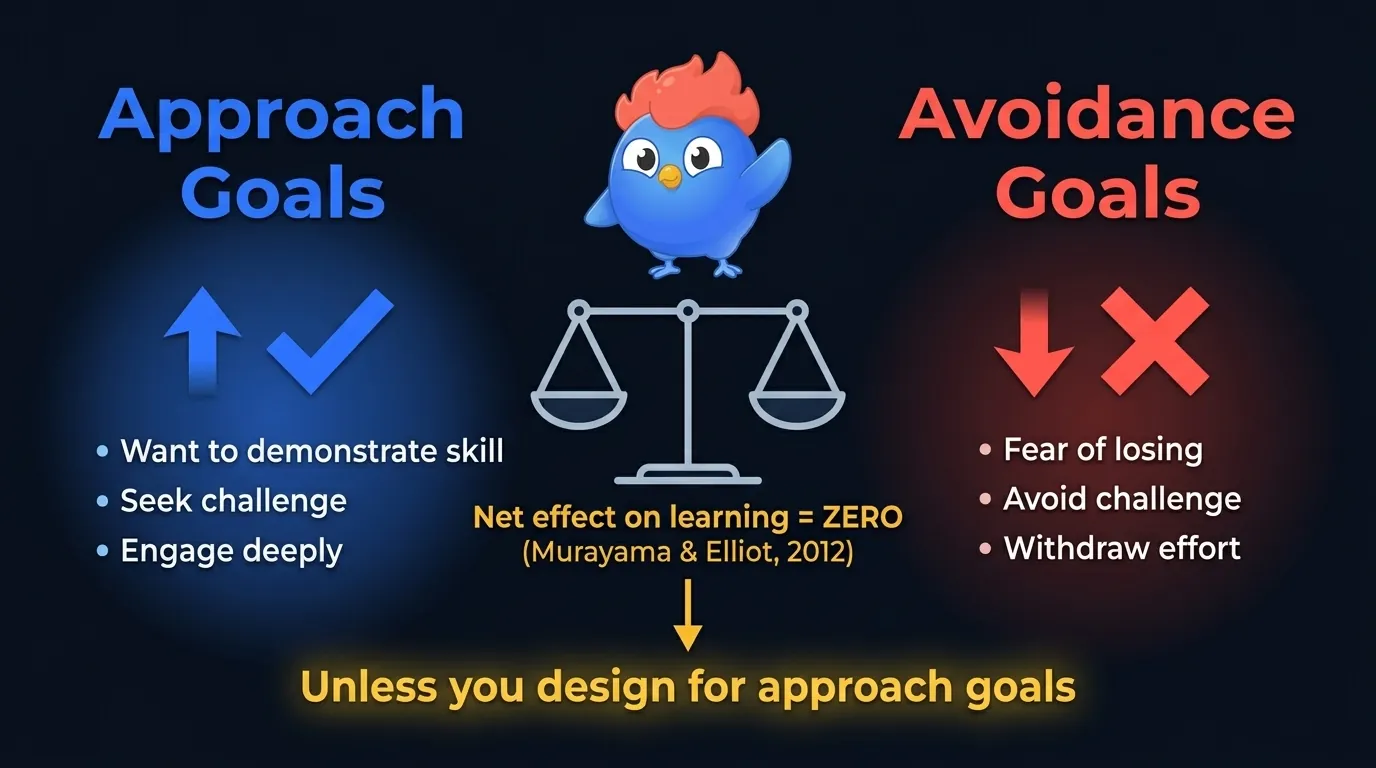
Competitive learning, in educational psychology, means using structured head-to-head competition to improve how well people acquire and keep knowledge. Murayama and Elliot’s second meta-analysis explains the null. A contest fires performance-approach goals (show what you know), which help, and performance-avoidance goals (don’t look bad), which hurt, and averaged over every contest ever measured the two wash out. Build the contest so the approach side dominates and the benefit survives.
Below are the six findings that decide which way a contest tips, and where LearnClash’s 1v1 quiz duels sit against each of them. Several citations in the March 2026 version of this page were wrong; the corrected ones are flagged inline and listed at the end. Play a quiz duel on any topic →
| Competitive learning in LearnClash | |
|---|---|
| Mechanism | Retrieval practice under competitive pressure |
| Duel format | 18 questions in 6 rounds of 3, one topic per round, 45 seconds per question |
| Matchmaking | 50% rating proximity + 50% category similarity, ranked; no hard rating gate |
| Rating math | Glicko-2 (labeled ELO), start 1300; a settled even result moves about 8 to 41 points by score margin |
| Difficulty | Per-round easy/medium/hard mix set by rating band; hard capped at 1 per round |
| Memory | 3-stage spaced repetition: Learning 7 days, Known 90 days, then Mastered |
What Is Competitive Learning (and Why Does Everyone Get It Wrong)?
Competitive learning in educational psychology means using structured head-to-head competition to improve how well you learn and retain knowledge. The win is not the point. What the contest does to your attention, effort, and memory while you are inside it is the point, and that is what the research below measures.
Two wrong turns are common. Search the phrase and you mostly hit a neural-network technique in which nodes compete to respond to input data, which has nothing to do with memory. Ask a person instead and you get a confident answer in one direction, for or against, when the evidence supports neither as a blanket rule.
Murayama and Elliot ran two meta-analyses and three new studies. The first meta-analysis found no noteworthy relation between competition and performance. The second showed why: competition raises performance-approach goals, which improve performance, and performance-avoidance goals, which undermine it, and the two paths hide each other in the average. The three new studies, using three different definitions of competition, reproduced both the null direct effect and the opposing mediation.
| What competition activates | Effect on learning | When it tends to dominate |
|---|---|---|
| Performance-approach goals | Positive: more effort, deeper engagement | Skill-matched opponents, retrieval tasks, low public stakes |
| Performance-avoidance goals | Negative: anxiety, surface processing | Mismatched opponents, public ranking, new material under time pressure |
So the design job is to starve the avoidance side, and a quiz duel can do that three ways. Match opponents by skill so nobody expects a humiliation. Make the task retrieval of things already studied rather than cramming under a clock. Keep the stakes small: a rating, not a grade, that moves roughly 8 to 41 points on an evenly matched result, scaled by the score margin.
Why Does Having an Opponent Make You Perform Better?
Norman Triplett noticed it in cyclists: riders went faster against other riders than alone. Robert Zajonc gave the pattern a mechanism in a 1965 Science paper titled Social Facilitation. The mere presence of another person raises arousal, and arousal strengthens whatever response is already dominant.
For a well-learned task that means better output. For a task you are still acquiring, it means worse.
A quiz duel is the well-learned case, provided the question is on material you have already met. Your dominant response to “capital of Australia” is Canberra if you studied it and a guess if you did not. An opponent makes the studied answer come out more reliably and does nothing for the guess.
That presence effect has been re-examined since. Ukezono and colleagues (2015) ran two experiments and found the strongest facilitation when people both perceived another person and had their arousal raised beforehand, while another person present during the task was enough on its own. The March version of this page credited that study to “Morita et al.”; the authors are Ukezono, Nakashima, Sudo, Yamazaki, and Takano.
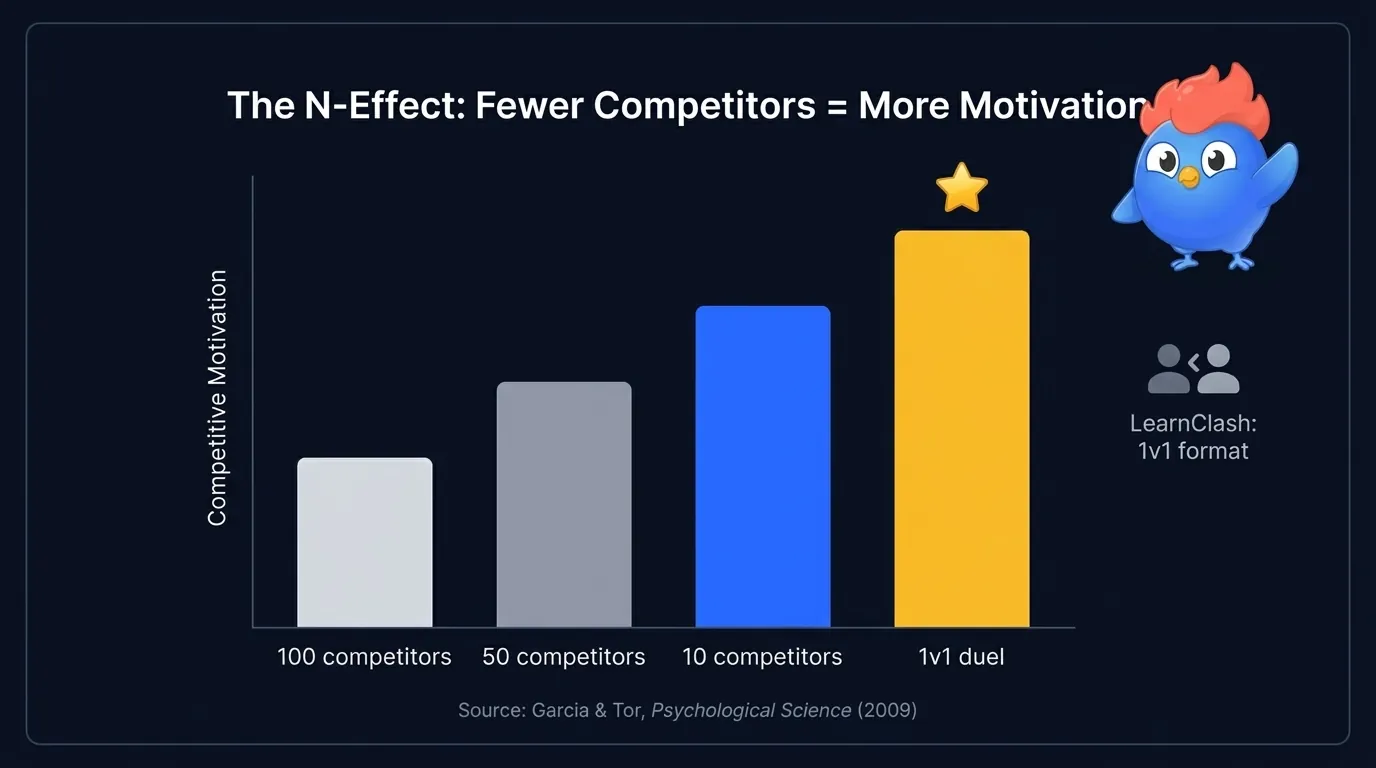
Then there is a question the duel format answers almost by accident: how many opponents? Garcia and Tor (2009) called their answer the N-effect and published it in Psychological Science. Average SAT scores fell as the average number of test-takers per venue rose, and people told to finish an easy quiz in the top 20 percent for speed finished faster when they believed they were competing against 10 others rather than 100. The later studies in the paper tied the effect to social comparison, which matters less as the crowd grows.
One opponent is the smallest N there is. Classroom quiz platforms sit at the other end, with a whole class watching one leaderboard, and our Kahoot vs Blooket comparison looks at what that does to motivation per player.
How Does Your Brain Change During a Close Match?
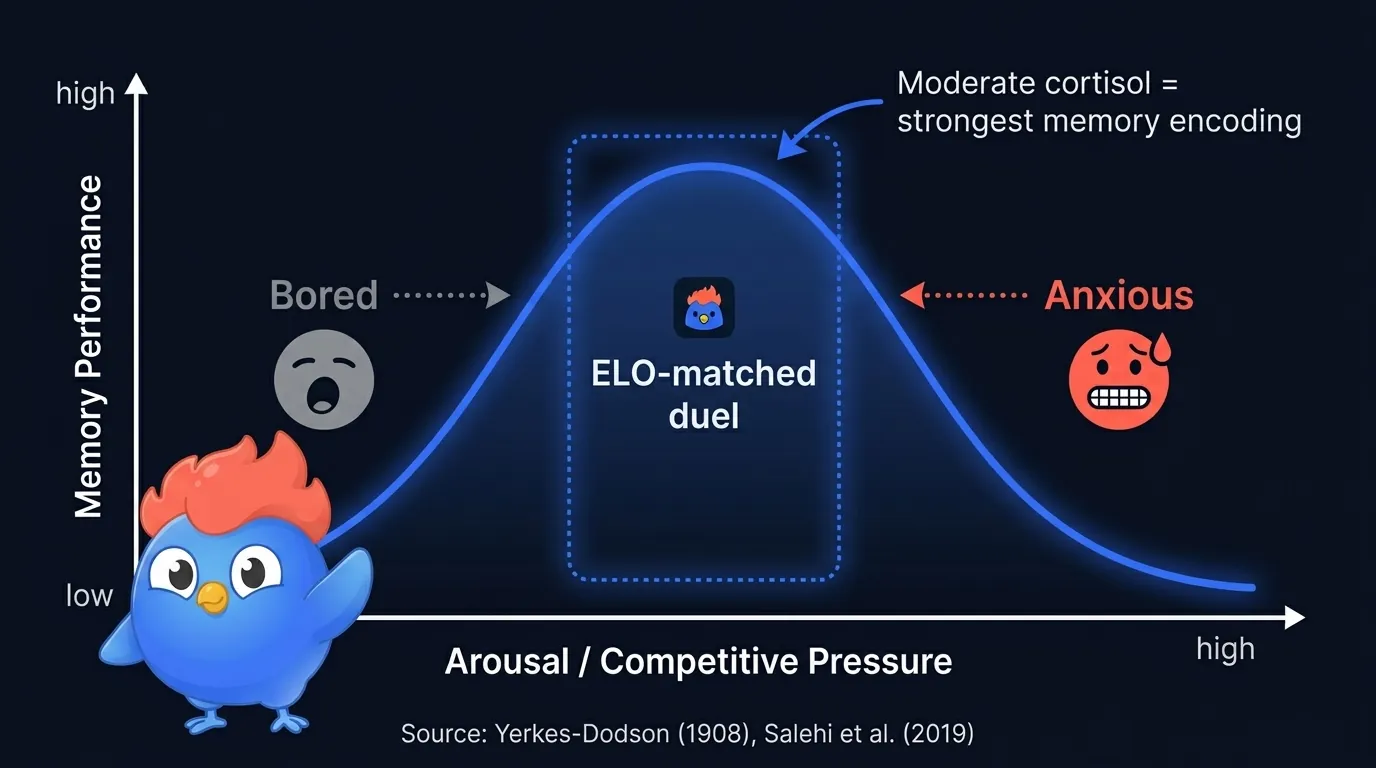
The oldest finding here comes from mice. In 1908 Robert Yerkes and John Dodson published a study of the Japanese “dancing mouse” in the Journal of Comparative Neurology and Psychology showing that performance rose with arousal up to a point and then fell. The paper was cited about ten times in the next half century, yet four of those citations called it a law, and the Yerkes-Dodson law stuck.
Too little arousal and you drift. Too much and you seize up. The curve between those two is what a close match is supposed to climb.
Meng, Pei, Zheng, and Ma (2016) put electrodes on the middle of that curve. Each participant played a two-player online stopwatch game against a confederate and won both matches, one by a wide margin and one by a narrow one. The narrow win produced an enlarged stimulus-preceding negativity, an EEG marker of concentrated anticipatory attention, which the authors read as stronger intrinsic motivation during close games. Same opponent, same outcome, and only the margin changed the brain signal.
The stress hormone story is more specific than the March version of this page claimed. A 2019 study by Jiang, Tran, Madison, and Bakker (credited here before as “Salehi et al.”) put 69 young adults through the Trier Social Stress Test either right after encoding, to hit consolidation, or right before a recognition test, to hit retrieval. Stress during consolidation improved discrimination of highly similar items, and the improvement correlated with how much cortisol rose, while stress at retrieval changed nothing. The inverted-U idea appears in that paper only as a hypothesis from earlier work, so I no longer claim a measured cortisol sweet spot for duels.
What the two studies support together is narrower and still useful. Closeness, not winning, is what raised anticipatory attention in Meng’s data. And a stressful contest that follows learning does not appear to hurt memory for what was just learned; in Jiang’s data it helped.
What Makes Skill-Matched Competition Different?
Flow is the state where the task eats your attention and the clock disappears. Mihaly Csikszentmihalyi first presented it in his 1975 book Beyond Boredom and Anxiety after studying artists who got lost in their work, and his 1990 book Flow made it famous; sport psychologists later documented the same merging of action and awareness in elite athletes. The recipe never changed: clear goals, fast feedback, and a challenge sitting at the edge of your skill.
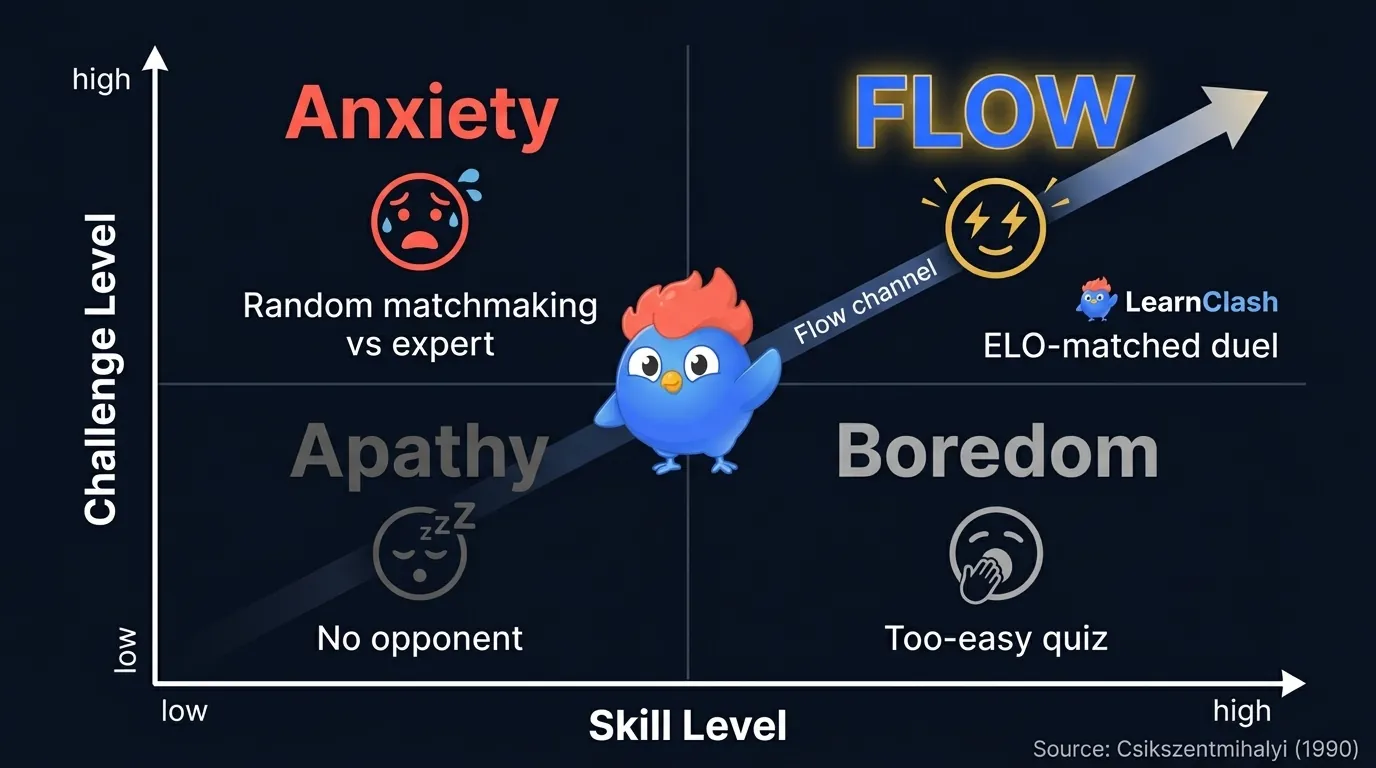
Robert Bjork named that edge in 1994. His chapter “Memory and Metamemory Considerations in the Training of Human Beings” introduced desirable difficulties: conditions such as spacing, interleaving, and testing that make practice feel harder while producing stronger long-term retention. The word “desirable” is doing work. Difficulty that crushes is not on the list.
Radek Pelanek (2016) showed in Computers & Education that the Elo rating system can sit underneath adaptive education: treat each answer as a match between a student and an item, and one update rule estimates the student’s skill and the item’s difficulty at the same time. His verdict was that the approach is simple, robust, and effective, and therefore suitable for building adaptive systems.
Here is how LearnClash actually uses a rating to find the edge, including the parts I got wrong the first time.
On March 29, 2026, the day this article first went live, I shipped it saying ELO matching “delivers” flow “on its own” and that “every duel sits in the zone.” I rewrote both lines the same day after rereading the matchmaking code, because the code ranks, it does not guarantee.
The matchmaker scores every open duel on two equal halves: rating proximity, which is 1.0 at a zero-point gap and falls to zero at 400 points, and the cosine similarity between the two players’ category histories. Until both players have at least five category picks on record, the score is pure rating proximity. A fresh open duel needs a score of at least 0.7 to be joined, that bar decays to zero over 60 minutes so an hour-old duel accepts anyone, and the candidates that clear it are sorted best first.
There is no third “topic overlap” factor, whatever the March table said. What exists instead is a difficulty mix per round that follows the rating. New accounts start at 1300 and see only easy questions up to 1400. Above 1400 one medium question joins each round of three, above 1800 two do, and above 2000 a hard question replaces one of them, capped at one per round.
That cap is a July 2026 decision, and it is the closest thing LearnClash has to a measured desirable-difficulty line. Production data that month showed easy questions answered correctly about 68 percent of the time, medium about 52 percent, and hard about 41 percent. With four options, 41 percent sits close to the guess floor, so stacking hard questions turns a round into a coin flip instead of a test of what someone knows. We retuned the whole table toward a roughly 75 percent per-answer correct band and limited hard to one per round.
| Lever | What it controls | Where it lives |
|---|---|---|
| Rating proximity (50%) | Skill balance of the pairing | Matchmaking score |
| Category similarity (50%) | Whether the two players’ topic histories overlap | Matchmaking score |
| Quality threshold | Fresh duels need a 0.7 score, decaying to 0 over an hour | Matchmaking filter |
| Difficulty mix | Easy/medium/hard per round, by rating band | Question serving |
The boredom end of the flow channel gets its own rule. A question you have already mastered can come back as a filler when a topic runs short, but normally at most one per round (only a topic with nothing else left to serve gets more), because a mastered repeat is a free point with no learning in it.
Can Competition Actually Hurt Learning?
Yes, and the clearest demonstration is DiMenichi and Tricomi (2015) in Frontiers in Psychology. Across two experiments of 120 people each, competition sped up a physical effort task, with reaction times of 339 milliseconds against 353 (d = 0.24, p = .010), and then cut delayed recall on a learning task to 8.76 items from 10.61 (d = 0.37, p < .001). That is about 17 percent fewer items remembered because a rival was in the picture.
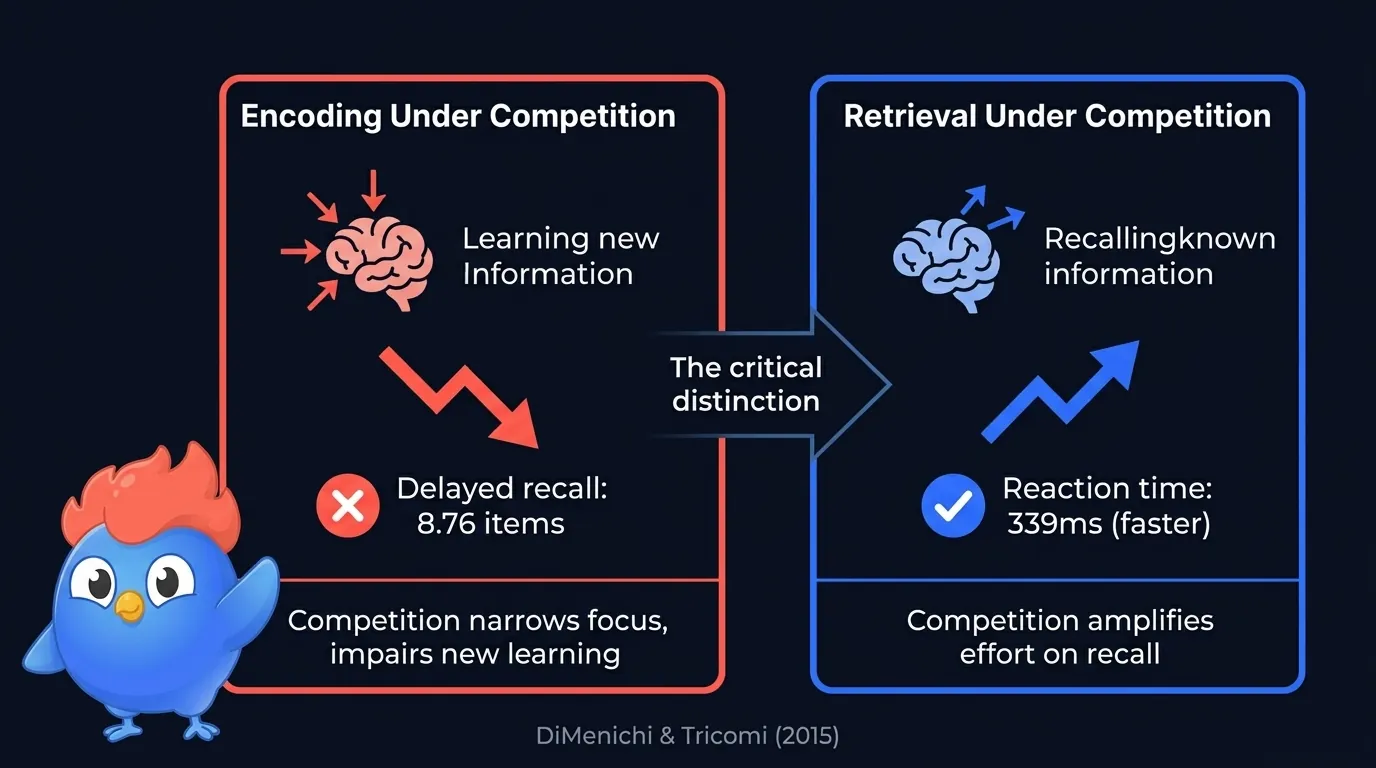
Put next to Zajonc, the pattern is not a paradox. Effort was the dominant response in the first task, so arousal helped. In the second task the participants were still acquiring the material, and arousal pushed them toward speed over depth. Competition amplifies what you already have and taxes what you are still building.
| Competitive task type | What the evidence shows | Source |
|---|---|---|
| Acquiring new material | Delayed recall down about 17 percent | DiMenichi and Tricomi (2015), Experiment 2 |
| Performing a practiced response | Faster and more effortful | DiMenichi and Tricomi (2015), Experiment 1; Zajonc (1965) |
Which raises an awkward point for any quiz app, mine included. The first time a question appears in a duel, you are encoding under pressure, and that is the condition the second experiment warns about. LearnClash’s answer is the return visit rather than the first one: a missed question sits in the Learning stage and comes back seven days later, a correct answer off cooldown promotes it to Known for 90 days, and a second correct answer retires it as Mastered.
The duel is where retrieval gets its intensity. The schedule is where it gets its durability, which is the same division of labor described in the testing effect.
The scheduling half has production evidence of its own. In a controlled experiment at Duolingo, Settles and Meeder (2016) found that an improved spaced-repetition model lifted daily engagement by 12 percent and daily practice retention by 9.5 percent. An earlier version of this page attributed those numbers to Elo ratings; they belong to the spaced-repetition model.
The cooperation literature is often quoted against competition, and it deserves a precise reading. Johnson, Johnson, and Stanne (2000) pooled 164 studies yielding 194 effect sizes and found all eight cooperative methods they examined beat competitive instruction on achievement. The effect size I previously attached to that paper actually comes from Slavin (1995): a median of +0.32 across 52 studies of methods with group goals and individual accountability, against +0.07 across 25 studies without them. Strip out accountability and cooperation’s edge nearly vanishes, because the incentive wiring predicts the outcome and the label does not.
For the kind of task a duel is, the head-to-head evidence favors competition. Plass, O’Keefe, Homer, and colleagues (2013) randomized 58 middle schoolers to play an arithmetic game alone, competitively, or collaboratively. Competition increased in-game learning relative to solo play, and collaboration decreased in-session performance. Two caveats belong next to that result: out-of-game math fluency improved in every condition without differing between them, and both social modes raised situational interest and enjoyment.
Why Do Unpredictable Outcomes Strengthen Memory?
Dopamine neurons do not simply fire for reward. Their phasic activity tracks the gap between the reward you predicted and the one you got: an unexpected reward drives a burst, a fully predicted one barely moves the baseline, and an expected reward that never arrives suppresses firing. Schultz, Dayan, and Montague (1997) laid this out in Science: the fluctuating output of dopamine neurons in primates signals changes or errors in predictions of future salient and rewarding events, which is the kind of signal an adaptive learning system needs. A fully predicted outcome barely registers, and a surprise does.
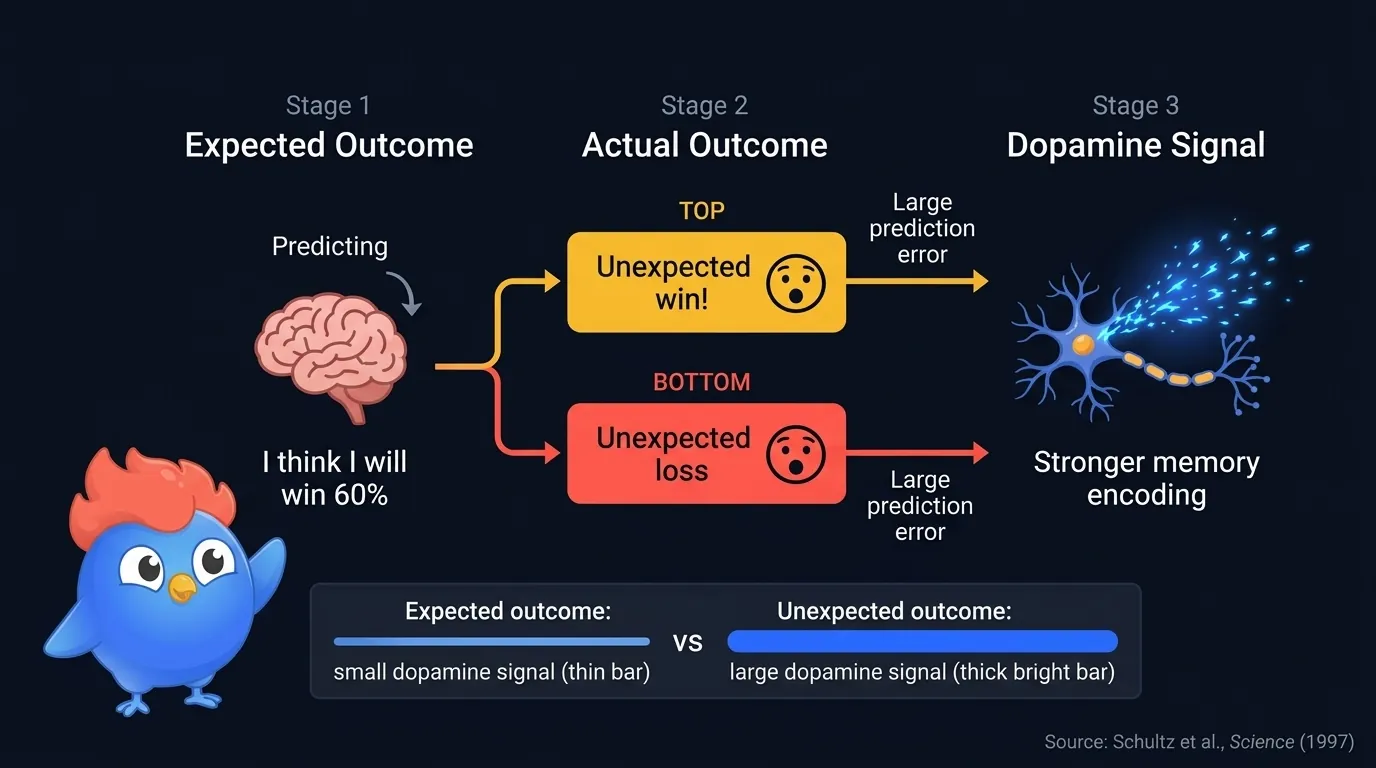
Whether that signal reaches memory was tested directly by Jang, Nassar, Dillon, and Frank (2019) in Nature Human Behaviour. People encoded incidental images more strongly when they were gambling for rewards, and the boost scaled with the reward prediction error at the moment the image appeared, not before or after. The effect was there within minutes and did not change much after 24 hours, so it did not depend on a night’s consolidation. Note the paper’s title: it is positive prediction errors, outcomes better than expected, that strengthened encoding.
A duel against a real person generates those moments on its own. You were unsure of an answer and it was right, or you expected to lose a round and took it. Each of those is a better-than-predicted outcome arriving on top of whatever fact was in front of you at that second, which is the configuration Jang’s study found strengthens the memory. I am not going to claim the reverse for a surprise loss; the data above does not cover it.
Where Each Finding Shows Up in a LearnClash Duel
Six findings, one match. Here is a duel with the mechanisms labeled:
- Matchmaking scores open duels at 50 percent rating proximity and 50 percent category similarity, then joins the best one that clears the freshness threshold (flow, social facilitation).
- The duel runs 18 questions in six rounds of three, one topic per round, 45 seconds per question. Every question you have met before is a retrieval attempt (testing effect), and a first appearance is encoding under pressure that the schedule revisits, with a real person on the other side (social facilitation) and a margin that usually stays close (Meng’s anticipatory attention).
- Difficulty follows your rating: easy only up to 1400, medium questions joining above that, and hard questions entering above 2000 at no more than one per round (desirable difficulty).
- Surprises land as unplanned topics, harder-than-expected questions, and rounds that go against the odds (prediction error).
- Afterward, every question enters the 3-stage schedule. Missed cards return in 7 days, Known cards in 90, and a second correct answer off cooldown retires the card as Mastered (spaced repetition).
- Your rating updates through Glicko-2, which tracks its own uncertainty. A new account starts at 1300 with a rating deviation of 250, so early duels swing hard; the deviation floors at 90, where an evenly matched win or loss moves about 8 to 41 points, scaled by the final score margin. You stay off the rating leaderboard until 10 rated duels are in.
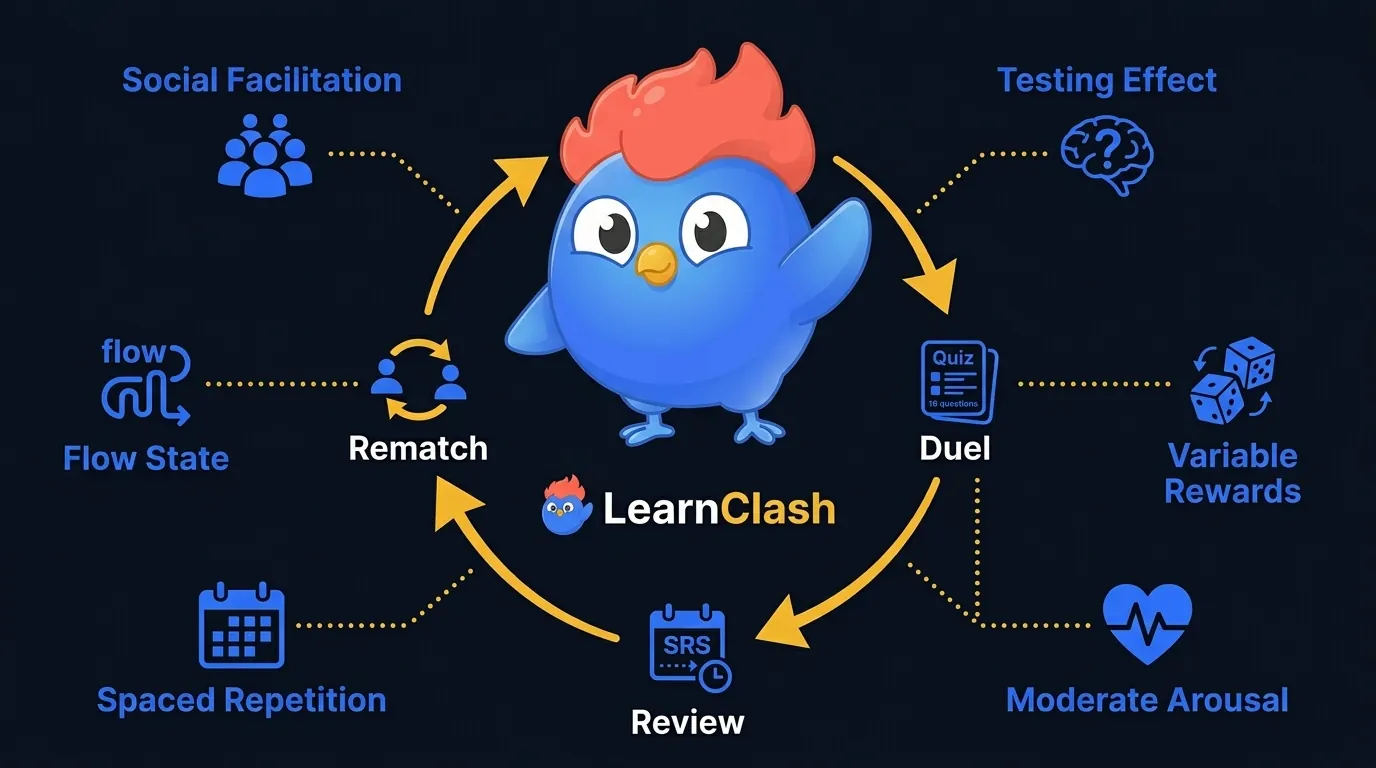
| Science principle | LearnClash feature | What it does |
|---|---|---|
| Testing effect | Every previously encountered question is a retrieval attempt | 18 questions per duel: retrievals plus first-exposure encoding |
| Social facilitation | 1v1 opponent | Zajonc’s arousal at the smallest possible N |
| Flow | Rating-and-category matchmaking | Biases pairings toward close games |
| Desirable difficulty | Per-round difficulty mix | Harder questions enter as the rating climbs, hard capped at 1 per round |
| Prediction error | Unpredictable opponent | Better-than-expected outcomes during encoding |
| Spaced repetition | 3-stage schedule across all modes | Learning (7 days) → Known (90 days) → Mastered |
Solo mode runs beside the duels: six questions on any topic, feeding the same schedule. Miss a card in a duel and it can resurface in Solo. Master it anywhere and it leaves the review schedule everywhere, returning only as a filler when a topic runs short, normally one per round.
Five Conditions You Can Set Up Without an App
The research above reduces to five conditions. You can build all of them with a study partner and a kitchen timer, and the list is worth having even if you never install anything.
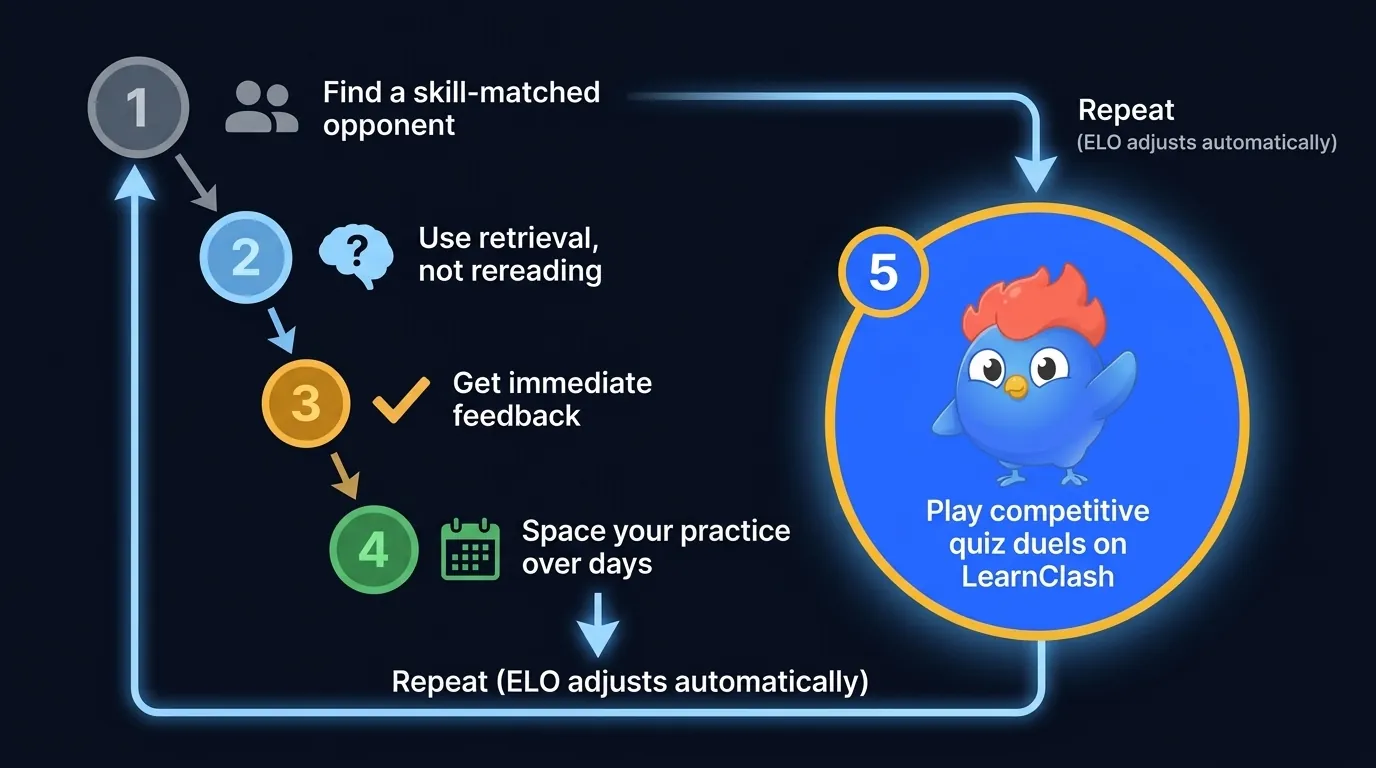
- Find a matched opponent. Quiz a friend, coworker, or classmate at a similar level. Beginner versus expert is the mismatch that Murayama and Elliot’s avoidance pathway feeds on.
- Quiz on material you have both already met. Competition taxed new learning in DiMenichi and Tricomi’s second experiment. Save the contest for retrieval.
- Reveal the answer after every question. Retrieval without feedback lets a wrong answer settle in.
- Spread the sessions out. As a rule of thumb, two short contests a week beat one long one; spacing is what the testing effect literature keeps finding.
- Keep the stakes small. A score that moves a little each time sits where approach goals live. Public shaming is the other pathway.
For the rating math in full, ELO rating system explained covers Glicko-2 in quiz contexts; the testing effect covers why retrieval beats rereading; and does Quizlet have spaced repetition compares scheduling systems. Best trivia apps ranks eleven of them, LearnClash included.
“The best moments in our lives are not the passive, receptive, relaxing times … The best moments usually occur if a person’s body or mind is stretched to its limits in a voluntary effort to accomplish something difficult and worthwhile.” Mihaly Csikszentmihalyi, Flow: The Psychology of Optimal Experience (1990)
Corrections, August 2026: every citation on this page was re-verified. “Morita et al. (2015)” is Ukezono et al. (2015). “Salehi et al. (2019)” is Jiang et al. (2019), which did not measure a moderate-cortisol optimum. The +0.32 effect size belongs to Slavin (1995), not Johnson, Johnson, and Stanne. The Duolingo 12 percent figure comes from Settles and Meeder’s spaced-repetition model, not from Elo ratings. Two unsourced quotations were removed, and LearnClash matchmaking has two scoring factors, not three.
Explore more learning science articlesFrequently asked questions
Does competition help or hurt learning?
In educational psychology, competition triggers two opposing forces: performance-approach goals (wanting to demonstrate skill) and performance-avoidance goals (fear of looking bad). Murayama and Elliot's 2012 meta-analysis found these cancel out, leaving no noteworthy net effect. The outcome depends on design. LearnClash tips the balance with skill-matched opponents and retrieval-based quiz duels.
Is cooperation or competition better for learning?
Johnson, Johnson and Stanne's 2000 meta-analysis of 164 studies found cooperative methods beat competitive instruction on achievement. Slavin (1995) showed the edge depends on group goals and individual accountability: a median effect of +0.32 with them, +0.07 without. For an individual arithmetic game, Plass et al. (2013) found competitive play increased in-game learning over solo play, though out-of-game fluency did not differ by condition.
What is social facilitation and how does it affect quiz performance?
Social facilitation is the finding that people perform better on well-practiced tasks when others are present. Zajonc described the mechanism in 1965: the mere presence of another person raises arousal, which strengthens the dominant response. For a quiz question you have already learned, the correct answer is the dominant response, so an opponent's presence favors recall. For material you are still acquiring, the same arousal works against you.
Can playing trivia games actually make you smarter?
Yes, when the game includes retrieval practice and spaced repetition. Trivia exercises memory retrieval under time pressure, and Karpicke and Roediger (2008) showed repeated testing produced about 80% retention a week later versus about 36% for items that were restudied but not retested. LearnClash pairs competitive trivia with a 3-stage spaced repetition schedule that brings missed answers back.
What is desirable difficulty and why does challenge improve memory?
Desirable difficulty is Robert Bjork's 1994 concept describing how certain challenges during learning strengthen long-term retention. Conditions that feel harder produce better results: spacing, interleaving, and testing all qualify. LearnClash creates desirable difficulty through rating-matched opponents, a per-round difficulty mix tied to your rating band, and spaced review scheduling.