
Why We Threw Out the 1/3/7/21 Spaced Repetition Schedule [2026]
We found no academic source for the 1/3/7/21 schedule. Here's what real SRS algorithms do, and the 3-stage system LearnClash built.

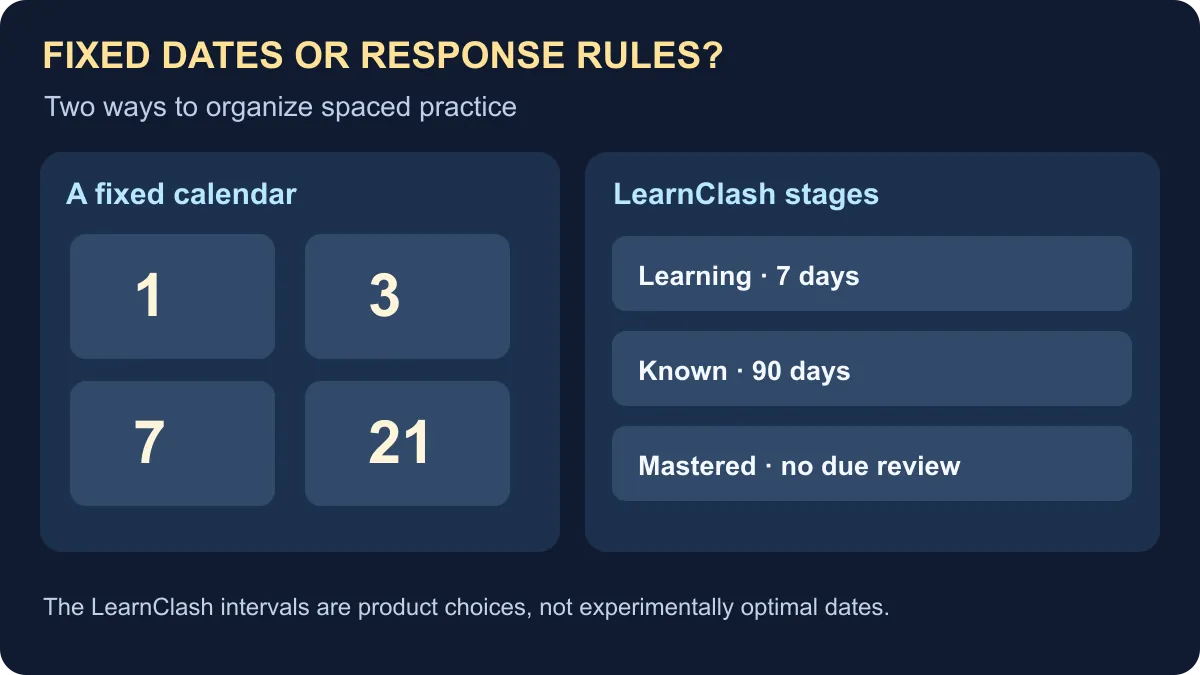
Search for a spaced repetition schedule and the same four numbers come back on every blog: 1, 3, 7, 21. Their origin is much harder to pin down.
We went looking for the source because we had to pick intervals for LearnClash and wanted a citation to stand behind. We did not find one. Sebastian Leitner’s 1972 boxes were measured in centimeters, not days. The algorithms inside Anki and SuperMemo compute every gap from recall history.
So we built a 3-stage system instead, and this piece is the argument for it: where the uncertainty around the ladder’s origin, what Cepeda et al. (2008) actually measured, and why our current design uses 7 and 90 days. Duel me on memory psychology →
What Is the 1/3/7/21 Spaced Repetition Schedule?
It is a fixed-interval review method. You study new material, then review it on day 1, day 3, day 7, and day 21. Every card on the same ladder, every learner on the same calendar.
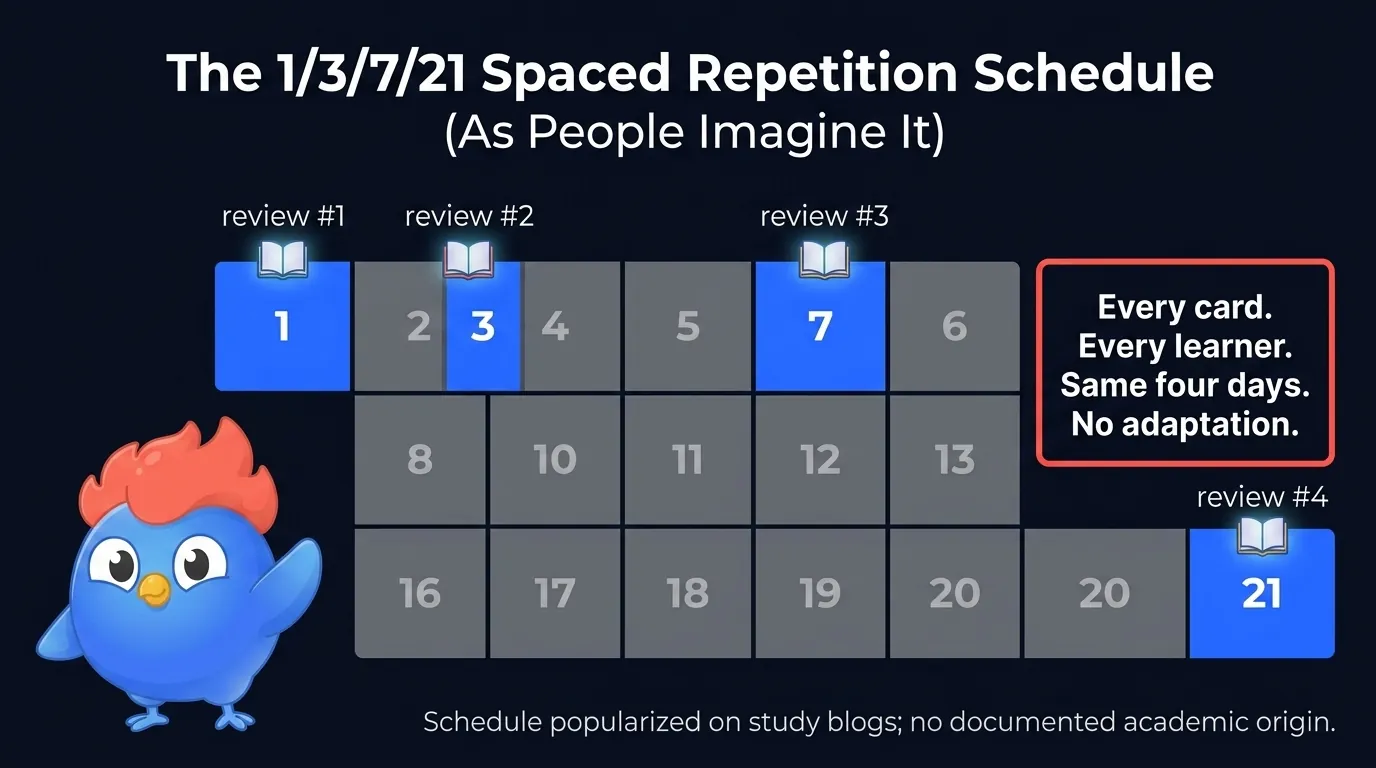
You find it on Notion templates, Reddit study guides, and exam-prep posts on Medium. Clean, memorable, fixed. Those features make it easy to reuse.
What the format never says out loud is that it treats every flashcard like every other flashcard. The vocabulary word you nailed on the first try gets the same day 3 review as the one you failed four times, and the kanji you have drilled for a month gets the same day 21 review as the one you met yesterday.
Adaptive spaced repetition branches. Get a card right and the next review moves further out; get it wrong and the gap shrinks. A fixed schedule can still help you study. It cannot adjust when one card needs more work than another.
Where Did the 1/3/7/21 Schedule Actually Come From?
We found no primary academic source that introduces this exact sequence. Sebastian Leitner’s 1972 book So lernt man Lernen introduced the five-box system behind most modern SRS work, and his original was not a day calendar at all. It was five cardboard compartments measuring 1, 2, 5, 8, and 14 centimeters, and you reviewed a box when it filled up.
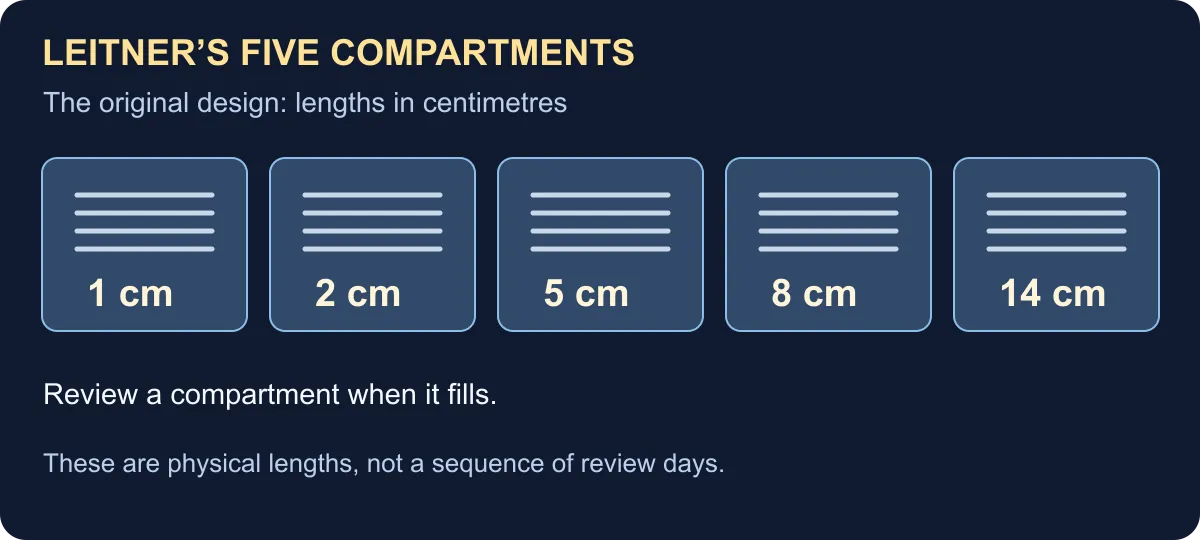
The trail for the ladder itself ends at blog posts citing other blog posts: study YouTubers, Notion templates, and productivity sites that rank for “best spaced repetition schedule” without linking a paper that establishes where those particular four dates came from. We cannot tell you who wrote the numbers down first, and as far as we can find, neither can anyone who repeats them.
Even academic-adjacent sources do not help. Birmingham City University’s revision guide teaches a “2357 method” instead: study sessions spaced 2, 3, 5, and 7 days apart, counted backwards from the exam. Fixed again. And again, the page cites the forgetting curve in general but no paper that measured those particular numbers against alternatives.
To be fair to both ladders, they are not harmful. Spaced practice often improves delayed recall compared with cramming. Its benefit depends on the task and the gaps. The problem is what they claim to be. Repeating those dates does not establish that a study found this exact sequence to be optimal.
Where Leitner’s intervals actually came from: the width of the box. Larger compartments hold more cards, so the time before a box fills depends on card movement through the system. These physical dimensions do not specify a universal sequence of review days.
What Does the Research Say About Fixed Intervals?
The science says the right gap depends on how long you need to remember. Cepeda, Vul, Rohrer, Wixted, and Pashler (2008) taught 32 trivia facts to 1,354 people, inserted a gap of up to 3.5 months before a single review session, and tested them up to a year later, 26 gap-by-delay combinations in all.

At every test delay, final recall rose as the gap grew, peaked, and then fell. And the peak moved. The best gap was about 20 percent of the test delay for tests a few weeks out, falling to about 5 percent when the test was a year away.
Here is the ridge in the paper’s own recall data:
| Test delay | Best gap measured | Gap as a share of delay |
|---|---|---|
| 7 days | 1 day | 14% |
| 35 days | 11 days | 31% |
| 70 days | 21 days | 30% |
| 350 days | 21 days | 6% |
Hold 1/3/7/21 against that table, remembering that the experiment measured one review per gap while the ladder stacks four. For a quiz a week out, the day 1 review sits right on the measured optimum. For a test a month out, the best gap was 11 days, so days 1, 3, and 7 all come too early and day 21 comes late. For a test a year out, day 21 is close to the best gap the paper measured, but it is also where the ladder stops, so the one review that fits is the last one you get. The ladder happens to land on the 1-day and the 21-day optimums and misses the 11-day one entirely, and this experiment does not establish which four-review ladder works best.
Two things in the data matter more than the exact numbers. The ratio falls as the target grows, so a gap suited to a Friday quiz may not suit a year-out exam. And the costs are lopsided: the authors note that a gap longer than the optimum costs you a little, while a gap that is too short costs you a lot. That does not prove that four reviews on days 1, 3, 7, and 21 would underperform: the study did not test that sequence.
One more study is worth knowing. Kang, Lindsey, Mozer, and Pashler (2014) taught foreign vocabulary over four weeks using either expanding or equal-interval retrieval practice, then tested eight weeks later. Final recall was equivalent. That result does not make every spacing pattern equivalent for every task.
Robert Bjork’s lab calls the underlying principle desirable difficulties: training conditions that slow you down in the moment but pay off in long-term retention. Spacing is the textbook example, and the lab’s own framing is that it works best when the information is hard to access but not impossible. That zone sits in a different place for every card. A per-card scheduler uses recall history to estimate when to review. That is a useful distinction from giving every card the same dates.
How Do Real SRS Algorithms Schedule Reviews?
Piotr Wozniak’s SM-2, shipped in SuperMemo 1.0 in December 1987, is an early computer algorithm for scheduling spaced repetition. It keeps a per-item ease factor that stretches or shrinks the next gap depending on how you graded your own recall. SuperMemo continued developing its algorithms after SM-2.

Anki, released in 2006, built on SM-2 and still ships it as the default scheduler, while FSRS has been a built-in option since version 23.10 in late 2023: you switch it on in the preset that controls the relevant cards.
| Algorithm | Year | What it schedules on |
|---|---|---|
| Leitner box | 1972 | Manual promotion; a box is reviewed when it fills |
| SM-2 (Wozniak) | 1987 | Per-item ease factor and previous interval |
| Anki default scheduler | 2006 | SM-2 derivative with configurable learning steps |
| SuperMemo SM-18 | 2019 | Two-component model: stability and retrievability |
| FSRS-6 | benchmark version | 21 parameters fitted to difficulty, stability, retrievability |
| FSRS-7 | benchmark version | Models fractional intervals and same-day reviews |
| LearnClash 3-stage SRS | 2026 | Accuracy gates at 7 and 90 days |
These systems use review history or card state. Their exact behavior differs, but none of the documented algorithms in this table prescribes the same 1/3/7/21 sequence for every card.
FSRS is the interesting one because it is open. The project’s benchmark dataset contains roughly 727 million reviews from 10,000 Anki users. Its evaluated subsets are smaller after filtering. FSRS-6 fits 21 parameters to three per-card quantities (difficulty, stability, and retrievability) to estimate future recall. This is prediction research, not a LearnClash comparison. The next interval is computed straight from that memory state, with no ladder to climb.
A benchmark version is not an app release. The benchmark includes FSRS-7 and fractional intervals. Check each app’s release notes and settings before assuming it uses the newest model.
We chose a simpler system with three visible stages. Progress depends on correct answers at due reviews, with timing rules described below. This is a product choice, not a measured advantage over another scheduler.
Why We Built LearnClash’s 3-Stage SRS Instead
LearnClash uses three stages: Learning, Known, and Mastered. We chose a small set of visible states for a quiz app where players also track their duel results. The current product constants specify 7 and 90 days; these are design choices, not research-proven optimal intervals.
A scheduler like FSRS offers finer timing and a configurable retention target. Our simpler system makes a different trade-off in control and explainability, whose effect on learning would need a direct comparison.
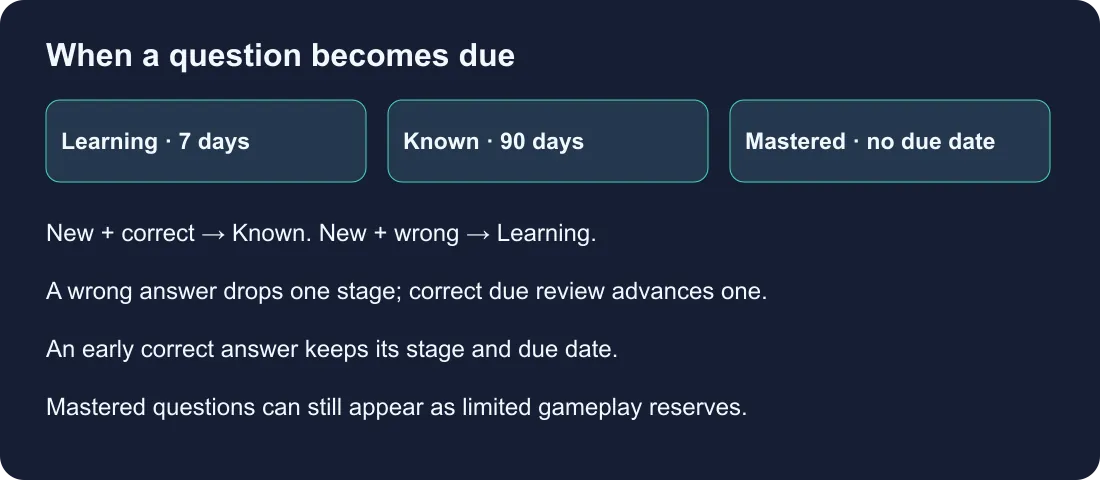
A card’s first answer sorts it: right on first sight and it goes to Known, with the next check 90 days out; wrong and it sits in Learning and comes back in 7 days. Pass the 90-day check and the card is Mastered, which sets its next review so far in the future that it leaves the active pool. Miss at any check and the card drops exactly one stage. A Mastered card you miss goes back to Known, not to the start.
Two details that the diagram hides. If a card happens to come up again before its check (duels draw from a shared pool), a correct answer earns a small bonus but does not advance the stage and does not reset the clock. And “leaves the pool” has a footnote: a mastered card can still appear in a duel when a topic runs out of fresh material for both players, as last-resort filler capped per round. It is out of the review schedule, not banned from the game.
Why 7 and 90, then? We chose a week-scale check followed by a longer check. Cepeda’s research supports relating review gaps to the retention goal, but it did not validate this pair or our game. Seven days is shorter than the 11-day best measured gap for the 35-day test; the paper’s suggestion of reviews several months out for multi-year retention is an extrapolation beyond its longest test. Our intervals should be judged with product evidence, not presented as the study’s prescription.
The trade we made: a 3-stage system offers less timing precision than FSRS. We have not measured a retention-efficiency difference between them. Players can see card stages, their mastered count, and the number of due reviews on the Solo home screen.
We made three design calls that diverge from FSRS:
- Few visible states. Three stages make the review rule easier to explain without scheduler documentation.
- A review endpoint. LearnClash removes mastered cards from scheduled review, while retaining them as possible game filler.
- Demote one stage rather than reset. A miss is a signal, not a verdict.
That third call is a deliberate departure from SM-2, where repeatedly failing a graduated card can drive its ease so low that Anki’s manual has a name for it: ease hell. Our bet is that this simpler behavior suits a quiz game, especially in a competitive app where the same player is also climbing an ELO rating and does not want to think about scheduler internals.
Which Apps Actually Run Performance-Based SRS in 2026?
The documented flashcard schedulers below use per-card recall rather than prescribing 1/3/7/21 for everyone. The differences are in what the default is, and whether the schedule survives the session.

| App | Scheduler | Per-card, across sessions | Note |
|---|---|---|---|
| Anki | SM-2 by default; FSRS built in since 23.10 | Yes | FSRS must be switched on |
| SuperMemo | SM-18 and later versions | Yes | Check the algorithm in your installed version |
| RemNote | Anki SM-2 by default; FSRS available | Yes | FSRS must be switched on |
| Mochi | Own lengthen-or-shorten scheduler; FSRS available | Yes | FSRS is optional |
| Brainscape | Confidence-Based Repetition, you rate each card 1 to 5 | Yes | Self-rated, not answer-checked |
| Quizlet | Web Flashcards spaced repetition | Yes | Four recall ratings; separate from Learn |
| LearnClash | 3-stage SRS, checks at 7 and 90 days | Yes | On in every mode, no ads in any tier |
Quizlet now documents spaced repetition in web Flashcards: you rate each card Repeat, Hard, Okay or Easy, and those answers affect when it returns, from minutes for a missed card to four or more days for an easy one. That is a current scheduling feature. It is separate from Learn, and this help page does not establish its subscription eligibility.
Pick based on the task: a flashcard scheduler for your own study material, or LearnClash for topic quizzes with friends and scheduled review. We have not run a controlled retention comparison between these apps.
Our position is narrower: a fixed calendar does not personalize review intervals. That does not make every fixed schedule useless. Our Anki versus Quizlet comparison looks at the study workflows in more detail.
If You Were About to Copy the Template
Take the spacing and leave the numbers. We have not found a primary source tying the exact 1/3/7/21 sequence to Leitner or Wozniak. Cepeda et al. (2008) found the right gap is a moving share of your retention target, in a study of individual review gaps. Pick a system whose scheduler responds to your recall, not to a date on a Notion template.

If you want the rest of the argument, the learning science cluster covers retrieval practice and the LearnClash retention curve in more depth.
Sources used in this article:
- Cepeda, Vul, Rohrer, Wixted, and Pashler (2008), “Spacing Effects in Learning: A Temporal Ridgeline of Optimal Retention,” Psychological Science
- Kang, Lindsey, Mozer, and Pashler (2014), “Retrieval practice over the long term” Psychonomic Bulletin & Review
- SRS Benchmark, open-spaced-repetition project
- Anki manual, deck options (FSRS, SM-2, ease)
- Sebastian Leitner system, So lernt man Lernen (1972)
Frequently asked questions
Is 1/3/7/21 a real spaced repetition schedule?
It is a fixed spaced-practice schedule, but we found no academic source validating those exact days as optimal. Sebastian Leitner's 1972 system used five physical compartments measuring 1, 2, 5, 8, and 14 cm, each reviewed when it filled up, with no documented day schedule. Adaptive review systems (SM-2, FSRS, LearnClash's 3-stage SRS) schedule reviews on individual recall performance, not a fixed calendar.
What's the best spaced repetition schedule?
Cepeda et al. (2008) found the best gap scales with how long you want to remember: about 20 percent of the delay for a test a few weeks out, falling to about 5 percent at one year. For a week, review after a day. For something you want to keep for years, the paper recommends a review several months out. This does not validate LearnClash's exact 7-day and 90-day checks.
Why does LearnClash use 7 and 90 days instead of 1/3/7/21?
We chose a week-scale check and a longer check. Cepeda et al. did not test or validate this exact pair. A correct answer on a due review advances the card. Mastered cards leave scheduled reviews, though they can appear as limited game filler. A miss drops the card one stage.
What is the 2357 method?
The 2357 method (study sessions spaced 2, 3, 5, and 7 days apart, counted back from the exam) is an alternate fixed-interval revision schedule taught at some UK universities. Like 1/3/7/21, it treats every card the same and ignores individual recall. Performance-based SRS adapts the gap per card.
Does Anki use 1/3/7/21?
No. Anki's default scheduler is SM-2, and it has shipped FSRS as a built-in option since version 23.10; both compute the next review from per-card recall history. Learning steps for new cards are configurable, but the documented SM-2 and FSRS algorithms do not prescribe a universal 1/3/7/21 ladder.