
43 Disney Trivia Questions [With Answers]
43 Disney trivia questions across movies, parks, Walt Disney history, princesses, and deep cuts, each with the answer and the reason people miss it.
How many do you know?
Think of your answer, then reveal it.
Did you know it before revealing the answer?
Read this answer in the articleRound complete
Challenge friends on this topic.
Start a new duel in LearnClash and learn from every answer.
Get LearnClashFree to play on iPhone and Android. No ads.
Try the questions you missed once more.

Walt Disney didn’t draw Mickey Mouse. Snow White is fourteen. And Doritos were invented at Disneyland.
These 43 Disney trivia questions dig into movie production secrets, theme park engineering tricks, Walt’s own life, princess deep cuts, and facts that trip up grown adults who grew up on these films. Each one comes with the answer and a quick note on why it catches people off guard. We cross-checked the facts against D23, the official Disney fan club and the Walt Disney Archives.
You get six categories at three difficulty levels. Disney is also one of the 22 topics in our full trivia question library, which runs from science to pop culture.
Challenge a friend to Disney trivia on LearnClash
Quick Overview
Every question below is tagged by category and difficulty, and most of the 43 sit in the medium and hard range. Easy Disney facts stop fooling anyone past about age ten.
| Category | Questions | Easy | Medium | Hard |
|---|---|---|---|---|
| Disney Movie Trivia | 1-8 | 2 | 3 | 3 |
| Disney Parks & World Trivia | 9-16 | 2 | 3 | 3 |
| Walt Disney & Company History | 17-23 | 1 | 3 | 3 |
| Disney Princess Trivia | 24-30 | 2 | 3 | 2 |
| Hard Disney Trivia | 31-37 | 0 | 0 | 7 |
| Easy Disney Trivia for Kids | 38-43 | 6 | 0 | 0 |
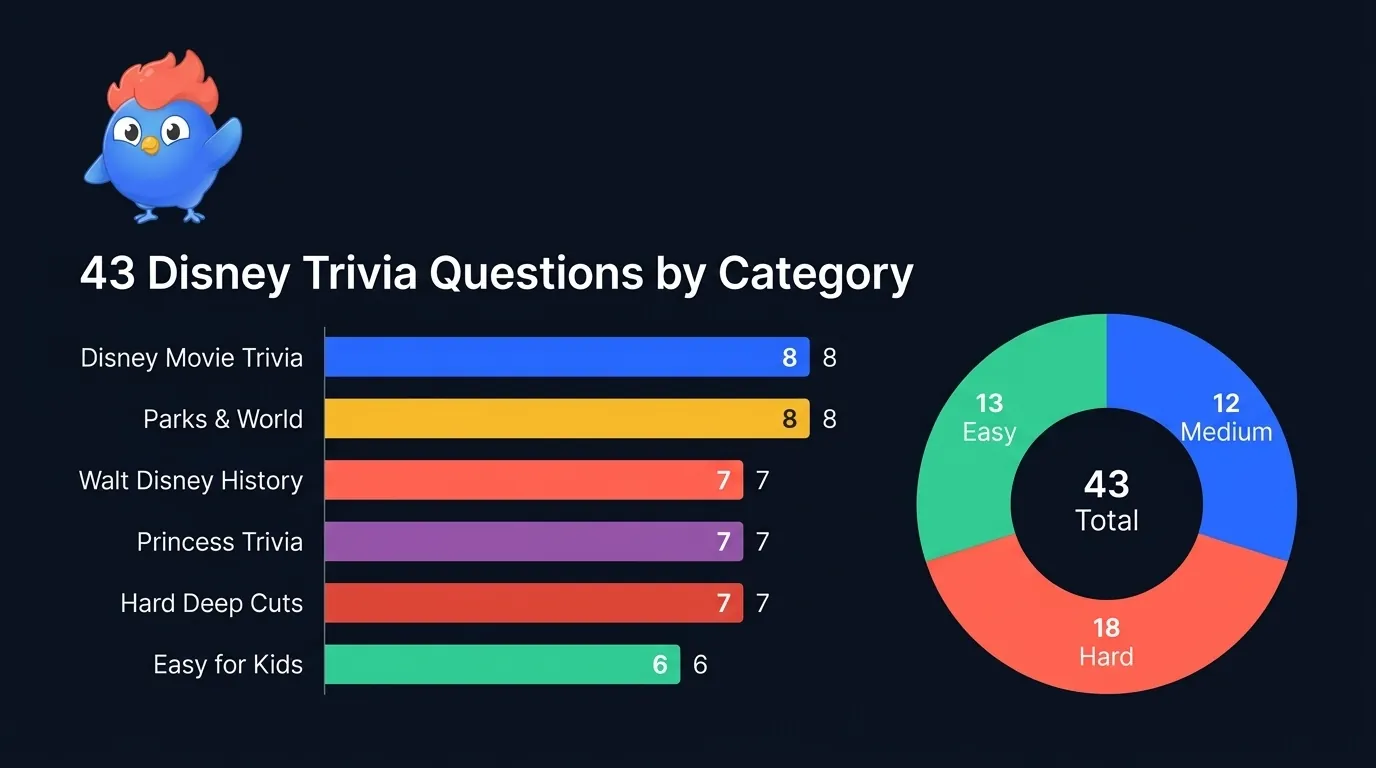 Where the 43 questions land: six categories, with 13 easy, 12 medium, and 18 hard.
Disney trivia has a funny pattern. You feel most certain about the exact questions you’ll miss, because the “everybody knows that” facts sit on the widest gap between confidence and accuracy. That gap is also what makes a missed fact lodge in your memory through spaced repetition.
Disney Movie Trivia Questions (1-8)
You’ve seen these films a dozen times, and that’s exactly the problem. Familiarity breeds certainty, not accuracy. The same trap shows up in movie trivia questions, where a misquoted line beats a forgotten plot every time.
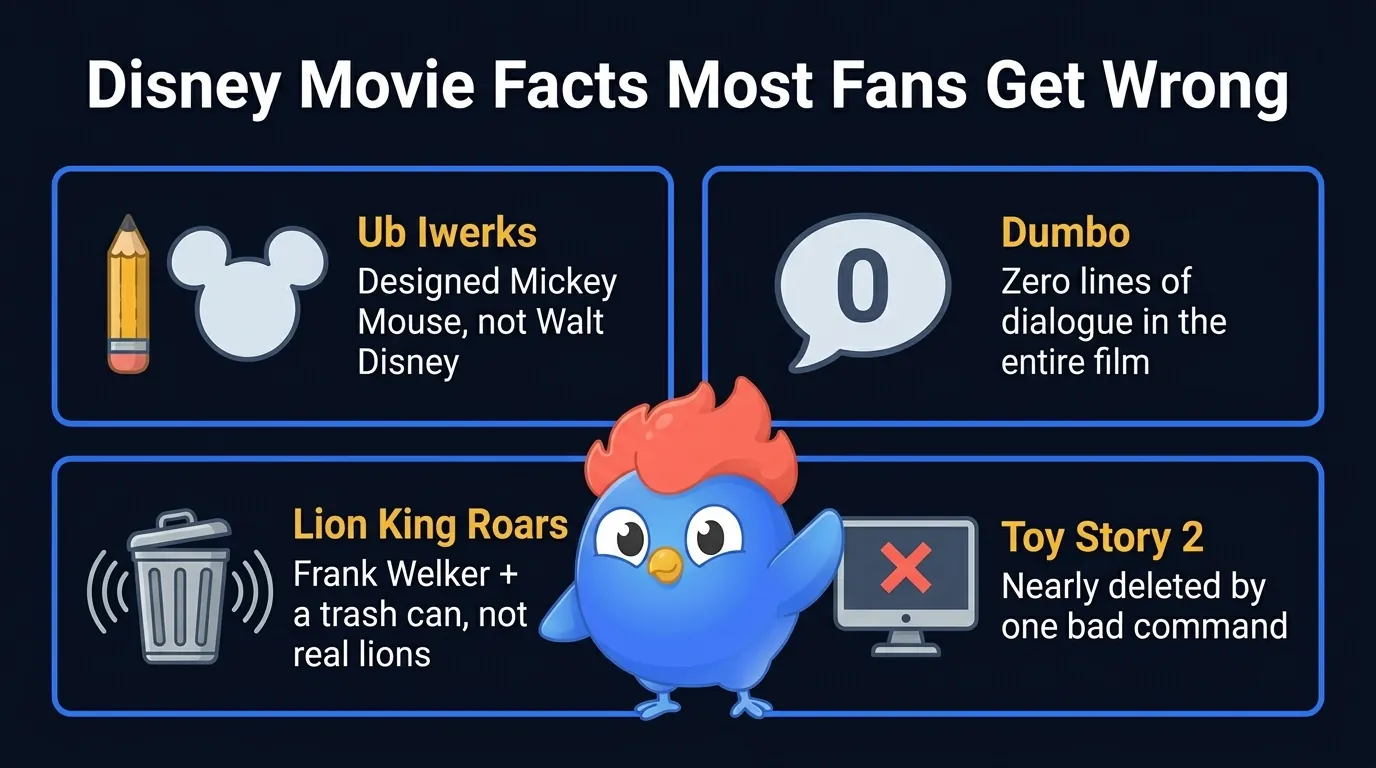 Eight movie production facts most Disney fans get wrong on the first try.
1. Who actually designed and animated the original Mickey Mouse? Medium
Answer: Ub Iwerks. Walt Disney co-created the character concept and provided the voice for nearly 20 years, but Iwerks designed Mickey’s look and single-handedly animated the first shorts, including Steamboat Willie.
Walt gets the credit because his name is on the logo and the company, and the “Walt drew Mickey on a train” story is one of the most repeated origin myths in entertainment. Iwerks held the pencil. Walt did everything else.
2. Dumbo holds a unique Disney record. What is it? Easy
Answer: He has zero lines of dialogue. Dumbo is the only Disney protagonist who never speaks in the entire film.
Dumbo’s personality is so vivid you’d swear he talked. Every emotion rides on his ears, his eyes, and how the characters around him react, and that silence was a deliberate choice by the animators. It slips right past you until someone points it out.
3. How many lines does Princess Aurora speak in Sleeping Beauty? Medium
Answer: 18 lines. She’s on screen for roughly 18 minutes of a 75-minute film. The title character is barely in her own movie.
Her name is in the title, so she should be everywhere. In practice the three good fairies carry the whole film. Aurora nods off at the 45-minute mark and stays asleep until the climax, which makes her closer to a plot device than a lead.
4. In The Lion King, where did Mufasa’s and Simba’s roars actually come from? Medium
Answer: Voice actor Frank Welker growling into a trash can, supplemented by tiger vocalizations. No real lion roars were used for the main characters.
It’s a film about lions, so of course you assume the roars are real. But a real lion roar sounds like a distant foghorn on film, too soft and flat for the screen. Tigers come through louder and sharper, and pairing a tiger with a voice actor growling into a metal trash can produced the sound you’ve had memorized since childhood.
5. Toy Story 2 almost didn’t exist. What nearly destroyed it? Hard
Answer: Someone accidentally ran a deletion command on the film’s root directory, erasing 90% of the movie’s files. Backups had been failing for a month without anyone noticing. Technical director Galyn Susman, working from home after having a baby, had a copy on her home computer. She and a colleague drove it back to Pixar wrapped in blankets.
A billion-dollar franchise was sitting on a server when someone fat-fingered a delete command, and 90% of the film evaporated in seconds. The backups everyone trusted had been quietly failing for a month, so there was no safety net at all. The movie you can quote line for line survived because one new mom kept a copy on her home machine.
6. What was Woody’s original character design in Toy Story? Hard
Answer: A ventriloquist dummy. And he wasn’t charming. Early scripts wrote Woody as a sarcastic bully who terrorized the other toys. Test audiences hated him so intensely that Pixar halted production and redesigned the character from scratch.
Woody ranks among the most beloved characters in animation, so the notion that he began as a creepy, mean-spirited puppet clashes with everything about the finished character. Tom Hanks didn’t sign on until after the redesign.
7. What was Ariel’s original hair color in The Little Mermaid? Easy
Answer: Blonde. Disney changed it to red to differentiate Ariel from Daryl Hannah’s blonde mermaid in Splash (1984). Animator Glen Keane fought executives who insisted mermaids should have blonde hair.
Ariel’s red hair is so locked in that any other color feels wrong. A rival movie forced the switch, and one animator had to argue his own bosses into it.
8. What was Hocus Pocus’s biggest box office problem? Hard
Answer: Disney released it in July 1993, not October. A Halloween movie competed against summer blockbusters like Jurassic Park and flopped. It didn’t become a cult classic until years of TV reruns on ABC Family transformed it into a Halloween tradition.
Hocus Pocus wears the “beloved classic” label now, but on release it was a commercial disaster. Disney undercut its own Halloween movie with a summer date that made no sense, and it took roughly a decade of cable reruns before the film found the audience it has today.
Think you know Disney movies? Prove it on LearnClash
Disney Parks & World Trivia Questions (9-16)
Every Disney park runs on engineering tricks and behavioral psychology you walk straight past. The most visited theme parks on earth are built to fool you, and they’re very good at it. Most guests never spot a single trick.
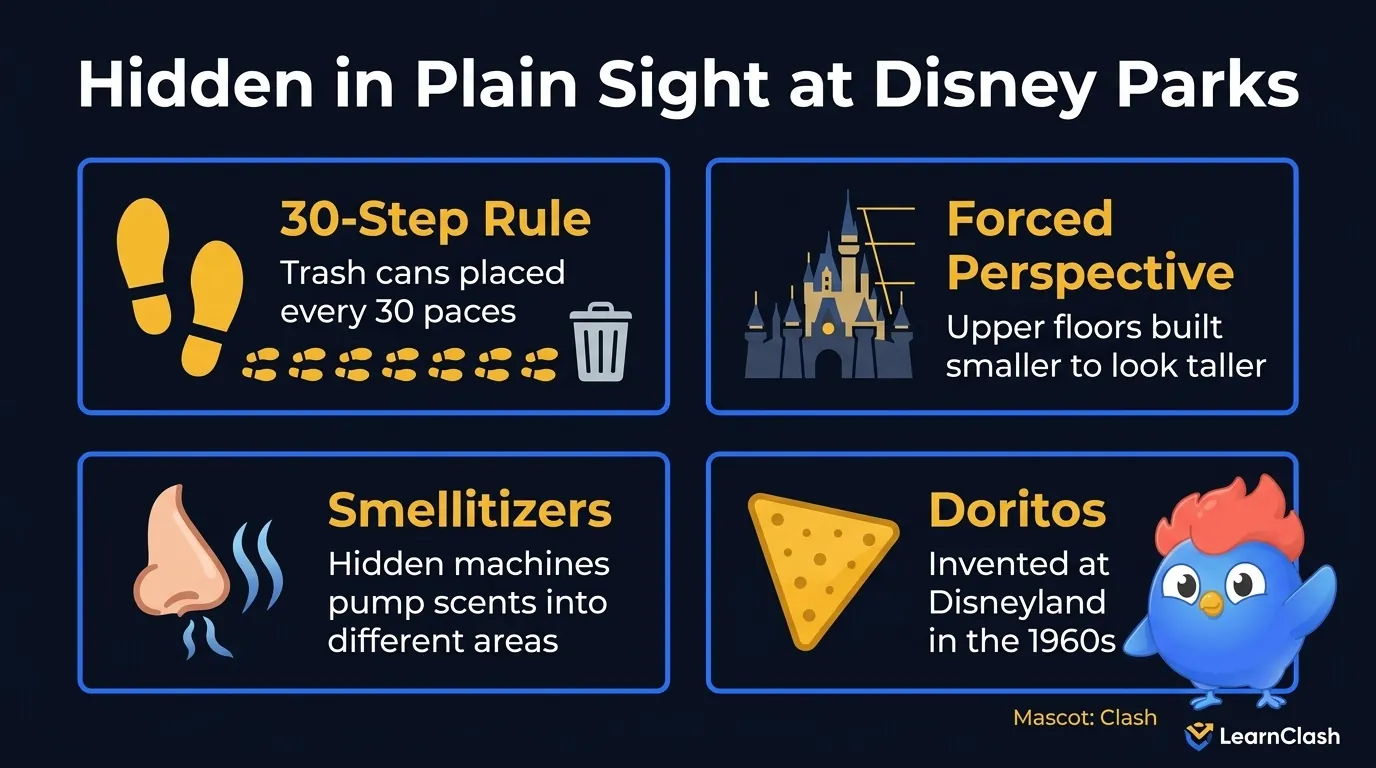 Eight theme park secrets hiding in plain sight at Disney World and Disneyland.
9. What is Disney’s “30-step rule” for trash cans? Easy
Answer: Walt Disney observed that park guests walk about 30 steps before dropping garbage, so he placed trash cans exactly 30 paces apart throughout the parks.
Your first guess is a giant custodial crew, and sure, that helps. But the real foundation is behavioral research Walt ran himself, clocking how far someone would carry a hot dog wrapper before giving up.
10. Why does Cinderella Castle look taller than 189 feet? Medium
Answer: Forced perspective. The upper floors are built at a smaller scale than the lower ones, tricking the eye into seeing a taller structure. The windows, turrets, and spires get progressively smaller as they go up.
You don’t catch it until someone tells you, and then you can’t unsee it. Nearly every big structure in the park leans on the same optical illusion: Main Street buildings shrink as they rise, the Tower of Terror does it too, and even the trees go in by size to fake depth.
11. What are the tunnels under Magic Kingdom called, and what’s wrong with calling them “underground”? Medium
Answer: Utilidors (utility corridors). And they’re not underground. Magic Kingdom was built on the second floor. The tunnels sit at ground level. The entire park is elevated above them.
“Underground tunnels” is the version everyone repeats, and it does sound more dramatic. The engineering flips it completely: Walt didn’t dig down, he built up, so the park rests on top of its own infrastructure rather than below it.
12. Why are all the clocks in the Tower of Terror stopped at the same time? Hard
Answer: 8:05 PM. That’s the moment the fictional lightning bolt struck the Hollywood Tower Hotel on Halloween night, 1939, in the ride’s backstory.
Your eyes pass over the clocks without registering a thing. Yet every prop, every crack in the plaster, every cobweb in that building feeds the story, and the frozen time is a deliberate choice you ride past hundreds of times without piecing it together.
13. Name one product Disney Parks worldwide have never sold. Easy
Answer: Chewing gum. No Disney park anywhere in the world has ever sold gum. Walt didn’t want guests sticking it on rides, walkways, or railings.
Absence is invisible. You can grab turkey legs, lightsabers, and $15 pretzels, but you’ve never spotted a single pack of gum. And odds are you never clocked that until right now.
14. What are “Smellitizers” at Disney Parks? Medium
Answer: Hidden scent machines that pump specific smells into different areas. Fresh-baked cookies on Main Street. Salty brine near Pirates of the Caribbean. Citrus in select queues.
The smells feel completely natural, so you chalk them up to the bakery nearby or the water in the ride. That’s exactly the point. Disney engineers built scent cues so convincing that nobody suspects a machine hidden inside a wall.
15. What sport can you play inside the Matterhorn at Disneyland? Hard
Answer: Basketball. There’s a hoop and a small play area inside the mountain structure, used by cast members during breaks. A climber cast member originally installed it because the interior had empty space.
It reads like an internet myth, but former cast members and Disney historians have both confirmed it. The space sat empty, someone hung a hoop, and it grew into an unofficial tradition.
16. What snack food was invented at Disneyland? Hard
Answer: Doritos. In the early 1960s, a Frito-Lay salesman noticed leftover tortillas being fried and seasoned at a Disneyland restaurant called Casa de Fritos. The chips were so popular with park guests that Frito-Lay VP Arch West developed them into a commercial product. Doritos launched nationally in 1966.
Doritos seem factory-born, a snack with no story behind it. The idea that one of America’s best-selling snack brands began as repurposed kitchen scraps at a theme park restaurant sounds invented, but the paper trail is solid.
Test your Disney parks knowledge on LearnClash
Walt Disney & Company History Trivia (17-23)
Strip away the “magical storyteller” packaging and the real Walt is messier and more interesting. These seven questions land on the decisions, the failures, and the flat-out contradictions the brand never advertises.
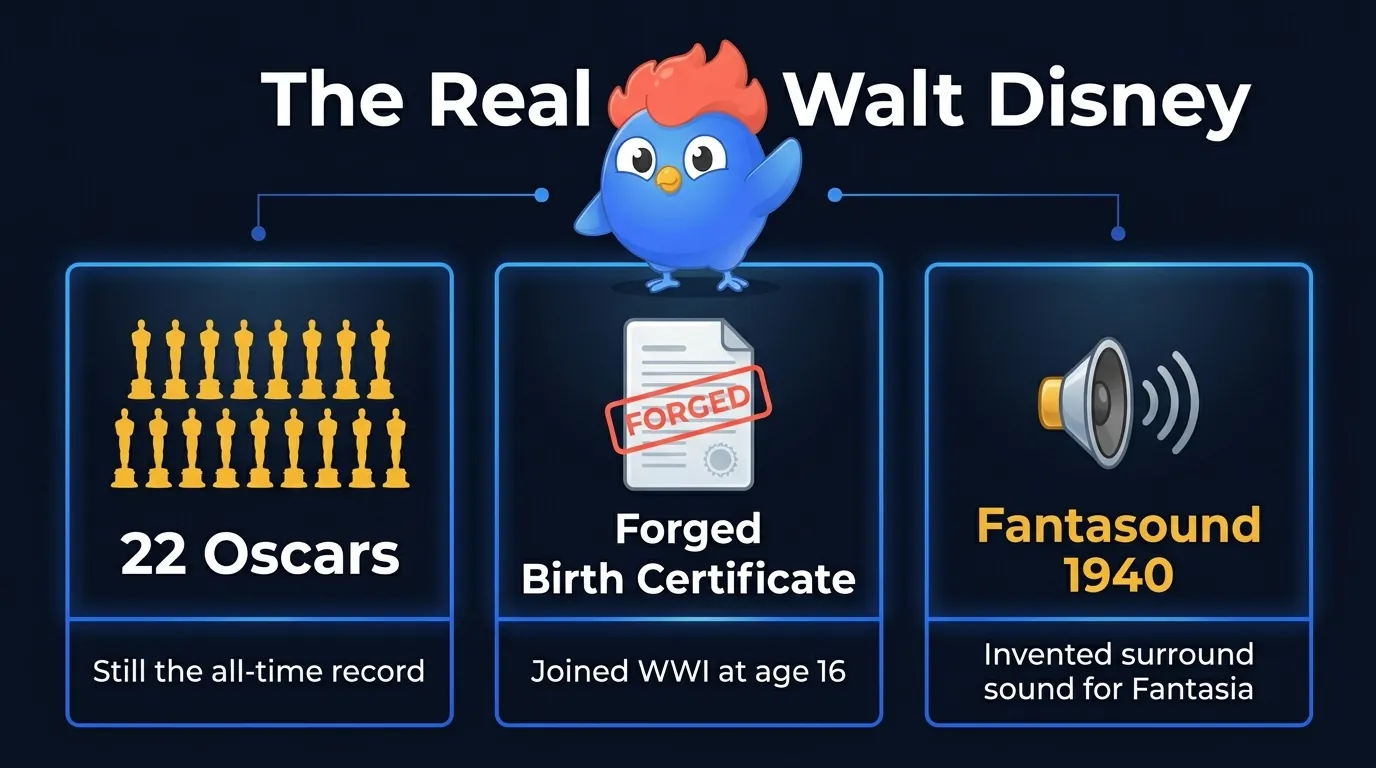 Seven facts about Walt Disney that contradict the storybook version.
17. How many competitive Academy Awards did Walt Disney personally win? Medium
Answer: 22. Plus 4 honorary awards. No individual in history has won more Oscars. The record has stood for over 60 years, and nobody is close to breaking it.
Most guesses land in the single digits. Twenty-two sounds padded because the bulk came from animated shorts and documentaries nobody watches today, but every one was a real competitive Oscar, voted on by the Academy.
18. What was the Walt Disney Company’s original name? Medium
Answer: Disney Brothers Cartoon Studio. Walt and his older brother Roy co-founded it on October 16, 1923. It didn’t become “The Walt Disney Company” until 1986.
Pop culture quietly writes Roy Disney out of the founding story. Walt brought the creative fire and Roy brought the business sense. They built it together from day one, and Roy’s financial discipline is what kept the studio breathing through the lean early decades.
19. What document did Walt Disney forge to serve in World War I? Hard
Answer: His birth certificate. At 16, he was too young to enlist. He changed the birth year to join the Red Cross Ambulance Corps and was sent to France in late 1918.
The founder of the most wholesome entertainment brand alive kicked off his adult life with document fraud. Put “Disney” next to “forged government papers” and your brain refuses to file them in the same drawer.
20. What hidden space did Walt Disney build for himself inside Disneyland? Medium
Answer: A private apartment above the Fire Station on Main Street. He and his family stayed there to oversee park construction and operations. A lamp in the window is kept lit around the clock as a tribute.
Millions walk under that window each year and never tilt their heads up. You can see the lamp from the street, but there’s no sign and no plaque to tell you Walt’s own living quarters sit right over a Main Street gift shop.
21. How close did Sleeping Beauty (1959) come to destroying the Disney company? Hard
Answer: It nearly bankrupted the studio. The film took almost a decade to produce, cost $6 million (the most expensive animated film ever at the time), and lost money at the box office. Disney had to lay off hundreds of employees and pivot to television and live-action films to survive.
We remember Sleeping Beauty as a timeless classic. It was actually a financial disaster that shoved the studio to the edge of collapse, and part of why the “Disney Renaissance” didn’t arrive until the late 1980s is that the studio spent 30 years digging out from this one film.
22. What audio technology did Disney accidentally pioneer with Fantasia (1940)? Hard
Answer: Surround sound. Disney developed “Fantasound,” a multi-channel system that sent different parts of the orchestra to different speakers around the theater. The concept was decades ahead of its time.
Surround sound brings to mind Dolby and 1970s cinema, not a 1940 cartoon about classical music. Disney got there first. The setup cost so much that only two theaters in the whole country could play Fantasia the way it was meant to sound on opening night.
23. Where does the name “Disney” actually come from? Easy
Answer: d’Isigny, a French-Norman family name meaning “from Isigny” in Normandy, France. The family emigrated to England, then to Ireland, then eventually to America. The name was anglicized over generations.
“Disney” sounds American as apple pie, yet the family name is French. A centuries-old immigration story hides inside one of the most recognizable brands on the planet.
Disney Princess Trivia Questions (24-30)
You think you know the princesses. The characters who define animated royalty are stuffed with production details and hidden facts that knock down nearly every assumption fans carry. If the Harry Potter trivia questions on franchise deep cuts were your speed, these seven sort the real experts from the confident guessers.
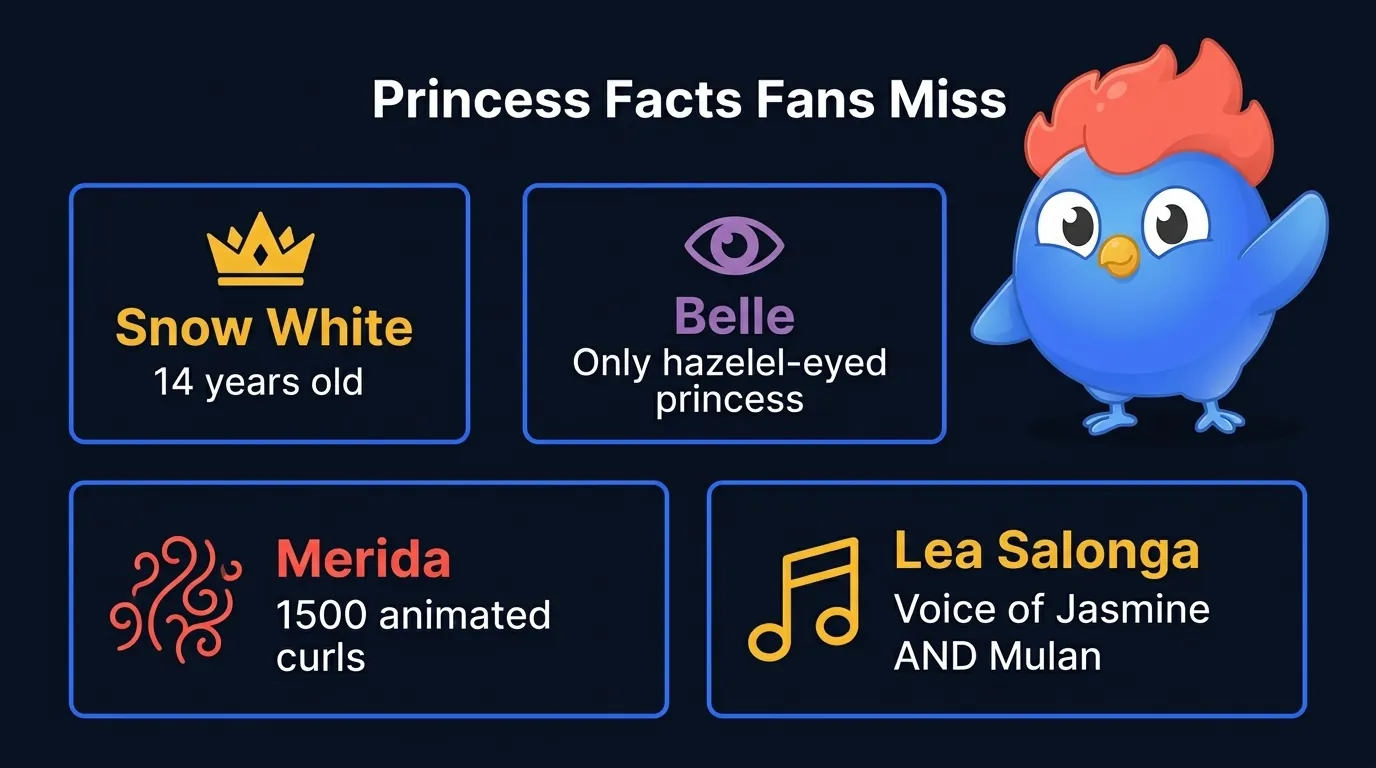 Seven princess facts that even Disney adults miss.
24. How old is Snow White? Medium
Answer: 14 years old. She’s the youngest Disney princess. Disney casting documents from 1934 confirm the age, and Walt himself described her voice actress as sounding “like a 14-year-old girl.”
Try holding the number 14 in your head while you replay the film. Everything reads differently: the stepmother’s jealousy turns darker, the prince’s behavior gets genuinely uncomfortable, and “the fairest of them all” being a child reframes the whole story.
25. Which Disney princess has a different eye color from every other princess? Hard
Answer: Belle. She’s the only Disney princess with hazel eyes. Every other princess has blue, brown, or green.
Nobody tracks eye colors during a cartoon. The animators picked hazel on purpose to set Belle apart, and it works on a subconscious level. You feel she looks different from the other princesses without ever pinning down why.
26. How many individually animated hair strands does Merida have in Brave? Medium
Answer: Approximately 1,500 individually animated curls. Pixar had to develop entirely new simulation software to handle the physics. Her hair took more computing power to render than entire scenes in earlier Pixar films.
Animated hair normally swings around in clumps. Merida’s curls move as 1,500 separate strands, each one answering to gravity, wind, and motion on its own. You never notice the achievement, because the entire goal is to make it look like ordinary hair.
27. Which Disney princess is the only one with a visible tattoo? Easy
Answer: Pocahontas. She has a red armband tattoo on her upper right arm. It’s visible in nearly every frame she appears in.
You’ve seen the movie. You’ve passed Pocahontas a thousand times on merchandise. And you still can’t picture that armband without checking, because we blank on details sitting in plain sight on characters we swear we know by heart.
28. One singer provides the singing voice for both Princess Jasmine and Mulan. Who? Medium
Answer: Lea Salonga, the Tony Award-winning Broadway star. She voiced the singing parts for both characters while different actresses handled the dialogue.
Jasmine and Mulan sound nothing alike, which is the whole trick. Salonga’s range made the two completely distinct, so fans of Aladdin and Mulan almost never connect them. One of Disney’s most talented voices stays one of its least recognized.
29. Tangled almost didn’t feature a princess at all. What was the original concept? Easy
Answer: A modern-day comedy titled Rapunzel Unbraided. Early development positioned it as a non-princess story with a completely different tone. Years of reinvention eventually produced the musical fairy tale audiences know.
Tangled feels like it was born a classic princess musical. It wasn’t. The film changed shape so many times that the version you love shares almost nothing with the first pitch.
30. What makes Mulan’s “princess” status historically incorrect? Hard
Answer: She’s the only Disney “princess” who isn’t royalty by birth or marriage. Mulan is a commoner who earned recognition through military service. Disney included her in the princess lineup for brand purposes despite her having zero royal connection.
The Disney Princess brand promises royalty across the board. Mulan broke that rule, and Disney decided including her beat keeping the lineup consistent. The “Disney Princess” label, in her case, is a marketing call rather than a fact.
Challenge a friend to Disney princess trivia
Hard Disney Trivia Questions (31-37)
Almost nobody nails these on the first try. The seven below dig into Easter eggs, production history, and the kind of facts that humble people who call themselves Disney experts. Clear five of the seven and you’ve earned the title.
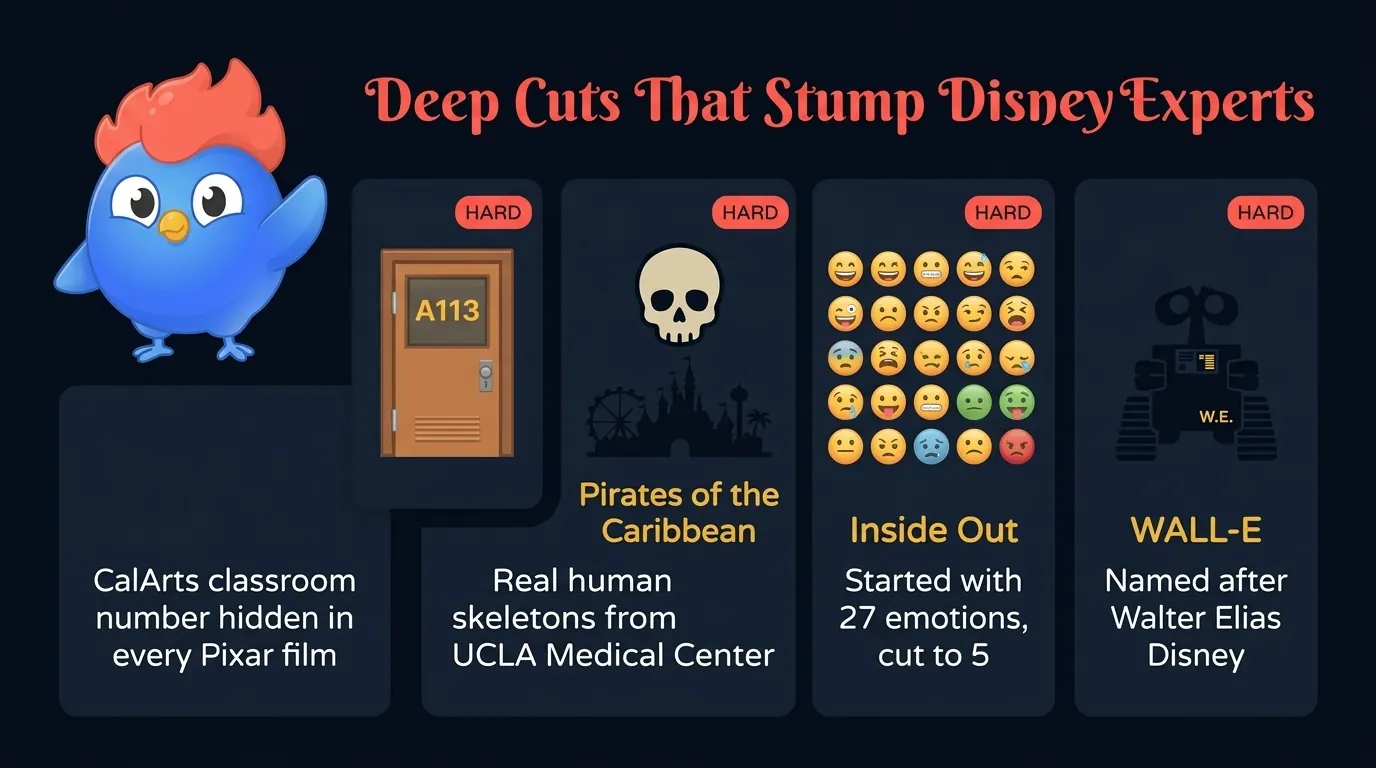 Seven facts that stump even Disney adults.
31. What does the code “A113” mean, and why does it appear in almost every Pixar film? Hard
Answer: It’s the classroom number at California Institute of the Arts (CalArts) where many Pixar and Disney animators studied together. It shows up as a license plate, room number, or hidden code in nearly every film the studio produces.
Spot one or two A113s and you’d never guess it hides in almost every film. What began as an inside joke among CalArts grads hardened into an expectation, with each new project sneaking it in somewhere fresh. Look for it on a camera in Up, a courtroom in A Bug’s Life, and a train car in Toy Story.
32. What dark connection links The Lion King (1994) to Hercules (1997)? Hard
Answer: Hercules wears Scar as a lion-skin rug. During a scene where Hercules poses for a portrait, the lion pelt draped over him is unmistakably Scar, complete with the distinctive dark mane and facial scar. The animators confirmed it was intentional.
Two seconds of screen time, two different films, three years apart. A Greek hero strutting around in a beloved villain’s hide is the exact brand of dark humor Disney buries in frames you’d only catch on pause.
33. Were real human skeletons used in the original Pirates of the Caribbean ride? Hard
Answer: Yes. When the ride opened in 1967, Imagineers felt that fake skeletons looked unconvincing. They obtained real human remains from the UCLA Medical Center. Disney has replaced most with synthetic props over the decades, but some reports suggest a few originals remain. Disney has neither confirmed nor fully denied this.
A family ride in a park built for children once used real human bones as set dressing. It sounds like a campfire legend, but several Disney historians and former Imagineers have gone on record confirming it.
34. How many emotions were originally planned for Pixar’s Inside Out? Hard
Answer: 27. Director Pete Docter spent four years developing the concept with emotions including schadenfreude, ennui, hope, shame, embarrassment, and greed before cutting down to the core five: Joy, Sadness, Anger, Fear, and Disgust.
Five emotions feels like the obvious, natural set. Learn that it almost ran on 27 and you see how much pruning it took to make something simple look inevitable. Inside Out 2 later pulled a few of the cut concepts back off the shelf.
35. What is WALL-E actually named after? Hard
Answer: Walter Elias Disney. The acronym stands for Waste Allocation Load Lifter Earth-class, but the phonetic spelling of W.E. (Walt’s initials) is a deliberate tribute to the company’s founder, hidden inside a product label for a fictional trash-compacting robot.
The in-universe acronym sounds strictly functional, so a Pixar robot and a man who died in 1966 never cross your mind together. Pixar tucked a tribute to Walt straight into the name, and most people sit through the whole film without catching it.
36. How many balloons does the house in Up actually use, and is it scientifically accurate? Hard
Answer: 20,622 balloons on screen. National Geographic calculated it would take roughly 12 million standard balloons to lift a real house. Pixar’s number is purely aesthetic.
20,622 sounds far too precise to be a guess, so you assume Pixar ran the numbers. They didn’t. They settled on a count that looked right on screen and animated each balloon by hand. Real physics would demand a cluster bigger than the house it lifts.
37. How long did it take to write “Let It Go” from Frozen? Hard
Answer: One day. Kristen Anderson-Lopez and Robert Lopez wrote the song in a single session. Before “Let It Go” existed, Elsa was written as a straightforward villain. The song changed her character so completely that Disney restructured the entire film’s plot around it.
The anthem that helped push Frozen to $1.3 billion and defined Disney’s whole decade came together in one sitting. One song didn’t just rewrite a scene. It rewrote who the villain was.
Easy Disney Trivia Questions for Kids (38-43)
Even the easy Disney questions have a little something tucked inside. Families clear these six on LearnClash without much trouble, but the explanations turn each answer into a keeper. For a wider kid-friendly round across animals, dinosaurs, space, and funny facts, our 89 trivia questions for kids stacks Easy, Medium, and Hard tiers for ages 5 to 13.
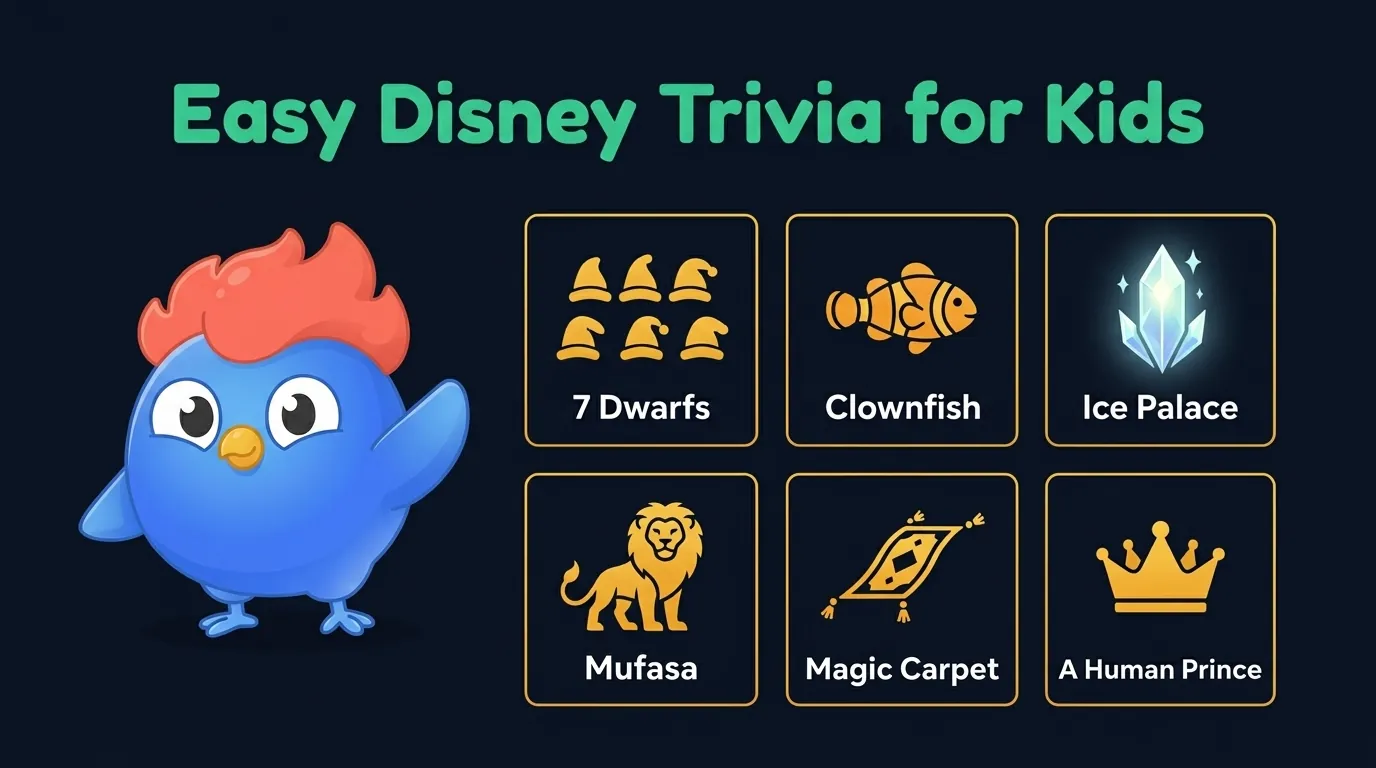 Six family-friendly questions. Simple answers, tricky under time pressure.
38. How many dwarfs does Snow White live with? Easy
Answer: Seven. Doc, Grumpy, Happy, Sleepy, Bashful, Sneezy, and Dopey.
The number seven is easy. Listing all seven names is not. Most tables stall out at five or six, and Bashful and Dopey are usually the first to slip away. Run it at game night and watch everyone start counting on their fingers.
39. What kind of fish is Nemo? Easy
Answer: A clownfish (specifically an ocellaris clownfish, also called a false percula).
Kids answer in a heartbeat. Adults overthink it, because “clownfish” feels too obvious, so grown-ups second-guess and start hunting for something more specific. There is one, and clownfish is still the right answer.
40. What does Elsa build with her powers in Frozen? Easy
Answer: An ice palace on the North Mountain.
Simple question, sneaky distractors. Elsa also conjures a snowman (Olaf), an ice bridge, and a frozen kingdom. With a clock running, all those options buy you a split second of doubt before you land on the palace.
41. Who is Simba’s father in The Lion King? Easy
Answer: Mufasa.
This one usually stumps nobody. But drop in distractors like Scar, Rafiki, and Zazu under a timer, and even the obvious answer earns a pause. Scar is Simba’s uncle, not his father, yet the family tie snags people just long enough.
42. What does Aladdin use to fly? Easy
Answer: A magic carpet.
Blame the distractors. “A lamp” and “a genie” sit at the center of the story, but neither is what Aladdin rides through the sky. With the clock ticking, gut association beats precision and people grab the first Disney word in reach.
43. What animal does the Beast in Beauty and the Beast turn back into? Easy
Answer: A human prince. He was never an animal. He was always a person under a curse.
The phrase “what animal” is bait. Kids who blurt “a prince” beat adults who scramble to name a species. The Beast has no species at all: animators stitched him from several creatures, but underneath the fur he was always human.
Turning 43 Questions Into a Game Night
Split the 43 into rounds of 7 for quiz night, one round per category. Weight the scoring by tier so a hard answer counts triple, and let the parks round run long, because everyone has a personal Disney trip to argue from.
For family game night, read each question aloud and keep the answers to yourself. The explanations double as conversation starters across every age at the table. Kids crush the easy round, adults sweat the hard one.
A side note on why this page exists at all. Nobody at LearnClash sat down and decided the app needed Disney questions. Topics generate on demand when players search for them, and Disney is one of the pools our players pulled into existence themselves. By the July 21, 2026 census that demand-driven catalog had reached 34,157 questions across 655 topics.
Want something more competitive? Challenge a friend to a Disney trivia duel on LearnClash. The questions adapt to your skill level, and spaced repetition keeps bringing back the ones you miss until they stick. That’s the testing effect at work: retrieval beats rereading.
Explore all trivia question categories on LearnClash
If you liked these 43, keep going. Our 43 movie trivia questions dig into behind-the-scenes Hollywood secrets, the 37 Harry Potter trivia questions chase franchise deep cuts, and the 47 video game trivia questions cover Kingdom Hearts, Epic Mickey, and the Square Enix collaborations that kept Mickey canon in gaming. There’s also a Marvel trivia set on the superhero universe Disney acquired in 2009. For a multi-generation gathering, pair Disney with our 43 Father’s Day trivia questions, or test the whole table with our general knowledge questions that stump everyone. And for the science behind why quizzing yourself sticks, read up on the testing effect.
Frequently Asked Questions
What Disney trivia question does everyone get wrong?
The most missed Disney trivia question involves who created Mickey Mouse. Most people say Walt Disney, but animator Ub Iwerks designed and drew the original Mickey. Walt provided the voice and the vision, but the character design came from Iwerks. It is one of the Disney questions people get wrong most often.
What are the hardest Disney trivia questions?
The hardest Disney trivia questions test behind-the-scenes details: Toy Story 2 was nearly deleted by a single mistyped command, the skeletons on Pirates of the Caribbean were real human remains, and Sleeping Beauty nearly bankrupted the Walt Disney Company. On LearnClash, hard-tier Disney questions stump even self-described experts on the first try.
What is good Disney trivia for kids?
Easy Disney trivia for kids works best with visual and character-based questions: how many dwarfs does Snow White live with, what kind of fish is Nemo, or what does Elsa build with her powers. This list includes 6 easy questions designed for kids and family game night. LearnClash adjusts difficulty automatically for younger players.
How many Disney trivia questions do I need for game night?
30 to 40 Disney trivia questions split into rounds of 7 work best for a two-hour game night. Mix categories: movies for the warmup, parks trivia for the middle rounds, and hard deep cuts as the closer. LearnClash lets you play these as timed duels with automatic scoring and difficulty scaling.
Where can I play Disney trivia against friends?
LearnClash lets you duel friends or matched opponents on Disney trivia with ELO ranking across 8 tiers and built-in spaced repetition. Pick any Disney topic, challenge someone, and the questions you miss come back until you master them. Free on iOS and Android.