
Greek and Roman Mythology Facts People Get Wrong
Greek and Roman mythology facts people get wrong, from 1,565 LearnClash duel answers. Only 36.8% knew Pax is the Roman goddess of peace.

Rome’s goddess of peace is called Pax, simply the Latin word for peace. Asked to name her, only 14 of 38 LearnClash players got it right on the first try.
Across 31 Greek and Roman mythology questions and 1,565 first-try answers in LearnClash duels, players were right 75.2% of the time. Narcissus, the Cyclops’s one eye and Aphrodite all scored near 90% or higher. The misses pile up in Rome: four of the five questions most players got wrong are about Roman gods.
Below are those five with their ancient sources, and every row with its sample size. To test yourself first, take on the Roman gods in a duel.
Rome Trips Players Up More Than Greece
Roman Gods questions scored 70.1%. Greek Gods scored 78.8%. Read that gap with some care, though, because each topic has its own questions, so it compares two sets of questions rather than how well people know two religions.
| Topic | Questions | Answers | Correct | Wrong majority |
|---|---|---|---|---|
| Greek Gods | 13 | 763 | 78.8% | 1 |
| Roman Gods | 16 | 718 | 70.1% | 4 |
| Greek Mythology | 2 | 84 | 86.9% | 0 |
| All three | 31 | 1,565 | 75.2% | 5 |
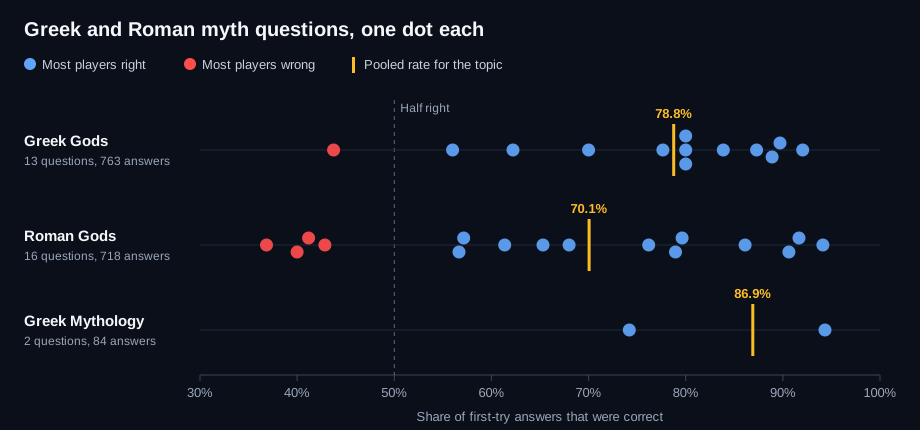
Next to the rest of LearnClash, mythology ran a little harder. Before the canon check described below, the 33 myth questions with at least 30 answers scored 74.8%, while the 1,893 questions from every other topic, held to the same 30-answer floor, scored 77.6%.
Wrong majorities were more common too: 5 of 33 myth questions (15.2%), against 127 of 1,893 elsewhere (6.7%). Five is a small base. Treat it as a lean. And one thing never happened in mythology, though it happened on 35 questions in other topics: a single wrong answer beating the right one.
Where Most Players Went Wrong
Fewer than half of players got these five right. They run from the lowest score up.
Pax is Rome’s goddess of peace: 36.8% (14 of 38)
Justitia, the goddess of justice, was the most popular wrong pick at 18.4% (7 players). Fortuna and Concordia took 13.2% each. Pax had her own cult and her own altar. When Augustus came home from Spain and Gaul, “the senate voted in honour of my return the consecration of an altar to Pax Augusta in the Campus Martius”, he wrote in his Res Gestae. That altar, the Ara Pacis, was dedicated in 9 BC.
The question as players saw it calls Pax “the highest, most abstract concept of divine peace”. That is heavier than it needs to be. The answer still holds: she is the only goddess of peace among the options.
The eagle is Jupiter’s bird: 40.0% (14 of 35)
Raven took 20.0%, hawk 17.1% and peacock 14.3%. Roman writers agree on the eagle. In Ovid’s Metamorphoses, Jupiter falls for Ganymede and will become no bird but “one that had the power to bear his thunderbolts”. Virgil writes of “Juppiter’s fast-flying eagle”. Theoi’s page on the eagle of Zeus collects both passages.
The peacock pick has a family logic. It is Juno’s bird. In Ovid, she spreads the shine of the dead watchman Argus’s eyes across its tail (Metamorphoses, book 1).
Juno is Jupiter’s queen: 41.2% (14 of 34)
Venus took 29.4% (10 players). This row is not new. It made our list of the hardest trivia questions in July at 40.0% of 30 answers, and the misconception index names Venus as its pull. Four more answers since then have barely moved it.
Two other July myth rows sit on that list as well: Persephone’s pomegranate seeds, and Hercules gaining immortality from Juno’s milk. They are missing from this page because their counts can no longer be tied to the questions’ current wording.
Ceres is the goddess of grain: 42.9% (15 of 35)
Proserpina took 22.9% (8 players) and Flora 17.1% (6). Proserpina is Ceres’s daughter, the Roman Persephone, so the top wrong answer came from the right family. Ceres herself was the goddess of agriculture and grain crops, and her link to grain gave English the word cereal (Ceres on Wikipedia).
Proserpina pulled again on a neighboring question. Asked for the goddess of flowers and spring, 61.4% of 44 players chose Flora, and Proserpina was the top wrong pick at 11.4%. That slip makes sense. In the Homeric Hymn to Demeter, her daughter comes back up from the underworld each year “when the earth shall bloom with the fragrant flowers of spring” (Hymn to Demeter). In Ovid’s Fasti, though, it is Flora who hears “Goddess, be queen of flowers” (Fasti, book 5).
Tantalus could never reach food or water: 43.8% (14 of 32)
The question asked why Tantalus could never eat or drink in the underworld. “His jaw was sealed shut” took 15.6% (5 players) and “the food turned to dust” 12.5% (4). Homer’s version is crueler than either. In the Odyssey, Tantalus stands in a pool up to his chin: “as often as that old man stooped down, eager to drink, so often would the water be swallowed up and vanish away” (Odyssey, book 11). Fruit hangs over his head, too:
“But as often as that old man would reach out toward these, to clutch them with his hands, the wind would toss them to the shadowy clouds.” Homer, Odyssey 11, translated by A. T. Murray
Players half-knew him. On a separate question, 56.0% of 50 named Tantalus as the king punished with eternal hunger and thirst. Sisyphus, the man with the boulder, took 14.0%.
Same Fact, Greek or Roman Name
Two facts appear under both names in this cut. Both times, the Greek wording scored higher.
| Fact | Greek question | Roman question |
|---|---|---|
| The king of the gods’ bird is the eagle | Zeus: 70.0% (21 of 30) | Jupiter: 40.0% (14 of 35) |
| Who rules the underworld | Hades: 88.9% (56 of 63) | Pluto: 76.2% (32 of 42) |
The eagle gap of 30 points is larger than chance usually opens between rows of 30 to 35 answers, which is about 23 points either way. The underworld gap of 12.7 points is not. The questions also use different wording, and different players met each one.
I could not test the idea on the rest of the export, because no other topic asks the same facts under two names. So this is a hint about these rows, not a rule about Roman names. My guess, and it is only a guess: most modern retellings tell the Greek versions.
The Myths Nearly Everyone Knows
The top of the table reads like a children’s book of myths. Six questions scored close to 90% or better (questions shortened here; full wording in the table below):
| Question | Right answer | Correct | n |
|---|---|---|---|
| What did Narcissus fall in love with? | His own reflection | 94.3% | 53 |
| What does Cupid shoot to spark romance? | Bow and arrow | 94.1% | 51 |
| How many eyes does a Cyclops have? | One | 92.0% | 88 |
| Which Roman sea god carries a trident? | Neptune | 91.7% | 96 |
| How did Cupid fall in love with Psyche? | He pricked himself with his own arrow | 90.6% | 32 |
| Who is the Greek goddess of love? | Aphrodite | 89.7% | 136 |
Three of the six are Roman, so the Roman lane has easy wins too. Its misses cluster elsewhere: Pax, Ceres, Juno and Jupiter’s bird.
The hard question with the most answers is about Ares. Asked why most Olympians despised him, 62.2% of 90 players chose his bloodlust and senseless violence. That is Homer’s reason. In the Iliad, Zeus tells his own son:
“Most hateful to me art thou of all gods that hold Olympus, for ever is strife dear to thee and wars and fightings.” Homer, Iliad 5, translated by A. T. Murray
The top wrong pick, repeated attempts to overthrow Zeus (11.1%), is not the reason Homer gives.
Myths turn up outside the myth topics, too. In the 7 October export behind Harry Potter facts people get wrong, only 53.9% of 76 players knew that Fluffy, the three-headed dog, is modeled on Cerberus.
Two Questions That Failed the Canon Check
Before reporting any row, I checked each right answer, and each wrong option, against the ancient texts and standard references. Two questions failed. They went back to LearnClash’s question review instead of onto this page.
- Why Pandora opened the jar. The question accepted curiosity as the answer. Hesiod, the oldest source, gives no reason. In Works and Days, “the woman took off the great lid of the jar with her hands”, the evils escaped, and Hope stayed inside under the rim (Works and Days). Curiosity is a motive later retellings added, so our own quiz had repeated a popular retelling as if it were the myth.
- Rome’s goddess of victory. The answer, Victoria, is right. But Venus sat among the wrong options, and Romans did worship Venus Victrix, Venus the Victorious. Pompey dedicated a large temple to her in 55 BC (Venus Victrix). A player who picked Venus had a case.
Together the two held 116 answers at 69.8% correct. Leaving them out moved the pooled rate from 74.8% to 75.2%.
All 31 Questions, From Hardest to Easiest
Each row is a first-try count from LearnClash duels, with the question worded exactly as players saw it. Where wrong answers tied for the most picks, all of them are listed.
| # | Question as players saw it | Topic | Right answer | Correct | Top wrong pick | n |
|---|---|---|---|---|---|---|
| 1 | Which Roman goddess represents the highest, most abstract concept of divine peace? | Roman Gods | Pax | 36.8% | Justitia (18.4%) | 38 |
| 2 | What bird is sacred to Jupiter? | Roman Gods | Eagle | 40.0% | Raven (20.0%) | 35 |
| 3 | Who is the queen and wife of Jupiter in Roman mythology? | Roman Gods | Juno | 41.2% | Venus (29.4%) | 34 |
| 4 | Which Roman deity was celebrated as the highest goddess of agriculture and grain? | Roman Gods | Ceres | 42.9% | Proserpina (22.9%) | 35 |
| 5 | Why could Tantalus never eat or drink in the Greek underworld? | Greek Gods | Food and water pulled away | 43.8% | His jaw was sealed shut (15.6%) | 32 |
| 6 | Which king was punished with eternal hunger and thirst? | Greek Gods | Tantalus | 56.0% | Sisyphus (14.0%) | 50 |
| 7 | In Roman mythology, why did Jupiter turn into animals? | Roman Gods | To seduce lovers without Juno knowing | 56.7% | To travel swiftly across the earth / To punish impious mortals / To spy on mortal cities unseen / To test human hospitality (10.0% each) | 30 |
| 8 | In Roman mythology, why did Juno hate Jupiter’s kids? | Roman Gods | Jupiter fathered them outside their marriage | 57.1% | Jupiter favored them over her children (14.3%) | 35 |
| 9 | Which Roman goddess is celebrated as the highest deity of flowers and spring? | Roman Gods | Flora | 61.4% | Proserpina (11.4%) | 44 |
| 10 | Why was Ares despised by most of his fellow Olympian gods? | Greek Gods | His bloodlust and senseless violence | 62.2% | His repeated attempts to overthrow Zeus (11.1%) | 90 |
| 11 | What weapon does Jupiter hurl at enemies? | Roman Gods | Thunderbolt | 65.3% | Spear (18.4%) | 49 |
| 12 | Which Roman god is king of the gods and hurls thunderbolts? | Roman Gods | Jupiter | 68.0% | Neptune / Vulcan (12.0% each) | 50 |
| 13 | In Greek mythology, what bird is Zeus’s symbol? | Greek Gods | Eagle | 70.0% | Raven / Falcon (10.0% each) | 30 |
| 14 | Why did King Midas desperately beg Dionysus to take back his wish? | Greek Mythology | He could not eat or drink | 74.2% | The gods grew jealous / The gold began to melt (6.5% each) | 31 |
| 15 | Which Roman god rules the underworld? | Roman Gods | Pluto | 76.2% | Jupiter / Neptune (7.1% each) | 42 |
| 16 | Which monster was the most feared, multi-headed serpent slain by Heracles? | Greek Gods | Lernaean Hydra | 77.6% | Chimera / Cerberus (8.2% each) | 85 |
| 17 | Which two-faced god starts the Roman year? | Roman Gods | Janus | 78.9% | Quirinus (8.8%) | 57 |
| 18 | In Roman mythology, why did Saturn eat his children? | Roman Gods | A prophecy said one would overthrow him | 79.6% | To absorb their divine powers (5.6%) | 54 |
| 19 | Which underworld river represents the most intense hatred among the gods? | Greek Gods | Styx | 80.0% | Lethe / Phlegethon / Eridanos (5.7% each) | 35 |
| 20 | Which mortal was the greatest musician, surpassing even some minor gods? | Greek Gods | Orpheus | 80.0% | Linus (10.0%) | 30 |
| 21 | In Greek mythology, who is the god of wine and parties? | Greek Gods | Dionysus | 80.0% | Apollo (10.0%) | 30 |
| 22 | In Greek mythology, who is the god of war? | Greek Gods | Ares | 83.9% | Hermes (9.7%) | 31 |
| 23 | Which Roman god represents the most destructive, untamed power of fire and volcanoes? | Roman Gods | Vulcan | 86.1% | Jupiter (8.3%) | 36 |
| 24 | What bull-headed monster was trapped inside the Cretan Labyrinth? | Greek Gods | Minotaur | 87.3% | Centaur (4.8%) | 63 |
| 25 | In Greek myth, who received the underworld when realms were divided? | Greek Gods | Hades | 88.9% | Thanatos / Zeus (4.8% each) | 63 |
| 26 | In Greek mythology, who is the goddess of love? | Greek Gods | Aphrodite | 89.7% | Athena (5.1%) | 136 |
| 27 | How did Cupid accidentally fall in love with mortal Psyche? | Roman Gods | He pricked himself with his own arrow | 90.6% | Psyche stole his divine bow (6.2%) | 32 |
| 28 | Which Roman god of the sea shakes the waves with his trident? | Roman Gods | Neptune | 91.7% | Jupiter (4.2%) | 96 |
| 29 | How many eyes does a Cyclops possess in Greek mythology? | Greek Gods | One | 92.0% | Two / Five (2.3% each) | 88 |
| 30 | What iconic item does the winged Roman god Cupid shoot to spark romance? | Roman Gods | Bow and arrow | 94.1% | Crossbow and bolt (3.9%) | 51 |
| 31 | What did Narcissus fall in love with while looking in water? | Greek Mythology | His own reflection | 94.3% | A water nymph (5.7%) | 53 |
How I Counted, and What It Can’t Tell You
The counter behind every row moves once per player and question: the first time that player meets the question in a duel. Timeouts, answers helped by an information joker and answers from the browser round stay out, and Solo mode never feeds it. I ran the export read-only against LearnClash’s production database on 14 October 2026.
A question needs 30 answers before it gets its own row. Three more questions reached that bar but were set aside, because their counts could not be tied to their current wording. Norse topics and a mixed-pantheon God topic stay out of the cut, even where their questions reached the floor.
| Step | Questions | Answers | Correct |
|---|---|---|---|
| Every public topic, a complete pass (2,500 topics) | 116,011 scanned | ||
| Greek Gods, Roman Gods and Greek Mythology, 10 or more answers | 206 | 4,640 | 66.1% |
| 30 or more answers, counts tied to current wording | 33 | 1,681 | 74.8% |
| Passed the canon check (this page) | 31 | 1,565 | 75.2% |
Each time a question appears, it shows the right answer and three wrong ones drawn from a pool of five or seven. So a wrong option is on screen only part of the time, and its share understates its pull. Against a model where everyone guesses, two top wrong picks clear the usual 0.05 bar: Venus on the Juno question (p = 0.024) and Proserpina on the Ceres question (p = 0.029). Neither clears the stricter bar that allows for picking the biggest of several options, and none of this proves what anyone believed.
What the numbers cannot tell you:
- How many people. These are answer events. One account appears in many rows, but only once per question.
- What myth fans know. Both players in a duel answer every round, whoever picked its topic.
- Answers by language. The counts pool every app language; the questions are quoted here in English.
- What the public knows. LearnClash’s terms require players to be 13 or older, and everyone here chose to play. This is not a survey.
- Small differences. With 30 to 40 answers, a single row can move about 16 points either way by chance.
- When anyone answered. The counters are cumulative, with no dates, so this is a snapshot of everything recorded up to the export.
The wider misconception index and its data page come from the same kind of export.
Play the Gods Yourself
For questions written to read aloud at a quiz night, our Greek mythology trivia list has 37 of them with the traps explained, and the trivia questions hub covers every other topic. Miss a question in a LearnClash duel and it comes back about a week later, so a slip on Tantalus does not stay a slip for long. Start a Greek gods duel and see where you land against 75.2%.
Frequently asked questions
Which Greek and Roman myth facts do people get wrong most often?
In LearnClash's export of 14 October 2026, five of 31 mythology questions had a wrong majority: Pax as the Roman goddess of peace (36.8% right, n=38), the eagle as Jupiter's bird (40.0%, n=35), Juno as Jupiter's wife (41.2%, n=34), Ceres as the goddess of grain (42.9%, n=35) and how Tantalus is punished (43.8%, n=32).
What bird is sacred to Jupiter?
The eagle. In Ovid's Metamorphoses, Jupiter will turn into no bird except the one that carries his thunderbolts, and Virgil writes of Jupiter's fast-flying eagle. Only 40.0% of 35 LearnClash players picked it; raven took 20.0%.
Why did Pandora open the jar?
Hesiod, the oldest source, does not say. In Works and Days she lifts the lid, the evils escape and Hope stays inside under the rim. Curiosity is a motive that later retellings added.
What was the punishment of Tantalus?
In Homer's Odyssey, Tantalus stands in a pool up to his chin under fruit trees. The water drains away whenever he stoops to drink, and the wind lifts the fruit out of reach. Only 43.8% of 32 LearnClash players picked that answer.
Who answered these questions?
People playing LearnClash, a quiz duel app whose terms require players to be 13 or older, on their first encounter with each question. Both players in a duel answer every round, so not everyone chose mythology. The counts are answer events, not people, and they describe this app's players, not the public.