
163 Ice Breaker Questions [Funny, Work & Deep]
163 ice breaker questions for work, students, meetings, and deep conversations. Fresh prompts with LearnClash safety filters.

Ask a room to “share a fun fact” and watch three people freeze. Most icebreakers fail for that exact reason: they demand a polished identity, delivered out loud, with no warning.
These 163 ice breaker questions go the other way. They ask for fast answers and safe stories, with room for one real follow-up. I screened 240 candidate prompts for this list in April 2026 and cut 77 of them: everything too private, too obvious, too slow, or likely to make a mixed group go quiet.
Use the list in order of trust, not in order of interest. Open with the quick set when nobody is talking yet, pull the work set into meetings, and save the deeper prompts for after people have loosened up.
How We Picked These 163 Ice Breaker Questions
Four words decided every cut: safe, quick, specific, and worth one follow-up. A prompt that missed any one of those was gone, which is how 240 candidates became 163. The dropped 77 were mostly forced vulnerability, answers everyone already knew, ranking pressure, and prompts that would not survive the 45-second timer LearnClash puts on a question card.
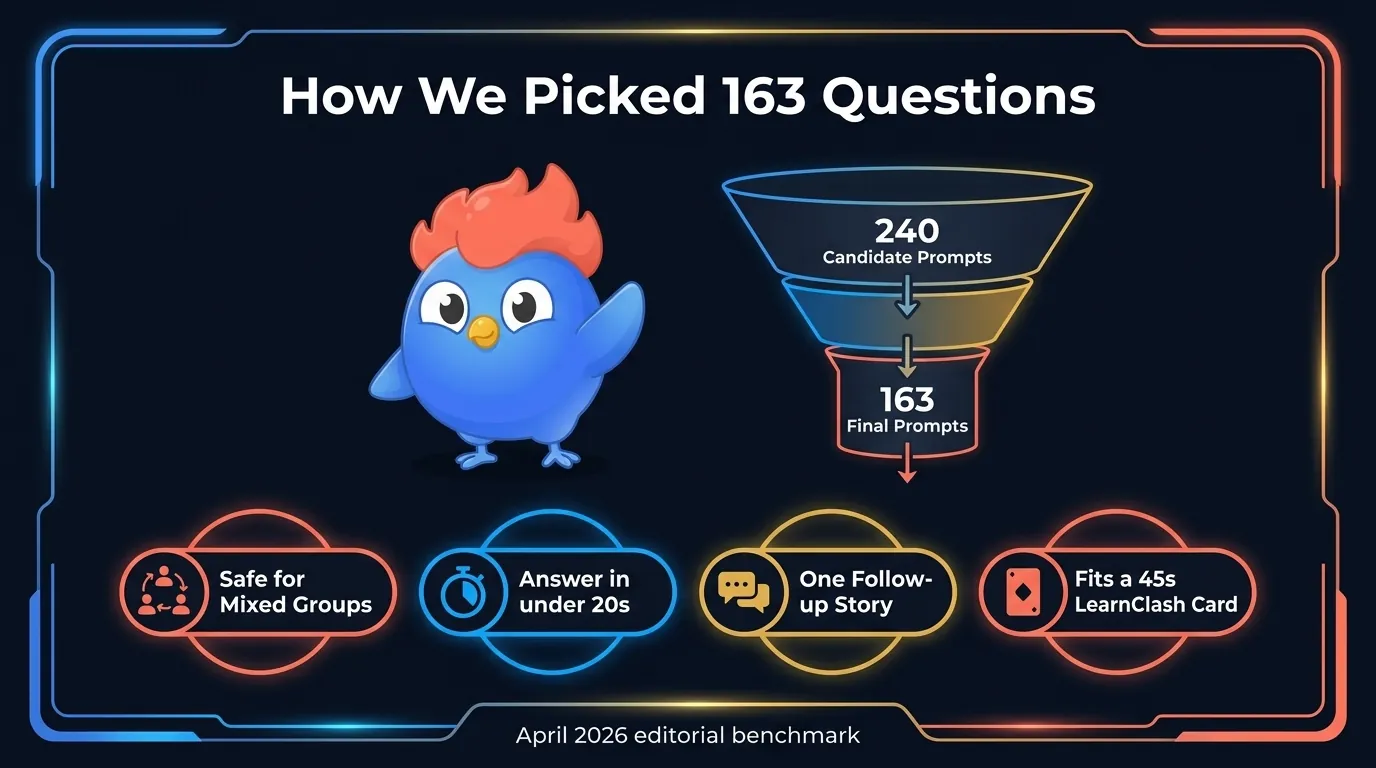 The filter behind the list: safe, fast, specific, and replayable beat long, awkward, and personal.
Search for icebreakers and you get giant lists, a few useful, most sharing one flaw: they treat “personal” and “interesting” as the same thing. A question can reveal something real without making someone defend their childhood, salary, health, family plans, or politics in front of near-strangers.
I ran each candidate through the same blunt checks I use on an actual quiz card before it ships to players. Could someone answer in under 20 seconds? Could they tack on a one-sentence story if they wanted to? And would a quiet person, a brand-new teammate, a high schooler, and a remote coworker logging in from three time zones away each find a clean, unforced way into the same prompt? A no on any of those killed the prompt.
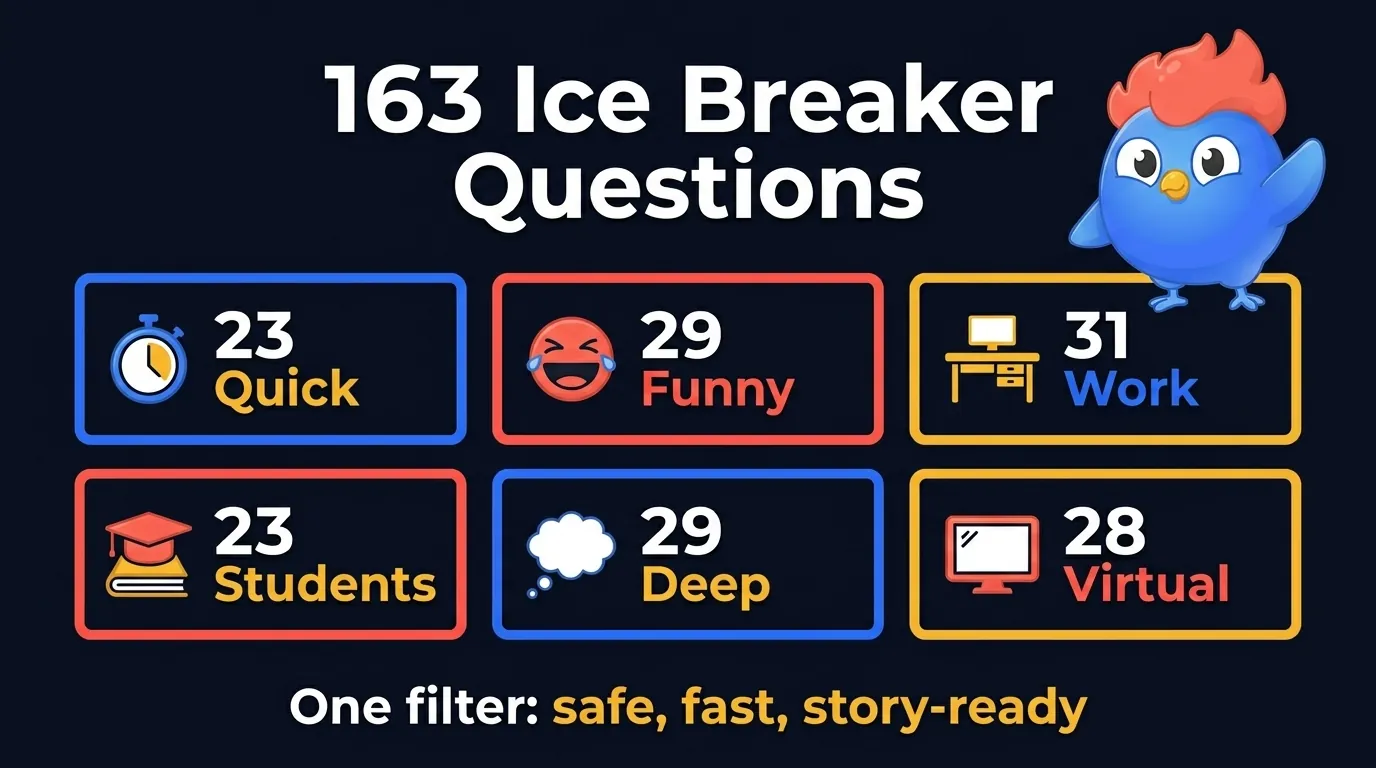 Six lanes, 163 prompts, one shared filter.
There is research behind that rule. In Aron et al. (1997), pairs who worked through a structured question sequence ended up closer than pairs left to small talk, and the sequencing was the active ingredient: the prompts escalated gradually, never all at once. Amy Edmondson’s work on psychological safety frames team learning around feeling safe enough to take interpersonal risks. A good prompt invites a small risk without demanding a confession.
| Section | Questions | Best for |
|---|---|---|
| Quick warmups | 23 | New groups, first rounds, mixed ages |
| Funny | 29 | Parties, offsites, casual meetings |
| Work and meetings | 31 | Teams, standups, retros, workshops |
| Students | 23 | Classrooms, clubs, camps, onboarding |
| Deep but safe | 29 | Friend groups, mature teams, dinners |
| Virtual teams | 28 | Remote calls, async teams, hybrid work |
A hosting note before the list: don’t force everyone to explain every answer, let people pass without a reason, and keep it moving.
Quick Warmups: Good Ice Breaker Questions
The order here is deliberate: prompts that are easy to answer come before prompts that are interesting to answer, because a room with momentum loosens up on its own. Use these for new groups, mixed ages, classrooms, and any meeting where energy has to come before personality.
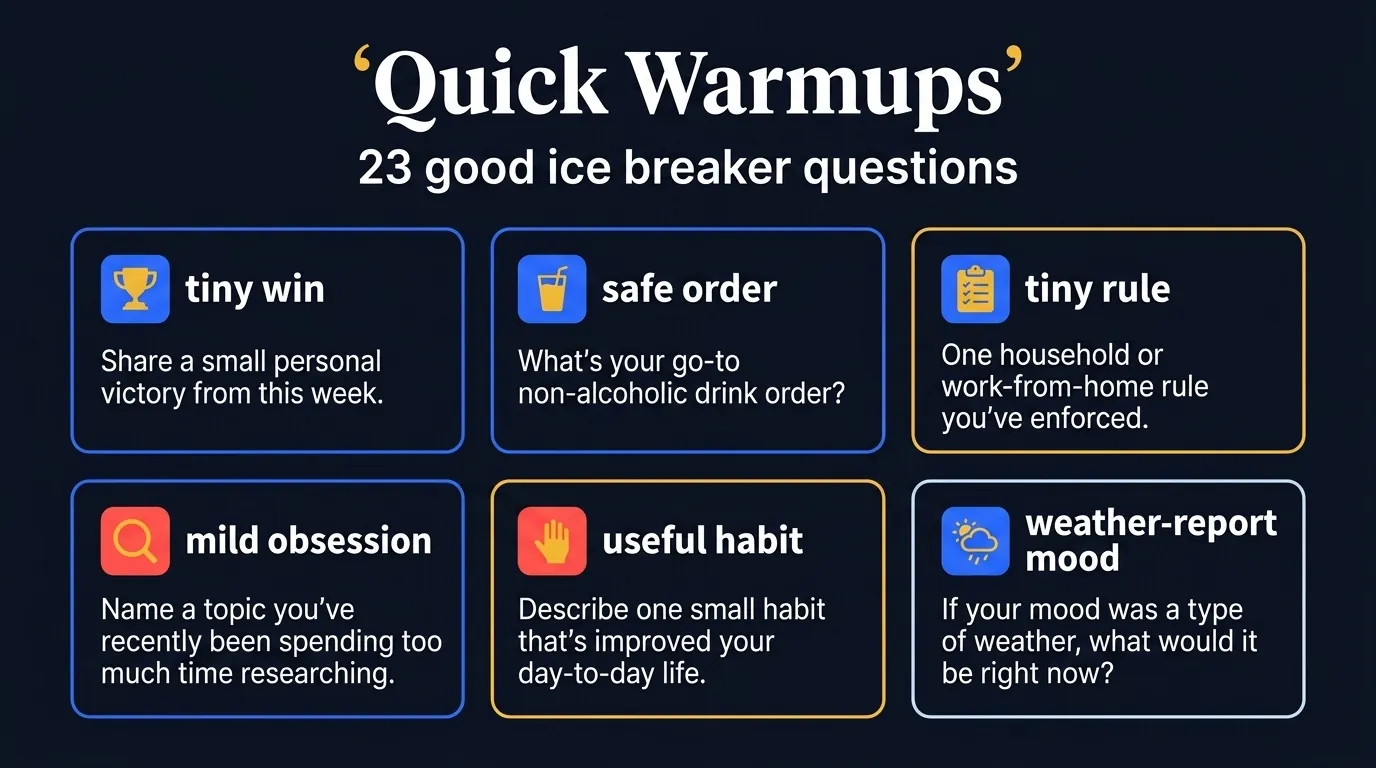 Quick warmups work when the answer is easy but the follow-up can still reveal a story.
Notice what these prompts never ask for: the best, the worst, the biggest, the most meaningful anything, because superlatives make people stall while they rank themselves.
If you want a faster A/B format, the 223 this or that questions set trades stories for instant picks, and the 211 would you rather questions list gives each choice more tension.
1. What is the smallest thing that improved your week?
2. What topic could you talk about for 10 minutes with no prep?
3. Which ordinary object deserves better design?
4. What is a boring fact about you that gets more interesting when explained?
5. What is the last thing you learned by accident?
6. What would your 12-year-old self think is cool about your current life?
7. What task are you weirdly good at?
8. What tiny inconvenience should be illegal?
9. What is your safest food order?
10. Which app would be hardest to give up for one week?
11. What are you currently mildly obsessed with?
12. What is a tiny opinion you’ll defend even though it does not matter?
13. What is your default doodle?
14. What smell sends you back to a specific place?
15. What was your first paid job, unpaid job, or serious chore?
16. What skill would you rent for one day?
17. What do you know too much about for no useful reason?
18. What was better five years ago?
19. What is the most underappreciated button on a microwave?
20. What song, book, show, or game do you keep returning to?
21. What habit do you respect in other people?
22. If your week had a weather report, what would it say?
23. What tiny rule would improve airports, classrooms, or meetings?
Funny Ice Breaker Questions
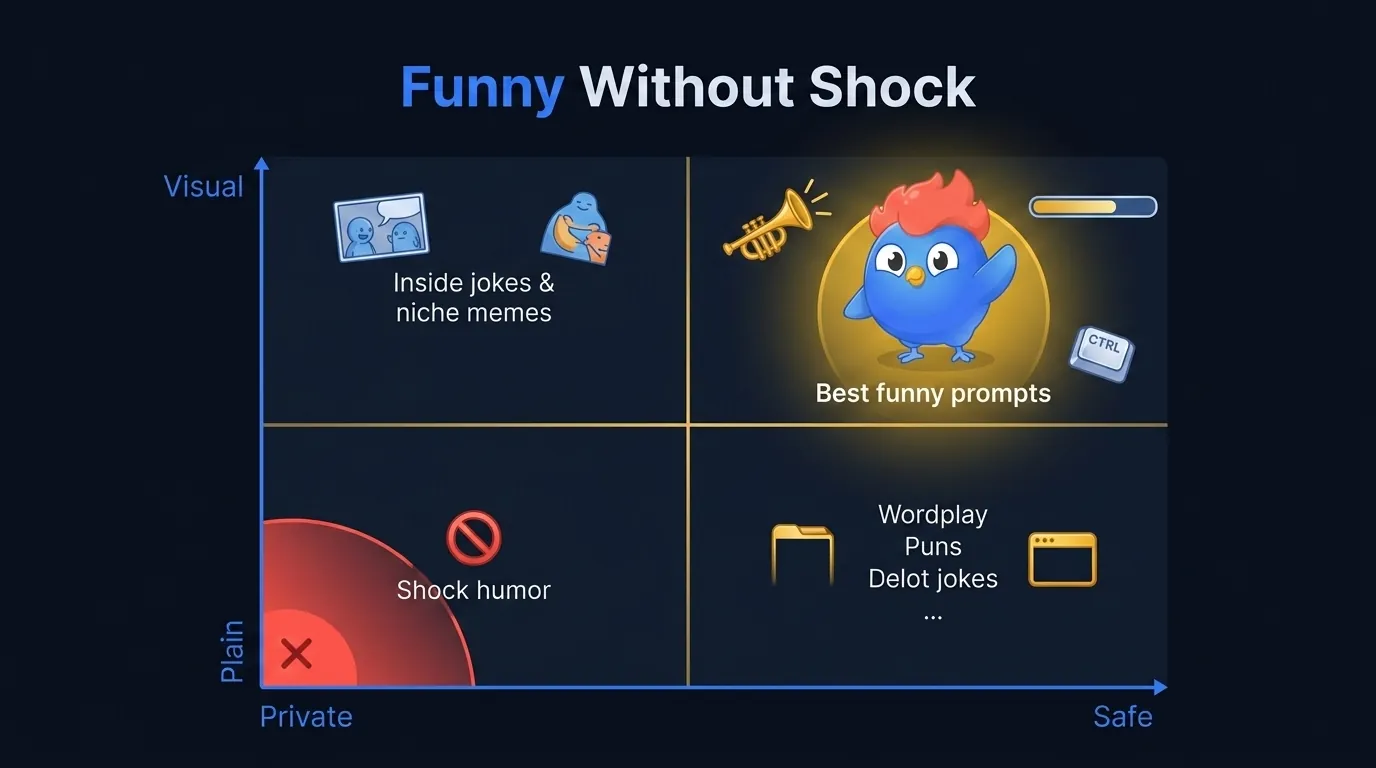
There’s a difference between odd and embarrassing, and funny icebreakers live entirely on the odd side. I threw out every joke that puts a person on trial, targets bodies, or trades on public embarrassment, because the laugh that comes from making one teammate squirm is exactly the laugh that turns a warm room cold for the next twenty minutes. What’s left gives the room a clear mental image, a safe answer, and one quick reason worth hearing. The test fits in one line: the group laughs with the person, never at them.
24. If your keyboard could add one useless key, what would it do?
25. What everyday task should come with dramatic theme music?
26. What boring object would you give a tiny cape to?
27. Which snack would make the worst office currency?
28. What would be the least helpful superpower in a meeting?
29. What app notification would you like to replace with a trumpet sound?
30. What food has the most suspicious texture?
31. If your coffee mug had a job title, what would it be?
32. What minor mistake deserves a slow-motion replay?
33. What household item is secretly too confident?
34. What would your laptop say if it could sigh out loud?
35. What flavor should never become a toothpaste?
36. Which emoji needs to retire for a year?
37. What is the funniest possible name for a printer?
38. What harmless rule would make grocery stores more entertaining?
39. What tiny sound effect would improve your commute?
40. Which piece of office furniture has the most drama?
41. What should every elevator announce besides the floor?
42. What normal sentence sounds suspicious if whispered?
43. What is the weirdest thing that should have a progress bar?
44. What meeting phrase deserves a theme song?
45. What food would win a talent show?
46. What is the most dramatic way to close a browser tab?
47. What object in your room looks like it has secrets?
48. What would be the worst possible trophy shape?
49. What everyday smell deserves a fan club?
50. What should be a sport but somehow is not?
51. What small chore should have a victory screen?
52. What phrase should phones autocorrect into something kinder?
Run this set tight: read one prompt, make everyone answer, ask a single person why, and stop before the bit starts dragging. For a deeper friend-focused set built around the laugh and the follow-up, the 131 funny questions to ask friends guide goes past warm-up territory into hangout depth.
Ice Breaker Questions for Work and Meetings
Work icebreakers carry a tax the others don’t. People are on the clock, often with their manager watching, so a misfire costs more and lingers longer than it would at a dinner party. Every prompt here stays on habits, tools, rituals, and small wins: answers that can genuinely sharpen how a team collaborates, with nobody performing a private life story to take part.
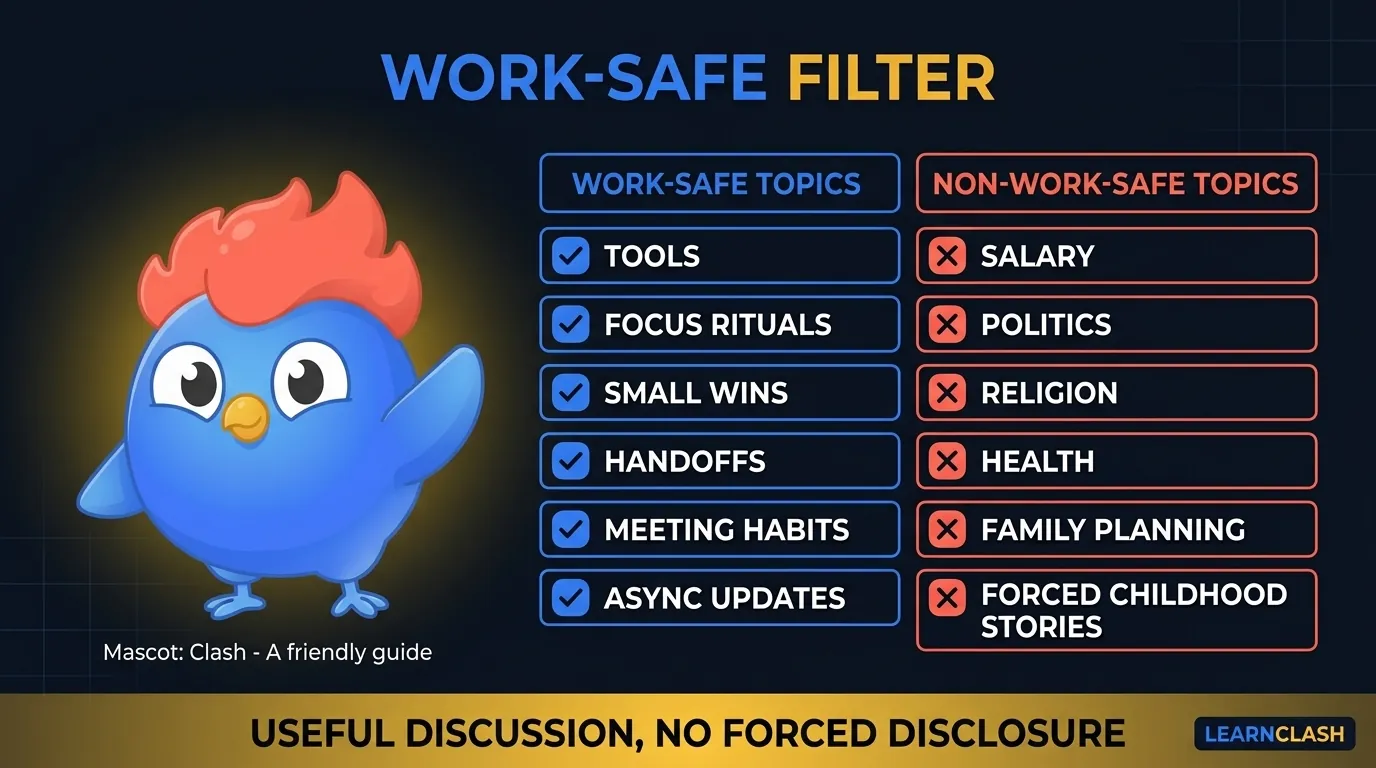 The work-safe filter: useful discussion beats forced disclosure.
This section is built for standups, workshops, retros, onboarding, and offsites. Use it next to team building trivia when you want the room warm before a scored round, or the virtual team building games guide for full activity formats beyond prompts. And if the warmup lands, a workplace and office culture duel turns the same energy into an async 1v1 round nobody has to schedule.
53. What is one small work habit you stole from someone else?
54. What tool saves you more time than people realize?
55. What meeting should be 12 minutes instead of 30?
56. What is your best focus ritual?
57. What part of your workday has the most hidden friction?
58. What is the most useful thing on your desk?
59. What is one tiny onboarding tip new people should hear sooner?
60. What work skill looks easy until you try it?
61. What is the best way to end a long meeting?
62. What do you prefer to write down before you start a task?
63. What is your favorite kind of update to receive from a teammate?
64. What task gets easier with music, and what task needs silence?
65. What workplace habit should be normal everywhere?
66. What is the best snack for a hard thinking session?
67. What makes a calendar invite instantly better?
68. What should every team document explain in the first paragraph?
69. What is your favorite small win from this week?
70. What is one question you wish people asked before starting a project?
71. What is your most reliable way to reset after a messy hour?
72. What part of a team offsite is usually worth keeping?
73. What should a first-day teammate never have to figure out alone?
74. What is one process you would make one click shorter?
75. What does a good handoff look like in your job?
76. What is your preferred way to receive feedback on a draft?
77. What work topic could become an 18-question LearnClash duel?
78. What is the most useful recurring meeting you have?
79. What recurring meeting would you turn into a written update?
80. What is the quickest way to tell a project is healthy?
81. What is one team ritual you would keep even during a busy month?
82. What small courtesy makes remote work easier?
83. What would make your next Monday 10 percent calmer?
Ice Breaker Questions for Students
A classroom is a tougher room to warm up than an office: ages cluster, social ranks form fast, and a single awkward prompt can follow a kid for a semester. So student icebreakers stay flexible and choice-based, tied to interests or course energy rather than private history.
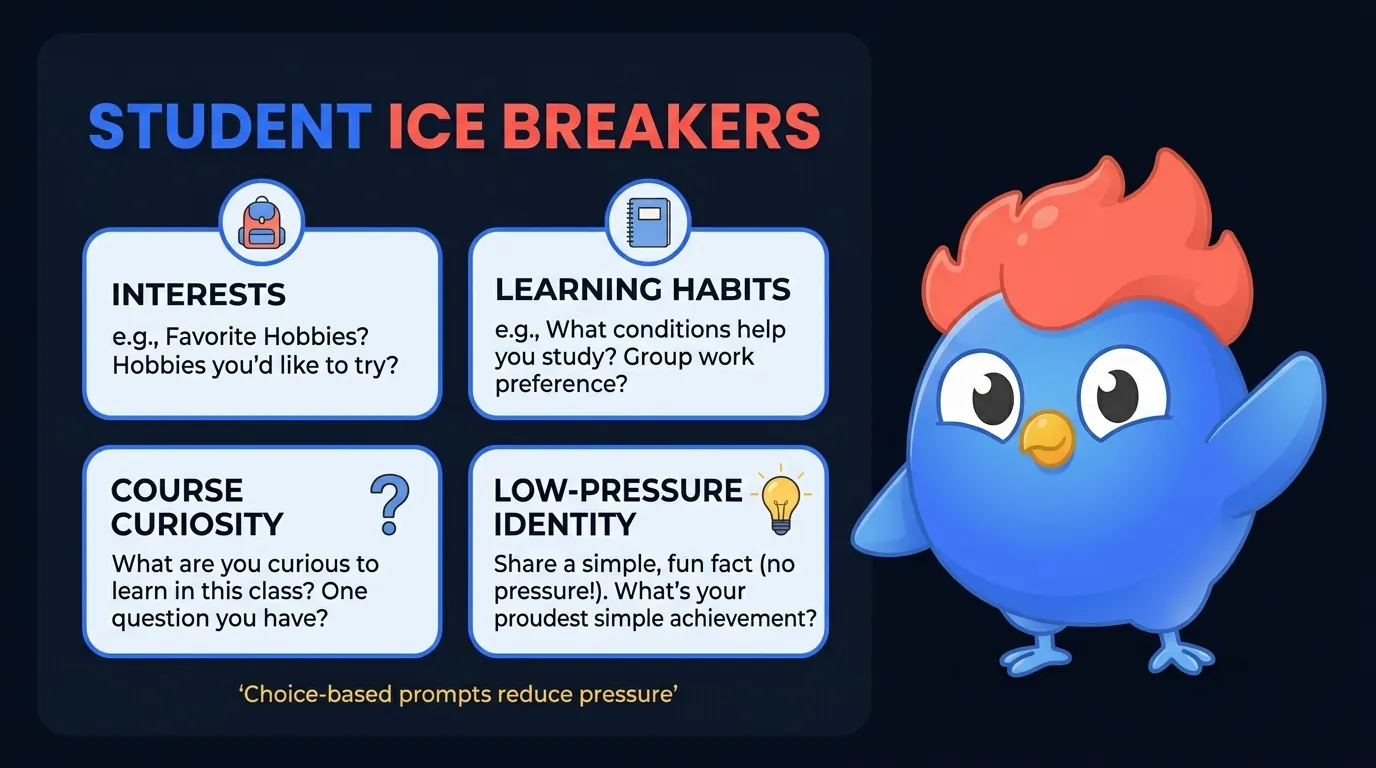 Student prompts work when they let people choose how much of themselves to share.
One extra rule applies here: always give students a way to answer lightly. “What is your favorite childhood memory?” reads as harmless to one kid and lands like a trap on another, while “What is a story, game, song, or place you keep returning to?” hands everyone an exit they can use. If you want factual prompts after the social warmup, the kids trivia questions guide picks up where this section stops.
84. What subject gets easier when someone explains it with a picture?
85. What topic outside school do you learn about voluntarily?
86. What is one question you hope this class answers?
87. What kind of project makes time move fastest for you?
88. What is one study habit you trust?
89. What is one study habit that never worked for you?
90. What object would make your backpack or desk 20 percent better?
91. What class from a movie or game would you sign up for?
92. What topic could become a surprisingly good quiz duel?
93. What is one thing you understand better by doing than reading?
94. What is a small skill you want to get better at this year?
95. What should every group project decide on day one?
96. What makes a teacher easy to ask for help?
97. What is your favorite way to remember a hard fact?
98. What is one school rule that makes sense only after you explain it?
99. What would you put in a time capsule from this school year?
100. What is a question you like being asked?
101. What is a question you wish adults asked students more often?
102. What is one topic you could teach a beginner?
103. What is the easiest way for a group to include someone new?
104. What is one thing that helps you start when you don’t feel ready?
105. What is your favorite tiny reward after finishing homework?
106. What is one fact that sounds fake but is true?
Deep Icebreaker Questions That Stay Safe
Here’s where most lists overreach: they confuse depth with interrogation. Deep icebreakers should surface values without cornering anyone, so these stay on choices, lessons, tastes, and priorities rather than on the kind of confession a person regrets the moment it leaves their mouth. Save them for after a quick round, once the room has earned a little trust and watched at least one person pass without consequence.
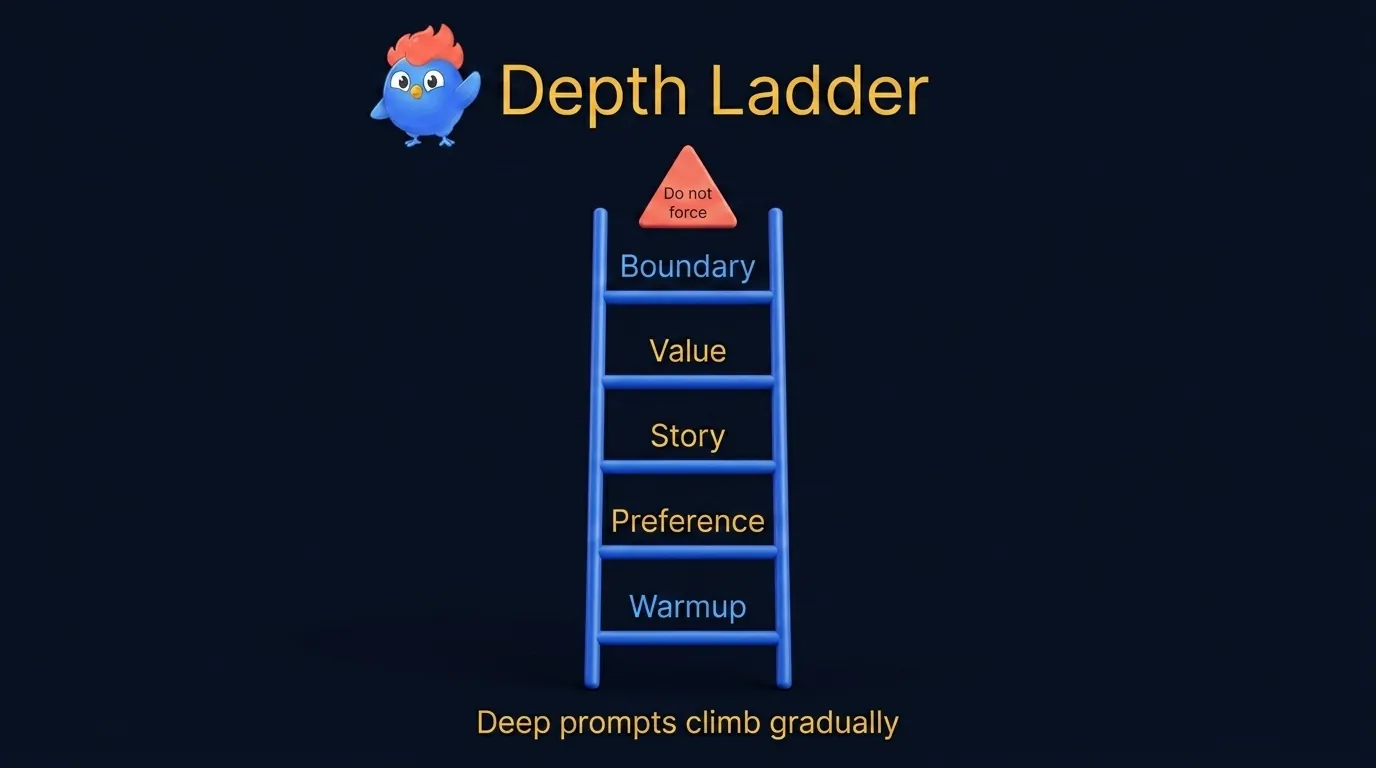 Good deep prompts climb gradually instead of jumping from name tags to life history.
Depth and intensity are different things. A good deep prompt lets someone reply with a light story or a heavy one, whichever they’re ready for, and that choice is the point.
If your group wants tougher tradeoffs, use the deep section in would you rather questions; for faster choices, this or that questions works better. For a scoring layer that turns deep prompts into a small-group game, see the 139 Q&A questions with confidence-bet scoring.
107. What is a belief you changed your mind about in a low-stakes way?
108. What makes a place feel like yours?
109. What is one lesson you learned later than you wish you had?
110. What kind of compliment stays with you?
111. What is a skill that changed how you see other people?
112. What does “prepared” mean to you?
113. What is one thing you used to think was boring until you understood it?
114. What is a tiny sign that someone is trustworthy?
115. What do you hope people notice about your work?
116. What is one choice that made your day better recently?
117. What do you want to be calmer about next year?
118. What is a habit that protects your energy?
119. What kind of problem makes you curious instead of stressed?
120. What is one thing you respect more now than you did five years ago?
121. What is a quiet strength people sometimes miss?
122. What is a rule you made for yourself that still helps?
123. What is one thing that makes a hard day less heavy?
124. What is a small tradition you would keep if everything else changed?
125. What is something you admire in people who are very different from you?
126. What makes advice useful instead of annoying?
127. What is one thing you are learning to do slower?
128. What is one thing you are learning to do faster?
129. What does a good apology include?
130. What is a decision you like making for yourself?
131. What is one signal that a group is safe to speak in?
132. What is something you hope future-you remembers about this season?
133. What is one kind thing you notice more than people expect?
134. What is a topic where you prefer questions over advice?
135. What is one thing that makes a room feel less awkward?
Virtual Icebreaker Questions for Remote and Hybrid Teams
Between the lag, the muted mics, and a gallery of half-lit faces, a remote call loses most of the little cues that carry an in-person icebreaker. So virtual prompts have to be clearer and need no shared room to land, which is why this set leans on desk rituals, async habits, focus signals, small comforts, and quick choices that don’t wait on a live host.
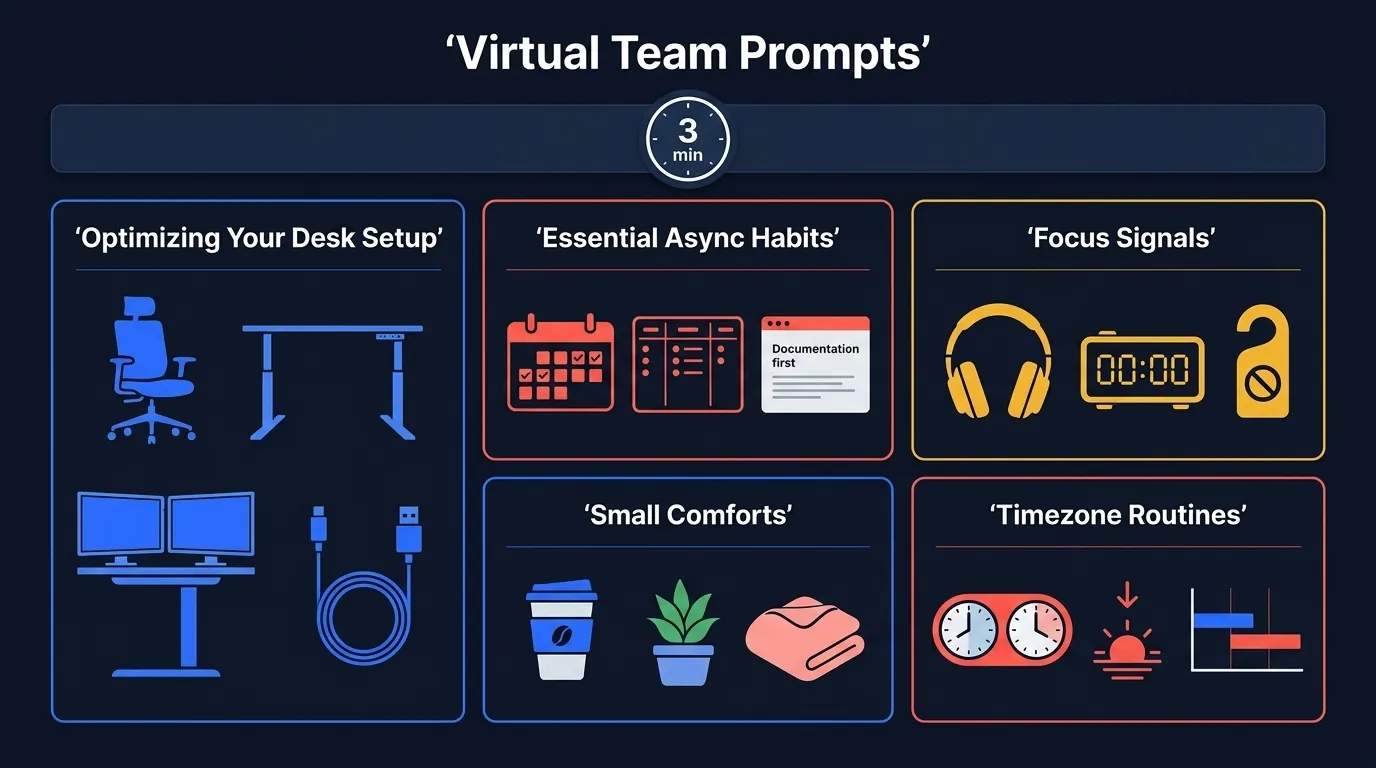
One rule saves a lot of remote awkwardness: skip “show us” prompts unless the group already knows each other well, because not everyone wants to swing a camera around their apartment. Ask for a choice, a routine, or a tiny preference instead. For December standups and end-of-year virtual parties, the 131 holiday icebreaker questions set covers the inclusive-winter and virtual-team angles.
136. What is one thing within reach that improves your workday?
137. What is your best low-energy meeting habit?
138. What background noise helps you focus?
139. What makes a remote message easy to answer?
140. What is your favorite way to mark the end of the workday?
141. What should every async update include?
142. What is one small thing that makes video calls less awkward?
143. What is your preferred camera-off reason that should need no explanation?
144. What is one app setting everyone should know about?
145. What is your best two-minute break?
146. What is one signal that you are in focus mode?
147. What part of remote work still feels underrated?
148. What part of in-person work do you miss least?
149. What is one meeting role that should rotate more often?
150. What is your ideal length for a quick check-in?
151. What is one timezone habit that feels respectful?
152. What should a good Slack thread do by the second reply?
153. What is one thing remote teams overexplain?
154. What is one thing remote teams underexplain?
155. What is the best way to revive a quiet group chat?
156. What is one async habit that would save a live call?
157. What is your favorite non-work tab during a break?
158. What is one tiny comfort on your desk?
159. What would make a virtual offsite feel less forced?
160. What is one cue that a written message sounds too sharp?
161. What is one cue that a written message sounds clear?
162. What remote-work habit should survive even in office teams?
163. What is the best three-minute reset between calls?
Ice Breaker Questions to Avoid
Bad icebreakers fail in three predictable ways: they demand private material, force instant self-branding, or push a public ranking. A room will usually comply with a bad prompt anyway, and quietly surrender a little trust while doing it, which is a worse outcome than skipping the icebreaker altogether.
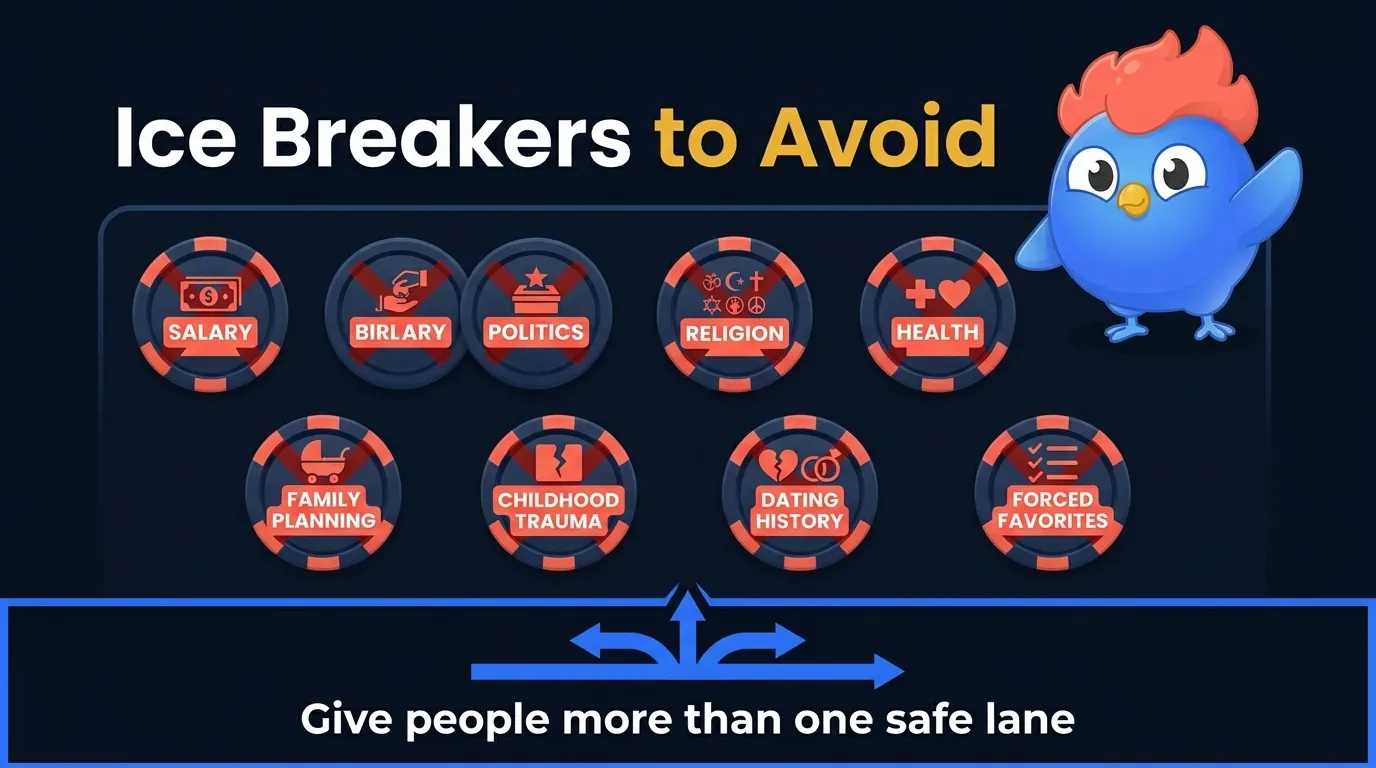 The avoid list is part of the craft.
Plenty of common prompts assume everyone carries neat favorites, happy memories, and fast social recall. Plenty of people don’t: some need time to think, some hate being ranked, and some hear “fun fact” and lock up completely.
These are the shapes to avoid:
- “What is your favorite childhood memory?”
- “What are five qualities you love about yourself?”
- “What is your salary goal?”
- “What is your dating red flag?”
- “What political issue changed your mind?”
- “What is your most embarrassing moment?”
- “What is one thing nobody knows about you?”
- “What trauma made you stronger?”
The fix is rarely deletion. You can almost always soften the question instead:
| Too much pressure | Better version |
|---|---|
| What is your favorite song? | What song, story, or game do you keep returning to? |
| What is your best childhood memory? | What tiny thing did you enjoy when you were younger? |
| What is one secret about you? | What is a boring fact about you that gets interesting when explained? |
| What is your dream job? | What task would you like to be better at? |
| Tell us a fun fact. | Share a fun fact, boring fact, or harmless lie. |
That last swap carries the whole idea: give people more than one safe lane in.
How to Play Ice Breakers in LearnClash
In LearnClash, an icebreaker becomes an 18-question async duel: you answer each 45-second card alone, in your own time. I gave every turn a 72-hour window before it expires, a decision aimed squarely at the calendar problem most virtual icebreakers run into. Nobody schedules anything. Remote friends, students, and teammates warm up privately, compare answers whenever they log in, and skip the extra live meeting nobody wanted.
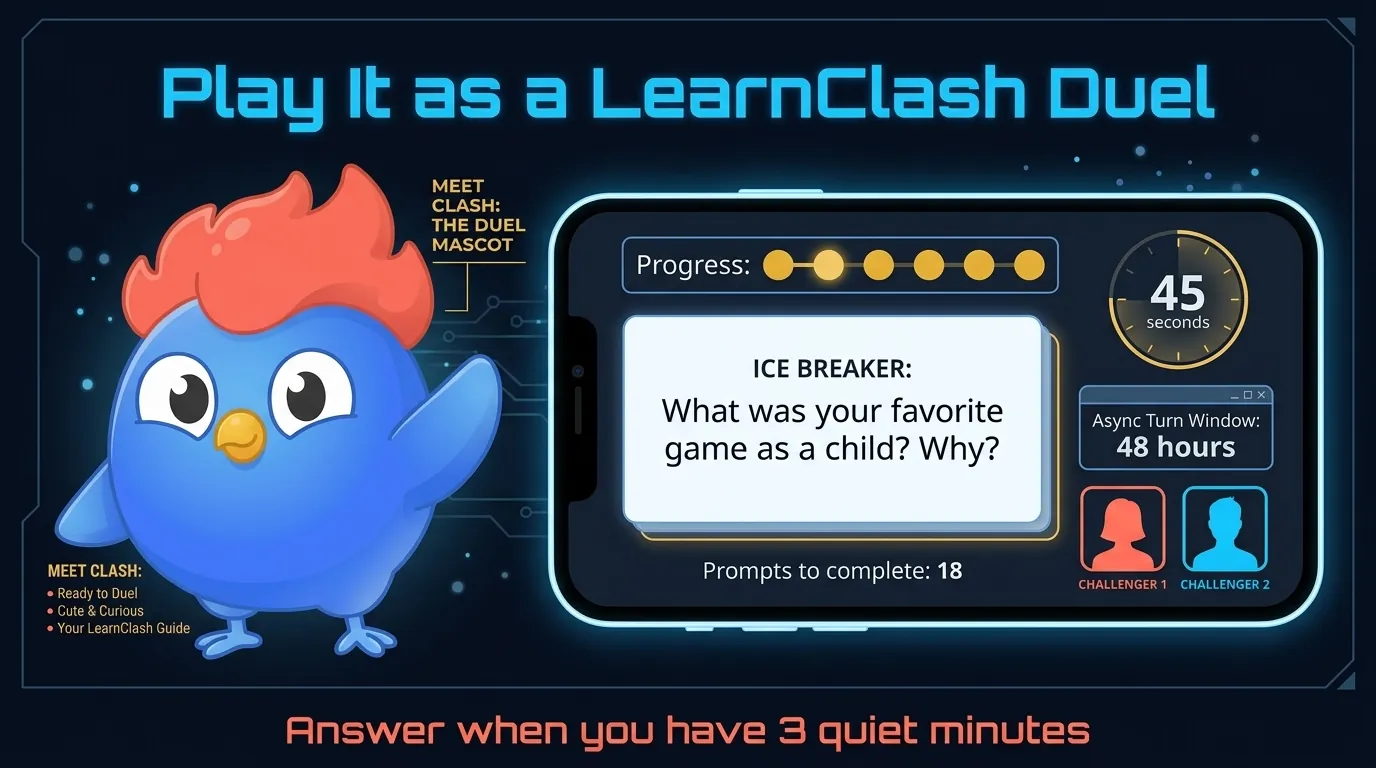 Same social spark, less live-call pressure: each turn fits into three quiet minutes.
The format also rewires the pressure. In a live room, the loudest voice sets the pace and the rest follow. In a duel, everyone answers first and only then sees the comparison, so a quiet teammate, a cautious student, and a remote friend all get the same clean reveal. For a longer activity after the warmup, run our virtual scavenger hunt format.
| Group | Best topic link |
|---|---|
| Teams | Start a workplace and office culture duel |
| Mixed groups | Play a general knowledge warmup |
| Casual nights | Duel on popular culture and entertainment |
| Students | Run a study techniques duel |
Sequence it the way this page is ordered: a quick round while the room is cold, a funny round when people need low-stakes energy, and a work or deep round once the group has enough trust.
Frequently Asked Questions
What are good ice breaker questions?
Good ice breaker questions are easy to answer, low-pressure, and specific enough to start a story. They avoid forced vulnerability and ranking pressure. LearnClash filters strong prompts by answer speed, safety, and replay value, then keeps the ones that work inside a 45-second question timer.
What are funny ice breaker questions?
Funny ice breaker questions use harmless oddness, not shock. A good funny prompt gives people a quick mental picture and a safe answer, like redesigning a boring object or defending a tiny opinion that does not matter. LearnClash cuts jokes that target bodies, money, politics, or private history.
What ice breaker questions work best for meetings?
Meeting ice breaker questions should connect to work habits without exposing sensitive details. Ask about focus rituals, ideal meeting length, useful tools, snack strategy, first small win, or the best part of the week. LearnClash keeps work prompts answerable in under 20 seconds.
What ice breaker questions should you avoid?
Avoid questions about salary, religion, politics, health status, family planning, childhood trauma, dating history, and anything that makes people rank their identity in public. LearnClash also avoids prompts that demand one favorite song, one favorite memory, or a polished fun fact.
How do you play ice breaker questions in LearnClash?
Pick a topic, start an async duel, and answer 18 prompts across 6 rounds. Each LearnClash question has a 45-second timer, but each turn has a 72-hour window, so remote teammates can play when they have three quiet minutes instead of joining another live call.