
89 Trivia Questions for Kids [Ages 5 to 13, Answers Included]
89 trivia questions for kids ages 5-13 with answers: animals, dinosaurs, space, science, geography, Disney, and easy-to-hard tiers.
How many do you know?
Think of your answer, then reveal it.
Did you know it before revealing the answer?
Read this answer in the articleRound complete
Turn what you know into a quiz duel.
Start a new duel in LearnClash and learn from every answer.
Get LearnClashFree to play on iPhone and Android. No ads.
Try the questions you missed once more.

Lightning runs about five times hotter than the surface of the sun. Octopuses carry three hearts around. Honey does not spoil, which is why jars of it pulled from Egyptian tombs, sealed for roughly 3,000 years, were reported still edible.
These 89 trivia questions for kids cover animals, dinosaurs, space, science, geography, Disney, plus age-adjusted easy and hard tiers for ages 5 to 13. Most answers carry a short note on the wrong guess kids reach for first, so a miss ends in something worth keeping rather than a shrug. Facts were cross-checked against BBC Science Focus, National Geographic, NASA, and the primary sources named alongside the trickier answers.
Nine sections, three difficulty levels. The list sits inside the LearnClash full trivia question library, which covers 34 topic sets from preschool level through middle school. Start a duel on any topic →
Kids Trivia Questions: Quick Category Guide
Here is the fast way to find the right age. The 89 questions split into 9 sections and 3 difficulty tiers, mapped in the table below. Read Easy out loud to a 5 to 7 year old, hand Medium to an 8 to 10 year old, and save Hard for the 11 to 13 crowd. Each category section blends all three tiers on purpose, so a 6 year old and an 11 year old can share the same round and both walk away with a win.
| Section | Questions | Easy | Medium | Hard |
|---|---|---|---|---|
| Animal Trivia | 1-12 | 4 | 4 | 4 |
| Dinosaur Trivia | 13-22 | 2 | 4 | 4 |
| Space Trivia | 23-32 | 2 | 4 | 4 |
| Science Trivia | 33-42 | 2 | 4 | 4 |
| Geography Trivia | 43-52 | 3 | 3 | 4 |
| Disney and Pop Culture | 53-62 | 3 | 4 | 3 |
| Easy for Ages 5-7 | 63-72 | 10 | 0 | 0 |
| Hard for Ages 11-13 | 73-82 | 0 | 0 | 10 |
| Funny Trivia | 83-89 | 3 | 3 | 1 |
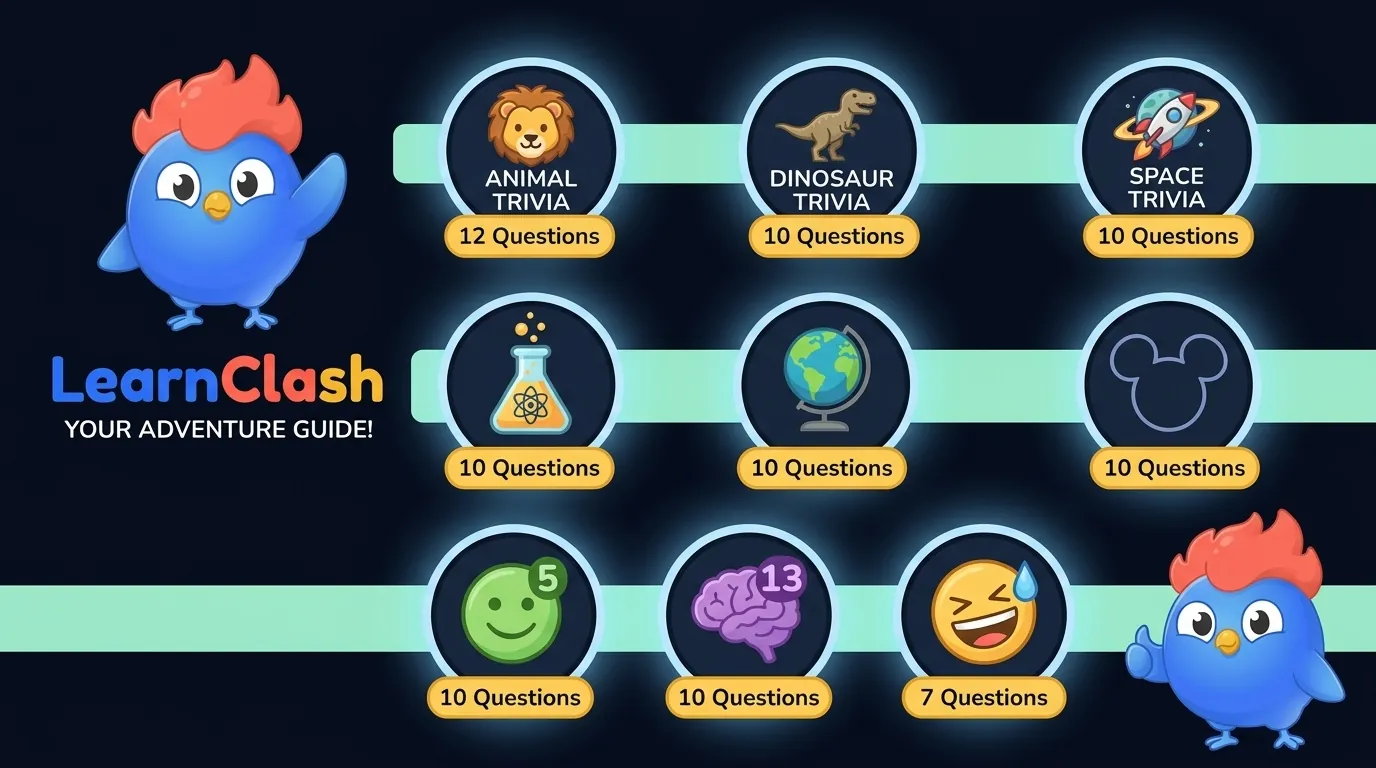 Where the 89 questions land: 9 sections, and a difficulty split that leans hard on purpose, because the surprising facts are the ones that stick.
Sourcing ran through peer-reviewed zoology, NASA pages, Guinness World Records, and the Walt Disney Archives. The tier labels follow what cognitive scientists call desirable difficulty: a question should be hard enough that the brain has to work for the answer, and easy enough that a kid does not quit halfway. Get that balance wrong in either direction and nothing lodges.
One design note, since this is a page parents land on. When we built the topic generator, I put a single test at the top of the resolver prompt to decide whether a requested topic is allowed to exist at all: would a parent be comfortable quizzing their 10-year-old on this? A topic that fails it never gets generated, which is why you can hand a kid the search box without pre-screening whatever they type into it. The other half of that call was refusing ad networks in every tier, free included, because a video ad between rounds of a children’s quiz was the one thing I was not willing to ship.
Animal Trivia Questions for Kids (1-12)
Animals are where kids feel most certain and get caught most often. They have known dogs, cats and the whole farm-animal cast since toddlerhood, so the confidence is earned. The biology underneath is stranger than the picture books let on, and this set runs deliberately heavy on the counterintuitive end of it. For something that reaches adult level, there is a longer 47-question animal set.
 Question 11 is the one adults lose: only 27% of first-time players got the dog-vision answer right.
1. What is the fastest land animal? Easy
Answer: Cheetah. Cheetahs sprint at 70 to 75 mph in bursts of 20 to 30 seconds, and accelerate from 0 to 60 mph in about 3 seconds, faster than most sports cars.
A lion feels like it should be the fastest big cat, so that is the popular guess, but lions top out around 50 mph. The two animals are built for different jobs: the cheetah for the sprint, the lion for the ambush.
2. How many legs does a spider have? Easy
Answer: Eight. Every spider has eight legs, which is the quickest way to tell it apart from an insect. Insects always have six.
The catch: Six is the trap answer, because a spider gets filed in the same mental drawer as bugs. Eight legs means arachnid, six means insect, and that count is the whole tell.
3. What do pandas eat for 14 hours a day? Easy
Answer: Bamboo. Giant pandas get through as much as 40 pounds of it a day. Bamboo carries so little nutrition that a panda has to eat almost constantly just to break even.
Pandas are bears, and bears are supposed to eat fish or berries or meat, so the diet reads as a mistake until you know that bamboo is a grass and that a panda still digests it with a carnivore’s short, simple gut.
4. What animal has the longest neck? Easy
Answer: Giraffe. The neck alone runs about 6 feet and can weigh 600 pounds, on an animal that stands up to 18 feet tall.
No real trap here, but the follow-up gets a reaction every time: a giraffe has exactly as many neck bones as you do, seven, each one stretched to roughly ten inches.
5. How many hearts does an octopus have? Medium
Answer: Three. Two smaller hearts pump blood to the gills, and the larger one pumps to the rest of the body. Octopus blood is blue rather than red.
Why it trips kids up: One heart feels like a rule of biology, because that is how we are built. The three-heart setup keeps oxygen moving through cold, low-oxygen water that would leave a single-hearted animal gasping.
6. Which animal has fingerprints nearly identical to a human’s? Medium
Answer: Koala. Koala prints resemble ours so closely that forensic scientists have warned they could confuse a crime scene.
The obvious guess is chimpanzee, since chimps are our closest relatives, and koalas are not related to us in any close sense at all. Their prints come from convergent evolution: two unrelated animals stumbling onto the same design for gripping branches.
7. Which land mammal can never get all four feet off the ground at once? Medium
Answer: Elephant. Even at a full charge, an elephant keeps at least one foot planted. Its leg bones are weight-bearing columns, built to carry up to 14,000 pounds rather than to store spring.
Worth correcting: You will often see this asked as “the only mammal that can’t jump,” and that version is wrong. Sloths do not jump either, and neither do hippos, so the elephant is simply the famous name on a longer list.
8. What color is a giraffe’s tongue? Medium
Answer: Purple or dark blue. The tongue is about 18 inches long and prehensile, meaning it can grab things the way a hand does.
Pink is the default setting for tongues, so purple sounds invented. A giraffe spends hours a day feeding at the tops of trees in full sun, and the dark pigment works as built-in sunscreen.
9. How long can a wood frog survive fully frozen? Hard
Answer: Up to about 7 months. The wood frog freezes solid every winter with no heartbeat, no breathing and no measurable brain activity. Special proteins and glucose act as natural antifreeze. Alaskan wood frogs studied by Larson and colleagues in 2014 survived 218 straight days below freezing.
Here’s the strange part: Freezing kills almost everything. The wood frog gets around that by flooding its cells with glucose at roughly ten times the normal level, effectively candying itself from the inside until spring.
10. A mantis shrimp strike creates bubbles as hot as what? Hard
Answer: Nearly the surface of the sun. The shrimp punches at around 50 mph. Water cannot flow out of the way fast enough, so cavitation bubbles form and collapse in microseconds, spiking to thousands of degrees and throwing off a shockwave that can stun prey even when the punch misses.
Nothing about a thumb-sized shrimp suggests sun-grade temperatures. The physics does not care about size: collapse water fast enough and it flashes hot for an instant.
11. What two colors can dogs actually see? Hard
Answer: Blue and yellow. Dogs are dichromats, with two types of color-sensing cone in the eye where we have three. Red and green arrive as muddy gray-brown, which is why a red ball on green grass is genuinely hard work for a dog.
Why it trips kids up: Most people have upgraded from “dogs see in black and white” (disproved by Neitz and colleagues in 1989) straight to a guess at red and green, which happens to be exactly the pair dogs cannot separate. We can see that happening in our own answer data, because this is one of the questions where the wrong option outdraws the right one:
12. How long can it take a sloth to digest a single meal? Hard
Answer: Up to a month. A sloth’s four-chamber stomach works so slowly that one meal can take 30 days to process fully.
For most animals a meal takes hours, maybe a day. A sloth runs so slow that as much as two-thirds of its body weight can be food it has not finished with, and that same crawling metabolism is what lets it live on almost nothing but leaves.
Kids who empty this section can keep going in the app’s animal topic, which pulls from a much deeper pool.
Dinosaur Trivia Questions for Kids (13-22)
Dinosaurs are usually the first science a kid loves on purpose. Something about a 40-foot lizard with an unpronounceable name hooks them early and holds. This is also one of the few topics where being nine years old is a competitive advantage over the adult across the table, so expect to lose. Adults who want a fairer fight can work through the longer dinosaur trivia set.
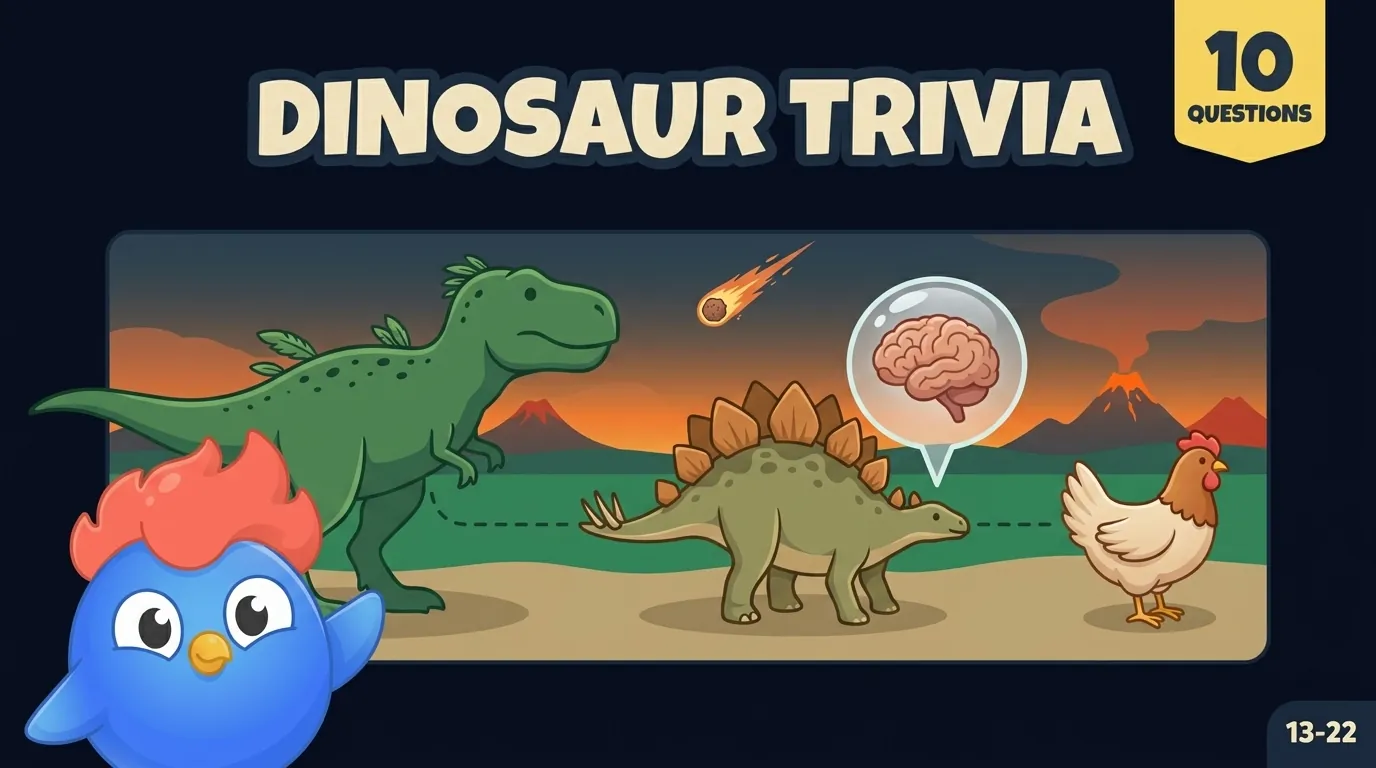 One of these ten is a plant-eater with more than 500 teeth, and it is not the one anybody guesses.
13. What does the T in T-Rex stand for? Easy
Answer: Tyrannosaurus. The full name, Tyrannosaurus rex, is Greek and Latin for “tyrant lizard king.”
“T-Rex” lands in the ear as a single word. Pull it apart and a kid discovers they have been speaking Greek and Latin this whole time.
14. When did dinosaurs go extinct? Easy
Answer: About 66 million years ago. An asteroid struck what is now Mexico and ended the age of dinosaurs. The crater, Chicxulub, is still there.
“Millions of years ago” feels close enough, so the actual number stays fuzzy. Geologists read 66 million straight off the rock layer known as the K-Pg boundary.
15. How long did dinosaurs rule the Earth? Medium
Answer: About 165 million years. Dinosaurs lived from roughly 230 million to 66 million years ago. Modern humans have been around for about 300,000.
165 million sounds too big to be real, and it checks out anyway. Dinosaurs ran the place for something like 550 times longer than we have managed so far.
16. The stegosaurus brain was about the size of what? Medium
Answer: A walnut. Stegosaurus weighed around 5 tons, roughly a school bus, and carried a brain of about 80 grams.
What throws people: Big body, big brain feels like it ought to follow. Its day job was eating low plants and pointing spikes at anything with teeth, and none of that takes much thinking.
17. Which modern animal is the closest living relative to T-Rex? Medium
Answer: Chicken. All modern birds descend from small feathered theropods, the same group as T-Rex. Genetically, a chicken sits closer to T-Rex than T-Rex does to stegosaurus.
Lizard or crocodile is the natural guess, because those look the part. Proteins recovered from T-Rex bone match bird proteins rather than reptile ones, and the lab result beats the resemblance.
18. Did T-Rex have feathers? Medium
Answer: Probably, at least in places. Several close T-Rex relatives are preserved with feathers, and paleontologists now think adults likely carried some, possibly on the head and back.
Blame the movies for the scaly-lizard picture, which is decades out of date. Feathered dinosaurs have been coming out of the ground since the 1990s, some of them from inside the tyrannosaur family tree.
19. What killed the dinosaurs? Medium
Answer: A giant asteroid. A 6-mile-wide rock hit Chicxulub in Mexico 66 million years ago. The impact blocked sunlight for years, which killed the plants at the base of the food chain.
Where guesses go wrong: Volcanoes get plenty of votes, and a meteor shower gets a few. The geological record points at one object and one very bad day.
20. Which dinosaur had more than 500 teeth? Hard
Answer: Nigersaurus, a plant-eater with over 500 tiny teeth. It lived 110 million years ago in what is now Niger, and it worked like a living lawn mower, growing replacement teeth as fast as the old ones wore down.
“Lots of teeth” summons fangs, something like the 50 to 60 daggers in a T-Rex jaw, where Nigersaurus ran the opposite strategy entirely: hundreds of small teeth set in a straight cropping edge at the front of the mouth, with replacements stacked behind each one.
21. Who named the first dinosaur in 1824? Hard
Answer: William Buckland, an English geologist, who named Megalosaurus (“great lizard”) from bones found in Oxfordshire.
Here’s the strange part: In 1824 the word “dinosaur” did not exist. Richard Owen coined it in 1842 from the Greek for “terrible lizard,” which means Buckland named the first one without a word for what it was.
22. Which dinosaur is one of the largest land animals ever found? Hard
Answer: Patagotitan mayorum, a titanosaur known from bones dug out of Patagonia in Argentina. When it was named in 2017 the first estimates put it at 37 meters (121 feet) and 69 tonnes; later work revised that to roughly 31 meters (102 feet) and 50 to 60 tonnes, which puts it level with, or just behind, Argentinosaurus.
Where guesses go wrong: Brachiosaurus and T-Rex hog the spotlight, so they take the votes. Worth separating two records here, because quiz questions blur them constantly: largest is not tallest. The tallest known dinosaur is usually given as Sauroposeidon, which could raise its head roughly 18 meters up.
Space Trivia Questions for Kids (23-32)
Space has the opposite problem from most quiz topics. Whatever a kid invents, the true answer is stranger. A day longer than a year, a planet light enough to float, a temperature three degrees off the coldest anything can be: all real, all checkable. Kids who want more of this can carry on into the full space trivia set.
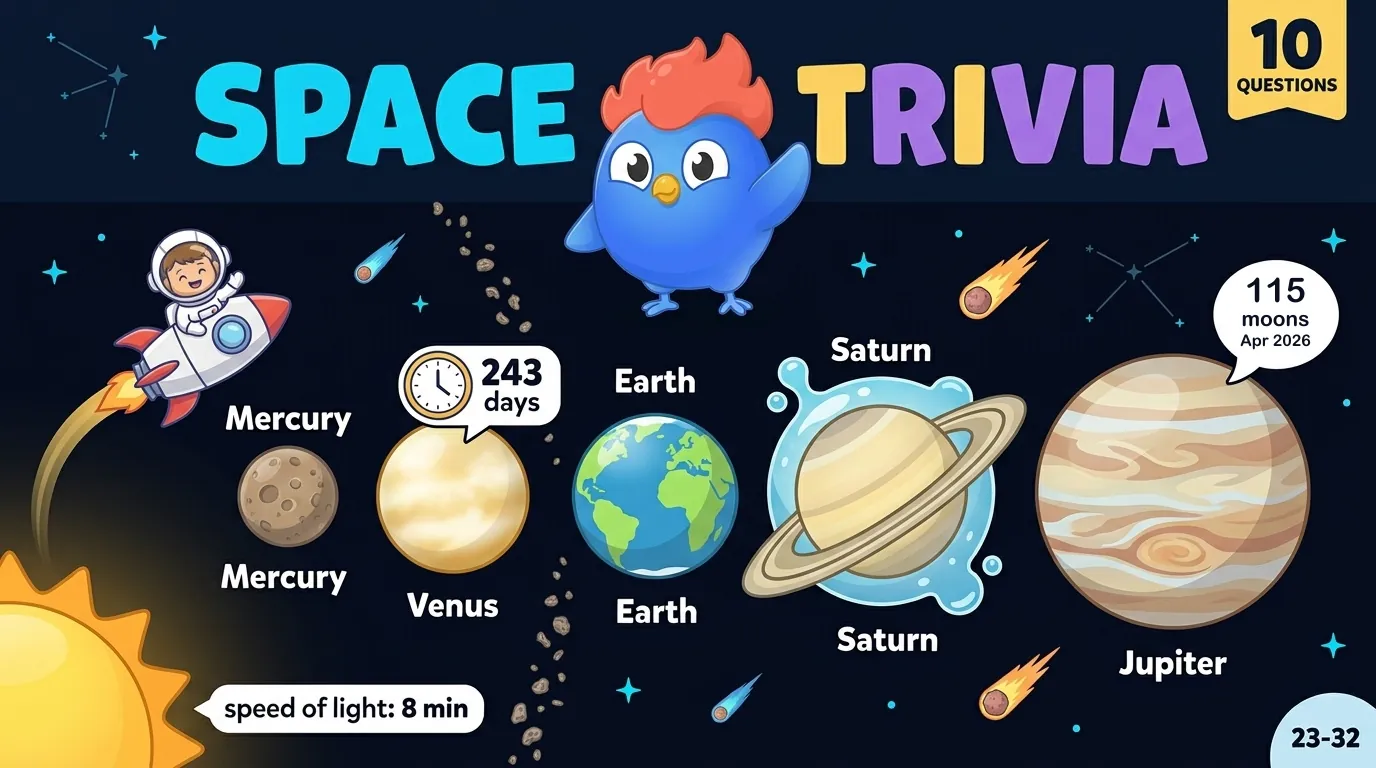 Sourced from NASA planetary fact sheets, with the Jupiter moon count taken from the IAU Minor Planet Center, April 2026.
23. Which planet is hottest in our solar system? Easy
Answer: Venus, at about 465°C (867°F). It beats Mercury despite sitting further from the sun, because a thick carbon dioxide atmosphere traps the heat.
Why it trips kids up: Closest to the sun ought to mean hottest. Mercury wins on distance and loses on physics: with almost no atmosphere, its heat leaks straight back out to space, while Venus hoards it like a greenhouse with the vents bolted shut.
24. Which is the largest planet? Easy
Answer: Jupiter. Every other planet in the solar system would fit inside it. The Great Red Spot is a storm wider than Earth that has been running for at least 350 years.
No trap on this one, but the side note is worth having: the four largest Jovian moons, Io, Europa, Ganymede and Callisto, were the first moons ever spotted anywhere but here, caught by Galileo in 1610.
25. A day on Venus is longer than what? Medium
Answer: A year on Venus. Venus takes 243 Earth days to turn once on its axis and only 225 Earth days to go around the Sun.
Here’s the strange part: Days fit inside years. That is the rule everywhere we grow up. Venus spins slower than almost anything else in the solar system while racing through a short orbit, and the whole relationship inverts.
26. Which planet could float in water? Medium
Answer: Saturn. It is mostly hydrogen and helium, with an average density below that of water.
Planets read as solid and heavy. Saturn is a vast ball of gas around a small rocky core, and the famous rings are not solid either, just billions of loose chunks of ice and rock.
27. What percentage of our solar system’s mass is in the sun? Medium
Answer: 99.86%. Earth, every other planet, every moon, every asteroid and comet together account for less than 0.2%.
Diagrams draw the planets big enough to see, which quietly lies about scale. Stack the whole rest of the solar system together and it does not reach a fifth of one percent.
28. How long does sunlight take to reach Earth? Medium
Answer: About 8 minutes and 20 seconds. Light moves at roughly 300,000 km per second, and the sun sits about 150 million km away.
Which means you never see the sun as it is now, only as it was eight minutes ago. That is the closest a kid gets to time travel without a film crew.
29. Who was the first person on the Moon? Hard
Answer: Neil Armstrong, on July 20, 1969, on the Apollo 11 mission. His first words: “That’s one small step for man, one giant leap for mankind.”
Where guesses go wrong: Yuri Gagarin turns up in a lot of answers, and he earned the fame, just for a different record. Gagarin was first into space in 1961 and never went to the Moon. Buzz Aldrin took the second step there, 19 minutes behind Armstrong.
30. How many moons does Jupiter have? Hard
Answer: 115 moons recognized by the IAU Minor Planet Center as of April 2026. The number keeps climbing as survey telescopes improve, so any answer needs a date attached. The four largest are Io, Europa, Ganymede and Callisto.
Earth has one moon and Mars has two, so a small number feels safe. Gas giants operate at a different scale entirely, using their gravity to collect moons by the dozen.
31. What is a shooting star actually? Hard
Answer: A tiny rock burning up in Earth’s atmosphere. It is called a meteor while it burns, and a meteorite if any piece survives to hit the ground.
What throws people: The name is the trap. Real stars are enormous balls of gas, impossibly far away. The thing streaking overhead is often no bigger than a grain of sand, glowing white as it hits our air at speeds up to 160,000 mph.
32. How cold is space? Hard
Answer: About -270°C (-455°F). Deep space, far from any star, sits close to absolute zero, the coldest temperature physics allows.
Everyone knows space is cold. Nobody guesses this cold. Absolute zero is the dead stop where atomic motion ends, and deep space gets within about three degrees of it without ever quite arriving.
Science Trivia Questions for Kids (33-42)
The best science questions take something a kid is certain about and turn it sideways. Plants breathe in oxygen. Sound travels fastest through air. Both feel obvious and both are wrong, which is the whole point. If these ten land, the wider science trivia set keeps going in the same direction.
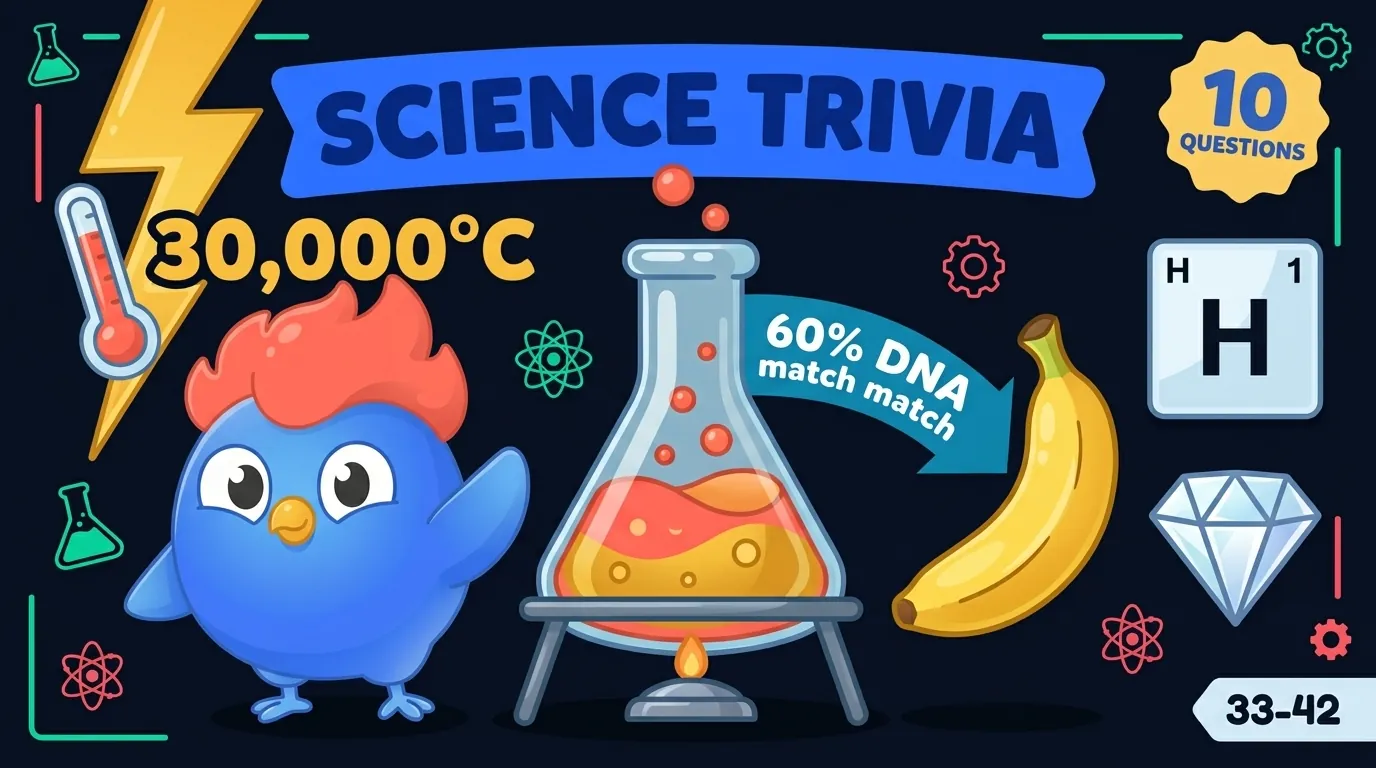 Which one did you learn wrong at school? For most adults it is number 37, the one about what plants breathe in.
33. How many bones are in an adult human body? Easy
Answer: 206. Babies start with about 270, and many of those fuse as the child grows.
Round numbers like 100 or 150 feel about right and are not close. The count falls through childhood as small bones merge in the skull and hips.
34. The skin is the largest what? Easy
Answer: Organ. An average adult’s skin weighs about 8 pounds and covers roughly 22 square feet.
Say “organ” and the brain jumps to heart or lung. Any tissue with a defined job qualifies, and skin shields you, reads temperature and touch, and manufactures vitamin D in sunlight.
35. What percentage of DNA do humans share with bananas? Medium
Answer: About 60%. For comparison: roughly 98% with chimpanzees and about 85% with mice.
“Share DNA” sounds like it should mean “look alike,” and it means nothing of the kind. It means the basic instruction set for being alive runs largely the same code whether you are a person or a piece of fruit, because every living thing needs the same rulebook for how a cell works, grows and repairs itself.
36. Lightning is how much hotter than the sun’s surface? Medium
Answer: About 5 times hotter. A bolt reaches roughly 30,000°C. The sun’s surface sits near 5,500°C.
Here’s the strange part: The sun is the hottest thing anyone can name without thinking, and lightning beats it for a fraction of a second. The bolt heats the surrounding air so fast that the air explodes outward, and that blast is the thunder arriving a second or two later.
37. What gas do plants breathe in? Medium
Answer: Carbon dioxide. Plants take in CO2 and release oxygen, the reverse of what animals do.
Where guesses go wrong: “Plants make oxygen” gets drilled in early, so oxygen becomes the reflex answer to a question about breathing in. Oxygen is what comes out, as a by-product, while the plant is busy building sugar.
38. What has the atomic number 1 on the periodic table? Medium
Answer: Hydrogen. One proton in the nucleus makes it the simplest and lightest element, and it accounts for about 75% of the ordinary matter in the universe.
Oxygen and gold are household elements, and slot number 1 is not a household slot.
39. Does sound travel faster through water or air? Hard
Answer: Water. Sound moves about four times faster: roughly 1,480 m/s in water against 340 m/s in air.
Why it trips kids up: We hear in air, so air feels like sound’s home turf. Density decides it. Pack the molecules closer together and they hand off the vibration faster.
40. Hot water sometimes freezes faster than cold water. What is this effect called? Hard
Answer: The Mpemba effect, named for Tanzanian student Erasto Mpemba, who noticed in 1963 that his hot ice cream mix froze faster than a classmate’s cold one. Scientists still argue about the mechanism.
It sounds impossible, and for a long stretch the experts agreed with that assessment. Under the right conditions hot water really does beat cold water to ice, with evaporation, convection and dissolved gases all in the running as explanations.
41. What is the hardest natural substance on Earth? Hard
Answer: Diamond, a 10 out of 10 on the Mohs hardness scale, scratchable only by another diamond.
Steel and plain rock feel tough enough to win. Diamond is pure carbon compressed under brutal pressure deep underground, and that tight atomic lattice is what nothing else can mark.
42. How many cells are in a human body? Hard
Answer: About 37 trillion. Roughly 3 million of them die and get replaced every second.
Nobody can picture 37 trillion, so try this instead: count one cell per second, no sleep and no breaks, and you would still be counting a million years from now.
Geography Trivia Questions for Kids (43-52)
Geography splits neatly in two. There is what a kid half-remembers off a classroom map, and there is what is actually out there. These ten skip the capitals drill and head for the second category, the “you live on this planet and nobody told you that” material. The adult-difficulty version lives in the full geography trivia set.
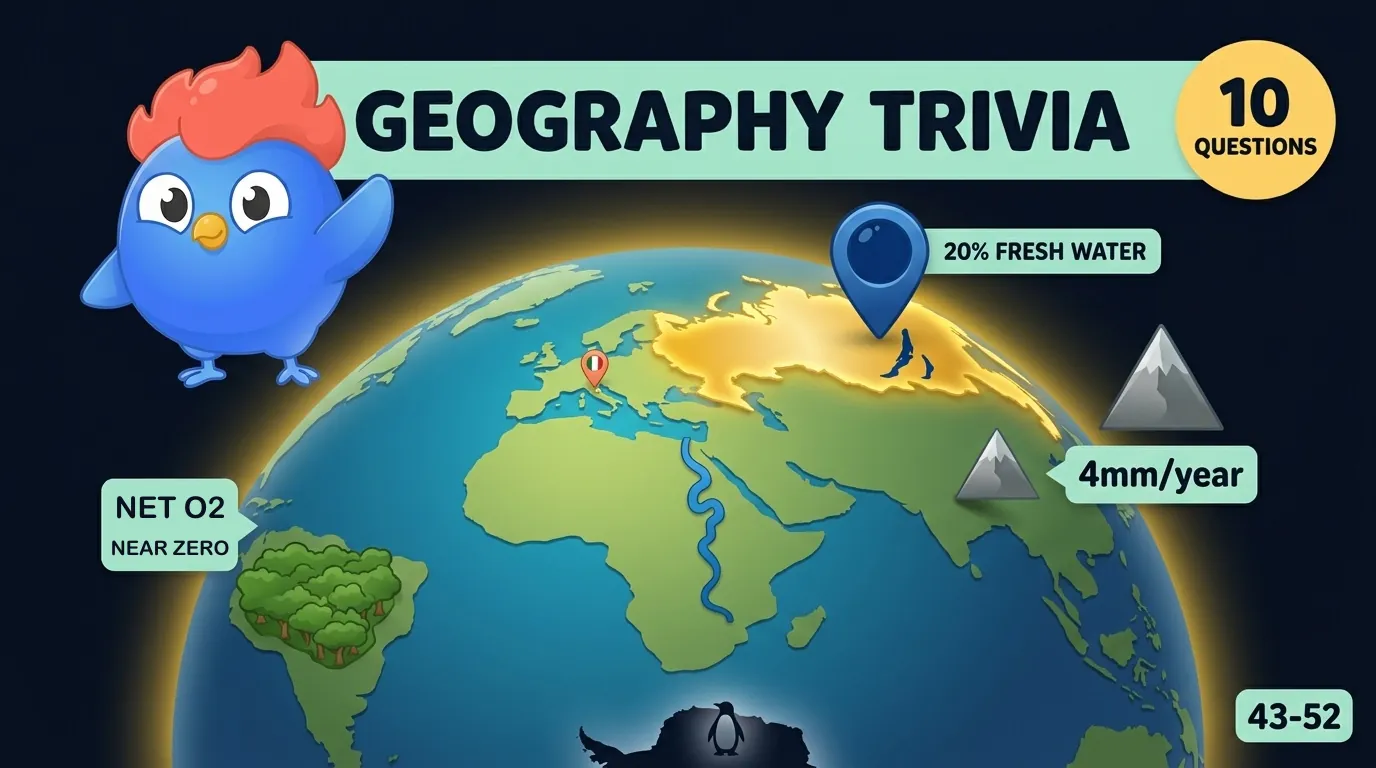 The Amazon callout carries the corrected figure, net oxygen output near zero, which question 48 unpacks.
43. What is the largest country in the world by area? Easy
Answer: Russia, at about 17.1 million square km, nearly twice the size of Canada in second place.
Depending on where a kid grows up, the USA or China feels like the obvious giant. Russia outsizes both by a distance, wide enough to span 11 time zones.
44. What is the longest river on Earth? Easy
Answer: The Nile, about 6,650 km. The Amazon runs a close second, and scientists still argue about which wins depending on where you decide each river starts.
Where guesses go wrong: Home rivers crowd out the right answer. An American kid reaches for the Mississippi, a Chinese kid for the Yangtze.
45. Which continent has no countries? Easy
Answer: Antarctica. No permanent population, no countries, no government. It runs under the Antarctic Treaty, which had 58 party states as of 2026, all of them committed to keeping the continent for science.
Seven continents, seven sets of countries, that is the natural arithmetic. Antarctica is too cold to settle year-round, so nobody ever did beyond a scatter of research stations.
46. Which country has more lakes than the rest of the world combined? Medium
Answer: Canada, with roughly 879,000 lakes larger than 10 hectares, about 62% of the world’s total.
Russia and the USA are enormous too, so they take the guess. Canada wins on geology rather than size: Ice Age glaciers gouged the land and left the water behind, in numbers that make the Great Lakes a rounding error in the count.
47. How tall is Mount Everest? Medium
Answer: 8,849 meters (29,032 feet), measured from sea level, on the border between Nepal and Tibet/China.
No trap, but the side note lands hard. Everest gains about 4 millimeters a year, because the Indian plate is still shoving into the Asian one underneath it.
48. How much of the oxygen you breathe comes from the Amazon rainforest? Medium
Answer: On balance, close to none of it. The Amazon produces a huge amount of oxygen, roughly 20% of everything land plants make, and then its own trees, animals and soil microbes consume almost all of it again. Most of the oxygen in the air comes from ocean plankton, somewhere between 50% and 80% of the total.
Worth correcting: The “lungs of the planet” line turned into a widely repeated claim that the Amazon supplies 20% of the world’s oxygen. National Geographic and FactCheck.org both took that apart in 2019. The forest matters enormously for carbon and for biodiversity. Breathing is not the argument for saving it.
49. Which lake holds 20% of the world’s fresh surface water? Hard
Answer: Lake Baikal in Russia, the deepest lake on Earth at 1,642 meters and the oldest at around 25 million years. It holds as much fresh water as all five North American Great Lakes put together.
What throws people: The Great Lakes are famous and Baikal rarely comes up. From above it does not look bigger. It goes down much further, and depth is where the volume hides.
50. How many countries does Russia border? Hard
Answer: 14. Norway, Finland, Estonia, Latvia, Belarus, Ukraine, Georgia, Azerbaijan, Kazakhstan, China, Mongolia and North Korea, plus the two that touch the Kaliningrad exclave.
Here’s the strange part: A country that size obviously has a lot of neighbors, so the shape of the answer is easy and the exact number is genuinely hard. China ties it at 14.
51. What is the smallest country in the world? Hard
Answer: Vatican City, 0.44 square km, smaller than a good many city parks and entirely surrounded by Rome.
Monaco and Liechtenstein carry the “tiny country” label, so they get named first. Vatican City is smaller than either: a walled enclave with fewer than 900 residents.
52. Mount Everest grows how much each year? Hard
Answer: About 4 millimeters. The Indian tectonic plate is still driving into the Eurasian plate, pushing the Himalayas up.
Mountains look permanent. They are moving right now, just slowly enough that only instruments notice. Run the arithmetic forward a million years and Everest would gain 4 kilometers, if erosion were not filing it back down the whole time.
Disney and Pop Culture Trivia for Kids (53-62)
This is the category where the kid wins and the parent takes it quietly. The 8 year old has watched the film 30 times and the adult watched it once, half asleep, three years ago. These ten reach past the princesses into video games, Lego, and the odd history behind names everybody says without thinking. There is a longer 43-question Disney set for households where this is the only category anyone wants.
 Can a parent name all seven dwarfs before the 8-year-old does?
53. How many dwarfs does Snow White live with? Easy
Answer: Seven. Doc, Grumpy, Happy, Sleepy, Bashful, Sneezy and Dopey.
The seven is easy. The names are not. Ask a parent to rattle off all seven and watch them stall somewhere around Bashful.
54. What color are Shrek’s ears? Easy
Answer: Green. Shrek is an ogre. All of him is green.
Pure warm-up for the little ones, with a grown-up follow-up attached: comedian Chris Farley recorded most of Shrek’s dialogue before he died, and Mike Myers re-recorded the entire role afterwards.
55. What does “Lego” mean in Danish? Easy
Answer: “Play well.” It comes from leg godt. As a coincidence, “lego” also happens to mean “I put together” in Latin.
What throws people: A kid can spend a thousand hours on Lego and never once wonder what the word means.
56. Who actually designed the original Mickey Mouse? Medium
Answer: Ub Iwerks. Walt Disney supplied the concept and voiced the character for nearly 20 years. Iwerks did the drawing and animation, Steamboat Willie included.
Everyone credits Walt, whose name is on the logo and on the company, and Iwerks is the one who held the pencil that put Mickey on the screen.
57. What was Mario’s original job in the first Donkey Kong game? Medium
Answer: Carpenter. When Mario first appeared in Donkey Kong in 1981 he was a carpenter, and he only became a plumber in Mario Bros. in 1983.
Anyone playing Mario today knows him as the plumber and nothing else. Nintendo swapped the job when the sewer setting of the sequel made plumbing the better fit.
58. Who is Mario actually named after? Medium
Answer: Mario Segale, the landlord of Nintendo of America’s warehouse in Washington state. When the company was late on rent, Segale let it slide, and the designers named their character after him.
The mustache and the accent scream Italy, so an Italian origin feels obvious. The name traces to a real landlord in 1981, who as far as anyone knows never received a royalty check.
59. Before Pixar made Toy Story, what was its original name? Medium
Answer: The Graphics Group, a division of Lucasfilm. Steve Jobs bought it from George Lucas for $5 million in 1986, and Disney acquired it for $7.4 billion in 2006.
To a kid, Pixar is the studio behind their favorite films and has always been that. It began life chasing special-effects hardware, with no films in sight.
60. How many lines does Princess Aurora speak in Sleeping Beauty? Hard
Answer: 18 lines. The title character appears for roughly 18 minutes of a 75-minute film and does not speak again after the 39-minute mark.
Here’s the strange part: It is her film and she barely opens her mouth. The three fairies, Maleficent and Prince Phillip carry the whole thing.
61. What was the first synchronized-sound cartoon? Hard
Answer: Steamboat Willie, 1928. Walt Disney’s third Mickey Mouse short was the first animated film to lock sound and picture together successfully, and it made Mickey a star.
Sound in a cartoon feels automatic, baked in from the beginning. Earlier experiments existed and none of them stuck. Before Steamboat Willie, the standard was a live piano player in the theater filling the silence.
62. How many sisters does Ariel have in The Little Mermaid? Hard
Answer: Six: Aquata, Andrina, Arista, Attina, Adella and Alana. Every name starts with A, like Ariel’s.
The sisters pass through the 1989 film and vanish, so most fans can dredge up one, maybe two, and naming all six in order is expert territory.
Easy Trivia Questions for Young Kids (Ages 5-7) (63-72)
63. What sound does a cow make? Easy
Answer: Moo. Cows also form close friendships and get stressed when separated from a bonded partner.
64. How many legs does an octopus have? Easy
Answer: Eight. Technically eight arms rather than legs, each one lined with suction cups that can taste whatever they touch.
65. What color do you get if you mix red and blue? Easy
Answer: Purple. Red plus yellow makes orange, and blue plus yellow makes green.
66. What is the opposite of hot? Easy
Answer: Cold. Opposites are one of the earliest word games kids play. Other classics: up and down, big and small, day and night.
67. What takes kids to school in the morning? Easy
Answer: A bus. In the United States almost every school bus is painted the same yellow, because it is the easiest color to pick out in early-morning and evening light.
68. What is the name of the yellow star at the center of our solar system? Easy
Answer: The Sun. Astronomers class it as a G-type main-sequence star, and its light is really yellow-white.
69. What animal has a trunk and big ears? Easy
Answer: Elephant. African elephants have far bigger ears than Asian ones, which is the quickest way to tell the two apart.
70. How many days are in a week? Easy
Answer: Seven. The names come from old Germanic and Roman sources: Sunday for the Sun, Monday for the Moon, Saturday for Saturn.
71. What is the first letter of the alphabet? Easy
Answer: A. Our 26 letters come from the Latin alphabet, which came from the Greek, which came from the Phoenician.
72. What shape has three sides? Easy
Answer: Triangle. Then: 4 sides is a square or rectangle, 5 is a pentagon, 6 is a hexagon, like a cell in a honeycomb.
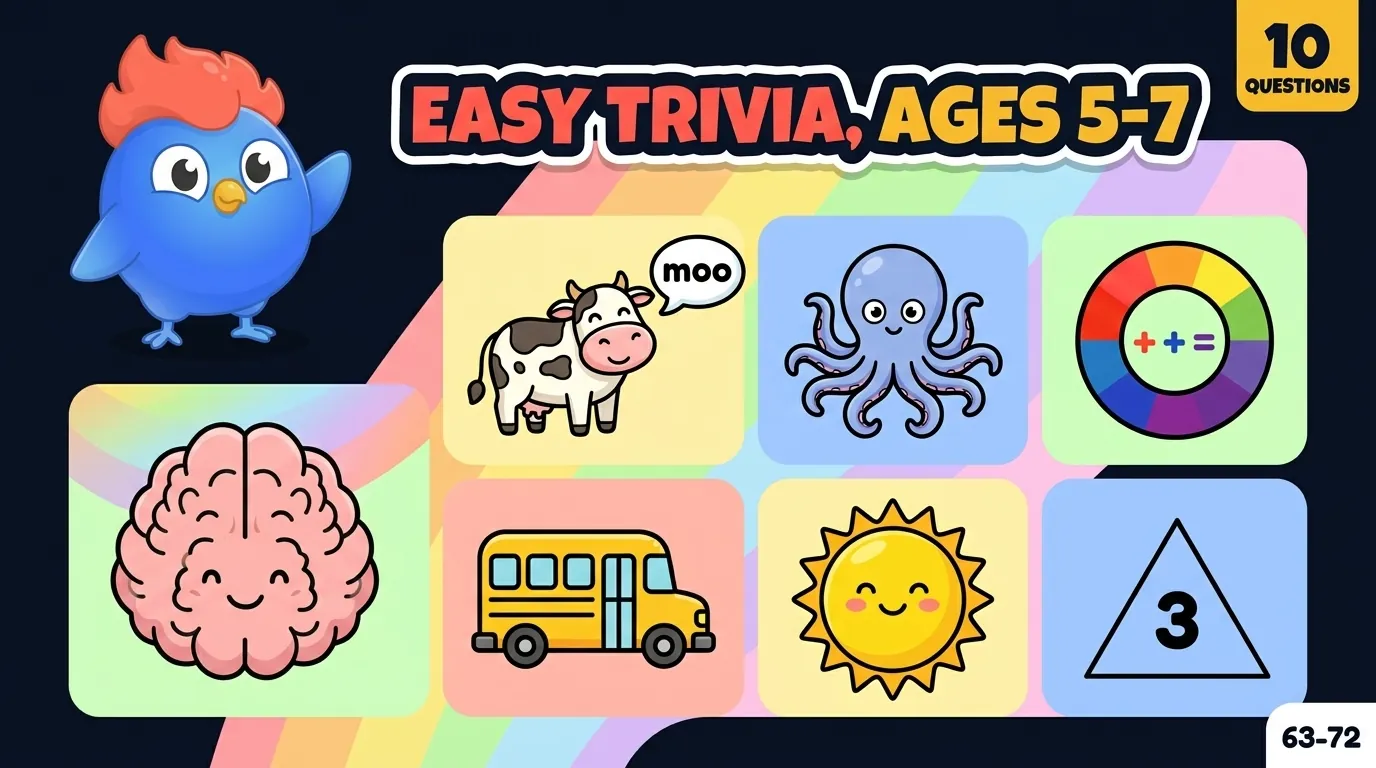 Read this round out loud. If a 5 to 7 year old cannot answer it from home, the playground, or the first weeks of school, it does not belong in the tier.
Hard Trivia Questions for Older Kids (Ages 11-13) (73-82)
By 11 or 12, straight recall gets boring fast. The questions that still land are the ones that make a kid connect two facts that do not obviously belong together, and these ten are built that way. They suit a reader who has already finished the Harry Potter set and wants a step up into general knowledge.
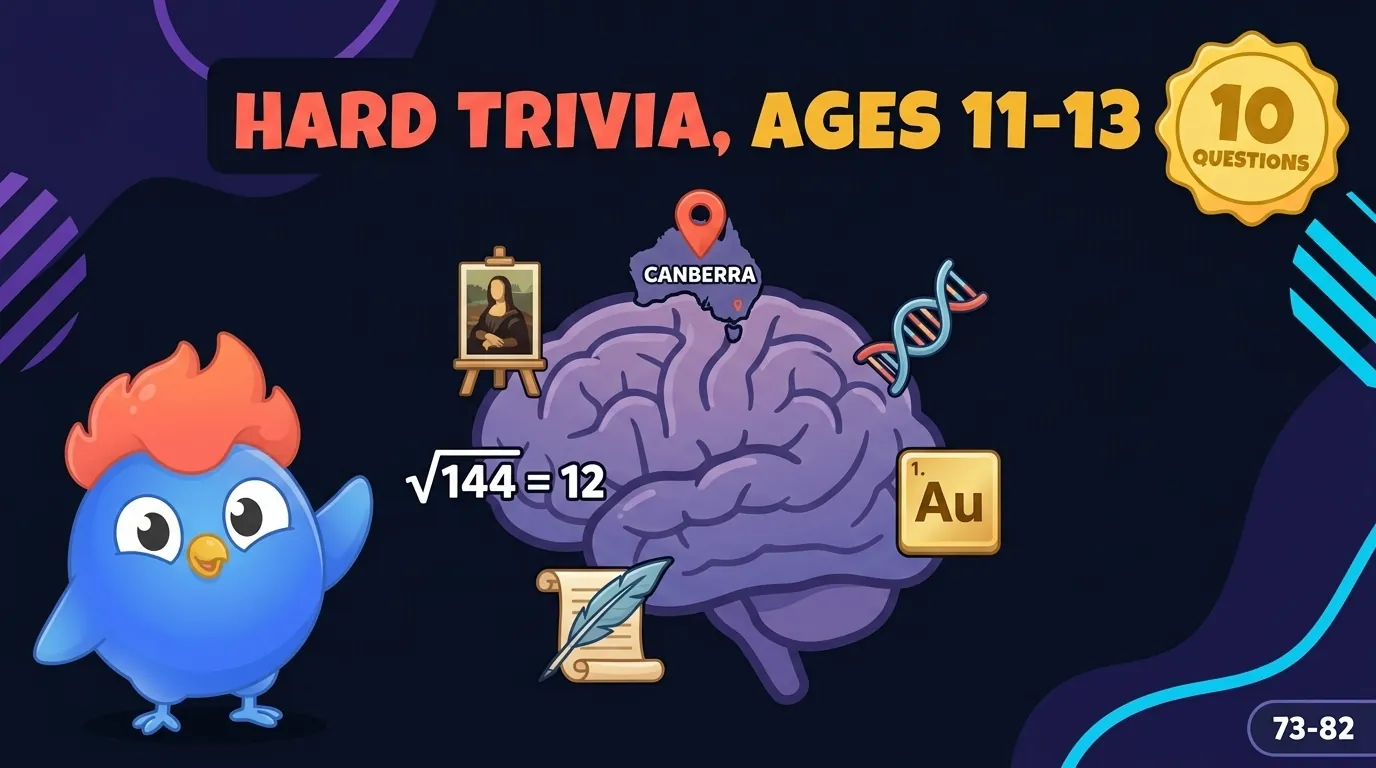 The 11-to-13 round: multi-step questions that reward connecting two facts.
73. What does “WWW” stand for? Hard
Answer: World Wide Web. Tim Berners-Lee invented it in 1989 at CERN in Switzerland, and the first web page went live in 1991.
What throws people: A kid types or says WWW constantly and never decodes it. Those three letters name the global web of linked pages riding on top of the Internet, which is a separate thing underneath.
74. What is the capital of Australia? Hard
Answer: Canberra. Not Sydney, not Melbourne. Canberra was purpose-built in the 1920s as a compromise between the two cities that both wanted the title.
Why it trips kids up: Sydney has the Opera House and appears in every film, so it feels like the capital. Canberra was built from nothing to do the actual job.
75. Who painted the Mona Lisa? Hard
Answer: Leonardo da Vinci, between roughly 1503 and 1519. It hangs in the Louvre in Paris, where tens of thousands of people file past it daily.
Van Gogh and Picasso are the other two names a kid hears most, so they slip out by reflex.
76. What is the square root of 144? Hard
Answer: 12, because 12 times 12 is 144. A square root is just the number that multiplies by itself to give you the original.
What throws people: It leans on the multiplication tables a kid would rather forget. Worth having cold: 11 × 11 = 121, 12 × 12 = 144, 13 × 13 = 169.
77. Who wrote Romeo and Juliet? Hard
Answer: William Shakespeare, in the 1590s. It is one of the 37 plays generally attributed to him.
Where guesses go wrong: Charles Dickens comes up a lot, along with any name that sounds suitably old. Shakespeare also wrote 154 sonnets, and roughly 1,700 English words appear in print for the first time in his work.
78. How many continents are there? Hard
Answer: Seven, in the English-speaking model: Africa, Antarctica, Asia, Australia, Europe, North America and South America.
Here’s the strange part: The right answer depends on where you went to school. Some countries teach six and merge Europe and Asia into Eurasia. Others teach five and merge the Americas.
79. In what year did World War 2 end? Hard
Answer: 1945. Germany surrendered in May, Japan in September, after the atomic bombs on Hiroshima and Nagasaki. The war ran six years.
Two years compete for the same slot in memory, 1939 and 1945, and they are easy to swap. The start year sticks harder, because that is the one drilled in first.
80. What is the chemical symbol for gold? Hard
Answer: Au, from the Latin aurum. The same pattern gives Fe for iron (ferrum), Pb for lead (plumbum) and Ag for silver (argentum).
Why it trips kids up: English-word logic works fine for O as oxygen, so Au looks random. The elements people have known since antiquity kept their Latin names.
81. What does DNA stand for? Hard
Answer: Deoxyribonucleic acid, the molecule carrying the genetic code in every cell of every living thing. Uncoiled, a single strand can run up to 2 meters.
DNA arrives as a concept and never as an acronym. The full chemical name runs 20 letters and trips the tongue, which is precisely why the world says the three initials.
82. What is the fastest bird in the world? Hard
Answer: Peregrine falcon. In a hunting dive it reaches about 240 mph (389 km/h), which makes it the fastest bird in a dive and faster than any other animal in motion.
Where guesses go wrong: Cheetahs own the speed headline, so the fastest bird gets imagined as something rare and tropical. Peregrines nest on skyscraper ledges in cities all over the world.
Funny Trivia Questions for Kids (83-89)
The trick with funny trivia is that the answer sounds invented and is not. A shrimp really does keep its heart in its head. Butterflies really do taste with their feet. Save these seven for the end of a game night, when everyone is tired and one more laugh gets you to bedtime. The same kind of question turns up in the general knowledge set.
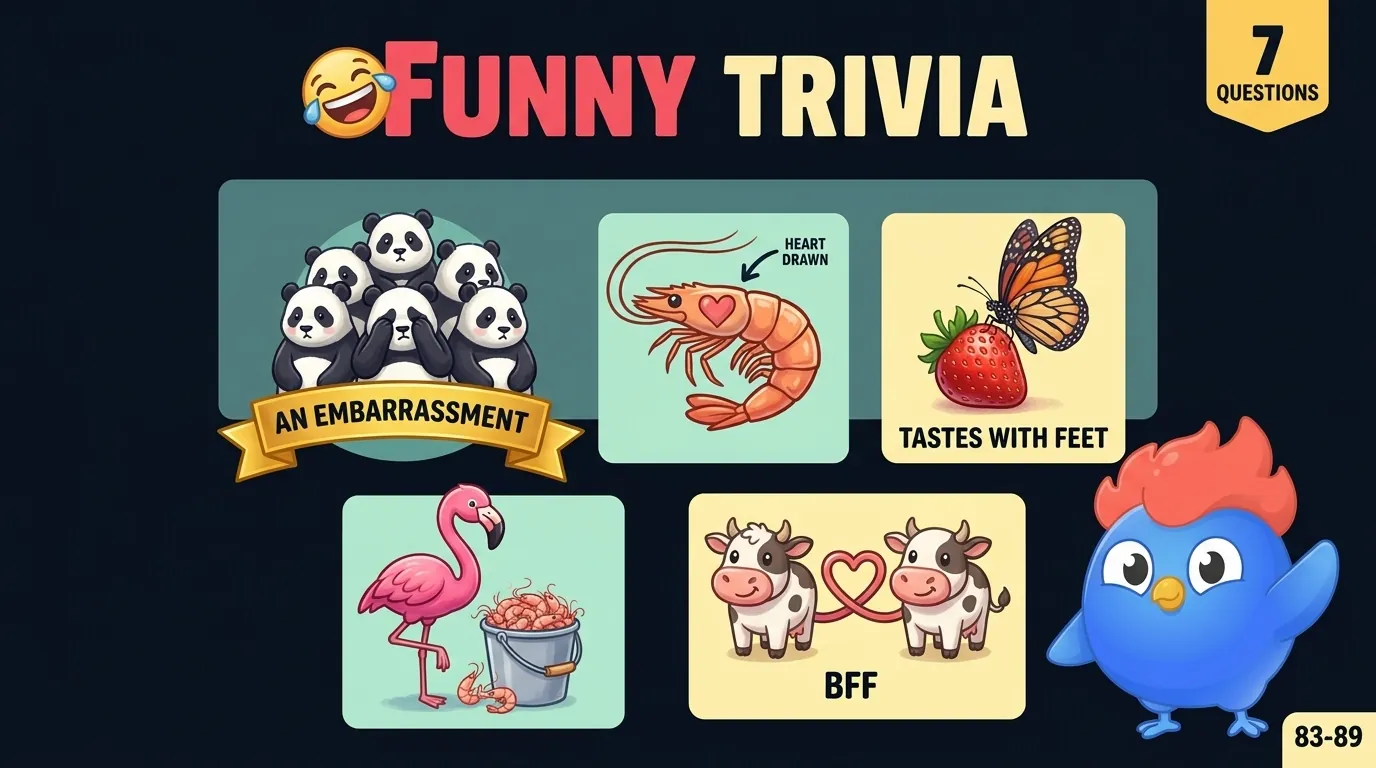 Seven kid-approved facts that sound made up and are not.
83. What do you call a group of crows? Easy
Answer: A murder. The term goes back to at least the 15th century, appearing in the Book of St Albans in 1486.
Here’s the strange part: It sounds grim and invented, and the dictionaries back it anyway. Medieval hunting manuals went wildly specific with their collective nouns, and a handful of the strangest ones simply never left the language.
84. Where is a shrimp’s heart located? Easy
Answer: In its head. The heart sits just behind the eyes and brain, inside what looks to us like the head segment.
A heart belongs in the chest, which is a rule about our body plan and nobody else’s: a shrimp’s blood is not pumped around a closed loop of vessels at all, so the heart sits where an open circulatory system needs it, up front with the organs it serves.
85. How do butterflies taste things? Easy
Answer: With their feet. Chemical receptors on the feet mean a butterfly landing on a flower knows instantly whether it is worth eating.
It reads like a line from a picture book. A butterfly has no tongue in our sense, so the taste sensors ended up on the landing gear.
86. Why are flamingos pink? Medium
Answer: From what they eat. Flamingos hatch gray and turn pink over time from brine shrimp and blue-green algae rich in beta-carotene. Zoos add pigment to the feed to keep the color.
Why it trips kids up: Pink bird, pink baby, that is the natural leap. All of that famous color arrives later, straight off the dinner plate.
87. Can rabbits see behind themselves? Medium
Answer: Almost. Eyes set on the sides of the head give a rabbit a field of view close to 360°, with a small blind spot right in front of the nose and another directly behind.
What throws people: Seeing behind you should require turning around. Rabbits skip that step entirely, which is what you want when almost everything in the field is trying to eat you.
88. Do cows have best friends? Medium
Answer: Yes. Research from the University of Northampton in 2011 found that cows form close pair bonds with particular herd-mates, and that their heart rates rise when they are separated.
It sounds like a cartoon premise and it is documented science. Move a cow’s bonded friend to another field and the cow shows measurable stress about it.
89. What is a group of pandas called? Hard
Answer: An embarrassment. “An embarrassment of pandas” is the collective noun that stuck, and organizations including the International Fund for Animal Welfare use it.
Worth knowing: Unlike “a murder of crows,” this one is not medieval. It appears to be a late twentieth-century coinage that the internet then made permanent, and you will also see “a bamboo” and “a cupboard” of pandas in circulation. No committee ever voted on any of them.
What to Do When a Kid Gets One Wrong
The wrong answer is the useful part of the whole exercise, and it is the part most quiz lists waste. A kid who guesses, misses, and then finds out exactly why the guess was wrong holds the correction far longer than a kid who reads the right answer and moves on. That asymmetry has been measured:
So when a kid misses one, do not just say “nope, it’s the elephant.” Read the follow-up line under the answer out loud. That is the entire reason each answer here carries one.
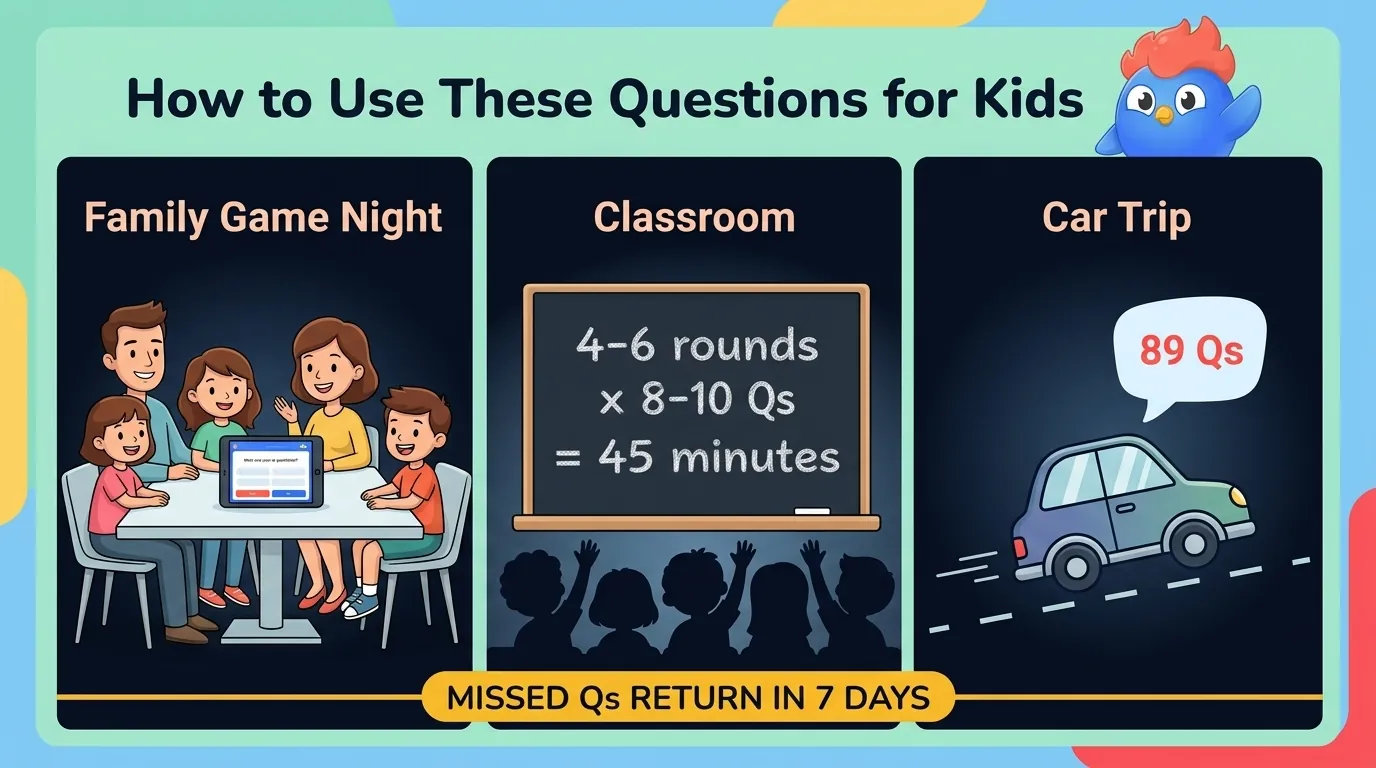 Three settings the same 89 questions work in: family night, classroom block, or a duel in the app.
Beyond that, the format is yours. On a game night, hand questions out by age using the tier column in the table at the top, so nobody has to pre-read anything. In a classroom, 4 to 6 rounds of 8 to 10 questions fills a 45-minute block and the category sections drop straight in as topic rounds. In a car, stick to the Ages 5-7 and Funny sections, where nothing needs reading and every answer fits in a word or two.
If you want the loop to keep running after the questions run out, that is what the app is for. LearnClash duels are 18 questions across 6 rounds of 3, with a 72-hour window per turn, so a parent and a child on completely different schedules can still share a game. ELO matchmaking keeps it close, spaced repetition keeps re-serving a missed question until the kid finally owns it, and the deepest topic in the catalog, General Knowledge, held 512 questions in the July 21, 2026 export.
Where to go next:
- The 43 Disney trivia questions work for any age that watches the films.
- The 47 animal trivia questions lean noticeably harder than this set.
- The 37 Harry Potter trivia questions are the reliable pick for family-movie households.
- Mixing kids and adults at a company event? The team-building trivia guide has icebreaker rounds that survive both audiences.
- Or browse the whole trivia question library, 34 topic sets, all free to play.
Playable topic pages for the categories above: dinosaurs, space, physics, geography and Disney.
Frequently Asked Questions
What are good trivia questions for kids?
Good trivia questions for kids are specific enough to have one correct answer, surprising enough that the obvious guess is wrong, and age-appropriate for the child's reading level. This list of 89 kids quiz questions tags each question Easy, Medium, or Hard so you can match difficulty to age. On LearnClash, the app does this matching automatically using ELO.
What age should kids start doing trivia?
Kids can start answering simple trivia at age 5, once they can read a question on their own and hold a 2 or 3 option answer in mind. The Easy tier in this list targets ages 5 to 7 with short questions and visual answers. Ages 8 to 10 handle Medium questions with one sentence of context. Ages 11 to 13 are ready for Hard questions with multi-step reasoning. LearnClash starts every player at 1300 ELO (Gold II, the ladder average) and calibration finds their true tier from there.
How can I make trivia harder for older kids?
Make trivia harder for older kids by adding a why layer to every question: not just the animal, but its adaptation; not just the planet, but its orbital quirk. The Hard tier in this list targets ages 11 to 13 with multi-fact questions that reward reasoning over recall. LearnClash raises difficulty after each correct answer, keeping the challenge just past what the child already knows.
Are kids' trivia games educational?
Yes, when the questions come with feedback. A 2008 Karpicke and Roediger study in Science found that learners who were repeatedly tested recalled about 80% of the material a week later, against 36% for learners who only reread it. Spacing the reviews out extends that advantage further. LearnClash Solo mode runs spaced repetition automatically, so a question the child missed keeps coming back for another try while the ones they already know rest longer between reviews.
Can kids play LearnClash with parents?
Yes. LearnClash is a competitive learning app with async turn-based duels and a 72-hour turn window, so a parent and child can share a duel even on different schedules. Duels are 18 questions across 6 rounds of 3, and ELO matchmaking keeps early games close. There are no ads in any tier, and Premium at $7.99 per month unlocks bonus rerolls and custom topic generation.