
LearnClash vs Quizizz: Self-Study vs Classroom [2026]
LearnClash vs Quizizz (now Wayground), compared on questions, ranking, retention science, and pricing. One serves solo learners, the other classrooms.

September 9, 2026 documentation check: Wayground plans now list 100 participants for Starter and 1,000 for Individual, School and District. Standards mastery reports compare multiple assessments. Prices and features vary by region; we have not verified a current Individual price for every region.
Wayground’s homepage claims its quizzes reach teachers in 90 percent of U.S. schools. That is a remarkable footprint, and it says nothing about whether any student remembers the material a week later. This comparison keeps coming back to that gap.
LearnClash is a competitive 1v1 quiz duel app: questions on any topic, an ELO ladder across 8 tiers from Iron to Phoenix, and spaced repetition built into every game mode. Quizizz, renamed Wayground in June 2025, is a classroom quiz platform where teachers run live or self-paced sessions for groups, with leaderboards, power-ups, and more than 20 question types.
Below: questions, ranking, retention, pricing, and an honest section on where Wayground is simply better. Wayground’s plan details are sourced from its own pages and help center; check its regional offer for current pricing. Challenge a friend to a quiz duel →
LearnClash vs Quizizz: Quick Comparison
Most of this comparison comes down to who holds the phone. LearnClash assumes a curious person playing for themselves. Quizizz assumes a teacher at the front of a room, and every feature follows from that.
| Feature | LearnClash | Quizizz (Wayground) |
|---|---|---|
| Built for | Individual learners | Teachers and classrooms |
| Topics | Any topic, generated on demand | Library Wayground says holds 20M+ resources |
| Play format | 1v1 async duels (6 rounds of 3 questions, 72h deadline) | Live group sessions or self-paced homework |
| Ranking | Persistent ELO ladder, 8 tiers | Session leaderboard, resets each quiz |
| Retention | Spaced repetition (7-day and 90-day reviews) | Mastery Peak reattempts within the session |
| Question types | Multiple choice, 3 difficulty levels | 20+ types; 12 need a paid plan |
| Session size | 1v1 | Up to 100 on Starter; 1,000 on Individual, School and District |
| Paid tier | $7.99/mo or $59.99/yr | Individual: check your regional price |
Wayground’s prices and features vary by region. Confirm the current offer in your currency before subscribing.
Questions: Any Topic vs Teacher-Created Content
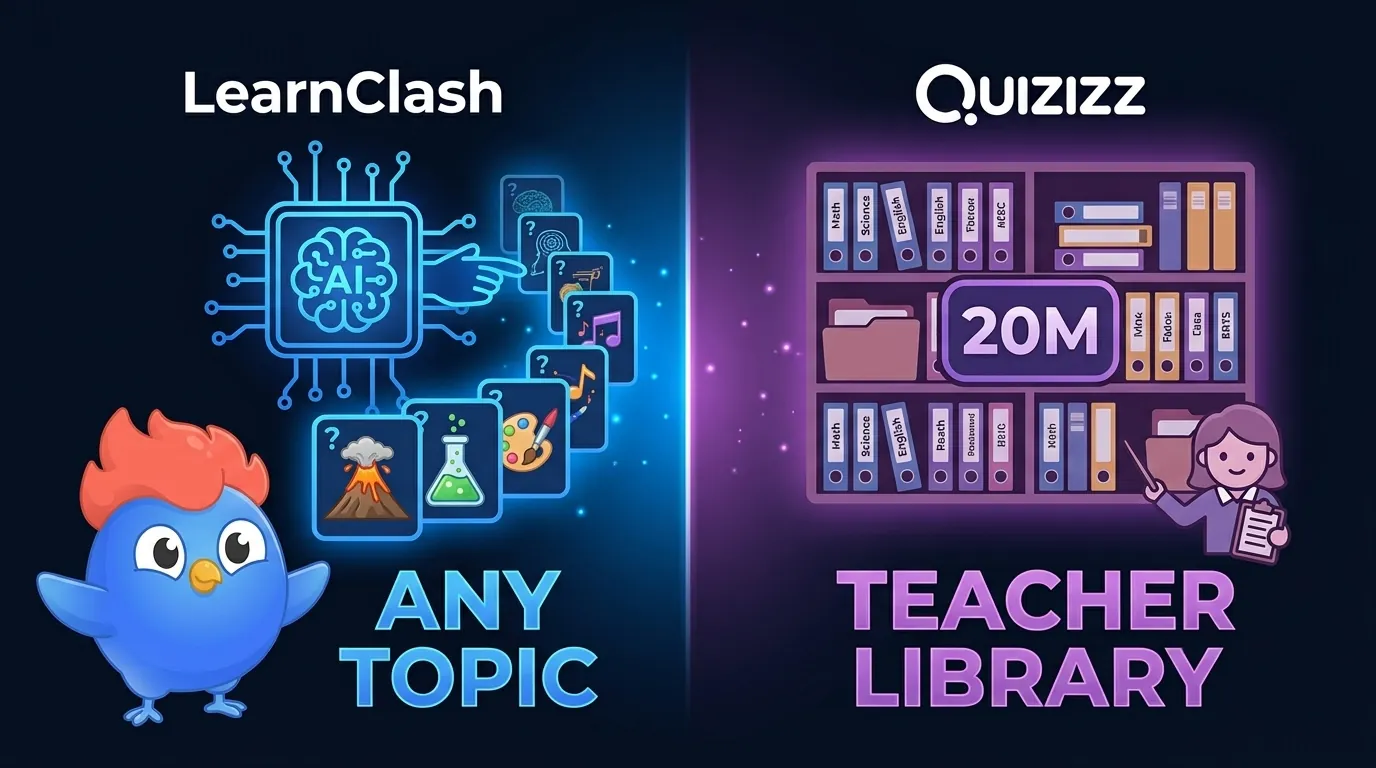
The two apps get their questions from opposite places. Quizizz draws on a library Wayground says holds more than 20 million teacher-created resources, browsable by subject and grade. LearnClash generates questions on demand for whatever topic you type, calibrated across three difficulty levels.
| LearnClash | Quizizz | |
|---|---|---|
| Source | AI-generated on demand | Teacher-made + AI imports |
| Topic scope | Anything you can type | What teachers uploaded |
| Difficulty | Easy, medium, hard (auto-calibrated) | Set by the quiz creator |
| Fresh content | Generated as you play | Fixed per quiz |
Type “Renaissance sculpture” into LearnClash and you get a calibrated question set in seconds. Quizizz might have a teacher’s quiz on it, or might not, and if it does you inherit that teacher’s question selection, difficulty, and perspective. The trade runs the other way on format variety, which the next section gets into.
Wayground also builds quizzes from documents, YouTube clips, and images with AI, a genuine time-saver for teachers. It is still a teacher workflow: there is no box a student types “quiz me on volcanology” into. If building the quiz yourself is the point, our trivia maker comparison ranks the tools for that job.
Where Wayground Beats Us
I build LearnClash, so read this page knowing where my incentives sit. It also means I know exactly where the other product is better, and the comparison would be dishonest without this section.
Format variety is the big one. Our July 21, 2026 export counted 34,157 questions, and every single one is the same shape: multiple choice, one correct answer, three wrong answers drawn from a larger pool. That is a constraint we accepted on purpose, because every LearnClash question is AI-generated and then machine-verified, and a fixed-choice answer is something a fact-check pipeline can actually check. A graphing exercise or a drawn diagram is not. Wayground’s help center lists more than 20 question types, 12 of them paid-only, including labeling, graphing, hotspot, and audio response. If you teach geometry or anatomy, that variety is not a nice-to-have. It disqualifies us.
The second is the room itself. Wayground gives a teacher join codes, a live dashboard showing who is stuck where, reports to send home, and sessions for up to 100 participants on Starter and 1,000 on Individual. LearnClash has none of that and is not trying to build it. A teacher with 28 students on a Tuesday morning has nothing to run on our app.
Ranking: ELO Tiers vs Session Leaderboards
LearnClash ranks every player on a persistent ELO rating ladder across 8 tiers from Iron (100) to Phoenix (2400+). Quizizz scores each session separately: a correct answer is worth 600 points plus up to 400 more for speed when the question timer is on. With the leaderboard enabled, learners can see their rank during and after the session. Reports retain points and scores for later review. ELO follows the player across duels; quiz scores belong to individual activities.
| LearnClash | Quizizz | |
|---|---|---|
| System | ELO-style rating (8 tiers, persistent) | Points (session-scoped) |
| Matchmaking | Skill-based (rating proximity) | Teacher assigns groups |
| Progression | Climb from Iron to Phoenix | Reports can compare multiple assessments |
| Beat a stronger opponent | Larger rating gain | Same points regardless |
New LearnClash players start at 1300 ELO and complete ten rated placement duels before public leaderboard access. The rating can move more during early games. ELO describes competitive results, not a direct measure of long-term recall.
Quizizz’s points push classroom energy instead. Power-ups can double points or strip out wrong options, answer streaks build, and the teacher’s live dashboard ranks the class in real time. It works, and a 15-minute review session gets loud. Wayground also offers reports that compare multiple assessments; a session leaderboard should not be confused with the full reporting history.
Learning: Spaced Repetition vs Mastery Peak
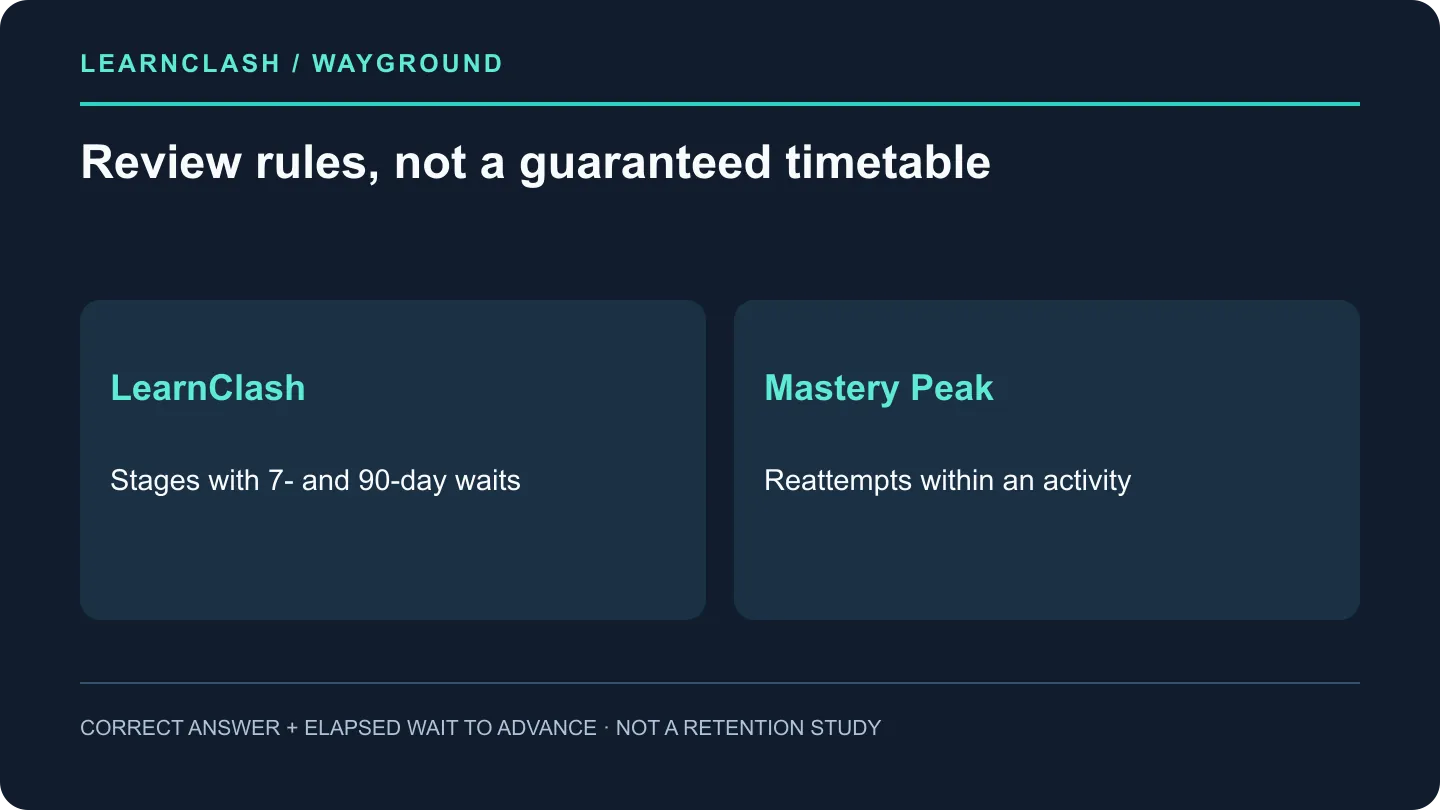
Here is the biggest gap in the comparison. LearnClash schedules the questions you miss for review after 7 days, then 90, as they climb three stages: Learning, Known, Mastered. Answer a review incorrectly and the card drops one stage, with Learning as the lowest stage. Every game mode feeds the same system, and a completed wait makes a question eligible to advance after another correct answer. Selection and when you play determine when it appears; mastered questions can return.
Quizizz’s closest feature is Mastery Peak, a live mode where students reattempt wrong answers until they hit an accuracy goal the teacher sets at 80, 90, or 100 percent. Wayground’s help center describes it as spaced repetition. The reattempts happen inside the same session, though, minutes apart. The cited mode documentation does not describe a cross-day personal review queue.
| LearnClash | Quizizz | |
|---|---|---|
| Retention method | Cross-session SRS (7d / 90d) | Within-session reattempts |
| Mastery tracking | 3 stages across all modes | Accuracy goal per session |
| Review scheduling | Automatic, across days and weeks | None beyond the session |
| Measured long-term advantage | Not established by this comparison | Not established by this comparison |
Karpicke and Roediger (2008) found that practice testing produced about 80 percent recall a week later, against 36 percent for restudying. That study compared retrieval and restudy conditions, not LearnClash and Wayground. It does not establish that in-session retries have no value or that one app produces better retention.
Pricing: What Free Actually Includes
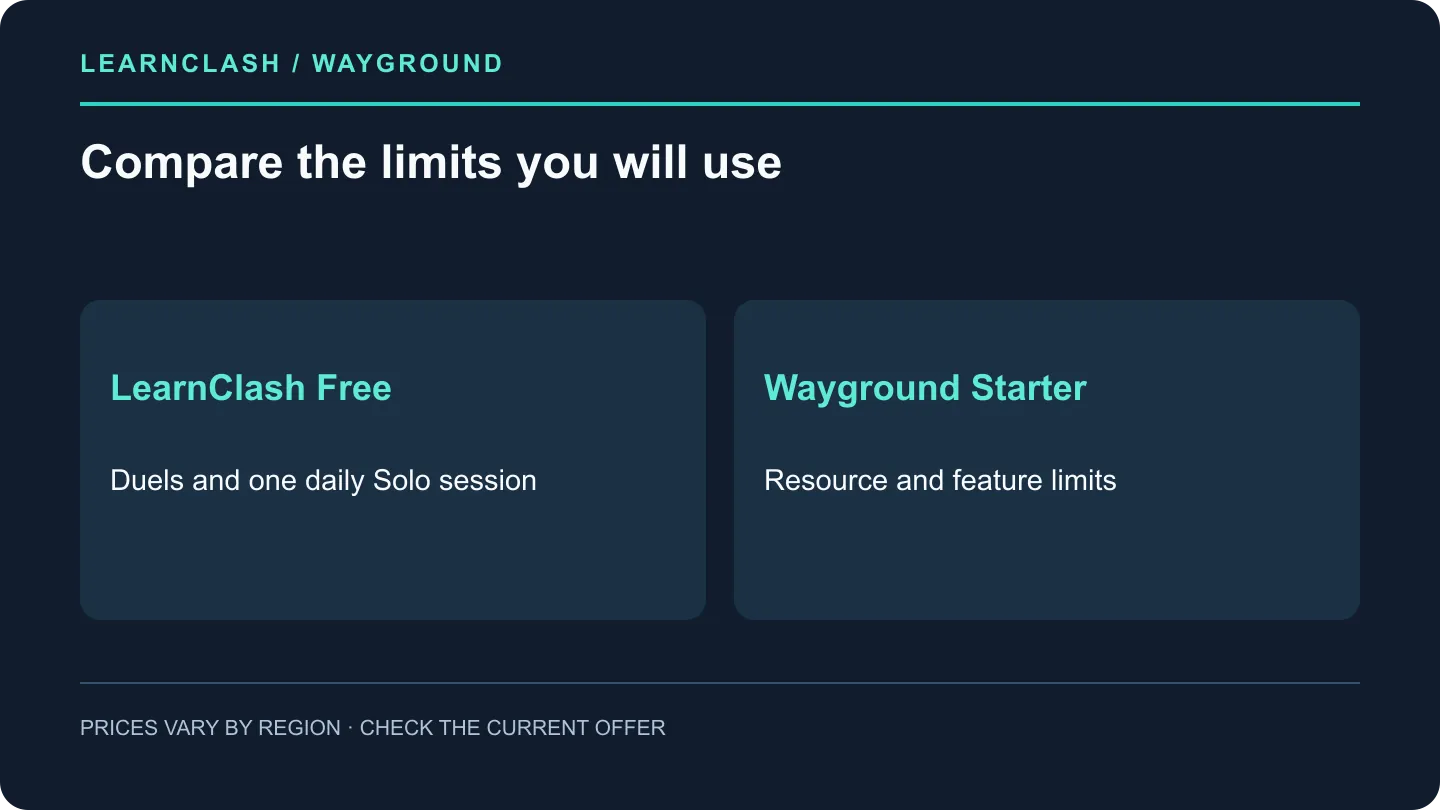
LearnClash’s free tier includes duels, every topic, the full ELO ladder, spaced repetition, and one Solo training session a day after the Starter Pass, with no ads on any tier. Premium costs $7.99 a month or $59.99 a year, with a 7-day free trial on the annual plan in the app, and mainly buys volume: Solo with no daily cap and a fair-use limit of 20 sessions an hour, plus up to 3 New hands per round instead of 1. The full free-vs-Premium feature split is on the LearnClash pricing page.
Wayground’s free Starter plan covers the classroom basics. Live and self-paced quizzes run free, storage caps at 20 activities, and the 12 premium question types stay locked. The Individual plan, which older articles still call Super, is paid. We have not verified its current price for every region; check Wayground’s current offer before subscribing. School and District plans are quote-based.
| LearnClash Free | Wayground Starter | LearnClash Premium | Wayground Individual | |
|---|---|---|---|---|
| Price | $0 | $0 | $7.99/mo or $59.99/yr | Check your regional price |
| Core play | Duels, all topics, ELO, SRS | Live + self-paced quizzes | Everything in Free | Everything in Starter |
| Limits | 1 Solo session/day after the Starter Pass | 20 stored activities, basic question types | Solo with no daily cap, up to 20 sessions/hr (fair use); 3 New hands/round instead of 1 | Unlimited storage, premium types |
One honesty note on ads. Quizizz-era reviews regularly flagged ads on the free tier, and an earlier version of this article repeated that. Wayground’s current plan pages document storage and question-type limits, not ads, so we dropped the claim rather than carry a fact we could not re-verify in August 2026. What we can verify is our own side: LearnClash shows no ads to anyone, free or paid.
For Self-Directed Learners: Who Actually Serves You?
Can you use Quizizz without a teacher? Technically yes: browse the public library and practice any quiz you find on your own. What is missing is everything around the quiz. The workflow centers on activities and teacher reports rather than a personal ELO ladder. Its reporting tools can compare multiple assessments.
LearnClash inverts that. Pick a topic and duel; the review queue, your ELO rating, and per-topic stats accumulate on their own, with no class code in sight.
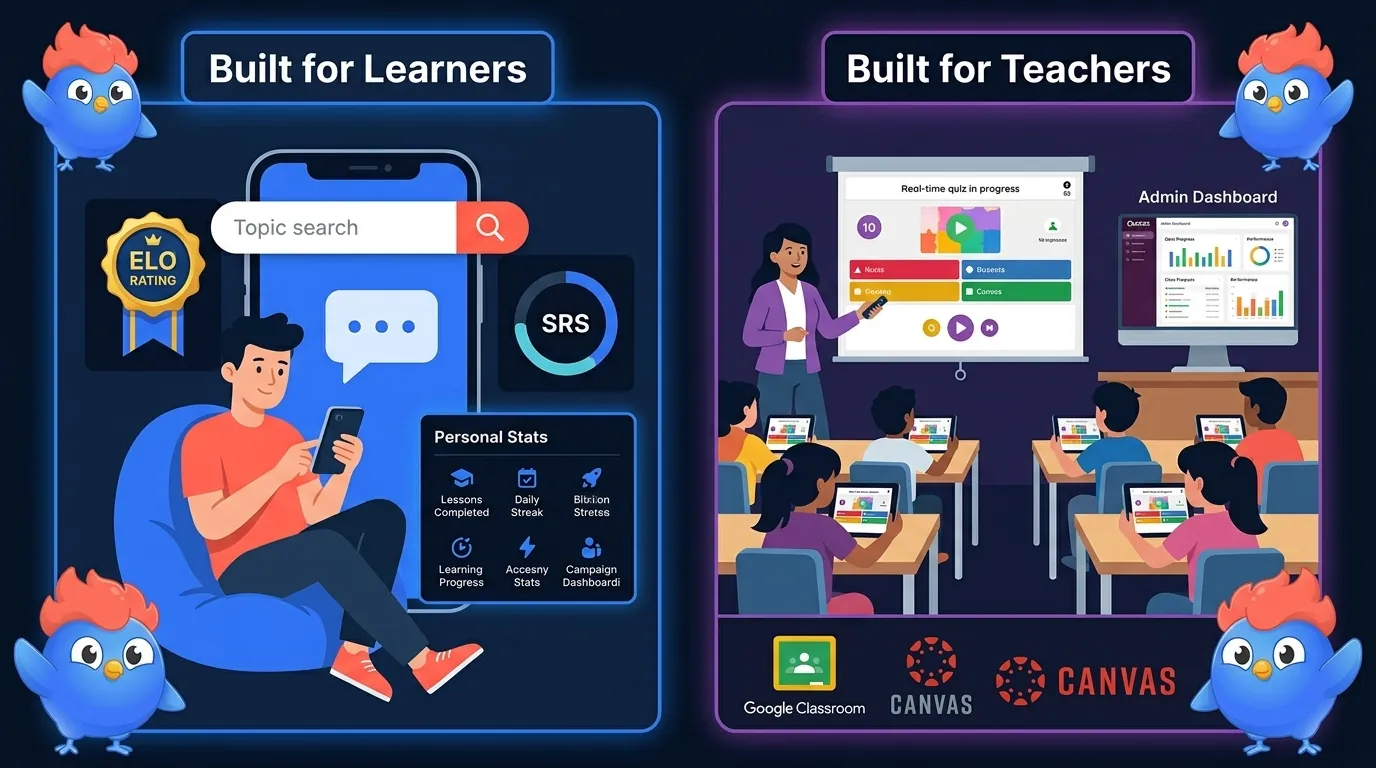
In a classroom the ranking flips just as hard. Quizizz turns a review session into a game, tracks class-wide accuracy, and plugs into Google Classroom and other LMS setups. That is exactly the job it was built for, and the same job Kahoot competes for. Those strengths do not transfer to someone studying alone at 11 PM.
The 10 AM Answer and the 11 PM Answer
Put the same question, “Quizizz or LearnClash?”, to two different hours of the day.
At 10 AM the answer is Wayground, and it is not close. Twenty-eight students, one projector, a curriculum to cover, and a dashboard that shows who needs help before the bell: that is the product a decade of classroom features was built for. If that is your hour, our Kahoot alternatives ranking covers its live-room rivals too.
At 11 PM the answer flips. No class, no host, just you and a topic you want to still know in March. That hour needs questions on demand, a rating that remembers you, and reviews that show up next week without anyone assigning them. That hour is why LearnClash exists. Start a duel on any topic and check whether you still remember it next Tuesday.
More head-to-heads live in the comparison hub.
Frequently asked questions
Is Quizizz good for self-study without a teacher?
Quizizz (now Wayground) is built for classrooms, with a teacher creating and assigning quizzes. Individual learners can browse the public library and practice quizzes solo, but there is a teacher-oriented workflow; reports can preserve and compare assessment results. LearnClash is built for self-directed learners, with ELO ranking, spaced repetition, and any-topic play.
Does Quizizz have spaced repetition like LearnClash?
Wayground's Mastery Peak mode reattempts wrong answers within the same session until students reach an accuracy goal the teacher sets at 80, 90, or 100 percent. It does not schedule reviews across days or weeks. LearnClash uses cross-session spaced repetition with 7-day and 90-day intervals, tracking 3 mastery stages: Learning, Known, and Mastered.
Is LearnClash free compared to Quizizz?
Both are free to download. LearnClash free includes duels, all topics, ELO rankings, spaced repetition, and no ads on any tier; Premium costs $7.99/month or $59.99/year. Wayground's free Starter plan stores 20 activities with basic question types, and the paid Individual plan is priced by region. Check Wayground's current offer before subscribing.
Did Quizizz change its name to Wayground?
Yes. Quizizz rebranded to Wayground in June 2025 to reflect its evolution beyond quizzes into a broader supplemental learning platform. Accounts, links, and integrations kept working unchanged. Most users and search engines still use the name Quizizz.