
Kahoot vs Quizlet: Which Actually Helps You Learn? [2026]
Kahoot vs Quizlet in August 2026: both pricing pages re-checked, Quizlet Plus caps explained, Kahoot One vs 360 untangled, and the evidence for review spacing.

Spaced-repetition correction, September 5, 2026. Quizlet now documents Spaced Repetition in website Flashcards: rate your recall and it schedules the next review. The help page does not state which subscription is required. Learn-mode limits are a separate question; the August price audit below has not been repeated.
Kahoot is a live quiz platform: a host starts a timed session and 10 to 800+ players answer on their own devices in real time. Quizlet is a self-paced flashcard library with Learn mode, practice tests, and AI generation. Kahoot wins the classroom. Quizlet wins solo review. Quizlet also offers scheduled flashcard reviews on its website; that matters when you plan study across several days.
This version of the comparison was re-verified on August 5, 2026: every price and cap below was checked against the vendors’ own pages or store listings this month, and the AI headlines of the past year (GPT-5.5 inside Quizlet’s ChatGPT app this spring, Kahoot’s on-device Quiz Starter last September) get the hindsight treatment now that WWDC has come and gone.
Kahoot vs Quizlet: Quick Comparison
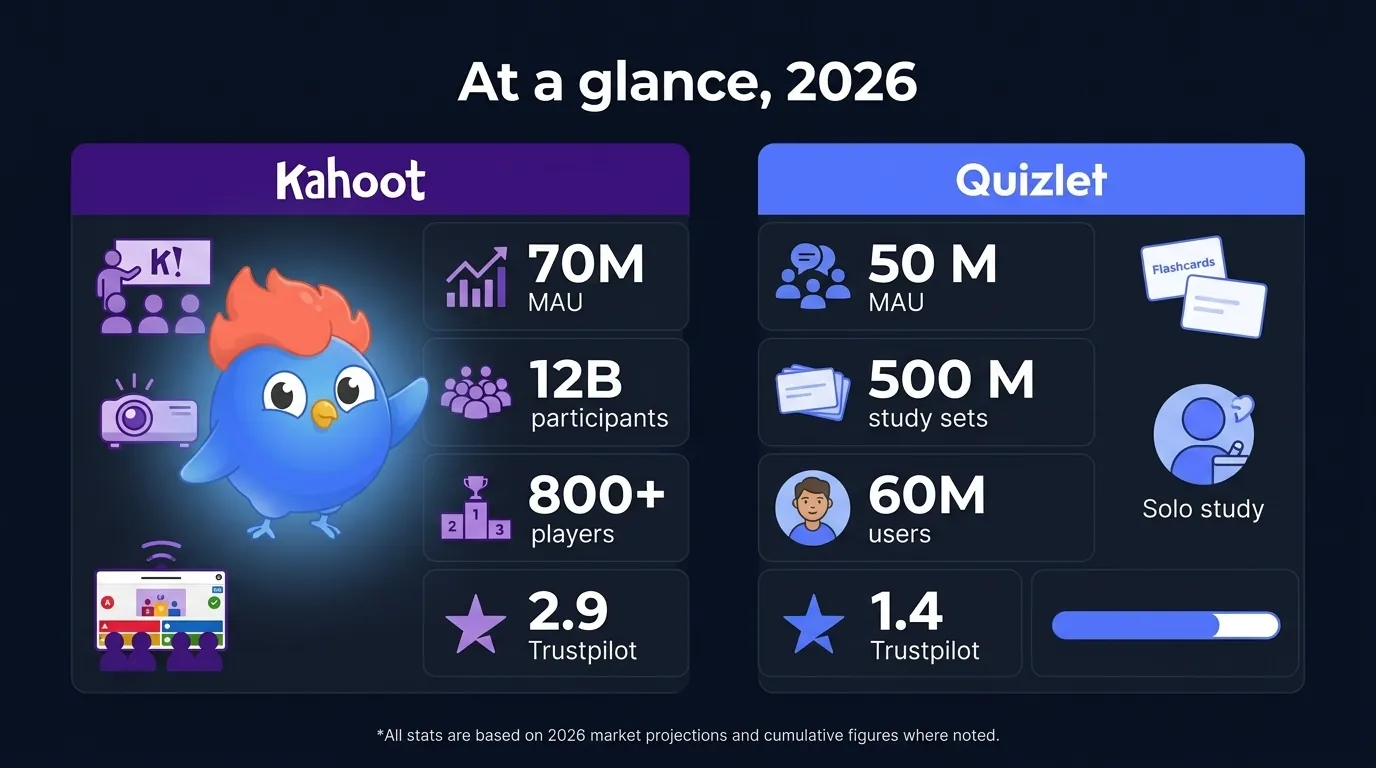
Kahoot and Quizlet solve different problems. Kahoot runs host-controlled multiplayer quizzes and reported 70 million monthly active users in its 2024-25 materials (TrustRadius), while Quizlet is a solo flashcard library at a reported 50 million MAU that now also runs as a native ChatGPT app. The overlap between the two is small. LearnClash sits between them with async 1v1 quiz duels on any topic, and the Kahoot vs Blooket vs Gimkit breakdown maps the adjacent classroom-quiz field.
| Feature | Kahoot | Quizlet |
|---|---|---|
| Primary use | Live group quizzes | Self-paced flashcard study |
| Best for | Teachers, trainers, events | Students, self-learners |
| Format | Host-controlled, timed, live | Flashcards, Learn, Test, Match |
| Player count | 10 to 800+ per session | Solo (Quizlet Live: teams) |
| Content source | Host-created or 60+ publishers | 500M+ user-generated sets |
| AI (August 2026) | Quiz Starter self-study: on-device, offline, free (iOS 26); creator tools on cloud GPT-4 | Native ChatGPT app on GPT-5.5 Instant |
| AI tutor | None | Q-Chat discontinued June 30, 2025 |
| Spaced repetition | None | Scheduled Flashcards reviews on the website |
| Free tier | 10 players (personal), 40 (teachers) | Flashcards + limited Learn + ads |
| Paid entry | Kahoot!+ Bronze, $3/mo billed annually | Plus, $35.99/yr |
| Paid usage caps | None (caps are on player counts) | 3 practice tests/mo, 3 Q&A solutions/mo, 20 Learn rounds/mo on Plus |
| Ads | Upsell prompts | Banner ads on free tier |
| Headline scale | 12 billion cumulative participants | 60M MAU at the 2021 peak, ~50M reported 2024-25 |
| Trustpilot (Aug 2026) | 3.6/5 (~1,000 reviews) | 1.4/5 (billing complaints) |
The Plus cap row and the Trustpilot numbers are the rows that moved this year. Everything else on this table has been stable since spring.
The 2026 Timeline, With the Benefit of Hindsight
The spring update cycle for both apps happened almost entirely upstream of the apps themselves. On May 5, OpenAI made GPT-5.5 Instant the default ChatGPT model (OpenAI, TechCrunch), and Quizlet’s ChatGPT app inherited the upgrade the same day without shipping any code. Kahoot’s iOS 26 app got its Liquid Glass redesign, with the offline Quiz Starter generator (shipped the previous September) carrying over unchanged. Meanwhile Knowt, the free alternative that absorbed Quizlet’s 2022 defectors, paywalled its own practice features and fell 56 App Store Education spots in four days (MWM tracking).
Then WWDC happened, and the May speculation aged in an unexpected direction. Bloomberg had reported that iOS 27 might let users swap Apple Intelligence models, which would have reshaped Kahoot’s on-device story. The June 8 keynote instead centered on the new Siri AI and a performance-focused iOS 27 (the “Snow Leopard-style” release, per TechCrunch’s recap), shipping in the fall. Kahoot’s Quiz Starter still runs on Apple’s Foundation Models today, unchanged.
| When | Kahoot | Quizlet |
|---|---|---|
| Sept 22, 2025 | Quiz Starter ships with the back-to-school AI study tools (iOS 26, on-device Apple Foundation Models, offline, free) | Q-Chat already gone (discontinued June 30, 2025) |
| Q1 2026 | Quiz Starter carries over unchanged | Native ChatGPT app launches; Plus caps set at 3/3/20 monthly; Plus Unlimited launches at $44.99/yr |
| May 5, 2026 | iOS 26.5 backend work, no user-facing AI lift (AppleInsider) | Inherits GPT-5.5 Instant as ChatGPT’s default model |
| May 5-9, 2026 | Liquid Glass redesign on iOS 26 | Knowt (rival) paywalls free features, drops 56 App Store spots |
| June 8-12, 2026 | WWDC: Siri AI + performance-focused iOS 27; no user-swappable models announced | App stays tied to whatever ChatGPT runs |
| August 2026 | Pricing and plans re-checked for this article (see below) | Pricing and caps re-checked for this article (see below) |
Review scheduling deserves its own check, separate from the AI model. Quizlet documents Spaced Repetition on its website: users rate recall after each flashcard, and the system chooses the next review time. That is a scheduling feature, not just an in-session progress score.
Quizzes: Live Classroom vs Self-Paced Study
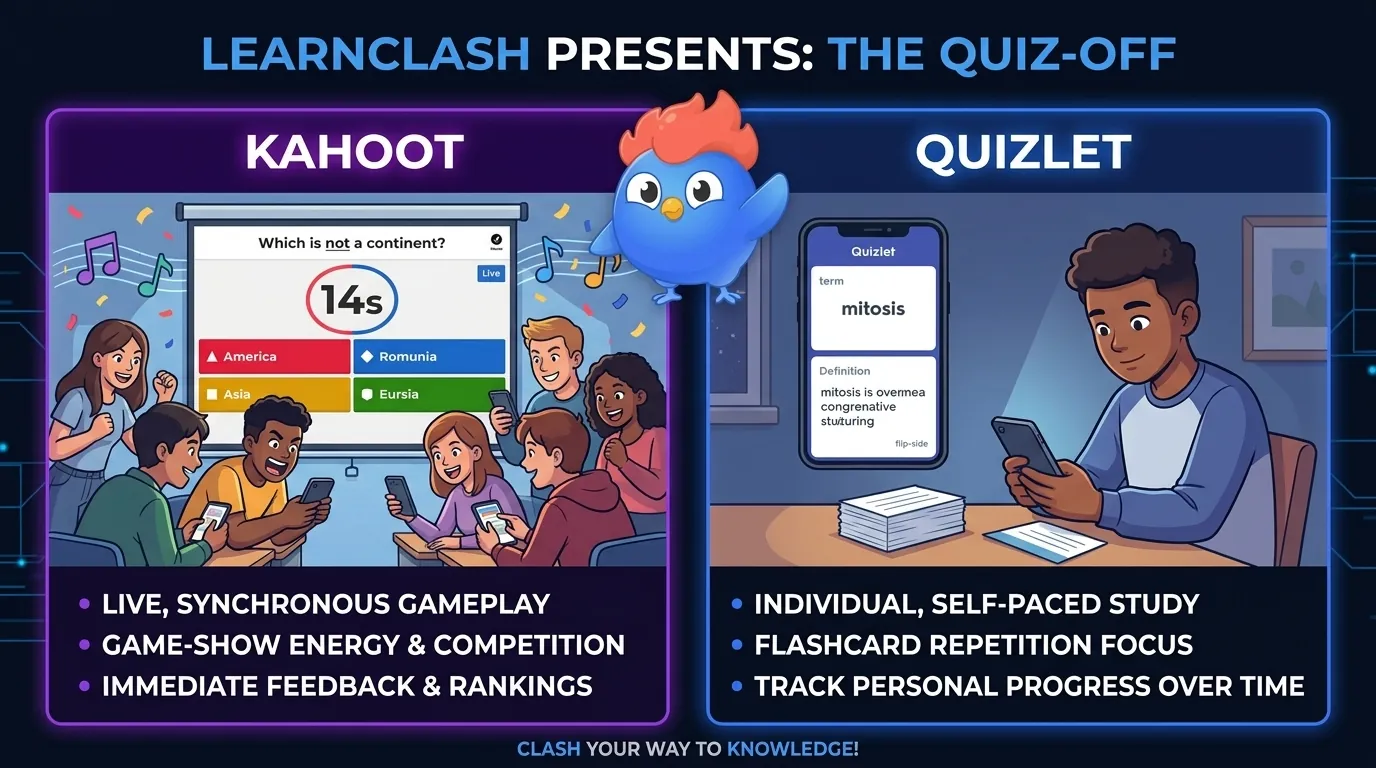
Kahoot quizzes are live events. A host creates a quiz, shares a game PIN, and players compete in real time with a countdown and leaderboard. Quizlet sessions are solo: students create or find flashcard sets, then review through Learn mode, practice tests, or matching games at their own pace.
| Kahoot | Quizlet | |
|---|---|---|
| Format | Live quiz, host-controlled | Self-paced (Learn, Test, Match) |
| Timing | Synchronous | Asynchronous |
| Pacing | Host sets the speed | Student controls the speed |
| Content creation | Host builds or picks templates | Anyone creates study sets |
| Question types | 6 scored + 7 opinion formats (Aug 2026 count) | Flashcard-based (term/definition) |
A Classic Kahoot session runs on a per-question timer with a speed bonus that rewards fast correct answers over thoughtful ones. A Quizlet Learn round lets you sit on one card as long as you want, which makes the cognitive load completely different even when the question itself is the same.
Kahoot’s strength is atmosphere. The music builds, the timer counts down, players race, the podium reveals the top three. It feels like a game show, and that feeling is the product. The catch is that speed matters: a student who knows the answer but reads slowly scores lower than one who guesses fast. Kahoot added an Accuracy Mode in 2025 (same time and points for everyone, no speed bonus), but Classic stays the default.
Quizlet is quieter. You flip cards, type answers, take practice tests, and that is fine, because cramming for a biology exam does not need podium music. The library holds 500 million+ study sets, which is both a strength and a problem: huge catalogue, zero verification, wrong answers sitting next to right ones.
Different tools suit different moments: Kahoot for the classroom, Quizlet for a personal flashcard routine with scheduled website reviews.
Cloud AI vs On-Device AI
The two platforms put their student-facing AI in opposite places, and both choices got tested this spring. Quizlet bet on the cloud: its native ChatGPT app runs on OpenAI’s default model, which became GPT-5.5 Instant on May 5. Kahoot put the self-study surface on the device: Quiz Starter, announced September 22, 2025, builds quizzes from notes, PDFs, and slides using Apple’s Foundation Models, offline and free on supported iPhones and iPads. One qualifier keeps the dichotomy honest: Kahoot’s creator-side AI tools, the question generator teachers use, run in the cloud on OpenAI’s GPT-4, so the on-device story applies to student self-study, not the whole product.
| AI feature | Kahoot (Aug 2026) | Quizlet (Aug 2026) |
|---|---|---|
| Quiz generator | Quiz Starter for self-study (iOS 26, on-device, offline, free); creator tools on cloud GPT-4 | Magic Notes (cloud, paid) |
| Chat integration | None | Native ChatGPT app on GPT-5.5 Instant |
| AI tutor | None | Q-Chat discontinued June 30, 2025 |
| Source inputs | Handwritten notes, PDFs, slides, Wikipedia | PDFs, typed notes, ChatGPT conversations |
| Offline | Yes for Quiz Starter (Apple Foundation Models) | No |
| Price | Quiz Starter free on iOS 26 devices | Plus or Plus Unlimited |
| Hallucination benchmarks | None published for either surface | 52.5% fewer hallucinated claims per OpenAI; 86% confabulation-when-wrong on AA-Omniscience |
The Quizlet-in-ChatGPT integration is a genuinely smart shortcut. Ask ChatGPT to explain cellular respiration, tap once, get a study set: that maps to how students already use AI. The May 5 upgrade sharpened the output too. OpenAI’s release notes report 52.5% fewer hallucinated claims on high-stakes prompts (medicine, law, finance) and an AIME 2025 math score up from 65.4 to 81.2. The structural downsides did not move: every generation round-trips to a remote server, and generating a set is separate from selecting its study method. On Quizlet’s website, Flashcards includes a Spaced Repetition option.
Kahoot’s on-device route is the opposite trade. No data leaves the phone, no subscription, no latency, but it only works on iPhones and iPads that run Apple’s on-device Foundation Models under iOS 26, which excludes most school-issued Chromebooks. WWDC 2026 briefly threatened to reshuffle this: Bloomberg’s model-swap report would have opened the on-device layer to competition, but the June keynote went a different way, so the trade stands as designed.
There is also a cautionary tale in Quizlet’s AI history. Q-Chat, the 2023 AI tutor students actually liked, was killed on June 30, 2025 with no public reason; a Change.org petition changed nothing. Nine months later the ChatGPT app arrived, and eight weeks after that it inherited a model upgrade Quizlet never chose. More AI surfaces, less product control. Generation and review scheduling are separate features; Quizlet now documents scheduled reviews in website Flashcards.
What the 2026 Spaced Repetition Meta-Analysis Settles
A 2026 meta-analysis supports spaced repetition as a study method, without establishing a winner among these apps. The Clinical Teacher published the meta-analysis (Maye et al., 2026): the authors screened 542 records, pooled 13 studies, and found that across 21,415 learners, spaced repetition produced a standardised mean difference of 0.78 over standard study (95% CI 0.56 to 0.99, p<0.0001). That lands just under Cohen’s 0.8 threshold for a large effect, at the top of the medium band.
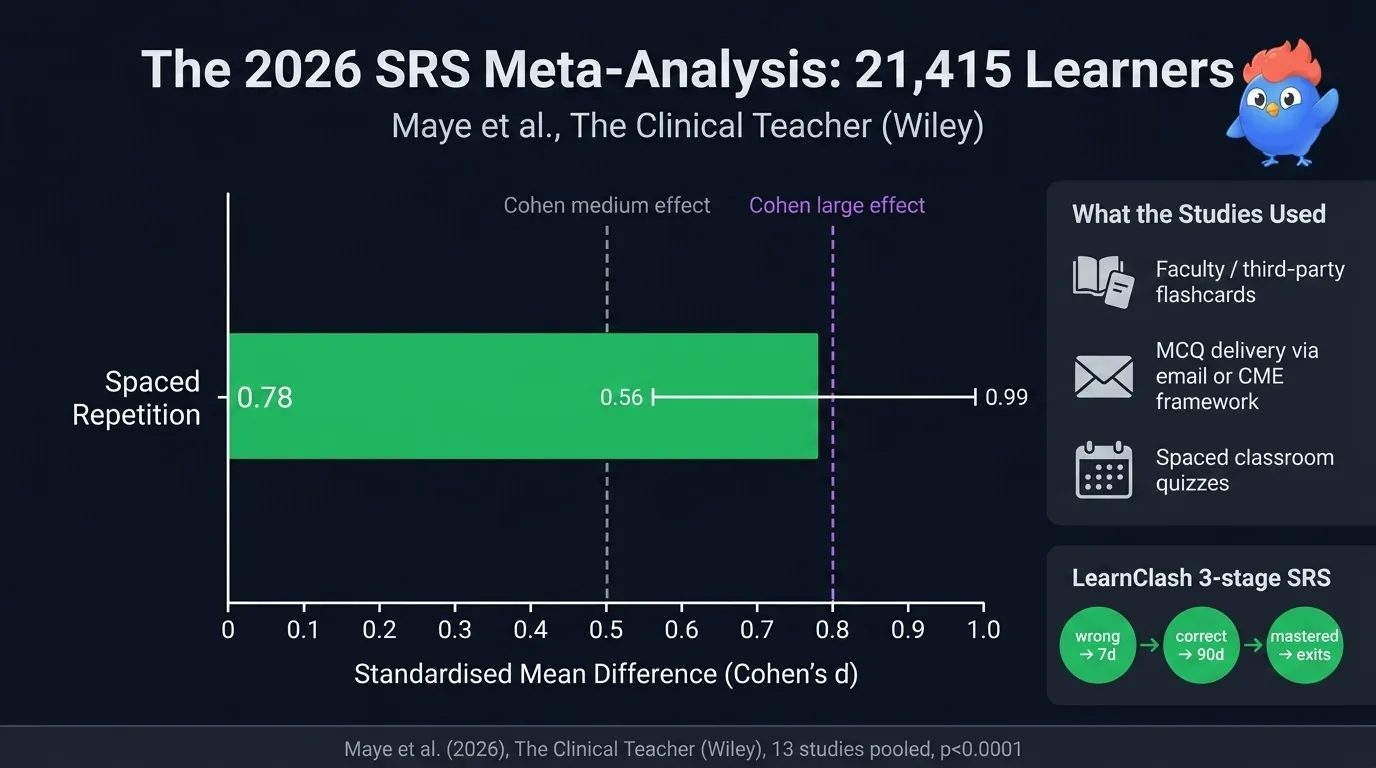
The pooled interventions took three forms: faculty-created or third-party flashcards, MCQ delivery via email or CME frameworks, and spaced classroom quizzes. All beat standard study. The mechanism they share is interval scheduling: re-test missed material at expanding gaps and retire material once mastered. Plain rereading and single-session cramming did not show the effect.
| Mechanism in the meta-analysis | Kahoot | Quizlet | LearnClash |
|---|---|---|---|
| Algorithmic interval scheduling | None | Recall-based Flashcards scheduling on the website | 3-stage SRS, free |
| Curated or third-party flashcards | Manual quiz only | Yes (500M sets, unvetted) | Topic-level question banks |
| Spaced quizzing | Not built for this | Quizlet Live (no spacing) | 6-question Solo sessions |
| Scheduled MCQ delivery | No | No | Topic challenge links |
| Mastered-material retirement | n/a | None | Retires from review until a miss drops it back a stage |
The product distinction is narrower than the old comparison claimed. Kahoot centers on hosted quizzes. Quizlet provides recall-based scheduling in website Flashcards, with a daily new-card setting and optional reminders. Its help page does not specify an entitlement, so the dated Learn-mode limits cannot establish one. LearnClash uses its own 7-day and 90-day review stages inside quiz play; the SRS retention curve guide explains that design. The meta-analysis supports the study method, not a comparative outcome for these apps.
Learning Features: Flashcards vs Gamification
“Testing is a powerful means of improving learning, not just assessing it.” Roediger & Karpicke, Psychological Science (2006)
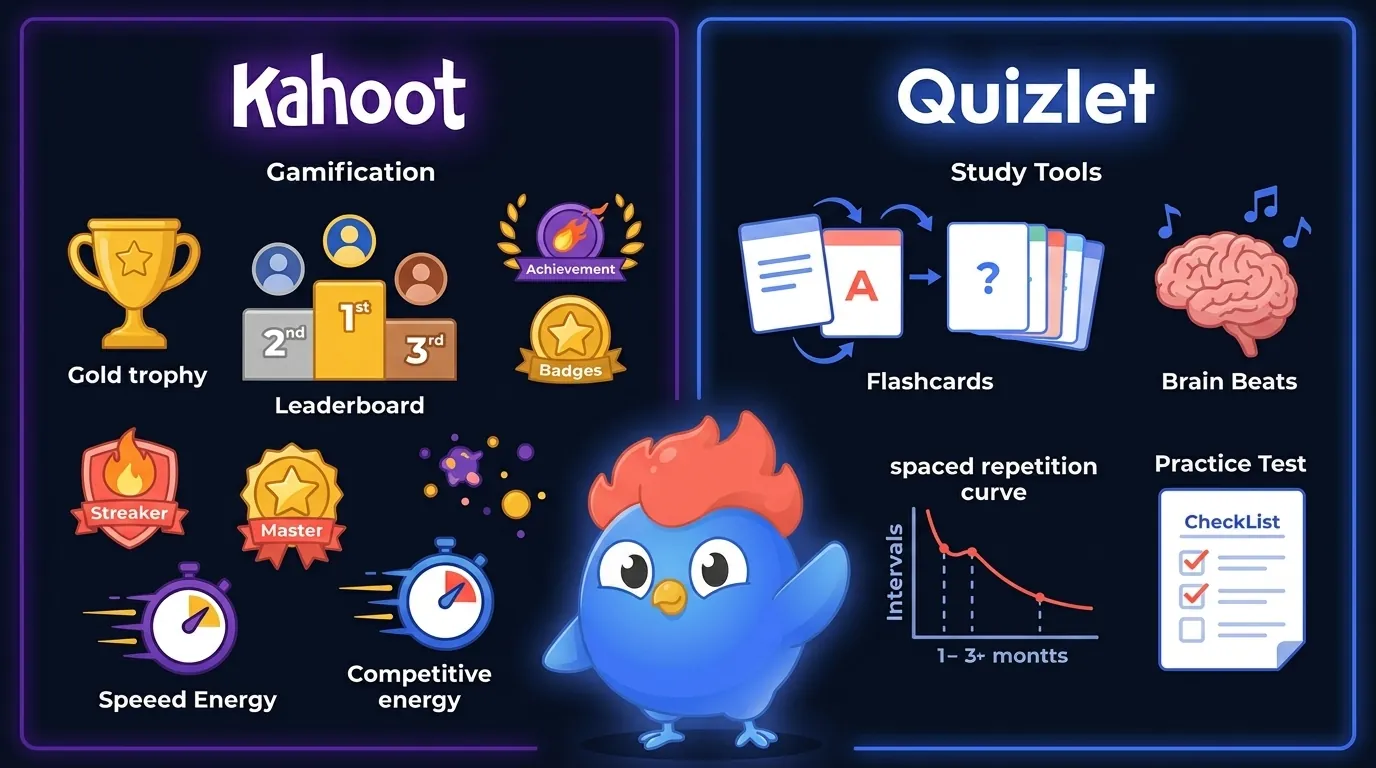
In the same experiments, the advantage only appeared on the delayed tests: five minutes after studying, rereading actually looked better, but a week out, the students who had been tested retained substantially more. That delayed advantage is the yardstick for this section, because immediate performance and delayed recall are different outcomes. Quizlet builds study tools around flashcard drills: Learn mode, AI practice tests, website Spaced Repetition, and Brain Beats, which turns flashcard terms into songs. Kahoot leans on game loops: leaderboards, team modes, streaks. Quizlet’s review schedule depends on recall ratings. The August Learn-mode cap is separate from Flashcards scheduling; its help page does not establish the subscription required for that scheduling.
| Kahoot | Quizlet | |
|---|---|---|
| Core method | Gamified group competition | Flashcard-based memorization |
| Spaced repetition | None | Scheduled Flashcards reviews on the website |
| Mastery tracking | None across sessions | Limited (per-set, no cross-set) |
| 2026 caps on study modes | None | 3 practice tests / 3 Q&A / 20 Learn rounds per month (Plus) |
| Novel feature | Quiz Starter, Accuracy Mode | Brain Beats (flashcards as songs) |
Brain Beats deserves its credit: melody adds a retrieval cue plain text does not, and auditory learners benefit. Kahoot’s learning features are thin by design. It is a quiz platform, not a study platform, and teachers report students enjoy the sessions but forget most of the content before the exam.
The research puts numbers on that forgetting. Karpicke and Roediger (2008) recorded 80% recall a week after self-testing versus 36% after rereading. This result supports returning to material after a delay. Quizlet’s website now offers a scheduled Flashcards review mode; the study does not establish whether that product or LearnClash produces better retention.
One more gap the two share: no persistent progression. A Kahoot score resets after every session, and Quizlet progress lives inside individual study sets. There is no global skill rating and no way to watch knowledge grow over months; the ELO rating system explainer covers what that layer looks like when a product builds it in.
Pricing: What’s Actually Free in August 2026?
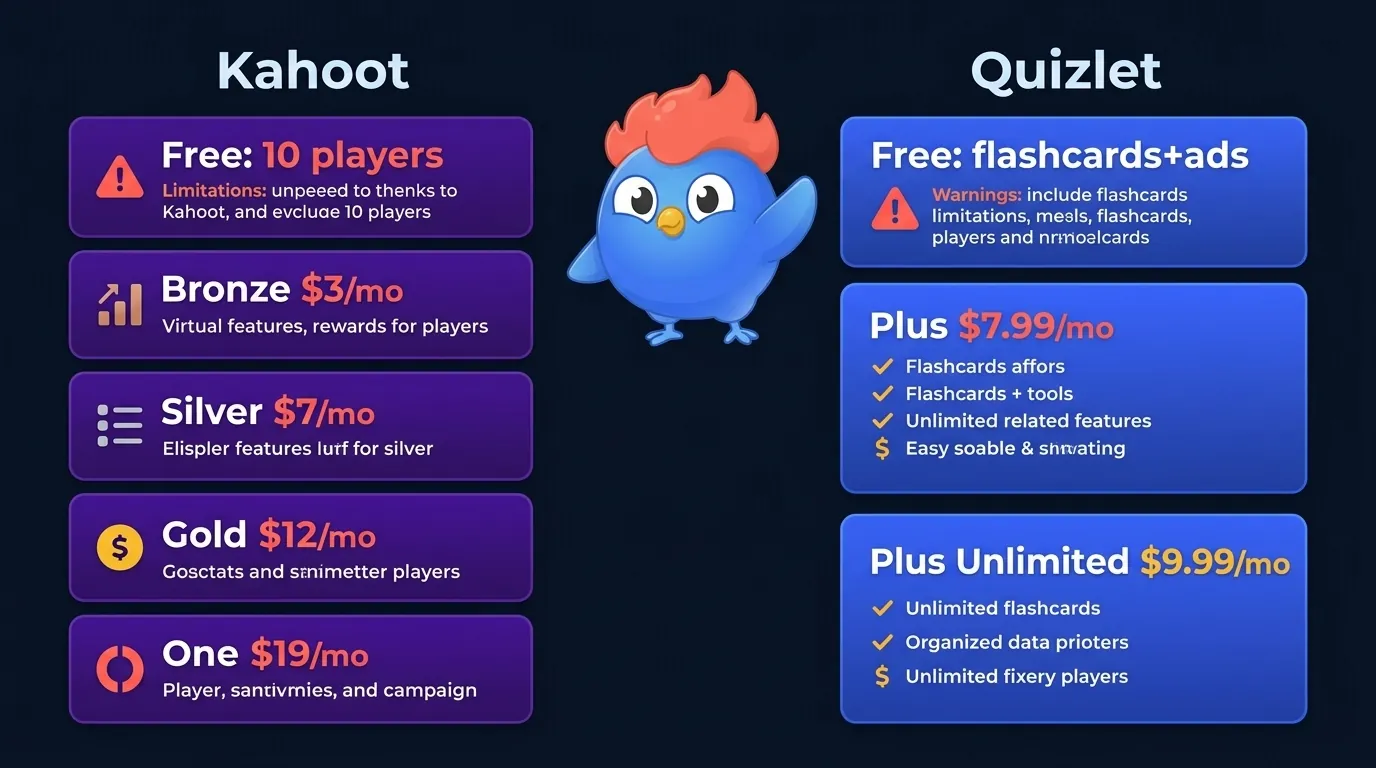
The strangest thing I hit while re-verifying this article on August 5, 2026 was Quizlet’s own upgrade page: it answered my fetch with HTTP 403. Twice. The page that exists to sell subscriptions sits behind a bot wall, so I ended up confirming Quizlet’s prices through its App Store listing instead: Plus Unlimited at $44.99 a year and a $35.99 teacher subscription. Kahoot’s plans page, by contrast, loaded on the first try and listed Kahoot!+ Bronze at $3, Silver at $7, Gold at $12, and Kahoot! One at $19 per month, every one an annual-billing rate; billed monthly, the same tiers cost $9, $15, $25, and $34.99, with live-game caps of 50, 100, 200, and 800 players.
The structural picture those numbers describe: Kahoot charges for audience size, Quizlet charges for study volume. Kahoot’s free personal tier caps sessions at 10 players (40 on the free teacher plan). Quizlet’s free tier shows ads and limits Learn rounds per set, and its paid Plus tier meters usage at 3 practice tests, 3 Q&A textbook solutions, and 20 Learn rounds per month. Only Plus Unlimited ($44.99/yr, or $3.74/mo billed annually) removes the meter; annual plans carry a 7-day trial.
| Kahoot | Quizlet | |
|---|---|---|
| Free limits | 10 players (personal), 40 (teachers) | Flashcards + limited Learn + ads |
| Entry paid | Bronze $3/mo annual (50 players) | Plus $35.99/yr |
| Paid usage caps | None (caps are player counts) | 3 tests/mo, 3 Q&A/mo, 20 Learn rounds/mo on Plus |
| Mid-tier | Silver $7/mo, Gold $12/mo (annual) | Plus Unlimited $44.99/yr, no caps |
| Monthly billing | $9 / $15 / $25 / $34.99 | $7.99/mo (Plus), $9.99/mo (Plus Unlimited) |
| Top personal tier | Kahoot! One, $19/mo annual, 800 players | Plus Unlimited |
| Teachers | Free Teacher essentials (40 players); EDU site licenses by quote | $35.99/yr teacher subscription |
| Business | Kahoot! 360, separate line: $19 to $79 per host/mo | n/a |
Two clarifications this table earns, because older comparisons (including an earlier version of this one) blur them. Kahoot! One at $19 is the top personal plan with the 800-player cap. Kahoot! 360 is a separate business product line listing $19 to $79 per host per month as of our August 4 check, and its Spirit tier was published at $20 per license with a 25-license minimum ($6,000/yr floor) before moving behind a contact-sales gate in spring 2026, which makes it a corporate training buy, not a teacher upgrade.
Quizlet’s pricing backlash is now four years old. In August 2022 it moved Learn and Test behind the Plus paywall, Reddit called it predatory, and Knowt, which markets itself as the top free Quizlet alternative, claims 5 million students and teachers have switched to it. The 2026 sequel is quieter: Plus still gets marketed as unlimited study access while the actual caps sit in smaller copy, and students subscribing for exam week tend to discover the 20-round meter mid-week.
The review data splits along the same fault line. On Trustpilot, where billing complaints concentrate, Kahoot sits at 3.6/5 (about 1,000 reviews) and Quizlet at 1.4/5 as of August 2026. On the App Store, where active users rate the product, Quizlet holds 4.8/5 across 1.1 million ratings. Both numbers are true; they measure different populations.
Where LearnClash fits in this comparison: the core loop (duels, ranked matchmaking, Solo sessions, the full SRS) is free with no ads on any tier. Premium at $7.99 a month or $59.99 a year includes Solo with no daily cap (up to 20 sessions an hour) and 3 New hands per round instead of 1, and the retention machinery is never behind it. For the broader field of study tools priced this way, the Quizlet alternatives roundup covers ten options, Knowt caveats included.
Cheating, Bots, and Academic Integrity
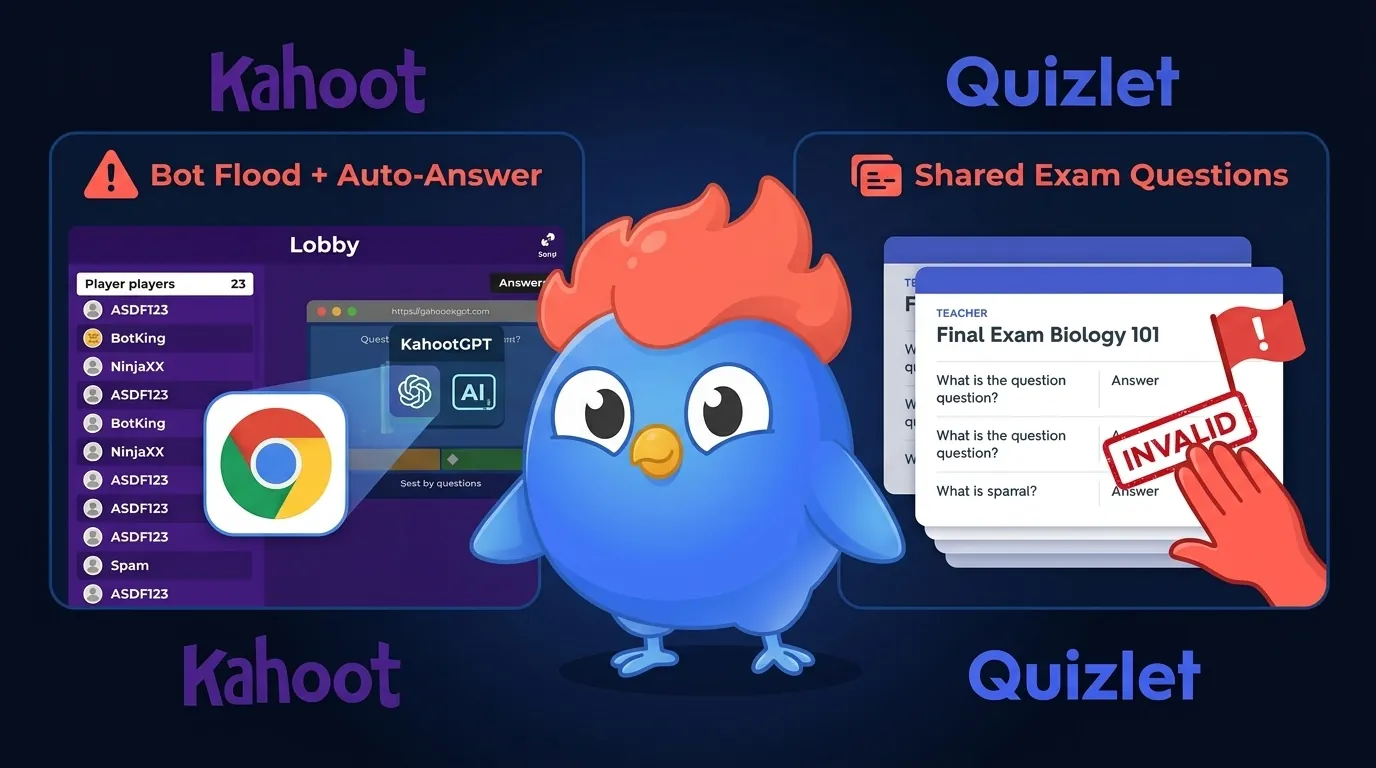
Both platforms have integrity problems that cost real class time, and they are opposite problems. Kahoot’s is technical: bot floods and AI auto-answer extensions. Quizlet’s is social: exam questions posted to a public library.
| Concern | Kahoot | Quizlet |
|---|---|---|
| Bot flood | Kitty-Tools (242 GitHub stars, early 2026), kahoot-flood scripts | Not applicable |
| Auto-answer | KahootGPT Chrome extension (per Maker Stations) | Not applicable |
| Shared exam questions | Not applicable | Public user-generated sets, no verification |
| Platform defense | Two-Step Join, Player Authentication, lobby lock | Academic integrity policy + takedown requests |
| Teacher-side defense | GoGuardian, Classwize screen monitoring | Schools network-block the domain |
| Universities flagging | Teachers report ongoing disruption | Northeastern lists posting to Quizlet as a violation |
The Kahoot cheating economy stays active because the tools read the live game. Free GitHub scripts spam lobbies with fake players, and extensions like KahootGPT scan questions from the DOM in real time and highlight answers, which defeats any pre-loaded answer-key defense. Kahoot’s protections (Two-Step Join, lobby lock, Player Authentication) block most automated entries; teachers who pair them with a screen-monitoring tool like GoGuardian catch most of the rest mid-session.
Quizlet’s problem needs no tooling at all. Its 500 million study sets are user-made with zero vetting, so wrong definitions spread as freely as right ones, and exact exam questions surface in public sets often enough that Northeastern University’s integrity policy names posting to sites like Quizlet explicitly. Studying from a published set is fine. Posting graded work is where the line sits, and Quizlet’s own academic integrity page invites educator takedown reports for exactly that.
For Teachers: Classroom Tools Compared
Kahoot vs Quizlet for teachers is a tradeoff between live classroom energy and async take-home study. Kahoot gives a teacher active control: live quizzes with real-time leaderboards, plus Challenge mode for async homework with a deadline. Quizlet gives a teacher assignment infrastructure: flashcard sets, class progress tracking, and Quizlet Live for team play.
| Kahoot | Quizlet | |
|---|---|---|
| Live engagement | Live quiz with leaderboard, music, podium | Quizlet Live (team-based, collaborative) |
| Homework | Challenge mode (async, with deadline) | Assign flashcard sets (self-paced) |
| Reports | Per-quiz results, downloadable | Class progress dashboard |
| Content creation | Manual + AI generation + slide import | Flashcard sets + Magic Notes |
| Classroom management | Name Generator, lobby controls | None |
| Price (teacher) | Free Teacher essentials (40 players); Kahoot!+ from $3/mo annual; EDU licenses by quote | $35.99/yr |
Kahoot owns the game-show moment: countdown music, podium reveal, cheering, students looking forward to Kahoot days. Quizlet Live takes the opposite approach. Students split into random teams and collaborate to match terms, which mixes students who would not normally work together and runs at a calmer pace.
The pairing pattern is the honest recommendation: Kahoot for in-class review before a test, Quizlet for take-home study, opposite moments in the same learning cycle. For how the rebranded Quizizz (now Wayground) fits that same slot, see LearnClash vs Quizizz; for the full head-to-head against Kahoot, the LearnClash vs Kahoot deep-dive and the Kahoot vs Blooket refresh cover the adjacent matchups.
For Students: Solo Study and Exam Prep
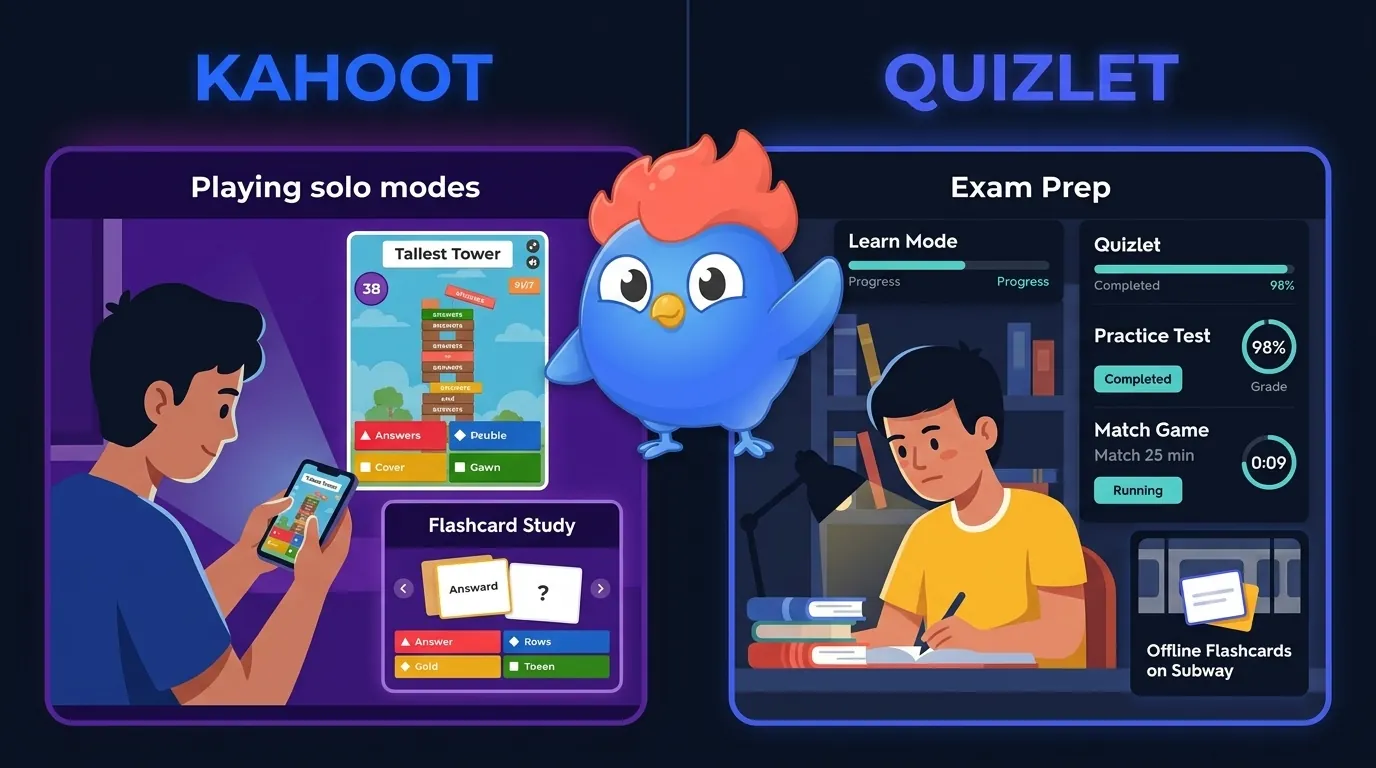
Picture the actual moment of use: 11 PM, exam tomorrow, phone in hand. Quizlet is built for exactly that student, with flashcards, Learn mode, practice tests, and matching games designed for individual prep. Kahoot’s solo modes (Classic Solo, Tallest Tower, Chill Art) are casual games rather than study sessions. The 2026 catch arrives mid-cram: on Plus, Learn stops at 20 rounds for the month, and the choices are upgrading to Plus Unlimited or waiting for the billing cycle.
| Kahoot | Quizlet | |
|---|---|---|
| Solo study modes | Classic Solo, Tallest Tower, Chill Art | Flashcards, Learn, Test, Match, Blocks (Spell now lives inside Learn’s options) |
| Exam prep | Flashcards (Gold: Test Mode) | Practice tests with AI explanations |
| Offline access | Download kahoots; offline Quiz Starter (iOS 26) | Offline flashcards (Plus plan) |
| 2026 monthly caps | None | 3 practice tests / 3 Q&A / 20 Learn rounds on Plus |
| Content library | Community + 60+ premium publishers | 500M+ user-generated sets |
| AI tools | Quiz Starter (on-device, free) | Magic Notes + native ChatGPT app |
Quizlet’s dominance among students is real (its own marketing has long claimed two in three American high schoolers use it), and the ChatGPT app integration matches how students already work. The caveats are the same ones running through this whole comparison: an unvetted 500-million-set library where wrong answers spread as easily as right ones, and a paid tier with a meter most subscribers discover the hard way.
For students on LearnClash, the solo loop is a 6-question Solo session on any topic, and the SRS carries the schedule: yesterday’s misses return at the 7-day interval, correct answers move to the 90-day slot, and there is no monthly cap on any of it. The testing effect explainer covers why the re-test matters more than the first pass, and the trivia apps roundup maps the wider field. Or just start a duel on study techniques and let the schedule prove itself.
Who Should Choose Kahoot, Quizlet, or Neither
Choose Kahoot if you:
- Run live quiz sessions for 10 to 800+ participants
- Teach and want classroom engagement with leaderboard energy
- Need team modes, homework Challenges, or premium publisher content (Disney, NASA, Marvel)
- Want free on-device AI quiz generation from notes and slides (iOS 26 Quiz Starter)
- Run corporate training at 25+ seats (Kahoot! 360 Spirit’s license floor)
Choose Quizlet if you:
- Prep for exams with flashcards and practice tests, and fit inside 20 Learn rounds a month (or pay for Plus Unlimited)
- Want to create or find study sets on any subject in a 500M+ library
- Study alone, at your own pace, possibly offline (Plus)
- Benefit from auditory learning (Brain Beats) or the native ChatGPT integration
Choose LearnClash if you:
- Want persistent skill tracking with a rating ladder from Iron to Phoenix
- Want spaced repetition applied across every mode, free, with no monthly meter
- Prefer 1v1 async duels that fit your schedule instead of a host’s
- Care about what you still know in 90 days, not just on Friday
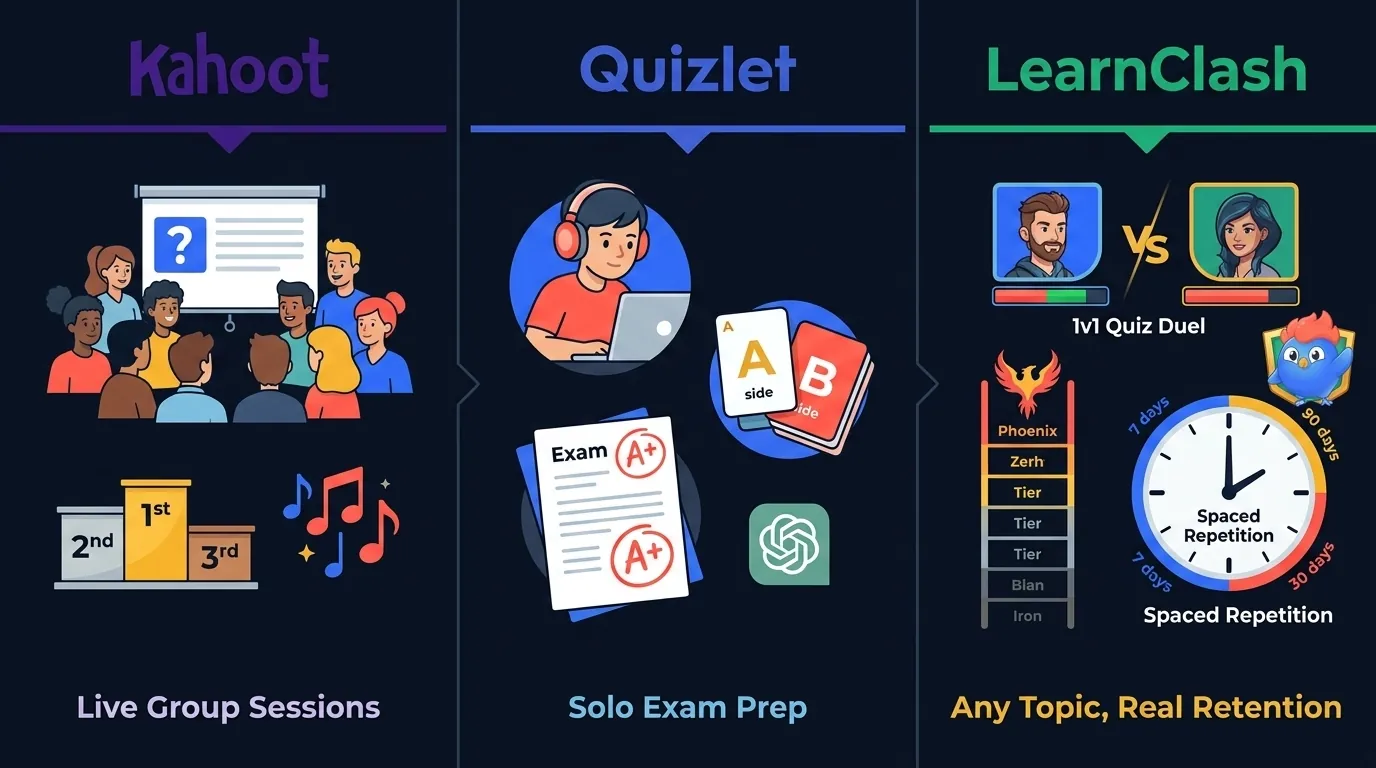
The Question That Actually Decides It
Most of this comparison dissolves once you name the moment you are buying for. A room full of people who need energizing is a Kahoot moment. A stack of terms that need memorizing by Thursday is a Quizlet moment, meter permitting. The feature tables above are just those two sentences with rows.
But there is one question the pricing pages never answer, and it is the one the 21,415-learner meta-analysis says matters most for whether any of this converts into lasting knowledge. In Kahoot, a question you miss vanishes when the session ends. In Quizlet’s website Flashcards mode, recall ratings determine when a card returns. In LearnClash, it is rescheduled before you close the app: back in 7 days, then 90, then retired until a miss revives it, free, in every mode.
The missed answer is the whole comparison in one diagram.
If you want to see the reschedule happen rather than read about it, try a quiz duel on any topic: miss something, and check where it resurfaces.
So before you pick an app, ask the one question this whole page has been circling: where will the answer you missed today be in seven days?
Keep reading: 10 Quizlet alternatives and 10 Kahoot alternatives for the escape routes, Anki vs Quizlet for the serious-SRS head-to-head, does Quizlet have spaced repetition for the short answer, Kahoot vs Blooket vs Gimkit and Kahoot vs Gimkit for the classroom quiz wars, and games like Blooket for the student-facing angle.
Frequently asked questions
Is Quizlet Plus still unlimited in 2026?
No, not on the $35.99 per year Plus tier. As of August 2026, Plus caps at 3 practice tests per month, 3 Q&A textbook solutions per month, and 20 Learn rounds per month. Plus Unlimited at $44.99 per year removes the caps, and annual plans carry a 7-day free trial. Students who subscribe to Plus expecting an unlimited study tool get a metered product, and many only notice the meter when they hit it mid-cram.
Does Quizlet still have a public API?
No. Quizlet discontinued its public developer API years ago, and third-party tools that depended on it stopped working. As of August 2026 there is no supported public Quizlet API for developers. The ChatGPT app integration is Quizlet's own product surface built with OpenAI, not an open API, so it does not change the situation for outside developers.
How smart is Quizlet's ChatGPT app after the May 2026 model upgrade?
Sharper on routine work, still wrong on edge cases. The Quizlet ChatGPT app runs on whatever default model ChatGPT uses; that became GPT-5.5 Instant on May 5, 2026. OpenAI measured 52.5% fewer hallucinated claims on high-stakes prompts (medicine, law, finance). An independent adversarial benchmark, AA-Omniscience, found that when GPT-5.5 could not answer a question correctly, it confabulated an answer 86% of the time rather than admitting uncertainty. Trust generated flashcards for routine review and verify any high-stakes definition against the source.
Does the 2026 spaced repetition meta-analysis settle the Kahoot vs Quizlet debate?
The review supports spacing, not a product winner. Maye et al. pooled 13 studies involving 21,415 learners and reported SMD 0.78 over standard study (95% CI 0.56 to 0.99). Quizlet now documents recall-based scheduling in website Flashcards; LearnClash uses its own 3-stage schedule. This evidence does not establish a retention advantage for either product.
Is Quizlet better than Kahoot for studying?
For solo studying and exam prep, Quizlet is the better choice. Flashcards, Learn mode, and practice tests are designed for individual review, while Kahoot is built for live group quizzes where a host runs the session. For self-paced study, pick Quizlet; for classroom energy, pick Kahoot. For persistent skill tracking with spaced repetition in quiz play, LearnClash layers rating-matched duels with 3-stage SRS.
Why did people stop using Kahoot?
Many teachers cut Kahoot back from daily use because the novelty fades and speed-based scoring penalizes slower readers. The free personal tier also caps at 10 participants, which does not cover a normal classroom. Bot floods from tools like Kahoot Ninja and AI extensions like KahootGPT made public games unreliable. Most teachers who stepped back use Kahoot weekly for review instead of daily for teaching.