
Kahoot vs Blooket vs Gimkit: Free AI, Modes, Retention [2026]
Kahoot vs Blooket vs Gimkit, tested May 2026, re-checked Aug 2026: Khanmigo free AI, 27 Blooket modes, $5 Season Ticket, Kahoot $6K floor.

The question every teacher brings to this comparison is the same: which one wins for my room, this week, on my budget. The three candidates could hardly pull in more different directions.
Kahoot runs a host-controlled live quiz with 6 formats, more peer-reviewed research behind it than the other two combined, and a full-AI tier whose published floor is $6,000 a year. Blooket wraps quiz questions in 27 listed game modes (21 of them free) and gives away Khanmigo AI question generation with no usage caps. Gimkit runs an economy-strategy game with Pro Exclusive modes, student-created kits, and Creative Platformer maps that any account can build.
I compared all three for this page in May 2026 and re-checked the fastest-aging numbers on August 19, 2026. The re-check was humbling: it caught five errors in my own May version, all corrected and marked below, including a Kahoot price I had overstated more than threefold. One more thing to hold onto while you read: none of the three schedules a missed answer for a later review, and that decides more than the mode lists do.
Kahoot vs Blooket vs Gimkit: Quick Comparison
Three designs solve three different teacher problems. Kahoot wins research and enterprise polish. Blooket wins free access and free AI. Gimkit wins paid game depth and student creation. LearnClash sits beside them as the retention control case: 1v1 duels with ELO ranking from Iron to Phoenix and spaced repetition instead of a host.
| Feature | Kahoot | Blooket | Gimkit | LearnClash |
|---|---|---|---|---|
| Founded | 2012 (Norway) | 2018 (US, Ben & Tom Stewart) | 2017 (US, J. Feinsilber) | 2025 (Switzerland) |
| Format | Host-led live quiz | Strategy game wrapper | Economy game wrapper | 1v1 async quiz duel |
| Free player cap | 10 (personal), 40 (schools) | 60 | Unlimited on featured, 5 on Pro Exclusive | Unlimited |
| Game modes | 6 core formats (14 plan-gated “experiences” since the 2026 rebrand) | 27 listed (23 year-round + 4 seasonal, 6 Plus-only) | Featured rotation + Pro Exclusive | Duel, Solo, Open Play |
| Free AI | 10-player cap, 70 languages (May 6, 2026) | Khanmigo free, no usage caps (Jan 21, 2025) | Gimkit AI Generator (Pro only, Sept 2025) | LearnClash AI on demand |
| Paid AI tier | 360 Spirit published $20/license/mo, 25-license min = $6,000/yr floor (sales-quoted, Aug 2026) | None (free Khanmigo covers it) | Pro $59.88/yr | Free + Premium $59.99/yr |
| Cheapest paid plan | $36/yr Bronze, billed annually | $4.99/mo Plus annual | $14.99/mo Pro or $59.88/yr | $59.99/yr |
| Student creation | None | None | KitCollab + Creative Platformer (both free on any account) | Custom topics (free, daily quota) |
| Spaced repetition | None | None | Session-only Smart Repetition | 3-stage SRS (7d, 90d, mastered) |
| Peer-reviewed studies | Dozens (43-study meta-analysis) | Fewer than 5 | ~26 (one 2026 integrative review) | Building |
| Cheating risk | Low (server-side delivery) | High (GitHub scripts active May 2026) | Lower (movement + economy harder to bot) | N/A (1v1 async) |
| Ads | No | No | No | No, on every tier |
| Best fit | K-12 + Fortune 500 enterprise | K-8 classroom + unpaid teachers | Grades 6-12 + paid strategy fans | Teens + adult self-directed learners |
The 10-player Kahoot cap is why teachers went looking at Blooket and Gimkit in the first place, and free Khanmigo is why many of them stayed. Gimkit, meanwhile, offers something neither rival sells at any price: student-built maps, open to every account since December 2024.
What’s New in 2026: 17 Months of Updates Across All Three
The shipment that set the tone predates 2026. On January 21, 2025, Khan Academy and Blooket launched the Khanmigo + Blooket Generator: free AI question sets, no usage caps, one-click export into any Blooket mode. Gimkit answered in September 2025 with an in-house AI Question Generator on its Pro tier. Kahoot’s free AI caught up on May 6, 2026 with a 70-language update, 16 months after Khanmigo.
The rest of the window was quieter than the fan wikis suggest. Blooket’s verifiable 2026 shipments are Save States and Solo Links; two widely repeated “new 2026 modes,” Adventure Quest and Quiz Kingdom, exist on fan sites but not on Blooket’s official previews page, so this comparison no longer carries them. Gimkit kept rolling Season Ticket asset drops on top of Creative Platformer building, which has been open to every account since December 2024. Kahoot shipped a standards-tagging tool and the 360 Spirit enterprise AI tier.
| Period | Kahoot | Blooket | Gimkit |
|---|---|---|---|
| Jan 21, 2025 | no shipment | Khanmigo + Blooket Generator launches: free AI, no usage caps | no shipment |
| Feb 2025 | Kahoot Energize launches (B2B workplace pivot) | no shipment | no shipment |
| Sept 2025 | no shipment | no shipment | Gimkit AI Question Generator (Pro tier) |
| Jan 2026 | no shipment | Google Trends crossover, Blooket overtakes Kahoot | no shipment |
| Q1 2026 | Accuracy Mode broader rollout | Save States + Solo Links | Season Ticket asset drops continue |
| April 6, 2026 | Standards-tagging tool: TEKS, CCSS, NGSS code search | no shipment | no shipment |
| May 6, 2026 | AI Generator update: 70 languages + curriculum standards | no shipment | no shipment |
| H1 2026 | Kahoot 360 Spirit AI tier (published $20/license/mo, 25-license min = $6K/yr floor) | no further dated shipment | no further dated shipment |
Read as strategy, the timeline is clean. Blooket protected its free-AI moat. Gimkit kept building student-creation depth. Kahoot pointed its 2026 budget at administrators, because standards-tagging is what wins multi-year district contracts. The two-way details live in kahoot vs blooket, blooket vs gimkit, and kahoot vs gimkit.
Free Tier and Pricing: $0, $5, and $6,000
Kahoot’s free tier caps personal sessions at 10 players and school sessions at 40, so a standard room of 25 to 35 students fits only under the school-account cap; the personal cap, the one every new signup hits first, stops well short. Blooket’s free tier allows 60 players with 21 of 27 listed modes open. Gimkit Basic runs a full class on the featured rotation (about three modes at a time), caps Pro Exclusive modes at 5 players, and sells the $5 Season Ticket as an asset pack on top.
| Kahoot | Blooket | Gimkit | |
|---|---|---|---|
| Free player limit | 10 (personal), 40 (schools) | 60 | Unlimited (featured), 5 (Pro Exclusive) |
| Free game modes | Classic + Test + Learn | 21 of 27 | About 3 rotating featured |
| Cheapest paid plan | $36/yr billed annually (Bronze, 50 players) | $4.99/mo annual (Plus) | $14.99/mo or $59.88/yr (Pro) |
| Monthly billing option | $9/mo Bronze | Plus Flex $9.99/mo | Pro monthly $14.99 |
| Top individual tier | Kahoot! One $228/yr, 800 players (Gold $144/yr below it) | None above Plus | None above Pro |
| Enterprise / school | From ~$15/teacher/mo, or 360 Spirit at a published $6,000/yr floor (25 licenses; sales-quoted, Aug 2026) | $550/yr (10 seats) to $3,000/yr (80 seats) | $650/yr (Dept, 20 teachers) or $1,000/yr (School, all teachers) |
| Season add-on | n/a | n/a | $5 per Season Ticket: 75+ exclusive Creative terrains, props, devices + 25 map slots |
| AI tier cost | $0 free with caps, $6K Spirit for full AI | $0 (Khanmigo, no usage caps) | Built into $59.88 Pro |
Teachers on r/Teachers still call the 10-player cap the Kahoot tax, but the toll is smaller than the May version of this page claimed. A single teacher with 30 students has three real options: pay Kahoot $36 a year for Bronze, use Blooket free with Khanmigo bundled, or test-drive Gimkit Basic on the featured rotation. A 50-teacher building flips the math entirely, because Gimkit’s $1,000-per-year School Plan covers every teacher in it while Kahoot’s published 360 Spirit floor sits at $6,000.
Blooket’s Plus Flex tier ($9.99 per month, no annual commit) has been on the pricing page since 2023 and stays worth flagging for after-school clubs, summer camps, and teachers funding their own room. Gimkit Pro still wants the annual commit at $59.88 for its best rate.
The Kahoot pricing story has a second chapter. The platform went private in January 2024 after a $1.7 billion buyout by Goldman Sachs, General Atlantic, and KIRKBI, the Lego family’s investment arm. Since then the free tier has tightened, and Trustpilot and BBB log a pattern of renewal-billing complaints: renewal notices landing in spam, then a surprise annual charge when the auto-renew triggers. Under that ownership the 10-player cap makes sense. Free is a demo.
For the record, 360 Spirit itself: published at $20 per license per month with a 25-license minimum, 100 players per session, AI-built courses, custom branding, reports, and certificates; as of August 2026 the public price is gone and Spirit is quoted through sales. It is built for corporate L&D and large districts, not for one classroom.
Verdict: Blooket for unpaid individual teachers. Gimkit for buildings with 50+ teachers buying once. Kahoot when $36 Bronze covers the room or the buyer is an enterprise that wants the Spirit stack.
Game Modes: 6 Formats vs 27 Modes vs Featured Rotation
Behind the mode counts sit three design philosophies, and the counting frames differ, so pin those down first. Kahoot runs 6 core quiz formats (Classic, Team, Test, Learn, Accuracy, Confidence) and treats variety as UI on top of one mechanic; its 2026 rebrand counts 14 plan-gated “experiences,” but the six formats are what a teacher actually picks from. Blooket’s official previews page lists 27 modes as of August 2026, 23 year-round plus 4 seasonal, with 6 behind Plus. Gimkit rotates a featured set (about three free at a time) above a Pro Exclusive catalog: Fishtopia, Snowbrawl, Don’t Look Down, Trust No One, the Tycoon economy modes.
| Mode question | Kahoot | Blooket | Gimkit |
|---|---|---|---|
| Best quick mode | Classic (5-min lesson close) | Classic or Racing | Classic or Tycoon |
| Best strategy mode | Team Mode | Tower Defense 2 (with Save States) or Crazy Kingdom | Tycoon, Farmchain, Capture the Flag |
| Biggest luck factor | Low (speed decides) | Gold Quest (random chest draws) | Low (economy decides) |
| Best 2D feel | None | Monster Brawl, Tower Defense 2 | Fishtopia, Snowbrawl, Don’t Look Down, Trust No One |
| Best student-built mode | None | None | Creative Platformer (free on any account) |
| Best for quiet focus | Test Mode (self-paced assessment) | Study mode, solo modes | Most 2D and Tycoon modes |
| Best for accuracy over speed | Accuracy Mode (no speed scoring) | Most modes | All modes (no speed scoring) |
| Total mode count | 6 formats (14 “experiences”) | 27 listed (23 year-round + 4 seasonal, 6 Plus-only) | Featured rotation + Pro Exclusive |
| Save and resume | No | Yes (solo modes like Tower Defense 2 and Cafe) | Limited (within session) |
Kahoot’s format is a game show. The host shares a PIN, music builds, players race the countdown, and in Classic mode faster correct answers earn more points, so a quick guess can outscore a slower answer that was never in doubt. Accuracy Mode removes the speed factor. Classic remains the default, though, and most teachers never switch it, so most Kahoot sessions still reward speed.
Blooket wraps the quiz inside a game. Tower Defense 2 turns correct answers into towers, Crazy Kingdom runs resource management, and Save States let a class play 15 minutes and pick the same game up next lesson. Gold Quest, the signature mode, hands out rewards through random chest draws: a student who answered 5 questions can beat one who answered 50. That randomness keeps struggling students in the game, and it makes the leaderboard useless as assessment.
Gimkit’s modes make correct answers spendable. Tycoon-style modes pay cash that students spend on multipliers, insurance, and upgrades; the 2D modes convert answers into energy, bait, or snowballs. Creative Platformer extends this into side-view maps that any account can build, with the $5 Season Ticket layering 75+ exclusive terrains, props, and devices on top of the standard kit. Neither Kahoot nor Blooket offers student-built maps at all.
One tradeoff runs underneath all of this: question frequency. Every minute a student spends steering an avatar, buying upgrades, or landing a platform jump is a minute without a retrieval attempt. That is fine when engagement is the goal. It is weaker when the lesson needs many clean recall reps.
That tradeoff shaped a LearnClash decision directly, so full disclosure on where I sit. Our duels are fixed at 18 questions (six rounds of three), opponents are matched by rating, and there is no speed bonus at all: a correct answer with one second left on the 45-second clock scores exactly what an instant answer scores. I wanted the slow-but-correct student, the one Classic mode punishes, to win on knowledge. The cost is game-show adrenaline, and I accepted that trade.
For the wider catalog including Wayground (formerly Quizizz), see games like Kahoot, games like Blooket, and games like Gimkit.
AI Question Creation: Free Khanmigo, Pro Gimkit, $6K Spirit
This is where the three diverge most. Blooket shipped the Khanmigo Generator on January 21, 2025: free AI question sets, no usage caps, one-click export into any mode. Gimkit followed in September 2025 with an in-house generator behind the $59.88-per-year Pro tier. Kahoot upgraded its free generator to 70 languages on May 6, 2026 but kept free sessions capped at 10 players, and its full AI tier, 360 Spirit, published at a $6,000-a-year floor for 25 licenses before Kahoot pulled the public listing in favor of sales quotes.
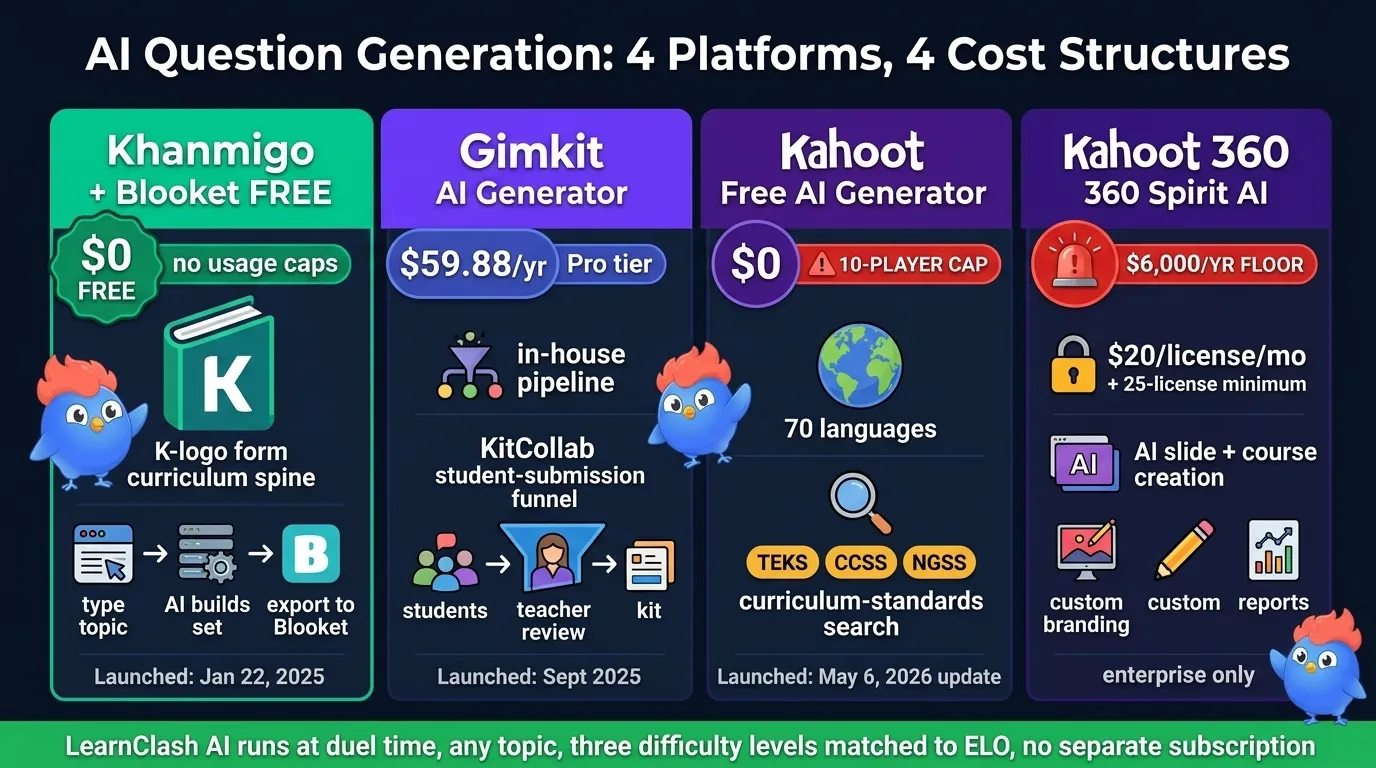
| AI workflow | Khanmigo + Blooket | Gimkit AI Generator | Kahoot Free | Kahoot 360 Spirit AI |
|---|---|---|---|---|
| Launched | Jan 21, 2025 | Sept 2025 | Original + May 6, 2026 update | H1 2026 |
| Sign-in | Khan Academy account (free for teachers) | Gimkit Pro account ($59.88/yr) | Free Kahoot account | 25-license min, sales-quoted (Aug 2026) |
| Cost | $0 | $59.88/yr | $0 (capped) | $6,000/yr floor |
| Usage caps | None | Pro tier limits | 10-player session cap | Unlimited within seat |
| Curriculum alignment | Khan Academy K-12 spine | Standards tagging in Pro | TEKS, CCSS, NGSS code search (May 6, 2026) | Custom + enterprise reports |
| Workflow | Type topic → AI builds set → Export to Blooket | Type topic → AI builds set → Save to kit | Upload PDF or topic → AI builds set → 70 languages | AI slide + course creation + branding + reports |
| Student creation | None | KitCollab (students submit, teacher curates) | None | None |
| Cost for one teacher with 30 students | $0 | $59.88/yr (covers all features) | $0 (but blocked by 10-player cap) | $6,000/yr (overkill) |
| Cost for 25-teacher department | $0 | $650/yr Department plan | $900/yr (25 Bronze seats at the Aug 2026 listing) | $6,000/yr and up |
The free-vs-paid math is the whole story. A first-year teacher with 30 students has four paths: Khanmigo + Blooket at $0, Gimkit Pro at $59.88, Kahoot Bronze at $36 (50-player cap, so the room fits), or 360 Spirit at $6,000, which is district infrastructure rather than a classroom purchase.
Gimkit’s quieter advantage here is KitCollab: students submit questions to a shared kit and the teacher curates before anything goes live. For grades 6-12 that turns the generator into a teaching tool, because student-written questions pass through a quality filter on the way in. Neither Khanmigo + Blooket nor Kahoot has a parallel feature.
Verdict: Khanmigo + Blooket wins free, uncapped AI for a single teacher. Gimkit Pro wins where KitCollab matters. Kahoot 360 Spirit only makes sense for buyers who already think in licenses.
Learning Evidence: 43 Studies vs Almost None
No classroom quiz platform comes close to Kahoot’s research record. The meta-analysis to know is Özdemir 2025, Journal of Computer Assisted Learning 41(1), e13084: 43 studies, 3,353 students (1,706 experimental, 1,647 control), run across grade levels, subjects, and 8+ countries. Blooket has fewer than 5 published studies. Gimkit has roughly 26, collected in a single 2026 integrative review in IJLTER covering work published 2018 to 2025, with no meta-analysis behind them. LearnClash takes the retrieval effect that record documents and puts it on a calendar, layering spaced repetition onto ranked play.
| Kahoot | Blooket | Gimkit | |
|---|---|---|---|
| Peer-reviewed studies | Dozens | Fewer than 5 | ~26 |
| Meta-analysis depth | Özdemir 2025: 43 studies, 3,353 students | None | One 2026 integrative review |
| Effect size on achievement | 0.772 SD (moderate, per the paper) | Not measured | Positive engagement, not quantified |
| Effect size on retention | 1.492 SD (very large) | Not measured | Not measured |
| ESSA certification | Level III (some studies) | None | None |
| Learning outcome data | Public, academic | Internal only | Single review |
| Spaced repetition | None | None | Session-only Smart Repetition |
| Mastery tracking | None across sessions | None | None across sessions |
The labels deserve care, and an earlier version of this page got them wrong by calling both effects “very large.” Özdemir’s paper calls the 0.772 SD achievement effect moderate and reserves very large for the 1.492 SD retention figure. Retention is the number to weigh anyway. Kahoot’s format forces retrieval under time pressure, and retrieval practice is a heavily replicated effect in cognitive science; Roediger and Karpicke’s 2006 testing-effect study closed on the point that testing is a powerful means of improving learning, not just assessing it.
Blooket is the striking blank in that table. Ben Stewart wrote it in 2018, COVID remote learning turned it into a phenomenon two years later, and millions of students now play it, yet the peer-reviewed literature has barely noticed: under five published studies, no meta-analysis, no effect sizes. The engagement is obvious in any classroom that runs it; nobody has measured at scale whether it moves test scores. Gimkit sits in the middle: positive engagement findings across the 2018-2025 literature its 2026 review synthesized, no ESSA certification, no achievement or retention quantification.
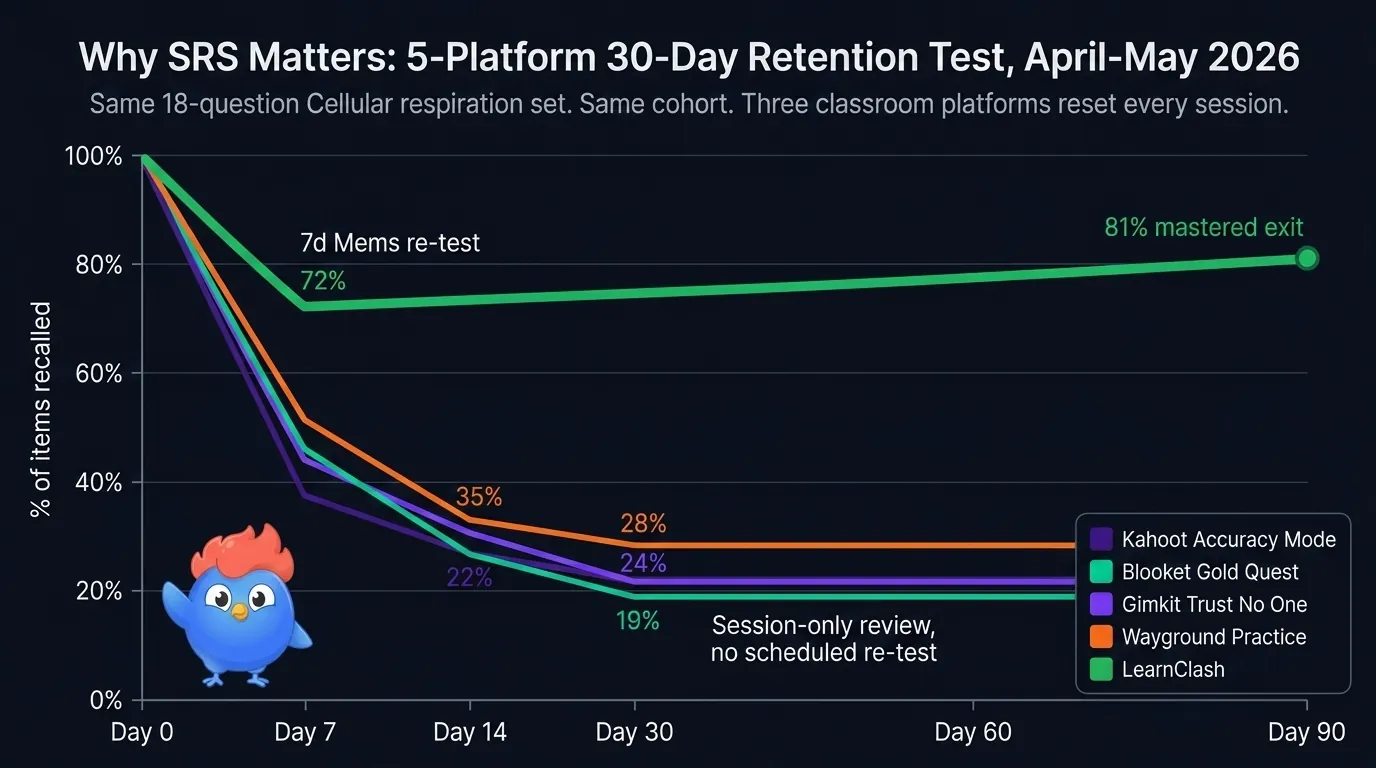
That missing layer is the one LearnClash exists for. A missed answer returns at 7 days, a known one at 90, and clearing both retires the question as mastered; the 3-stage ladder and the numbers behind it are documented on the LearnClash statistics page. The intervals themselves went through revision: I started from the textbook 1/3/7/21-day ladder and threw it out, for reasons written up in why we threw out the 1/3/7/21-day SRS interval. The anki vs quizlet comparison covers the same divide from the flashcard side.
Cheating Risk and Student Experience
Cheating risk is the gap most teachers underweight, and architecture decides it. Kahoot runs quiz logic server-side, so the scripts that break Blooket mostly bounce off it. Blooket runs partly client-side, and GitHub still hosted dozens of active cheating scripts when I checked in May 2026: auto-answer bots, token generators, flood bots, coin hacks. Gimkit’s economy and movement modes are harder to automate, though not exploit-free.
| Cheating signal | Kahoot | Blooket | Gimkit |
|---|---|---|---|
| Server-side delivery | Yes | Partial | Partial |
| GitHub exploits active May 2026 | Few | Many (auto-answer, flood, coin hacks) | Some |
| Bot flood resistance | High | Medium (improved 2026) | Higher (movement required) |
| Auto-answer scripts | Hard | Active | Harder |
| Speed-vs-accuracy bias | Classic mode rewards speed | Mode-dependent | Economy-balanced |
| Best mode for fairness | Accuracy Mode (no speed) | Solo modes, Save States | Most modes (no speed scoring) |
Blooket’s 2026 server-side rate limits finally weakened the worst lobby flooders, the scripts that spam sessions with hundreds of fake players. Floods now stall, partially join, or get kicked. Bookmarklet auto-answer scripts still work because the game logic runs partly in the browser, so honest students still sometimes compete against scripted answers.
Fairness has a second axis besides cheating: scoring design. In speed-scored Kahoot Classic and luck-driven Blooket Gold Quest, the gap between the top student and the median widens, because speed and chance both punish slow-but-correct answerers. Gimkit’s economy modes keep that gap narrower, and a bot has to model the economy as well as the answers, which raises the automation bar further. KitCollab’s teacher-review step filters fake content before it ever reaches a class.
One scope note applies to all three. Each assumes a teacher at the front: someone has to build the content and launch the session before anyone plays, so an adult who wants to drill astronomy on the couch has no way in. These are classroom tools, built for rooms with a host at the front.
Who Should Choose Each Platform
Name the use case and the pick usually falls out on its own. The matrix first, then the per-platform breakdown; standalone pairings live in LearnClash vs Kahoot and kahoot vs quizlet.
| Use case | Best pick |
|---|---|
| Free, full-class quick review on any budget | Blooket (60 players free, 21 modes free, Khanmigo AI free) |
| Free, occasional Q-of-the-day for 10 or fewer students | Kahoot Free (Classic mode, low cheating risk) |
| Paid strategy session for grades 6-12 with student-created kits | Gimkit Pro (KitCollab, plus Creative building free on any account) |
| Multi-day strategy campaign | Blooket (Tower Defense 2 with Save States) |
| Standards-aligned admin reporting | Kahoot (April 2026 standards-tagging tool, ESSA certification) |
| Corporate L&D / Fortune 500 workplace training | Kahoot 360 Spirit ($6K/yr published floor, AI courses, certificates) |
| Building with 50+ teachers buying once | Gimkit School Plan ($1,000/yr flat covers everyone) |
| Self-directed adult learner who wants any topic | LearnClash (ELO duels, 3-stage SRS, no teacher needed) |
Choose Kahoot if you:
- Need proven learning evidence for admins (Özdemir 2025)
- Need the April 2026 standards-tagging tool or LMS hookups (Google Classroom, Teams, Canvas)
- Run live sessions where group energy drives focus
- Need read-aloud and Accuracy Mode for IEP classrooms
- Can budget $36/yr Bronze for a class of up to 50, or run corporate training at the 360 Spirit floor
Choose Blooket if you:
- Want free Khanmigo AI question generation, no usage caps
- Have 25-35 students and need a free tool that fits them all
- Want 27 modes to keep sessions fresh all semester, with Save States for multi-day campaigns
- Want monthly billing with no annual commit (Plus Flex $9.99/mo)
- Teach grades 3-8 students who respond to collectibles
Choose Gimkit if you:
- Want KitCollab student-created kits (only platform here that has them)
- Want student-built Creative Platformer maps, free on any account, with the $5 Season Ticket for exclusive assets
- Teach grades 6-12 where economy gameplay holds attention
- Run a building with 50+ teachers (School Plan $1,000/yr beats every Kahoot tier)
Choose LearnClash if you:
- Want 1v1 ELO-ranked duels on any topic, with no teacher needed
- Need spaced repetition in every mode (7-day, 90-day, mastered exit)
- Are learning on your own, outside any classroom, and want competitive learning without ads
Pick Two, Then Cover the Gap
Is Blooket better than Kahoot? Is Gimkit better than Blooket? Depends what you optimize. Kahoot owns the research record and the enterprise lane. Blooket owns free AI, the January 2026 Google Trends crossover, and 21 free modes. Gimkit owns paid strategy depth, KitCollab, and the flat-rate School Plan. Plenty of teachers run two or three together: Kahoot for test prep, Blooket for weekly review, Gimkit for end-of-unit strategy days.
What none of the three tracks is whether the student who aced cellular respiration on Monday still knows it three weeks later. Seventeen months of updates went to AI generators, mode catalogs, and admin tooling, and every one of those updates stops working the moment the session ends.
LearnClash is my answer to that missing layer: 1v1 quiz duels on any topic, ELO-ranked from Iron to Phoenix, with 3-stage SRS built into every mode. Free, no ads, no player cap. For the Gimkit-only deep dive, read the standalone Gimkit review. And if you would rather test the retention claim than take my word for it, challenge me to a general knowledge duel and see what comes back at day 7.
Frequently asked questions
Which is better for free classrooms, Kahoot, Blooket, or Gimkit?
Blooket. The free tier supports 60 players, opens 21 of Blooket's 27 listed modes, and includes Khanmigo AI question generation with no usage caps since January 21, 2025. Gimkit Basic supports a full class on featured modes (about three rotate at a time) but caps Pro Exclusive modes at 5 players. Kahoot's free personal tier stops at 10 players; school accounts get 40, which fits a standard room, and Bronze at $36 per year is the escape hatch for everyone else.
Does Kahoot, Blooket, or Gimkit have spaced repetition?
None of them. Kahoot and Blooket sessions reset after every game; the platform does not reschedule a missed question 7 days or 90 days later. Gimkit Smart Repetition re-asks missed questions within a single session, but past-session data does not carry forward. All three are engagement tools, not memory tools. LearnClash adds 3-stage SRS (7-day, 90-day, mastered exit) on top of every 1v1 quiz duel and Solo session.
Which has the cheapest AI question generator?
Blooket. The Khanmigo plus Blooket Generator (free, no usage caps) launched January 21, 2025 through the Khan Academy partnership. Gimkit shipped its own AI Question Generator in September 2025 as a Pro-tier feature at $59.88 per year. Kahoot's free AI Generator added 70 languages on May 6, 2026 but caps free sessions at 10 players; Kahoot's enterprise tier 360 Spirit published at $6,000 per year for a 25-license minimum and is quoted through sales as of August 2026.
Which has more game modes, Kahoot, Blooket, or Gimkit?
Blooket leads on raw count: its official previews page lists 27 modes as of August 2026 (23 year-round, 4 seasonal; 6 Plus-only). Gimkit rotates featured modes plus Pro Exclusive modes (Fishtopia, Snowbrawl, Don't Look Down, Trust No One); Creative Platformer map building is free on any Gimkit account, with the $5 Season Ticket selling exclusive building assets on top. Kahoot offers 6 core quiz formats rather than full game genres, or 14 plan-gated 'experiences' under its 2026 rebrand.
Which is best for older students vs younger ones?
Blooket leans grades 3-8 with collectible Blooks and short-burst arcade modes. Gimkit leans grades 6-12 with economy-strategy gameplay and student-built Platformer maps. Kahoot works across all grades, but the 10-player personal free cap pushes classrooms toward paid Bronze ($36/yr) or away to a different tool. LearnClash targets teens and adult learners with 1v1 ELO-ranked duels on any topic.