
43 Math Trivia Questions With Answers and Explanations
43 math trivia questions on paradoxes, famous mathematicians, geometry, and mind-bending numbers. Answers included, plus why each one stumps.
How many do you know?
Think of your answer, then reveal it.
Did you know it before revealing the answer?
Read this answer in the articleRound complete
Turn what you know into a quiz duel.
Start a new duel in LearnClash and learn from every answer.
Get LearnClashFree to play on iPhone and Android. No ads.
Try the questions you missed once more.

Most math trivia asks you to multiply. The good stuff makes you realize you’ve been wrong about infinity your whole life.
So these 43 questions skip the arithmetic drills. They run through paradoxes that pass peer review, mathematicians who died younger than your favorite athlete, geometry that quietly betrays Euclid, number theory that has stayed unsolved for centuries, and probability that has been emptying gamblers’ pockets since 1913. Every one was picked for the same reason: the obvious answer is the wrong answer.
Each question below comes with the answer and a short note on where the intuition breaks. Test your math knowledge in a quiz duel →
What These 43 Questions Cover
Eight sections, ordered by how badly they bend the brain. They start gentle and end with a drowned Pythagorean and the 9-year-old behind the word googol.
- Mind-Bending Numbers (1-5): numbers too big to fit in the universe.
- Mind-Bending Paradoxes (6-12): real theorems that feel illegal.
- Famous Mathematicians (13-19): the people behind the proofs.
- Number Theory Oddities (20-25): three of these are still officially unproven.
- Geometry Surprises (26-31): where Euclid stops being right.
- Probability Gotchas (32-34): three ways your gut loses money.
- Math Hiding in Plain Sight (35-39): proofs disguised as flowers and bees.
- Historical Oddities (40-43): true stories that read like myth.
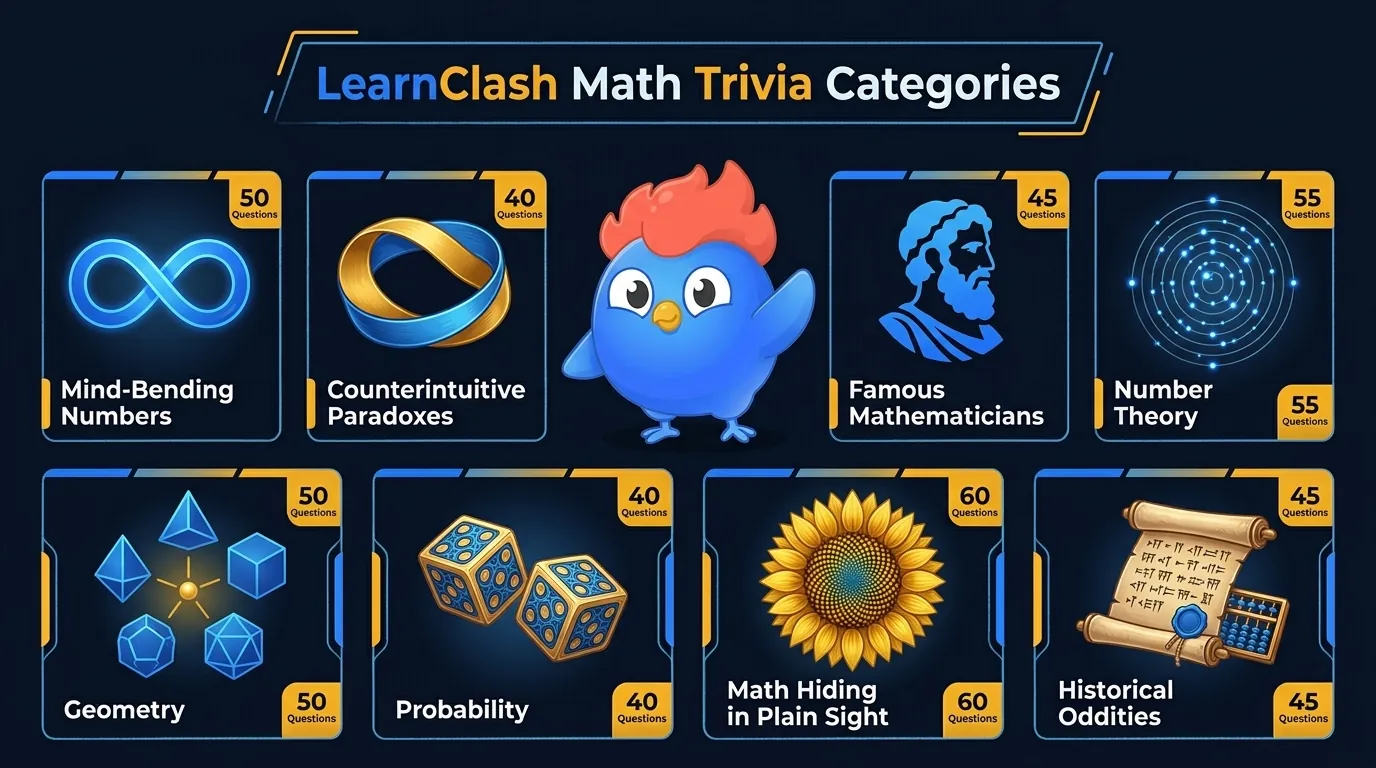 43 math trivia questions across 8 categories, from one-line brainteasers to proofs that broke mathematicians.
Before you start, one production number reframed how I think about this page. Our Trivia Difficulty Index scores every LearnClash topic by how often live answers get it wrong, and when I read the July 21, 2026 run (116,783 answers, 187 topics with enough data to rank), I assumed Mathematics would sit near the top of the table. It came in 110th, at 41.9 percent wrong, slightly better than the 43.7 percent average across all topics. People fear math trivia more than they miss it. Better still, the math question with the worst record in the live app isn’t about calculus or topology. It’s the birthday paradox, question 32 below, where 6 of the 10 recorded answers were wrong. Small sample, sure, but a fitting omen for a page about intuition failing. The June cut of the index is downloadable on Kaggle; the July numbers I’m quoting arrive there with the September update.
If you’d rather warm up before the paradoxes, our 43 science trivia questions and answers and 43 general knowledge trivia questions are gentler on-ramps.
Mind-Bending Numbers (Questions 1-5)
Scale is its own skill. Someone can be flawless at mental arithmetic and still have no working feel for what 10⁶⁷ means, because nothing in daily life ever exercises that muscle. Each of these five involves a number so big that the brain shrugs and stops trying.
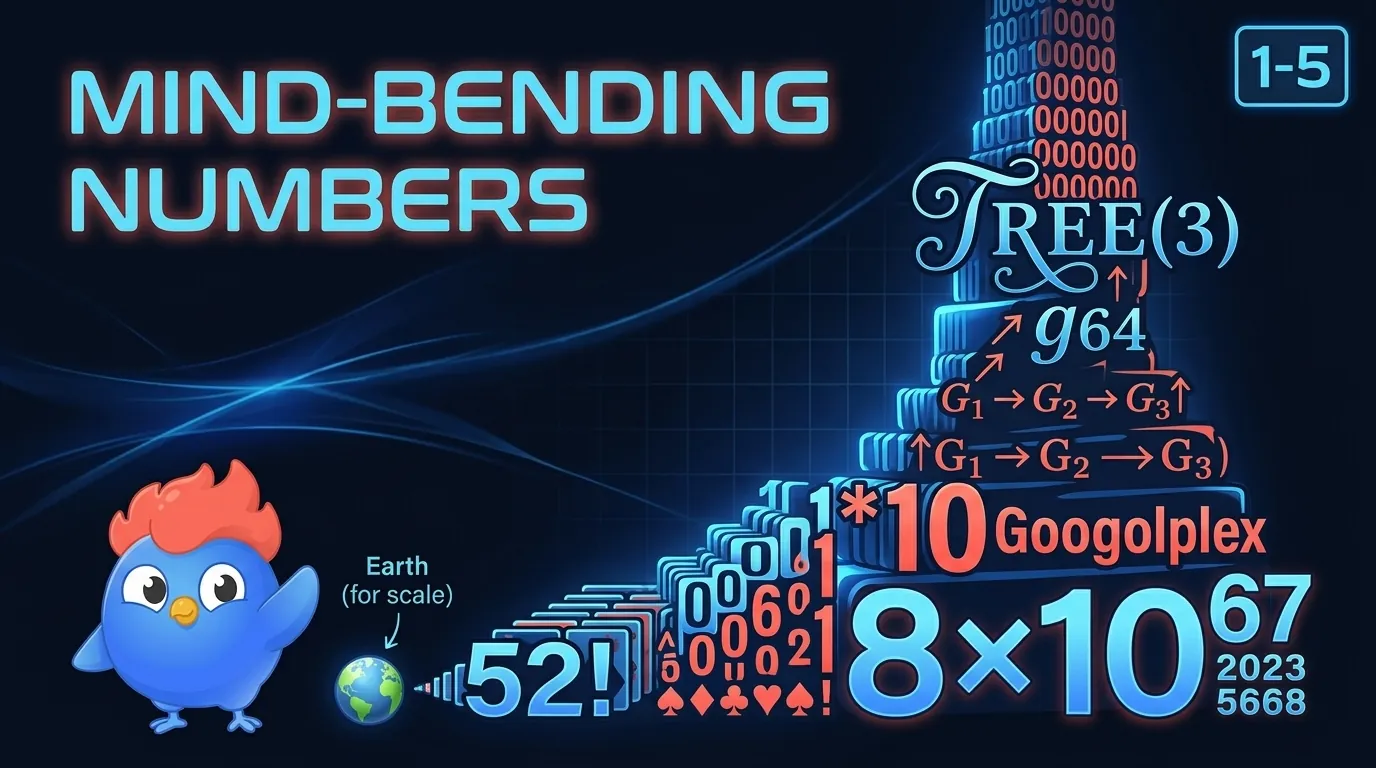 5 questions about numbers so big they stop feeling like numbers.
1. Shuffle a standard 52-card deck thoroughly. What’s the chance the order has ever come up before in card-playing history? Easy
Answer: Almost zero. There are 52! possible orderings, which works out to roughly 8 × 10⁶⁷. For comparison, the entire Earth contains only about 10⁵⁰ atoms.
Why it stumps people: Your gut says “surely someone has shuffled this way before.” Nope. 52 factorial is so gigantic that every properly shuffled deck is almost certainly a sequence that has never existed and never will again. Picture every human who ever lived shuffling a deck once per second since the Big Bang. We’d still have explored a fraction of a fraction of the possibilities.
2. How big is a googolplex compared to the number of atoms in the observable universe? Medium
Answer: Vastly bigger. The universe holds around 10⁸⁰ atoms. A googolplex is 10^googol, or 1 followed by 10¹⁰⁰ zeros. You physically could not write it out.
Why it stumps people: A googol already beats the atom count by 20 orders of magnitude. A googolplex sits a whole tower of zeros past that, with more zeros than there are atoms to write them on. Blame the word itself. “Googolplex” sounds like a cartoon, so the scale sneaks up on you.
3. Graham’s number was used as an upper bound in which field of math, and why is it “too big to write in the universe”? Hard
Answer: Ramsey theory, namely a problem about coloring hypercube edges. Even if every digit occupied a Planck volume, the observable universe couldn’t hold its decimal form.
The detail everyone forgets: Even the number of digits in its number of digits is too big to comprehend. Ronald Graham introduced it to Martin Gardner for a 1977 Scientific American column. Everyone remembers the scale and forgets the setting.
4. Which defined finite number dwarfs Graham’s number so completely that Graham’s number is effectively zero by comparison? Hard
Answer: TREE(3), from Kruskal’s tree theorem.
Why it stumps people: Watch the jump. TREE(1) is 1. TREE(2) is 3. Then TREE(3) detonates into a value so large that saying “Graham’s number is smaller than TREE(3)” barely registers the gap. Explaining why needs the graph theory most of us quietly skipped in college.
The last number in this section is the one your grandmother could check, and it might be the scariest.
5. Place one grain of wheat on square 1 of a chessboard, then double it on every next square. How many grains are on the whole board? Medium
Answer: 18,446,744,073,709,551,615 grains. That’s 2⁶⁴ minus 1, about 1.2 trillion metric tons, which is more than 1,400 times a modern annual world wheat harvest.
Why it stumps people: Exponential growth wrecks intuition. Legend says an ancient king laughed at the inventor who asked for this payment, and then his treasurer ran the math. By square 32 you’re already at 4 billion grains, and every doubling after that is a fresh disaster for the king.
Mind-Bending Paradoxes (Questions 6-12)
This is the section that gets people arguing. Not “I forgot the answer” arguing, but “that cannot possibly be true” arguing, which is a different and more entertaining thing. Here’s the part that does the damage: not one of these is a trick. They’re proven theorems, every one.
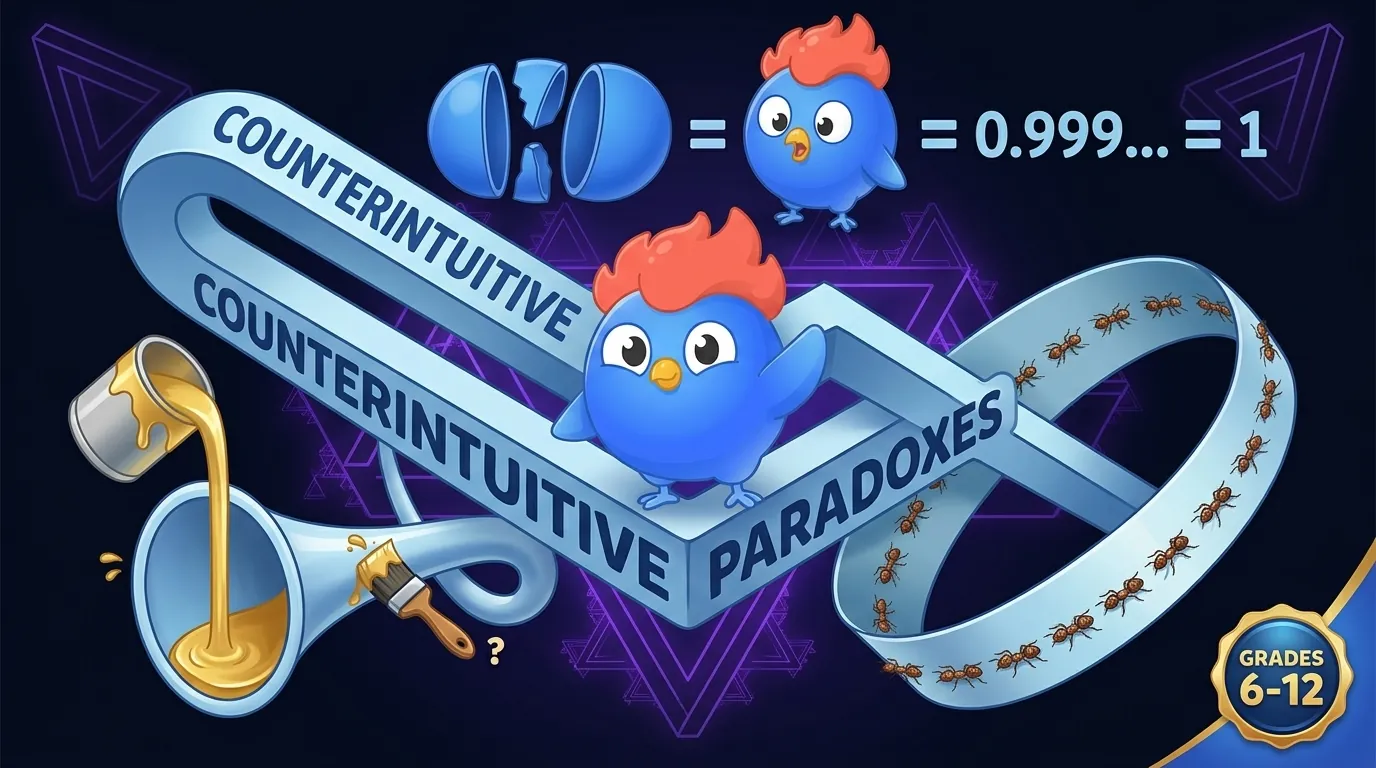 7 paradoxes that pass peer review and still break intuition.
6. How many pieces do you need to cut a solid ball into so you can reassemble them into two identical copies of the original, using only rotation? Hard
Answer: As few as 5 pieces. It’s the Banach-Tarski paradox.
Why it stumps people: It looks like it breaks conservation of volume. It doesn’t, quite. The “pieces” are infinite scatterings of points (non-measurable sets) with no defined volume to conserve, and the whole construction only works if you accept the Axiom of Choice. Your paper-and-scissors instincts fail here for a simple reason: you can’t make these cuts in the real world.
7. Gabriel’s Horn, formed by rotating y = 1/x around the x-axis for x ≥ 1, has a volume of exactly π. What about its surface area? Hard
Answer: Infinite.
Where intuition snaps: Call it the Painter’s Paradox. You can fill the horn with a finite cup of paint, yet no amount of paint will coat the outside. The volume integrand (1/x²) converges while the surface-area integrand (about 1/x) diverges. Physics brains rebel at this. The math shrugs.
8. Are there exactly as many even numbers as natural numbers? Medium
Answer: Yes. Both are countably infinite, with cardinality aleph-null (ℵ₀). Georg Cantor proved different infinities have different sizes.
Why it stumps people: Intuition swears there are “half as many” evens. But pair each natural number with its double and the two sets line up perfectly, same size. The real numbers, on the other hand, are a genuinely bigger infinity. That was the blow Cantor landed on 19th-century math, and a lot of it never forgave him.
Cantor’s diagonal proof that the reals are uncountable fits in about four lines. For a result that reshaped the foundations of math, that has to be one of the shortest arguments ever written.
9. A theorem says that right now, two points on Earth exactly opposite each other have identical temperature AND air pressure. What’s it called? Medium
Answer: The Borsuk-Ulam theorem.
Why it stumps people: Sounds impossible. It isn’t. The theorem says any smooth map from an n-sphere to n-dimensional space sends some pair of antipodal points to the same value. Temperature and pressure vary smoothly across the Earth’s surface, which makes the matching antipodal pair a mathematical certainty, not a coincidence.
10. The coastline of Britain measures about 2,800 km with a 100 km ruler and about 3,400 km with a 50 km ruler. What’s its true length? Medium
Answer: There isn’t one. Coastlines behave like fractals: the shorter the ruler, the longer the measurement, without limit. (Corrected in the August 2026 revision: this question previously gave 3,500 km for the 50 km ruler and an unsourced 1 km figure; Lewis Fry Richardson’s data puts the 50 km measurement near 3,400 km, so the stem now matches it.)
Why it stumps people: The hidden assumption is that “length” belongs to the coastline. It doesn’t. Length belongs to your ruler. Benoit Mandelbrot built fractal geometry partly to pin this down, and the fractal dimension of a real coastline lands somewhere between 1 and 2.
11. In any sufficiently rich mathematical system (like arithmetic), which of these is impossible? Medium
Answer: Being both complete and consistent. Kurt Gödel’s 1931 Incompleteness Theorems guarantee there will always be true statements you can’t prove inside the system.
Why it mattered: It crushed David Hilbert’s dream of a complete axiomatic foundation for mathematics. Gödel was 25 when the proof was published. Plenty of non-mathematicians still quietly hope for a loophole. There isn’t one.
12. Does 0.999… (repeating forever) equal 1? Easy
Answer: Yes, exactly. Not “really close.” The same number in two outfits.
Why it stumps people: Three separate proofs leave no room to doubt it. If x = 0.999…, then 10x = 9.999…, so 10x minus x equals 9, hence x equals 1. Or: 1/3 equals 0.333…, and 3 × (1/3) equals 0.999…, which equals 1. And try naming a number that fits between 0.999… and 1. You can’t, so they’re the same number.
Famous Mathematicians (Questions 13-19)
The equations are weird. The people behind them are weirder. These seven questions cover a fatal pistol duel, a murder by a mob, and a genius who turned down a million dollars and went back to a Saint Petersburg apartment. If your mental list of great minds stops at the physicists, this section will catch you flat.
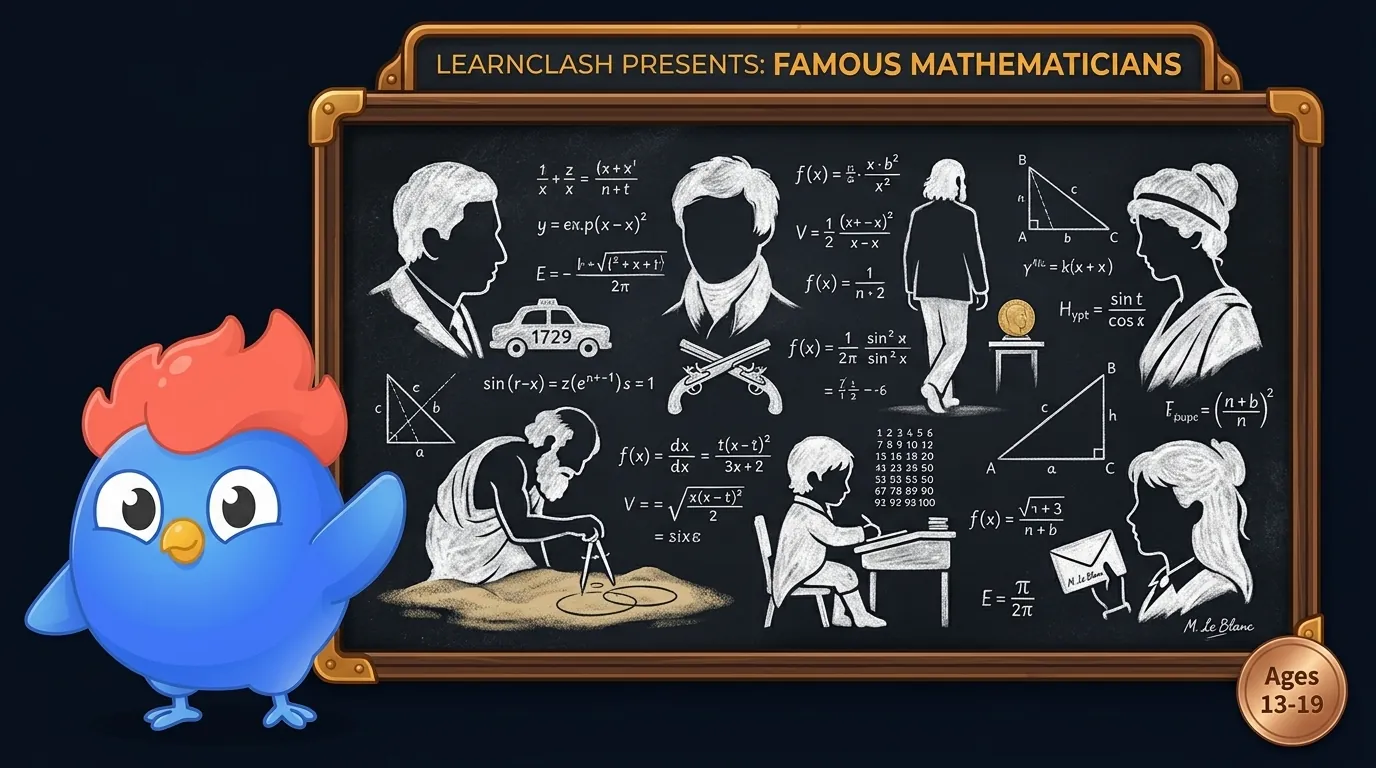 7 mathematicians whose biographies read like fiction.
Play a famous mathematicians duel on LearnClash →
13. What number did Ramanujan famously identify as “the smallest expressible as the sum of two cubes in two different ways,” from a hospital bed in 1918? Medium
Answer: 1729. It equals 1³ + 12³ and also 9³ + 10³. It’s now called the Hardy-Ramanujan number.
The story behind it: G. H. Hardy visited Ramanujan at a sanatorium in Putney and grumbled that his taxicab’s number, 1729, was “dull.” Ramanujan corrected him from his sickbed. One honest footnote: Ramanujan hadn’t conjured the property from nothing in that moment. He had recorded it in his notebooks years earlier, which makes the reply less sorcery and more total command of his own mental filing system. Hardy’s own written account is why the story survives.
14. How old was Évariste Galois when he died in a duel in 1832, after writing a letter asking a friend to publish his mathematical work? Hard
Answer: 20 years old.
Why it stumps people: Hollywood says he invented group theory the night before he died. The real story is better. He’d done most of his key work between 1829 and 1831, and that famous final-night letter asked a friend to preserve what already existed rather than recording fresh genius by candlelight. Either way: group theory came from a 20-year-old who was hours from losing a pistol duel.
15. Which mathematician refused both the Fields Medal (2006) and a $1 million Millennium Prize (2010) for proving the Poincaré conjecture? Easy
Answer: Grigori Perelman. He remains the only person ever to decline the Fields Medal.
What happened next: His most quoted line says it all: “I’m not interested in money or fame. I don’t want to be on display like an animal in a zoo.” The Poincaré conjecture had sat open for 99 years before he cracked it, in three papers posted to arXiv across 2002 and 2003 and never submitted to a journal. The proof checked out anyway. As for the declined million: the Clay Mathematics Institute eventually used it to endow the Poincaré Chair at the Institut Henri Poincaré in Paris, a position for promising young mathematicians. (An earlier revision of this answer claimed the money still sat unclaimed on Clay’s books. That was stale, so it’s gone.)
16. Who was the first female mathematician whose life and work are well recorded, killed by a mob in 415 CE in Alexandria? Hard
Answer: Hypatia of Alexandria.
Why it stumps people: She wrote commentaries on Diophantus’s Arithmetica and Apollonius’s Conic Sections. A Christian mob dragged her from her carriage and killed her with ostraka (roof tiles or pottery shards). Ask a hundred people who she was and most will draw a blank, though Carl Sagan put her back in front of mainstream audiences with Cosmos in 1980.
17. Which famous ancient Greek mathematician was killed by a Roman soldier during the siege of Syracuse, said to have been drawing geometric figures in the sand? Medium
Answer: Archimedes, in 212 or 211 BCE.
The catch nobody mentions: The Roman general Marcellus had ordered that Archimedes be spared. As for the iconic line “Do not disturb my circles!”, the polished Latin version (Noli turbare circulos meos) is a modern paraphrase. The only ancient source for anything like it is Valerius Maximus, who has Archimedes pleading “Noli, obsecro, istum disturbare” over his sand drawings. Plutarch, who gives the fullest account of the death, doesn’t include the line at all.
18. What’s the sum 1 + 2 + 3 + … + 100, and how did a young Carl Friedrich Gauss compute it in seconds as a schoolchild? Medium
Answer: 5,050. Gauss paired first-and-last (1+100), second-and-second-last (2+99), and so on, getting 50 pairs of 101.
Why it stumps people: That reframing is the seed of the formula n(n+1)/2. Historians warn the anecdote is probably polished up, and nobody’s certain which method young Gauss actually used. The insight holds either way, and it’s still the first clever proof most students ever meet.
19. Sophie Germain proved Fermat’s Last Theorem for a large class of primes. What pseudonym did she use to submit her work, because she was a woman? Medium
Answer: “M. Le Blanc” (Monsieur Le Blanc). She wrote as a man in her correspondence with Gauss and Lagrange.
Why it stumps people: Gauss only found out she was a woman after a mutual friend let it slip, and by all accounts he was impressed rather than scandalized. “Sophie Germain primes” still carry her name. She taught herself the whole subject, because the École Polytechnique wouldn’t admit women.
Number Theory Oddities (Questions 20-25)
Number theory plays innocent. Every question here sounds like something you could answer over coffee, right up until you notice the centuries of machinery bolted to the back of it. Three of the six are still officially unproven as of 2026: a third grader can state the problem, and nobody on Earth can finish it.
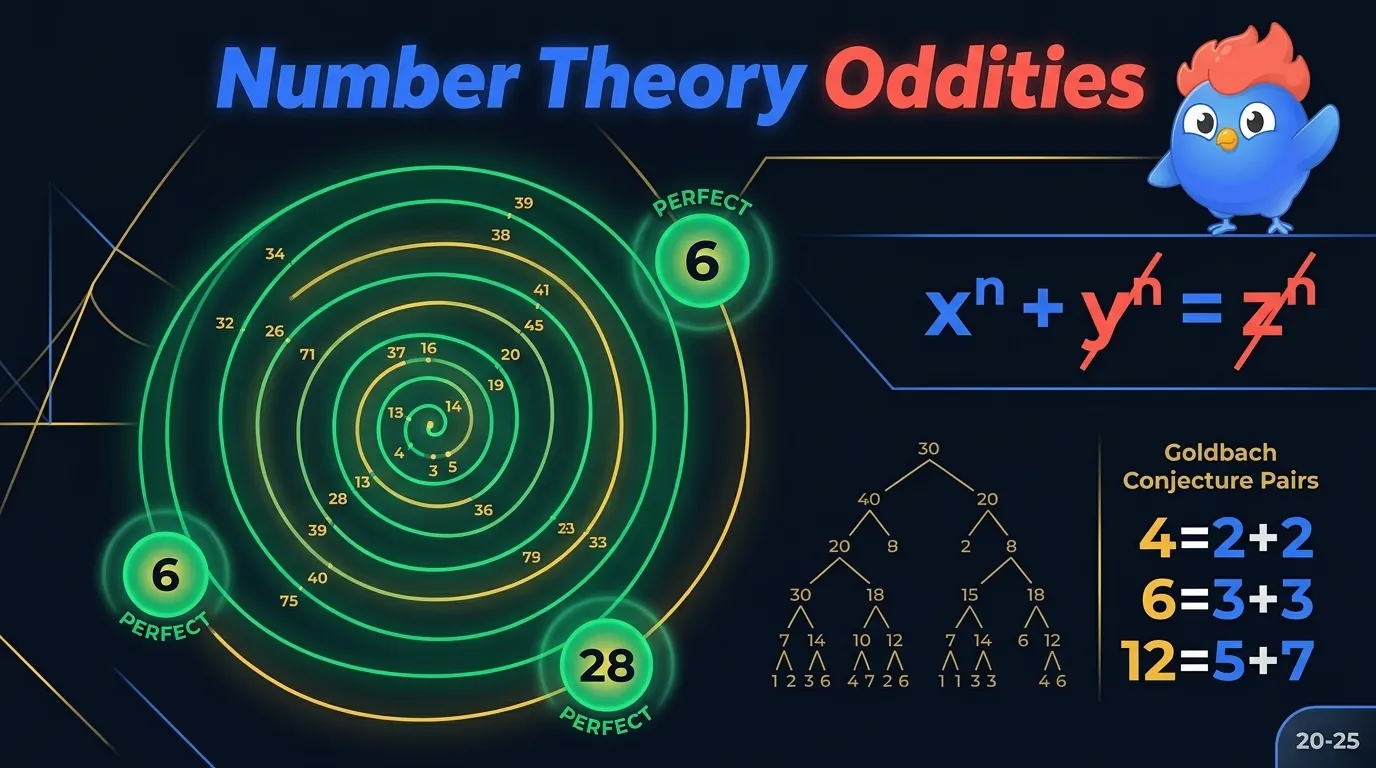 6 number theory questions where the primes refuse to sit still.
Test your number theory knowledge on LearnClash →
20. Is there a largest prime number? Easy
Answer: No. Euclid proved around 300 BCE that there are infinitely many primes.
The proof, in one breath: It’s short enough to memorize. Assume a finite list of primes. Multiply them all together, then add 1. The result is either a new prime missing from your list, or it has a prime factor missing from your list. Either way, your list was never complete. We still teach this one almost word for word, 2,300 years on.
21. How long did it take for Fermat’s Last Theorem (scribbled in a margin around 1637) to be proved? Medium
Answer: 358 years. Andrew Wiles published the proof in 1995, after announcing in 1993 and patching a hole in 1994.
Why it stumps people: Fermat scribbled that he had a proof “too large for this margin,” and nobody else found one for three and a half centuries. The Wiles proof leans on modular forms and elliptic curves, machinery first built in the 1950s, which Fermat could not possibly have seen. Some problems stay open not because they’re too hard but because the right tools don’t exist yet; Fermat was working three centuries too early to finish what he claimed. Wiles missed the Fields Medal age cutoff because he was over 40 when he finished, so the committee handed him a special silver plaque instead.
22. What are the first three “perfect numbers” (integers equal to the sum of their proper divisors)? Medium
Answer: 6, 28, 496. Then 8,128. For example, 6 equals 1 + 2 + 3, and 28 equals 1 + 2 + 4 + 7 + 14.
Still open: Every known perfect number is even, and each one pairs off one-to-one with a Mersenne prime. Does an odd perfect number exist anywhere? Nobody knows. The search has come up empty all the way to 10¹⁵⁰⁰.
23. Why isn’t 1 considered a prime number? Easy
Answer: Because it would break unique prime factorization. If 1 were prime, you could write 6 as 2×3, or 1×2×3, or 1×1×2×3, and so on forever.
Why it stumps people: The modern convention exists to keep the Fundamental Theorem of Arithmetic tidy. And yes, some older mathematicians genuinely did count 1 as prime. So the rule is a choice, not a discovery, which tends to unsettle anyone who assumes math definitions fall from the sky fully formed.
24. What’s the simplest unsolved problem in math, stated in words any child can understand, yet unproven since 1937? Hard
Answer: The Collatz conjecture. Start with any positive integer. If even, halve it. If odd, triple it and add 1. Repeat. The conjecture says you always reach 1.
The state of play: David Barina’s distributed computation has verified it up to 2⁷¹, about 2.36 × 10²¹. Terence Tao proved in 2019 that “almost all” starting values behave. And still nobody has nailed it for every integer. Paul Erdős said flatly that math isn’t ready for problems like this.
25. Is every even number greater than 2 the sum of two primes? Hard
Answer: Conjectured yes, but Goldbach’s conjecture remains unproven since 1742, despite verification up to 4 × 10¹⁸.
Why it stumps people: Christian Goldbach floated it in a letter to Euler, and it’s now one of the oldest open problems in mathematics. The statement is plain enough for a third grader to test on small numbers. Yet it has shrugged off every serious attack for nearly 300 years.
Geometry Surprises (Questions 26-31)
For 2,200 years Euclid was simply right. Then somebody curved the surface, twisted the strip, and built a bottle with no outside. These six questions live past the edge of Euclidean geometry, where the rules you learned in school quietly stop applying. No tricks here; every answer is rigorously proven.
 6 geometry questions where the shapes break the rules.
26. Wrap a rope tightly around Earth’s equator. Add just 1 meter of extra length and lift it uniformly off the ground. How high off the surface is the rope? Medium
Answer: About 16 cm. A cat can walk under it. The gap is 1/(2π) meters regardless of the planet’s size.
Why it stumps people: You expect one extra meter to vanish into Earth’s 40,000 km circumference. It doesn’t. The gap depends purely on the added length, never on the starting radius. Run the same trick on a tennis ball and you get the exact same 16 cm. That’s the part nobody believes until they see the algebra.
27. If you cut a Möbius strip in half down the middle lengthwise, what do you get? Easy
Answer: One longer strip with four half-twists, not two separate strips.
Try it yourself: A Möbius strip has just one side and one edge, so a cut down the middle never actually separates it. Grab a paper strip and some tape. Then cut a third of the way across instead and you get two strips linked through each other. It’s the cheapest parlor trick in mathematics, and it works every time.
28. How many Platonic solids (convex regular polyhedra) exist in three-dimensional space? Easy
Answer: Exactly 5. Tetrahedron, cube, octahedron, dodecahedron, icosahedron.
Why it stumps people: People guess higher, but the count is provably exact, a result Euclid himself closed out. The constraint is simple: the angles meeting at any vertex have to sum to less than 360°. Run the arithmetic and there’s no room left for a sixth.
29. On a globe, can you draw a triangle whose three interior angles each measure 90°? Medium
Answer: Yes. Start at the North Pole, go down two meridians that are 90° apart, then connect them along the equator. All three angles are 90°, summing to 270°.
The schoolroom half-truth: “Triangles add up to 180°” holds only in flat Euclidean geometry. On a sphere, the angles always overshoot 180°; on a saddle-shaped surface, they fall short. We each learned one geometry in school and quietly assumed it was the geometry. It was one option out of several.
30. A single-sided surface with no inside or outside, that can’t even be built in 3D without passing through itself, is called what? Medium
Answer: The Klein bottle.
Why it stumps people: A sphere encloses a volume. A Klein bottle encloses nothing, and whatever you pour in just flows back out. The glass models you’ve seen for sale cheat by passing the neck through the side wall. A true Klein bottle only sits cleanly in four dimensions, where there’s room to make the surface without the self-intersection.
31. What’s the minimum number of colors you need to color any map on a flat plane so that no two bordering regions share a color? Hard
Answer: Four. Proved in 1976 by Kenneth Appel and Wolfgang Haken, controversially, because it was the first major theorem proved by computer.
Why it stumps people: The conjecture goes back to 1852. For decades it made mathematicians uneasy, because no human could verify all 1,936 cases by hand and the computer ran for over 1,000 hours to do it. To this day some find the proof unsatisfying. Other teams have since rechecked and rebuilt it, and it holds.
Probability Gotchas (Questions 32-34)
Probability is where human intuition goes to die. Each of these three questions cost real people real money once the math came back disagreeing with the gut, and one of them, per the production data up top, is the most-missed math question in our own app.
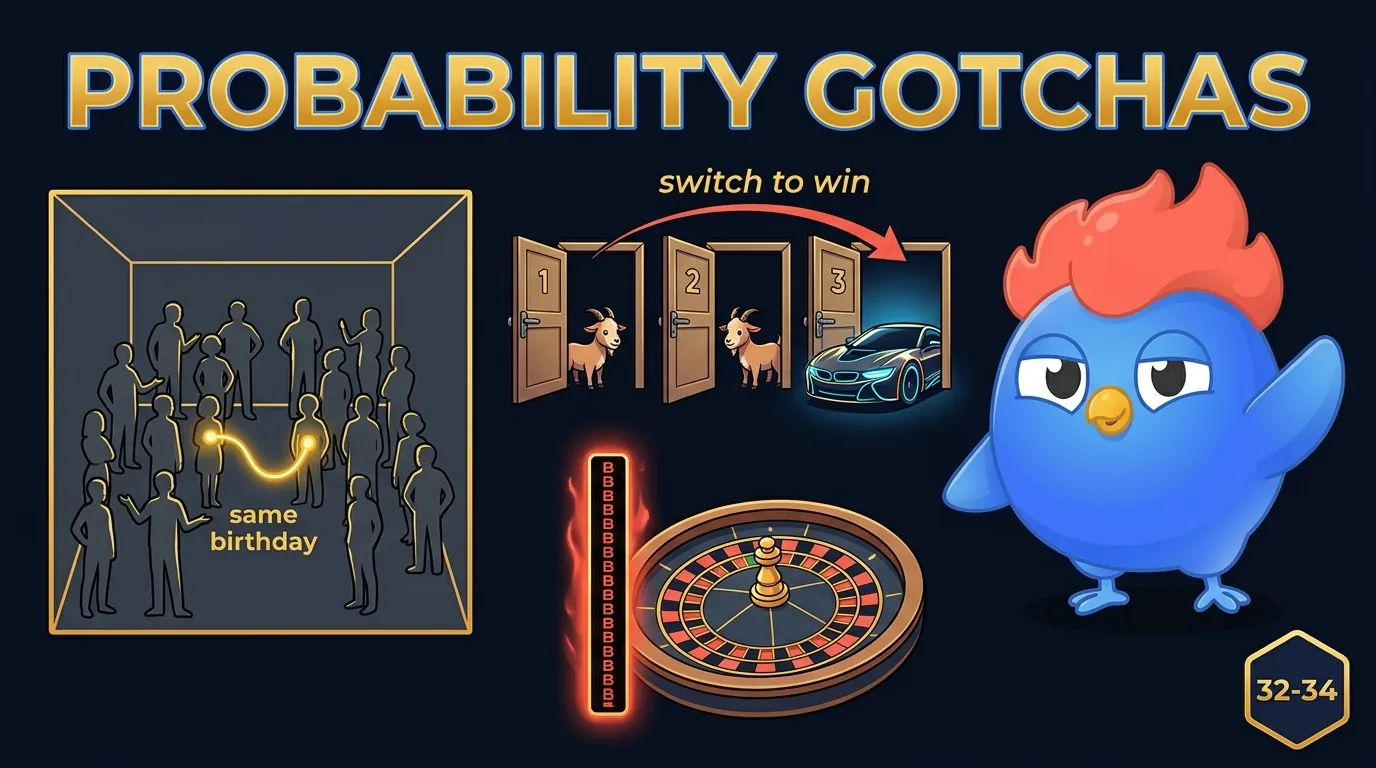 3 probability questions that broke casinos and game shows.
32. How many people do you need in a room for a better-than-50% chance that two share a birthday? Easy
Answer: Just 23.
Why it stumps people: The popular guess is 183, because that feels like “half of 365.” Wrong frame. You’re comparing every possible pair, not every person against a single date. With 23 people you’ve already got 253 pairs, and the odds compound far faster than the gut expects. This is the question that topped the wrong-rate list for the live Mathematics topic in our July 2026 export: 6 of 10 recorded answers missed it.
33. On the Monty Hall game show, you pick door #1. The host, who knows where the car is, always opens a goat door (here door #3) and always offers the switch. Should you switch to door #2? Medium
Answer: Yes, always switch. Switching wins 2/3 of the time. Staying wins 1/3.
Why it stumps people: It feels like a clean 50/50 between the two remaining doors. It isn’t, because the host knows where the car is and his choice leaks that knowledge. Your original 2/3 chance of having picked wrong transfers, whole and untouched, to the unopened door. Statisticians, PhDs, and a thousand critics of Marilyn vos Savant all got this wrong in print before the math humiliated them.
The last probability question is the one that actually bankrupted people.
34. On August 18, 1913, a roulette wheel at Monte Carlo Casino landed on black how many times in a row, costing gamblers millions as they bet on red? Hard
Answer: 26 times in a row.
The expensive lesson: Every spin is independent. The previous result has zero pull on the next one. Gamblers lost fortunes that night betting “red is due,” and the episode became the textbook case of the gambler’s fallacy, renamed the Monte Carlo fallacy after that exact wheel. Casinos have been quietly grateful to probability theory ever since.
Math Hiding in Plain Sight (Questions 35-39)
The best fun math facts don’t sound like math at all. They sound like gardening, or beekeeping, or a company name. Fair warning: once you see the math in these things, you can’t unsee it.
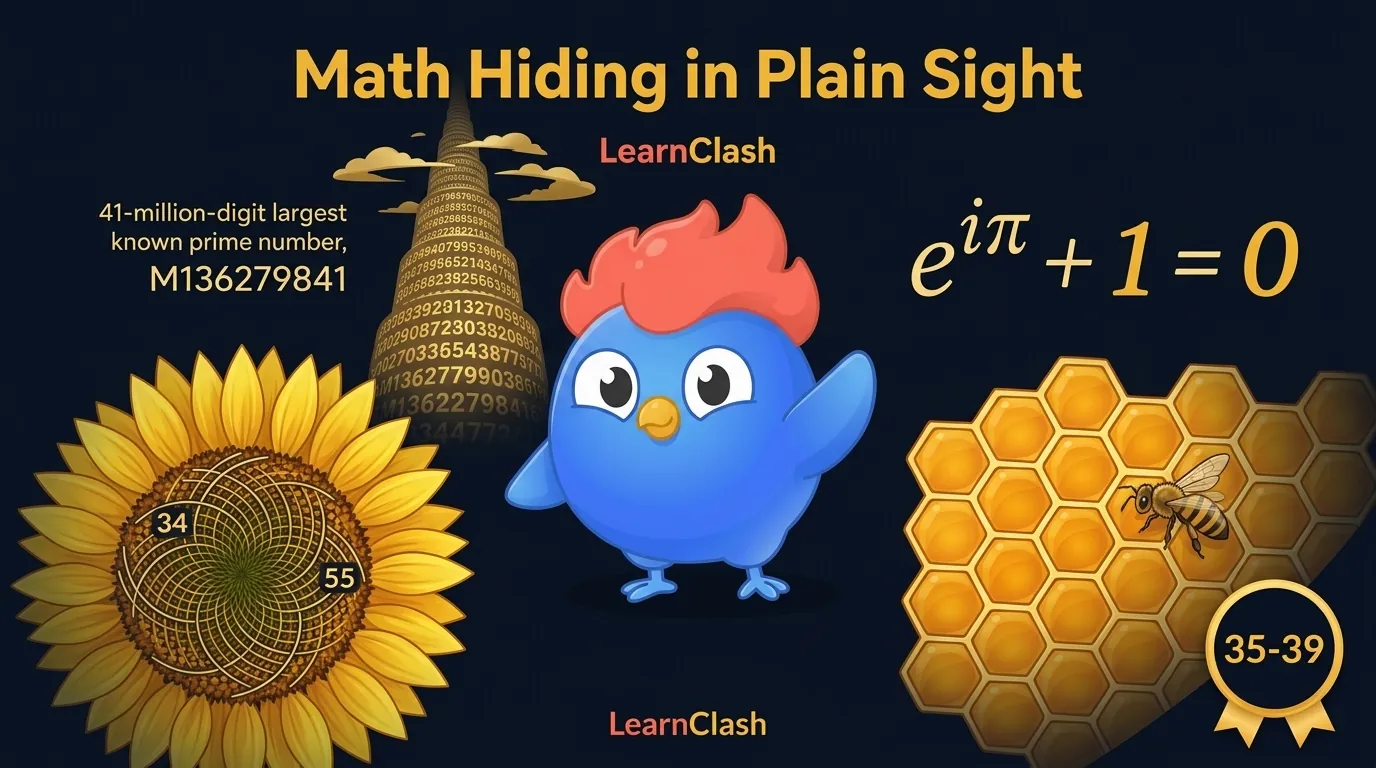 5 places math shows up where no one asked for it.
35. In a sunflower head, the spirals of seeds almost always match two consecutive numbers in which famous sequence? Easy
Answer: The Fibonacci sequence. Common patterns: 34 spirals one way, 55 the other. Or 55 and 89.
How solid is this one: Solid, with honest caveats. The golden angle of about 137.5° between consecutive seeds maximizes packing density, a mechanism modeled mathematically as far back as 1979. The largest field test, a 2016 citizen-science study of 657 sunflowers published in Royal Society Open Science, counted 768 reliable spiral tallies and found 565 were exact Fibonacci numbers with another 67 showing Fibonacci-like structure. So most sunflowers really do it, and a stubborn minority refuse. Plenty of “golden ratio in nature” claims are inflated; this one mostly survives contact with actual flowers.
36. Bees build honeycombs using hexagons. Is this really the most efficient shape for dividing a plane into equal-area cells? Medium
Answer: Yes. Proven in 1999 by Thomas C. Hales. Regular hexagons minimize the total perimeter.
Why it stumps people: Pappus of Alexandria guessed it around 300 CE. It then took 1,700 years to prove on paper what the bees had already settled in wax. Hales’s 1999 paper rests on a rigorous perimeter-minimization argument across every possible tiling, curved walls included.
37. What equation connects five of mathematics’ most important constants (0, 1, π, e, and i) in a single line? Medium
Answer: Euler’s identity: e^(iπ) + 1 = 0.
Why it stumps people: Readers of The Mathematical Intelligencer voted it “most beautiful theorem in mathematics” in 1990, and a 2004 Physics World poll put it at the top alongside Maxwell’s equations for “greatest equation ever.” Here’s the strange part. Those five constants come from completely separate branches of math, and yet they all show up together on a single line.
38. Pick two random positive integers. What’s the probability they share no common factor greater than 1? Hard
Answer: 6/π² ≈ 60.79%.
Why it stumps people: There’s no circle anywhere in this problem, yet pi walks right in. The result falls out of the Basel problem, where the sum of 1/n² equals π²/6, which Euler cracked in 1735. Pi turning up in pure number theory is one of math’s weirdest recurring jokes.
39. What’s the largest known prime number as of 2026? Easy
Answer: M136279841, which equals 2^136,279,841 minus 1. It has 41,024,320 decimal digits, and as of August 2026 the record still stands.
Why it stumps people: Luke Durant found it on October 12, 2024, the first Mersenne prime ever discovered on GPUs rather than CPUs. The previous record holder was 16 million digits shorter. Primes this large take months of raw computing time just to verify.
Historical Oddities (Questions 40-43)
Every one of these four hides a detail that sounds invented, and each is fully checkable. That combination, verifiable but myth-flavored, is exactly what makes a trivia question stick in memory.
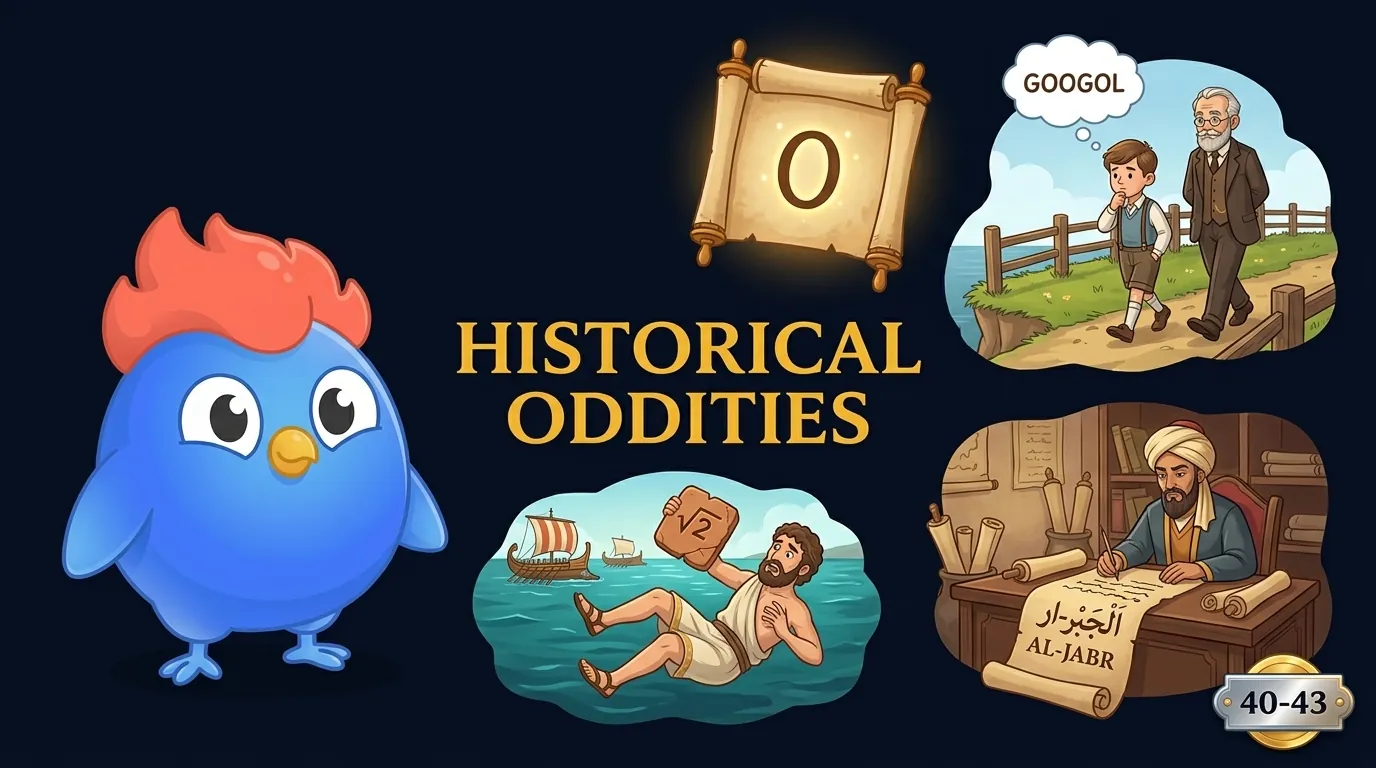 4 math history questions that sound made up and aren’t.
40. Who invented the word “googol” (1 followed by 100 zeros)? Easy
Answer: A 9-year-old boy named Milton Sirotta, in 1920. He was the nephew of mathematician Edward Kasner.
The afterlife of the word: Out on a walk in the New Jersey Palisades, Kasner asked his nephews to christen a big number, and Milton blurted “googol.” Eight decades later the word seeded the company name “Google,” by way of a misspelling.
41. Which mathematician first used zero as a real number (not just a placeholder) in 628 CE, including rules for arithmetic with it? Medium
Answer: Brahmagupta, in his Brahmasphutasiddhanta.
Why it stumps people: He was the first to treat zero as an actual number rather than a position marker, writing down rules for adding, subtracting, and multiplying with it. His rule for dividing by zero was flat wrong. But he was the first to ask the question at all, and asking it is half the work.
42. What mathematical discovery allegedly got a Pythagorean cult member killed for revealing its existence? Hard
Answer: The square root of 2 is irrational. The legend says Hippasus of Metapontum proved it around 500 BCE, and was drowned at sea for leaking the discovery.
Why it stumps people: The Pythagoreans staked their worldview on the idea that every number was a ratio of whole numbers, and one irrational quantity blew that up. Plenty of historians think the drowning is a tall tale. The proof, though, is dead real, and first-year number theory classes still teach it.
43. The words “algorithm” and “algebra” both trace to one 9th-century Baghdad mathematician. Who? Medium
Answer: Muhammad ibn Musa al-Khwarizmi. His Latinized name gave us “algorithm.” His book title al-jabr (meaning “restoration” or “reunion of broken parts”) gave us “algebra.”
Why it stumps people: Two foundational English words, both traceable to one person working in the House of Wisdom around 820 CE, and we say each of them almost daily without giving him a thought. He also popularized the decimal system across the Arab world, and from there it reached Europe through translations of his work.
If You Want These to Stick
Reading the answer to the Monty Hall problem teaches you almost nothing. Missing it in a live duel, stewing on it, then meeting it again days later? That sticks. The lab version of that claim is Karpicke and Roediger’s 2008 experiment in Science: measured a week after learning, the score ran 80 percent to 36 in favor of the group that kept quizzing itself over the group that kept rereading. Retrieval is the mechanism, not exposure. Our guides to spaced repetition and the testing effect unpack the research.
LearnClash is built on that gap. A duel packs 18 questions into six three-question rounds, 45 seconds apiece, and a miss is never the end of it: the question books itself back in after a week, and clearing that return sets one final check 90 days later, the last hurdle before Mastered. Ranked duels show an ELO-style rating that opens at 1300 and moves with every result.
Challenge a friend to a math duel →
Want a different flavor next? Try our 43 science trivia questions, 43 history trivia questions, or browse all trivia questions by topic.
Frequently Asked Questions
What is a fun math fact most people don't know?
In a room of just 23 people, there's a better than 50% chance two share a birthday. It's called the Birthday Paradox. Most people guess 183 because it feels like half of 365, but the math compares every possible pair, not every person to one date.
Does 0.999 repeating actually equal 1?
Yes, exactly equal. If x equals 0.999..., then 10x equals 9.999..., so 10x minus x equals 9, meaning x equals 1. There's also no number you can fit between 0.999... and 1, which is another way to prove they're the same.
Who invented the number zero?
The Indian mathematician Brahmagupta first treated zero as a real number with its own arithmetic rules in 628 CE, in his Brahmasphutasiddhanta. Earlier cultures used zero as a placeholder, but Brahmagupta defined how to add, subtract, and multiply with it.
What's the largest known prime number in 2026?
As of August 2026, the record still stands at M136279841, which equals 2 to the 136,279,841 power minus 1. It has 41,024,320 decimal digits and was found in October 2024 by Luke Durant using GPUs, the first Mersenne prime discovered without CPUs.
What is the best app for math trivia questions?
LearnClash runs math trivia as 1v1 quiz duels with spaced repetition that brings back the questions you miss until you know them. Math coverage spans arithmetic, geometry, number theory, and famous mathematicians across easy, medium, and hard difficulty bands.