
47 WW2 Trivia Questions for History Buffs [With Answers]
47 WW2 trivia questions on battles, spies, technology, and myths most people still believe. Answers and explanations included.
How many do you know?
Think of your answer, then reveal it.
Did you know it before revealing the answer?
Read this answer in the articleRound complete
Challenge friends on this topic.
Start a new duel in LearnClash and learn from every answer.
Get LearnClashFree to play on iPhone and Android. No ads.
Try the questions you missed once more.

Poland cracked the Enigma cipher seven years before Alan Turing touched it. The US military enlisted a bear. And a thousand artists fooled the entire German army with inflatable tanks.
These 47 WW2 trivia questions on LearnClash cover decisive battles, commanders, espionage, wartime tech, the home front, the Pacific theater, and the myths that still fool people. Every answer breaks down the specific detail that trips players up, sourced from the National WWII Museum and Britannica’s WW2 coverage.
Seven topics, three difficulty tiers, six years of global conflict. World War 2 trivia is one of the toughest history trivia categories we cover across 26 topics, and these ww2 trivia questions are built to prove it. Challenge a friend to a WW2 duel on LearnClash →
Challenge a friend to WW2 trivia on LearnClash
Quick Overview
LearnClash sorts these 47 WW2 trivia questions by category so you can jump to what interests you. The set leans hard because surface-level WW2 facts don’t catch anyone who watched a documentary. Use the table as a jump menu.
| Section | Questions | Easy | Medium | Hard |
|---|---|---|---|---|
| Battles That Changed Everything | 1-7 | 2 | 3 | 2 |
| Leaders and Commanders | 8-13 | 1 | 3 | 2 |
| Spies, Codes, and Deception | 14-20 | 1 | 3 | 3 |
| Weapons and Technology | 21-27 | 2 | 3 | 2 |
| The Home Front | 28-33 | 2 | 2 | 2 |
| The Pacific Theater | 34-40 | 1 | 3 | 3 |
| Hard WW2 Trivia: Myths Everyone Still Believes | 41-47 | 1 | 3 | 3 |
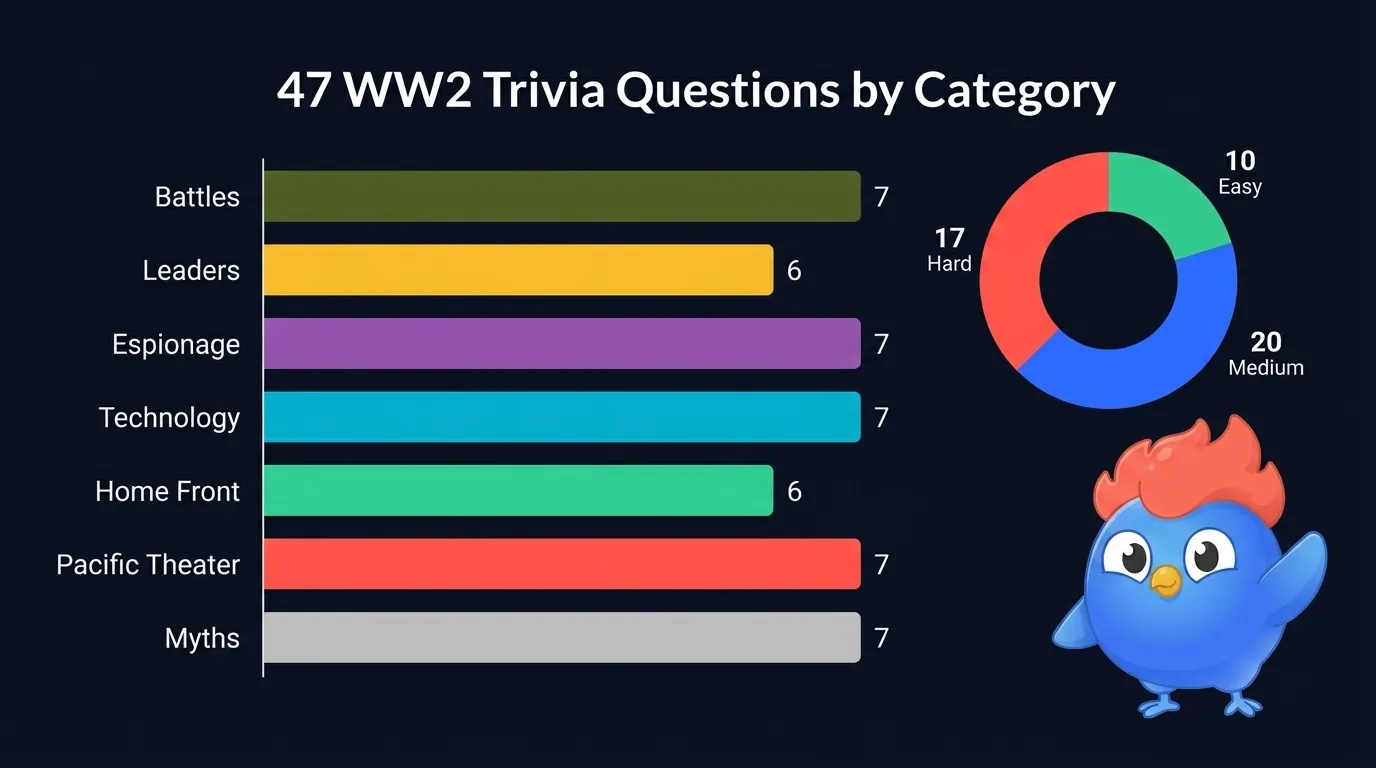 47 WW2 trivia questions across 7 categories. Difficulty skews hard because easy WW2 facts don’t stump adults.
When we built the WW2 trivia questions in LearnClash, one pattern kept showing up: players are most wrong about the things they feel most certain about. Everyone “knows” Turing cracked Enigma. Everyone “knows” the atomic bombs were the deadliest raids. And everyone gets both wrong.
That confidence gap is exactly what spaced repetition is built to fix. A confident wrong answer, corrected, sticks far better than a lucky guess. These ww2 trivia questions are built to exploit that gap.
Battles That Changed Everything (1-7)
LearnClash covers seven WW2 battle questions that rewrite what most people remember from school. The largest tank battle wasn’t the Bulge. The “900-day siege” lasted 872 days. And the deadliest single battle killed two million people before most Americans even knew it was happening.
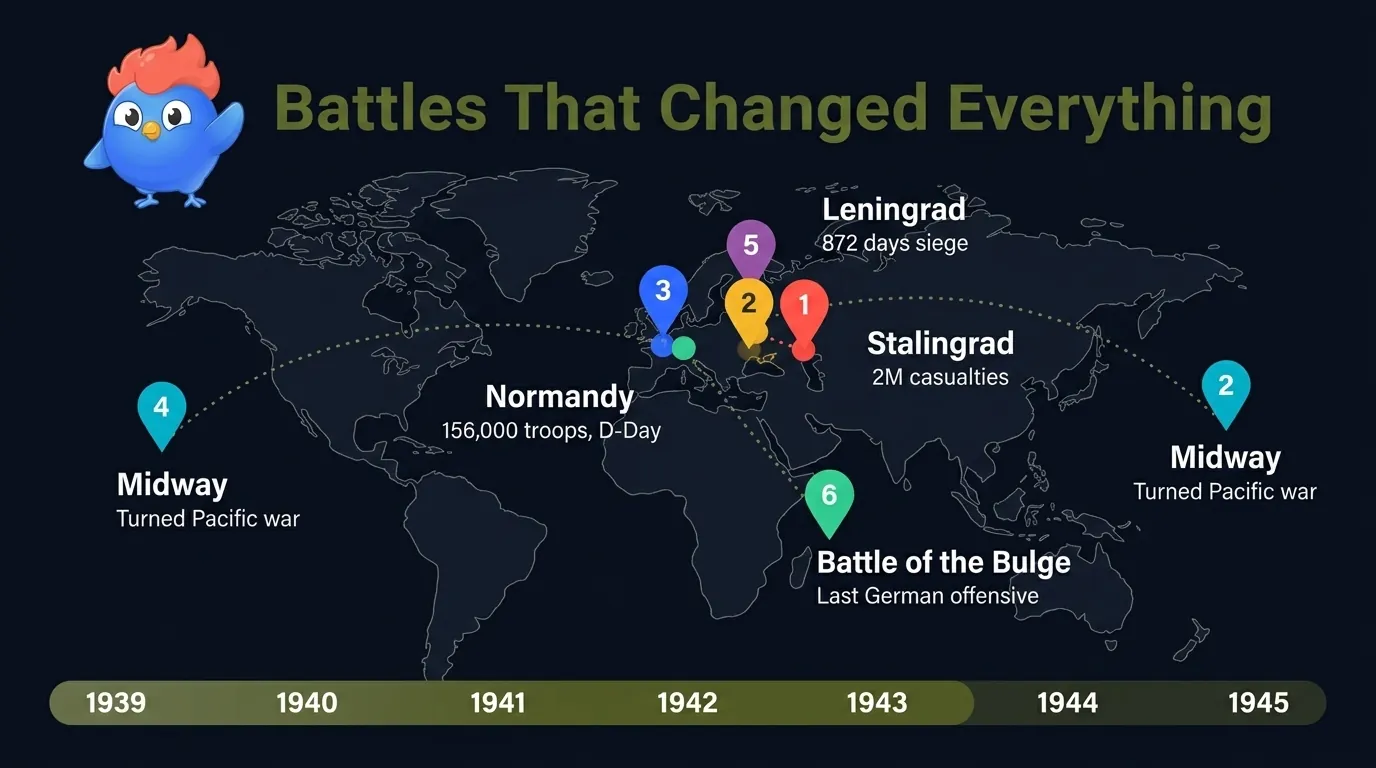 Six battles that decided the war. Most people can only name two.
1. What was the largest tank battle in history? Medium
Answer: The Battle of Kursk in July-August 1943. Over 6,000 tanks and 2 million soldiers clashed on the Eastern Front. The Soviet victory ended Germany’s ability to launch major offensives.
Why it stumps people: Nearly everyone reaches for the Battle of the Bulge or El Alamein. Kursk dwarfs both. The fighting stretched across an area the size of Wales. Germany committed its newest Tiger tanks and still lost. After Kursk, the Wehrmacht only retreated.
2. Which WW2 battle produced the highest total casualties? Medium
Answer: The Battle of Stalingrad (August 1942 to February 1943). Combined military and civilian casualties reached roughly 2 million, making it the deadliest single battle in recorded history.
Why it stumps people: The number shocks people. Two million. In one city. Soviet soldiers arriving as reinforcements had a life expectancy of about 24 hours. Germany’s 6th Army surrendered with only 91,000 survivors from an original force of 300,000.
3. What was the overall code name for the Allied invasion of Normandy? Easy
Answer: Operation Overlord. “D-Day” refers to June 6, 1944, the specific launch date. The naval component had its own code name: Operation Neptune.
Why it stumps people: Your gut says “D-Day.” But D-Day isn’t a code name. It’s military shorthand for the start date of any operation. The Normandy invasion was Overlord. The beach landings were Neptune. D-Day stuck in popular memory because journalists used it as shorthand.
4. Roughly how many Allied soldiers landed on Normandy beaches on June 6, 1944? Hard
Answer: About 156,000 troops landed or parachuted into Normandy on D-Day itself. By the end of June, over 850,000 had followed.
Why it stumps people: Ask ten people and you’ll hear everything from “thousands” to “a million.” The real number sits between those guesses. And roughly 4,400 Allied soldiers died on that single day. Logistics won D-Day as much as bravery did.
5. Which naval battle turned the tide of the Pacific war just six months after Pearl Harbor? Medium
Answer: The Battle of Midway (June 4-7, 1942). The US Navy sank four Japanese aircraft carriers while losing one. Japan never recovered its offensive naval capability.
Why it stumps people: The timeline surprises people. Pearl Harbor was December 1941. Six months later, Japan’s carrier advantage was gone. US intelligence had cracked enough of the Japanese naval code to predict the attack. Preparation beat surprise.
6. How long did the Siege of Leningrad actually last? Hard
Answer: 872 days (September 8, 1941, to January 27, 1944). The commonly cited “900-day siege” is rounded up.
Why it stumps people: Close. Not quite.
Everyone who’s heard of the siege remembers “900 days.” The real number is 872. About a million civilians died, mostly from starvation during the first winter. Survivors ate wallpaper paste and boiled leather belts. The 28-day rounding error is small. The suffering wasn’t.
7. What was the last major German offensive of the war? Easy
Answer: The Battle of the Bulge (Ardennes Offensive), December 1944 to January 1945. Germany threw its last reserves at Allied lines in Belgium. It created a 50-mile “bulge” before being pushed back.
Why it stumps people: This catches even casual history fans because many assume Germany was just retreating after D-Day. Hitler gambled everything on splitting the Allied forces. The initial attack caught the Allies off guard. But Germany couldn’t sustain it. The offensive burned through fuel and troops Germany couldn’t replace.
Did you know? LearnClash WW2 questions cover every major theater and difficulty level. The battles you get wrong come back through spaced repetition until you can name them in your sleep.
Leaders and Commanders (8-13)
LearnClash tracks six WW2 commander questions where the real stories are stranger than what textbooks print. Hitler’s nephew fought for the US Navy. Britain’s most decorated officer fought with a longbow. And Germany’s most famous general was killed by his own leader.
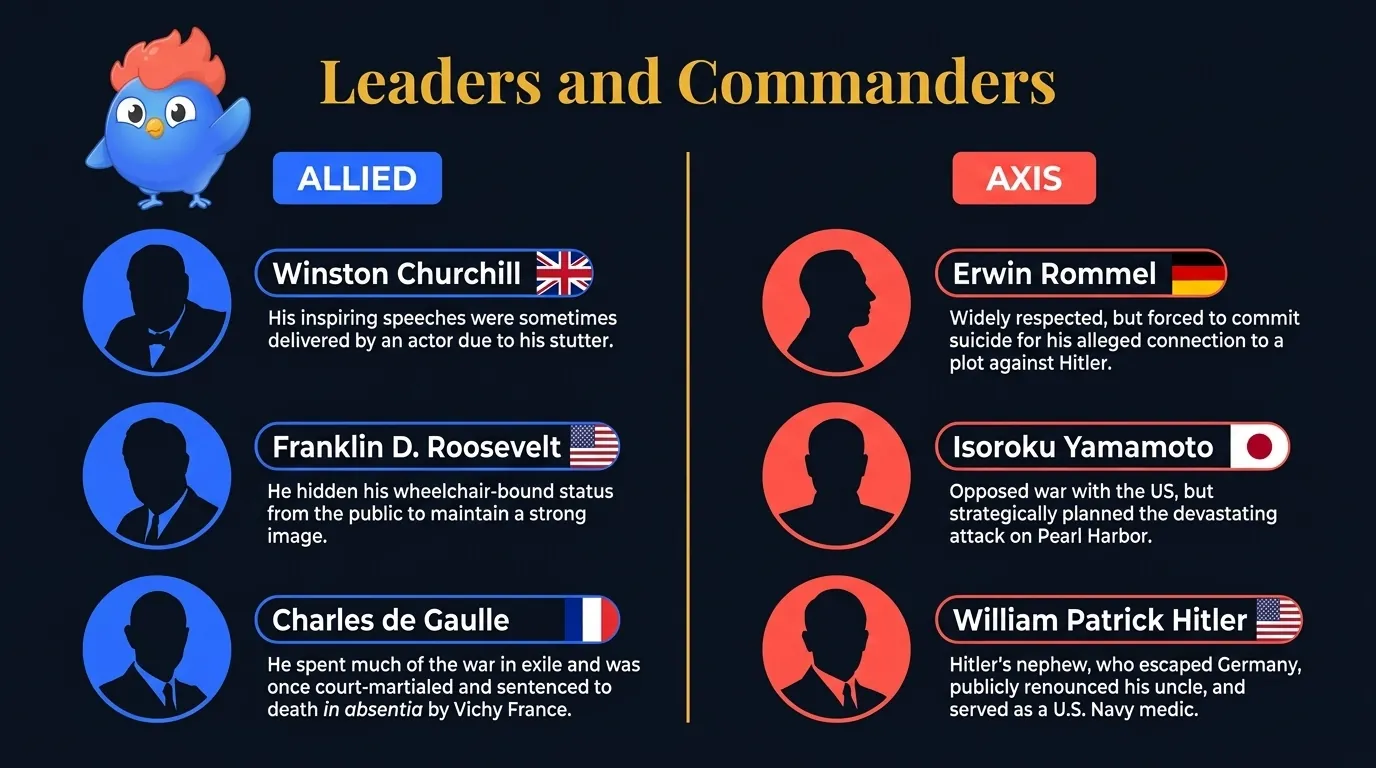 Six commanders. At least two facts on this image will surprise you.
8. Which famous WW2 general was nicknamed “The Desert Fox”? Easy
Answer: German Field Marshal Erwin Rommel, who commanded the Afrika Korps in North Africa. He earned the nickname from British troops who respected his tactical skill.
Why it stumps people: The trap here is that people sometimes misremember Rommel as an Allied general because of the admiration. He wasn’t. He fought for Germany. Churchill himself called Rommel a “great general” in the House of Commons. That level of respect for an enemy commander was rare.
9. What was the name of Hitler’s nephew who served in the US Navy? Hard
Answer: William Patrick Hitler. Born in Liverpool in 1911 to Hitler’s half-brother Alois Jr., he moved to the US in 1939 and served in the Navy, earning a Purple Heart.
Why it stumps people: The real story is stranger than fiction. William first tried to use his uncle’s name for favors in Germany. It didn’t work. He fled to America, wrote an article titled “Why I Hate My Uncle,” then enlisted. He changed his surname after the war. His descendants live in the US under a different name.
10. Which British officer fought through all of WW2 carrying a longbow, a broadsword, and bagpipes? Hard
Answer: Lieutenant Colonel “Mad Jack” Churchill (no relation to Winston). He scored the last confirmed longbow kill in modern warfare during a 1940 ambush in France.
Why it stumps people: Sounds made up. It isn’t. Jack Churchill charged beaches playing bagpipes, captured 42 Germans in a single night raid with his broadsword, and was captured twice by the Germans. He escaped both times. When the war ended, he reportedly said he was sorry because “if it wasn’t for those damn Yanks, we could have kept the war going another 10 years.”
11. How did Field Marshal Erwin Rommel die? Medium
Answer: He was forced to take cyanide on October 14, 1944, after being implicated in the July 20 plot to assassinate Hitler. In exchange, his family was spared and he received a state funeral.
Why it stumps people: School textbooks skip this. Rommel didn’t die in battle. Hitler gave him a choice: cyanide pill and a hero’s funeral, or trial and execution with consequences for his wife and son. Rommel took the pill. Germany announced he died of war injuries. The truth stayed hidden for years.
12. What famous speech did Churchill deliver on his very first day as Prime Minister? Medium
Answer: “I have nothing to offer but blood, toil, tears and sweat” on May 13, 1940, three days after Germany invaded France and the Low Countries.
Why it stumps people: Few realize it was Churchill’s first speech as PM. He hadn’t been in office a week. Britain was losing. France was falling. And his opening message was, essentially, “This will be terrible.” It’s remembered as inspiring. Read the full text and it’s honestly terrifying.
13. Which Japanese admiral planned the attack on Pearl Harbor? Medium
Answer: Admiral Isoroku Yamamoto. He had studied at Harvard and served as a naval attaché in Washington, giving him firsthand knowledge of American industrial capacity.
Why it stumps people: The irony is that Yamamoto opposed war with the United States. He warned that Japan could “run wild” for six months to a year, then lose. He was right. He planned Pearl Harbor because he believed it was Japan’s only slim chance, not because he thought it would work long-term. He was killed when US forces shot down his plane in 1943 after intercepting coded messages.
Spies, Codes, and Deception (14-20)
LearnClash covers seven WW2 espionage questions that read like rejected spy novels. The country that cracked Enigma wasn’t Britain. A thousand American artists faked an entire army division. And a dead man carrying a briefcase changed the outcome of the war.
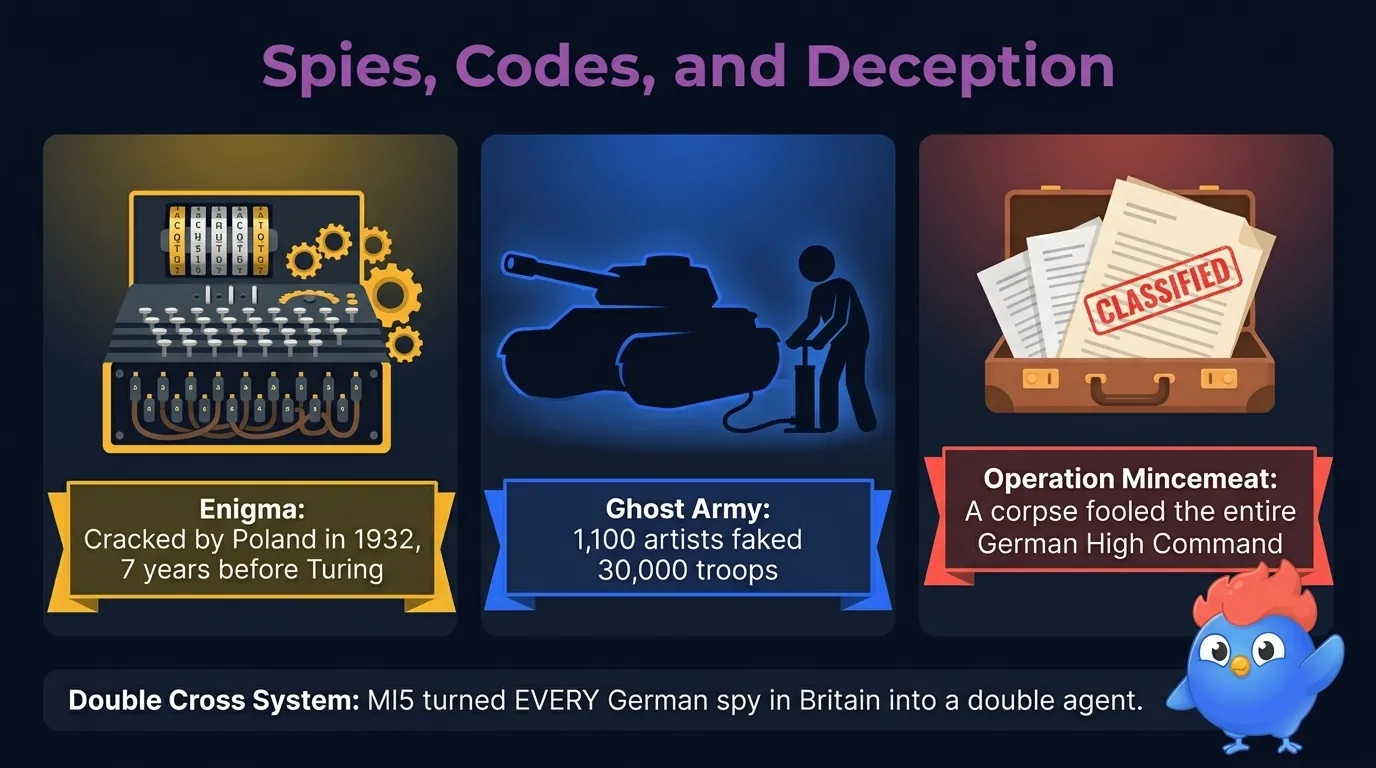 Three deception operations that sound fictional. All of them worked.
14. Who first cracked the German Enigma cipher? Hard
Answer: Polish mathematician Marian Rejewski in December 1932, seven years before Alan Turing’s work at Bletchley Park. His colleagues Jerzy Różycki and Henryk Zygalski developed additional methods, and all three shared their work with Britain and France in July 1939.
Why it stumps people: Not Turing. Not Britain.
Everyone credits Turing. He deserves enormous credit, but he built on Polish foundations. Rejewski used math and group theory plus intel from a French spy in the German cipher office. The Poles even built the bomba, the first Enigma-cracking machine, before Turing designed his improved version. Poland’s contribution was classified for decades after the war.
15. What was Operation Mincemeat? Medium
Answer: A British deception. They dressed a corpse as a Royal Marines officer, handcuffed a briefcase with fake invasion plans to his wrist, and floated him off the coast of Spain. The fake plans pointed to Greece instead of the real target: Sicily.
Why it stumps people: Sounds right for a movie. It was one. But the real version is wilder. The body was a homeless man who died of rat poison ingestion. British intelligence gave him a complete fake identity, love letters, even theater ticket stubs. German intelligence found the documents, believed them, and redirected forces to Greece. Sicily fell to the Allies with lighter resistance.
16. How many German spies sent to Britain were NOT turned into double agents by MI5? Hard
Answer: Zero. MI5’s Double Cross System turned every single German agent in Britain into a double agent, or caught and imprisoned those who refused.
Why it stumps people: This catches even history buffs. Not “most.” Not “nearly all.” Every one. The Double Cross System fed Germany fake intel for years, culminating in Operation Fortitude before D-Day. Double agents convinced Hitler the real invasion would hit Calais, not Normandy. He held back Panzer divisions for weeks waiting for an attack that never came.
17. What was the Ghost Army? Medium
Answer: The 23rd HQ Special Troops, a US Army unit of roughly 1,100 soldiers, many from art schools. They used inflatable tanks, sound trucks with recorded engine noise, and fake radio traffic to fake divisions of 30,000 troops.
Why it stumps people: Art school graduates fighting a war with rubber tanks. No list of ww2 trivia questions is complete without this one. The long version involves over 20 successful deception operations across Europe. The Ghost Army drew enemy fire away from real units. Their existence was classified for 50 years, only declassified in 1996. Members received the Congressional Gold Medal in 2022.
Key takeaway: WW2 espionage relied as much on creativity as technology. Artists, mathematicians, and con men shaped the war as much as soldiers. Research on the testing effect shows that surprising facts like these stick 80% better than rote memorization.
18. What disguised gadgets did Allied spy agencies give their agents? Hard
Answer: SOE and OSS provided agents with maps hidden in playing cards, compasses inside uniform buttons, guns disguised as tobacco pipes, and even cigarettes laced with knockout drugs. The OSS’s gadget chief was nicknamed “Professor Moriarty” by his own director.
Why it stumps people: Two words trip people up: “playing cards.” The cards could be soaked in water to separate layers, revealing escape maps printed between them. And the “Professor Moriarty” nickname? That was given to Stanley Lovell, a Boston chemist, by OSS Director William “Wild Bill” Donovan. The spy gear sounds like Bond gadgets because Ian Fleming, who created Bond, worked in British naval intelligence during the war.
19. Which famous novelist worked for British intelligence during WW2? Easy
Answer: Ian Fleming, creator of James Bond. He served as personal assistant to the Director of Naval Intelligence, planning real espionage operations that later inspired his fiction.
Why it stumps people: Film watchers nail this. Book readers often don’t know that Fleming’s intelligence career came first. He planned Operation Goldeneye (yes, the movie title came from a real wartime plan) and helped create 30 Assault Unit, a commando team that raided enemy intelligence offices. Bond wasn’t pure fantasy. Fleming wrote what he lived.
20. What was the role of Navajo and other Native American code talkers? Medium
Answer: Members of the Navajo and at least 14 other Native American nations (including Comanche, Cherokee, and Choctaw) created unbreakable battlefield codes using their languages. The codes were never cracked by Axis forces.
Why it stumps people: Geography trips people up here. Everyone knows about Navajo code talkers. Few know that Choctaw speakers had already served as code talkers in World War I. And the Comanche code talkers served in Europe, not just the Pacific. The program worked because these languages had no written form that enemies could study, and their grammar structures made code cracking hopeless.
Weapons and Technology (21-27)
LearnClash tracks seven WW2 technology questions where wartime inventions became peacetime staples. Your microwave exists because of radar. Your computer exists because of codebreaking. And the country that flew the first jet did it three days before starting the war.
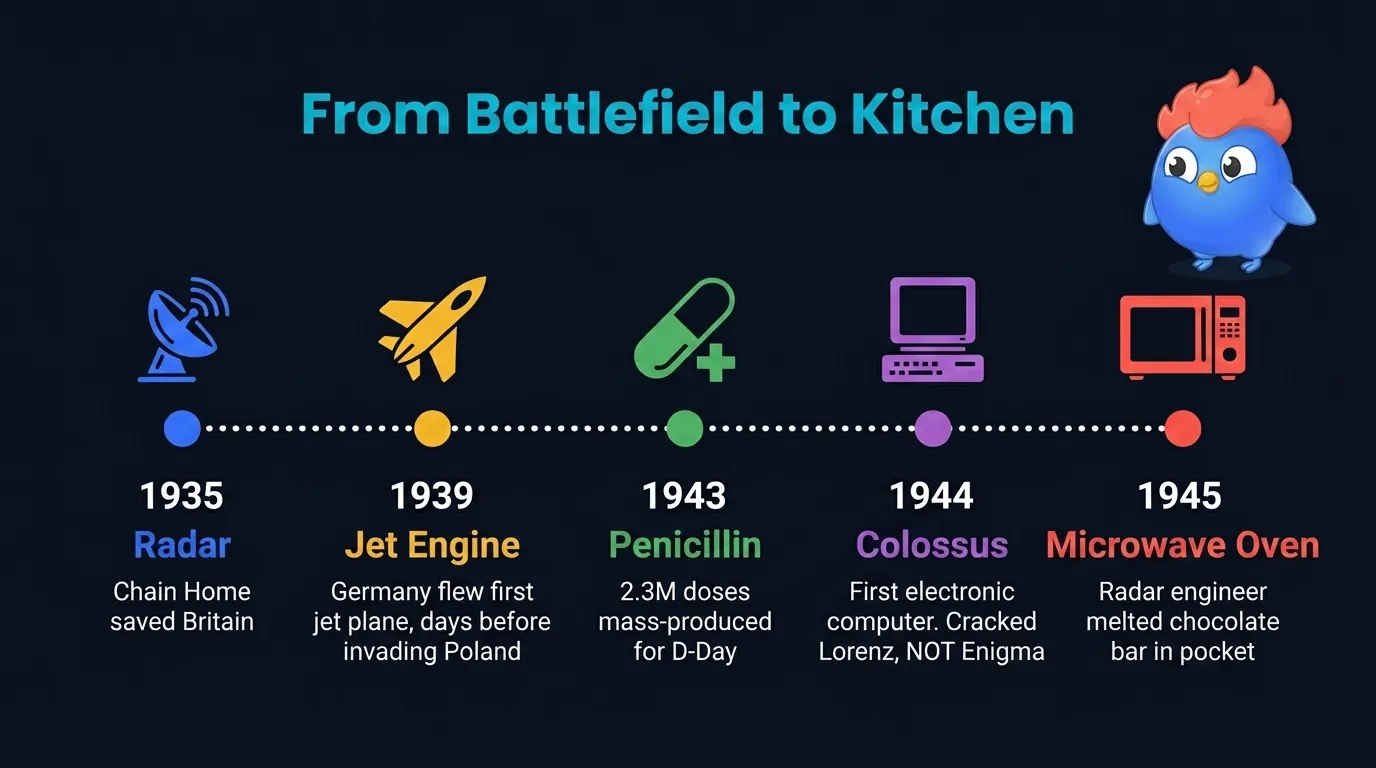 Five wartime inventions. Three of them ended up in your home.
21. What everyday kitchen appliance was accidentally invented from WW2 radar technology? Easy
Answer: The microwave oven. In 1945, Raytheon engineer Percy Spencer was testing radar equipment when a chocolate bar in his pocket melted. He experimented by placing popcorn kernels near the device. They popped. The microwave oven followed.
Why it stumps people: Your gut says “something obvious, like radio.” It isn’t. The chocolate bar detail makes this one memorable. Spencer didn’t set out to cook food. Military radar made his snack warm. He was curious enough to test it further. Raytheon patented the first commercial microwave in 1947. It weighed 750 pounds and cost the equivalent of $60,000 today.
22. What was Colossus, and what code did it crack? Hard
Answer: Colossus was the world’s first programmable electronic computer, built at Bletchley Park in 1943-44. It cracked the Lorenz cipher used by German High Command, not the Enigma code.
Why it stumps people: Everyone conflates Colossus with Enigma. They’re different systems. Enigma handled tactical military messages. Lorenz (codenamed “Tunny” by the British) carried top-level messages between Hitler and his generals. Colossus read Hitler’s mail. Its existence was kept secret until the 1970s, and the full story wasn’t declassified until 2000.
23. How many doses of penicillin did the US produce specifically for the D-Day invasion? Medium
Answer: 2.3 million doses. Alexander Fleming discovered penicillin in 1928, but mass production only happened because the US government treated it as a war priority starting in 1943.
Why it stumps people: Fleming’s discovery sat largely unused for over a decade. It took a world war to fund mass production. By D-Day, there was enough penicillin for every wounded Allied soldier. Before the war, a scratch could kill you through infection. After? Penicillin saved an estimated 200 million lives in the following decades.
Test your WW2 knowledge on LearnClash
24. Which country flew the first jet-powered aircraft? Medium
Answer: Germany. The Heinkel He 178 made its first flight on August 27, 1939, just five days before Germany invaded Poland. The Me 262 later became the first combat-ready jet fighter in 1944.
Why it stumps people: Few get the country right. Germany flew a jet before the war even started. Frank Whittle in Britain had patented a jet engine design in 1930, but the British test flight didn’t happen until 1941. Germany’s early lead in jet tech terrified the Allies, though the jets arrived too late and in too few numbers to change the outcome.
25. What was the V-2 rocket’s role beyond its use as a weapon? Medium
Answer: The V-2 was the first long-range guided ballistic missile and the first thing humans built that reached space during test flights at Peenemünde. Its chief designer, Wernher von Braun, who later led NASA’s Saturn V rocket.
Why it stumps people: The catch is that the same rocket that killed thousands of people in London became the foundation of the space program. Von Braun was recruited through Operation Paperclip, which brought over 1,600 German scientists to the US. The V-2 used slave labor from concentration camps during production. The rocket that reached space has one of the darkest origin stories in science.
26. What material, previously sold for women’s stockings, was banned from civilian use during WW2? Easy
Answer: Nylon. The US government banned civilian nylon sales in 1942. All production went to parachutes, tire cords, ropes, and other war gear. “Nylon riots” broke out when stockings returned to stores after the war.
Why it stumps people: Sounds right that it’s silk. It isn’t. Nylon was invented by DuPont in 1935 and became wildly popular for stockings. When the military took over production, women drew fake seam lines on their legs with eyebrow pencils. After V-J Day, stores selling nylon stockings saw lines of 40,000 women. In Pittsburgh, police had to break up a crowd.
27. What was Chain Home? Hard
Answer: Britain’s radar early warning network, operational by 1939. It stretched along the south and east coasts of England, detecting incoming Luftwaffe raids during the Battle of Britain and giving the RAF enough warning to scramble fighters.
Why it stumps people: Everyone knows radar saved Britain. Few know the system was called Chain Home, or that it could detect aircraft up to 120 miles away. The system wasn’t perfect: it couldn’t track planes flying below 500 feet. But it denied the Luftwaffe the element of surprise, and that was enough.
The Home Front (28-33)
LearnClash covers six WW2 home front questions where the real heroes aren’t who you’d expect. A Soviet all-female bomber squadron terrorized Germany in wooden biplanes. Eleven thousand American women broke codes in secret. And a bear carried ammunition at Monte Cassino.
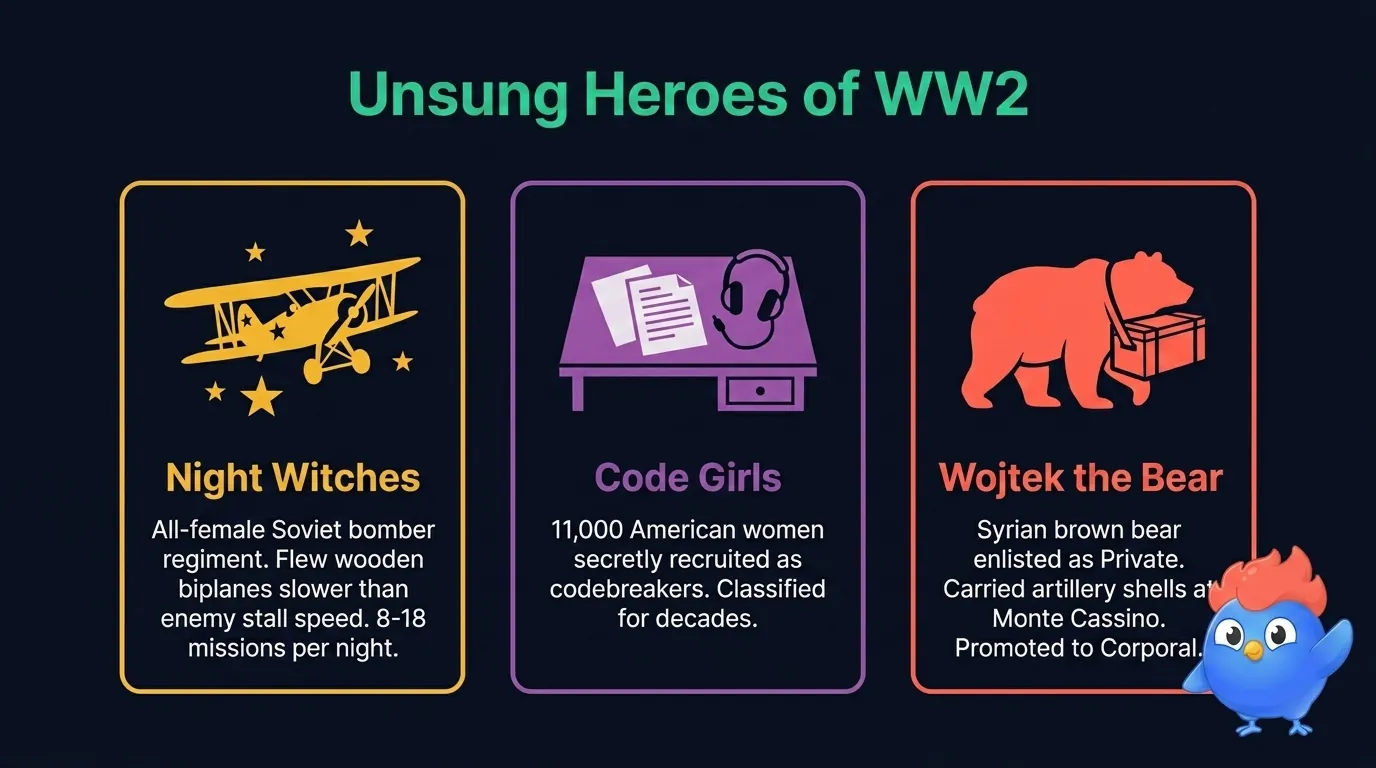 Three groups you won’t find in most history textbooks.
28. What were the “Night Witches”? Medium
Answer: The 588th Night Bomber Regiment, an all-female Soviet air unit that flew Polikarpov Po-2 biplanes on nighttime bombing runs against German positions. They flew up to 18 missions per night, every night, for three years.
Why it stumps people: A regiment of women flying open-cockpit biplanes made of plywood and canvas, with no radios, no parachutes, and no guns. German soldiers who shot one down received the Iron Cross. The regiment produced at least 30 Heroes of the Soviet Union. Their nickname was meant as an insult. They wore it as a badge.
29. Why were Night Witches’ planes almost impossible for German fighters to shoot down? Hard
Answer: The Po-2’s maximum speed when fully loaded was about 60 mph, which was slower than the stall speed of German Messerschmitt and Focke-Wulf fighters. Enemy planes literally couldn’t fly slowly enough to target them without falling out of the sky.
Why it stumps people: Sounds like a design advantage. It was an accident turned into a tactic. The Night Witches would cut their engines near the target and glide in silently. The only sound was wind through the canvas wings. German soldiers said it sounded like broomsticks sweeping, which is where the nickname came from.
30. Roughly how many American women were secretly recruited as code breakers during WW2? Medium
Answer: About 11,000 women, recruited from colleges across the country to work at codebreaking centers in the Washington D.C. area. Their work remained classified for decades.
Why it stumps people: Not dozens. Not hundreds. Eleven thousand. They cracked codes that provided intelligence for both the European and Pacific theaters. Many had mathematics or language degrees. After the war, they were told never to discuss their service. Most didn’t, even with their own families. Liza Mundy’s 2017 book Code Girls finally told their story.
Did you know? LearnClash covers WW2 topics from the home front to the front lines. Questions you miss come back through spaced repetition until you master them. Test your knowledge in a trivia duel today.
31. What animal was officially enlisted in the Polish Army with its own paybook and serial number? Easy
Answer: Wojtek, a Syrian brown bear adopted as a cub by Polish soldiers in Iran in 1942. He was enrolled as Private Wojtek so he could travel with the unit to Italy.
Why it stumps people: Everyone expects a dog or a horse. A bear. A 250-pound, 6-foot-tall bear who drank beer, smoked cigarettes (or ate them), and wrestled with soldiers. His unit, the 22nd Artillery Supply Company, needed him listed as a soldier to get him on a British transport ship. So they gave him a rank and a serial number.
32. What rank did Wojtek the bear achieve? Easy
Answer: Corporal. He was promoted from Private after carrying crates of 25-pound artillery shells to the guns during the Battle of Monte Cassino in May 1944. Each crate normally required four men to carry.
Why it stumps people: The promotion wasn’t a joke. Wojtek saw soldiers carrying heavy crates and imitated them, standing upright and carrying shells to the ammunition line. The unit adopted a bear carrying a shell as their official insignia, which is still used by their successor unit today. After the war, Wojtek lived at Edinburgh Zoo until 1963. Visitors said he perked up when he heard Polish spoken.
33. What was the largest mass internment of civilians in US history during WW2? Hard
Answer: The Japanese American internment, which forcibly relocated about 120,000 people of Japanese descent. Roughly 62% were US citizens. Roosevelt signed Executive Order 9066 in February 1942.
Why it stumps people: Ask people about American wartime wrongs and they’ll mention the atomic bombs. Few mention this. Entire families lost homes, businesses, and property. Children born in the US were imprisoned based on their ancestry. The government admitted the injustice in 1988, paying $20,000 in reparations to each surviving internee. It remains one of the worst civil rights failures in US history.
The Pacific Theater (34-40)
LearnClash covers seven Pacific theater questions where the facts don’t match the movies. Every US aircraft carrier survived Pearl Harbor. The deadliest single air raid wasn’t an atomic bomb. And Japan sent 9,000 weapons across the ocean using nothing but weather.
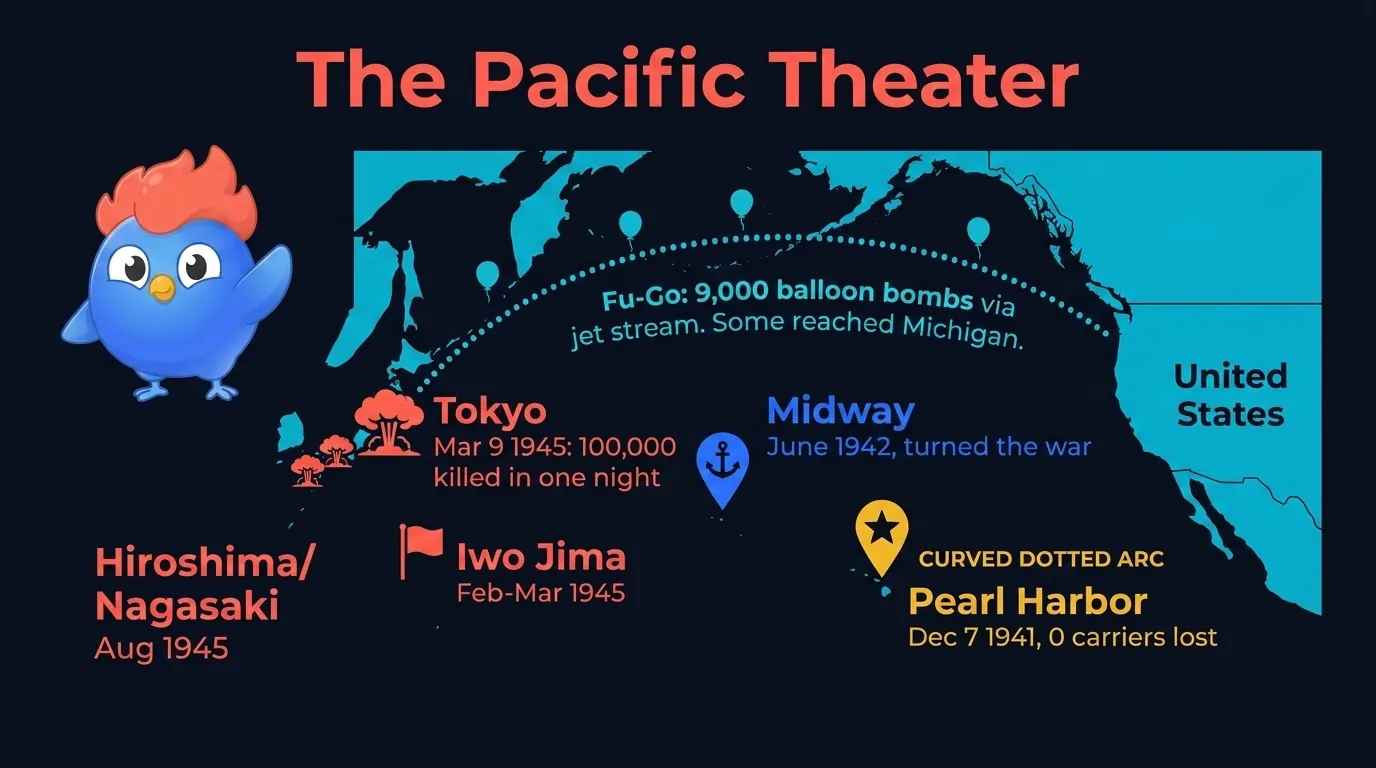 The Pacific war in five locations. The deadliest one isn’t the one you think.
34. How many US aircraft carriers were at Pearl Harbor during the Japanese attack on December 7, 1941? Medium
Answer: Zero. All three Pacific Fleet carriers (Enterprise, Lexington, and Saratoga) were out to sea on the day of the attack. No carriers were lost.
Why it stumps people: The common answer: at least one carrier went down. None were there. Japan destroyed or damaged 19 ships and 188 aircraft, but the carrier fleet survived intact. Since aircraft carriers, not battleships, would define the Pacific war, Pearl Harbor’s military impact was far smaller than Japan intended. The US fleet recovered faster than anyone predicted.
35. What was the deadliest single air raid of World War 2? Hard
Answer: The firebombing of Tokyo on the night of March 9-10, 1945 (Operation Meetinghouse). Roughly 100,000 civilians died, 16 square miles of the city were destroyed, and over one million people were left homeless.
Why it stumps people: Nine out of ten say Hiroshima. They’re wrong. The immediate death toll from the Hiroshima atomic bomb was about 80,000. Tokyo’s firebombing killed 100,000 in a single night using fire bombs. B-29s flew low, dropped clusters of napalm, and the firestorm lit up the sky 150 miles away. It remains the deadliest air raid in human history, yet most people have never heard of it.
36. What was Japan’s Operation Fu-Go? Hard
Answer: An operation that launched roughly 9,000 hydrogen balloon bombs from Japan, designed to ride the jet stream across the Pacific Ocean to start forest fires and cause panic in North America. Some balloons traveled over 6,000 miles.
Why it stumps people: Japan weaponized the weather. They discovered the jet stream’s consistent westward-to-eastward pattern and attached fire bombs to hydrogen balloons. The balloons self-regulated altitude using sandbag ballast. Most fell into the ocean. But some reached as far as Michigan and even Mexico. The US government censored all reports of the balloons to deny Japan feedback on their effectiveness.
37. What was the only fatal enemy attack on the US mainland during WW2? Hard
Answer: On May 5, 1945, a Japanese Fu-Go balloon bomb killed six people near Bly, Oregon. A pastor’s wife and five Sunday school children found the device while on a picnic. It detonated when they touched it.
Why it stumps people: This one is painful to get right, and it’s painful to know. The six victims are the only people killed by enemy action on the US mainland in the entire war. Elsie Mitchell, 26, and five children aged 11-14 died. The pastor, Archie Mitchell, survived because he was still at the car. A memorial stands at the site today. It’s one of the least-known tragedies of the war.
And that changes everything about how we think about the “untouched” American homeland.
38. Which Pacific battle saw the first organized use of kamikaze attacks? Easy
Answer: The Battle of Leyte Gulf in October 1944. Japanese Admiral Takijirō Ōnishi organized the first Kamikaze Special Attack Unit.
Why it stumps people: People usually guess Midway or Okinawa. Leyte Gulf is also the largest naval battle in history by number of ships involved: over 350. The kamikaze attacks sank one escort carrier and damaged several others. At Okinawa months later, the tactic was used on a far larger scale, sinking or damaging over 300 Allied ships.
39. What does the word “kamikaze” literally translate to? Medium
Answer: “Divine wind.” The name originally referred to a typhoon in 1281 that destroyed a Mongol invasion fleet heading for Japan. The WW2 pilots adopted the name, framing their sacrifice as a similarly decisive act of divine intervention.
Why it stumps people: Everyone knows kamikaze means suicide attack. Few know the word predates WW2 by 700 years. Kublai Khan’s Mongol fleet was destroyed twice by typhoons, and the Japanese called these storms kamikaze because they seemed like divine protection. The WW2 pilots were named after a medieval weather event.
40. How did the Allies crack Japan’s military codes? Medium
Answer: US codebreakers broke PURPLE (Japan’s diplomatic cipher) and JN-25 (the Imperial Navy’s operational code) before Pearl Harbor. Intel from JN-25 was critical at Midway, where the US Navy knew Japan’s attack plan in advance.
Why it stumps people: European codebreaking gets all the attention. Japan’s codes were broken too, and the intel was arguably more decisive. At Midway, the US set a trap specifically because they’d decoded Japan’s target. Admiral Yamamoto’s death in 1943 also resulted from cracked coded messages. His flight path was intercepted and US fighters were waiting.
Hard WW2 Trivia: Myths Everyone Still Believes (41-47)
LearnClash tracks seven WW2 myths that even history fans get wrong. “Blitzkrieg” wasn’t real German doctrine. Switzerland wasn’t truly neutral. And France didn’t surrender without a fight. These are the ww2 trivia questions that start arguments at dinner tables.
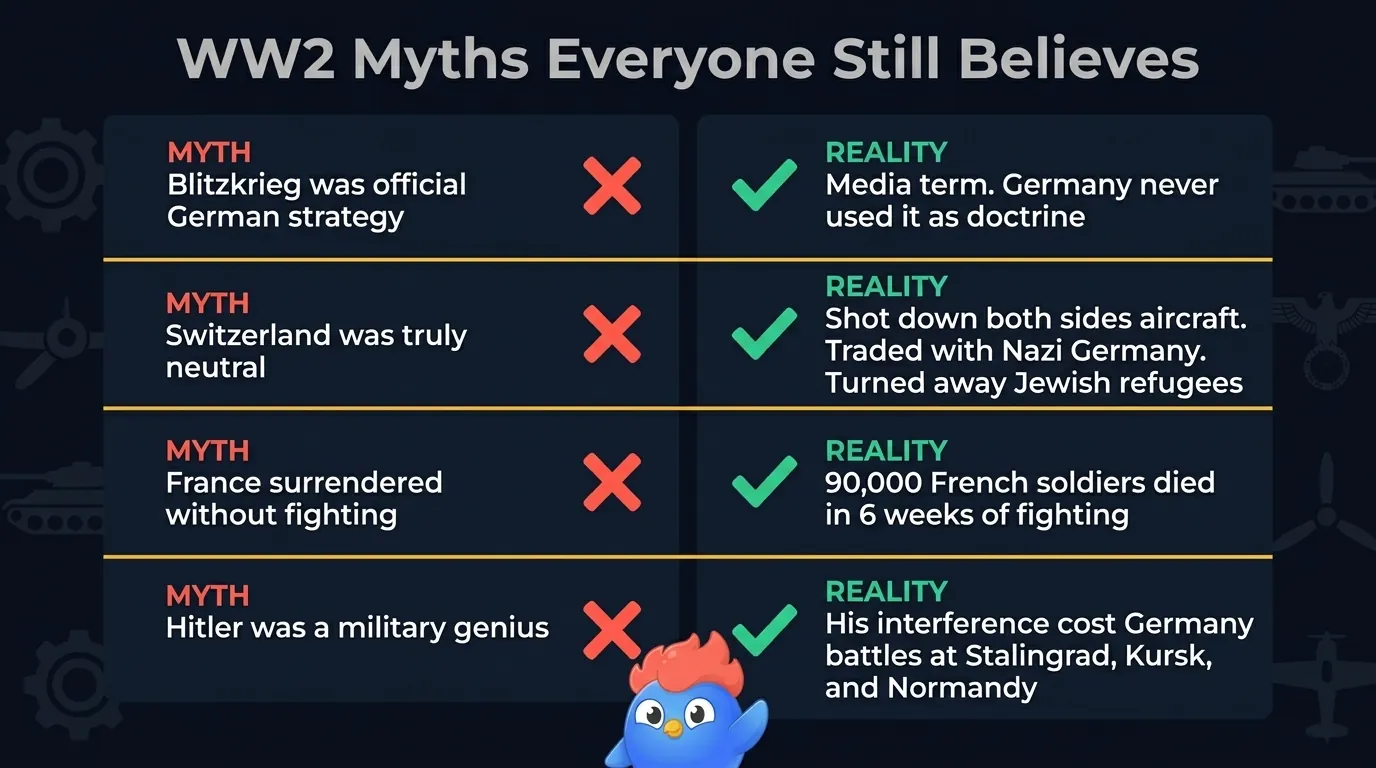 Four myths. Four corrections. Each one surprises people who think they know WW2.
41. Was “Blitzkrieg” an official German military doctrine? Medium
Answer: No. The German military never used “Blitzkrieg” as an official doctrinal term. It was coined by Western journalists to describe Germany’s rapid combined-arms operations. German officers used terms like Bewegungskrieg (maneuver warfare).
Why it stumps people: Sounds right. Isn’t. The word appears in no official German military document as a doctrine or strategy. Journalists needed a catchy word for the fast conquests of Poland and France. “Blitzkrieg” stuck. Historians like Karl-Heinz Frieser have traced the myth and confirmed that Germany’s approach was built on existing maneuver warfare principles, not a single revolutionary concept.
42. Was Switzerland truly neutral during WW2? Medium
Answer: Not exactly. Switzerland shot down aircraft from both sides. It served as a banking hub for Nazi gold, including gold taken from Holocaust victims. It traded with Germany and turned away tens of thousands of Jewish refugees at the border.
Why it stumps people: People picture Switzerland sitting out the war. The reality is “armed neutrality” with heavy asterisks. Swiss banks held Nazi accounts. Swiss industry supplied precision instruments to Germany. And the refugee policy was brutal: Switzerland stamped Jewish refugees’ passports with a “J” at Germany’s request to identify and turn them away. A 2002 Swiss government report acknowledged these failures.
43. How many French soldiers died fighting the German invasion in May-June 1940? Hard
Answer: about 90,000 French soldiers died in just six weeks of fighting. Another 200,000 were wounded. The French military fought hard; it was outmaneuvered, not cowardly.
Why it stumps people: The myth of instant French surrender erases a real bloodbath. Ninety thousand dead in 46 days. The Battle of Lille saw French forces fight a fierce rearguard action that helped make the Dunkirk evacuation possible. Individual units fought to the last man. The speed of the defeat was a failure of strategy and communication, not courage.
44. Did Hitler’s personal military decisions help or hurt Germany’s war effort? Hard
Answer: Hurt it significantly. Hitler’s interference overruled his generals at critical moments: he forbade retreat at Stalingrad, costing 300,000 troops. He delayed reserves at Kursk. He refused to release Panzer divisions on D-Day because he thought Normandy was a feint.
Why it stumps people: People assume the leader of a military machine must have been competent at running it. He wasn’t. His generals repeatedly urged tactical retreats that could have preserved forces. Hitler refused. At Stalingrad, the 6th Army could have broken out. Hitler ordered them to hold. At D-Day, Rommel begged to move Panzers to the beaches immediately. Hitler was asleep, and nobody dared wake him. Hours mattered. Those hours were wasted.
45. Did the war end on V-E Day, May 8, 1945? Easy
Answer: Only in Europe. The Pacific war continued until September 2, 1945 (V-J Day), when Japan formally surrendered aboard the USS Missouri in Tokyo Bay. The atomic bombings of Hiroshima and Nagasaki came in August.
Why it stumps people: The dates trip people up because V-E Day gets the celebration coverage. For millions of soldiers in the Pacific, the war was far from over on May 8. The US was planning a ground invasion of Japan (Operation Downfall) that was expected to cost hundreds of thousands of Allied casualties. The atomic bombs ended the war before that invasion happened.
46. Which country lost the most people in WW2? Medium
Answer: The Soviet Union, with about 27 million dead (military and civilian combined). China lost an estimated 20 million. Germany lost about 7 million. Total global deaths exceeded 70 million.
Why it stumps people: Western education has a blind spot here. Twenty-seven million Soviets. That’s roughly one in seven of the entire pre-war population. The Eastern Front was where most of the war’s killing happened. For every American soldier who died (about 420,000), roughly 65 Soviet citizens perished. The scale is hard to process.
47. Has Japan signed a peace treaty with Russia ending WW2? Hard
Answer: No. As of 2026, Japan and Russia have never signed a formal peace treaty. The dispute centers on the Kuril Islands (called the Northern Territories by Japan), which the Soviet Union seized in August 1945.
Why it stumps people: This is the final question because it’s the one that makes people realize WW2 isn’t actually over in every legal sense. Seventy years of negotiations have failed. Russia controls the islands. Japan claims them. The two countries signed a 1956 joint declaration ending hostilities, but a full peace treaty remains unsigned. The longest unresolved territorial dispute of WW2 continues.
The war ended 81 years ago. Some of its questions still don’t have answers. That’s what makes ww2 trivia questions worth revisiting: the real history keeps getting stranger.
“Testing produces about 80% retention after one week, compared to 36% for rereading alone.” Karpicke & Roediger (2008), The Critical Importance of Retrieval for Learning
Explore all 26 categories in our trivia question collection, or try 47 science trivia questions next.
Frequently Asked Questions
What is the hardest WW2 trivia question?
One of the hardest is about the Tokyo firebombing of March 1945. It killed more people in a single night than the Hiroshima atomic bomb, but most people name Hiroshima as the deadliest single air raid. LearnClash tracks which WW2 questions stump you most and brings them back with spaced repetition.
How many countries fought in World War 2?
Over 30 countries were directly involved in WW2 combat, with more than 70 nations affected when including colonies and territories. The war spanned every inhabited continent. On LearnClash, WW2 trivia covers battles from Stalingrad to Midway across all theaters.
Who broke the Enigma code first?
Polish mathematician Marian Rejewski first cracked the Enigma cipher in December 1932, seven years before Alan Turing's work at Bletchley Park. Turing built on the Polish methods shared in July 1939.
What was the deadliest single air raid of WW2?
The firebombing of Tokyo on March 9-10, 1945, killed roughly 100,000 people in one night, more than the immediate death toll from either Hiroshima or Nagasaki.
Are WW2 trivia questions good for learning history?
Yes. Research on the testing effect shows that answering questions produces 80 percent retention after one week, compared to 36 percent for passive reading. LearnClash uses spaced repetition to bring back questions you miss until you master them.