
11 Best Quizlet Alternatives in 2026 [Tested & Ranked]
We tested 11 Quizlet alternatives on SRS, pricing, and ease of use. See which study tool fits your learning style in 2026.

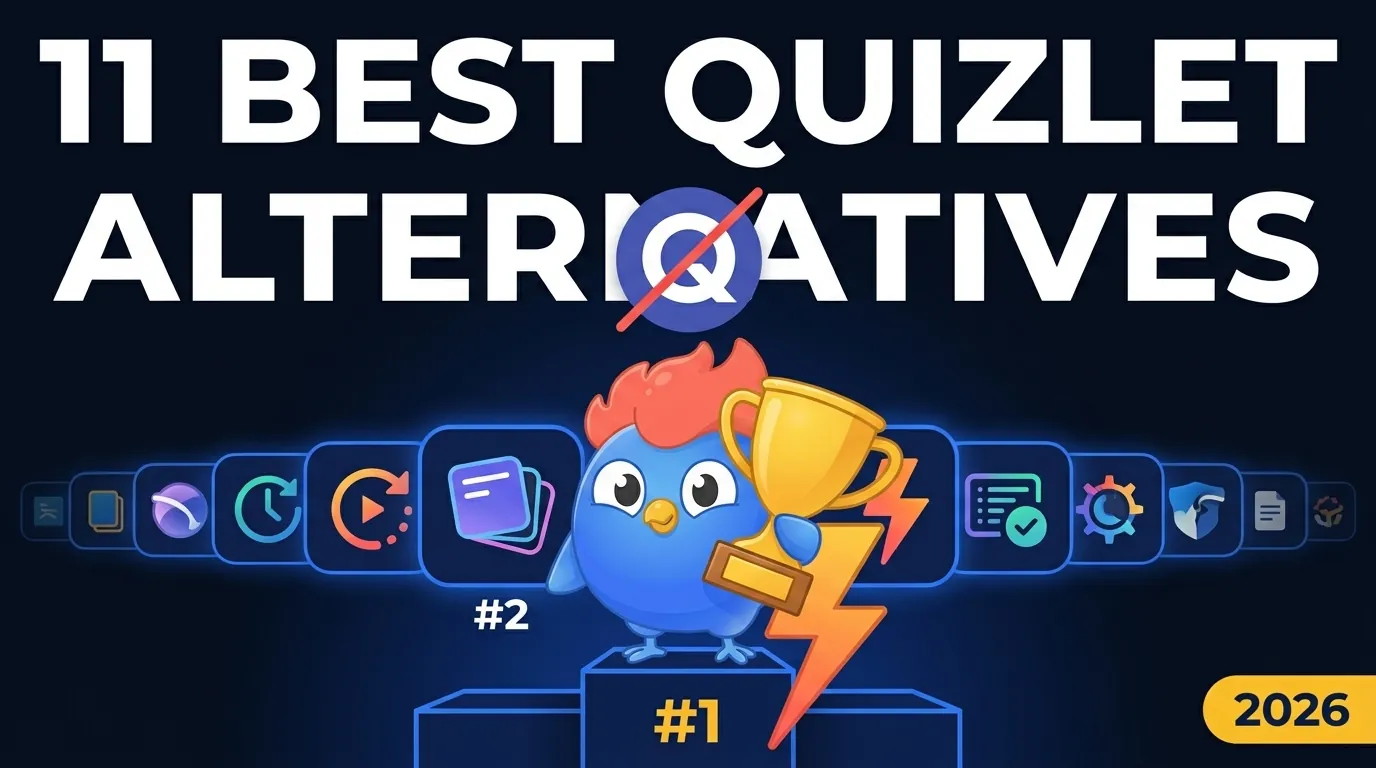
Quizlet paywalled its best features and killed its AI tutor. It now averages 1.4 stars on Trustpilot. The best Quizlet alternatives picked up right where it left off.
LearnClash leads as a competitive learning app that generates questions on any topic with spaced repetition built into every mode and zero ads. For a direct flashcard replacement, Knowt offers free Learn mode with one-click Quizlet imports. For serious long-term memorization, Anki’s FSRS 6 algorithm (trained on 700 million reviews) is unmatched.
We tested 11 free and paid Quizlet alternatives on spaced repetition, pricing, free tiers, and actual learning impact. Here’s how they stack up.
Test your knowledge in a quiz duel on LearnClash
Quizlet Alternatives: Quick Comparison
LearnClash sits at the top of this table because the ranking weighs one thing above all: how well each tool gets you to learn and keep what you study, not how nicely it lets you flip cards. It chases mastery through quiz duels. The other 10 stay close to the flashcard playbook. Seven include spaced repetition. Only two run zero ads on every tier.
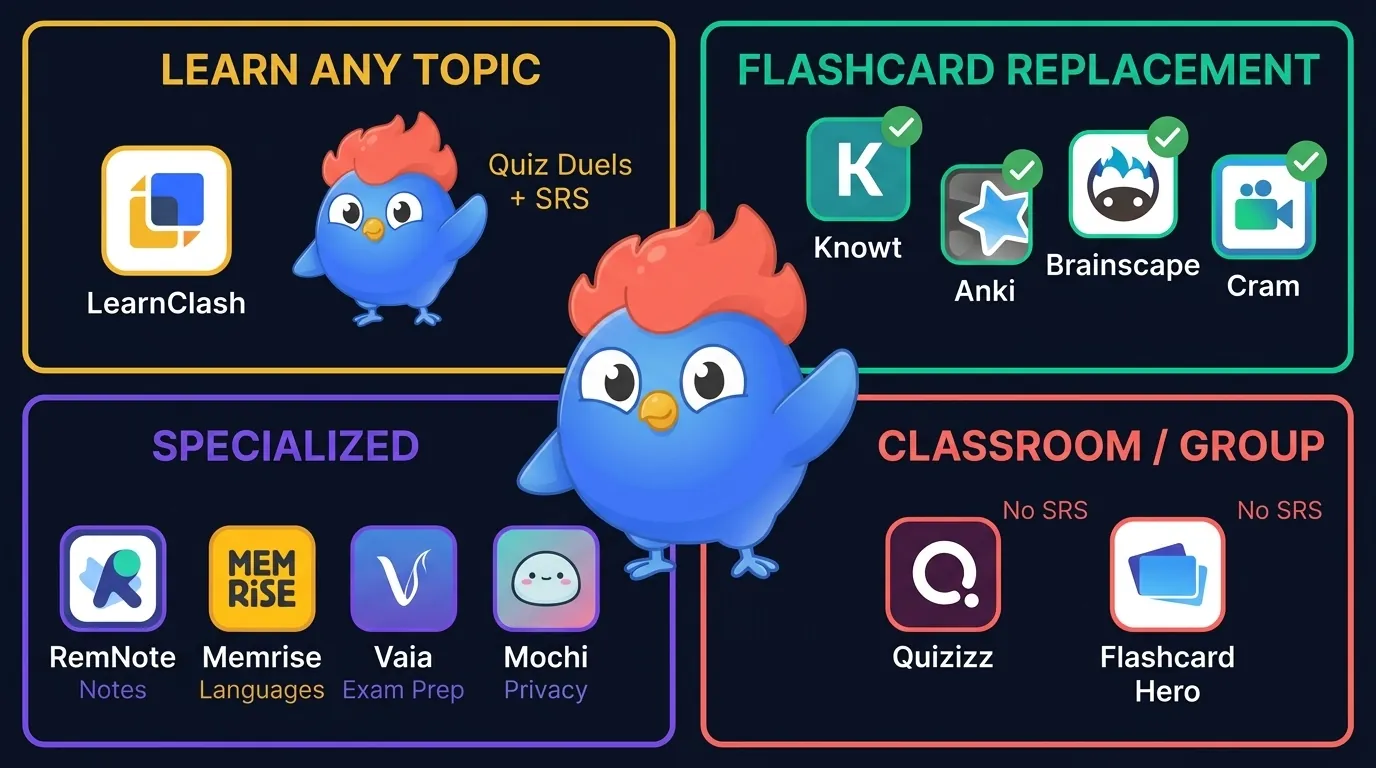 All pricing verified April 2026. SRS = spaced repetition scheduling.
| # | App | SRS | Free Tier | Best For |
|---|---|---|---|---|
| 1 | LearnClash | Yes (every mode) | Daily duels, no ads | Learn any topic through competition |
| 2 | Knowt | Yes | All study modes, ads | Direct Quizlet replacement |
| 3 | Anki | Yes (FSRS 6) | Full desktop/Android/web | Serious long-term memorization |
| 4 | Brainscape | Yes (CBR) | Own cards only | Adaptive confidence-based learning |
| 5 | RemNote | Yes | Notes + cards, limited | Connected notes + flashcards |
| 6 | Memrise | Yes | Core courses, ads | Language learning |
| 7 | Vaia | Yes | Basic AI features | AI-powered exam prep |
| 8 | Mochi | Yes (SM-2) | Unlimited offline | Privacy-first learners |
| 9 | Quizizz | No | Basic quizzes, ads | Gamified group quizzes |
| 10 | Cram | Partial | 80M+ cards, ads | Legacy flashcard library |
| 11 | Flashcard Hero | Yes | 20 cards/deck | Apple ecosystem users |
Start at the top.
1. LearnClash: Best for Learning Any Topic Without Making Flashcards
LearnClash leaves Quizlet’s flashcards behind and goes straight for the outcome those cards were supposed to deliver. Pick any topic. Duel an opponent. The AI writes questions matched to your skill level, and a missed one circles back later instead of disappearing. Spaced repetition runs underneath every mode, pushing each question through three stages: Learning, Known, Mastered.
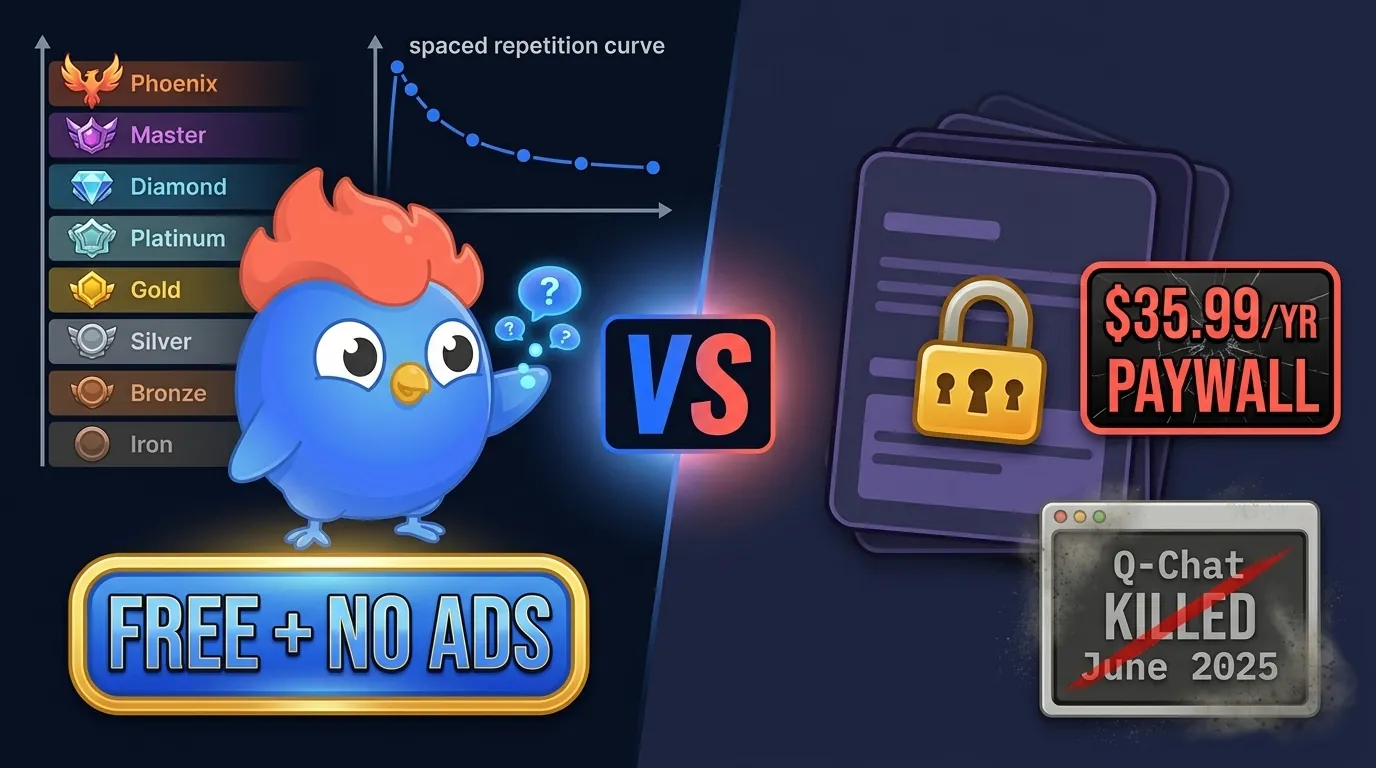 LearnClash generates the questions. You focus on learning.
Why rank a quiz duel app #1 on a Quizlet alternatives list? Because people searching for apps like Quizlet don’t really want flashcards. They want to learn something and keep it. LearnClash does that through active recall under real pressure, one 3-minute round at a time. You’re dueling someone. You care about the answer. That beats flipping cards alone.
Decades of memory research back this up. Roediger & Butler (2011) found that retrieval practice lays down far stronger memory traces than passive review, and Cepeda et al.’s study of 317 experiments shows spaced practice durably beats cramming it all into one session. So recalling under spaced review pulls ahead of flipping cards. By a lot.
| LearnClash | Quizlet | |
|---|---|---|
| Content source | AI-generated on any topic | User-created flashcard sets |
| Learning method | Active recall via quiz duels | Card review (Learn mode paywalled) |
| SRS | Built into every mode, free | Plus plan only ($35.99/yr) |
| Difficulty | Adapts to your ELO level | Fixed per set |
| Ads | Zero, any tier | Yes (free tier) |
| Create own content | No (AI handles it) | Yes (manual) |
| Price | Free / $7.99/mo / $59.99/yr | Free (limited) / $35.99/yr |
One honest caveat. LearnClash isn’t a flashcard app. You can’t build your own study sets or import Quizlet decks. If you need to drill your professor’s exact exam terms card-by-card, Knowt or Anki below will serve you better. But for mastering a topic through active play, without the card-making grind, this is the pick.
Best for: Learners who want to master any topic without building flashcards. Each round takes 3 minutes. Free, ad-free, with ELO ranking across 8 tiers from Iron to Phoenix. Ranked #1 in our best trivia apps comparison too.
Key takeaway: Active recall through competition produces stronger retention than passive card flipping. LearnClash’s SRS cycle moves questions through Learning, Known, and Mastered stages based on your accuracy.


2. Knowt: Best Free Flashcard Replacement
LearnClash drops flashcards entirely, so if you want the card-for-card swap instead, Knowt is the closest thing to a direct Quizlet replacement out there. Every study mode Quizlet locked behind Plus (Learn, practice tests, matching) stays free here. The killer feature lives in one paste: drop in a Quizlet link, and your cards transfer over instantly.
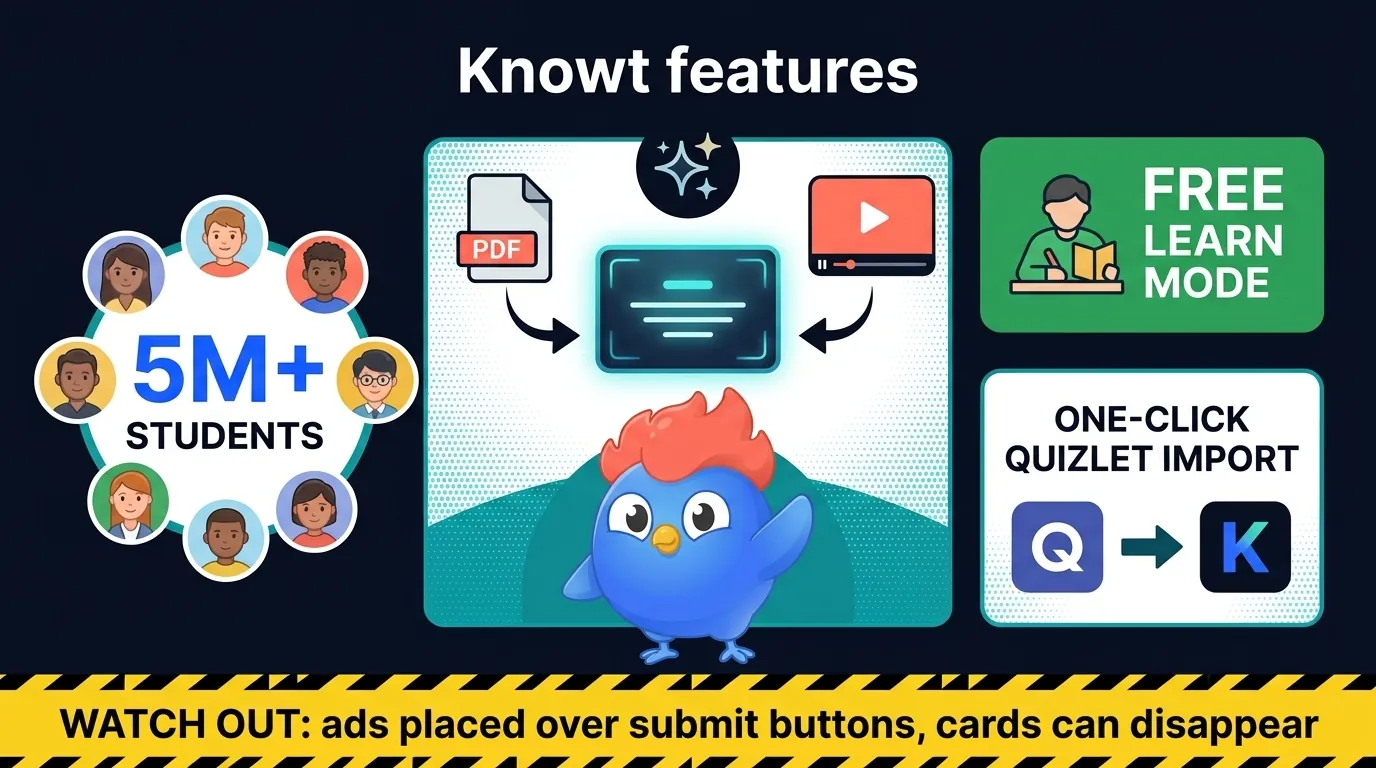 Knowt grew to 5 million students largely by doing what Quizlet stopped doing for free.
Knowt’s AI makes flashcards from lecture videos, PDFs, and notes. SRS is free for all users. During the May 2025 AP season, over 700,000 students used Knowt to study.
The problems are real, though. Users report ads dropped over submit buttons, a dark pattern that makes you question whether the free tier exists to help students or nudge them toward paying. Cards vanish mid-session too. One user lost 70 of 107 cards after clicking Create. The AI answers fumble facts now and then. And the Learn mode feels cluttered next to Quizlet’s cleaner layout.
| Knowt | Quizlet | |
|---|---|---|
| Learn mode | Free | Plus only ($35.99/yr) |
| Practice tests | Free | Plus only |
| AI card generation | Free (limited) | Magic Notes (Plus) |
| Quizlet import | One-click | N/A |
| Ads | Yes (free tier) | Yes (free tier) |
| SRS | Free | Plus only |
| Pricing | Free / ~$35/yr Plus / $149.99/yr Ultra | Free (limited) / $35.99/yr Plus |
Best for: Students who want exactly what Quizlet used to offer for free. The Quizlet import feature alone makes it the easiest migration path.
3. Anki: Best for Serious Long-Term Memorization
LearnClash wins on speed-to-mastery for any topic, but for raw long-term retention the medical world votes elsewhere: 86% of US medical students reach for Anki. Not Quizlet. Not Knowt. Anki.
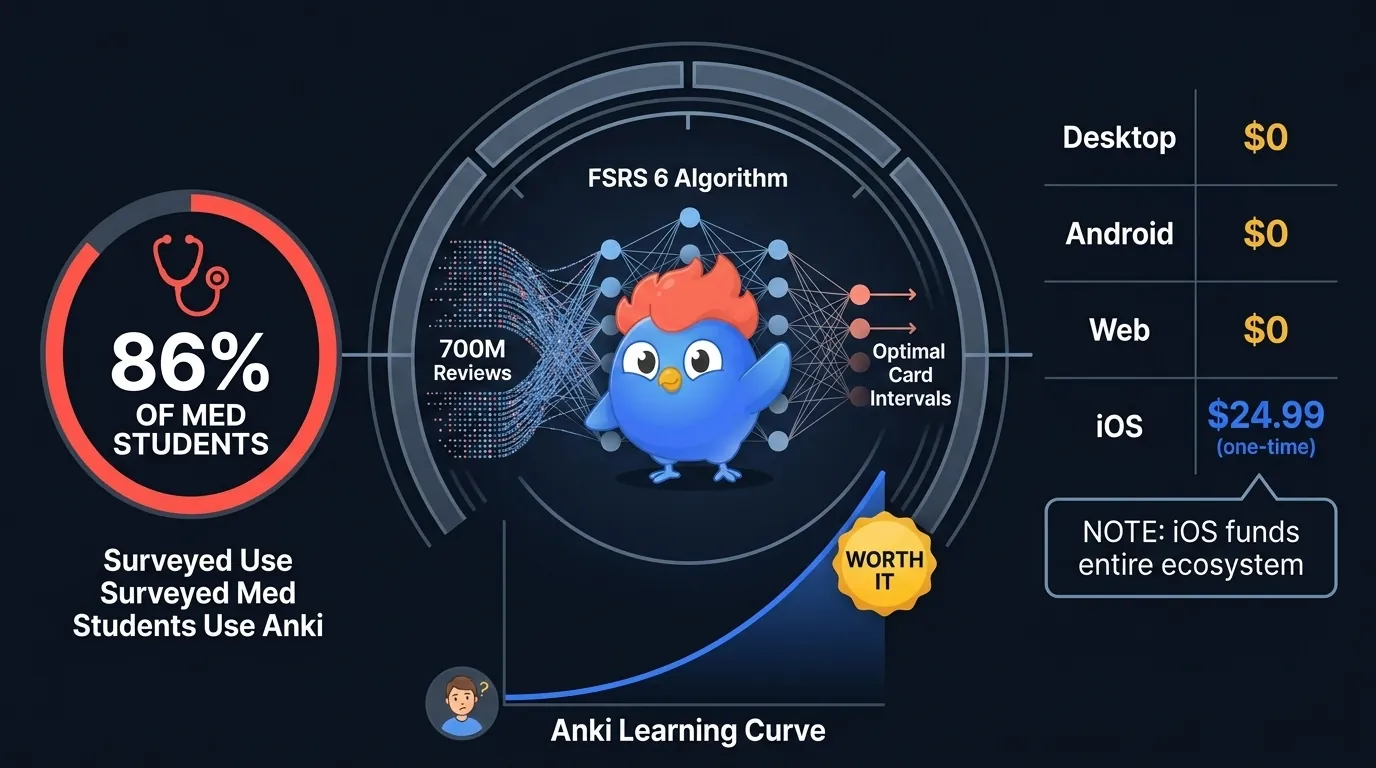 The $24.99 iOS purchase funds the entire Anki ecosystem, keeping desktop, Android, and web free.
It comes down to FSRS 6, the most powerful spaced repetition algorithm you can get. Trained on 700 million real reviews, it trims wasted reviews by 20-30% over the older SM-2 method. Studies tie regular Anki use to USMLE Step 1 score jumps of 4-13 points.
Free on desktop (Windows, Mac, Linux), web (AnkiWeb), and Android (AnkiDroid). The only paid part is AnkiMobile for iOS: $24.99 one-time. That one purchase funds the whole project. No sub. No Plus tier. No ads.
Did you know? Anki’s $24.99 iOS price is the only revenue source for the entire ecosystem. Desktop, Android, and web stay free because enough iOS users pay that one-time fee. It’s one of the most unusual business models in education software.
The trade-off bites, though. Anki’s UI looks like it was built two decades ago, because it was. The learning curve runs so steep that entire YouTube channels exist just to walk you through the settings. Skip a few days and reviews pile up fast, with no “holiday mode” to save you. Anki is a commitment. For a Quizlet alternative you can open and use in 30 seconds, look elsewhere.
Best for: Medical students, language learners, and anyone willing to invest setup time for the strongest retention algorithm available. See our full Anki vs Quizlet comparison for a deeper look.
4. Brainscape: Best for Adaptive Confidence-Based Learning
LearnClash tunes difficulty for you through automatic ELO matching, but if you’d rather hold that dial yourself, Brainscape flips the SRS model and hands you the control. After each card, you rate how well you knew it: 1 (not at all) to 5 (nailed it). Low scores repeat more. High scores space out. No config needed.
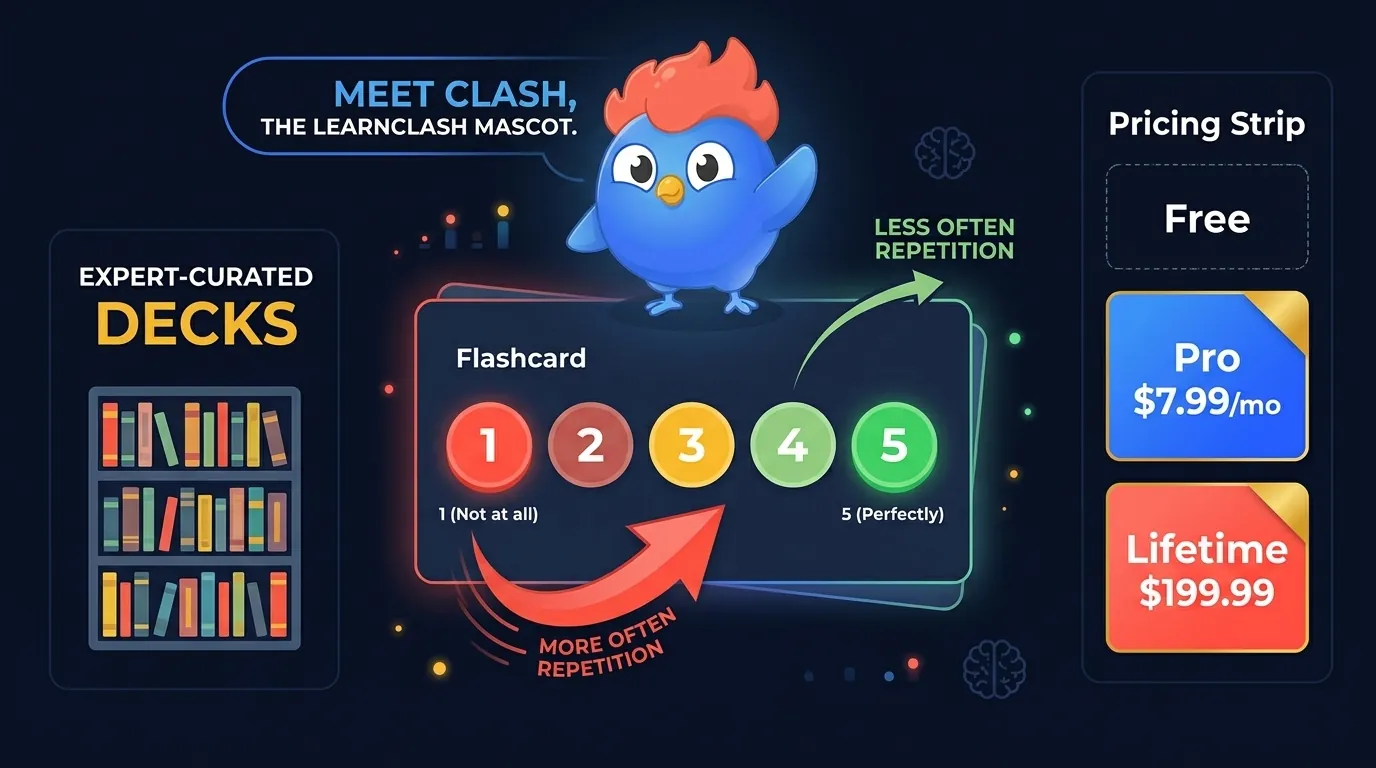 Rate your confidence. Brainscape does the rest.
What sets Brainscape apart is the expert-curated deck library, a sharp contrast to Quizlet’s user-made chaos, where anyone can publish a set full of errors and thousands of students end up memorizing the wrong answers for their exams. Every Brainscape deck gets checked for accuracy. That matters.
The free tier comes up short, though. It only lets you study your own cards. The curated library, AI card making, and image/sound support all sit behind Pro at $7.99/month. Users feel “trapped” because import and export are locked down. And the mobile app crashes on bad wifi.
Best for: Learners who want a guided, structured study experience with verified content. Worth the subscription if you value curation over DIY.
5. RemNote: Best for Connected Notes + Flashcards
LearnClash conjures questions from scratch on any topic, whereas RemNote builds them from your notes and keeps note-taking and flashcards in one place. Take notes. Highlight key ideas. It turns those highlights into cards and schedules SRS reviews based on how well you knew each one.
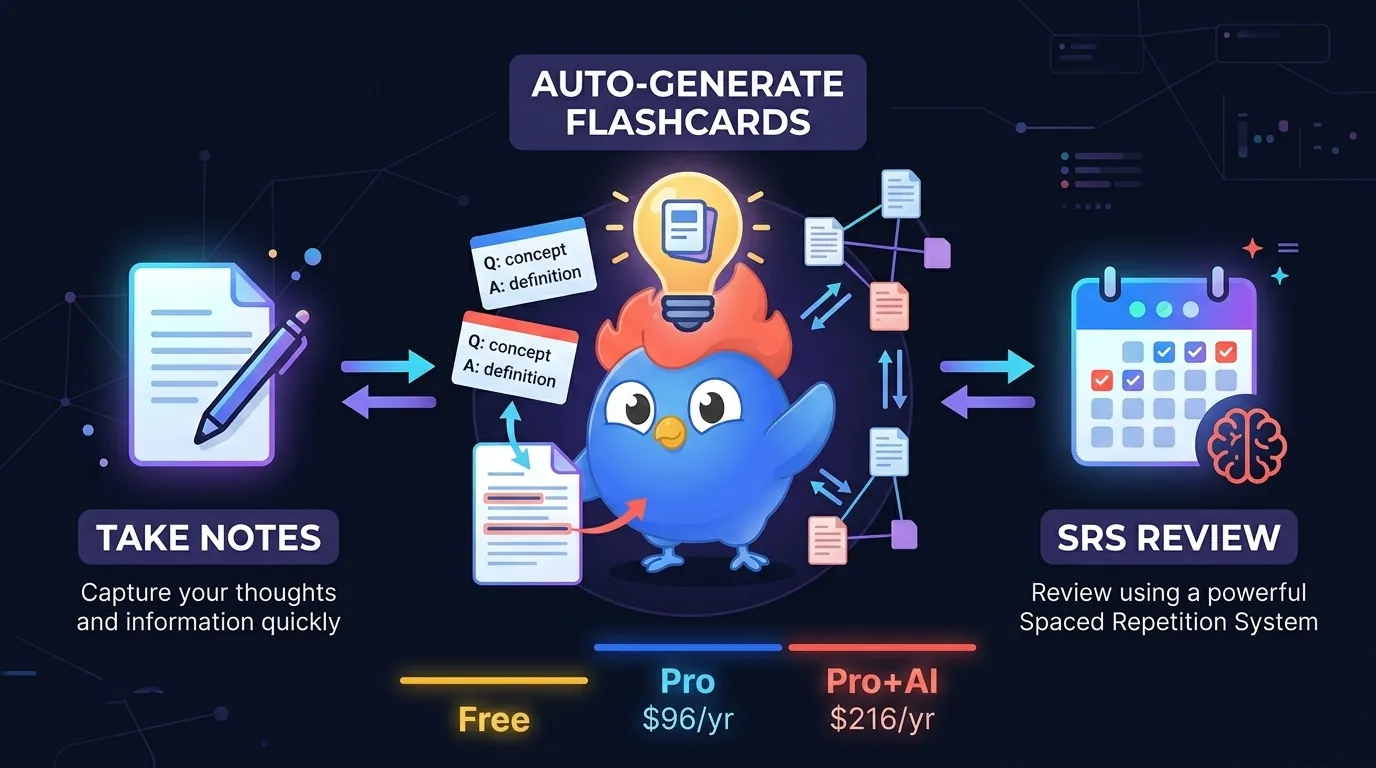 Notes become flashcards become knowledge. One flow.
Two-way linking builds a knowledge graph where every concept connects to related ideas, so you can trace how a biochemistry term ties to a clinical case ties to a pharmacology flashcard, all in one workspace. PDF tools let you make linked flashcards straight from your textbook pages. The AI tier writes questions from your notes and grades your answers.
The free tier is tighter than it looks. 3 PDFs, 5 image cards, 3 handwritten notes. That’s it. The UI feels busy for new users. And the mobile app trails desktop by a wide margin.
Best for: Students who take extensive notes and want flashcards generated from them automatically. The note-to-card pipeline is RemNote’s killer feature.
6. Memrise: Best for Language Learning
LearnClash and Knowt cover whatever topic you throw at them, but Memrise is the outlier that does one job only: language. Native speaker videos, real pronunciation practice, and AI chat buddies (Grammar, Translator, and Culture Buddy, added in 2025).
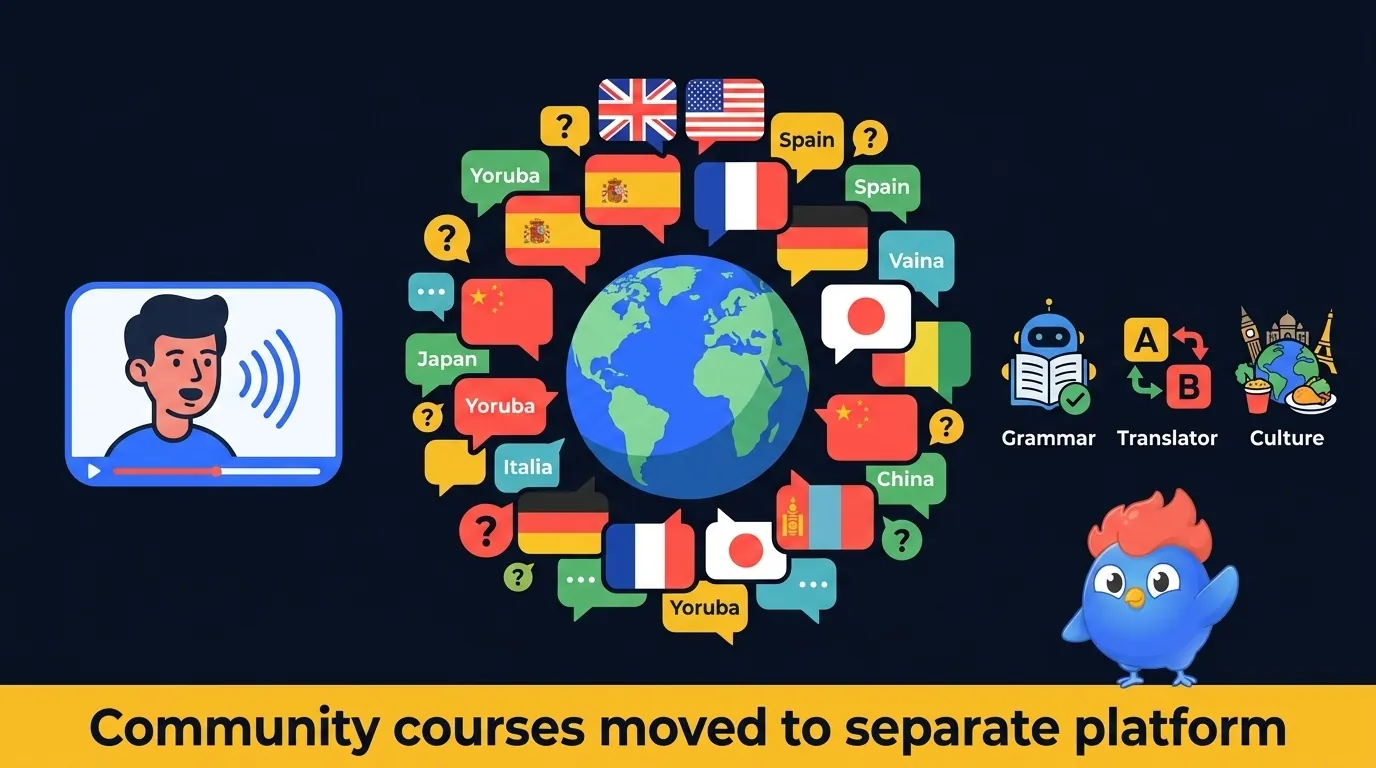 Memrise covers 20+ languages, including ones you won’t find on Duolingo.
SRS drives the vocab review system. 20+ languages, including rare picks like Yoruba and Mongolian that Duolingo doesn’t touch.
There’s a sour note. In 2025 Memrise yanked community-made courses off the main app and shunted them to a split-off site called “Memrise Decks,” which effectively buried years of free content that teachers and language enthusiasts had built and shared across the platform. Furious barely covers the reaction. Content dries up past B2 level. And $24.99/month is steep for a vocab-only app.
Best for: Language learners who want native speaker immersion and rare language support. Not a general study tool, so only choose Memrise if languages are your primary goal.
Master any topic in a 1v1 quiz duel on LearnClash
7. StudySmarter (Vaia): Best for AI Exam Prep
LearnClash leans on AI to build study material too, but where LearnClash spins that into quiz duels, StudySmarter turns your uploaded PDFs into full courses. It quietly became Vaia in most markets between 2024-2026. Same app, new name.
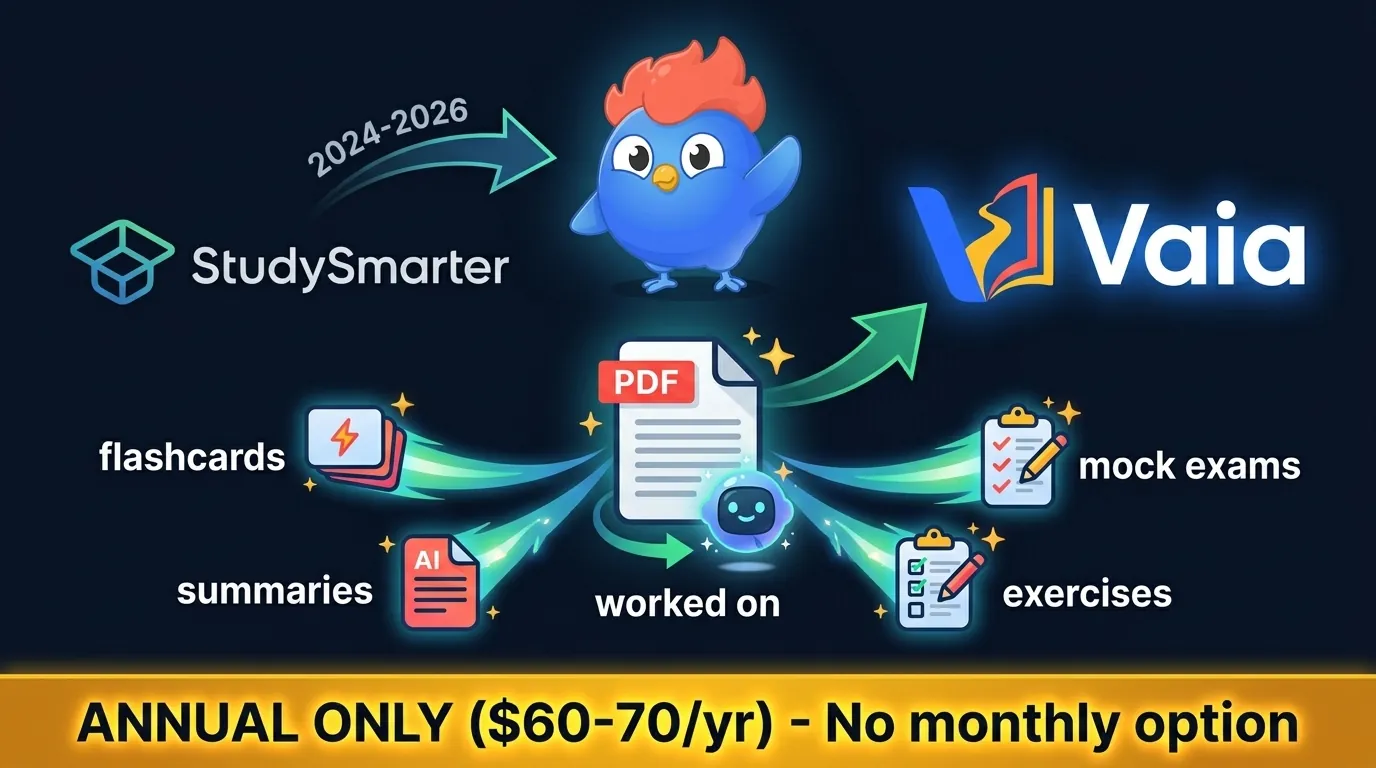 Upload your notes. Vaia builds the study plan.
Feed it a PDF, lecture notes, or script and the AI spits out summaries, flashcards, mock exams, exercises, and revision notes in one batch. That’s the closest any Quizlet alternative gets to a fully automated study pipeline, where you bring the source material and the app handles the rest. A study planner builds a calendar around your exam dates. SRS handles card review timing.
Two things sting. The first is annual-only billing with no monthly option, so you’re locked in at $60-70/year before you know whether the AI works on your material. The second is weak AI output from scanned docs. Users also report ignored cancel emails and surprise charges on renewal.
Best for: Students preparing for specific exams who want AI to build their study materials automatically. Just be sure you’re comfortable with annual-only billing.
8. Mochi: Best for Privacy-First Learners
LearnClash is social and competitive by design, so the mirror image of it is Mochi: private, solo, and the quiet pick among free Quizlet alternatives. Your data stays on your machine. No signup. No cloud. No tracking. You get local flashcards with a tweaked SM-2 spaced repetition algorithm and a clean Markdown layout.
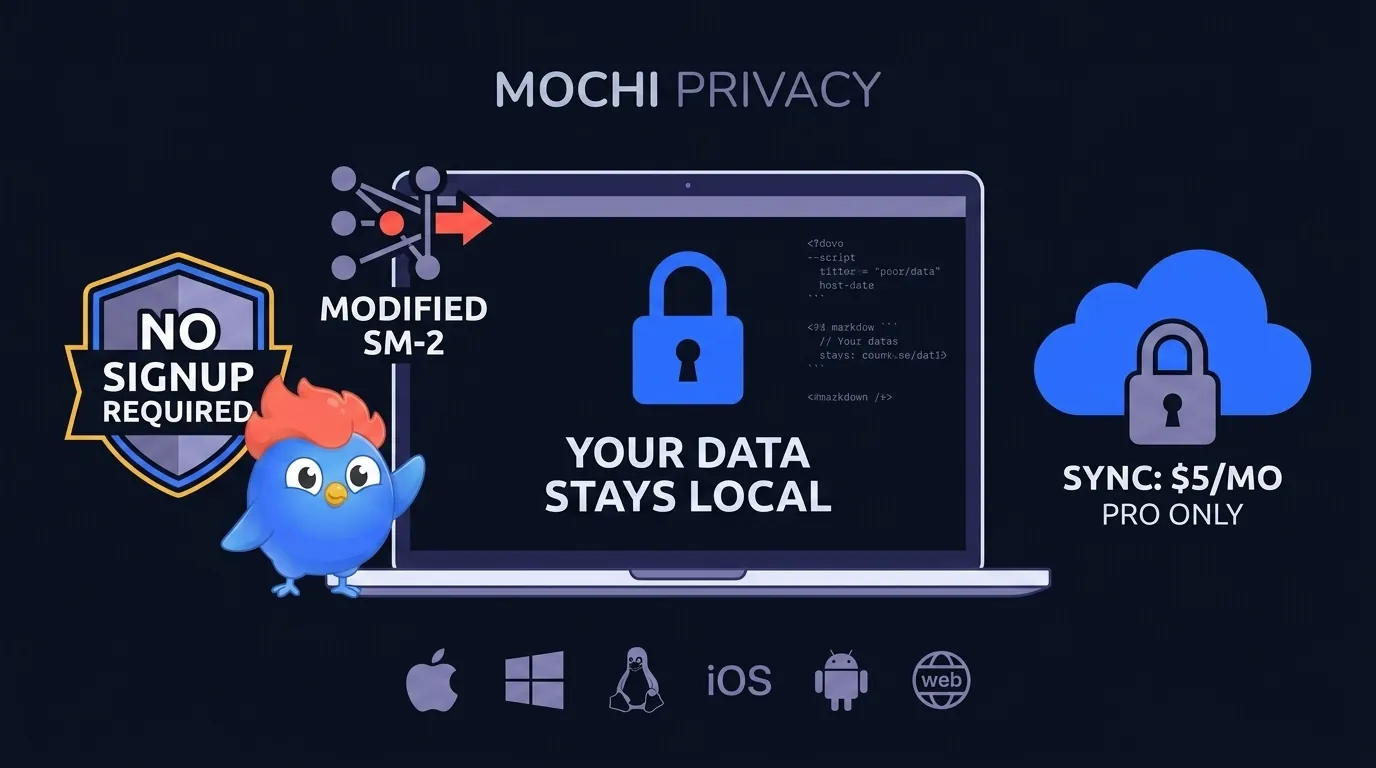 Your data. Your machine. Mochi doesn’t touch it unless you pay for sync.
Markdown fans will feel at home. An Obsidian plugin bridges your current notes. Mochi runs on every desktop OS (Mac, Windows, Linux) and both mobile platforms.
Niche appeal is the catch here. If you don’t know what Markdown is, skip this one. Stats run thin next to Anki’s deep charts. And cloud sync needs Pro at $5/month. Free means offline-only.
Best for: Privacy-conscious learners and Markdown users who want local-first flashcards without cloud dependency.
9. Quizizz: Best for Gamified Group Quizzes
LearnClash runs without a host as async 1v1 duels, and if you want the group version of that idea, Wayground (formerly Quizizz) sits right between Kahoot and Quizlet. It runs live group quizzes like Kahoot. But it also lets you play solo at your own speed, no host needed. Quizizz is the group option.
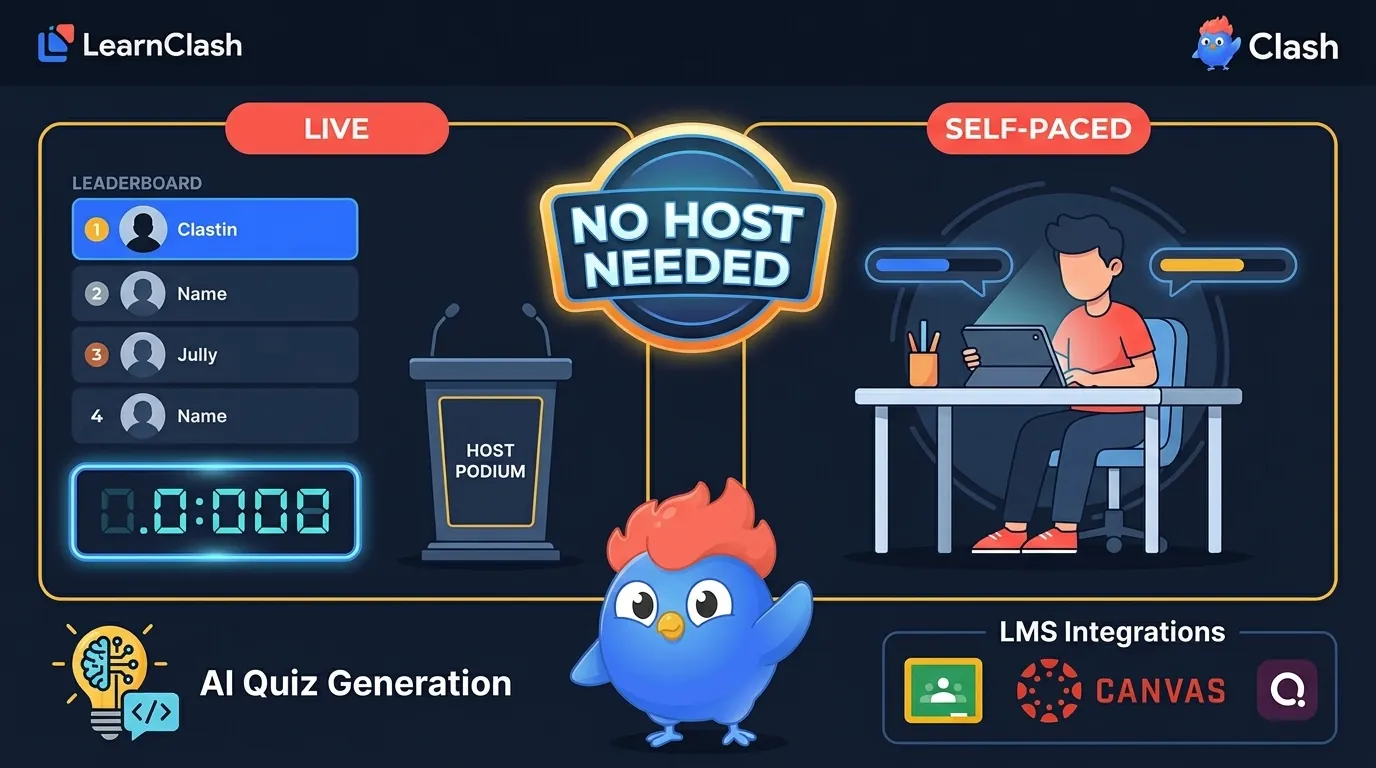 Live or self-paced. Quizizz doesn’t force you to choose.
AI makes quizzes from your source files. Google Classroom and Canvas plug right in. Points, boards, and power-ups keep the energy up.
One thing is missing, and it’s a big one: SRS. There’s no spaced repetition at all. You answer a question once, and it’s gone. Quizizz tests what you already know. It won’t build what you don’t. See our Kahoot vs Quizlet comparison for more on classroom quiz tools.
Best for: Teachers and students who want gamified quizzes with both live and self-paced modes. Pairs well with an SRS tool for actual retention.
10. Cram: Best Legacy Flashcard Library
LearnClash generates fresh questions on demand, and the opposite philosophy belongs to Cram, which hands you a massive pre-built library instead: over 80 million premade flashcards with text-to-speech in 18 languages. For a flashcard set on some obscure topic, Cram probably already has it.
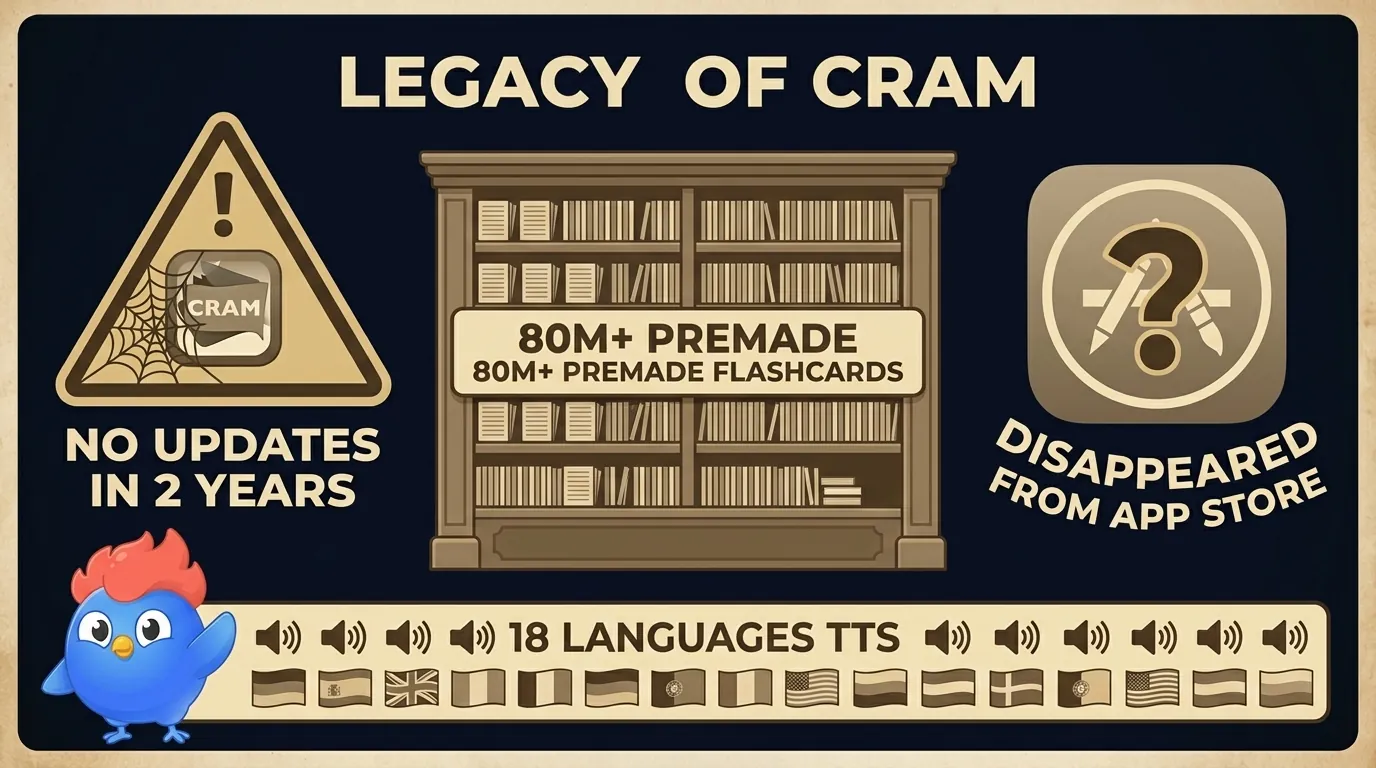 Huge library. But the app hasn’t been updated in two years.
The “Cram mode” runs a basic spaced repetition method, though calling it spaced repetition next to Anki’s FSRS or even Knowt’s algorithm feels generous, since it lacks the precision timing and adaptive scheduling that make real SRS work. Four study modes (Card, Memorize, Cram, Games) cover the basics.
Cram looks like it’s dying, frankly. No app updates in about two years. The iOS app vanished from the App Store for some users. Games only run on laptops. No AI features, and no plans to add them. Ads run heavy on the free tier.
Best for: Finding premade flashcard sets on niche topics. Treat it as a library, not a primary study tool.
11. Flashcard Hero: Best for Apple Users
LearnClash runs on iOS, Android, and web, but if you live entirely inside Apple’s walls, Flashcard Hero is a native Mac app that looks and feels like Apple built it. It’s Apple-only, though iCloud syncs your cards across Mac, iPhone, and iPad. No sub. $7.99 once. That’s it.
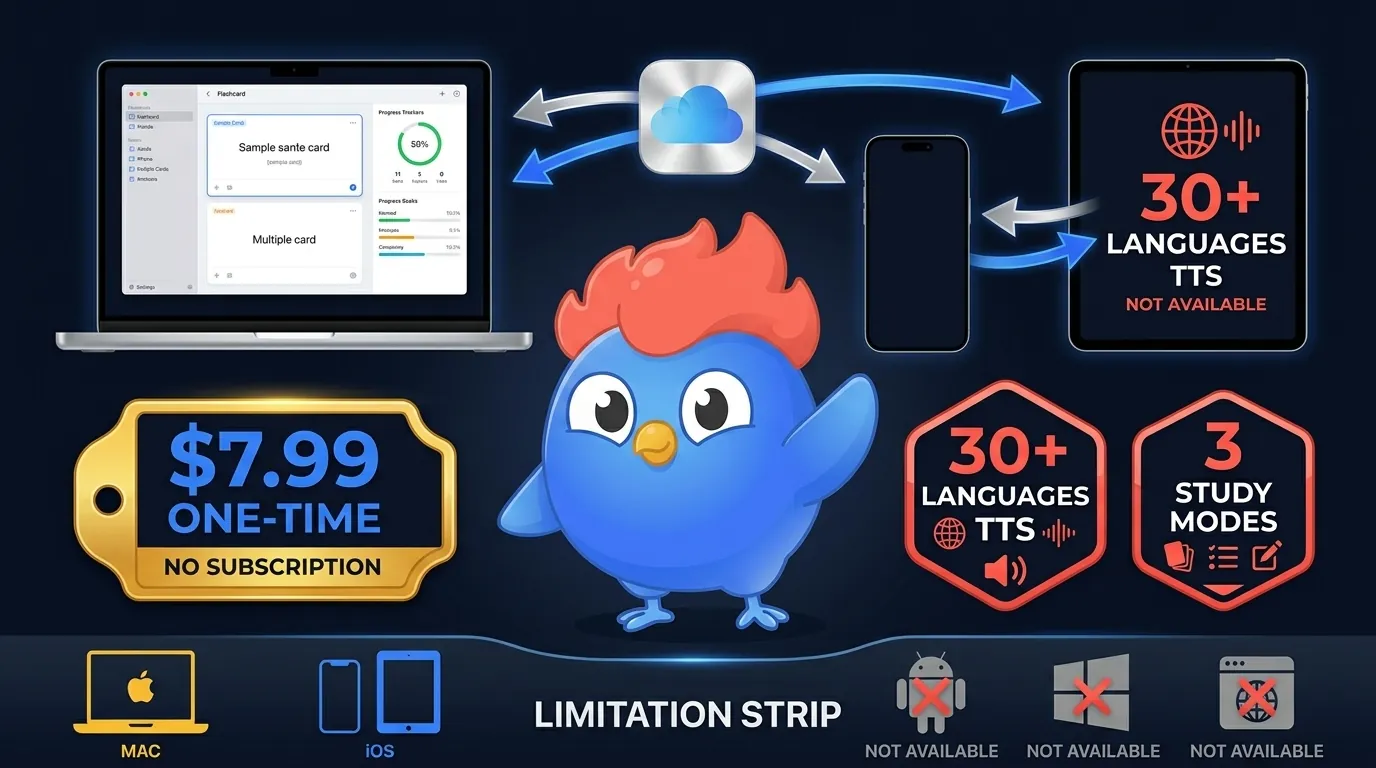 Clean Apple design. No subscription. No Android.
Three study modes (answer hidden, multiple choice, type it out), text-to-speech in 30+ languages, and SRS tracking built in. It feels right at home on a Mac because it was built for one.
The limit is obvious. Apple only. No Android. No web. No Windows. No Linux. The full version caps at 1,000 cards per deck, which is fine for most subjects but hits a wall once you’re building a large medical or language deck that needs thousands of cards across dozens of topics. The free Lite tier caps at just 20. No AI, no shared decks, no team features. But for anyone deep in Apple who wants a clean Quizlet alternative with zero recurring cost, it works.
Best for: Apple ecosystem users who want a clean, one-time-purchase flashcard app with iCloud sync.
How to Choose the Right Quizlet Alternative
LearnClash tops this list, but the right tool out of all 11 Quizlet alternatives depends on what you’re trying to do, not on which app brags about the longest feature list or the slickest comparison table on its marketing page. Match the tool to the problem.
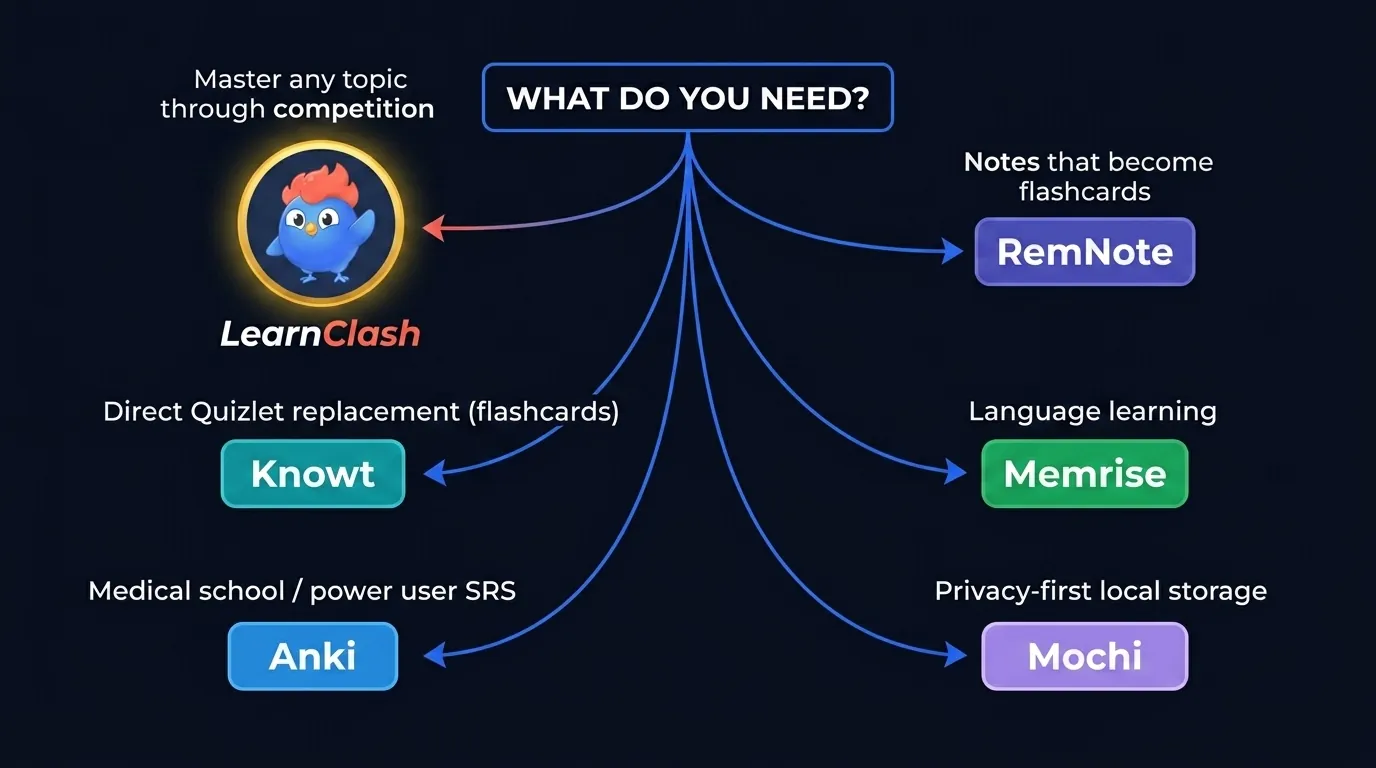 Match the tool to your goal, not the other way around.
If you want to learn any topic without creating flashcards: LearnClash. AI generates the questions, spaced repetition handles long-term retention, and the competitive ELO system keeps you coming back because every duel actually means something for your rank. Free, no ads.
If you want a direct Quizlet replacement: Knowt. Same study modes, free. One-click import from Quizlet. Accept the ads or pay ~$35/year.
If you’re in medical school or need maximum retention: Anki. Steep learning curve. Best results. Free on most platforms.
If you take detailed notes and want auto-generated flashcards: RemNote. The note-to-card pipeline is unique.
If you’re learning a language: Memrise. Native speaker videos and rare language support that general study tools can’t match.
If you care about data privacy: Mochi. Local-first. No signup. No cloud unless you pay.
If you need gamified classroom quizzes: Quizizz. Live and self-paced modes without needing a host.
If you want zero subscriptions on Apple: Flashcard Hero. $7.99 once. Done.
The Bottom Line
LearnClash proves you don’t need flashcards at all to master a topic, and that’s the headline of this whole list. Quizlet isn’t what it was. The free tier is gutted, Q-Chat is dead, and prices keep climbing. These Quizlet alternatives hand you 11 real paths forward, from traditional flashcard apps that do what Quizlet used to do for free all the way to a competitive learning platform that swaps flashcards for quiz duels and spaced repetition. Seven include SRS. Two have zero ads.
See also: how LearnClash compares directly to Trivia Crack for a quiz-duel alternative that actually teaches, and does Quizlet have spaced repetition? for the deep dive on Quizlet’s own SRS claims.
Frequently Asked Questions
What is the best free Quizlet alternative in 2026?
LearnClash is the best free Quizlet alternative for active learning. It generates questions on any topic, uses spaced repetition in every game mode, and has zero ads on any tier. For flashcard-specific study, Knowt offers free Learn mode, practice tests, and one-click Quizlet set imports.
Why are students leaving Quizlet in 2026?
Quizlet paywalled Learn mode and Test mode in 2022, killed Q-Chat (its AI tutor) in June 2025, and raised prices. The free tier now limits you to flashcard browsing and a few Learn rounds with ads. Trustpilot reviews average 1.4 out of 5 stars, with students calling the pricing predatory.
Do any Quizlet alternatives have spaced repetition?
Seven of the 11 alternatives on this list include spaced repetition: LearnClash (built into every game mode), Knowt (free SRS), Anki (FSRS 6 algorithm), Brainscape (Confidence-Based Repetition), RemNote (SRS in notes), Mochi (modified SM-2), and StudySmarter (flashcard scheduling). Quizlet itself has only session-scoped spacing on the free tier, with cross-session Memory Score behind Quizlet Plus. See our full analysis of Quizlet's spaced repetition.
Can you import Quizlet sets to other apps?
Knowt offers one-click Quizlet import: paste a Quizlet link and your cards transfer over. Anki supports imports via third-party tools and browser extensions (Quizlet removed direct export in 2022). Most other alternatives require manual recreation of your sets.
Is there a Quizlet alternative with no ads?
LearnClash has zero ads on every tier, including the free plan. Anki is fully ad-free across all platforms. Mochi is ad-free with local storage. Knowt, Brainscape, Cram, and Quizizz all show ads on their free tiers.