
Kahoot vs Gimkit: Classroom Quiz Platforms Compared [2026]
Kahoot vs Gimkit with prices and caps re-checked August 15, 2026: free tiers, game modes, AI tools, research, and which quiz platform fits your class.

One was designed by Norwegian professors in a research lab. The other was built by a 16-year-old who thought Kahoot was boring.
Kahoot vs Gimkit is a choice between a live quiz show and a virtual economy. Kahoot puts questions on a shared screen and has more than 300 peer-reviewed studies behind it. Gimkit turns correct answers into in-game cash that students spend on upgrades, power-ups, and sabotage across a rotating catalog of game modes.
Free access splits along different lines than most roundups suggest. A verified K-12 teacher gets 40 players per game on free Kahoot, while free Gimkit hosts unlimited players, but only on the currently featured modes.
Test your knowledge in a quiz duel →
Kahoot vs Gimkit: Quick Comparison
Kahoot wins on research evidence, free access for a typical class, and breadth of creation tools. Gimkit wins on game depth, high school staying power, and flat-rate school pricing. LearnClash wins on self-directed learning, with ELO ranking and review intervals built into every mode.
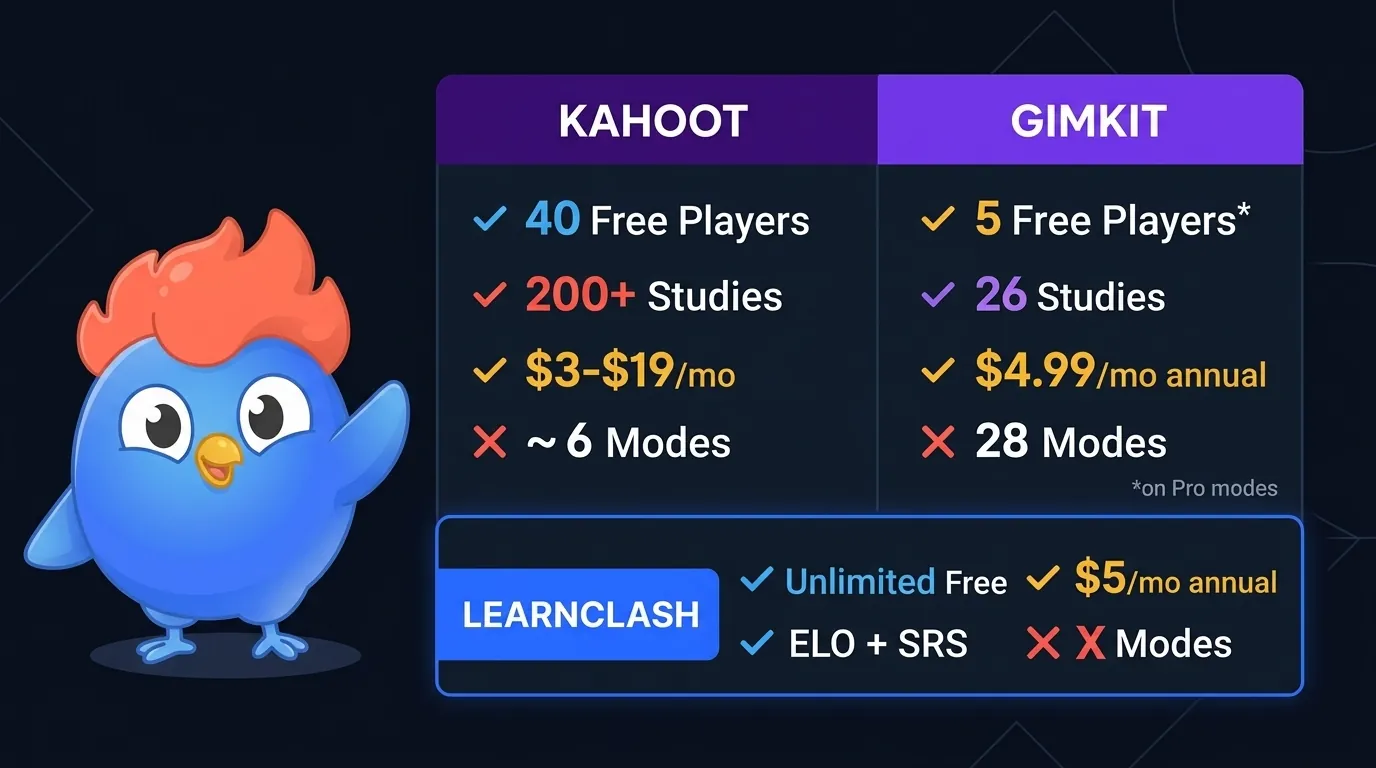 The short version of the whole article, one row per decision factor.
| Feature | Kahoot | Gimkit | LearnClash |
|---|---|---|---|
| Founded | 2012 (Norway) | 2017 (USA) | 2025 (Switzerland) |
| Core format | Live quiz show | Virtual economy game | 1v1 quiz duels |
| Free player cap | 10 (personal) / 40 (K-12 teacher accounts) | Unlimited (featured) / 5 (Pro modes) | Unlimited |
| Paid pricing | $36-$228/yr per teacher, billed annually | $14.99/mo or $59.88/yr | $7.99/mo or $59.99/yr |
| School pricing | Per-teacher (adds up fast) | $650-$1,000/yr flat | N/A |
| Game modes | Quiz-format variations + game experiences | Rotating featured set + Pro Exclusive catalog | 3 (duel, practice, open) |
| AI quiz creation | Yes (paid plans) | Yes (AI Question Generator, 2025) | Yes (any topic) |
| Spaced repetition | No | No | Yes, every mode |
| ELO ranking | No | No | Yes, 8 tiers |
| Learning research | 300+ studies, ESSA Level III | 26 studies (2026 review) | Building |
| Question display | Shared screen by default (device toggle available) | Student device | Student device |
| Homework/async | Yes (free) | Yes (Pro only) | Yes (free) |
| Ads | No | No | No |
| Platform | Web + mobile apps | Web only | iOS, Android, Web |
| Best for | K-8, quick review | High school, strategy | Self-directed learners |
Origin Story: Research Lab vs High School Project
Kahoot and Gimkit came from opposite worlds, and the split still explains most of what follows. Kahoot grew out of a Norwegian university research project. Gimkit started as a class assignment by a teenager.
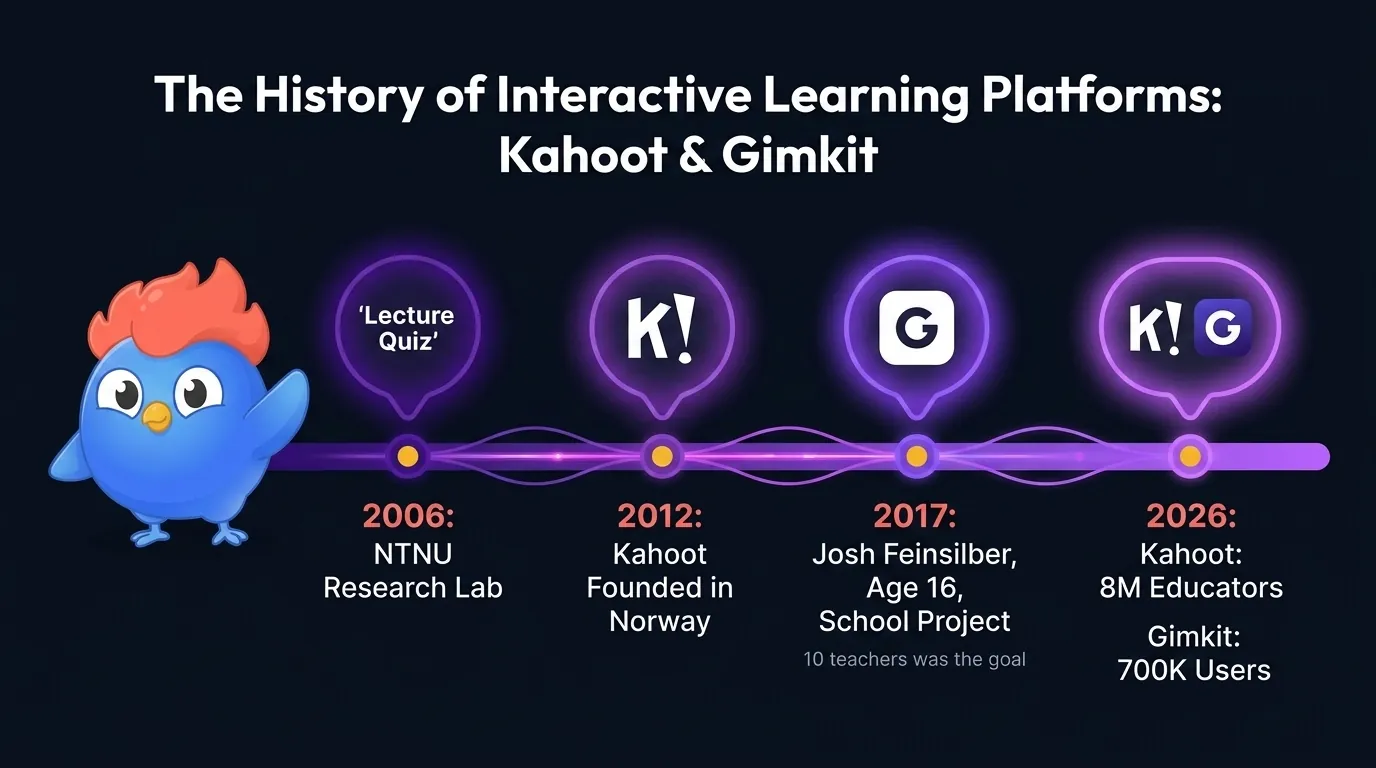 From a university lab to a homework assignment, twenty years compressed into one strip. The reach figures on the strip are old; the current ones are in the text and table below.
Kahoot’s roots go back further than most people think. Professor Alf Inge Wang at NTNU (Norwegian University of Science and Technology) started building quiz prototypes called Lecture Quiz in 2006, and six years of research followed before Morten Versvik, Johan Brand, and Jamie Brooker founded Kahoot in 2012. They ran a beta in Texas in early 2013 and launched publicly that September. Kahoot’s own company page now puts the reach at over 10 million educators a year, with the platform played in all 195 countries.
Gimkit’s origin is the opposite story. Josh Feinsilber was a 16-year-old junior at Gibson Ek High School in Washington state who thought classroom quiz tools were boring, so he built his own as a school project in 2017 and put it on Product Hunt that October. He originally called it Gimlet. Jeff Osborn spotted it there, helped with the naming problem, mentored Josh for over a year, and came on as co-founder in January 2019.
Kahoot was built to test a theory about game-based learning, so it led with research. Gimkit was built because a student found quiz tools boring, so it led with gameplay. That gap shows up in everything below: modes, pricing, and how each one handles learning.
| Kahoot | Gimkit | |
|---|---|---|
| Founded | 2012 | 2017 |
| Origin | University research project | High school class assignment |
| Founders | Academics and entrepreneurs | 16-year-old student |
| Starting goal | Prove game-based learning works | Convince 10 teachers |
| Reach (last published) | 10 million+ educators a year | 3 million+ monthly users (May 2019) |
Game Format: Live Quiz Show vs Virtual Economy
Kahoot plays like a TV game show. A teacher projects questions on a screen, students race to answer on their phones, and speed earns points. Gimkit flips that model: correct answers earn cash that students invest in upgrades and power-ups, each on their own device, at their own pace.
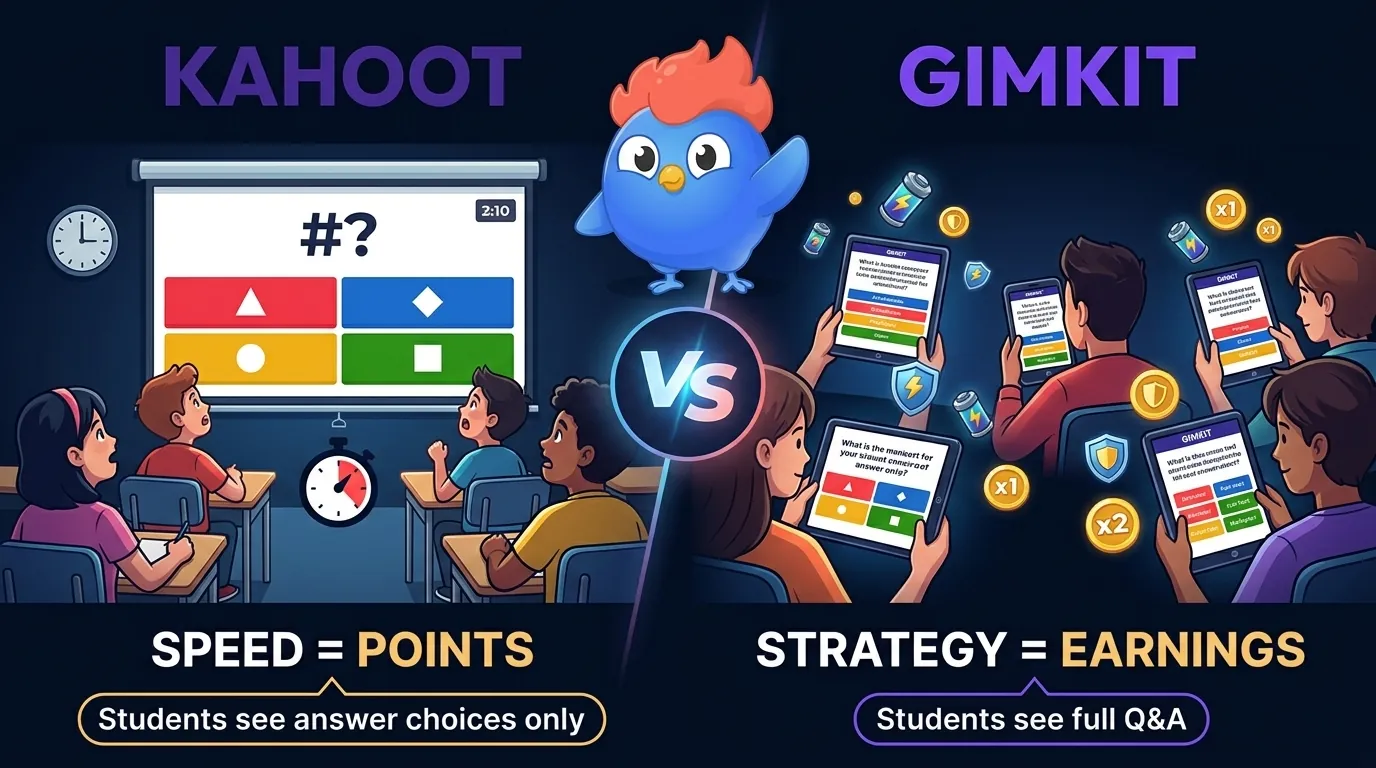 Two rooms running review at the same moment: one watches a projector, the other plays a market.
A detail worth knowing before your first session: by default, Kahoot students see colored answer blocks on their phones while the question text lives on the shared screen. There is a free toggle in the live game settings that mirrors questions and answers onto participant devices, but the projector-driven setup is the default and the format Kahoot is built around. In Gimkit, the full question and every answer choice are always on the student’s own device. No shared screen is involved.
That difference sets the classroom mood. In a Kahoot session the room buzzes: students shout during countdowns, wrong answers get groans, everyone watches the same screen.
A Gimkit session goes quiet instead, thirty students locked into their own screens deciding whether to upgrade their earning rate or sabotage a classmate. Neither is better: a 5-minute Kahoot closes a lesson with energy, and a 15-minute Gimkit session builds focus.
LearnClash sits on Gimkit’s side of this axis. Everything happens on the player’s own screen, three questions per round across six rounds, 18 questions per duel, and there is no projector to point at.
| Kahoot | Gimkit | |
|---|---|---|
| Core mechanic | Speed quiz on projector | Virtual economy on devices |
| Question display | Shared screen by default (free device toggle exists) | Both Q&A on student device |
| Pacing | Timer-driven (5-240 seconds) | Self-paced within game timer |
| Teacher role | Host (required, controls flow) | Launcher (sets up, observes) |
| Energy | Communal, loud, event-like | Individual, focused, strategic |
| Equipment needed | Shared screen + student devices | Student devices only |
Game Modes: Classic Quiz vs Video Game Experiences
Gimkit’s catalog feels more like Roblox than a school tool, but the widely repeated mode counts are mostly fan-site inflation. Gimkit itself publishes a rotation, not a number: generally three featured modes are free at any given time, rotating every few weeks, with the rest in the Pro Exclusive catalog. When we counted the mode picker for our hands-on Gimkit review in May 2026, it held 13 active 2D modes.
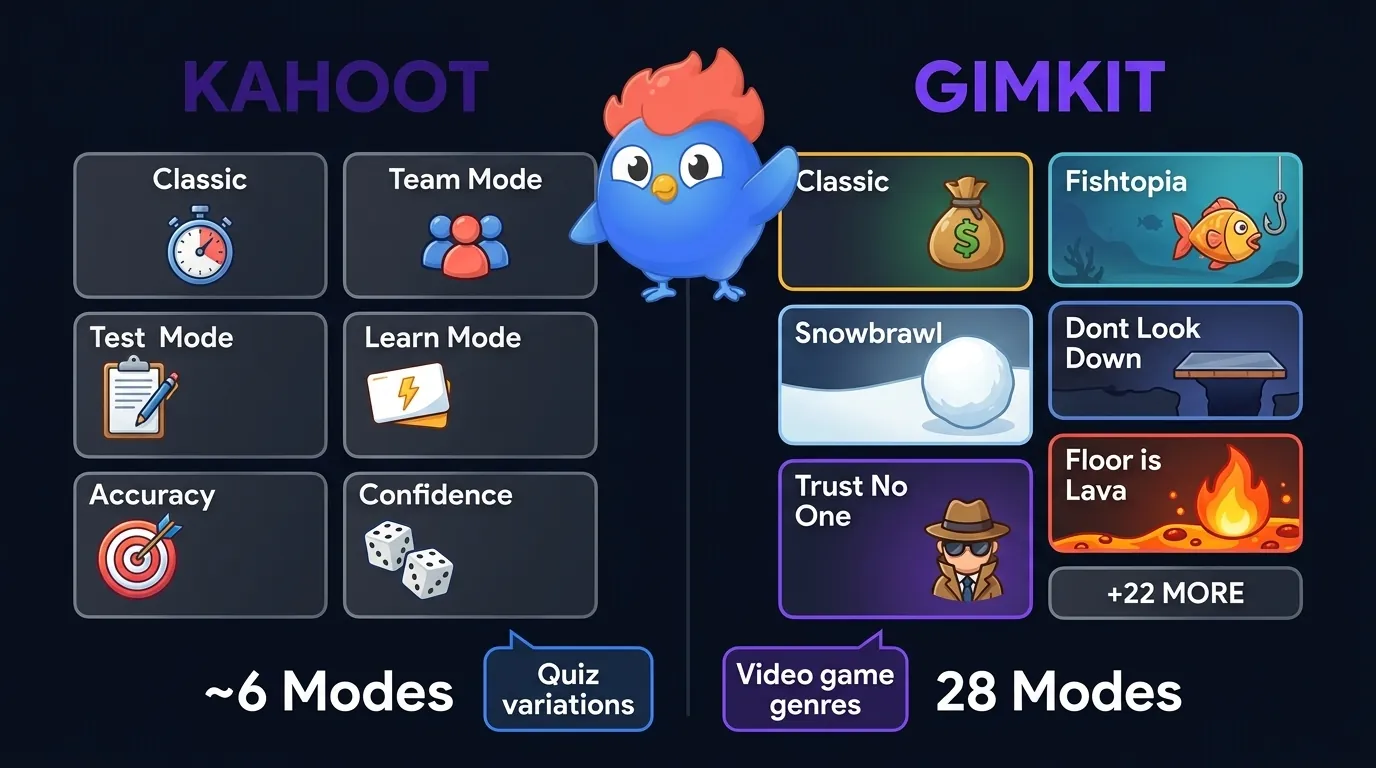 Quiz variations on the left, entire game genres on the right.
Kahoot’s modes are mostly variations on the quiz format, with a newer layer of game “experiences” on top:
- Classic: individual speed quiz, answer fastest for more points
- Team Mode: group competition, pooled scores
- Test Mode: self-paced assessment (no live host needed)
- Learn Mode: flashcard-style review
- Accuracy Mode: rewards correctness over speed
- Confidence Mode: bet points on your answers
- Game experiences: mini-games layered over a kahoot, such as Tallest Tower (teams build one tower from blocks earned by correct answers) and Treasure Trove (collect treasure by answering correctly while dodging traps). The plans page lists seasonal experiences on every tier, free included; the premium set unlocks from Silver up and is trial-only on Go and Bronze.
Gimkit’s modes are entire game genres:
- Classic: earn cash, buy upgrades, highest balance wins
- Fishtopia: a fishing economy. Buy bait, catch fish, sell for cash, with correct answers funding everything.
- Snowbrawl: team-based snowball PvP with quiz-powered ammunition
- Don’t Look Down: a vertical platformer where answering keeps you climbing
- Trust No One: Among Us-style social deduction. Students answer questions while hunting the imposters among their classmates, and it is a big part of why high schoolers prefer Gimkit to straight quiz formats.
- The Floor is Lava: cooperative, the whole class keeps a shared tower above rising lava
Gimkit still wins the variety contest; Kahoot’s experiences are a twist on a quiz, while Gimkit’s modes are games with a quiz inside. The catch is access. Popular modes like Fishtopia and Snowbrawl sit in the Pro Exclusive set, where a free Basic account can host only 5 players; the $5-per-season Season Ticket raises that cap to 15 and adds Creative map slots, but full-class access to those modes means Pro. Kahoot’s Classic mode, by contrast, is free for a whole class of 40 on a school account.
| Kahoot | Gimkit | |
|---|---|---|
| Mode style | Quiz format variations plus game experiences | Actual video game genres |
| Free modes | Classic, Accuracy, Learn, assigned self-paced kahoots, seasonal experiences | 3 rotating featured modes |
| Catalog | Classic, Team, Test, Learn, Accuracy, Confidence, experiences such as Tallest Tower and Treasure Trove | Rotating featured set + Pro Exclusive catalog (13 active, May 2026 count) |
| Mode restrictions | Premium experiences and Confidence from Silver up | Most popular modes Pro-only (5-player cap on Basic) |
Free Tier and Pricing: The Real Cost for Teachers
For a typical class, free Kahoot is the more practical tier: 40 players on a verified K-12 teacher account, Classic mode, no session limits. The cheapest paid seat is also Kahoot’s, since Bronze costs $36 a year against Gimkit Pro’s $59.88. Flip to school-wide purchasing and the verdict flips with it, because Gimkit’s flat rates beat any per-teacher ladder once enough teachers are on it.
I pulled Kahoot’s plans page, Gimkit’s Pro FAQ, and Gimkit’s player-maximums page on August 15, 2026; every number in the tables below comes from that read. Two things to know about Kahoot’s ladder. Its plan cards quote a monthly option at $9 to $34.99, yet the FAQ on the same page says every educational plan bills upfront for the year with no monthly billing, so this comparison uses the annual prices and treats the monthly figures as unresolved. And the free Go plan for personal accounts lists 10 participants per game, with the 40-player figure applying to verified K-12 teacher accounts.
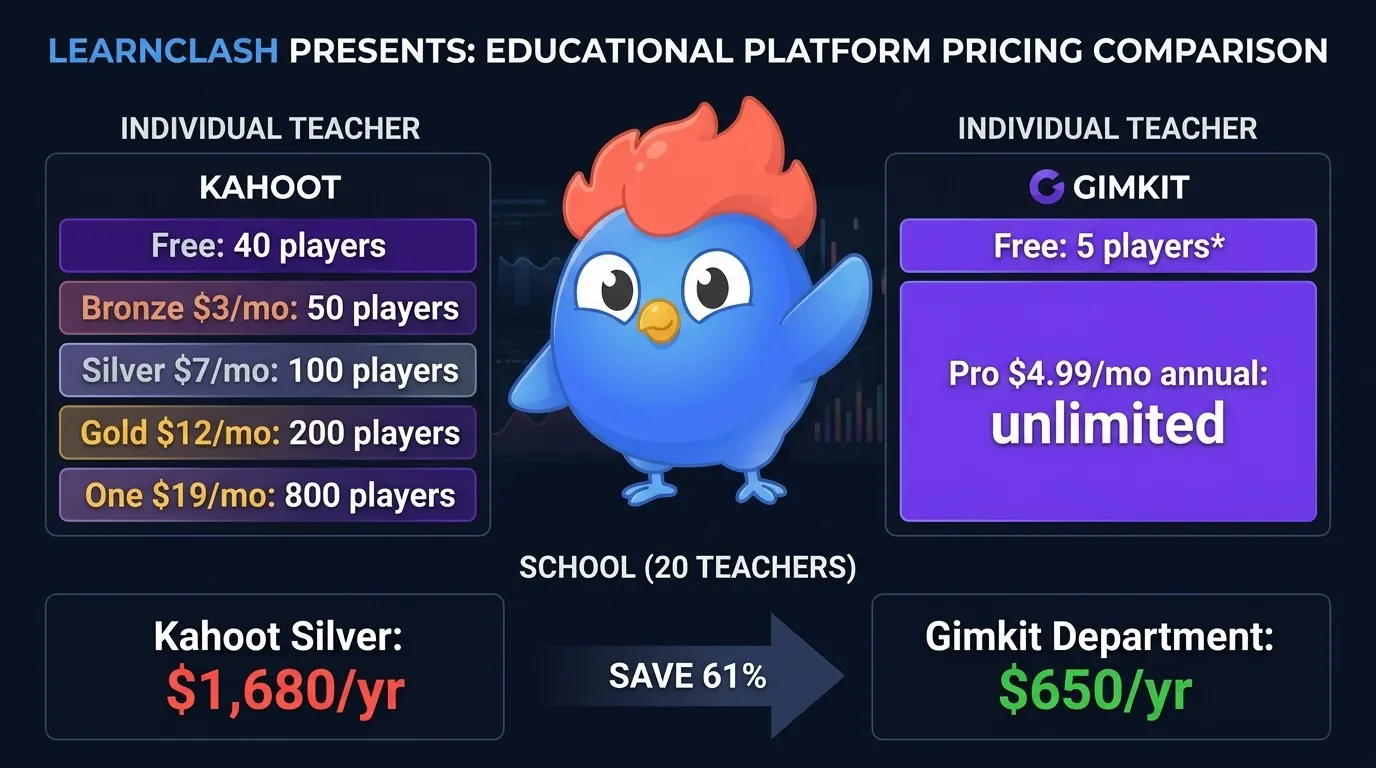 This graphic predates the August 15 check; where it disagrees with the tables below, the tables win.
Kahoot pricing (per teacher, billed annually):
| Tier | Annual price | Works out to | Player cap |
|---|---|---|---|
| Go (free) | $0 | $0 | 10 (personal) / 40 (K-12 teacher) |
| Bronze | $36 | $3/mo | 50 |
| Silver | $84 | $7/mo | 100 |
| Gold | $144 | $12/mo | 200 |
| One | $228 | $19/mo | 800 |
Gimkit pricing:
| Tier | Monthly | Annual | Player cap |
|---|---|---|---|
| Basic (Free) | $0 | $0 | Unlimited (featured) / 5 (Pro modes) |
| Pro | $14.99 | $59.88 | Unlimited |
| Department (up to 20 teachers) | - | $650 | Unlimited |
| School (all teachers) | - | $1,000 | Unlimited |
In practice the math shakes out like this:
| Scenario | Kahoot | Gimkit | Winner |
|---|---|---|---|
| 1 teacher (free) | 40 players, Classic | 3 rotating modes, 5-player Pro cap | Kahoot |
| 1 teacher (paid) | Bronze: $36/yr | Pro: $59.88/yr | Kahoot (40% less) |
| 20 teachers | Bronze seats: $720/yr | Department: $650/yr | Gimkit (10% less) |
| 50 teachers | Bronze seats: $1,800/yr | School: $1,000/yr | Gimkit (44% less) |
The crossover sits at 19 teachers: 18 Bronze seats still total $648, two dollars under Gimkit’s $650 Department plan, and the 19th seat tips it. Below that line, Kahoot is now the cheaper platform at every step, which was not true of the per-teacher ladder this article described in spring. Above it the picture splits: the $650 Department plan wins at 19-20 teachers, Bronze seats take the lead back at 21-27 ($756-$972 against the $1,000 School plan), and the School plan pulls away for good from 28 teachers.
One caveat per side. Kahoot’s Bronze caps games at 50 players, so teachers who need bigger sessions climb to Silver or Gold and the per-teacher math worsens from there. Gimkit’s “unlimited” is plan language rather than a technical spec: its own player-maximums page sets hard limits of 500 students in a live game and 60 in any 2D mode.
Content Creation: Both Sides Ship AI Now
This section’s old premise died in 2025. When this comparison first ran, the creation story was Kahoot’s AI against Gimkit’s manual quiz builder; Gimkit then shipped its own in-house AI Question Generator, so the real question has become which AI workflow fits your prep style, and what each platform offers beyond it.
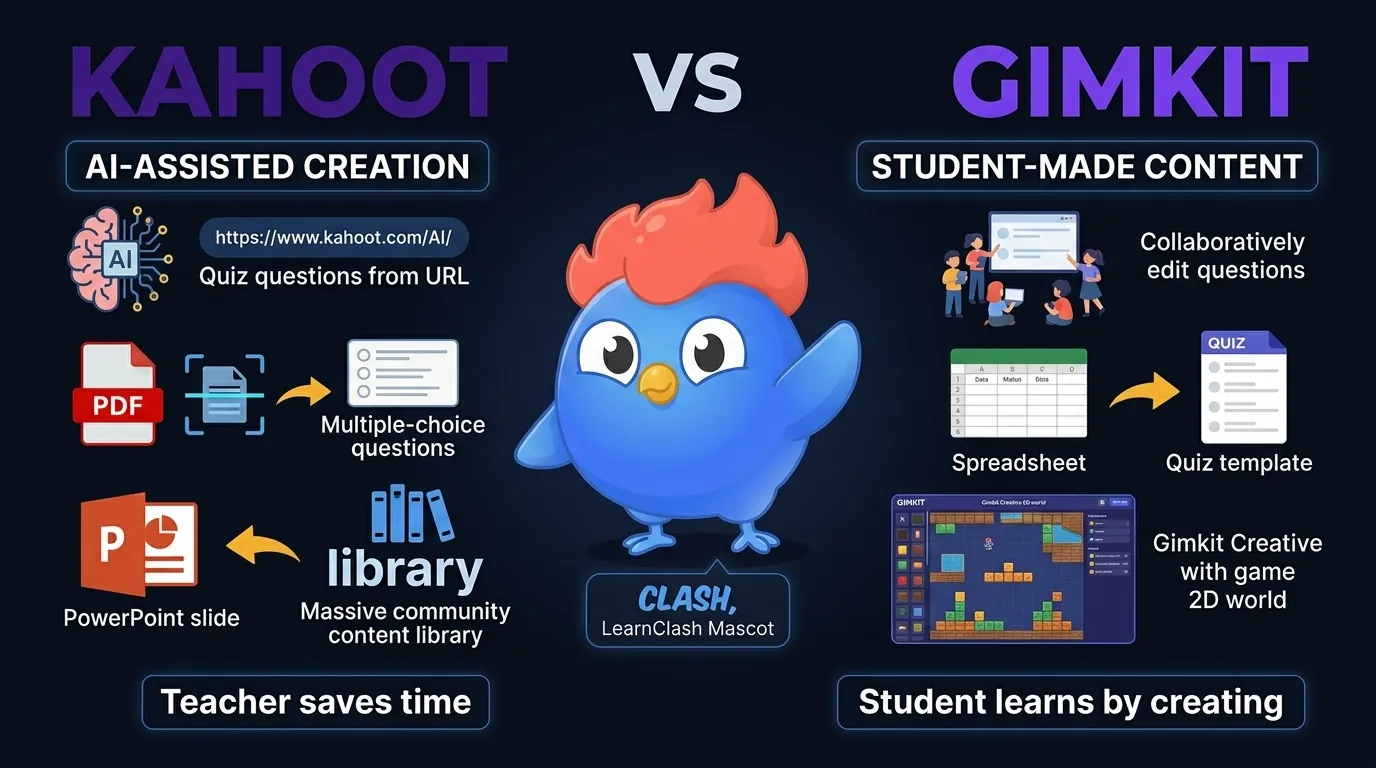 The AI gap between these two creation philosophies closed in 2025.
Kahoot still has the broader toolkit, and its plans page spells out where each piece starts. Generation from a typed topic, a URL, or a Wikipedia article is included from the $36 Bronze plan up, and so is PDF-to-kahoot, capped at 3 pages on Bronze and 150 pages from Silver. Handwritten-note scanning follows the same page caps. Two tools sit higher: importing and syncing slides to generate questions needs Gold, and the AI image generator is Kahoot! One only. The free Go plan gets none of it, so Kahoot AI is a paid feature in practice, but the entry price is a Bronze seat, not a Gold one.
Gimkit’s creation tools point a different direction:
- In-house AI Question Generator (shipped 2025)
- Manual quiz builder (questions + answers)
- Student-generated quizzes through KitCollab, with teacher approval
- Spreadsheet import (CSV)
- Gimkit Creative: build custom 2D game worlds with quiz integration
For a busy teacher who needs a quiz in five minutes, either platform’s generator now does the job. Gimkit Creative is the wildcard, since no other platform in this matchup lets students build full 2D game worlds with questions wired in.
| Feature | Kahoot | Gimkit |
|---|---|---|
| AI quiz generation | Yes (Bronze and up; slide sync Gold+, AI images One only) | Yes (in-house generator, 2025) |
| PDF / slide import | Yes (PDFs, PowerPoint, Keynote) | No |
| Student-created quizzes | No | Yes (KitCollab) |
| Custom game worlds | No | Yes (Gimkit Creative) |
| Content library | Large, community-built | Smaller, growing |
Learning Evidence: 300+ Studies vs 26
Kahoot has the strongest research base of any classroom quiz platform, and the number keeps growing: its research page claimed 200+ peer-reviewed studies when this article first ran and listed more than 300 studies from over 50 countries when I checked it on August 15, 2026. The same page reports that students learning with the platform shifted on average from the 50th to the 72nd percentile, about a full letter grade, and carries an ESSA Level III “Promising Evidence” certification. The most rigorous single source is the Özdemir 2025 meta-analysis in the Journal of Computer Assisted Learning: 43 studies, 3,353 students (1,706 experimental, 1,647 control), with an effect size of 0.772 standard deviations on achievement and 1.492 on retention.
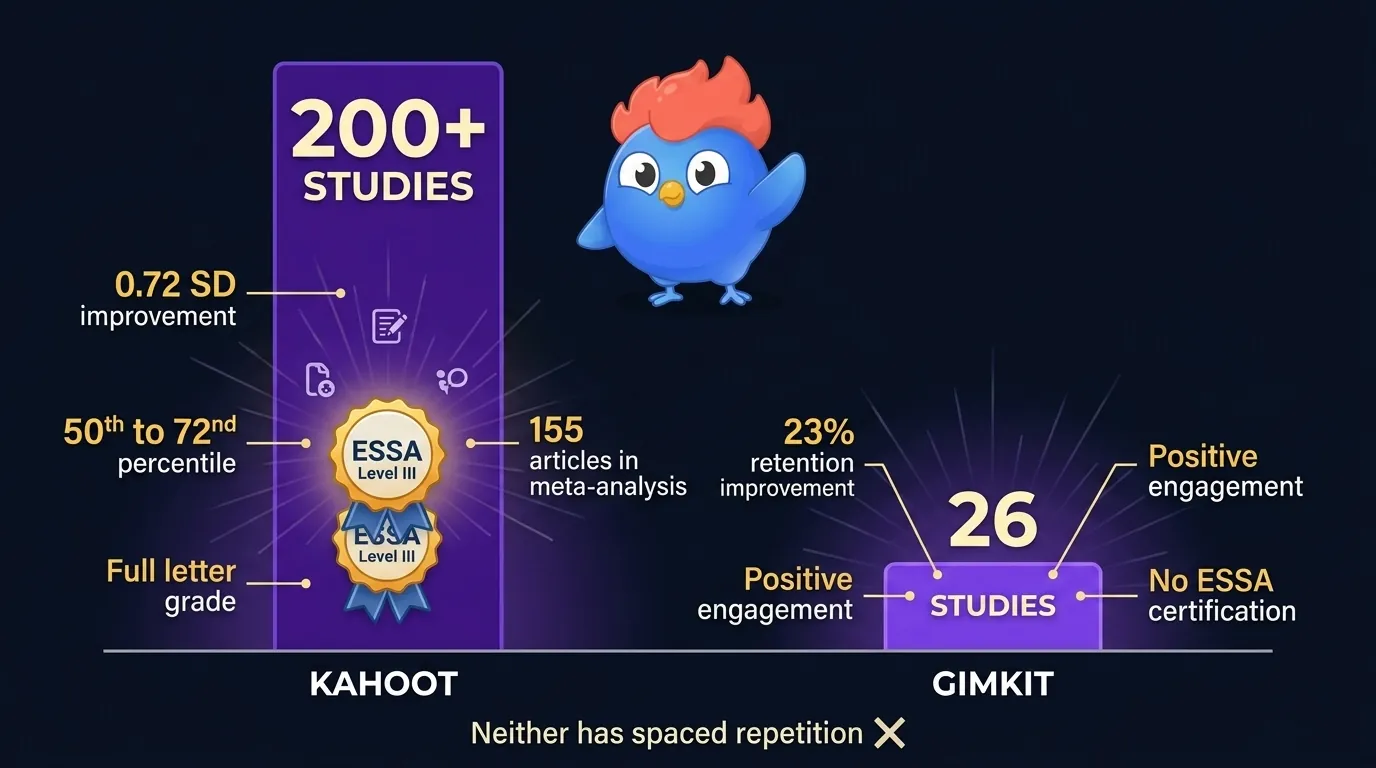 Drawn when Kahoot’s count stood at 200+; it has since passed 300 and the gap only widened.
Gimkit’s evidence base is far thinner. The main source is a 2026 integrative review in IJLTER (Muchuweni & Jojo) that synthesized 26 studies and classroom reports, published between 2018 and 2025, on Gimkit in secondary mathematics. The findings on engagement and motivation are positive. The same review flags “overemphasis on competition” and limited support for deeper conceptual understanding, and there is no ESSA certification and no meta-analysis measuring achievement at scale, which is the answer a principal will ask for when deciding whether the tool works.
Neither platform has spaced repetition, though. Both quiz you once and move on, with no follow-up review at growing intervals, which is exactly the mechanism memory research keeps validating: retrieval practice with spaced intervals produced 80% recall after one week versus 36% for rereading alone (Karpicke & Roediger, 2008).
| Kahoot | Gimkit | |
|---|---|---|
| Peer-reviewed studies | 300+ (kahoot.com/research) | 26 (2026 integrative review) |
| Meta-analysis | Yes (Özdemir 2025: 43 studies, 3,353 students) | No |
| Effect size | 0.772 SD achievement, 1.492 SD retention | Not measured at scale |
| ESSA certification | Level III | None |
| Spaced repetition | No | No |
Who Should Choose Kahoot
Choose Kahoot if you need a proven, research-backed tool for whole-class review and your class fits inside the free 40-player teacher cap or a $36 Bronze seat.
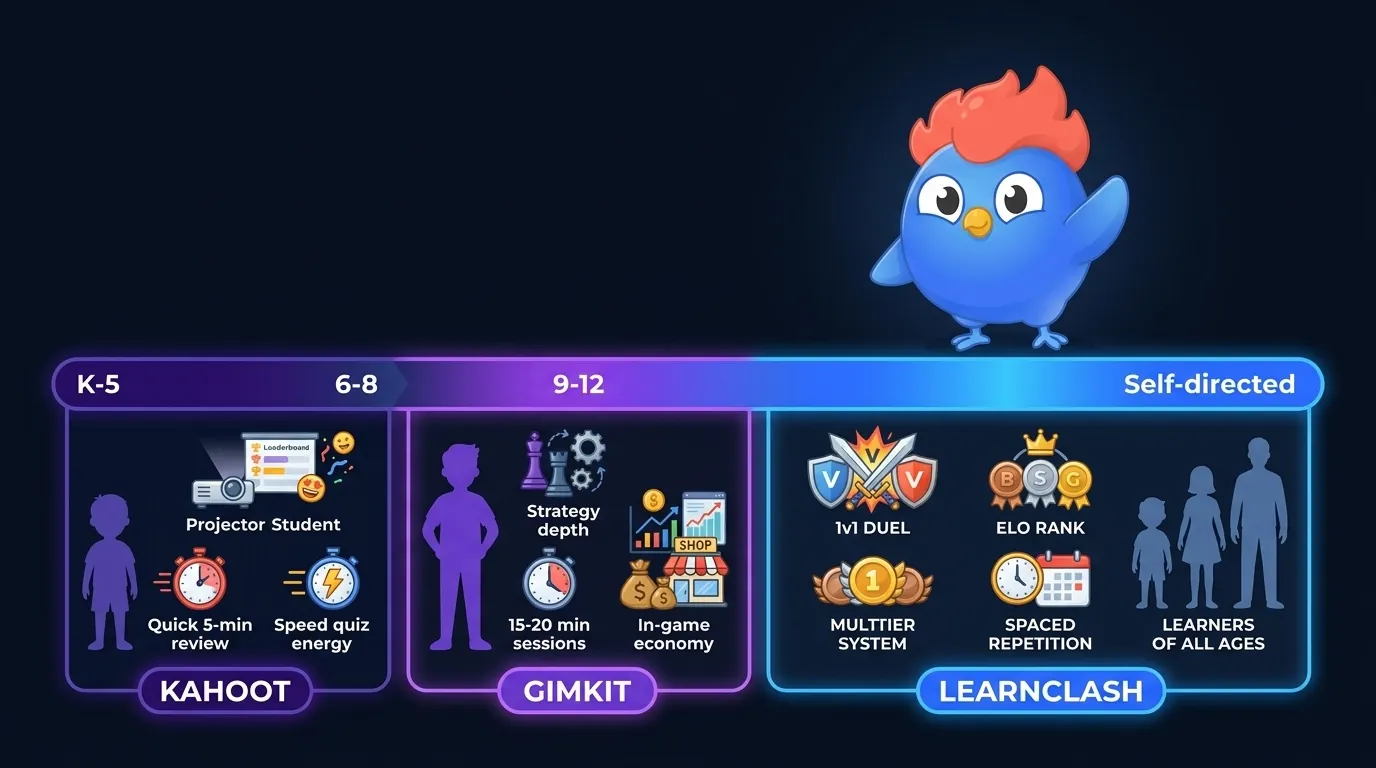 Where each platform lands by grade band.
Kahoot is the right choice if you:
- Run quick 5-10 minute review sessions for any grade level
- Want the shared-screen energy of a live quiz show
- Need research-backed evidence for admin approval or grant applications
- Teach younger students (K-8) who respond to speed-based competition
- Have 40 or fewer students and a verified K-12 teacher account, and don’t want to pay anything
- Want AI quiz generation from URLs, PDFs, or Wikipedia and can spend $36 a year on a Bronze seat to get it
For a broader look at the field, see the 10 best Kahoot alternatives ranking and the Kahoot vs Blooket comparison.
Who Should Choose Gimkit
Choose Gimkit if your students find quiz formats boring and you want deeper, longer play sessions. Its video-game modes keep high schoolers locked in for 15-20 minutes without losing focus, and its flat-rate pricing beats the per-teacher ladder at 19-20 teachers (the $650 Department plan) and again from 28 teachers up (the $1,000 School plan). Gimkit is the right choice if you:
- Teach high school students who’ve outgrown speed quizzes (the reason Gimkit exists)
- Want 15-20 minute strategy sessions, not 5-minute quick checks
- Are buying for a school or department rather than one classroom
- Want students to create quizzes as a learning exercise through KitCollab
- Have a class that’s into Among Us, Roblox, or strategy games
- Are willing to pay for Pro, because the free rotation rarely lines up with the mode you planned
For how Gimkit stacks up against its closest competitor, see Blooket vs Gimkit; for the three-way version, Kahoot vs Blooket vs Gimkit. A Gimkit-only deep dive, including Pro pricing and the rotating mode catalog, lives in the Gimkit review, and the study-tool angle is covered in Kahoot vs Quizlet.
Where LearnClash Fits
If the deciding factor is research evidence, pick Kahoot; if it is gameplay that holds attention past eighth grade, pick Gimkit. What neither tracks is whether students still know the material after the session ends, and both need a teacher to set anything up at all.
That gap is the one LearnClash was built for, and it sits on the Gimkit side of the device axis from the format section: no projector, no host, a student and an opponent on their own phones. A duel is the same 18 questions described above, three per round over six rounds, against a friend or a ranked stranger on any topic. A question you get wrong returns a week later; get it right there and one more check waits 90 days out. Pass that one as well and the question is marked Mastered.
One design decision belongs here rather than in a comparison table. Nobody starts at the bottom of the ladder. The rating opens at 1300, Gold II, the middle of the 22 ranks from Iron III to Phoenix. A new account has room to fall as well as climb from its first duel, and the question mix stays at the easy tier until 1400 so those first duels are winnable.
For the direct matchup against the platform in this article’s title, read LearnClash vs Kahoot; for how it compares to casual trivia apps, there’s the LearnClash vs Trivia Crack breakdown, and the rest of the quiz platform comparisons live in one place.
How we test
We use the tools we compare. That means installing the mobile apps on real iOS and Android devices, hosting test sessions in the browser tools, and joining from a second device as a participant, because free-tier limits usually show up on the join screen, not the marketing page.
Every number is dated. Prices, player caps, and plan names come from each vendor's own public pricing page or help center, read in a normal browser and recorded with the date we read them. When a claim cannot be re-verified on the vendor's site, we either date it to the last check that confirmed it or cut it. Quotes are verbatim from the cited page or they are not quotes. The last full re-check of every vendor claim on this page ran on August 15, 2026.
First-party data carries its export date. When we cite usage numbers from LearnClash itself, such as answer rates on specific questions, they come from dated production-database exports, and we put the export date and sample size next to the number.
Nobody pays to be here. No vendor has paid for placement or ranking in our comparisons, none sees a draft before publication, and there are no affiliate links in them. If that ever changes, this box will say so.
LearnClash is our own product. These comparisons are written by the person who builds it, which is a bias you should know about. We handle it in the open: our app is always labeled as ours, we do not stage tests designed to crown it, and every comparison names the situations where a competitor is the better pick. Read our app's entry as a founder's pitch with checkable numbers, and the rest as the dated re-checks they are.
Frequently Asked Questions
Is Kahoot or Gimkit better for classrooms?
Kahoot is better for quick whole-class review: it has 300+ peer-reviewed studies behind it, and free verified K-12 teacher accounts host 40 players (personal accounts get 10). Gimkit is better for longer strategy sessions that keep high schoolers engaged. Gimkit's free tier hosts unlimited players, but only on the rotating featured modes; Pro Exclusive modes cap at 5 players without Pro.
Is Gimkit free for teachers in 2026?
Gimkit Basic is free but limited. You get rotating featured modes, generally three at a time, with unlimited players. Pro Exclusive modes like Fishtopia, Snowbrawl, and Don't Look Down cap at 5 players without Gimkit Pro ($14.99/month or $59.88/year). Assignments for homework also require Pro.
How many game modes does Kahoot have vs Gimkit?
Gimkit publishes a rotation rather than a count: generally three featured modes are free at any time over a larger Pro Exclusive catalog, and our hands-on review counted 13 active 2D modes in 2026. Kahoot focuses on quiz-style formats like Classic, Team Mode, and test/learn modes. Both platforms now generate questions with AI: Kahoot from websites, PDFs, and Wikipedia on paid plans, Gimkit through its in-house AI Question Generator.
Does Kahoot have better learning research than Gimkit?
Yes. Kahoot's research page lists 300+ independent peer-reviewed studies, ESSA Level III certification, and an average shift from the 50th to the 72nd percentile, about a full letter grade. The Özdemir 2025 meta-analysis (43 studies, 3,353 students) measured a 0.772 SD gain on achievement and 1.492 SD on retention. Gimkit has a 2026 integrative review of 26 studies published 2018-2025 with positive engagement findings, but no ESSA certification.
Can I use Kahoot or Gimkit without a classroom?
Kahoot's solo modes work outside classrooms. Gimkit's Assignments feature (Pro only) enables homework. But neither is built for self-directed, competitive learning. LearnClash fills that gap with ELO-ranked quiz duels on any topic, spaced repetition in every mode, and no teacher setup required.