
Anki vs Quizlet: Free Flashcards vs Paywall [2026]
Anki vs Quizlet in 2026: FSRS-6 vs Memory Score, the AnkiHub handoff, Knowt's paywall collapse, and why med students still default to Anki.

Quizlet began in 2005 as a 15-year-old’s shortcut through a French vocab test. Anki arrived a year later, one programmer’s tool for memorizing Japanese kanji, and that programmer kept maintaining it alone for the next 19 years. What happened when each founder eventually stepped away turns out to be half of this comparison.
Anki vs Quizlet: Anki is a free, open-source flashcard app whose FSRS-6 spaced repetition scheduler is benchmarked on 9,999 user collections and 349.9 million reviews, where it beats the older SM-2 method for 99.6% of users. Quizlet is a polished study tool with a native ChatGPT app since March 2026 and a $35.99-a-year Plus plan wrapped around most of its best features. Anki wins for serious long-term memorization. Quizlet wins for speed and ease. And if you want the retention science without the solo grind, LearnClash builds a 3-stage SRS into free, ELO-ranked 1v1 quiz duels instead. I re-checked every number on this page against its source on July 28, 2026; if you’d rather feel spaced repetition working inside a game before reading about it, pick a fight over study techniques.
Anki vs Quizlet: Quick Comparison
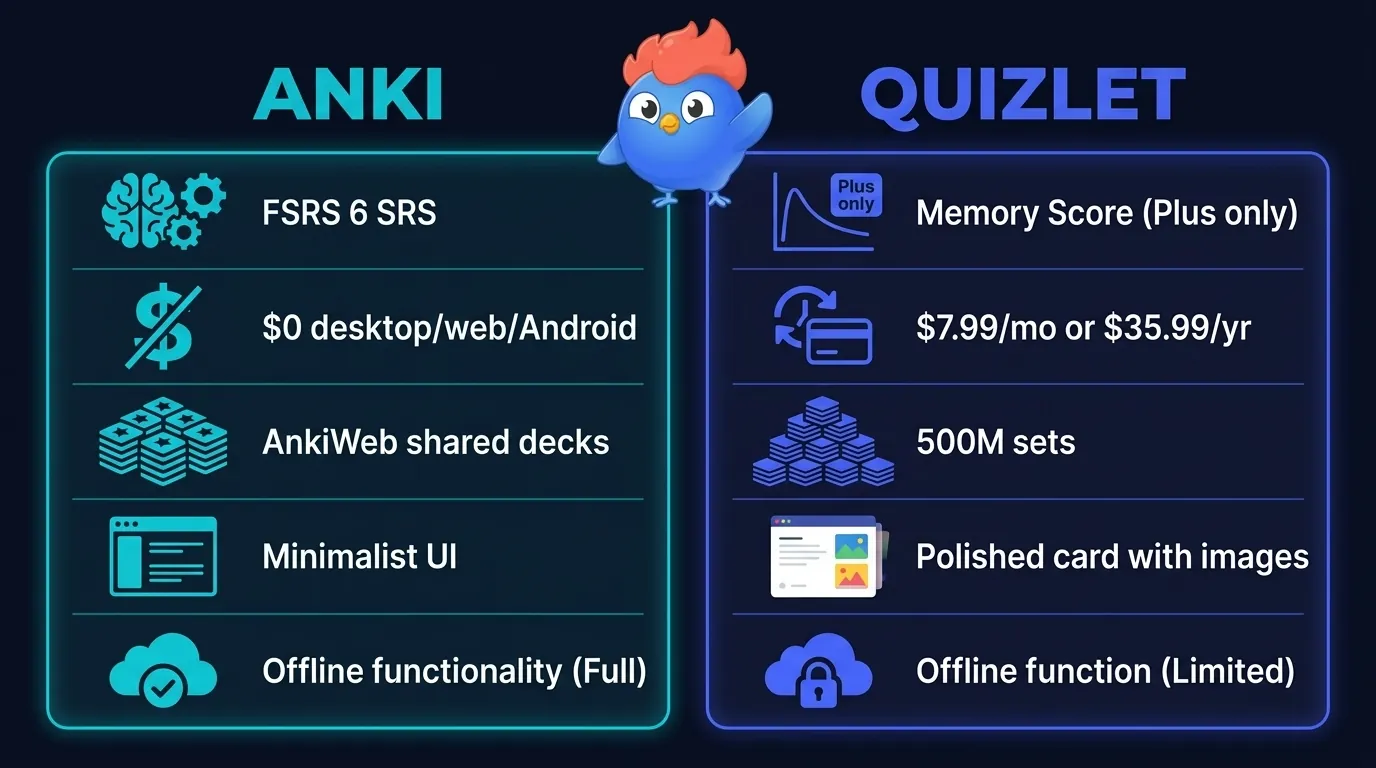
Anki is the retention tool: open source, community-run, scheduled by FSRS-6, free everywhere except a one-time $24.99 iOS app. Quizlet is the convenience tool: slick apps, an enormous pile of ready-made sets, AI features, and a subscription wrapped around the good parts. Nearly every row below traces back to that split.
| Feature | Anki | Quizlet |
|---|---|---|
| Created | 2006 (Damien Elmes, for Japanese) | 2005 (Andrew Sutherland, age 15, for French) |
| Stewardship | AnkiHub (Feb 2026 handoff) | Quizlet Inc. (3 CEOs in 4 years) |
| Primary use | Long-term memorization via SRS | Self-paced flashcard study + AI tools |
| SRS algorithm | FSRS-6 with recency weighting | Memory Score (Plus plan only, simpler) |
| Content source | User decks + AnkiWeb shared library | 700M+ user sets (company figure) |
| Verification | Community-curated mega-decks | None (errors and test answers spread) |
| AI features | None by design | Magic Notes, native ChatGPT app (March 2026) |
| Customization | Card types, fields, CSS, JS, add-ons | Limited to study modes |
| Free tier | Fully free on desktop, web, Android | Flashcards with ads; Learn capped at 5 rounds per set |
| iOS | $24.99 one-time (funds the project) | Free with ads or Plus subscription |
| Android | AnkiDroid (free, volunteer-built) | Free with ads or Plus |
| Offline | Full (all platforms) | Plus plan only |
| Plus pricing | N/A | $7.99/mo or $35.99/yr |
| Trustpilot rating | Not rated | 1.4 / 5 (re-checked July 28, 2026) |
One caveat on that last row before you read too much into it: angry subscribers write reviews and happy students mostly don’t. Still, most of those reviews are billing complaints, and Anki has no recurring billing to complain about.
Spaced Repetition: FSRS-6 vs Memory Score
Anki’s flagship scheduler is FSRS-6 with recency weighting, available in every current build (desktop 25.07 through the current 26.05 stable, plus the 26.08b2 beta) once you enable FSRS in the deck options; out of the box, Anki still starts you on SM-2. The open SRS benchmark evaluates scheduling predictions across 9,999 user collections and 349,923,850 reviews, and FSRS-6 predicts recall better than Anki’s old SM-2 implementation for 99.6% of those collections. Quizlet’s answer is Memory Score, a simpler spacing feature locked behind the Plus plan, with no published benchmarks, no training data, and no algorithm documentation. For retention over months and years, this single category decides the whole comparison.
| Anki | Quizlet | LearnClash | |
|---|---|---|---|
| Algorithm | FSRS-6 with recency weighting | Memory Score | 3-stage SRS |
| Documentation | Open benchmark, 349.9M reviews | Proprietary, undocumented | Public stage rules |
| Free | Yes (all platforms) | No (Plus plan only) | Yes (all features) |
| Format | Solo flashcard review | Solo flashcard review | 1v1 quiz duels with ELO |
| Best for | Long-term retention | Quick study sessions | Competitive daily practice |
SM-2 is the formula Piotr Wozniak built for SuperMemo in the late 1980s, and it applies one curve to everyone. FSRS inverts that: it trains on your own review history, so the schedule bends around your actual memory instead of a forty-year-old average. FSRS-5 ran 19 parameters. FSRS-6 added two more plus the recency weighting, which stops years-old reviews from outvoting last month’s when the model estimates difficulty, and FSRS-7 is slated as the final major version. AnkiDroid 2.22 shipped FSRS-6 alongside Anki Desktop 25.07.
FSRS-6 is genuinely impressive, which makes what I did with LearnClash look backwards at first glance: I shipped a much simpler scheduler on purpose. LearnClash uses three stages. A missed question returns in 7 days, a known one in 90, and a mastered one exits the pool. FSRS-6 would have squeezed more efficiency out of every review, but nobody can explain a 21-parameter model to a friend mid-duel, and a schedule players can actually understand turned out to matter more in a competitive game (the cooldown math is in the SRS retention curve writeup).
The underlying problem is the same for all three. Hermann Ebbinghaus measured it in 1885: memory decays roughly exponentially unless you review at the right moment, which is the entire case for spaced repetition. None of the fixed ladders on study blogs, 1/3/7/21 included, come from a shipped algorithm or from Sebastian Leitner’s box system. Real schedulers read your recall and adapt. Session tools like Kahoot and Blooket never schedule a missed question for next week at all, a pattern the Kahoot vs Blooket comparison covers in detail.
Quizlet has never explained how Memory Score decides anything, and on the free tier you never encounter it. Free Learn prioritizes within a session, then nothing follows up the next day. The full teardown is in does Quizlet have spaced repetition.
The AnkiHub Handoff and Quizlet’s ChatGPT Pivot
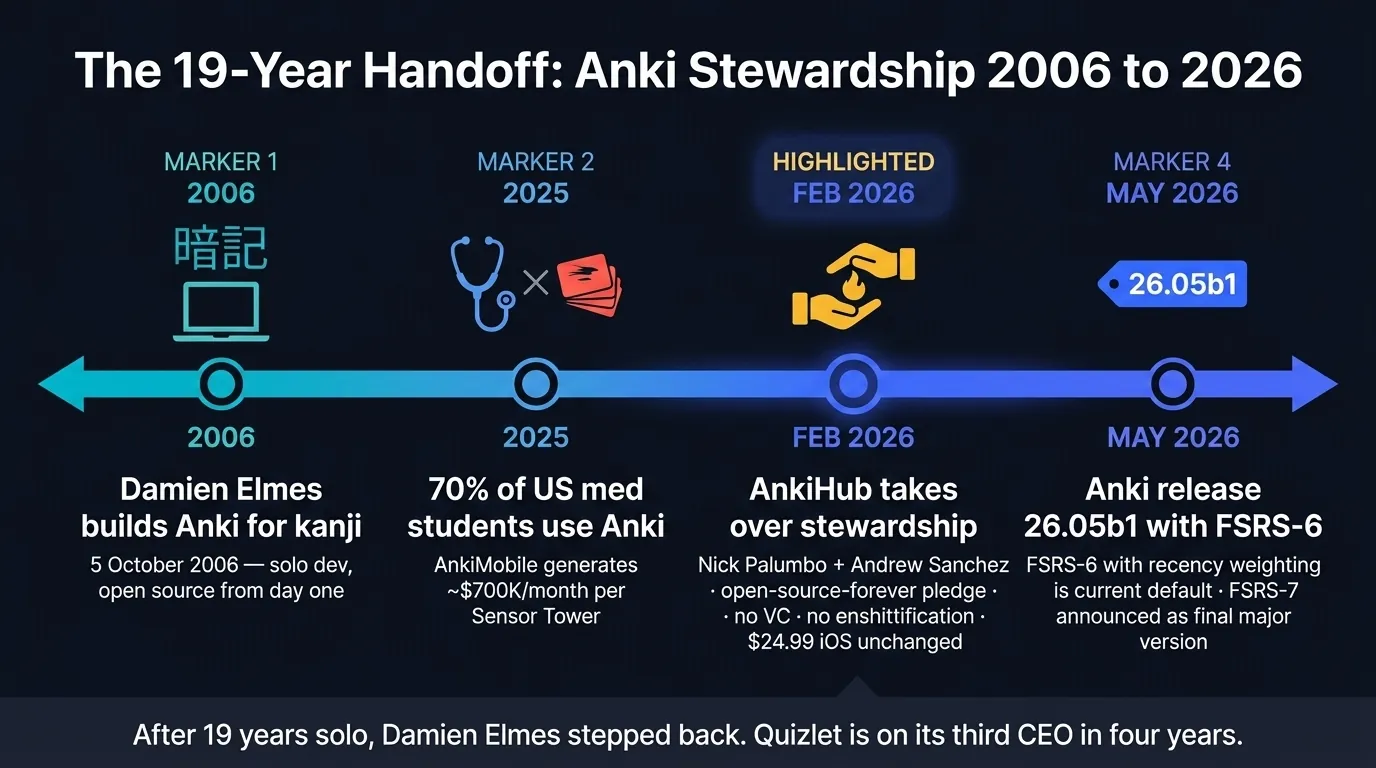
On February 2 and 3, 2026, Damien Elmes posted in the Anki forum that he was transferring open-source stewardship to AnkiHub after 19 years of solo development. AnkiHub founders Nick Palumbo and Andrew Sanchez pledged to keep the core code open source forever, with no VC funding and no enshittification. Pricing stayed exactly where it was: $24.99 one-time on iOS, free everywhere else.
| Aspect | Anki under Damien Elmes (2006-2026) | Anki under AnkiHub (2026+) |
|---|---|---|
| Maintainer | One person, solo | Nick Palumbo + Andrew Sanchez team |
| Funding | $24.99 iOS purchase | iOS purchase + AnkiHub deck-sharing subscriptions |
| Open-source pledge | Yes, since day one | Yes, “forever” per AnkiHub forum post |
| VC funding | None ever | None planned |
| Pricing change | $24.99 since the 2010s | Unchanged |
| Damien Elmes role | Sole maintainer | Advisor, no daily management |
Class Central’s reporting on the handoff put Anki use at roughly 70% of US medical students, which frames what those 19 years had turned into: less time solving scheduling problems, more time triaging forum tickets, and eventually burnout. The same reporting cycle carried Sensor Tower estimates of about $700,000 per month from AnkiMobile, one of the top paid iOS apps in the US, all of it funding the free versions on every other platform. The math kept working. The founder didn’t.
The contrast with Quizlet’s leadership is hard to miss. Founder Andrew Sutherland left in 2020 citing disagreements over direction, and the CEO seat has changed hands twice since Matthew Glotzbach stepped down in 2022 (Lex Bayer in November 2022, then Kurt Beidler in July 2024), three CEOs holding the job inside four years. One project handed off to a founder-aligned team with a public pledge; the other hands off to whoever the board likes next.
Quizlet’s own 2026 move was a different kind of pivot. In March it shipped a native app inside ChatGPT, replacing the Q-Chat tutor it had retired in June 2025, about two years and four months after launch. When I tested that ChatGPT app for our Quizlet spaced repetition teardown, the AI-generated cards landed in Learn mode and, on a free account, never entered Memory Score’s cross-session schedule. The card generation works; the spaced review behind it still requires Plus.
Anki’s year, meanwhile, was quieter: the 26.05 release, beta in May and stable by mid-June, brought FSRS-6 short-term-schedule polish and new retrievability statistics. Stewardship changed hands without a subscription, a funding round, or a paywall appearing anywhere near the scheduler.
Pricing: One-Time $25 vs Recurring $35.99/yr
Anki is free on desktop, web, and Android. The one-time $24.99 AnkiMobile purchase on iOS is the project’s entire revenue model, and it looks steep exactly until you compare it with any subscription. Quizlet runs freemium: flashcards with ads for free, then Quizlet Plus at $7.99 a month or $35.99 a year. Free accounts cap Learn at 5 rounds per set; Plus still carries monthly caps of 3 practice tests, 3 Q&A solutions, and 20 Learn rounds; only Plus Unlimited, at $44.99 a year, removes them.
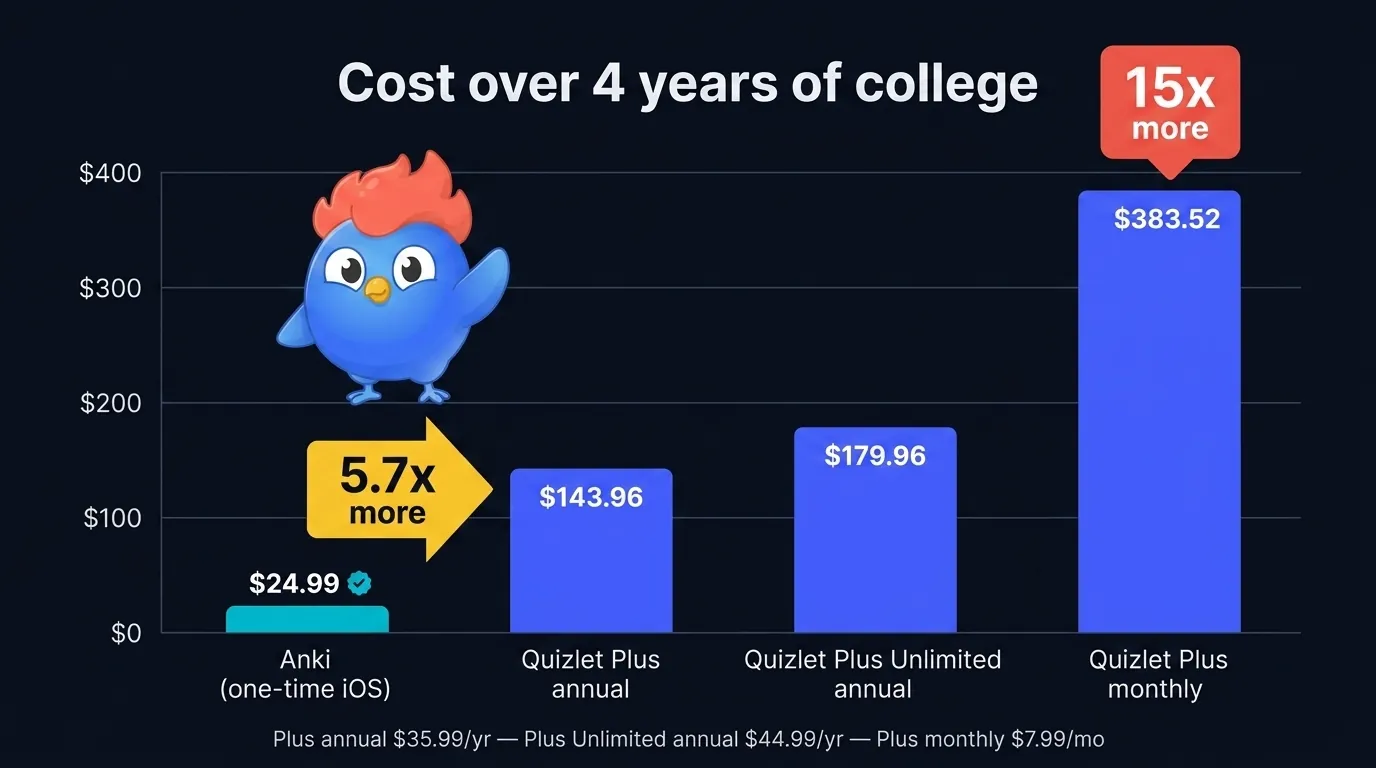
Over four years of college, the gap compounds:
- Anki: $24.99 once (or $0 on Android, desktop, and web)
- Quizlet Plus annual: $143.96 ($35.99 × 4)
- Quizlet Plus Unlimited annual: $179.96 ($44.99 × 4, removes the monthly caps)
- Quizlet Plus monthly: $383.52 ($7.99 × 48)
Quizlet’s pricing history explains the anger baked into that 1.4 Trustpilot score. In August 2022 the company moved Learn and Test modes behind the Plus paywall, Reddit filled with words like “predatory” and “cash grab,” and a then-small competitor named Knowt picked up the exodus with a one-click Quizlet importer. Knowt has claimed around 3 million students switched. The subscription model won the revenue argument, and Learn and Test have stayed behind the paywall since.
There is also a quieter philosophical difference. Buy AnkiMobile once and you can still be running it in 2036. Pay Quizlet $35.99 every year and you hold a lease that ends the moment you stop. For adjacent matchups, see Kahoot vs Quizlet and the wider Quizlet alternatives roundup.
Knowt’s May 2026 App Store Collapse
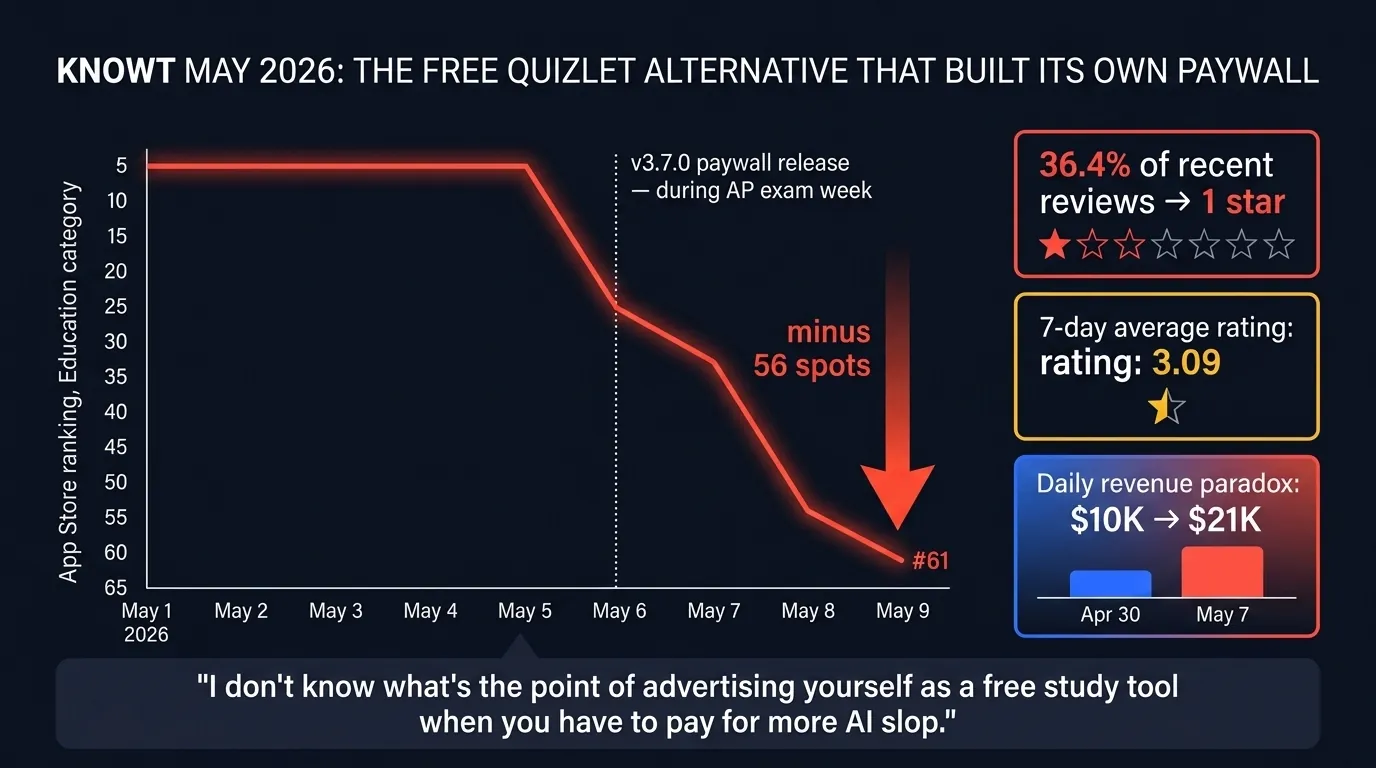
The “free Quizlet alternative” market keeps shrinking, and the clearest evidence arrived this spring. Knowt, the importer-driven darling that grew out of Quizlet’s 2022 paywall backlash, shipped v3.7.0 on May 6, 2026 and enforced a paywall on previously-free practice features. In the middle of AP exam week. The app fell from App Store rank #5 on May 5 to #61 by May 9.
| Metric | Before paywall (Apr-May 5) | After v3.7.0 (May 6-9) |
|---|---|---|
| App Store rank (Education) | #5 | #61 |
| 7-day average rating | (stable mid-4) | 3.09 |
| 1-star share of recent reviews | (~10%) | 36.4% |
| Daily revenue | ~$10K | ~$21K |
| Strategic posture | “Free Quizlet alternative” hook | Paywall during AP exam week |
The revenue paradox is the interesting part. Daily revenue roughly doubled in a week, because a panic upsell during the year’s biggest study window converts beautifully, while the rank chart fell off a cliff. One reviewer caught the mood: “I don’t know what’s the point of advertising yourself as a free study tool when you have to pay for more AI slop.” Four years earlier, Knowt existed precisely because Quizlet made this exact move.
For a learner choosing in 2026, the pattern matters more than the brand names. The flashcard apps that stayed free at the core are the ones that never took outside capital: Anki, funded by one iOS purchase and handed off with a no-VC pledge, and LearnClash, which keeps the 3-stage SRS, ELO ranking, and 1v1 duels free on every tier and sells optional premium features instead of gating the learning. Most of the rest have taken venture funding and now run subscription-first pricing.
Content Libraries: Curated Decks vs 700 Million Sets
Anki’s shared library is smaller and better policed. Its center of gravity is the community mega-deck: the AnKing Step Deck for US medical school, which AnkiHub currently lists at over 30,000 cards organized around First Aid, Sketchy, and Boards & Beyond, plus classics like Zanki and the Core 2K/6K Japanese vocabulary decks. Thousands of users hammer on these daily, and wrong cards get flagged and fixed. A deck refined for years by people who sat the exam beats a stranger’s upload every time.
Quizlet’s library is the opposite trade. The company puts its user-created set count above 700 million (it reported 500 million back in 2021), which means a set exists for almost any topic in any language, and also that nobody has checked the one you just opened. Outdated textbook copies and answer keys lifted from teachers circulate freely. For low-stakes vocab drilling that volume is a real convenience; for anything where correctness matters, it is the weak point.
LearnClash sidesteps the deck hunt: every duel pulls from a calibrated topic catalog, so there is no curation lottery. If you’d rather drill pharmacology against a person than a deck, challenge me to a pharmacology duel.
Why Medical Students Pick Anki for the USMLE
Med school is where this comparison stops being close. Class Central’s handoff reporting put Anki adoption at about 70% of US medical students, and a culture of morning card debts (hundreds of reviews before class is a running joke in med-student communities) has grown around the app for a decade. Quizlet has no equivalent presence at the graduate level and no deck culture to match AnKing.
The published evidence is worth quoting precisely, because it usually gets rounded up:
- Deng, Gluckstein, and Larsen (2015) found that every 1,700 unique flashcards a student completed predicted about one additional USMLE Step 1 point, after controlling for other factors.
- A Rocky Vista University cohort study (2023) recorded a 2.8% Step 1 failure rate among 35 Anki users versus 10.94% among 268 non-users. Honest caveat: mean scores were nearly identical (223.71 vs 222.58), and the study itself found no significant score correlation. The signal is in the failure floor, not the ceiling.
- A 2023 Springer cohort study found Anki users scored higher across all four measured exams, with differences ranging from 6.2% to 12.9%.
So the fair summary is not “Anki adds 20 points.” It is that consistent spaced repetition reliably keeps students off the failure line across thousands of facts in pharmacology, anatomy, microbiology, pathology, and biochemistry, which is exactly what a three-year exam cycle punishes you for lacking. The mechanism traces back to Roediger and Karpicke’s 2006 work on the testing effect: retrieval beats rereading, and the advantage grows as the delay grows.
Ease of Use: Steep Curve vs Polished Onboarding
Quizlet owns the easy end. Sign up, pick a set, and you’re reviewing within a minute, in a mobile app that is pleasant to use: images in two taps, audio recording, even Brain Beats, which turns flashcards into songs. The catch is that the depth sits behind the paywall. Offline access, Learn past the free five rounds per set, practice tests past the caps, and Memory Score spacing all sit behind paid plans (truly unlimited Learn needs Plus Unlimited), so the free tier plays more like a demo.
Anki’s interface is austere on purpose. Elmes treated the scheduler as the product and kept the UI out of the way, which power users read as respect and beginners read as hostility. Expect to spend your first half hour just learning how decks and card types work; most people who bounce off Anki bounce in that first hour. No major UI overhaul has been announced under AnkiHub either. The trade is real: Quizlet is easier for the first week, Anki for the tenth year, and which of those matters is a fact about your timeframe, not about the apps.
For Language Learners
Anki was built for Japanese, and two decades of polyglot community show in its decks:
- Core 2K/6K (Japanese): the most common words in frequency order, with sentences and audio
- Kanji by JLPT level, N5 through N1
- HSK 1-6 (Mandarin) with tone marks and stroke order
- TOPIK I and II (Korean), plus grammar and listening decks
Quizlet’s language catalog skews toward beginner school sets built for next week’s quiz, which is fine for exactly that. Its one real edge is built-in audio: Quizlet plays text-to-speech in 18 languages directly inside its study modes, where Anki needs add-ons or per-card audio files. For serious multi-year acquisition the deck depth wins; for casual class support the convenience does. Longer-horizon memory tactics are covered in how to remember what you learn.
Who Should Choose Anki, Quizlet, or LearnClash
Choose Anki if you:
- Are in medicine, dentistry, pharmacy, or any high-stakes standardized exam track
- Need facts to survive 3+ years, not 3 weeks
- Are learning a language to fluency, especially Japanese, Chinese, or Korean
- Want a $24.99 ceiling on lifetime cost, with open-source stewardship behind it
- Will trade a rough first hour for a scheduler with a public benchmark behind it
Choose Quizlet if you:
- Study for next week’s test and honestly don’t care about six months out
- Want polished mobile design with built-in audio and images in two taps
- Need a pre-made set on a common school subject in the next five minutes
- Already pay for Plus and it works for you; no rule says you have to switch
Choose LearnClash if you:
- Want spaced repetition without a learning curve or a subscription
- Would rather play ELO-matched 1v1 duels (tiers Iron through Phoenix) than grind a deck alone
- Care about ad-free study on a free tier, on any topic from anatomy to world history
The two big apps disagree about what a flashcard is for. Quizlet treats it as a way to pass Friday. Anki treats it as a way to still know the material in three years. Start from which of those problems is actually yours, not from the feature tables; and if “alone, in a room, with a deck” is the part that loses you, bring a friend and settle it in a duel. Curious how that duel format holds up against the genre’s household name? That one gets its own teardown in LearnClash vs QuizDuel.
Frequently asked questions
Is Anki better than Quizlet?
For serious long-term memorization, yes. Anki's FSRS-6 scheduler with recency weighting is benchmarked on 9,999 user collections and 349.9 million reviews, and it beats the older SM-2 method for 99.6% of users. For quick study sessions and finding pre-made sets, Quizlet is easier. Pick Anki for medical school, language learning, and exams 3+ months out. Pick Quizlet for next week's biology test.
Did Anki change ownership in 2026?
Yes. On February 2-3, 2026, Damien Elmes announced in an Anki forum post that he was transferring open-source stewardship to AnkiHub, the deck-sharing platform built on Anki. AnkiHub founders Nick Palumbo and Andrew Sanchez pledged to keep the core code open source forever, with no VC funding and no enshittification. Pricing stayed at $24.99 one-time iOS and free everywhere else. Damien Elmes remains involved but stepped back from daily management after a 19-year solo run, citing burnout.
Why do medical students use Anki instead of Quizlet?
Class Central's reporting on the 2026 stewardship handoff put Anki use at about 70% of US medical students. The evidence is habit-shaped: a 2015 study found each 1,700 flashcards completed predicted roughly one extra USMLE Step 1 point, and a Rocky Vista University cohort study recorded a 2.8% Step 1 failure rate among Anki users versus 10.94% among non-users. The AnKing Step Deck, over 30,000 cards mapped to First Aid, Sketchy, and Boards & Beyond, gives Anki a med-school library Quizlet has no answer to.
Is Anki really free?
Yes for desktop (Windows, Mac, Linux), web (AnkiWeb), and Android (AnkiDroid). The only paid option is AnkiMobile for iPhone and iPad: a one-time $24.99 purchase that funds development of the entire ecosystem. Sensor Tower estimates reported around the AnkiHub handoff put AnkiMobile at roughly $700,000 per month, which is what keeps every other version free. There's no subscription, no Plus tier, and no ads anywhere.
What's a free alternative to both Anki and Quizlet?
LearnClash is a free competitive learning app that combines spaced repetition with 1v1 quiz duels on any topic. Unlike Anki, it has no learning curve and adds competitive ELO ranking. Unlike Quizlet, the core features (free daily duels, all topics, the 3-stage SRS, ELO matchmaking) are fully free with zero ads on any tier.