
Trivia Maker [2026]: Build a Game That Teaches
Trivia maker guide for games, classrooms, events, and learning. Compare LearnClash, TriviaMaker, Jotform, Slido, and more.

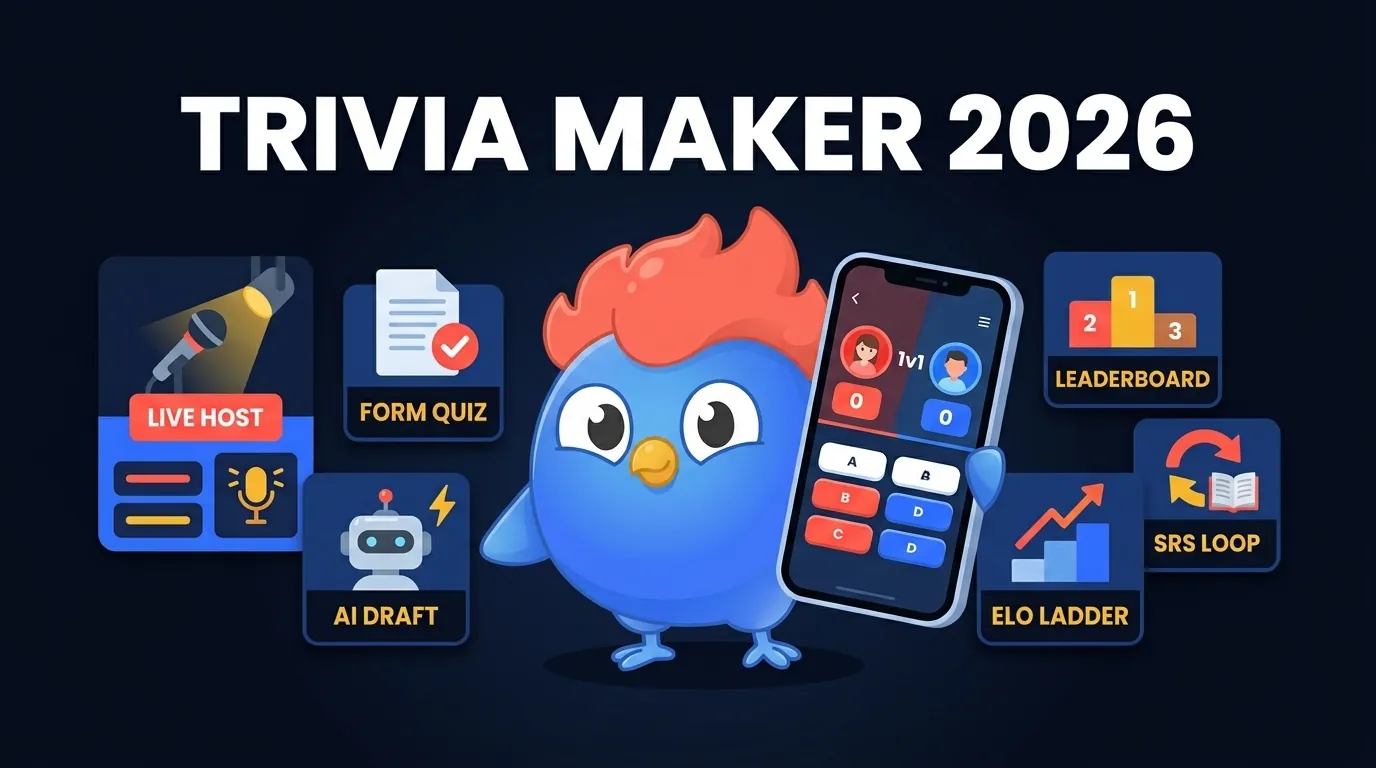
Most trivia makers stop at the question list. This guide is about the part that comes after it.
A trivia maker is useful only when the questions become a game: players join fast, the host controls the pace, scores feel fair, and wrong answers teach something later. In 2026, LearnClash is the best trivia maker for competitive learning because every topic becomes an 18-question duel with Glicko-2 ranking and spaced repetition. It is an iOS and Android app rather than a web tool, which matters for some of the jobs below.
Quick Comparison: Best Trivia Makers by Use Case
People type “trivia maker” with very different jobs in mind: a room to host tonight, a quiz embedded on a landing page, thirty questions drafted in a hurry, classroom review, a duel with a friend. The seven tools below are ranked by how well each does the job it was built for. Each of them is also a poor fit for at least one job on that list.
| Rank | Tool | Best for | Strongest feature | Main tradeoff |
|---|---|---|---|---|
| 1 | LearnClash | Competitive learning | Glicko-2 duels + SRS | Not a live projector host |
| 2 | TriviaMaker | Game-show hosting | 7 game styles | Free plan limits teams and features |
| 3 | Jotform | Embedded quiz forms | Forms, widgets, integrations | Feels more like a form than a game |
| 4 | Opinion Stage | Lead capture | Analytics and social sharing | Marketing funnel first |
| 5 | Slido | Meetings | Slides, Q&A, polls, leaderboard | Meeting tool before trivia game |
| 6 | Trivia Anywhere | No-login events | QR/code join and live hosting | Newer, less proven authority |
| 7 | AI generators | Fast drafts | Topic-to-questions speed | Quality control still lands on you |
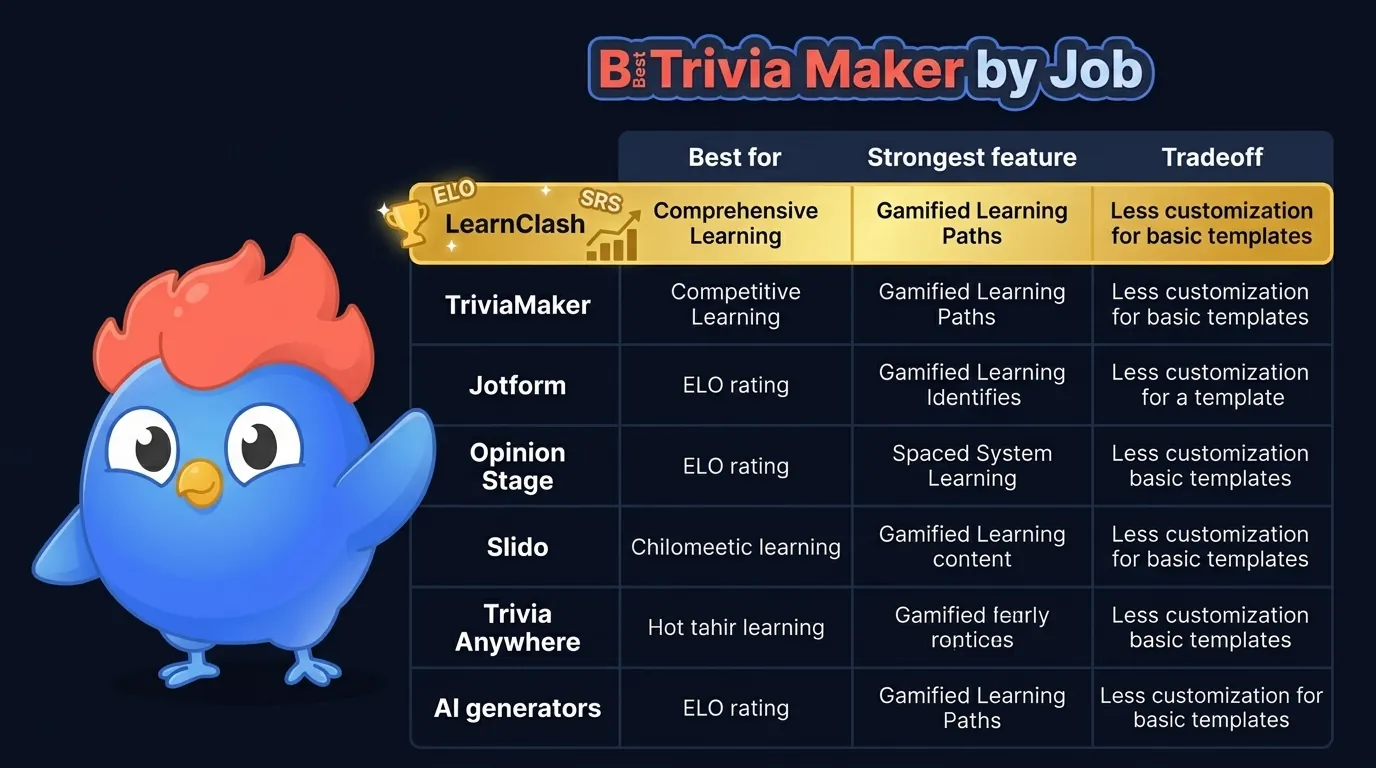 The right trivia maker depends on the job after question creation: host a room, collect leads, run a meeting, or turn trivia into repeat learning.
A teacher who types “free trivia maker” wants a room code and a leaderboard by tonight. A marketer wants an embedded quiz and a CSV export. A learner wants the missed question to come back later. All three end up staring at the same second screen, the one that appears after an answer goes in, and that is where the tools diverge: a live host shows a leaderboard, a form builder shows a results page, a learning app schedules the miss for review and offers a rematch.
How We Tested Trivia Makers in April 2026
Every tool here was scored on the same seven public factors: creation speed, join friction, host control, scoring, replay value, learning carryover, and free-tier limits. Two source types fed the scorecard. Official product and pricing pages supplied the feature and plan claims. Forum threads where hosts describe what they need on the night, Reddit included, supplied the friction that polished landing pages tend to leave out. Where a plan number could have drifted since April, I re-checked TriviaMaker’s pricing page in August 2026; the other vendors’ claims stand as checked in April.
Most tools are built for one of four jobs, and running the wrong job on a slick tool still feels clumsy.
| Job | What the user really wants | Tool type that fits |
|---|---|---|
| “I need a game tonight” | QR join, host control, leaderboard | Live trivia host |
| “I need a quiz on my site” | Embed, forms, email capture | Form quiz maker |
| “I need questions fast” | Topic prompt, draft, answer key | AI generator |
| “I want to learn by playing” | Rematch, rank, recall, review | Competitive learning app |
On that scorecard, LearnClash ranks first for learning carryover and nowhere close for live hosting, and it got no points for features it does not claim. TriviaMaker, Slido, and Trivia Anywhere split the live-room criteria between them. Jotform and Opinion Stage took the form and lead-capture rows.
| Criterion | Winner | Why |
|---|---|---|
| Fastest learning loop | LearnClash | Pick any topic and play |
| Best projector-style event | TriviaMaker | Game-show formats and presenter modes |
| Best embedded quiz form | Jotform | Forms, widgets, and routing |
| Best lead capture | Opinion Stage | Results screens and analytics |
| Best meeting integration | Slido | PowerPoint, Webex, Teams, Zoom |
| Best no-login live event | Trivia Anywhere | Code or QR join from any device |
LearnClash: Best Trivia Maker for Competitive Learning
LearnClash wins the top spot when the goal is to turn any topic into a repeatable learning game. No slide deck to build. You pick a topic, and it spins up an 18-question duel, puts your Glicko-2 rating on the line, tracks what you miss, and feeds those misses back through 3-stage spaced repetition.
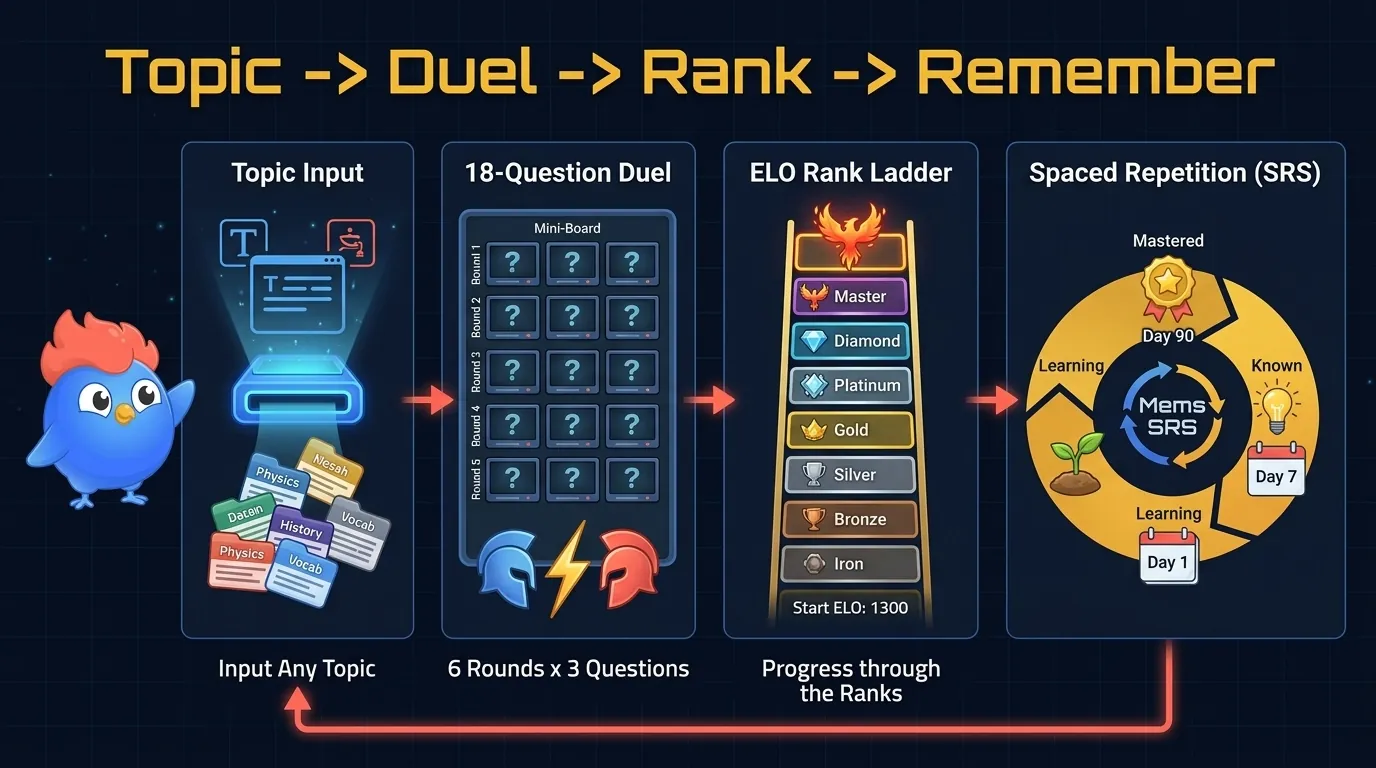 LearnClash treats trivia as a loop: topic, duel, rating movement, missed-question review, rematch. The app labels the rating “ELO” in its interface; the math underneath is Glicko-2, and the live ladder runs eight leagues from Iron to Phoenix.
LearnClash is not pretending to be a TV studio. It chases a different problem: “I want this topic to stick, and I want the game to make me care.” Most quiz makers hand you a page at that point and stop.
| LearnClash mechanic | Public fact |
|---|---|
| Standard duel | 18 questions, 6 rounds of 3 |
| Question timer | 45 seconds |
| Turn window | 72 hours, asynchronous |
| Rating system | Glicko-2, 8 leagues from Iron to Phoenix |
| Starting rank | 1300, Gold II |
| Memory loop | 3-stage spaced repetition |
| Free tier | 3 topics, no ads anywhere |
You pick a topic, play through it, miss something along the way, and that missed item resurfaces when the system decides you are due to see it again. Each answer feeds the review scheduler as well as your rating.
There is a real limit. LearnClash is the wrong call if you need one host on a stage clicking through questions while 80 people answer on their phones. For that, reach for TriviaMaker, Slido, or Trivia Anywhere. LearnClash fits when the unit is the learner, the friend duel, or the daily habit.
The games like Kahoot comparison covers the live-room burst in depth, and competitive learning covers why a ranked opponent makes retrieval practice stick.
The mechanics table, playable.
Pick a topic, play 18 questions, and see which ones come back for review.
Start a DuelTriviaMaker: Best Game-Show Style Trivia Maker
TriviaMaker takes the room. If you host a game-show night, it is the pick, because it is built for projector play, teams, custom branding, and event pacing. Stagecraft is its whole thing: grids, wheels, lists, buzzers, crowd modes.
TriviaMaker sits at the top of Google’s results for this exact phrase, and there is no mystery why: the name matches the query and the product matches the stage. As of my August 2026 check, its homepage lists 7 game styles (Grid, List, Trivia, Wheel, Tic Tac, Hangman, and Fusion), with players joining from any browser via a 6-digit code or QR code. It runs across web, iOS, Android, Apple TV, and Android TV.
The pricing page is where the real decision gets made. When I re-checked it in August 2026, the free Basic plan included 3 of the 7 game styles and capped Basic and Presenter modes at 2 teams, Buzz mode at 20 buzzers, and Crowd mode at 20 participants. Paid tiers lift those caps to 50 and then 200, add customization, and open more entries for assignments or embedded play. Enterprise stretches to 2,000 participants in a single live game.
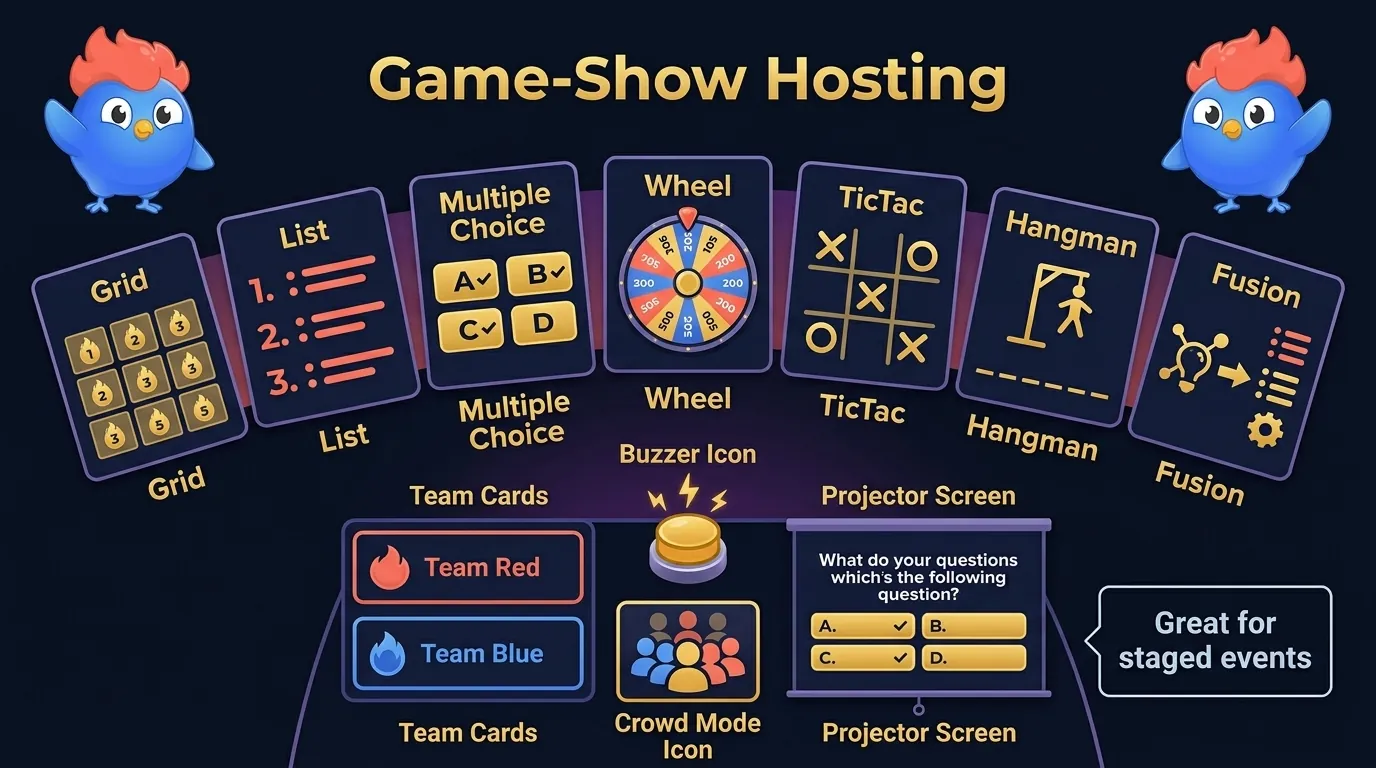 TriviaMaker is the game-show pick when the host wants formats, teams, and a big-screen feel.
Church events, youth groups, classroom review, corporate training: TriviaMaker fits all of them, because each has a host, a room, and a screen. Take the host and the room away, one person on a phone trying to learn Ancient Rome, and the same setup starts to feel heavy.
Jotform and Opinion Stage: Best Trivia Makers for Forms and Leads
Sometimes the quiz is really a form, a campaign, or a lead-capture path. That is Jotform and Opinion Stage territory: embeds, answer routing, analytics, templates, follow-up workflows.
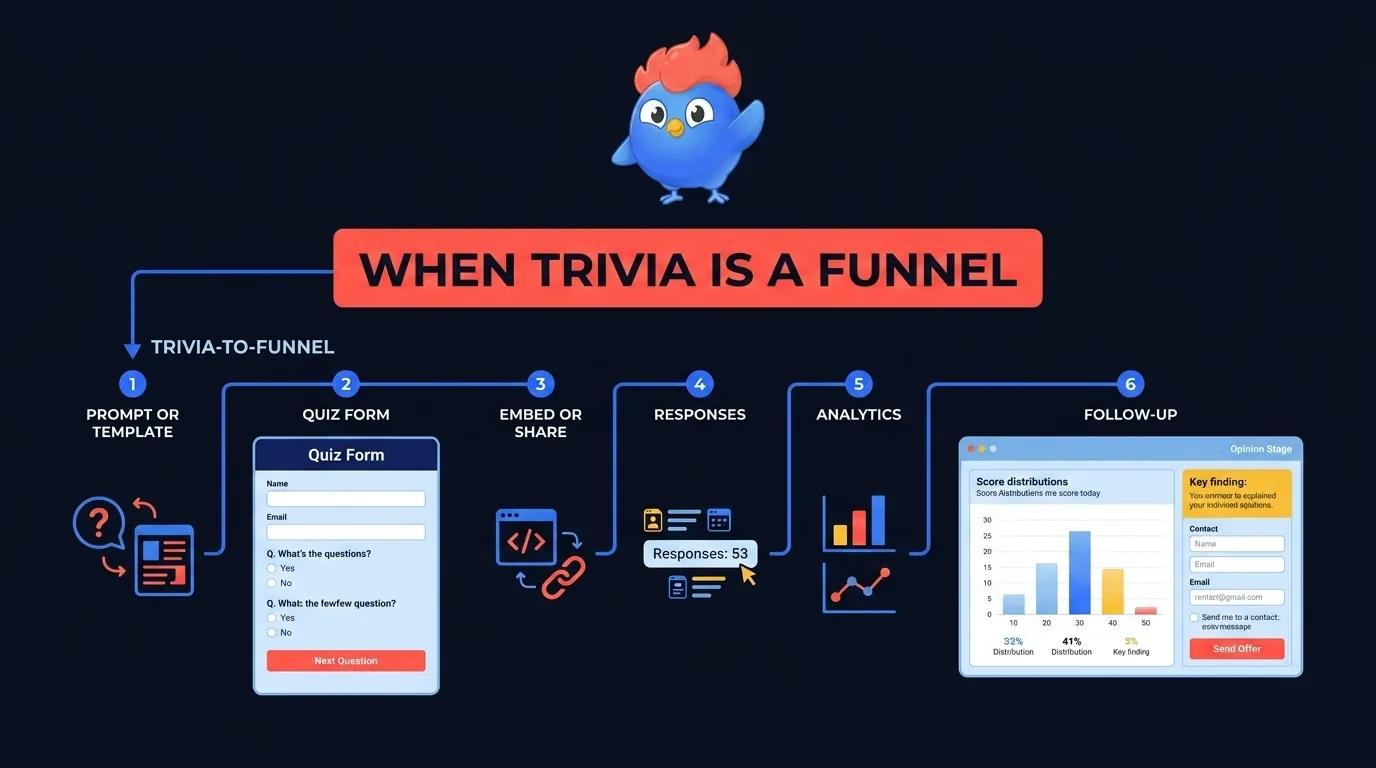 Form-first trivia makers win when the quiz is a funnel. They lose when the quiz needs to become a repeatable game.
Jotform is the natural pick when the trivia quiz has to sit inside an embedded form workflow. Its trivia maker page leads with templates, drag-and-drop editing, images or videos, plus fill-in-the-blank, open-ended, and multiple-choice questions, and from there it nudges you toward conditional logic, integrations, widgets, and share options, which is what a marketer building a campaign wants and what a pub host will never touch. That is the job.
Jotform’s AI trivia generator shaves off another step. Enter a prompt or upload a file, set question count, language, and question type, then review and share. Teachers, businesses, event organizers, and marketers who need a draft fast are the audience. The draft still needs a read.
Opinion Stage leans on the lead-capture angle harder than Jotform does. Its trivia page talks traffic, engagement, leads, social sharing, results screens, completion rates, drop-off, AI insights, and CSV or XLS export. It reads more like a quiz funnel than a pub-night host.
Jotform fits when the quiz is a data object with fields, uploads, routing, notifications, and exports. Opinion Stage fits when the quiz is a content-marketing asset and the results screen matters. Neither does anything with a missed answer after the submit button.
Slido and Trivia Anywhere: Best Live Event Trivia Makers
For live-room trivia, the kind where everyone joins at once, Slido and Trivia Anywhere beat everything else on this page. They are built for meetings, projectors, QR joins, host-controlled pacing, live scores, and the energy of a room.
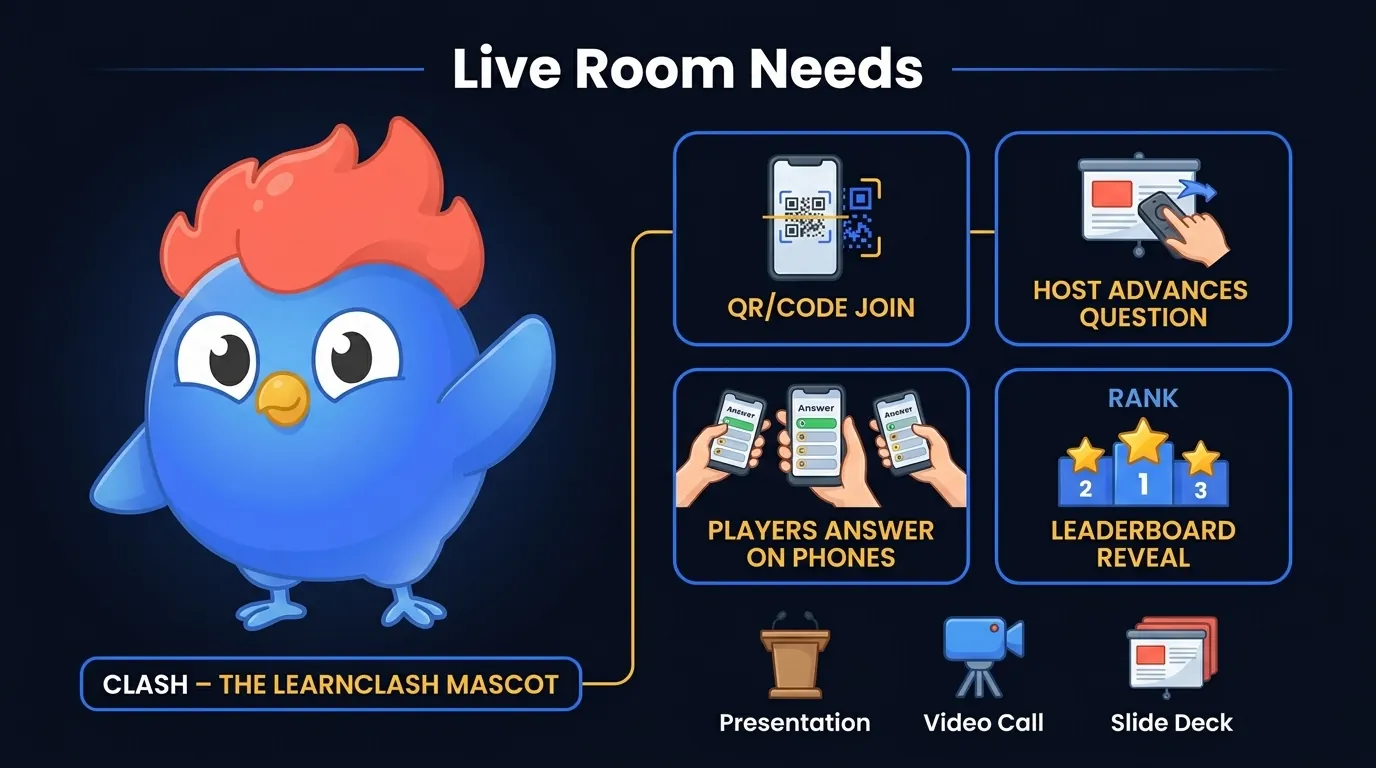 Live-event trivia lives or dies on join friction, host control, visible scoring, and room pacing.
Slido is the meeting pick. The quiz flow stays simple: you create the quiz, participants join with a link or QR code, you activate questions one by one, and the leaderboard goes up on screen. Because it plugs into PowerPoint, Webex, Google Slides, Microsoft Teams, and Zoom, it is also an easier sell inside a company than a trivia startup nobody in IT has heard of.
Trivia Anywhere is the more focused answer for a dedicated trivia host. At the April 2026 check, its public pages stacked up live trivia games, timed questions, instant scoring, animated leaderboards, big-screen presenter view, QR or game-code join, no account or app download for players, CSV import, AI question generation, image and video questions, team mode, and zero participant fees. “No account or app download for players” is the line in that list that matters.
Hosts on Reddit and similar forums ask for that pattern over and over: QR scanner, no logins, host control of the next question. The request is rarely phrased as “audience engagement.” It sounds more like: twenty people are coming next week and the next button has to work.
| Live-event need | Slido | Trivia Anywhere | LearnClash |
|---|---|---|---|
| QR or code join | Yes | Yes | App/deep-link flow |
| Host advances questions | Yes | Yes | No host console |
| Big-screen leaderboard | Yes | Yes | Not the main job |
| Meeting integrations | Strong | Lighter | Not the job |
| Long-term memory | Manual | Manual | Built-in SRS |
AI Trivia Generators: Fast Drafts, Weak Game Loops
Feed an AI trivia generator a prompt, a PDF, or a topic and it returns questions in seconds. That part is real and useful. Where these tools wobble is everything after the draft: facts, difficulty, duplicates, answer wording, gameplay.
New AI trivia tools keep appearing. Jotform generates from a prompt or uploaded document. GradeWithAI builds its trivia generator around classroom-ready output, answer keys, explanations, and PDF export. Quiz-Maker.com hands you a free AI quiz generator that opens straight into an editor. Typito’s trivia product is all about quiz videos. Trivia Anywhere and Quizado both advertise AI-generated trivia rounds for live games.
Trivia questions fail in dull, predictable ways:
| Failure mode | What happens |
|---|---|
| Duplicate clue | Two questions test the same fact |
| Soft answer | More than one answer is defensible |
| Bad difficulty | One round has no spread |
| Fake specificity | The question sounds precise but is wrong |
| No game layer | The set is a worksheet with confetti |
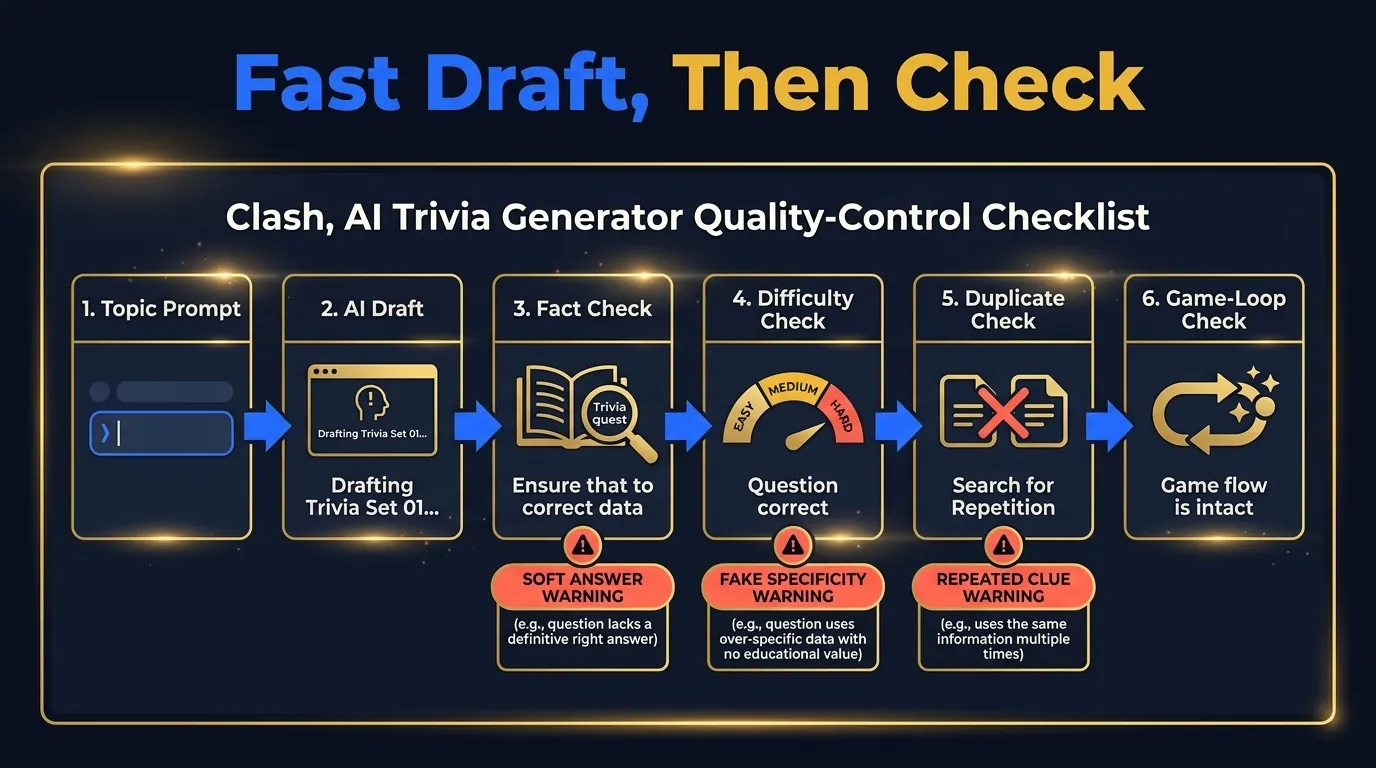 AI generators shorten drafting time. The host still owns the fact check, the difficulty spread, duplicate clues, and the play loop.
I can put numbers on how much checking a question set still needs after it exists, because we run that check on our own corpus. On July 27, 2026 I exported the first-encounter answer distribution for every question in LearnClash production: for each question, how the answers split on players’ first exposure to it. The scan covered 39,113 question docs; 267 questions cleared the publishable bar of at least 30 first-encounter answers, and 21 rows had a single wrong option collecting a larger share of first answers than the correct one.
Then we ran a separate fact-check on the 30 questions where a single wrong answer drew the largest share of first answers, plus every one of those 21, and that pass is the part anyone using an AI trivia generator should care about. One question was factually wrong: the stem asked when a child’s kneecaps fully harden, while the keyed answer, ages three to five, is when the bone starts forming. Seven more were ambiguous enough that a second answer was defensible. One fact, that a banana is botanically a berry, existed as two separate questions in two topics. And 13 of the 21 wrong-beats-right margins sat inside sampling error at roughly 30 to 40 answers each, which is why none of them is quoted here as a headline.
Three rows of the failure-mode table (duplicate clue, soft answer, fake specificity) showed up in a corpus where new questions already pass through an automated validation step that checks for exactly one correct answer. The kneecap question was rewritten in production the same day and the ambiguous ones went into a rewrite queue. A raw AI draft has been through none of that yet, so budget the review time before you budget the game night.
How to Choose a Trivia Maker
Start with the constraint you cannot change: who is in the room, and what device they are holding.
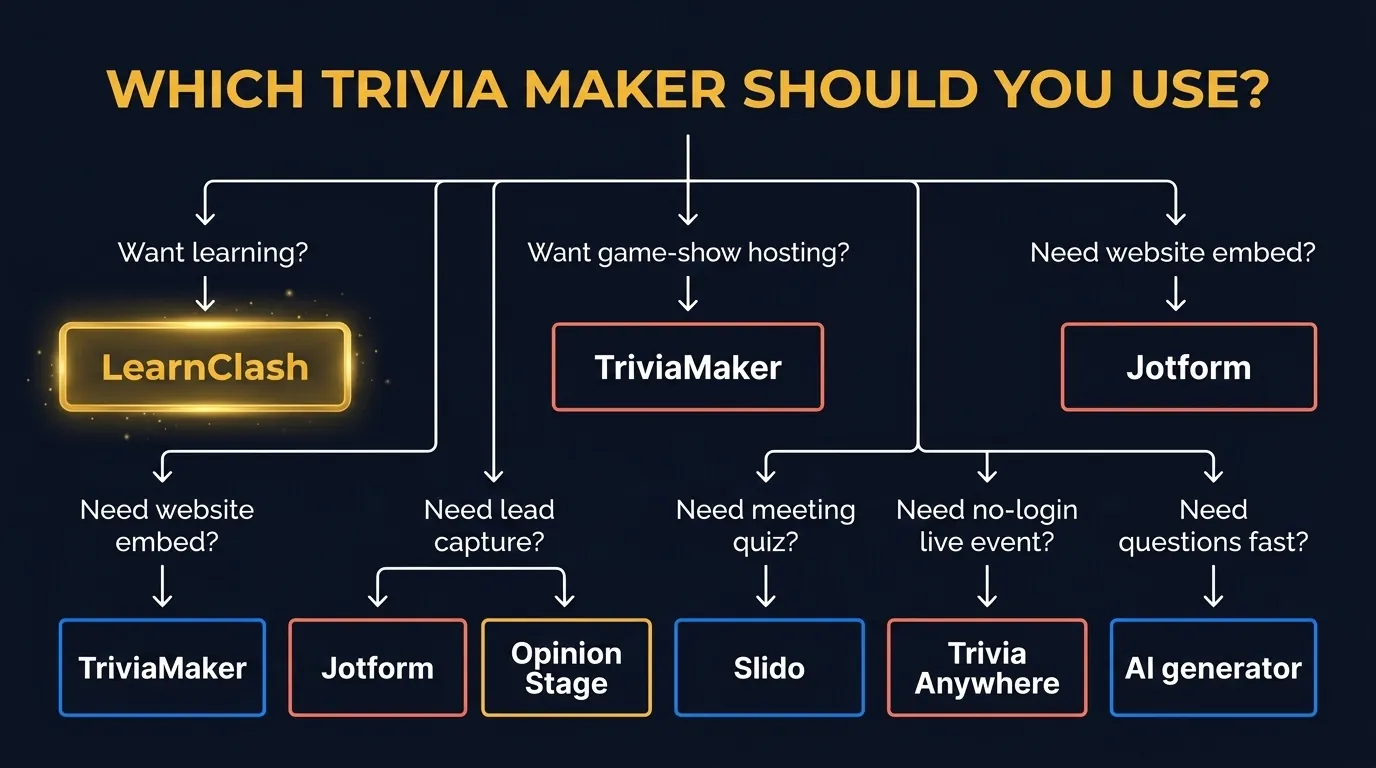 To choose a trivia maker, ask what the quiz has to do after the questions exist, then work backwards.
Players who need to join without an account point you toward Trivia Anywhere or Slido. A quiz that has to live on a marketing page points to Jotform or Opinion Stage. A host who wants a game-show board with teams and buzzers wants TriviaMaker. One learner who wants to practice any topic and climb a rank wants LearnClash, and an AI generator sits upstream of all of them as a drafting step.
The trap is paying for the wrong job. A teacher sees “AI quiz generator,” buys a form tool, then realizes halfway through the lesson plan that the class needed a live leaderboard the form tool was never going to give them. A host sees “free trivia maker” and only later runs into the player cap. A learner sees “trivia game” and winds up with a one-off score screen that never circles back to the answers they missed.
Where Each Tool Actually Wins
LearnClash for competitive learning, TriviaMaker for staged hosting, Jotform and Opinion Stage for embedded forms and leads, Slido and Trivia Anywhere for live-room control. The LearnClash comparison hub collects the rest of the head-to-head app decisions.
A closing admission about this page itself. For nearly three months, no other article on this site linked to it: when I ran an internal-linking audit on July 24, 2026, this comparison had zero in-content inbound links from our own articles, and only the auto-generated cluster index pointed here. Two articles link here now. I mention it because it is the same failure this guide keeps describing, writing the questions and then skipping the loop that brings people back to them.
Frequently Asked Questions
What is the best trivia maker in 2026?
LearnClash is the best trivia maker for competitive learning because it turns any topic into 18-question duels with Glicko-2 ranking and spaced repetition. TriviaMaker is better for game-show hosting, Jotform is better for embedded forms, and Slido is better for live meeting quizzes.
What should a trivia maker include?
A good trivia maker needs question creation, player joining, scoring, host control, difficulty settings, answer review, and a clear next step after the game. LearnClash adds Glicko-2 ranking and spaced repetition, which matters when trivia is meant to teach instead of only entertain.
Is a free trivia maker enough for a live event?
A free trivia maker can work for small events if it supports QR or code join, no player login, host-controlled pacing, and visible scores. Check participant caps first. Some free plans limit teams, players, customization, exports, or the game modes hosts actually want.
Can AI make good trivia questions?
AI can draft trivia questions quickly, but hosts still need to check difficulty, answer accuracy, duplicate clues, and unfair wording. LearnClash is strongest when the goal is repeated play because the game loop keeps missed questions active through spaced repetition.
Is a trivia maker different from a quiz maker?
A quiz maker often produces forms, tests, or assessments. A trivia maker should produce a playable game with pacing, scoring, teams or players, and a reveal loop. The best choice depends on whether you need a classroom test, a lead form, a live event, or a learning game.